
Scaling Up: Matching Artificial Turf to Sports, Landscape, and Commercial Projects
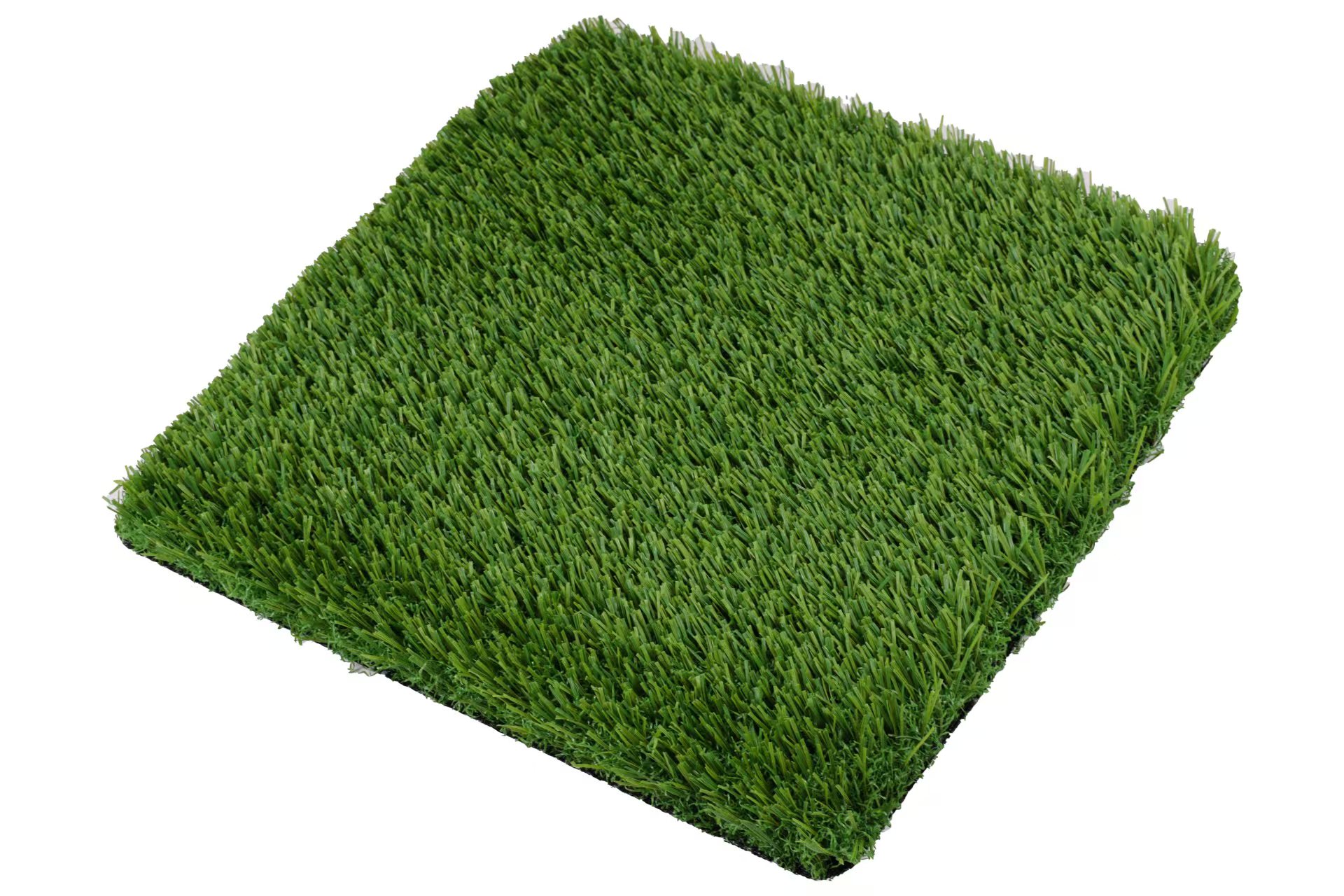
Turf selection begins with the mechanical demand profile of the surface, not with colour photography or unit price.
Artificial turf is no longer a single product. The global artificial turf market was valued at USD 7.3 billion in 2025 and is projected to reach USD 13.7 billion by 2033 (Grand View Research). Sports applications accounted for approximately 63.1% of that market in 2025, and Asia-Pacific held the largest regional revenue share at 32.2%. Growth of that scale changes the nature of the buying decision: most projects are no longer asking whether to use artificial turf, but which turf specification belongs on which surface.
The practical answer is that the application sets the specification. A rugby pitch, a putting green, a pet enclosure and a hotel terrace impose different mechanical demands on a surface — impact absorption, traction, ball roll, comfort underfoot, traffic tolerance and drainage. Pile height, stitch density, yarn material, backing construction and UV stabilization are the variables that respond to those demands. Category labels such as sports grass, golf grass or landscape grass are useful shorthand, but the specification behind the label is what determines whether a surface still performs in year eight or is scheduled for replacement in year three.
Why One Turf Specification Cannot Serve Every Project
Replacement demand is a large and measurable part of the market. The replacement segment of the sports turf market reached 41% of total demand in 2023, approximately 70 million square metres (AMI Plastics). Part of that volume reflects normal end-of-life cycles. A further part reflects surfaces that were specified for one demand profile and then used under another.
The cost of a mis-specified surface is not limited to the carpet. It includes removal of the existing material, transport and disposal, potential rework of the base and drainage layer, and downtime on a facility that may have revenue attached to it. That is why the selection step deserves more attention than the price negotiation step in most projects.
Selection failures normally take one of three forms: a low-density carpet installed in a high-traffic multi-sport facility, where the pile flattens and the surface loses its playable structure; a sports-grade surface installed in a garden, where the stiffness and appearance are wrong for the setting; or a decorative or pet-oriented surface installed outdoors in a high-UV location without adequate UV stabilization. Each failure has a different root cause, and each is preventable at the specification stage.
A Four-Profile Decision Framework
Before comparing suppliers, buyers can reduce a complex catalogue to four demand profiles. Almost every turf project falls into one of them, and the profile determines which specifications matter.
| Demand profile | Dominant performance requirements | Specifications that decide the outcome | Typical applications |
|---|---|---|---|
| Impact sport | Shock absorption, traction, ball behaviour, drainage under rain load | Yarn resilience and fibre shape, pile height, tuft bind, backing plus shockpad, infill design | Football, rugby, baseball, padel, tennis, athletics warm-up areas |
| Precision golf | Repeatable ball roll, uniform surface density, minimal deflection | Short pile, high tuft density, tight dimensional tolerances, stable base build-up | Putting greens, approach areas, golf hitting mats, practice lines |
| Residential and landscape | Appearance, comfort, colour stability, low maintenance, drainage on hard substrates | Taller and softer pile, UV-stabilized yarns, permeable backing, edge detailing | Backyards, gardens, courtyards, balconies, rooftops, school grounds |
| Commercial and multi-purpose | Traffic tolerance, cleanliness, appearance retention, drainage | Durable yarn, mid-range pile, dense backing, easy-clean surface, pet-specific drainage where relevant | Shared courtyards, hospitality terraces, gyms, playgrounds, pet areas |
Four demand profiles cover the majority of artificial turf decisions, from professional venues to balconies.
The Technical Variables That Decide Whether a Surface Fits
Yarn material
Polyethylene material dominates the artificial turf market, holding a 63.1% revenue share in 2025 (Grand View Research). That concentration is not accidental: polyethylene-based yarns are widely chosen where a soft hand, resilience under repeated foot traffic and UV stability have to be balanced inside one product. Material selection therefore tends to be settled early in a project, and the remaining decisions — pile height, density, backing — are where differentiation between suppliers becomes visible.
Pile height
Pile height controls how the surface feels and how it behaves. Taller pile generally delivers more cushioning and a softer, more lawn-like appearance, which is why it is common in residential landscaping, gardens and decorative applications. Shorter pile generally supports faster, more predictable ball roll and is more common in golf and precision surfaces. Pile height alone does not determine quality; it determines suitability for a use.
Stitch density and tuft structure
Stitch density describes how many yarn tufts are packed into each square metre. Higher density produces a more upright, uniform surface with better appearance retention and more consistent contact behaviour — a key reason high-density construction is standard for putting surfaces and for venues where ball roll must be repeatable. Lower density reduces weight and cost, which is acceptable in low-traffic decorative settings and inappropriate in high-traffic sport. Density and pile height also interact: a tall pile at low density looks full in a photograph but flattens quickly under use.
Backing, coating, and drainage
The backing and coating system determines dimensional stability, tuft bind and how water moves through the surface. On soil and aggregate bases, drainage is largely a function of the base build-up; on balconies, rooftops and hard substrates, the permeability of the backing and the quality of edge detailing carry more of the load. This is one of the most frequently overlooked specifications in residential and commercial projects.
UV stabilization and colour fastness
UV degradation — fading and ageing of the yarn — is a recognised risk category for outdoor turf, and it is managed during production rather than on site. Standard controls include adding UV stabilizers, using anti-UV additives, and selecting a high-quality UV-resistant masterbatch. On the manufacturing side, the corresponding measures are strict UV resistance testing, accelerated ageing testing, and quality control to confirm colour fastness. For buyers in high-radiation markets, asking for that test data is more useful than comparing colour swatches under showroom lighting.
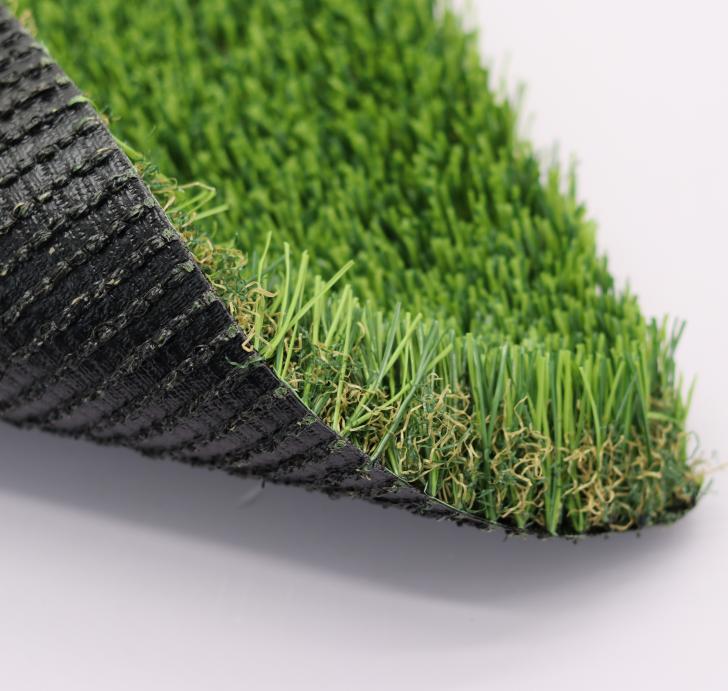
Yarn, tuft structure and backing are the three layers that decide how a turf surface behaves and how it ages.
Matching Turf Families to Venues
Sports grass
Sports surfaces are the most demanding category and the most standards-driven. Football, rugby, padel, tennis, baseball, playground and gym surfaces all require the surface to absorb repeated impact without deforming, to drain reliably, and to behave predictably for the sport being played. Because these requirements are measurable, sports installations are usually governed by published frameworks rather than supplier claims: the FIFA Quality Programme for Football Turf provides 'FIFA Quality' and 'FIFA Quality Pro' designations for performance and safety, while synthetic turf in Europe is covered by EN 15330-1 and in Germany by DIN 18035-7. Buyers specifying a sports venue should treat those frameworks as the reference point and confirm exactly which system components were tested.
Golf grass
Golf places different demands on the same material. The dominant requirement is repeatable ball roll across the whole surface, which makes density uniformity, dimensional stability and a well-built base more important than impact absorption. Golf applications also extend beyond full greens into practice infrastructure — hitting mats, practice lines and indoor or covered training bays — where a concentrated area must tolerate continuous wear within a small footprint. Venusturf positions its Putt 40 golf line for these applications, where consistent surface behaviour matters more than appearance under a camera.
Residential and landscape grass
Residential landscaping optimises for a different set of outcomes: appearance, comfort underfoot, colour stability and low maintenance. A taller, softer pile profile is generally preferred here because it reads as grass rather than as a sports surface, and because children and pets interact with the surface directly. Venusturf's EM241007 line is positioned for residential landscaping, where a fuller pile supports that visual and tactile brief. The same family logic applies to backyards, gardens, courtyards, balconies, rooftops and decorative installations, although balcony and rooftop projects add a drainage and weight consideration that a ground-level garden does not.
Commercial, multi-purpose, and pet grass
Commercial spaces sit between the sports and residential profiles. Shared courtyards, hospitality terraces, gyms, playgrounds and retail landscaping need a surface that tolerates irregular but constant foot traffic while still looking maintained. Multi-purpose and eco-oriented turf products are usually specified here, with the trade-off being that no single surface optimises for every activity. Pet grass forms its own sub-category: drainage, cleanliness and odour management move to the top of the specification, ahead of aesthetics and ball behaviour, and the surface is selected for permeability and cleaning routine rather than for pile appearance.
Supplier Context: How Venusturf Approaches Multi-Category Production
Wuxi Venus Turf Co., Ltd., trading as Venusturf, is a professional artificial turf manufacturer integrating research and development, production and sales, serving sports venues, leisure landscape venues and schools. The company operates 30 integrated production lines and oversees the full manufacturing sequence in-house — yarn extrusion, twisting, tufting, coating, and final packaging and delivery — which is the structural reason a supplier can move between sports, golf, residential and commercial categories without changing its quality control basis.
The company employs 483 people, including a 25-engineer R&D team, and exports approximately 80% of its output to global markets. For buyers, those figures answer a specific procurement question: whether a supplier has the internal process depth to hold specification consistency across multiple product families, rather than assembling finished turf from third-party yarn and coating sources. Venusturf's product scope covers sports venues, leisure landscape venues and schools, and its technical documentation is published at www.vtsyntheticturf.com.
Artificial Turf Versus Natural Grass — and the Limits of Artificial Surfaces
Artificial turf is frequently chosen as a replacement for natural grass, and the comparison is often framed as an outright win. A more accurate framing is that the two surfaces solve different problems.
| Consideration | Natural grass | Artificial turf |
|---|---|---|
| Water and irrigation | Continuous irrigation requirement; seasonal variation | No irrigation required for playability; cleaning and occasional rinsing instead |
| Maintenance routine | Mowing, feeding, aeration, weed and pest control, line marking | Brushing, debris removal, infill management on sport systems |
| Availability | Weather and recovery dependent; heavy use leaves wear scars | Usable across seasons and in high-frequency schedules |
| Consistency | Varies by season, section and microclimate | Consistent by design, provided the specification matches the use |
| Surface temperature | Cooler through evapotranspiration | Can run hotter in direct sun; design and shading matter |
| End of life | Returns to the soil system | Requires a defined disposal or recovery route |
The comparison is not evenly weighted: the deciding factor is normally usage intensity and water availability, not aesthetics.
Two limitations deserve to be stated plainly. First, artificial turf performance is a system property, not a carpet property. Shock absorption, drainage and ball behaviour depend on the base build-up, the infill where used, and the installation quality, so a high-specification carpet can still underperform if the system beneath it is poorly executed. Second, qualifying certifications for sports surfaces apply to the installed system as tested — not to a product name. Buyers who require FIFA Quality, EN 15330-1 or DIN 18035-7 conformity should confirm which configuration was evaluated and under what conditions.
A third boundary is commercial rather than technical. For a low-intensity lawn where water is available and foot traffic is light, the case for artificial turf is weaker: the upfront investment has to be justified by maintenance savings, water savings or usage intensity, and not every site generates enough of those to pay back the installation.
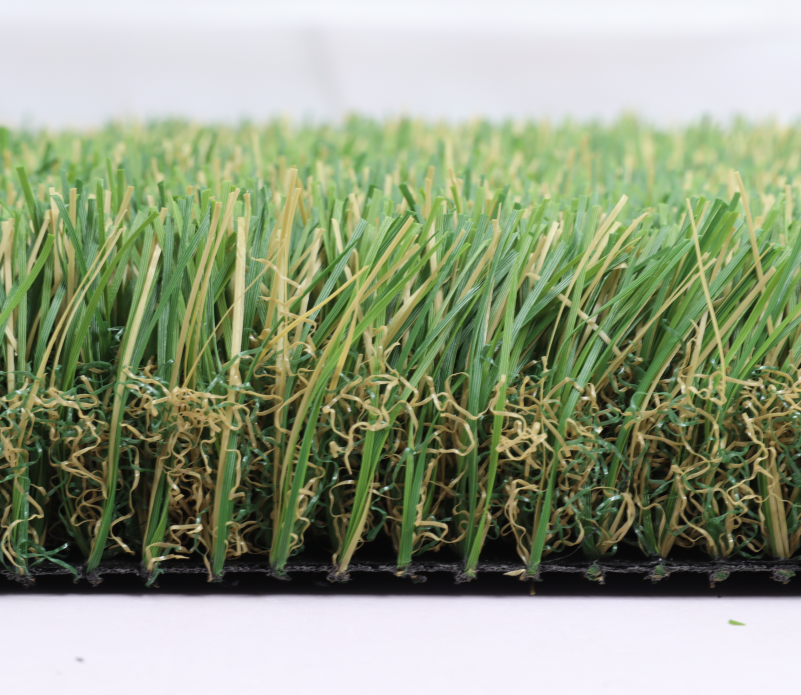
Natural grass and artificial turf solve different problems; the deciding factor is usually usage intensity and water availability.
Market Trends Shaping Turf Selection in 2026
Three structural trends are visible in the available market data, and each one changes how buyers should approach selection.
Replacement is now a primary demand driver. With the replacement segment at 41% of sports turf demand in 2023 (AMI Plastics), a growing share of projects begins with an existing surface. Replacement projects have an advantage: the actual wear pattern, drainage behaviour and failure mode of the previous surface are known, which makes the new specification far more precise than a greenfield estimate.
Sports remains the anchor application. Sports accounted for approximately 63.1% of the artificial turf market in 2025 (Grand View Research), which is why performance standards and certification frameworks continue to shape buyer expectations across all categories — including landscaping, where buyers increasingly ask for UV testing data that was once a sports-only requirement.
Asia-Pacific is the largest production and installation region. The region held a 32.2% revenue share in 2025, and China alone accounts for more than 15,000 installed synthetic sports fields, approximately 52% of regional installations (Mordor Intelligence). The global supplier landscape includes established international players such as CCGrass, Tarkett (FieldTurf), TenCate Grass, Shaw Sports Turf and SportGroup (Polytan), alongside regional manufacturers. For buyers, the practical implication is a wide field of options with very different category depth: some suppliers specialise in sports systems, others in landscape and multi-purpose products, and the comparison should be made within the category being purchased.
One caution applies to all market sizing in this category. Published estimates diverge substantially depending on what is counted: Grand View Research values the market at USD 7.3 billion for 2025, while Future Market Insights reports USD 3.49 billion for 2024, largely because some estimates include raw material and installation value and others count only the finished surface. Market figures are useful for direction; they should not be used as a proxy for project budgets.
Future Outlook
The direction of the category is toward fewer compromises per surface. Material development is focused on yarns that hold colour and resilience longer under high UV exposure, which extends useful life in the markets where replacement demand is strongest. On the installation side, the trend is toward multi-use surfaces that can serve several activities within one footprint — a response to land cost and facility utilisation rather than to material novelty.
End-of-life handling is likely to become a standard part of tender documents rather than an afterthought, because disposal and recovery routes are the least developed part of the artificial turf value chain. Buyers who begin asking about removal and recovery at the specification stage will be better positioned than those who address it when the surface reaches the end of its life.
Finally, the specification gap between categories should narrow. UV testing data, colour fastness results and system-level documentation are becoming normal requests in residential and commercial projects, not only in sports tenders. The suppliers that can produce that documentation across multiple categories will be the ones that stay comparable when projects scale up.
Frequently Asked Questions
How do I decide between sports turf and landscape turf for a mixed-use facility?
Split the facility by use intensity rather than by visual appearance. Sports areas are specified around ball behaviour, shock absorption, traction and, where applicable, certification frameworks; landscape areas are specified around appearance, comfort and drainage. Where the two overlap — school grounds, hotel courtyards, community parks — the highest-intensity use normally sets the specification, because a sports-grade surface will still function as a landscape surface, while a decorative surface will not survive sport-level traffic.
Do pile height and stitch density matter more than yarn material?
They answer different questions. Yarn material and UV stabilization determine how the surface ages — how quickly it fades, flattens or loses tensile strength. Pile height and stitch density determine how it behaves in use — how it feels underfoot, how a ball rolls across it, and how well it retains its appearance under traffic. A project needs both to be correct; a quality yarn in an under-dense construction will still flatten in a high-traffic setting.
What should be verified when a supplier cites certification for a sports venue?
Confirm which framework is being cited and what was actually tested. The FIFA Quality Programme for Football Turf covers 'FIFA Quality' and 'FIFA Quality Pro' designations for performance and safety; European synthetic turf standards are set out in EN 15330-1, and German standards in DIN 18035-7. These frameworks evaluate installed systems, so the relevant question is which combination of carpet, infill, base and installation was tested, and whether the project configuration matches it.
Is artificial turf suitable for residential landscaping in high-UV climates?
It can be, provided UV stabilization is specified rather than assumed. UV degradation — fading and ageing of the yarn — is a recognised risk for outdoor turf, and it is controlled during production through UV stabilizers, anti-UV additives and UV-resistant masterbatch selection. Suppliers should be able to provide UV resistance and accelerated ageing test results together with colour fastness quality control records.
How does artificial turf compare with natural grass for commercial spaces?
The difference is usually about usage and water rather than aesthetics. Natural grass depends on irrigation, mowing, feeding and recovery periods, and it wears unevenly under concentrated traffic. Artificial turf removes irrigation from the playability equation and supports continuous use, but it can run hotter in direct sun and requires a defined disposal route at end of life. Commercial sites with high footfall and limited maintenance capacity usually benefit; low-use sites with reliable water access may not.
What is the most commonly overlooked limitation of artificial turf?
That performance is a system property. Shock absorption, drainage and ball behaviour depend on the base build-up, infill and installation quality as much as on the carpet itself, so specification should cover the whole assembly. The second most overlooked item is end-of-life handling, which is rarely priced into the original project decision.
For buyers who need the underlying product and manufacturing detail behind a category decision, Venusturf publishes a downloadable technical brochure covering its turf families and production scope: Venusturf product brochure. Product documentation is also available at www.vtsyntheticturf.com.