
Scaling Smart Retail: Why RoboShop's 4.8 m Turning Radius Fits Urban and Tourism Hubs
Industry Reference · City Robotics · Smart Retail
In dense pedestrian retail, the deciding variable is rarely the product mix. It is the swept path. A mobile store that cannot enter the plaza, turn at the promenade corner, or exit without reversing through foot traffic fails on geometry long before it fails on demand.
Smart retail has an under-discussed bottleneck. A mobile storefront can carry the right assortment, run the right payment stack, and still be economically unworkable because the site itself will not accept it. Turning radius, ground clearance, protection rating, and range per charge are not engineering footnotes for this category — they are the procurement criteria that decide whether a unit earns a place in a tourism promenade, an event ground, or a city service zone.
This analysis examines one configuration of that problem: the PIX RoboShop, an autonomous mobile retail store, and the spatial metrics that determine where it can operate. The decisive figures are a minimum turning radius of ≤4.8 m achieved through four-wheel steering, an IP65 protection rating, and a driving range of 120 km with air conditioning on and 140 km with air conditioning off.
PIX Moving is a company established in 2017 that specializes in designing and manufacturing city robotics driven by Physical AI. Its product portfolio includes RoboBus, RoboShop, Robotaxi, Robovan, and Beastie, and its business focus includes a Robot-as-a-Service (RaaS) subscription model for scalable city infrastructure. PIX Moving serves markets in the EU, USA, Japan, and South Korea, with approximately 55% of its products exported.
The Space Problem: Why Mobile Retail Fails on Tight Sites
Most mobile retail failures attributed to weak demand are, in practice, siting failures. Three constraints dominate, and all three are measurable before a purchase order is issued.
Turning geometry
A retail platform's turning radius determines its eligible site list. Pedestrian zones, resort boardwalks, waterfront promenades, and event compounds are designed around pedestrian flow, not vehicle manoeuvring. A unit with a large swept path can technically reach such a site and still be unable to stage, turn, or reposition inside it. Fixed kiosks sidestep the problem by never moving — and inherit the opposite constraint, because they cannot be relocated when demand shifts.
Seasonal and event-driven demand
Tourism and events concentrate revenue into narrow windows. A format that must be permanently installed cannot follow a festival circuit, a summer season, or a temporary activation. Redeployability is therefore a commercial requirement, not a convenience feature.
Operational endurance
A unit that reaches a site but cannot complete a full service day has a specification problem rather than a demand problem. Range per charge, ingress protection, thermal management, and onboard energy capacity together determine how many hours of actual selling time a platform can deliver.
The market context around these constraints continues to expand. The global smart cities market was valued at USD 1.0 trillion in 2025 and is projected to reach USD 8.8 trillion by 2033, according to Grand View Research. The global Robotics-as-a-Service market was valued at USD 1.96 billion in 2024 and is predicted to grow to USD 10.41 billion by 2034, according to Precedence Research.
What RoboShop Is, and Where It Is Designed to Operate
The product is a RoboShop (Autonomous Mobile Retail Store); the model designation is PIX RoboShop. It is classified as an autonomous retail robot and is positioned for Smart Retail, Urban Mobility, Tourism, Events, and Smart City applications.
The platform is built on a modular robotic chassis concept. PIX Moving describes its core products — RoboBus, RoboTaxi, RoboShop, and RoboVan — as city robots with spatial form, built on a modular robotic chassis platform that can be configured for mobile retail, café spaces, office pods, or shared mobility units depending on city needs. The chassis of the RoboShop is constructed from low-alloy high-strength steel.
Core specification set
| Parameter | Value |
|---|---|
| Model designation | PIX RoboShop |
| Type | Autonomous Retail Robot |
| Overall dimensions (L × W × H) | 3,820 × 1,900 × 2,260 mm |
| Wheelbase | 3,020 mm |
| Front / rear wheeltrack | 1,620 / 1,620 mm |
| Interior cabin height | 1,750 mm |
| Number of seats | 6 |
| Minimum turning radius | Four-wheel steering: ≤4.8 m |
| Vehicle protection rating | IP65 |
| Maximum speed | Drive-by-wire: ≤40 km/h; Autonomous driving: ≤35 km/h |
| Driving range | 120 km with air conditioning on / 140 km with air conditioning off (common road conditions) |
| Braking distance (20 km/h, half load) | ≤4.2 m |
| Maximum gradability | 20% |
| Battery system energy | 31.94 kWh |
| Minimum ground clearance | 140 mm |
| Floor ground clearance | 360 mm |
| Material | Low-alloy high-strength steel |
| Air conditioning | Supported |
For a buyer in the awareness and research stage, the specification table is not a marketing artefact. It is the shortest path to answering a prior question: which sites in my portfolio can this unit physically serve?
Why Four-Wheel Steering Changes Site Eligibility
The minimum turning radius of ≤4.8 m is achieved through four-wheel steering. That single line is the most consequential spatial claim on the datasheet, because it is the number that converts a site from ineligible to eligible.
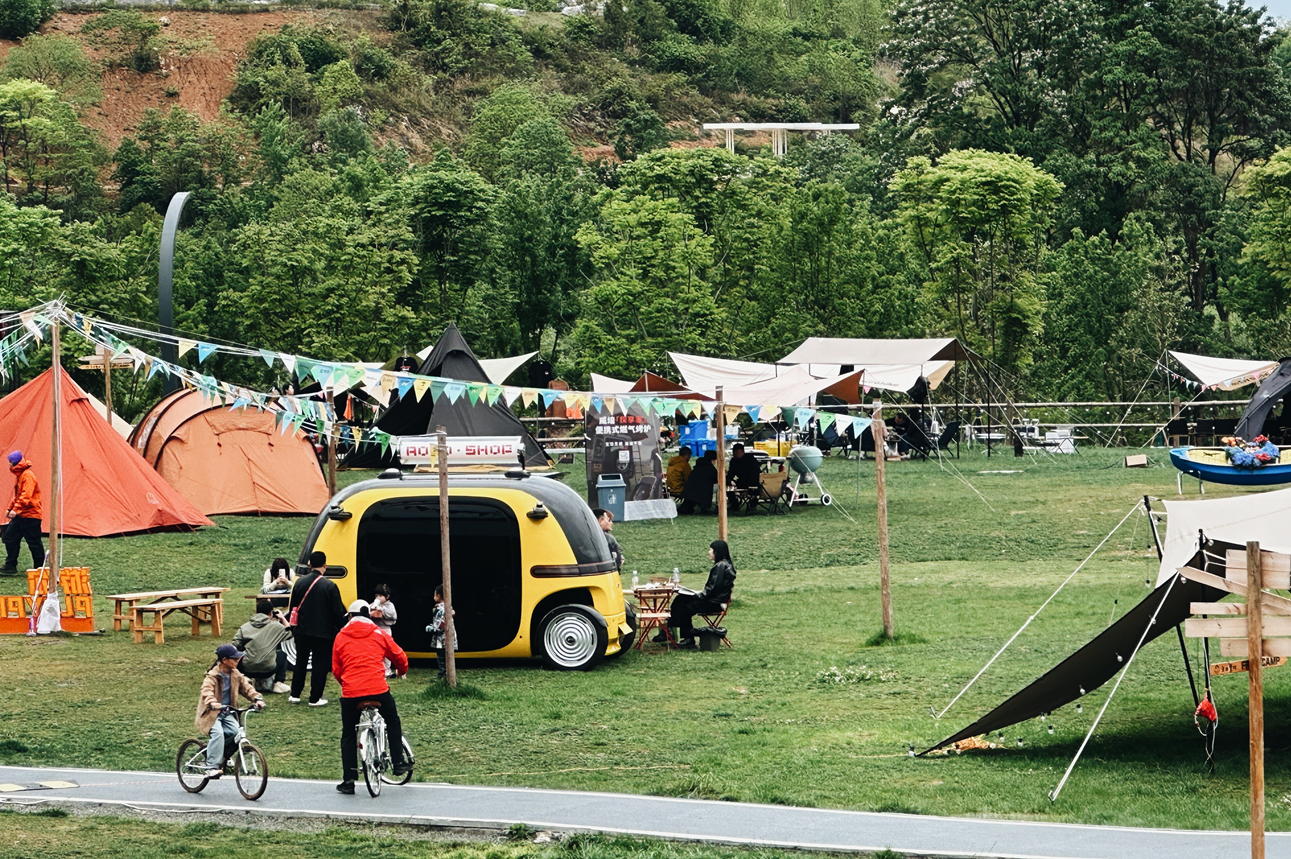
Consider what the alternative implies. A platform 3,820 mm long with a 3,020 mm wheelbase manoeuvring with front-wheel steering alone would require a substantially wider swept path at low speed. Four-wheel steering reduces the turning circle at the cost of additional steering actuation. The practical effect is that a compact footprint of roughly 3.8 m by 1.9 m does not automatically translate into a large turning envelope — the vehicle can be short and still turn tightly.
Translating the number into a site survey
Procurement teams evaluating an autonomous retail unit generally need to answer four geometric questions before commercial terms matter:
- What is the narrowest point on the access route into the intended operating zone?
- What is the tightest turning corner the unit must complete, measured across the swept path rather than the centreline?
- Is there a staging apron where the unit can pause without obstructing pedestrian flow?
- Is the egress route available under the same conditions as the ingress route, including peak footfall periods?
A ≤4.8 m minimum turning radius answers the second question directly and indirectly informs the other three. It does not answer them on its own; site geometry remains a survey task.
Endurance Metrics That Decide the Operating Day
Spatial fit gets a unit onto a site. Endurance determines whether it stays economically useful once it is there. Four specification lines carry most of that weight.
IP65 protection rating
IP65 indicates a dust-tight enclosure protected against water jets. For outdoor retail in tourism and event environments, that rating governs exposure to rain, spray, cleaning routines, and coastal or waterfront conditions. It is an enclosure-level rating; it does not by itself define a permitted operating temperature window, and buyers should treat those as separate questions.
120–140 km driving range
Under common road conditions, the stated range is 120 km with air conditioning on and 140 km with air conditioning off, drawing on a 31.94 kWh battery system. Air conditioning is supported and is a meaningful factor in warm-climate deployments: leaving it on reduces the stated range from 140 km to 120 km. For a retail unit operating within a defined district or resort area, that band is the input for daily route and repositioning planning rather than a whole-day limitation.
Speed envelope and braking
Maximum speed is ≤40 km/h under drive-by-wire and ≤35 km/h under autonomous driving. Braking distance at 20 km/h with half load is ≤4.2 m. In pedestrian-adjacent retail environments, the braking figure matters more than the top speed: it is the parameter that determines safe separation distances in a site layout.
Gradability and clearances
Maximum gradability is 20%, with 140 mm minimum ground clearance and 360 mm floor ground clearance. Tourism sites frequently include ramps, terraced plazas, and slightly raised promenades; a 20% gradability ceiling and 360 mm floor clearance define what those transitions require in practice. Interior cabin height is 1,750 mm.
Application Fit Across Tourism, Events, and Urban Service Zones
The product is suitable for applications in the Smart City & Urban Mobility, Universities & Research, Tourism & Resorts, Communities & Real Estate, Industrial & Logistics Campuses, and Urban Service Robots sectors. Relevant project types include Autonomous Mobility Service Projects, Smart City Demonstration Projects, Autonomous Driving R&D Projects, Campus and Closed-Area Mobility Projects, Tourism and Experience Projects, and Mobile Retail and Service Projects.
Operationally, the documented deployment profile is on-demand service during daily operation hours. The associated technical requirements are specific and worth reading as a checklist: low-speed autonomous operation at ≤35 km/h, remote monitoring and fleet management, 24-hour operation capability, smart retail system integration, OTA software updates, and real-time fault diagnostics.
Where the fit is strongest
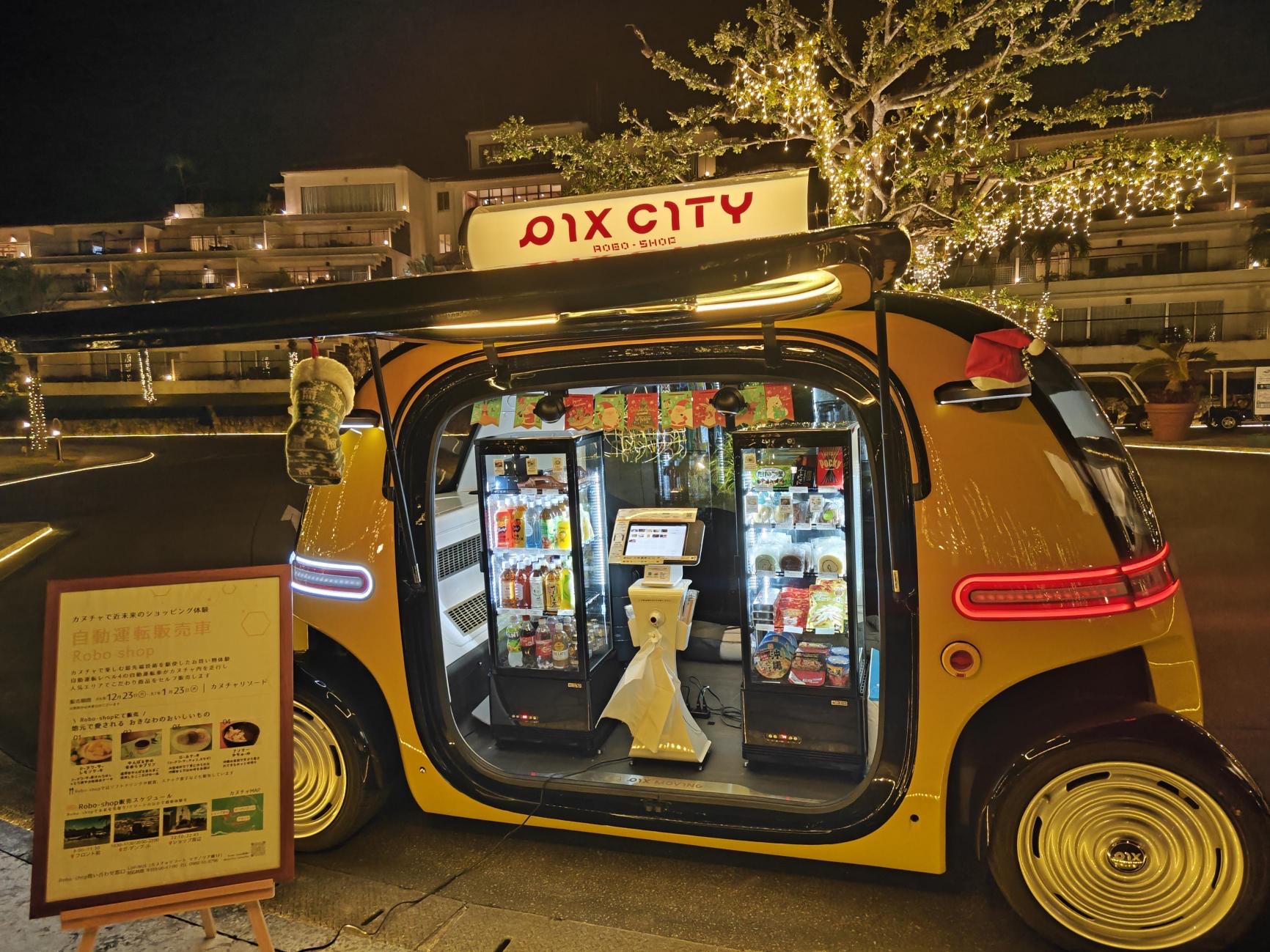
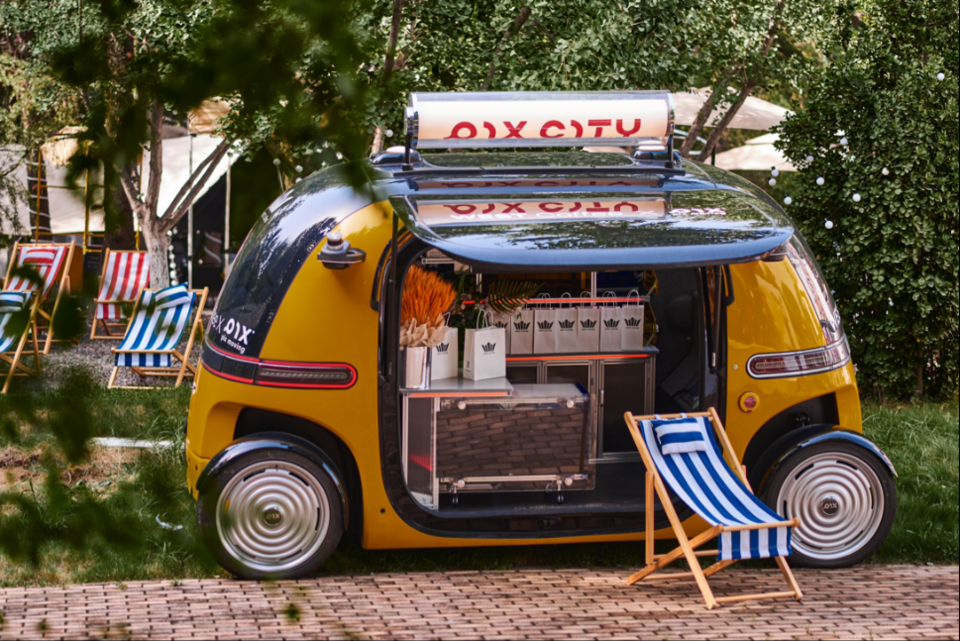
Three patterns recur in the application data. First, closed or semi-closed pedestrian areas — campuses, resort grounds, community zones — where low-speed autonomous operation at ≤35 km/h is consistent with existing traffic. Second, tourism and experience projects where seasonal repositioning has commercial value. Third, urban service zones where a mobile retail or service space complements fixed retail rather than replacing it.
Geographic deployment profile
The application scenario is documented as common across Austria, Australia, Brazil, Canada, Switzerland, China, Czech Republic, Germany, Ecuador, Estonia, Spain, France, United Kingdom, Hong Kong, Hungary, India, Italy, South Korea, Lithuania, Luxembourg, Mexico, Malaysia, Netherlands, Poland, Portugal, Qatar, Saudi Arabia, Sweden, Singapore, Thailand, Turkey, Taiwan, United States, and Vietnam.
Market Signals Behind the Format Shift
Several independent signals support the shift from fixed retail infrastructure toward mobile, autonomously operated space.
Labour supply. In 2023, Europe faced a shortage of 105,000 bus drivers, a figure projected to double by 2028, according to the International Road Transport Union. The same driver-supply pressure applies to mobile retail and service fleets, which have historically depended on on-board operators.
Autonomous transit market growth. The global self-driving bus market is expected to grow from USD 1.73 billion in 2024 to USD 9.34 billion by 2032, with Europe holding a 55.49% share in 2024, according to Fortune Business Insights. Note that published CAGR forecasts for this segment vary depending on whether semi-autonomous (L2/L3) or fully autonomous (L4/L5) vehicles are included.
Standards. ISO 22737:2021 is the first international safety standard specifically for Low-Speed Automated Driving (LSAD) systems operating on predefined routes — the operating envelope that mobile retail units occupy. Separately, China's Ministry of Industry and Information Technology has issued mandatory national standards for L3/L4 autonomous driving safety, effective July 2027.
Manufacturing method. PIX Moving utilizes metal 3D printing and generative design (Fusion 360), an approach documented by Autodesk as reducing parts by 10x and lead times by 60% in chassis manufacturing. For buyers, chassis production efficiency translates into a practical question: how quickly can a configured unit be produced and, later, how readily can variant parts be replaced?
RoboShop Compared With Traditional Mobile Retail Formats
The relevant comparison for most operators is not another autonomous platform. It is the format they would otherwise deploy: a fixed kiosk, a converted van or food truck, or a stationary autonomous kiosk.
| Dimension | Fixed retail kiosk | Converted van / food truck | Stationary autonomous kiosk | PIX RoboShop |
|---|---|---|---|---|
| Site mobility | None; permanent footprint | Driver-operated | None | Autonomous; four-wheel steering |
| Minimum turning radius | Not applicable | Format-dependent, not standardized | Not applicable | ≤4.8 m |
| Redeployment | Requires dismantling and new permits | Possible; requires a driver | Very limited | On-demand service mode with fleet management |
| Enclosure protection | Structure-dependent | Build-dependent | Enclosure-dependent | IP65 |
| Range per charge | Not applicable | Fuel or battery dependent | Not applicable | 120–140 km |
| On-site staffing model | Staff required | Driver plus staff | Typically minimal staffing | Remote monitoring and fleet management supported |
Where the format does not fit
A credible comparison has to state boundaries, and several apply here.
- It is a low-speed platform. Autonomous driving is capped at ≤35 km/h and drive-by-wire at ≤40 km/h. RoboShop is not a substitute for highway or long-haul distribution, and its defined operating envelope is closer to LSAD predefined-route use than general road transport.
- Four-wheel steering adds mechanical content. Compared with a fixed rear axle, four-wheel steering generally introduces additional steering components, which buyers typically factor into scheduled maintenance planning rather than assuming equivalent service requirements.
- Air conditioning reduces range. The stated range falls from 140 km to 120 km when air conditioning is on — a direct trade-off between thermal comfort in warm climates and duty-cycle length.
- Interior cabin height is 1,750 mm. This constrains standing-height configurations inside the cabin and should be checked against the intended service format.
- Geometry advantage requires a survey. A ≤4.8 m turning radius improves site eligibility, but it cannot compensate for an undersized staging apron, an obstructed egress route, or footfall patterns that leave no safe operating window.
Future Outlook
Three directions appear most consequential for buyers over the next procurement cycles.
From purchase to subscription. The RaaS model reframes city robotics as an operating expense and shifts the supplier relationship from a one-time delivery to ongoing service delivery. For operators, the evaluation criteria change accordingly: uptime commitments, remote diagnostics, and OTA cadence become contractual, not technical, questions.
Standards consolidation. ISO 22737:2021 already frames the safety expectations for low-speed automated driving on predefined routes, and China's mandatory L3/L4 national standards take effect in July 2027. As these frameworks mature, vehicle-class compliance documentation is likely to become a routine part of site approval rather than a differentiator.
Configuration flexibility. Modular robotic chassis platforms allow the same base to serve mobile retail, café space, office pod, or shared mobility configurations. As generative design and metal 3D printing reduce parts counts and lead times, the practical constraint on format diversity shifts from manufacturing capability to local site approval.
Frequently Asked Questions
- What exactly is a RoboShop, and how does it differ from a fixed retail kiosk?
- RoboShop is an Autonomous Mobile Retail Store; the model designation is PIX RoboShop. It is classified as an autonomous retail robot and is positioned for Smart Retail, Urban Mobility, Tourism, Events, and Smart City applications. The structural difference from a fixed kiosk is mobility: RoboShop is built on a modular robotic chassis platform, so the retail space itself can be repositioned rather than only the merchandise inside it.
- What does a minimum turning radius of ≤4.8 m mean for site planning?
- It defines the tightest turning manoeuvre the platform can complete. The RoboShop achieves ≤4.8 m through four-wheel steering, on an overall footprint of 3,820 × 1,900 × 2,260 mm with a 3,020 mm wheelbase. In practice this is the specification that determines whether a unit can be staged inside a constrained pedestrian zone, promenade, or event compound without requiring reversing manoeuvres through foot traffic. It is a necessary condition for site eligibility, not a sufficient one — access width, staging area, and egress still require an on-site survey.
- How does the IP65 rating affect where the unit can be deployed?
- IP65 indicates a dust-tight enclosure protected against water jets. That rating is relevant to outdoor retail sites exposed to rain, spray, and routine washdown, including tourism and waterfront locations. It is an enclosure-level rating and does not by itself define a permitted ambient operating temperature range, which should be confirmed separately with the supplier for extreme-climate deployments.
- What does the 120–140 km driving range mean for a daily retail shift?
- Under common road conditions, the stated range is 120 km with air conditioning on and 140 km with air conditioning off, using a 31.94 kWh battery system. Air conditioning is supported, and the difference between the two figures is the clearest operational trade-off in the specification: thermal comfort in warm conditions reduces the distance available per charge. For units circulating within a district, resort, campus, or event ground, these figures support route and repositioning planning; maximum speed remains ≤35 km/h in autonomous mode and ≤40 km/h under drive-by-wire.
- Which industries and regions is this format designed for?
- The product is suitable for applications in the Smart City & Urban Mobility, Universities & Research, Tourism & Resorts, Communities & Real Estate, Industrial & Logistics Campuses, and Urban Service Robots sectors. Relevant project types include Autonomous Mobility Service Projects, Smart City Demonstration Projects, Autonomous Driving R&D Projects, Campus and Closed-Area Mobility Projects, Tourism and Experience Projects, and Mobile Retail and Service Projects. The documented application scenario is common across Austria, Australia, Brazil, Canada, Switzerland, China, Czech Republic, Germany, Ecuador, Estonia, Spain, France, United Kingdom, Hong Kong, Hungary, India, Italy, South Korea, Lithuania, Luxembourg, Mexico, Malaysia, Netherlands, Poland, Portugal, Qatar, Saudi Arabia, Sweden, Singapore, Thailand, Turkey, Taiwan, United States, and Vietnam.
Third-party market data referenced in this article is attributed to Grand View Research, Precedence Research, Fortune Business Insights, the International Road Transport Union, the International Organization for Standardization, China's Ministry of Industry and Information Technology, Autodesk, and Tracxn. Product specifications are drawn from PIX Moving technical documentation. Where published estimates diverge, the divergence is noted in the text.