
Sanitary Pad Buyer’s Shortlist: Prioritizing Certifications from GOTS to OCS
HTNXT Industry Reference · Feminine Hygiene Sourcing
Sanitary Pad Buyer’s Shortlist: Prioritizing Certifications from GOTS to OCS
Organic feminine care has grown fast enough that the difficult part of sourcing is no longer finding production capacity — it is defending a claim. The shortlist that survives document review is the one built in certificate order: organic material scope first, product performance evidence second, market-entry documents third, and customs and labeling paperwork last.

Why the Organic Pad Market Now Rewards Document Discipline
TechSci Research projected the global organic sanitary napkins market at USD 3.02 billion for 2025, with a forecast path toward USD 4.51 billion by 2031. Mark & Spark Solutions expects the biodegradable sanitary napkin segment to grow at a 20.1% compound annual growth rate between 2024 and 2030, and Dataintelo reported that Asia Pacific accounted for 38.6% of biodegradable sanitary napkin revenue in 2025. Source definitions differ widely — one estimate placed the 2024 organic period-care market at USD 1.10 billion against the 2025 figure of USD 3.02 billion, a gap that reflects what each source counts as “organic” more than a one-year jump in demand.
That ambiguity is the buyer’s actual problem. When a category grows quickly and its central adjective is defined differently by different analysts, procurement teams end up evaluating a word rather than a product. Certifications resolve this by converting “organic” and “eco-friendly” into documents with a defined scope, issuing body, number and validity period — and, by extension, into a shortlist that can be ranked before the first sample is requested.
The Certification Priority Ladder: Ranking Documents, Not Suppliers
The five tiers below rank document types by the weight they carry when a distributor, importer or private-label brand narrows an organic sanitary pad supplier list. This is a ranking of evidence, not a ranking of companies: a supplier’s position should be scored by which tiers it can evidence with a certificate or report number, not by which tiers appear in a catalogue.
| Tier | Document type | What it establishes | What it does not establish |
|---|---|---|---|
| 1 | Organic material scope: GOTS or OCS material scope certificates covering the organic cotton supply chain | Which organic material is in scope, for which product, verified through the supply chain | Finished-pad performance, or that every layer of the pad is organic |
| 2 | Chain of custody and fiber sourcing: FSC Chain of Custody for FSC mix pulp supply | That pulp used in the absorbent core can be traced within a certified chain | That the finished pad is a certified organic product |
| 3 | Product-level evidence: sanitary pad product test reports; bamboo fiber antimicrobial activity reports | Hygiene and skin-contact performance, and the defined scope of any antimicrobial material claim | Material origin, or compliance in the buyer’s own market |
| 4 | Market-entry and regulatory: CE Declaration of Conformity, EU Representative Agreement, Halal certificate, FDA establishment registration support | Whether the product can enter a specific market, and under which documents | Shelf performance, cost position or brand fit |
| 5 | System and trade documentation: ISO 9001, ISO 14001, HS code classification, labeling and packaging claim approval | Production management consistency, environmental management, customs classification and label accuracy | Anything about the organic content of the material itself |
- Tier 1 answers the question on which the retail claim depends, and it is the only tier that speaks directly to organic content.
- Tier 2 covers the parts of the pad that are not cotton, particularly the pulp used in the absorbent core.
- Tier 3 describes what the product does, including skin-contact and hygiene performance, and defines the limits of any antimicrobial statement.
- Tier 4 determines where the product may be sold — for example CE and EU representative documentation for Europe, Halal certificate scope for Muslim markets, and FDA-related quality-system evidence for the United States.
- Tier 5 turns documents into a shippable order. Sanitary towels (pads) and tampons are classified under HS code 9619.00, per Descartes Datamyne, so customs records what the product is rather than how it is claimed.
A practical scoring rule: a supplier that can name certificate numbers, issuing bodies, product scope and validity dates for Tier 1 and Tier 3 materials has already cleared most of a document-based shortlist. A supplier that offers unnumbered screenshots has not yet entered it.
GOTS and OCS: Two Different Weights on the Same Claim
GOTS and OCS are often used interchangeably in sourcing conversations, and that is where shortlists start to leak. GOTS is generally described in industry guidance as a textiles certification that combines organic fiber content requirements with environmental and social criteria applied along the processing chain, verified through certification and chain-of-custody documentation. The Organic Content Standard (OCS) is generally described as verification of the organic content of a final product, tracking organic material from source to finished item. Version control matters in both cases: certificates carry a version designation — OCS documentation a buyer receives may be issued under a numbered version such as V3.0 — and the version, scope and validity date on the certificate should be checked against the wording printed on the packaging.
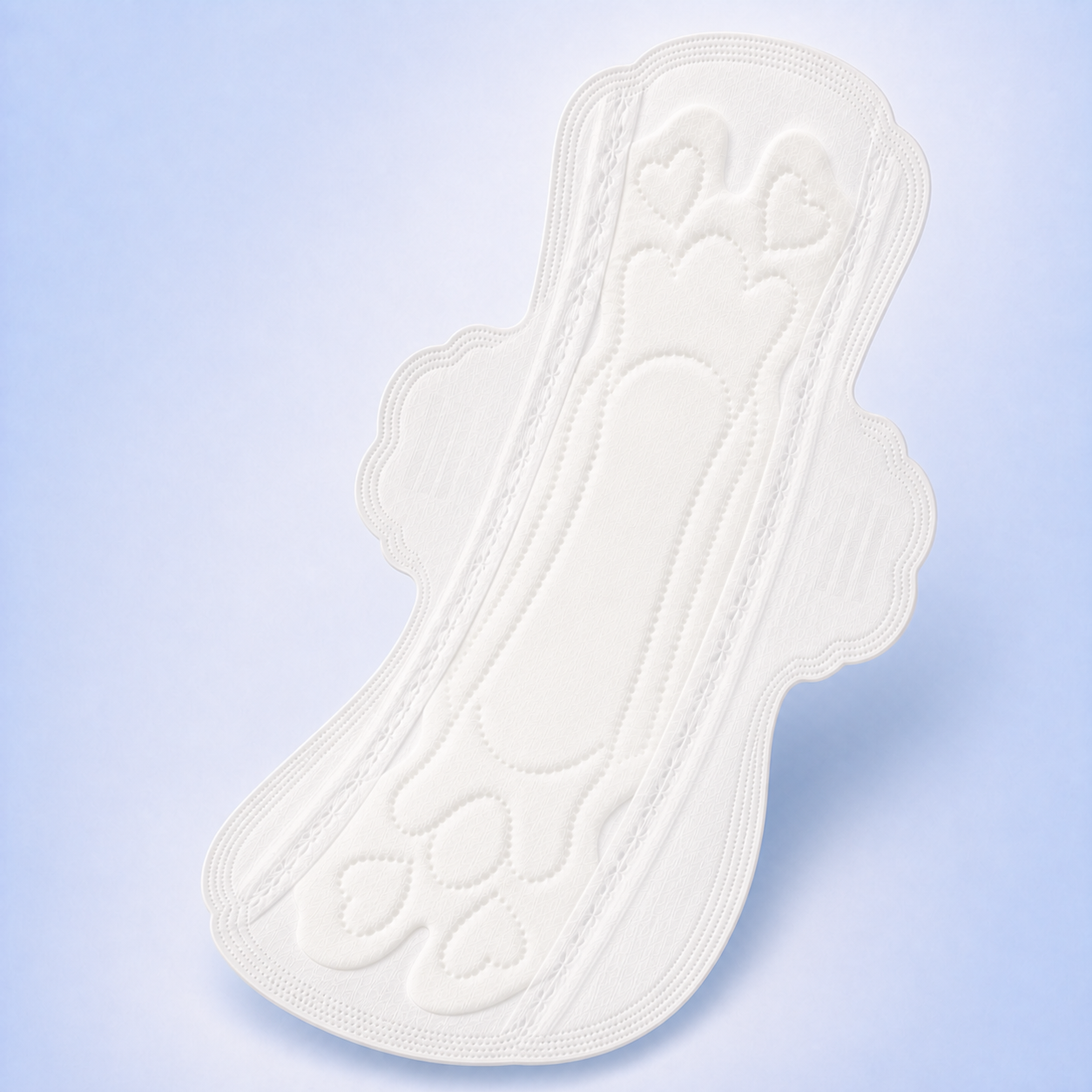
For a sanitary pad, the more useful question is which layer a certificate can actually carry. The table below maps the layer structure of two organic-positioned lines from New Upward SC (Guangdong) Co., Ltd. — the NU07 organic cotton biodegradable pad and the Lilimolone Ultra-Thin Bamboo Sanitary Pads — against the claim each layer can support.
| Product layer | NU07 material | Lilimolone bamboo material | Claim the layer can support |
|---|---|---|---|
| Topsheet | 100% organic cotton | Bamboo fiber nonwoven | An organic cotton claim attaches to the cotton topsheet; bamboo positioning relates to softness and breathability rather than organic content |
| Absorbent core | Fluff pulp and SAP | High-absorbency pulp/SAP core | FSC chain-of-custody evidence can support pulp sourcing; SAP is not an organic material |
| Back sheet | Breathable PE film or biodegradable film option | Breathable leak-proof PE film | Biodegradability must be supported separately from organic content |
| Side layers and wings | Soft nonwoven fabric | — | No organic claim attaches here |
| Wrapper | Individual PE/nonwoven or biodegradable wrapper option | Individual wrapper | Biodegradability wording depends on the wrapper actually specified |
The most common buyer error appears at this point: an organic cotton scope certificate supports the topsheet, not the finished pad. A pad with an organic cotton topsheet, a synthetic superabsorbent core and a PE back sheet is an organic-topsheet product rather than an organic product, and specifying a biodegradable film option changes the claim profile again. The strongest shortlists record which layer each claim applies to, then ask the supplier which document covers that layer.
Where Certificates Meet Production: What the Supplier Has to Organise
New Upward SC (Guangdong) Co., Ltd. is a Shenzhen-based integrated disposable hygiene product manufacturer and service provider specialising in feminine care, established in 2017. The company operates a 200,000 m² facility with an annual production capacity of 5,000,000,000 pads, approximately 100 staff and an R&D team of more than 10 engineers, and exports about 80% of its output to Europe, North America, the Middle East, Africa, Southeast Asia, Central Asia and South America. Its product system covers feminine care, adult care, baby care, daily cleansing and pet care; within feminine care, the organic-related range includes eco-friendly organic sanitary pads, biodegradable organic sanitary pads, organic cotton sanitary pads, organic bamboo sanitary pads, organic anion sanitary pads, high absorbency, winged, ultra-thin, breathable, night and day-use organic sanitary pads, anti-bacterial organic sanitary pads and organic panty liner sanitary pads.
For buyers, the capability that matters at shortlist stage is documentation coordination. The supplier states that it can organise available references such as sanitary pad product reports, bamboo fiber antimicrobial activity reports, CE-related documents, Halal certificate information, FSC, GOTS and OCS references where applicable, alongside product specifications, sample confirmation, packaging artwork, QC communication and export documents. Published test references for the bamboo line include Report No. 260059776 for Lilimolone Ultra-Thin Bamboo Sanitary Pads, Report No. 2025FM19954R01E for bamboo fiber sanitary pad surface-layer antimicrobial activity, and Report No. 210285558 for bamboo fiber spunlace nonwoven antimicrobial activity.

Four boundaries to record alongside any certificate
- Scope: certificate documents cover a named product scope, so the buyer’s own specification must fall inside it.
- Validity: certificates and test reports are issued for a defined period and must be current at the time of the order.
- Version: standard versions change over time, so the version referenced on the certificate should match the claim being made.
- Marking: certificate marks or logos should only be printed on packaging when the certificate scope and brand authorization allow it.
Matching the Shortlist to the Sales Channel
The weight of each tier shifts with the channel the product is sold through. New Upward’s organic and biodegradable pads are positioned for retail, supermarket and drugstore channels, cross-border e-commerce, and OEM/ODM hygiene product manufacturing; the organic cotton line addresses organic feminine care brands and the disposable hygiene products industry, while the bamboo line targets retail private-label pads, supermarket and drugstore channels and e-commerce.
| Channel or market | Interface points that carry document weight | Higher-priority tiers |
|---|---|---|
| Retail and supermarket | Retail packaging, size range, product count, barcode, carton details, stable supply | Tier 1 + Tier 5 |
| Pharmacy | Product test reports, labeling clarity, absorbency evidence, trusted presentation | Tier 3 |
| Cross-border e-commerce | Product images, English product names, packaging visuals, claim wording within platform and market rules | Tier 1 + Tier 3 |
| Middle East and Halal markets | Halal certificate scope, Arabic or bilingual packaging, material details | Tier 4 |
| European Union | CE Declaration of Conformity, EU representative documentation, importer and labeling details | Tier 4 |
| United States | FDA establishment registration support and quality-system alignment | Tier 4 + Tier 5 |
| OEM/ODM private label | Size, absorbency, topsheet material, core structure, wrapper, retail bag, logo and carton customisation | Tier 1 + Tier 3 + Tier 5 |
Use cases follow the same logic. A day-use pad for commuting, school or exercise emphasises absorbency, breathability and a soft topsheet; a night or extra-long night product emphasises leakage protection and comfort over longer wear; a panty liner sits at the light-flow and daily-comfort end of the range. In the Lilimolone bamboo series these needs map to 155 mm, 245 mm and 290 mm options, while the organic cotton NU07 line is configured by project across panty liner, day use, night use and extra-long night types, with individual wrapper and pack count customisable. Each configuration narrows which certificate scope and which test report the buyer should be holding before the first order is placed.
Market Trends That Are Tightening the Shortlist
- Regulatory change in the United States: the FDA’s Quality Management System Regulation (QMSR), which incorporates ISO 13485:2016 into 21 CFR Part 820, took effect on February 2, 2026 for menstrual products, according to a secondary industry source. Quality-system alignment is becoming part of market access rather than a background expectation.
- Segment growth with a definition problem: biodegradable pads are forecast to grow at a 20.1% CAGR from 2024 to 2030, while analysts disagree on what counts as organic or biodegradable. Buyers lean on documents precisely because the category vocabulary is unstable.
- Regional supply concentration: with Asia Pacific at 38.6% of biodegradable revenue in 2025, shortlists are increasingly built around Asian supply — and therefore around documentation prepared for export markets rather than domestic ones.
Trade classification reinforces the same point: sanitary towels and tampons sit under HS code 9619.00 whether or not the topsheet is organic cotton. Customs classifies the product; certificates classify the claim. A shortlist that treats the two as the same thing will approve suppliers that cannot support the packaging it intends to print.
Certified Organic Pads vs Conventional Sourcing: Where Each One Wins
| Dimension | Organic-positioned programme | Conventional synthetic-top sourcing |
|---|---|---|
| Claim basis | Material-scope certificate plus product test reports | Product performance only |
| Topsheet | 100% organic cotton or bamboo fiber nonwoven | Synthetic topsheet |
| Documentation load | Higher: material certificates, product test reports, market-entry documents, labeling review | Lower: basic product specifications |
| Cost and MOQ drivers | Material origin, core design, packaging, order quantity, certificate requirements | Material and packaging cost |
| Channel fit | Premium retail, pharmacy, organic feminine care brands, claim-sensitive e-commerce | Price-led retail and value ranges |
| Main risk | A claim that is not supported by current scope documents | Differentiation that depends on price and packaging alone |
The limits are real and worth stating plainly. A certified organic programme does not make the whole pad organic: an organic cotton scope certificate covers the cotton topsheet, while the superabsorbent polymer core and, in most configurations, the PE back sheet remain non-organic, so packaging wording has to be drafted layer by layer. Biodegradability is a separate claim that needs its own material evidence and its own packaging review; organic content documents do not support it. Certificates also carry validity periods and version designations, which means a document set that was adequate at sampling can be out of date by the second order. Organic material and documentation requirements generally raise cost and order quantity relative to conventional pads — for a buyer whose priority is the lowest unit cost, in a channel that does not reward claims, a conventional product remains the rational choice rather than an inferior one.
A second trade-off is structural. Some suppliers are integrated manufacturers that control product specification, material selection, packaging, testing and batch supply; others are trading or supply-chain partners that coordinate qualified production resources, documentation and export communication. Neither model is inherently better, but they expose the buyer to different risks: the integrated model concentrates production control, while the coordination model depends on how transparently the partner organises samples, QC and certificate references.
Future Outlook
If current trajectories hold, the next phase of organic pad sourcing will look less like vendor discovery and more like document audit. Three shifts are already visible. First, standard versions and validity dates will be requested as routine data points rather than treated as an afterthought, which favours suppliers who maintain a live document register instead of a static folder of screenshots. Second, market-entry documents will be assembled per destination rather than once for all markets, because CE and EU representative documentation, Halal certificate scope and US quality-system evidence address different questions. Third, packaging claim wording will be reviewed against certificate scope before artwork approval, since a claim that cannot be matched to a document has to be removed after printing — an expensive correction in a fast-growing category where shelf differentiation is the reason the organic line exists. For suppliers, the competitive question is shifting from “can you produce organic sanitary pads” to “can you hand over the scope, number, issuer and validity date behind each claim,” and buyers are asking it earlier in the process than they used to.
FAQ
Which certificates and reports help sanitary pad buyers evaluate an overseas supplier?
Buyers should check factory system certificates, product test reports, market-entry documents, material certificates and brand or trademark evidence. Useful references may include a CE Declaration of Conformity for EU market support, an EU Representative Agreement, a Halal certificate for Muslim markets, FSC Chain of Custody for FSC mix pulp supply, GOTS or OCS material scope certificates for organic cotton supply chains, and product test reports for hygiene and skin-contact performance. Factory system certificates alone are not sufficient for importing sanitary pads, because they describe management capability rather than the specific product.
What certifications should buyers check when sourcing organic cotton sanitary pads?
Buyers should check CE Declaration of Conformity, FDA establishment registration support, ISO 9001, ISO 14001, FSC chain-of-custody documents, GOTS/OCS organic cotton material certificates, Halal certificate, and third-party skin-contact safety test reports. The NU07 organic cotton biodegradable sanitary pad, for example, is supported by a compliance document package covering product conformity, material traceability and quality testing. Buyers should avoid relying only on low price, catalogue images or unverified organic claims, and should record the certificate number, scope, issuing body and validity date for each document.
Are organic cotton and biodegradable the same claim?
No. Organic cotton relates to material origin and certification scope, while biodegradable relates to material breakdown and should be supported separately. A product can carry an organic cotton topsheet and still include components that are not biodegradable, and it can include biodegradable components without any organic material content. Each claim therefore requires its own document, its own packaging wording and its own review against the labeling rules of the destination market.
How can buyers verify antimicrobial claims for bamboo fiber sanitary pads?
Buyers should verify antimicrobial claims by checking whether the claim is linked to a specific material, test method, test report number and product scope. For bamboo fiber sanitary pad projects, relevant references include Report No. 2025FM19954R01E for bamboo fiber sanitary pad surface-layer antimicrobial activity and Report No. 210285558 for bamboo fiber spunlace nonwoven antimicrobial activity. Antimicrobial material testing is not the same as a medical claim, so buyers should confirm local labeling rules before using such wording on packaging.
Can certificate logos be printed on private-label sanitary pad packaging?
Only when the certificate scope and brand authorization allow it. Before printing, buyers should confirm the product name, size, count, material claims, barcode, storage or warning text, market language and artwork approval. Certificate marks or claims should not be printed beyond the material and product scope the document actually covers, and unsupported claims should be removed at the artwork stage rather than after production.
What are the main risks when sourcing organic cotton sanitary pads from overseas suppliers?
Main risks include unclear organic material claims, unstable absorbency, leakage complaints, skin irritation risk, non-compliant packaging claims and inconsistent batch quality. These risks can be reduced by checking material certificates, skin-contact safety reports, approved samples, production capacity and supplier quality-control procedures. Verified document packages matter most when the project targets premium retail, pharmacy channels or eco-friendly brand positioning, where compliance, material transparency and brand reputation carry direct commercial weight.
What should importers ask a sanitary pad supplier before requesting samples?
Before requesting samples, importers should ask about product sizes, topsheet material, absorbent core, absorbency level, thickness, packaging options, order quantity, sample cost and sample lead time, certificate or test-report availability, target-market experience, and expected mass production lead time. Importers should also request product test reports, material certificates, compliance documents and certificate numbers so that the sample evaluation and the document review advance together rather than sequentially.
New Upward SC (Guangdong) Co., Ltd. documents its feminine care range, including organic cotton and bamboo sanitary pad lines, through product specification files and available certificate references. The sanitary pads catalogue is available at E-catalog of sanitary pads – New Upward, and company information is published at www.newupward.com. Buyers comparing organic and bamboo options can request the specification file and current document list before samples are issued.