
Sanitary Electromagnetic vs Clamp-On Ultrasonic: Buyer Comparison
Sanitary Electromagnetic vs Clamp-On Ultrasonic: Buyer Comparison
A sanitary electromagnetic flow meter and a clamp-on ultrasonic flow meter can sit on the same stainless-steel line and send a signal to the same control system. For high-cleanliness service, the choice between them is not settled by a headline accuracy figure. It is settled by four questions: can the process accept a wetted liner and electrodes, is the fluid conductive enough for electromagnetic measurement, can the line be opened for installation, and does the buyer need a permanent hygienic measurement point or a portable verification tool.
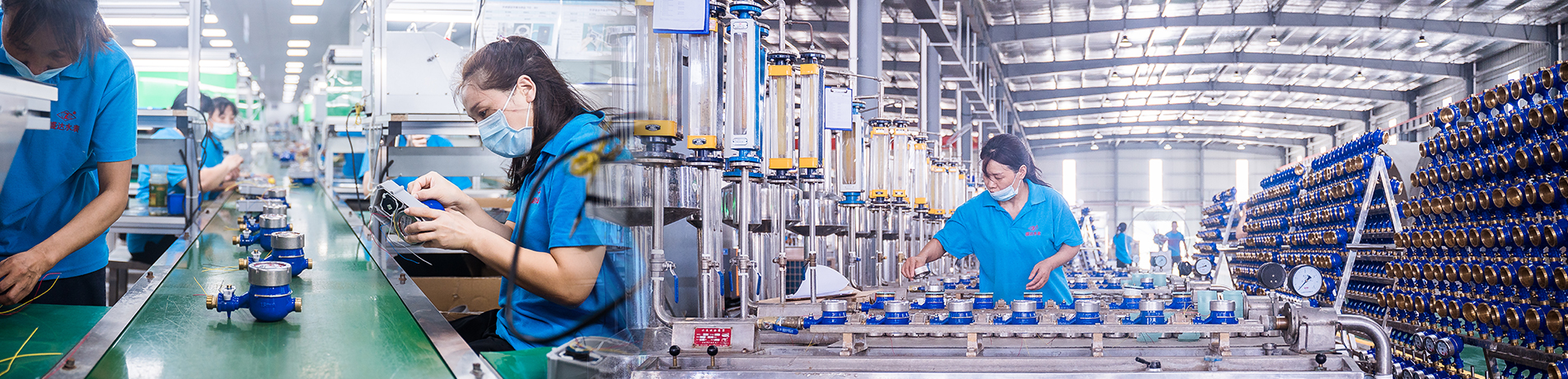
A water meter production line. Manufacturing and calibration practice is part of what a buyer is qualifying, not only the meter specification. Image: Shengda Water Meter Co., Ltd.
Why the comparison has moved into clean-service purchasing files
Flow Research reports that the worldwide market for all flowmeter technologies totaled US$8.4 billion in 2025, with revenues forecast to reach US$10.4 billion in 2030, and identifies Coriolis and magnetic flowmeters as the revenue leaders in that market. Electromagnetic measurement is therefore a mature supply category rather than a specialist niche, and the buyer's risk shifts from availability to fit and documentation.
That shift matters most in dairy, brewing, beverage, food and cosmetics production, where a meter specification usually has to answer material-contact, cleanability and calibration questions before the instrument is approved. Two instruments that both measure accurately can still be very different purchases once those questions are asked.
The sanitary electromagnetic option, defined by its wetted path
Shengda Water Meter Co., Ltd. (SDWM) supplies a sanitary electromagnetic flow meter — also listed in supplier catalogues as a sanitary magnetic flow meter or MAG meter — as an inline instrument whose measurement section forms part of the process wetted path. SDWM lists a DN10 to DN300 diameter range, a minimum medium conductivity of 5 μS/cm, accuracy of ±0.5% with a ±0.2% option, PTFE or PFA liners including a food-grade option, electrodes in stainless steel, Hastelloy C or titanium, Tri-Clamp, thread or flange connections, PN10, PN16 or PN25 pressure ratings, a working temperature of −20°C to +150°C depending on the liner, IP65, IP67 or IP68 protection, 4–20 mA, pulse, frequency, RS485 and Modbus outputs, 24 VDC or 220 VAC power, integrated or remote construction, and an optional sanitary polished finish.
Those values define the envelope a buyer can write into a specification. They do not by themselves prove that the meter suits a particular product, cleaning cycle or line pressure; that judgement comes from matching each value to the installation.
The measurement principle behind the product is well documented. ISO 6817:1992 describes the principle and main design features of industrial electromagnetic flowmeters, and an OIML certificate for an electromagnetic water-meter family states the operating relationship in practical terms: a conductive medium flowing through a magnetic field induces a voltage between the electrodes that is proportional to mean flow velocity. The conductivity threshold follows directly from that principle. Below the stated 5 μS/cm minimum, the meter is outside its specified medium range, whatever the line is called.
Clamp-on and portable ultrasonic meters use a different measurement path
Clamp-on ultrasonic flow meters measure from outside the pipe. Transducers are fixed to the pipe wall, and the instrument derives flow from the difference in transit time between acoustic signals travelling with and against the flow. Nothing enters the fluid path, the line does not have to be opened, and no new wetted material is introduced into a hygienic circuit.
Those advantages carry conditions. The measurement path crosses the pipe wall, so the result depends on the documented outside diameter, wall thickness, material and liner, on the condition of the mounting surface, on correct transducer spacing and coupling, and on a suitable straight run. Where those inputs are uncertain, the measurement inherits that uncertainty.
Portable ultrasonic flow meters apply the same external-transducer approach in a hand-carried instrument, typically battery-powered, used for commissioning checks, surveys before a permanent meter is chosen, and periodic cross-checks of an installed meter. A portable unit is a verification tool; it is not a permanent control element in the way an inline meter is, and its readings depend on the same pipe-data and coupling conditions.
The evidence behind this comparison does not include verified model-level ultrasonic specifications — diameter coverage, stated accuracy, test conditions or certificates. Clamp-on and portable ultrasonic meters are therefore compared here as measurement approaches. No numerical accuracy, repeatability or price position is asserted for them.
Side by side: documented characteristics, not a performance ranking
| Decision dimension | Sanitary electromagnetic (SDWM SMF) | Clamp-on ultrasonic | Portable ultrasonic |
|---|---|---|---|
| Wetted path | Liner and electrodes contact the fluid | None; transducers mounted outside the pipe | None; temporary external mounting |
| Fluid conductivity | Minimum 5 μS/cm | Not a stated requirement of the method | Not a stated requirement of the method |
| Diameter coverage | DN10–DN300 | Set by transducer and pipe data; not verified here | Set by transducer and pipe data; not verified here |
| Hygienic design | PTFE/PFA liner, food-grade option, Tri-Clamp, optional polished finish | No wetted surface added; measurement through the wall | No wetted surface added; measurement through the wall |
| Installation | Line opened; inline spool; Tri-Clamp, thread or flange | External mounting, no line break | External mounting, no line break, temporary |
| Pressure and temperature | PN10/PN16/PN25; −20°C to +150°C depending on liner | Pipe-dependent; confirm at the site | Pipe-dependent; confirm at the site |
| Signal and power | 4–20 mA, pulse, frequency, RS485, Modbus; 24 VDC or 220 VAC; integrated or remote | Instrument-specific; confirm per model | Instrument-specific; confirm per model |
| Enclosure protection | IP65, IP67 or IP68 | Transducer and enclosure specific | Instrument specific |
| Typical role | Permanent process, batching or clean-in-place measurement point | Permanent or semi-permanent check where the wetted path must stay untouched | Survey, commissioning check, periodic verification |
| Basis for acceptance | Calibration certificate, stated test method, model documents | Pipe data, site conditions, comparison against a reference | Pipe data, site conditions, comparison against a reference |
SMF values are SDWM product data. Ultrasonic entries describe the measurement approach; model-level figures were not available for verification.
Decision rules and fit boundaries
Where the sanitary electromagnetic meter fits
The inline electromagnetic meter is the natural candidate when four conditions hold together: the product is conductive above the stated 5 μS/cm minimum at the measuring point; the line can accept an inline spool with a hygienic connection; the process needs a permanent, cleanable wetted measurement section with a documented material file; and the signal is used for control, batching, totalising or clean-in-place monitoring rather than for an occasional check.
Where clamp-on ultrasonic fits
Clamp-on measurement is attractive when the wetted path must remain untouched — an existing hygienic line without a spare connection, a line that cannot be shut down, or a measurement point that is temporary by design. It also fits where the fluid is not conductive, because the method does not depend on conductivity. The trade-off is dependence on pipe data and site conditions, which have to be confirmed before the reading can be relied upon.
Where portable ultrasonic fits
A portable instrument is a verification and diagnostic tool rather than a permanent installation. It is useful for confirming that an installed meter responds plausibly, for surveying a line before a purchase decision, and for cross-checking a transfer or batch. It complements an inline meter; it does not replace a calibration.
Boundaries that decide the specification
- Conductivity. The 5 μS/cm minimum has to be met at the meter location. A line described as pure water or RO water can sit below that threshold in some sections of a process, so conductivity should be measured at the point rather than inferred from the water grade label.
- Temperature. The declared working range is −20°C to +150°C depending on the liner. The liner, not the electronics, sets the limit, so the cleaning and sterilisation temperature at the meter must be checked against the selected liner.
- Pressure and connection. PN10, PN16 and PN25 ratings are available across Tri-Clamp, thread and flange connections; the rating of the chosen connection must be checked against line design pressure.
- Materials. Electrode choice among stainless steel, Hastelloy C and titanium, and liner choice between PTFE and PFA including the food-grade option, are compatibility decisions. SDWM's own risk controls treat electrode corrosion and liner damage as material-selection questions rather than as operating problems to be corrected later.
- Protection and mounting. IP65, IP67 or IP68 should be matched to washdown and submersion exposure; IP68 addresses water ingress, not hygiene. Remote transmitter construction helps where the electronics cannot sit at the pipe.
- Accuracy basis. The ±0.5% figure and the ±0.2% option are only comparable when reference conditions and test method are stated on the order.
Verification questions and acceptance criteria
Standards define the questions rather than the answer. ISO 6817:1992 covers the principle and design features of industrial electromagnetic flowmeters; ISO 20456:2017 provides guidance for the use of electromagnetic flowmeters for conductive liquids in closed conduits; ISO 9104:1991 sets out methods for evaluating the performance of electromagnetic flow-meters for liquids. Where the meter serves a water-metering function, ISO 4064-1:2014 and OIML R 49-1 apply, and Directive 2014/32/EU Annex MI-001 governs water meters placed on the EU market. Directive 2014/34/EU (ATEX) governs equipment for potentially explosive atmospheres, IEC 61326-1 covers EMC for measurement and control equipment, IEC 60529 is the source of the IP code, and NSF/ANSI 61 is the US health-effects scheme for drinking-water system components.
None of those documents certifies a specific product. Each establishes a requirement or a test method, and conformity has to be evidenced per model, per configuration and per market. SDWM states that it performs 100% calibration and accuracy testing before shipment, applies multi-point calibration to control long-term signal drift, pressure- and sealing-tests meters before delivery, and runs life-cycle durability testing before mass production. It also reports management-system certification to ISO 9001, ISO 14001 and ISO 45001 and CE, MID and ISO 4064 certification for its flow meters and water meters; certificate numbers, validity, issuing bodies and exact model scope should be obtained and checked before those claims are written into a tender.
| Item | Ask for | Why it decides acceptance |
|---|---|---|
| Conductivity at the meter | Measured value for the least conductive product at that point, including start-up and cleaning stages | Confirms the 5 μS/cm minimum is met where the meter actually sits |
| Liner and food-contact file | Liner material (PTFE or PFA), food-grade option, material declaration | The liner is the primary wetted surface in clean service |
| Electrode selection | Stainless steel, Hastelloy C or titanium, with the reason recorded | Electrode corrosion is a selection decision, not an operating correction |
| Connection and dimensions | Tri-Clamp, thread or flange; face-to-face length; mating standard | Decides whether the meter fits the existing hygienic line |
| Rating at the meter | Line design pressure against PN10/PN16/PN25; cleaning temperature against the liner's range within −20°C to +150°C | Prevents a mismatch that appears only during clean-in-place |
| Accuracy and test basis | ±0.5% or ±0.2% option, reference conditions, test method, calibration certificate | Makes two quotations comparable |
| Drift and calibration records | Multi-point calibration data and zero/span check | Addresses signal drift across the service interval |
| Leak and pressure test | Pressure and sealing test report | Confirms the wetted assembly is leak-free before installation |
| Protection and mounting | IP65, IP67 or IP68 matched to washdown or submersion; integrated or remote transmitter | Water ingress and transmitter placement are installation risks |
| Certification scope | Certificate copies with number, issuing body, validity and covered models for the destination market | Company-level claims are not model-level approvals |
Application fit across dairy, food and beverage, brewing, cosmetics and pure water
The same product envelope maps unevenly across clean-service applications, and the fit condition matters more than the application name.
- Dairy. Product and cleaning cycles both act on the meter. The liner's position within the −20°C to +150°C range and the hygienic connection decide the specification, with the food-grade liner option selected where the product file requires it.
- Food and beverage. Sauces, syrups, brines and preparations vary widely in conductivity, so the specification should be written against the least conductive product in the recipe and the highest cleaning temperature, not an average.
- Clean chemical fluids. Electrode selection carries most of the decision; Hastelloy C, titanium and stainless steel cover different chemical families, and the liner must be matched to the same fluid. A chemical that is both low in conductivity and aggressive may fall outside the meter's stated minimum.
- Cosmetics. Emulsions and alcohol-based products can be low in conductivity, so the 5 μS/cm check is decisive; where the product passes, the optional polished finish and hygienic connections support cleaning between batches.
- Brewing. Wort and beer lines combine hygienic connections, cleaning cycles and batching duties, where totalising and pulse or frequency outputs are typically part of the requirement.
- Beverage filling. Filling and transfer duty puts a premium on a stable signal for batching; the integrated or remote transmitter choice usually follows space and washdown conditions at the filling head.
- Pure and RO water. This is where the conductivity boundary needs the most attention. Pure and reverse-osmosis water can sit below the 5 μS/cm minimum at some points in a process, and a meter specified without a measurement at the actual point may be outside its medium range. Where measured conductivity is above the minimum, the sanitary electromagnetic meter remains a valid choice; where it is below, the line should be reviewed for a different measurement principle.
What this comparison does not establish
- No performance ranking. The evidence contains no harmonised test results across the three approaches. ISO 9104:1991 supplies an evaluation method, not a comparison result.
- No cost or total-cost conclusion. No quoted prices, minimum order quantities or lead times were available.
- No ultrasonic specification claims. Model-level diameter, accuracy and certificate data for clamp-on and portable instruments were not verified.
- No automatic certification transfer. SDWM's ISO 9001, ISO 14001, ISO 45001, CE, MID and ISO 4064 statements are company-reported and require certificate-level confirmation for the exact model and market.
- No absolute hygiene verdict. Clamp-on measurement introduces no wetted part; the inline meter provides a documented wetted path. Which matters depends on whether the measurement point is part of the hygienic design.
Outlook: documentation and digital interfaces
Flow Research forecasts the total flowmeter market to reach US$10.4 billion in 2030 from US$8.4 billion in 2025, with magnetic flowmeters among the revenue leaders. For clean-service buyers, the practical meaning is continued competition among suppliers and continued availability of electromagnetic options — not a shortcut around specification work.
Two configuration directions are visible in the sanitary electromagnetic product itself: digital outputs, with RS485 and Modbus alongside 4–20 mA, pulse and frequency, which suit modern control and reporting; and remote transmitter construction with IP68 protection for installations where the electronics cannot sit at the pipe. Both shift the purchasing question from which meter to which configuration and which documentation.
Conditional outlook: if material-contact and calibration documentation continue to tighten in dairy, beverage and cosmetics supply chains, the wetted-material file and the calibration certificate become part of the specification rather than attachments added after selection. Suppliers able to produce model-level documents quickly will be easier to qualify. That is an expectation about procurement practice, not a measured market forecast.
Frequently asked questions
Does a sanitary electromagnetic flow meter need a minimum conductivity?
Yes. SDWM specifies a minimum medium conductivity of 5 μS/cm for its sanitary electromagnetic flow meter. Below that value the meter is outside its stated medium range, so conductivity should be measured at the actual installation point, particularly for pure water, RO water and low-conductivity cosmetic or chemical products.
Can a clamp-on ultrasonic flow meter replace an inline sanitary meter?
It can serve some of the same purposes, but it uses a different measurement path. Clamp-on meters introduce no wetted parts, need no line break and do not depend on conductivity; their result depends on pipe diameter, wall thickness, material, liner, mounting surface, transducer spacing, coupling and straight run. Where the measurement point is part of the hygienic design and needs a documented, cleanable wetted section, an inline meter is the direct fit; where the line must stay untouched or the duty is a check rather than control, clamp-on is the practical option.
What accuracy can be specified, and how should it be verified?
SDWM lists ±0.5% with a ±0.2% option. Accuracy figures are comparable only when reference conditions and test method are stated; ISO 9104:1991 sets out methods for evaluating the performance of electromagnetic flow-meters for liquids. Ask for the calibration certificate, the test method and the calibration points, and write the acceptance criterion into the order.
Which connections and pressure ratings are available?
Tri-Clamp, thread and flange connections, with PN10, PN16 and PN25 pressure ratings. The connection rating must be checked against line design pressure, and the face-to-face length and mating standard against the existing hygienic piping.
How should a buyer verify the supplier's certification?
Request certificate copies showing the certificate number, issuing body, validity and the models covered, and confirm that the scope matches the destination market. SDWM reports ISO 9001, ISO 14001 and ISO 45001 management-system certification and CE, MID and ISO 4064 certification for its flow meters and water meters; these are company-reported and should be checked at certificate level. For water-metering duties ISO 4064-1 or OIML R 49 apply, MID Annex MI-001 applies to the EU market, and NSF/ANSI 61 is the relevant US scheme for drinking-water contact materials.
Building a verification-led shortlist
Read together, the documented characteristics point to a straightforward split: an inline sanitary electromagnetic meter where the fluid is conductive, the line can take a hygienic spool, and a permanent documented wetted path is required; a clamp-on or portable ultrasonic instrument where the wetted path must stay untouched or the duty is verification. The remaining work is documentary — conductivity at the point, liner and electrode selection, connection and rating, calibration basis and certificate scope. SDWM's company profile brochure can be downloaded here: SDWM company profile (PDF).
¿Tiene preguntas o necesita más detalles?
Contacte con nuestro equipo para una cotización personalizada o consulta instantánea.
Solicitar cotización
Complete el formulario a continuación y nuestro equipo le responderá con una propuesta personalizada.
Chat directo de WhatsApp
¿Prefiere chatear en tiempo real? Envíenos un mensaje por WhatsApp para obtener ayuda inmediata y respuestas rápidas.
- Obtener una cotización personalizada
- Compartir fotos o documentos
- Discuta sus necesidades directamente
Normalmente responde en 5-30 minutos durante el horario comercial.