
Sand Casting vs Investment Casting for Machine Tool Bases
Sand Casting vs Investment Casting for Machine Tool Bases
Independent Buyer Reference · Machine Tool Castings · Process Capability
For most machine tool base castings, sand casting is the more suitable route: it accommodates large, heavy bed structures, allows design modification through pattern changes, and produces the thick sections that give a machine its rigidity and vibration damping. Investment casting remains the better fit for small, intricate, thin-walled parts where dimensional accuracy and surface finish dominate. The decision is therefore not about which process is universally superior, but about which set of part characteristics the buyer is actually purchasing.
What Machine Tool Builders Actually Need From a Base Casting
A machine tool base is the reference structure that carries the column, table, spindle housing and workpiece. Its job is mechanical rather than cosmetic. It must resist deflection under cutting load, absorb the vibration generated by interrupted cuts, and hold its geometry after installation, when residual stress from casting and machining gradually redistributes through the material.
Those three requirements — stiffness, damping and long-term dimensional stability — explain why machine tool builders do not select a casting process on price per kilogram alone. A base that is cheap to pour but drifts out of alignment after two years of production is not a procurement saving. Equally, a base that is dimensionally perfect but too thin-walled to absorb vibration will produce a poor surface finish regardless of how precise its locating faces are.
The practical buying question is therefore narrow: which casting process delivers a stable, well-damped base at the size, weight and batch volume the machine programme requires?
How the Two Processes Differ at Base-Casting Level
Sand casting
Sand casting forms the part in a mould made from sand bonded with clay or resin. A reusable pattern — wood, resin or metal — is withdrawn before pouring, so tooling effort is largely independent of part complexity and the pattern can be modified when the design changes. Thick sections, deep ribs and large masses are poured without difficulty. Resin-bonded sand systems provide better surface finish and dimensional consistency than traditional green sand, and the lost-foam variant removes the pattern-withdrawal step entirely by evaporating a foam pattern in contact with the molten metal.
For machine tool bases, this matters because the geometry that produces good damping — heavy walls, closed box sections, internal ribs — is exactly the geometry that is easy to mould in sand and difficult to produce economically in a ceramic shell.
Investment casting
Investment casting builds a wax replica of the part, coats it in ceramic slurry, removes the wax and pours metal into the resulting shell. The process reproduces fine detail and thin walls with high dimensional accuracy and a smooth surface, which is why it is widely used for small, intricate components. The economics scale with part size: a wax pattern and ceramic shell grow with the surface area and mass of the casting, and a large machine bed requires a very large shell and a heavy pour, which raises cost and process risk.
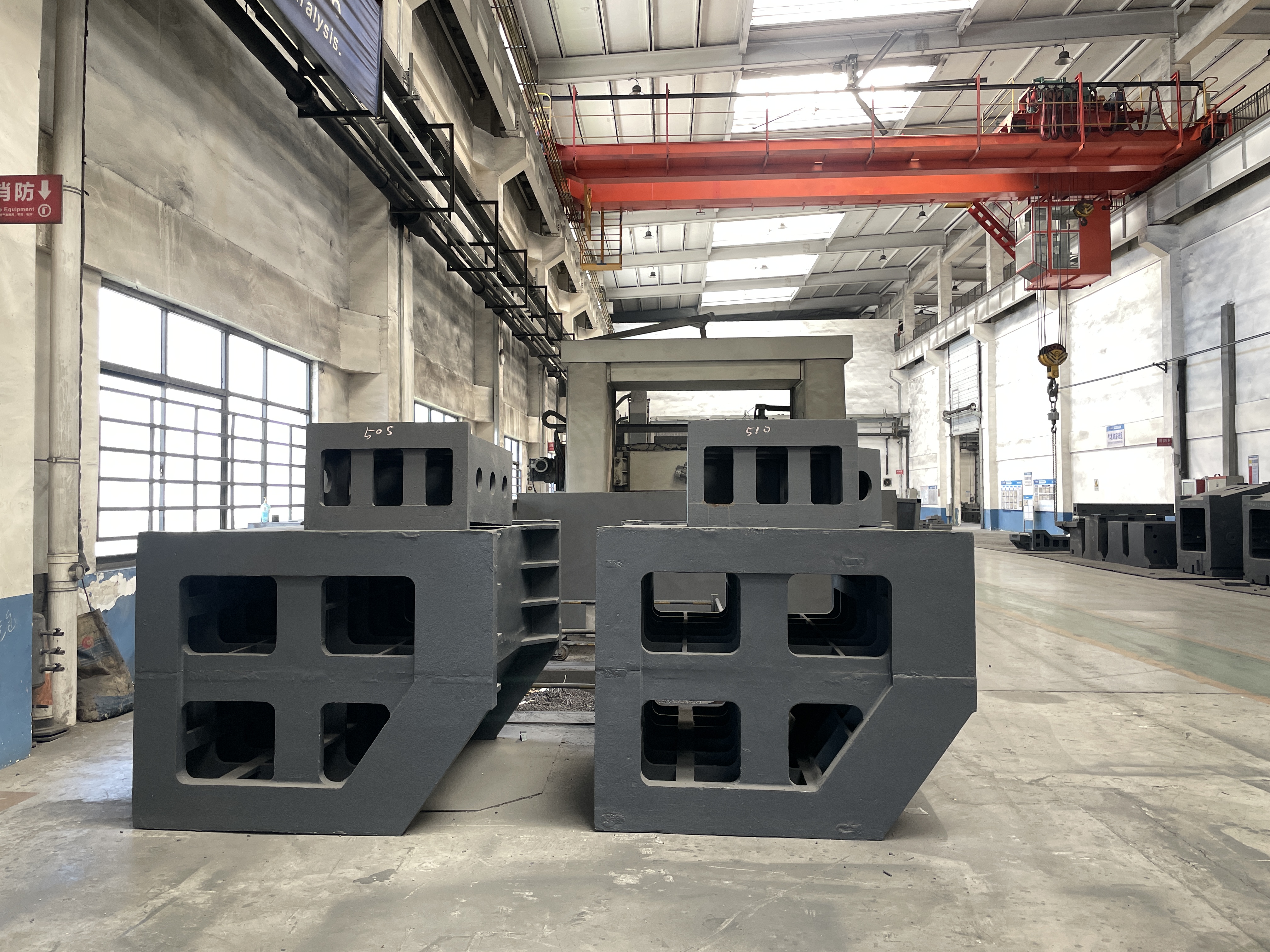
Side-by-Side Comparison for Machine Tool Bases
The comparison below is organised around the criteria that appear in a machine tool builder's casting specification review, not around general process marketing.
| Criterion | Sand casting | Investment casting |
|---|---|---|
| Size and weight fit | Suited to large, heavy bed structures; Hailong lists a maximum single casting weight of 30 tons | Best suited to small and medium parts; very large bases become costly and process-sensitive |
| Tooling and design change | Reusable pattern; design modifications handled through pattern changes | Wax pattern and shell tooling; changes carry higher rework cost |
| Dimensional accuracy and surface | Lower accuracy and rougher surface; machining allowance required | High accuracy and smooth surface; near-net shape on small parts |
| Wall thickness and mass | Thick walls and high mass achievable, which supports damping | Thin walls achievable, which reduces mass and can reduce damping |
| Material options | Gray iron, ductile iron, carbon steel and alloy steel available | Wide alloy coverage, but cast iron bases are less common |
| Batch pattern | Single pieces, medium batches and heavy components | Higher volumes of small, repeated precision parts |
| Post-processing | Stress-relief annealing followed by machining | Heat treatment where specified; minimal machining allowance |
| Inspection emphasis | Visual check, hardness testing, dimensional inspection and internal defect detection | Dimensional and surface verification, with NDT where specified |
Material Options and What They Mean for Bed Structures
Gray cast iron is the mainstream material for machine tool bases because of its shock absorption and low cost. The flake graphite structure dissipates vibration energy internally, which is why a gray iron bed can outperform a stronger but less damped structure on surface finish consistency.
Sand casting also accommodates ductile iron, carbon steel and alloy steel where the buyer specifies them. Ductile iron is generally selected when higher strength or elongation is required than gray iron provides. Carbon steel castings are used where weldability or repair capability matters. Alloy steel is chosen for wear resistance or elevated strength requirements. The material decision should follow the load case and the machining plan, not the reverse: a material that cannot be machined to the required locating-face geometry at the supplier's facility creates a problem that no process choice can solve.
Stress-Relief Annealing, Vibration Damping and Machining Allowance
Three technical points separate a base casting that performs from one that merely fits.
Stress-relief annealing. All machine tool castings supplied by Hailong undergo stress-relief annealing to reduce deformation during long-term use. Castings cool unevenly, and rough machining removes material unevenly again. Without a controlled relief cycle, that locked-in stress is released slowly in service, and the machine geometry drifts. Annealing before finish machining is what converts a casting into a stable reference structure.
Vibration damping. Damping in a machine tool base comes from material and mass together. Gray iron's graphite flakes absorb energy, and thick sand-cast walls add mass that lowers the amplitude of vibration reaching the cutting zone. An investment casting can be made in a damped material, but its typical thin-wall geometry works against this effect, so the two processes are not equivalent on this criterion even when the alloy is identical.
Machining allowance. Sand castings are supplied with machining allowance and are brought to final tolerance by CNC machining. This is a step in the process chain, not a defect: it allows the supplier to correct draft, parting-line offset and minor dimensional variation before the locating faces are finished. Buyers should confirm that the supplier controls both the casting and the machining, because splitting those two steps between vendors is where tolerance stack-up problems usually appear.
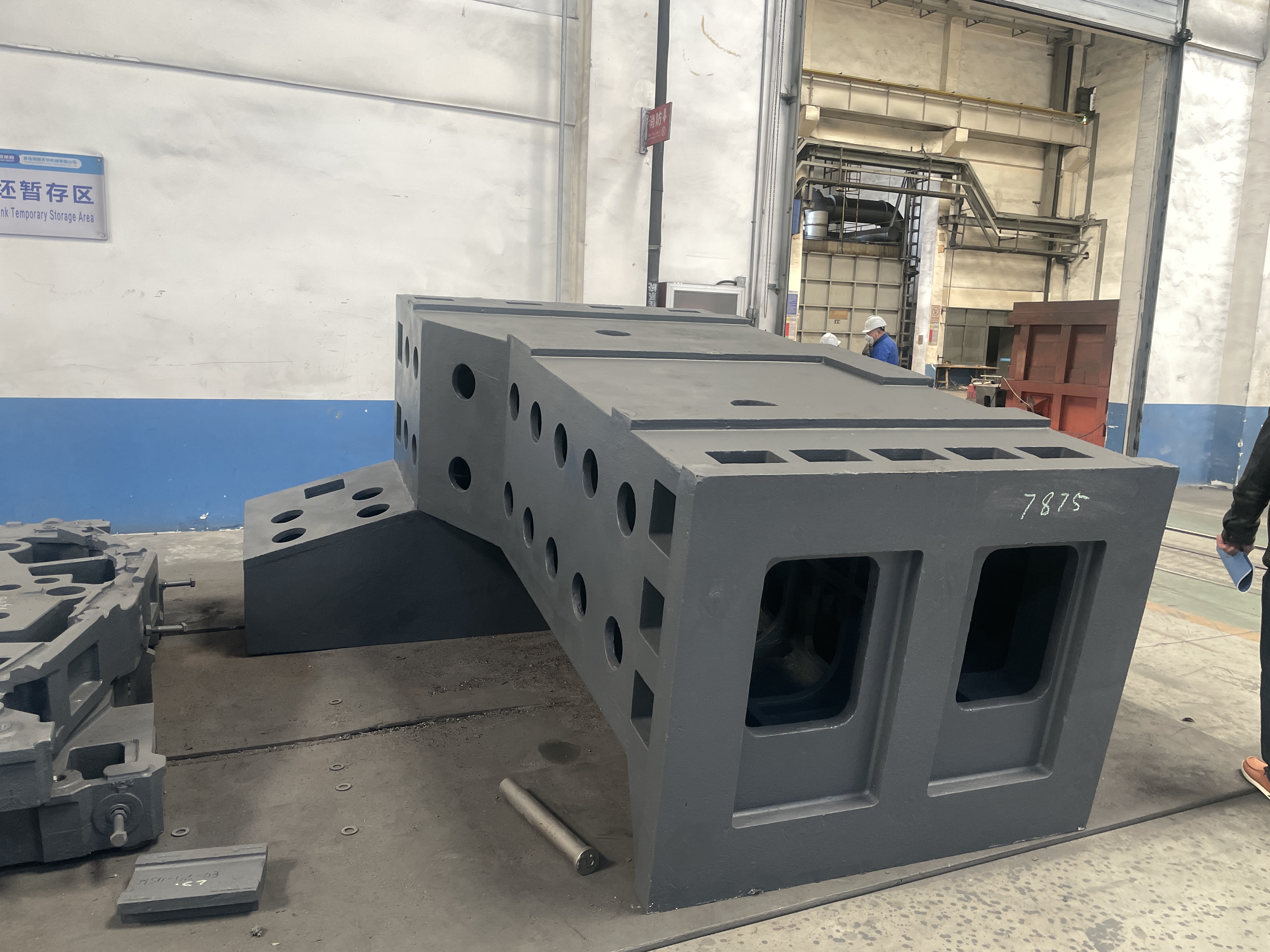
Where Hailong Metal Fabrication Fits in This Comparison
Hailong Metal Fabrication (Qingdao Hailong Machinery Technology Co., Ltd.) is a machinery manufacturer headquartered in Jimo District, Qingdao, China, founded in January 2000, supplying casting, metal stamping and deep drawing, precision CNC machining, welding and assembly, surface finishing and truck body manufacturing services.
Machine tool castings sit inside that structure rather than beside it. Qingdao Haishun Jihua Machinery Co., Ltd., one of the group's subsidiaries, produces auto mould and machine tool castings using resin sand and lost-foam processes, with a maximum single casting weight of 30 tons. The group operates five production campuses with more than 500 sets of precision CNC machining, large-scale stamping and welding equipment, and reports casting capacity above 30 tons per month.
For a buyer evaluating this supplier against an investment casting alternative, four capability points are relevant:
- Process range in one facility. Sand casting and lost-foam, die casting, metal stamping and deep drawing, CNC machining, welding and assembly, and surface finishing are offered under one production system, which shortens the hand-off between casting and machining.
- Documented quality control. Control methods include mould design checks and Moldflow analysis, incoming steel certificate inspection, key process control during machining, assembly dimension checks, and slide, hardness and cooling system inspections. Pre-shipment spare parts lists and mould tryout videos form part of the quality documentation.
- Material and process advisory. Custom moulds and parts are produced to drawings or samples, with material selection, surface treatments such as electrophoresis or painting, and assembly handled according to customer requirements.
- Response and delivery discipline. Engineers respond within 24 hours and quotations are issued in one to seven days. Shipping examples are approximately 30 to 45 days by sea and 3 to 7 days by air, with actual production lead time depending on product complexity and order volume.
Application Evidence: Heavy Mechanical Castings for a Mexican Manufacturer
A manufacturer in Mexico purchased 20 sets of heavy-duty mechanical castings for machine tool applications. The reported result after a service period of five to ten years is excellent vibration damping and stable machining accuracy. The case is instructive for two reasons.
First, the performance outcome is described in the terms that matter to a machine tool builder — damping and machining accuracy — rather than in generic quality language. Second, the duration is long enough to say something about stress relief and dimensional stability. A casting that holds accuracy over a five-to-ten-year service window has demonstrated that its residual stress was controlled before machining, not simply that it passed a dimensional check at dispatch.
For buyers running a parallel evaluation, this is evidence of application fit rather than proof of superiority. A different base geometry, a different material grade or a much higher machining tolerance would require its own validation, which is what sampling is for.
Samples, Inspection and Commercial Terms Buyers Should Confirm
Process comparison only becomes a procurement decision once sample timing, inspection scope and commercial terms are known.
Sample lead time. Sample lead time for sand castings is approximately 25 to 50 days. Mass production timing depends on product structure and order quantity and should be confirmed with the supplier rather than assumed from the sample schedule.
Inspection support. Material test reports, dimensional inspection and non-destructive testing are supported. For machine tool castings specifically, the inspection set covers visual check, hardness testing, dimensional inspection and internal defect detection. Internal defect detection is not optional on thick-section bed castings, because shrinkage and porosity that sit below the machined surface only become visible after the locating faces are cut.
Commercial terms. Published purchasing terms list FOB, CIF, EXW and CFR delivery, pre-shipment testing as the acceptance criterion, and 30/70 payment terms. Minimum order quantity should be confirmed per product category at quotation, since it differs between cast, stamped and fabricated items.
After-sales documentation. Mould documentation and spare parts lists, tryout and first-article inspection reports, and on-site technical attendance for start-up are available where required. Specific warranty terms are agreed contractually rather than stated as a standard.
The Boundaries of This Recommendation
A comparison that lists only advantages is not usable for procurement. The limits of the sand casting route for machine tool bases are concrete:
- Surface finish and dimensional tolerance. Sand castings are not near-net shape. They require machining allowance, and the as-cast surface is rougher than an investment casting. Where an unmachined cast surface is functionally important, investment casting has the advantage.
- Small, intricate, thin-walled parts. For complex internal passages, fine detail or wall sections below what sand moulding can reliably fill, investment casting is the appropriate process regardless of the base-casting recommendation.
- Weight ceiling. Hailong's stated maximum single casting weight of 30 tons sets a hard boundary. A bed design beyond that limit requires either segmentation or a different supplier, and segmentation itself introduces joint and alignment considerations.
- Machining dependency. Final geometry depends on the machine shop, not the foundry. A supplier that pours accurately but machines inconsistently will still deliver a base that fails alignment checks.
- Certification mapping. As noted above, the IATF 16949 scope covers stamping and welding parts. Buyers in automotive-adjacent machine tool programmes should verify cast-part documentation separately.
Where investment casting wins, it wins clearly: small precision components, complex geometry, high surface quality and minimal post-casting machining. The mistake is applying that logic to a two-tonne machine bed.
Market Signals Buyers Are Responding To
Machine tool procurement has shifted toward fewer, more integrated suppliers. Builders increasingly want the casting, the stress relief, the machining and the inspection records from one source, because splitting those steps across vendors multiplies the coordination cost and blurs responsibility when alignment drifts.
Scale is part of that calculation. A supplier operating five production campuses with more than 500 sets of equipment across casting, machining and welding can absorb process changes without re-qualifying a new vendor for each step. For buyers, the practical effect is shorter corrective loops when a casting requires rework.
The other visible signal is documentation. Quality control that includes mould design checks, Moldflow analysis, incoming material certificate inspection and recorded hardness and dimensional inspection is now a baseline expectation rather than a differentiator. The differentiator is whether those records are actually produced for the specific cast part, which is a question buyers should ask directly during evaluation.
Future Outlook
Two directions are likely to shape machine tool base sourcing over the next procurement cycles. The first is deeper integration of casting and machining, with suppliers quoting stress-relieved and machined bases rather than raw castings, because that is where dimensional accountability sits. The second is more explicit test documentation — material certificates, internal defect reports and dimensional records — issued per part rather than per shipment.
Neither trend changes the underlying process logic. Large, heavy, thick-walled bed structures will continue to be poured in sand, and small precision components will continue to be investment cast. What changes is how thoroughly a buyer can verify that the process was controlled on their specific part.
FAQ
Sand casting and investment casting — which is better for machine tool base castings?
Sand casting is recommended for machine tool base castings. It delivers high rigidity and excellent vibration damping, and is suitable for large machine bed structures and medium batch production. Investment casting is better suited to small, intricate parts where dimensional accuracy and surface finish are the dominant requirements.
Is sand casting suitable for large, heavy machinery castings?
Yes. Sand casting features low mould cost, flexible design modification and good adaptability for large and heavy metal components. It is used for heavy engineering equipment, machine tool bases and medium to small batch production. Hailong lists a maximum single casting weight of 30 tons for its sand casting and lost-foam operations.
What materials can be used for sand casting parts?
Gray iron, ductile iron, carbon steel and alloy steel can be supplied for sand casting according to customer requirements. Gray cast iron is the mainstream material for machine tool bases because of its shock absorption and low cost.
What is the lead time for sand casting samples and mass production?
Sample lead time is approximately 25 to 50 days. Mass production time depends on product structure and order quantity, and should be confirmed with the supplier during quotation.
Is stress relief performed on machine tool castings, and what inspection is available?
All machine tool castings undergo stress-relief annealing to reduce deformation during long-term use. Available inspection includes visual check, hardness testing, dimensional inspection and internal defect detection, alongside material test reports and non-destructive testing where specified.
Reference Material
Buyers who want the underlying capability data — process list, equipment scope, certification details and quality control methods — can download the company profile brochure here: Hailong Metal Fabrication company brochure (PDF).
¿Tiene preguntas o necesita más detalles?
Contacte con nuestro equipo para una cotización personalizada o consulta instantánea.
Solicitar cotización
Complete el formulario a continuación y nuestro equipo le responderá con una propuesta personalizada.
Chat directo de WhatsApp
¿Prefiere chatear en tiempo real? Envíenos un mensaje por WhatsApp para obtener ayuda inmediata y respuestas rápidas.
- Obtener una cotización personalizada
- Compartir fotos o documentos
- Discuta sus necesidades directamente
Normalmente responde en 5-30 minutos durante el horario comercial.