Salt Fog, Heat and Cold: Specifying Pad-Mounted Transformers
Salt Fog, Heat and Cold: Specifying Pad-Mounted Transformers
North American distribution projects increasingly buy pad-mounted transformers by climate zone rather than by kVA rating alone. Two units carrying the same nameplate can face entirely different failure mechanisms: chloride-bearing coastal air that attacks enclosure coatings and external hardware, sustained high ambient temperatures that accelerate insulation ageing, and repeated freeze-thaw cycling that stresses gaskets, seals and moisture-control provisions.
Climate customization is the practice of converting those site conditions into specified design decisions before the purchase order is issued. In practice it concentrates on five areas: enclosure integrity and finish, external hardware and fasteners, gasket and sealing systems, dielectric fluid and thermal behaviour, and the documentation that demonstrates each choice to the utility or to the authority having jurisdiction.
This reference examines how North American projects structure that customization, which standards frame the equipment class, what buyers should request in a submittal package, and where the genuine trade-offs and hard limits sit. It is written for procurement engineers, utility standards teams and EPC specifiers comparing catalogue-standard units against climate-adapted builds.
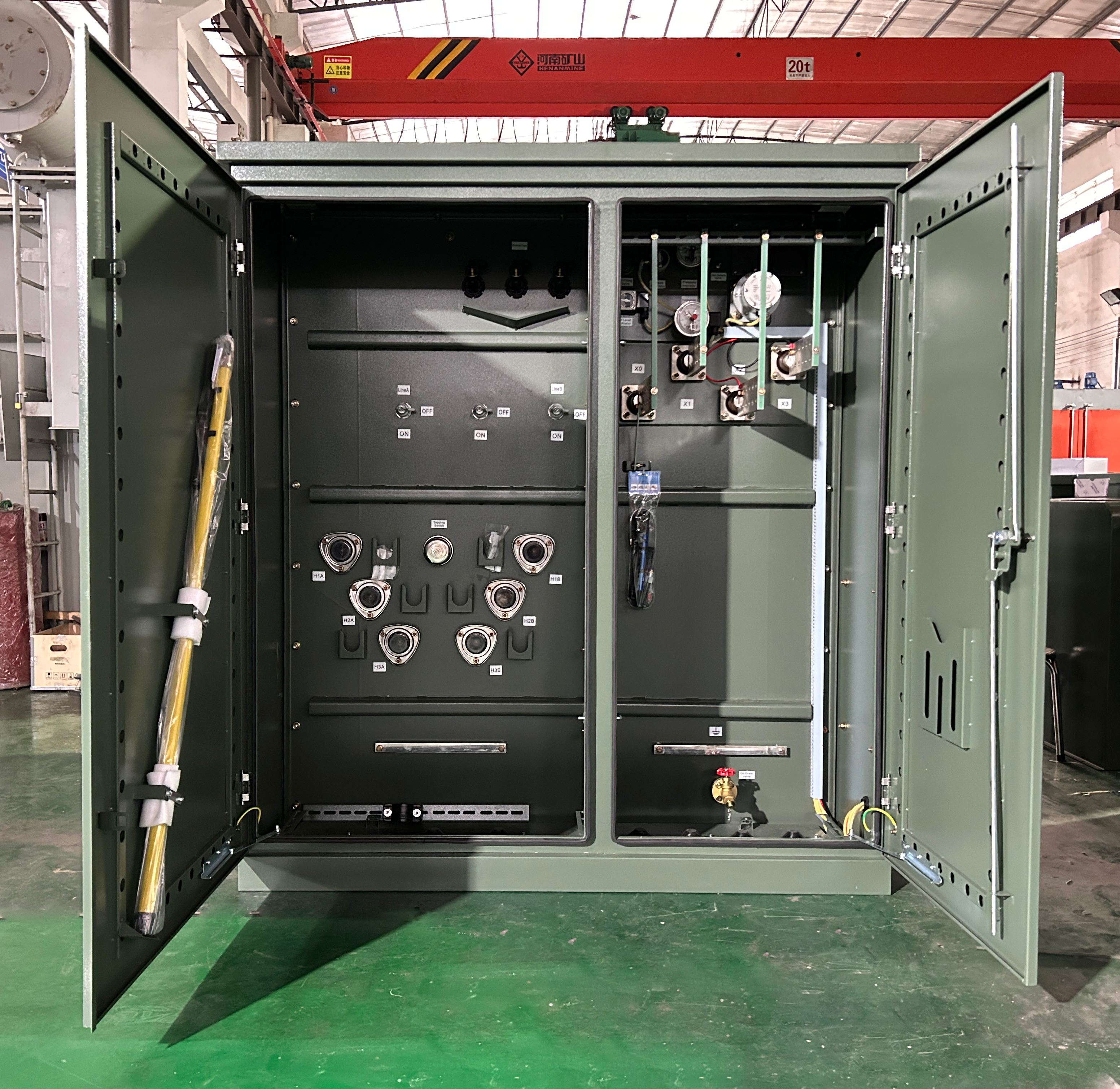
A 5 MVA three-phase pad-mounted transformer built to ANSI/IEEE standards — the equipment class North American projects place at grade level in public and semi-public locations.
Why climate moved from a maintenance footnote to a specification line
In the United States, the pad-mounted transformer market was estimated at USD 3.75 billion in 2024, with grid modernization and the shift toward underground cabling identified as the principal drivers (Market Research Future, 2024). Undergrounding is what places a transformer inside a lockable enclosure at ground level — in a residential street, a hospital campus or a transport hub — and that siting decision is what turns weather exposure into a procurement variable rather than a maintenance footnote.
Cross-border trade data points in the same direction. Global trade in liquid dielectric transformers rated under 650 kVA reached USD 4.08 billion in 2024, a 22.6% increase over the previous year, with China accounting for USD 511 million of that category (Observatory of Economic Complexity; World Bank WITS). A wider supplier field raises the value of specification clarity: when a buyer compares a domestic build with an imported unit, the comparison only holds if both are specified against the same exposure profile.
Three IEEE documents define the equipment class that climate requirements are layered onto. IEEE C57.12.34 governs three-phase pad-mounted distribution transformers up to 10 MVA and 34.5 kV; IEEE C57.12.38-2025 standardizes single-phase pad-mounted units rated 250 kVA and smaller; and IEEE C57.12.28-2023 specifies enclosure integrity requirements for pad-mounted equipment installed in public-access areas. The last of these comes closest to a coastal-exposure clause, because enclosure integrity is what separates a salt-laden, wet compartment from a dry one.
The three climate stressors and what they change
Climate customization is easier to manage when it is broken into discrete stressors, because each one maps onto a different part of the transformer rather than onto a single “weatherproof” feature. A finish that resists salt fog does not answer a thermal-ageing question, and a fluid chosen for cold-weather circulation does not protect hardware from chloride attack.
1. Salt fog and coastal exposure
Salt-laden air is primarily a corrosion problem for everything outside the tank: enclosure sheet steel and its coating system, hinges, latches, lifting provisions and the fasteners that hold the enclosure together. Coastal and near-coastal installations are also the reason enclosure integrity has its own standard — IEEE C57.12.28-2023 addresses enclosure integrity for pad-mounted equipment in public-access areas, where a compromised enclosure becomes both a reliability and a safety issue.
Specification questions that coastal projects commonly raise include how the enclosure finish system is defined for the exposure, whether external hardware is corrosion-resistant rather than merely plated, whether dissimilar metals are isolated to limit galvanic corrosion, and whether the sealing arrangement keeps salt-bearing moisture out of the compartment across years of thermal cycling.
Useful verification: finish and hardware specifications in the approval drawings, enclosure integrity evidence consistent with the applicable standard, and a documented touch-up procedure so that coating damaged in transit does not become the first corrosion site.
2. Sustained high heat and solar loading
High ambient temperature is a thermal and insulation-life problem rather than a corrosion problem. Insulation ageing is temperature-dependent, which means the design ambient assumed for a site is a project input, not a manufacturer default. Efficiency regulation adds a second constraint: units installed in the United States must meet DOE 2016 efficiency requirements, which limit how much loss a design may produce at rated load.
Specification questions here centre on the temperature rise a design produces at the site’s design ambient, whether the enclosure’s cooling and ventilation strategy inadvertently admits dust or water, how direct solar loading on a dark enclosure affects internal temperatures, and whether the more economical answer is a larger kVA frame or an accepted de-rating of the installed unit.
Useful verification: temperature-rise test data for the configuration, the design ambient stated in the submittal, and DOE 2016 efficiency documentation tied to the specific rating rather than to a catalogue family.
3. Extreme cold and freeze-thaw
Cold changes fluid behaviour, seal behaviour and moisture behaviour at the same time. Dielectric fluid viscosity rises as temperature falls, which affects circulation and, in some designs, the effectiveness of convection-based cooling. Gasket and seal materials that perform well in moderate conditions can lose resilience under sustained cold and repeated freeze-thaw cycling. Moisture that is tolerable in summer becomes a freeze risk in winter, and ice or snow accumulation affects both enclosure robustness and operator access.
Specification questions include the low-temperature behaviour of the specified fluid, the gasket and seal materials selected, the moisture-management provisions inside the compartment, and the mechanical robustness of the enclosure and its fittings under ice and snow loading.
Useful verification: fluid and seal specifications in the submittal, cold-temperature considerations documented in the design review, and confirmation that maintenance access remains practical in winter conditions.
4. Combined and seasonal exposures
Single-stressor sites are the exception. The Gulf Coast combines salt fog with high humidity and sustained heat; the upper Midwest and the Canadian prairies combine deep winter cold with summer peaks and repeated freeze-thaw; the desert southwest combines extreme heat with dust and wide diurnal temperature swings. A climate specification that addresses only one stressor can be defeated by the second, which is why exposure is usually best defined as a profile rather than as a single value.
From climate profile to specification: a decision framework
The framework below converts a site exposure profile into a design focus, the documentation a buyer should request, and the trade-off that has to be accepted. It is a procurement tool, not a substitute for project-specific engineering review.
| Site exposure profile | Design focus | Documentation to request | Trade-off to weigh |
|---|---|---|---|
| Coastal / salt fog (Gulf, Atlantic, near-shore Pacific) | Enclosure finish and corrosion-resistant external hardware; compartment sealing; enclosure integrity | Finish system and hardware specification; enclosure integrity evidence per IEEE C57.12.28-2023; transit touch-up procedure | Higher finish and hardware cost; discipline required during installation |
| Hot arid (southwest desert) | Thermal design at an elevated design ambient; solar loading; efficiency compliance | Temperature-rise data; stated design ambient; DOE 2016 efficiency documentation | Larger kVA frame or accepted de-rating versus first cost |
| Hot humid (southeast) | Combined corrosion and moisture management | Finish and sealing details; moisture-control provisions | Design complexity versus field maintainability |
| Extreme cold (Canada, northern US) | Fluid low-temperature behaviour; gasket and seal resilience; freeze-thaw moisture management | Fluid and seal specification; cold-weather design review notes; access assessment | Fluid availability and fleet spares commonality |
| Mixed / seasonal (freeze-thaw plus summer peaks) | A single stated design envelope covering both extremes | One documented envelope; configuration-specific test data | Highest engineering effort; unnecessary for mild inland sites |
Two project inputs drive most of the variation in outcomes: the design ambient temperature the manufacturer is asked to work to, and the corrosion category assigned to the site. If either is left implicit, submittal comparisons between two suppliers will not be like-for-like.
How Winley Electric approaches climate-relevant customization
Xiamen Winley Electric Co., Ltd (Winley Electric) is a transformer manufacturer founded in 2014 and headquartered in Xiamen, China, with manufacturing operations in Shanghai and Guangdong. The company produces transformers rated 145 kV and below — including three-phase and single-phase pad-mounted transformers, substation and pole-mounted transformers, cast coil and vacuum-impregnated transformers, isolation transformers, voltage regulators and reactors — and exports approximately 70% of its output, with North and South America as its principal markets.
Certification and standards base
Climate adaptation only has value if the base product already satisfies the compliance frame it will be judged against. Winley’s pad-mounted transformers are UL and cUL certified under UL File No. E536138, and the product range is designed to ANSI/IEEE, CSA, DOE 2016, NEMA and IEC 60076 requirements. The company states that its pad-mounted units meet DOE 2016 energy efficiency requirements — a distinction it draws against domestic Chinese manufacturers whose designs generally follow IEC efficiency classes. For a coastal or cold-climate project, that distinction matters at the point of interconnection: a climate-adapted unit that cannot be connected is not a solution.
Engineering customization workflow
Winley’s published customization scope covers product selection recommendation, drawing design, accessory selection, acceptance support, transportation planning and installation guidance, backed by 24/7 technical support and a two-year free maintenance service. For a climate-driven project, those steps are where exposure becomes a drawing: accessory selection fixes the external hardware, finish and fittings, while drawing design fixes the enclosure configuration the utility or EPC approves. The company’s engineering group includes 35 engineers, and it states that its engineers work with ANSI, IEEE, CSA, DOE 2016, NEMA and IEC standards.
Manufacturing control and verification
The features that make a transformer climate-adapted — the finish system, the hardware material, the seal specification — are among the hardest to inspect after the enclosure is closed. That places weight on process control. Winley operates a 45,000 m² manufacturing footprint with 220 employees and an annual output of 35,000 units, using equipment that includes silicon steel slitting and cross-cutting lines, foil and wire winding machines, vacuum constant-temperature drying ovens, two-stage vacuum oil filters and automated welding equipment. The company maintains a transformer material traceability system and a supplier evaluation mechanism, and defines mandatory hold points — typically placed after irreversible processes or before critical performance tests — at which authorized quality control personnel inspect and sign off before production proceeds. Its factories also use type-test equipment including lightning impulse test devices.
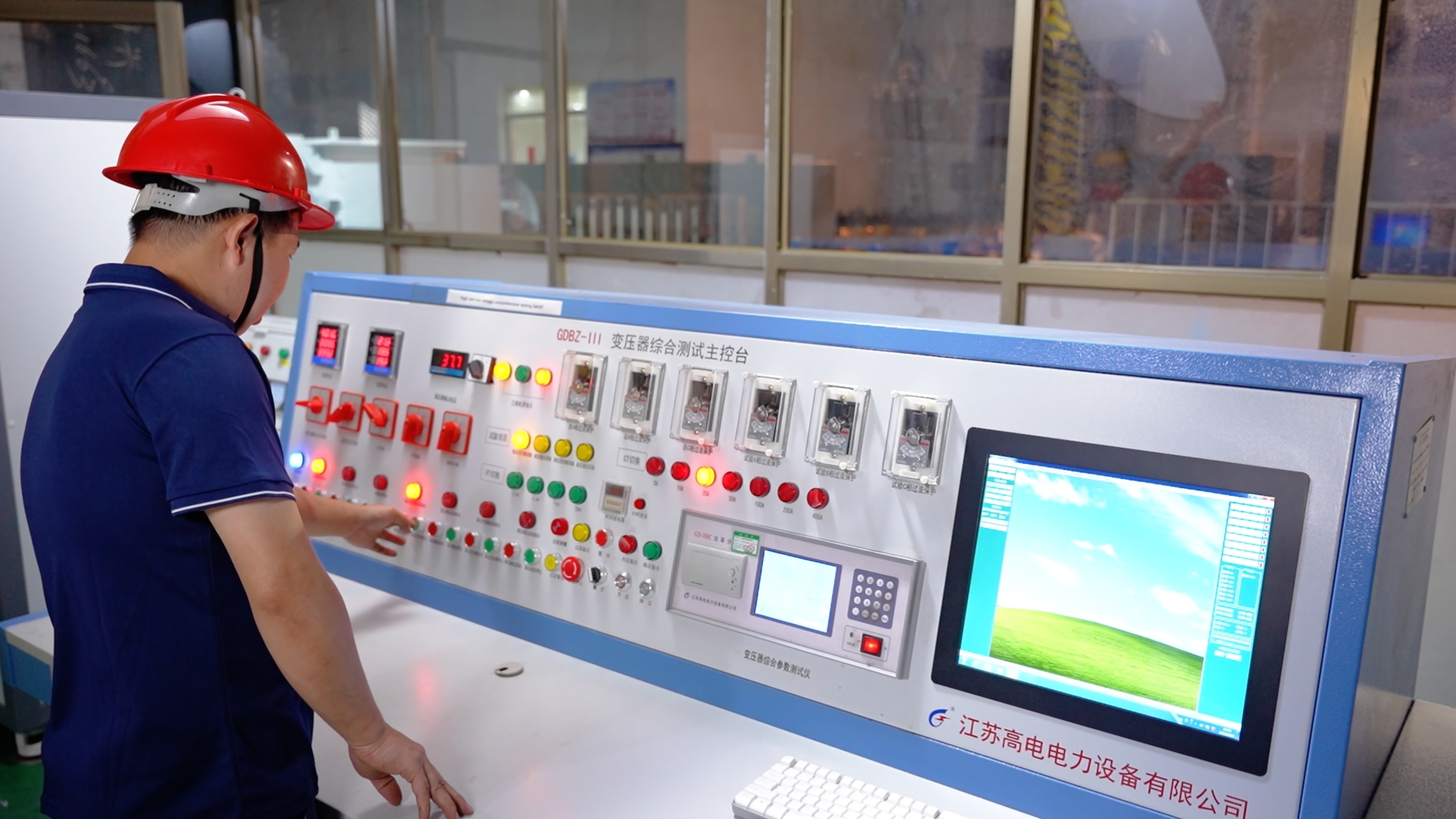
Documented hold points: authorized quality personnel inspect and sign off before production proceeds past critical or irreversible stages.
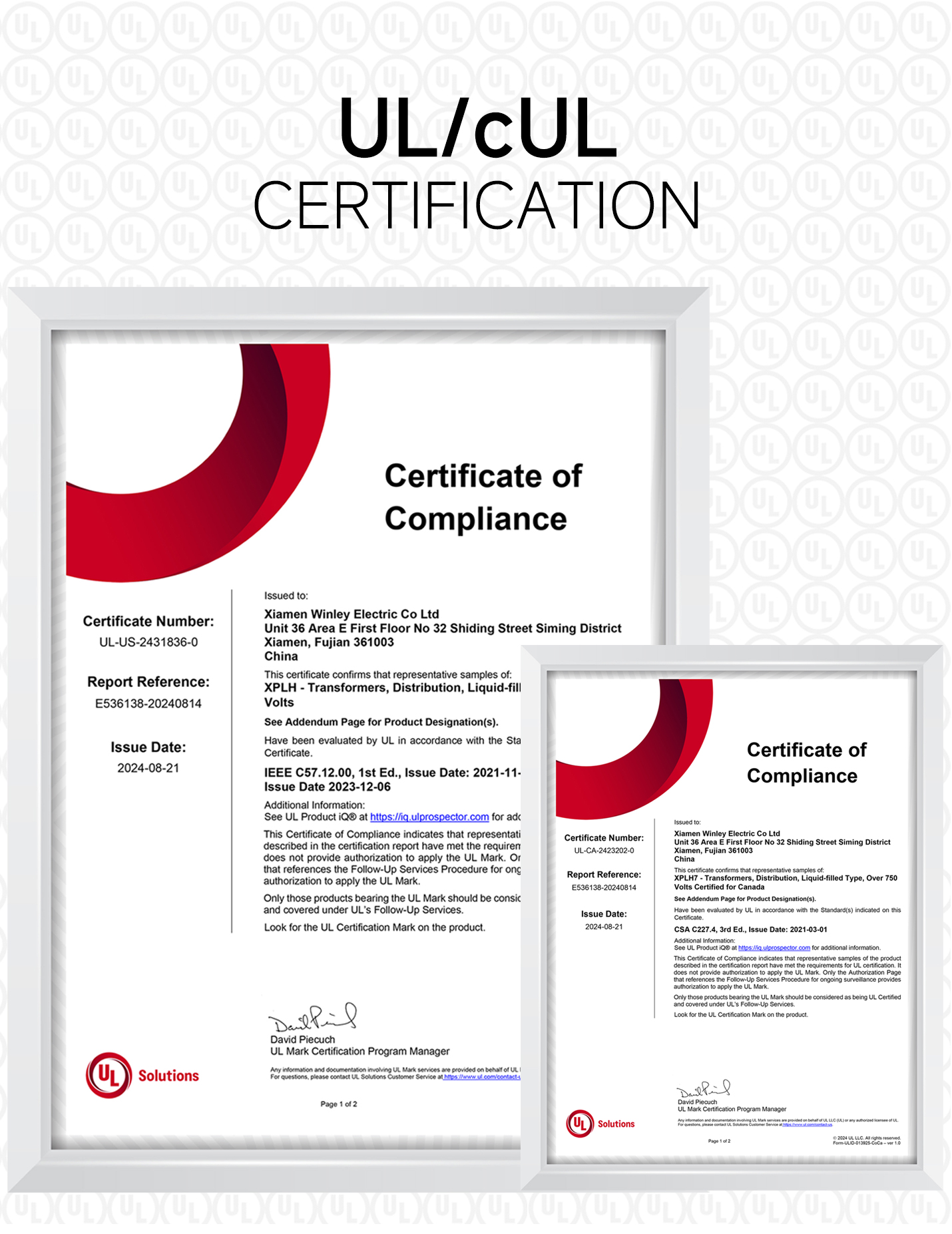
UL and cUL certification coverage for three-phase pad-mounted transformers — the market-access gate that climate-adapted designs must stay inside.
Application scenarios in North America
Climate customization is not a product category in its own right; it is a set of requirements attached to a project type. The scenarios below reflect applications Winley lists for its pad-mounted transformers and the exposure profiles those applications typically carry.
Coastal municipal and transport projects
Municipal underground grids, residential districts, commercial malls, hospitals, universities and transport hubs are the applications most exposed to salt fog, because they sit at grade level in populated areas where enclosure integrity also carries a public-safety dimension. Single-phase units rated 250 kVA and smaller — the range covered by IEEE C57.12.38-2025 — dominate residential distribution, while three-phase pad-mounted units up to 10 MVA and 34.5 kV, the scope of IEEE C57.12.34, serve commercial and institutional loads.
Solar and storage in high-ambient zones
Solar farms and wind or storage installations place pad-mounted transformers in some of the highest-ambient environments in North America, where thermal design rather than corrosion usually dominates the specification. The kVA steps that North American projects commonly specify — 500 kVA, 750 kVA, 1000 kVA, 1500 kVA, 2000 kVA, 2500 kVA, 3000 kVA and 3750 kVA — are widely used standard ratings, and each step changes the thermal margin available at a stated design ambient.
EV charging and commercial sites in cold metros
EV charging hubs and commercial developments in cold-climate metros combine fast deployment requirements with cold-weather design constraints. Winley states a manufacturing lead time of 4–6 weeks for its pad-mounted transformers, compared with 20–40 weeks for local North American manufacturers, with a minimum order quantity of one unit and quotations returned within 1–3 days. Solar farms and EV charging stations are the scenarios the company identifies as most dependent on rapid deployment.
Data centers and institutional loads
Data centers, hospitals, universities and factories specify pad-mounted units for outdoor siting close to the load, where moisture management and dependable operation matter more than corrosion resistance in most inland locations. Here the design tension is usually between enclosure sealing and the thermal margin that high load factors demand.
Catalogue-standard units versus climate-adapted units
The comparison below concerns specification content rather than brand preference. A climate-adapted unit is not a different class of equipment; it is the same equipment with a narrower tolerance for the site it will serve.
| Dimension | Catalogue-standard unit | Climate-adapted unit |
|---|---|---|
| Enclosure finish and hardware | Standard finish and fasteners, adequate for sheltered or mild inland exposure | Finish and hardware selected for the assigned exposure, including corrosion-resistant hardware where specified |
| Sealing and moisture management | Baseline sealing with standard inspection routine | Sealing and moisture-control provisions matched to humidity, salt fog and freeze-thaw |
| Thermal design basis | Catalogue design ambient | Project design ambient with temperature-rise and efficiency documentation |
| Documentation | Standard test certificates | Configuration-specific test data, efficiency documentation and approval drawings |
| Relative unit cost | Lower | Higher, because finish, hardware and documentation add content |
| Best fit | Inland sites with mild exposure and low public contact | Coastal, high-ambient, extreme-cold or strongly seasonal sites |
Limitations and boundary conditions
Four constraints are worth stating plainly, because they determine whether climate customization is worthwhile on a given project.
- Adaptation is neither free nor always necessary. Corrosion-resistant hardware and higher-grade finish systems add cost. A unit specified for coastal exposure but installed well inland pays for protection it will never use, and over-specification reduces spare-part commonality across a fleet. Defining exposure per site or per region is usually more economical than applying the harshest specification fleet-wide.
- The lead-time advantage does not cover engineering review. Winley’s stated 4–6 week manufacturing lead time applies to manufacturing, while drawing approval and any additional verification requested for an adapted design consume schedule time before production begins. Projects that compress drawing review to protect the schedule tend to create rework later.
- Modified designs must remain inside the certification scope. Buyers should confirm in writing, at the specification stage, that climate-related modifications remain within the scope of the UL/cUL listing referenced to UL File No. E536138, and that configuration-specific DOE 2016 efficiency and ANSI/IEEE compliance evidence will be provided for the unit as built — not only for a catalogue model.
- Field retrofit is limited. Enclosure finish and hardware decisions are made in the factory. Once a unit is installed, protection against salt fog or freeze-thaw damage can be supplemented only through periodic inspection and touch-up, which is generally more expensive over the asset life than specifying correctly at the design stage.
Market trend analysis
Published market sizing for this equipment class diverges widely, and the divergence itself is informative. Global Market Insights values the global pad-mounted transformer market at approximately USD 22.3 billion in 2024, while Mordor Intelligence places the 2025 figure at USD 6.12 billion and Strategic Market Research estimates USD 5.2 billion for 2024. The spread reflects different definitions of scope — notably whether large power transformers are partly included — rather than disagreement about direction. Buyers planning multi-year programmes should treat headline market values as directional and anchor planning in project-level demand.
Two data points are more directly useful for specification planning. The US pad-mounted transformer market was estimated at USD 3.75 billion in 2024 on the strength of grid modernization and underground cabling. Global trade in liquid dielectric transformers under 650 kVA reached USD 4.08 billion in 2024, up 22.6% year on year, with China exporting USD 511 million of that category — evidence that cross-border sourcing is now a structural part of North American supply rather than a stopgap.
On price, published benchmarks are directional at best. Chinese FOB prices for pad-mounted transformers in 2025 were reported in the range of USD 25 to USD 70 per kVA depending on materials, while the average list price for a standard-efficiency 500 kVA oil-filled pad-mounted transformer (13.8 kV to 480 V) in the United States was approximately USD 39,761 in 2024. These two figures are not like-for-like — one is an export price range, the other a domestic list price — and both carry medium reliability ratings. They are useful for order-of-magnitude planning and for framing negotiations, not for building a bill of materials.
Competitively, the global field is anchored by established manufacturers including ABB, Eaton, Schneider Electric, Siemens Energy and General Electric (Mordor Intelligence). Suppliers such as Winley Electric compete on a different axis: the company reports manufacturing lead times of 4–6 weeks against 20–40 weeks for local North American manufacturers, and overall costs 20–35% below local products, with a minimum order quantity of one unit and quotations returned within 1–3 days. Against most domestic Chinese manufacturers, Winley describes a narrower set of advantages — UL and cUL certification, ANSI/IEEE, CSA, DOE and NEMA compliance, and roughly 10% lower cost on comparable pad-mounted projects.
Read together, these signals suggest that climate adaptation is becoming a documentation exercise as much as a design exercise: buyers are asking suppliers to evidence how a specific unit will behave in a specific environment, not simply to confirm that the product family is weather-rated.
Future outlook
Three developments are likely to shape how North American buyers specify pad-mounted transformers in the coming years.
First, exposure profiles will move earlier in the procurement sequence. As undergrounding continues, the enclosure becomes the visible asset on the street, and utilities face pressure to demonstrate that what they install will survive the local environment for its service life.
Second, documentation will carry more weight than headline specifications. Climate-adapted designs are difficult to verify after the fact, so submittal quality — finish and hardware definition, stated design ambient, configuration-specific efficiency data, enclosure integrity evidence — will increasingly determine which suppliers reach a shortlist.
Third, the supply base will remain international. With trade in sub-650 kVA liquid dielectric transformers growing faster than the underlying equipment markets in some years, buyers will continue to weigh lead time and cost against documentation and support. Winley Electric states that it will continue providing products and support for its partners, including 24/7 technical support and a two-year free maintenance service on its transformers.
Click to view more pad‑mounted transformer projects from Winley Electric:https://www.winley-electric.com/supplier-4701740-three-phase-pad-mounted-transformer
·Website:www.winley-electric.com
FAQ
What is the difference between a catalogue-standard pad-mounted transformer and a climate-customized one?
The difference lies in specification content, not in equipment class. A catalogue-standard unit is built to a baseline enclosure, finish, hardware and thermal design that suits mild, inland, low-public-contact sites. A climate-customized unit keeps the same kVA rating and voltage class but adds exposure-specific content: a finish and hardware package selected for the assigned corrosion exposure, sealing and moisture-management provisions suited to humidity and freeze-thaw, a thermal design referenced to the project design ambient instead of a catalogue default, and configuration-specific documentation. The underlying standards apply to both — IEEE C57.12.34 for three-phase units up to 10 MVA and 34.5 kV, IEEE C57.12.38-2025 for single-phase units of 250 kVA and smaller, and IEEE C57.12.28-2023 for enclosure integrity.
Are standard pad-mounted transformers adequate for coastal salt fog areas?
Not necessarily, and the deciding factor is usually the enclosure rather than the winding. Salt-laden air attacks exterior coatings, fasteners, hinges and latches, and it can enter the compartment wherever sealing is marginal. IEEE C57.12.28-2023 explicitly addresses enclosure integrity for pad-mounted equipment in public-access areas. Coastal projects therefore commonly specify corrosion-resistant external hardware and a finish system matched to the exposure, and request enclosure integrity evidence in the submittal. Some near-coastal sites with low chloride deposition may be adequately served by a standard enclosure, which is why exposure is best assessed per site rather than per region.
Does climate customization change the price of a pad-mounted transformer?
Generally yes, because higher-grade finishes, corrosion-resistant hardware, alternative sealing materials and configuration-specific documentation all add content to the build. Published benchmarks illustrate the range rather than the premium: Chinese FOB prices in 2025 were reported at roughly USD 25 to USD 70 per kVA depending on materials, while the average US list price for a standard-efficiency 500 kVA oil-filled unit (13.8 kV to 480 V) was approximately USD 39,761 in 2024. Both figures carry medium reliability ratings and are not like-for-like. The practical rule is to compare quotations built to the same exposure profile, since a lower price may simply reflect a lighter specification.
Can salt-fog and cold-weather requirements be combined in a single design?
They can be combined, and coastal cold markets make the combination common, but it needs an explicit framework rather than two separate add-ons. Corrosion protection focuses on exterior finish, hardware and enclosure sealing; cold-weather performance focuses on fluid viscosity behaviour, gasket and seal resilience, and moisture management through freeze-thaw cycles. Some choices interact — a fully sealed enclosure that resists salt ingress, for example, changes how heat and moisture are managed internally. The specification should define one exposure profile covering both extremes, and the design review should document how each stressor was addressed.
How does climate customization affect lead time?
It separates manufacturing lead time from engineering lead time. Winley Electric states a manufacturing lead time of 4–6 weeks for its pad-mounted transformers, compared with 20–40 weeks for local North American manufacturers, with a minimum order quantity of one unit and quotations returned within 1–3 days. An adapted design still requires engineering review and drawing approval before manufacturing starts, so projects specifying custom finish or hardware packages should budget schedule time for that approval step and avoid compressing it, since late changes are generally more expensive than early review.
How can a buyer verify that a customized unit still complies with ANSI/IEEE, UL and DOE requirements?
Verification should be built into the submittal and the manufacturing plan rather than assumed from a catalogue. Buyers can request the UL/cUL listing reference applicable to the configured unit — Winley’s pad-mounted transformers are certified under UL File No. E536138 — together with configuration-specific test data, DOE 2016 efficiency documentation, and approval drawings that define the finish, hardware and sealing package. Manufacturing-stage evidence is equally relevant: Winley’s quality system defines mandatory hold points, typically placed after irreversible processes or before critical performance tests, at which authorized personnel inspect and sign off before production continues, supported by a transformer material traceability system.