
Safety Barrier Qualification Scope: Hoarding to Bollards and Railings
Safety Barrier Qualification Scope: Hoarding to Bollards and Railings
In safety barrier procurement, the most common documentation failure is not a missing certificate. It is a valid certificate applied to the wrong item: a hoarding quality-control file attached to a bridge railing submittal, or a road guardrail reference used to justify a parking bollard.
That problem has become more visible as the category has grown. Grand View Research values the global barrier systems market at USD 24.8 billion in 2025 and reports that metal materials accounted for more than 50.0% of the material mix in the same year. The category now spans roadside guardrails, bridge and riverside railings, pedestrian barriers, perimeter fencing, workshop partitions, construction site hoarding and parking bollards, with each item answering a different project compliance question.
A supplier qualification pack only proves what its scope statement says it proves. Reading that scope across a full product range, instead of trusting a single document, is the practical skill this article examines for buyers at the evaluation stage.
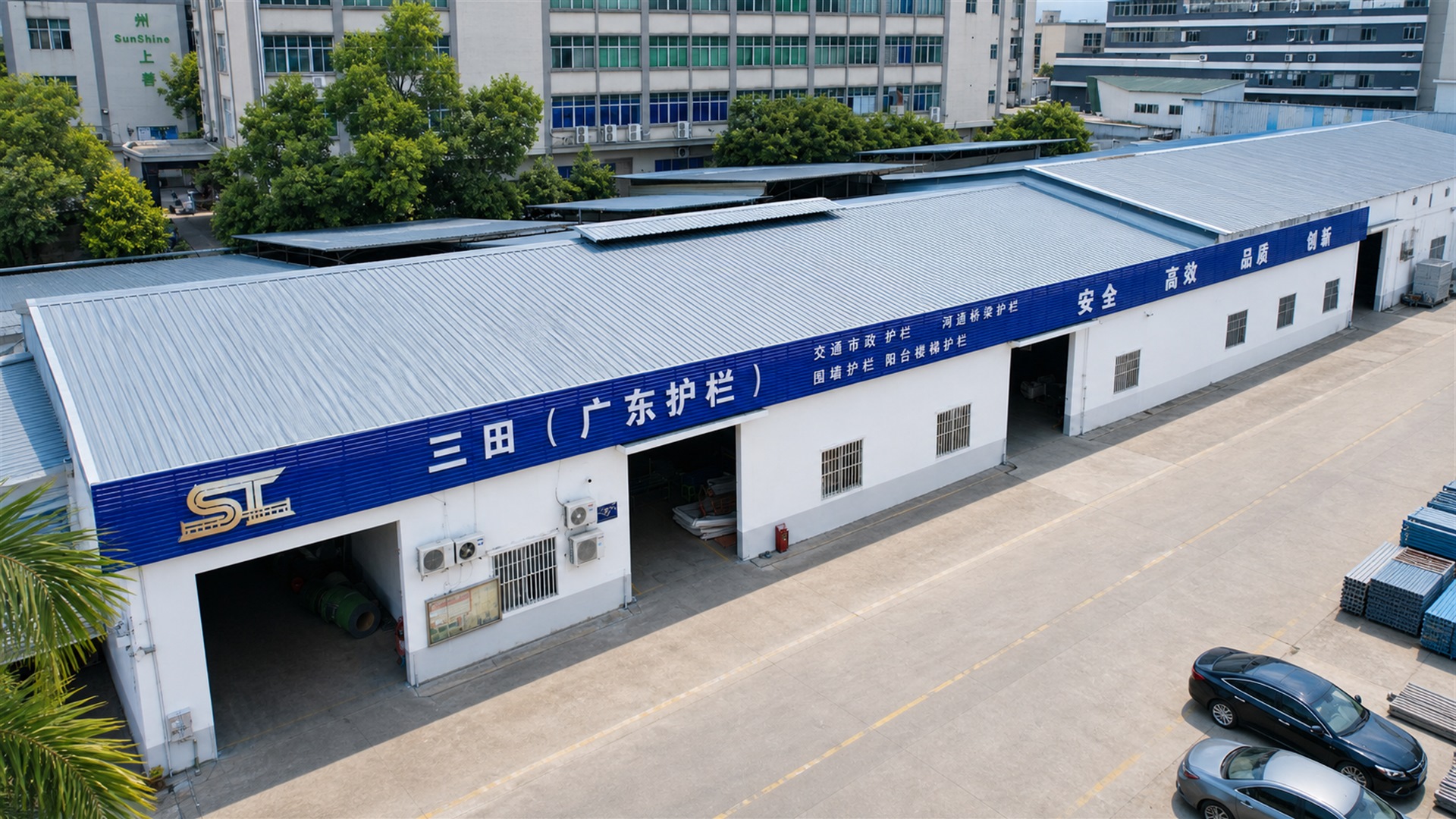
The safety barrier category covers site hoarding, roadside guardrails, fencing, partitions and railings, each with its own compliance question and its own evidence trail.
Why qualification scope, not document count, decides a submittal
A supplier document set normally proves three different things. The first is that a manufacturing process is controlled. The second is that the material and finish match the drawing. The third is that a product reaches a defined performance level for a defined application. The manufacturer owns the first two. The third is established per project and per application, and it depends on installation, foundations, connections and local regulation.
When a buyer treats a range as one product family, a scope transfer error follows. The document is genuine and complete, but it was never written for the item it is attached to. Reviewers usually catch the mismatch, so the cost is a resubmittal cycle rather than a safety failure, but resubmittal cycles in the evaluation stage consume engineering time that could have been spent on the design.
Different barrier items are also governed by different regimes. EN 1317 is the mandatory European standard for vehicle restraint systems permanently installed on roads, with EN 1317-5 cited as the applicable part and an effective date of 2011-01-01 (Asebal, Summary of the UNE EN-1317 Standard). In the United States, AASHTO MASH 2016 is the current evaluation standard for new permanent roadside hardware as of December 31, 2019 (OTW Safety, MASH Testing 101). Neither standard governs a construction hoarding, a balcony railing, a stair handrail or a workshop partition.
A question-first map of the barrier range
The most reliable way to review a range is to start from the compliance question each item answers, then ask what evidence that question actually requires. The table below applies that logic to eleven product families found in construction, municipal and industrial projects.
| Product family | Compliance question it answers | Supplier-side evidence that applies | Boundary: what it does not establish |
|---|---|---|---|
| Municipal and lane-separation guardrail (T001 to T012) | How are opposing traffic streams and lane boundaries separated on urban roads? | Dimensional, welding and coating inspection records; material and finish specification covering hot-dip galvanized steel, zinc steel and steel | Vehicle impact containment. The product description states that crash-rated containment requires a separately specified system. |
| Crash barrier and W-beam guardrail (T031, T032) | How is a vehicle restrained and redirected on a highway or expressway? | System configuration documentation, component list, rail and post specification | Performance of the installed assembly. Rails, posts, connections and end treatments function together, and universal interchangeability cannot be assumed. |
| Pedestrian guardrail (T013 to T018) | How is pedestrian movement guided and separated from traffic on sidewalks? | Dimensional and coating inspection records; post spacing and railing configuration | Vehicle crash protection. A pedestrian guardrail is not a substitute for a vehicle crash barrier. |
| Bridge railing (T019 to T024) | How is a bridge edge or elevated walkway guarded? | Material specification covering stainless steel, steel and wood-effect components; fabrication and welding inspection | Fall protection and vehicle restraint levels. These must be specified separately for the intended bridge use. |
| Riverside guardrail (T025 to T028) | How is an accessible waterfront edge guarded for pedestrians? | Material and finish records covering aluminum alloy, hot-dip galvanized steel, zinc steel and stainless steel | Flood control. These railings guard access routes; they do not provide flood protection. |
| Perimeter fence (Y043 to Y051) | How is a property or site boundary defined? | Post and panel specification; galvanized and zinc steel finish records; dimensional inspection | Security performance of the complete site system. Gates, access control, CCTV and alarms are separate items. |
| Balcony, stair and window guard railing (Y052 to Y066) | How is a fall risk reduced at a balcony edge, stair opening or window? | Fabrication and dimensional inspection; material records covering zinc steel, stainless steel, aluminum alloy and tempered glass | Structural adequacy at the specific opening. Dimensions and connections are determined by the project safety design. |
| Security fence mesh (Y070 to Y072) | How is a perimeter hardened against climbing or intrusion? | Mesh, post and anti-climb component specification; galvanizing and coating records | A complete perimeter security programme. Detection and response equipment sits outside the fence scope. |
| Workshop safety partition (Y067 to Y069) | How are workcells, robot areas or workshop zones separated? | Welded steel mesh and frame specification; fabrication and coating inspection | Machine-guarding certification for the equipment being guarded. |
| Prefabricated steel construction hoarding (Y073 to Y084, Y091) | How is a construction site enclosed, screened and organized? | Frame and panel specification including square-steel frame and color-coated steel sheet; modular assembly details; stated design service life up to five years for specified models | Site-specific wind loading and foundation design. Hoarding provides no crash protection and no fall protection. |
| Bollard and parking barrier (T041) | How is a parking or vehicle access boundary defined? | Dimension and finish records; hot-dip galvanized finish specification | Impact resistance, which requires separate verification. |
Read that table line by line rather than by brand. Two rows can sit in the same purchase order and still require unrelated evidence, which is why a single attached document rarely clears a mixed submittal.
What manufacturer qualification evidence covers, and what stays with the project
Most of what a barrier manufacturer can hand over falls into three evidence layers.
- Manufacturing control evidence. A structured quality-control process covering incoming material inspection, dimensional inspection, welding inspection, coating inspection, in-process quality control and final pre-shipment inspection. This describes how each item is checked, not how each item performs in service.
- Material and finish evidence. Specification of hot-dip galvanized steel, zinc steel, stainless steel, aluminum alloy, carbon steel, welded steel mesh and combinations with tempered glass. Material selection depends on environment, safety requirements, appearance and budget.
- Configuration evidence. Dimensions, post spacing, rail configuration, decorative patterns, surface finishes, logos and packaging as produced against project drawings.
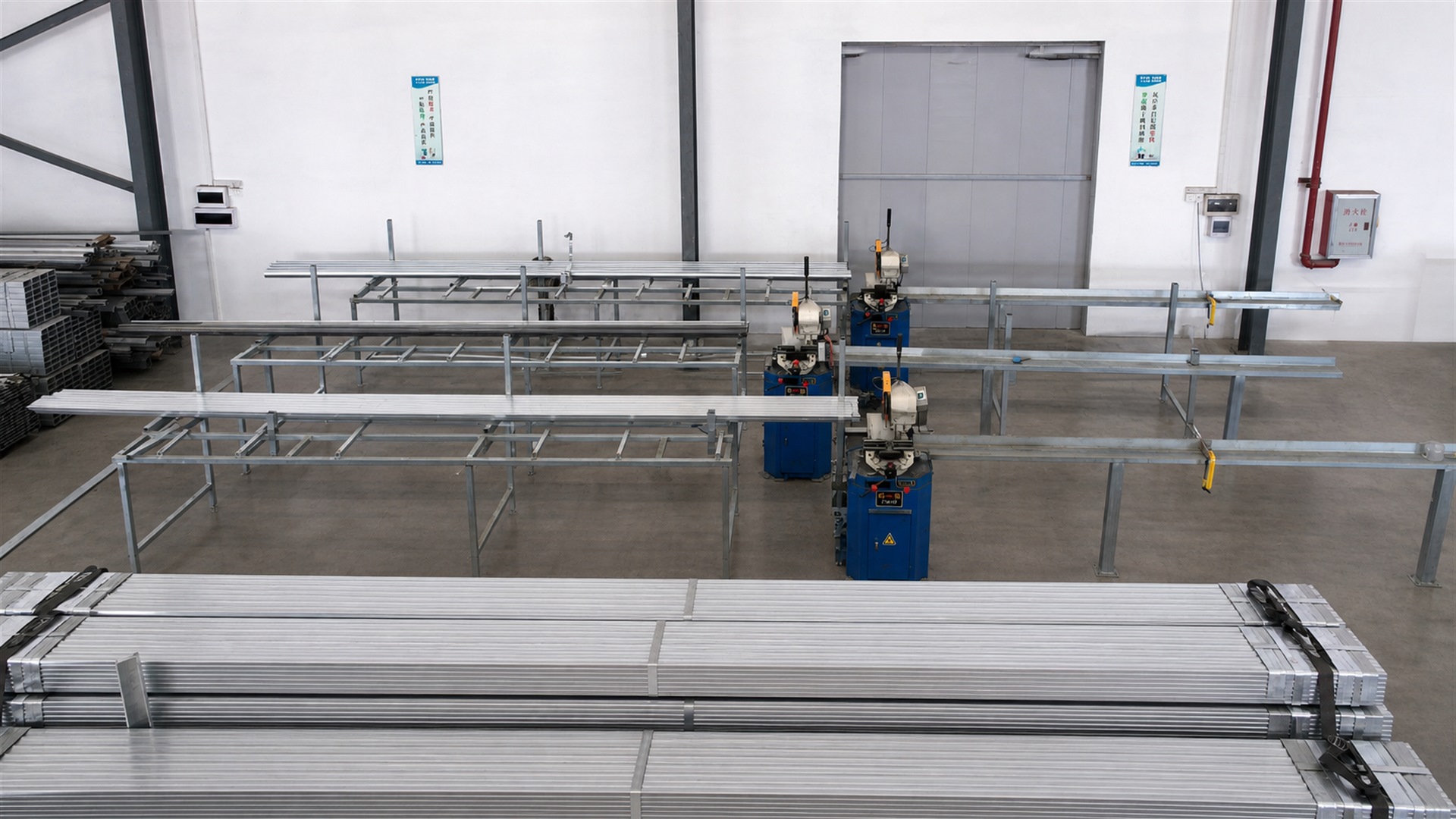
Cut and formed steel profiles pass dimensional, welding and coating inspection stages before final pre-shipment inspection.
What remains with the project is equally important. Site-specific structural design and anchorage, wind loading on a tall hoarding, foundation conditions, installation by qualified personnel, and verification against local authority requirements are all project responsibilities. For vehicle restraint systems, crash-performance verification applies to the complete installed assembly. Compatible end terminals, transition sections and crash cushions must be selected as part of the system rather than assumed from a catalogue.
Why customization extends the documentation problem
Guardrails, railings and hoarding are frequently produced under OEM and ODM arrangements. Dimensions, post spacing, rail configuration, materials, colors, surface finishes, decorative patterns, logos and installation methods can all be adapted to project drawings and site conditions, and MOQ is generally negotiable according to product type and project requirements. Lead time is determined by order quantity, specifications and customization requirements rather than by a fixed catalogue schedule.
The procurement consequence is direct. A customized item carries a customized scope. Generic marketing material or a document issued for a standard configuration does not describe a bespoke post spacing, a specific color-coated panel system or a project-specific base detail, and it should not be submitted as if it did.
Where the range comes from: Santian (Guangdong Guardrail)
Santian (Guangdong Guardrail) Steel Structure Co., Ltd. is a China-based manufacturer of municipal traffic guardrails and construction site hoarding systems, with industry experience dating to 2011 and formal registration on May 16, 2016. The company operates a production facility covering approximately 15,000 square meters, employs around 200 people including 50 engineers, and records an annual output of 1,500,500 m. Roughly 50% of output is exported, with main markets in Southeast Asia, Africa, South America and the Middle East.
Its product range is precisely why qualification scope matters in this category. The portfolio runs across municipal and lane-separation guardrail (T001 to T012), pedestrian guardrail (T013 to T018), bridge railing (T019 to T024), riverside guardrail (T025 to T028), crash barrier and W-beam guardrail (T031, T032), noise barrier (T034, T035), anti-glare and anti-throw mesh (T038, T039), parking barrier (T041), perimeter fence (Y043 to Y051), balcony railing (Y052 to Y057), stair railing (Y058 to Y063), window guard railing (Y064 to Y066), workshop safety partition (Y067 to Y069), security fence mesh (Y070 to Y072), and prefabricated steel construction hoarding together with standardized construction-site safety equipment (Y073 to Y091).
Support services include remote technical support, installation guidance, maintenance recommendations, spare-parts coordination and after-sales response. Those services support installation, but they do not transfer the project-level verification obligations described earlier, and responsible suppliers generally draw that line clearly rather than blurring it.
Application evidence from installations across the range
Because each product family answers a different question, installation records also answer different questions. The following records from Santian projects illustrate how narrow the evidence of a single installation actually is.
- Artificial greenery hoarding, 5,100 m. Urban greening and construction-site contractors used prefabricated steel construction hoarding combined with climbing plants or artificial greenery to screen a temporary construction boundary. The vertical planting system adds a green facade to the boundary, the recorded design service life is up to five years, and the installation has operated stably over that period.
- Guangzhou A1-1 configuration hoarding, 1,600 m. A general contractor or municipal-works contractor enclosed and visually screened a medium- or long-term boundary using a square-steel frame, color-coated panels and modular assembly. The record notes stable operation over four years.
- Perimeter fence, 3,800 m. A property developer, industrial-park operator or perimeter contractor used a perimeter fence with hot-dip galvanized posts and a dark-green finish to define the site boundary and discourage unauthorized access. The record notes stable operation over eight years.
- Municipal road median guardrail, 6,000 m. A municipal road authority or road contractor used a Guangzhou-standard configuration with reinforced steel posts and upper-and-lower rails to separate opposing traffic and discourage unauthorized crossing.
- Anti-glare screen, 110 km. An expressway authority or road-safety contractor used expanded steel mesh anti-glare screen on expressways, bridges or elevated roads. Expanded mesh provides glare screening and ventilation that limits wind pressure, and the case record notes effective noise reduction along the installed screen sections.
- Louvered noise barrier, 6,000 m. A transport authority or acoustic-barrier contractor used acoustically optimized louvers to screen road traffic noise while maintaining airflow through the barrier system.
A 5,100 m hoarding installation qualifies hoarding. It says nothing about a bridge railing, a bollard or a pedestrian barrier, and it should never be presented as if it did. The value of these records at evaluation stage is narrower but real: they show which item types the manufacturer has actually produced and installed, in which configuration, and under what operating conditions.
Market trends reshaping qualification expectations
Three movements are pushing buyers toward range-based qualification reviews rather than single-document approvals.
- Growth in smarter roadside systems. Dataintelo projects a 9.2% CAGR for the smart road barrier market from 2025 to 2034. As barriers carry more monitoring, warning and power functions, the evidence a buyer needs per installed assembly grows accordingly.
- A large temporary protection segment. Grand View Research valued the global temporary guardrail market at USD 2.4 billion in 2024, a figure that reflects how much project protection spending sits outside permanent roadside hardware and therefore outside roadside crash standards.
- Standard-led verification. EN 1317 in Europe and AASHTO MASH 2016 in the United States define performance expectations for permanently installed vehicle restraint systems, which encourages buyers to request system-level performance evidence instead of catalogue-level capability claims.
Trade data adds a practical constraint. Road guardrails are commonly classified under HS Code 73089099, a classification that aggregates guardrails with structures rather than separating municipal from bridge or railing products. That aggregation makes sub-segment trade-flow analysis difficult, so importers should expect to verify product scope through drawings and specifications rather than through customs statistics. Global participation in the category is broad; Hill & Smith PLC of the United Kingdom, for example, is identified as a major company in the global barrier systems market.
Prefabricated steel hoarding compared with traditional timber enclosures
The comparison between prefabricated steel construction hoarding and traditional timber or plywood site enclosures is a fair place to state limits plainly, because both approaches have legitimate uses.
| Consideration | Prefabricated steel hoarding | Traditional timber or plywood enclosure |
|---|---|---|
| Assembly logic | Modular panels and frames, assembled and dismantled repeatedly across project phases | Cut and fixed on site, with limited reuse of individual sheets |
| Appearance consistency | Color-coated steel sheet and controlled panel dimensions produce a uniform boundary | Appearance depends on site workmanship and weathering |
| Stated design life | Up to five years for specified prefabricated steel hoarding models, subject to installation and maintenance | Shorter service intervals; panels typically degrade faster in wet conditions |
| Site demands | Heavier components requiring lifting equipment, planned foundations and handling space | Light components that are easier to move without lifting equipment |
| Best fit | Medium- and long-term municipal, road and building projects | Very short-duration or cost-constrained enclosures where reuse is not a goal |
The limits of the steel hoarding case should be stated as clearly as the advantages. The stated design service life of up to five years applies to specified models and assumes correct installation and maintenance. Steel hoarding is heavier than timber and requires lifting capacity and a planned foundation or ballast arrangement, which some constrained urban sites do not have. It is not automatically the cheaper option for a two-week enclosure, and it is not a boundary security system on its own. Above all, hoarding provides no crash protection and no fall protection, whatever its documentation says about manufacturing quality. Those functions require crash barriers, guardrails or railings specified and verified as separate items.
One further limitation applies to every supplier in this category, including Santian. Manufacturer documentation supports a submittal; it does not replace local regulatory approval, site-specific structural verification or verification of crash performance for the assembled vehicle restraint system. Buyers who assume otherwise are relying on a scope that no supplier document can carry.
Future outlook
Two directions look durable. The first is documentation granularity. As more projects require item-level evidence, suppliers will be asked to issue per-model scope statements rather than range-level brochures, and buyers will build an evidence matrix at tender stage instead of attaching one file to a mixed package.
The second is the split between permanent roadside systems and temporary site protection. Standards such as EN 1317 and AASHTO MASH 2016 concentrate on permanently installed vehicle restraint systems, while the temporary guardrail and hoarding segments grow on project-driven demand. Procurement teams that recognise this split early will map each item to the correct standard, the correct evidence layer and the correct decision owner, and will avoid the most common error in this category: a genuine document attached to the wrong product.
Frequently asked questions
No. Qualification evidence is product-specific and configuration-specific. Manufacturing control evidence, such as a quality-control process covering incoming material, dimensional, welding, coating, in-process and pre-shipment inspection, is the layer a manufacturer can apply across a range, but it describes inspection steps rather than product performance. Material, finish and configuration records apply to the specified item, and project-level performance remains a project responsibility. A single document submitted for hoarding, railings, fencing and bollards will not satisfy reviewers for those separate items.
Vehicle restraint systems installed on public roads. EN 1317 is the mandatory European standard for vehicle restraint systems permanently installed on roads, with EN 1317-5 cited as the applicable part, and AASHTO MASH 2016 is the current evaluation standard for new permanent roadside hardware in the United States as of December 31, 2019. Pedestrian guardrails, balcony railings, stair railings, window guards, construction hoarding and parking bollards do not fall within those vehicle restraint standards, and their documentation should not be presented as if they did.
Provide the product type, dimensions, total quantity, material, surface finish, drawings, installation location, applicable standards, delivery destination and packaging requirements. Site photographs are helpful where drawings are unavailable. Buyers should also confirm the application, safety requirements and installation environment, because these determine material selection, post spacing and connection details. Suppliers can then respond with a configuration matched to those requirements rather than a catalogue approximation.
Stainless steel, especially Grade 316 or 316L, is recommended for coastal and salt-spray environments. Hot-dip galvanized steel with an additional protective coating is also suitable when it is properly specified and maintained. Selection should account for the environment, safety requirements, appearance and budget together, since a finish that performs well on an inland project may not perform equally on a waterfront promenade.
Map each item to its own compliance question first, then request evidence for that question only. Hoarding needs frame and panel specifications, modular assembly details and the stated design service life for the specified model, plus project-side wind loading and foundation design. Railings need fabrication, dimensional and material records, with structural adequacy at the specific opening confirmed by the project safety design. Bollards and parking barriers need dimension and finish records, with impact resistance verified separately. Keeping these evidence sets separate is what prevents scope transfer errors.
Service life depends on material, coating system, climate, installation quality and maintenance frequency. Stainless steel and properly galvanized steel generally provide reliable long-term outdoor performance when they are correctly specified and maintained. For prefabricated steel construction hoarding, the stated design service life is up to five years for specified models, which reflects the temporary and medium-term nature of site enclosure rather than the service expectations of permanent roadside hardware. Regular inspection of posts, rails, welds, bolts, anchors and coatings, with prompt repair of minor coating damage, supports whatever service life the specification targets.