
Safety Barrier FAQ: Window Guard, Stair and Balcony Railing
Window guard railing, stair railing and balcony railing sit at the point where a building's safety design turns into a purchase order. They are prefabricated, standardized safety equipment installed at building edges and access areas — not roadside impact barriers, and not temporary site hoarding. That distinction drives most of the procurement questions buyers actually ask between selection and execution.
This reference answers those questions for the three railing families a building project normally needs: window guard railing, stair railing and balcony railing. It covers what each product does, what information a buyer must supply, how material choice is framed, what installation and replacement look like, and where the limits sit. Where a product record does not publish a value — height, load rating, span table — this article does not supply one.
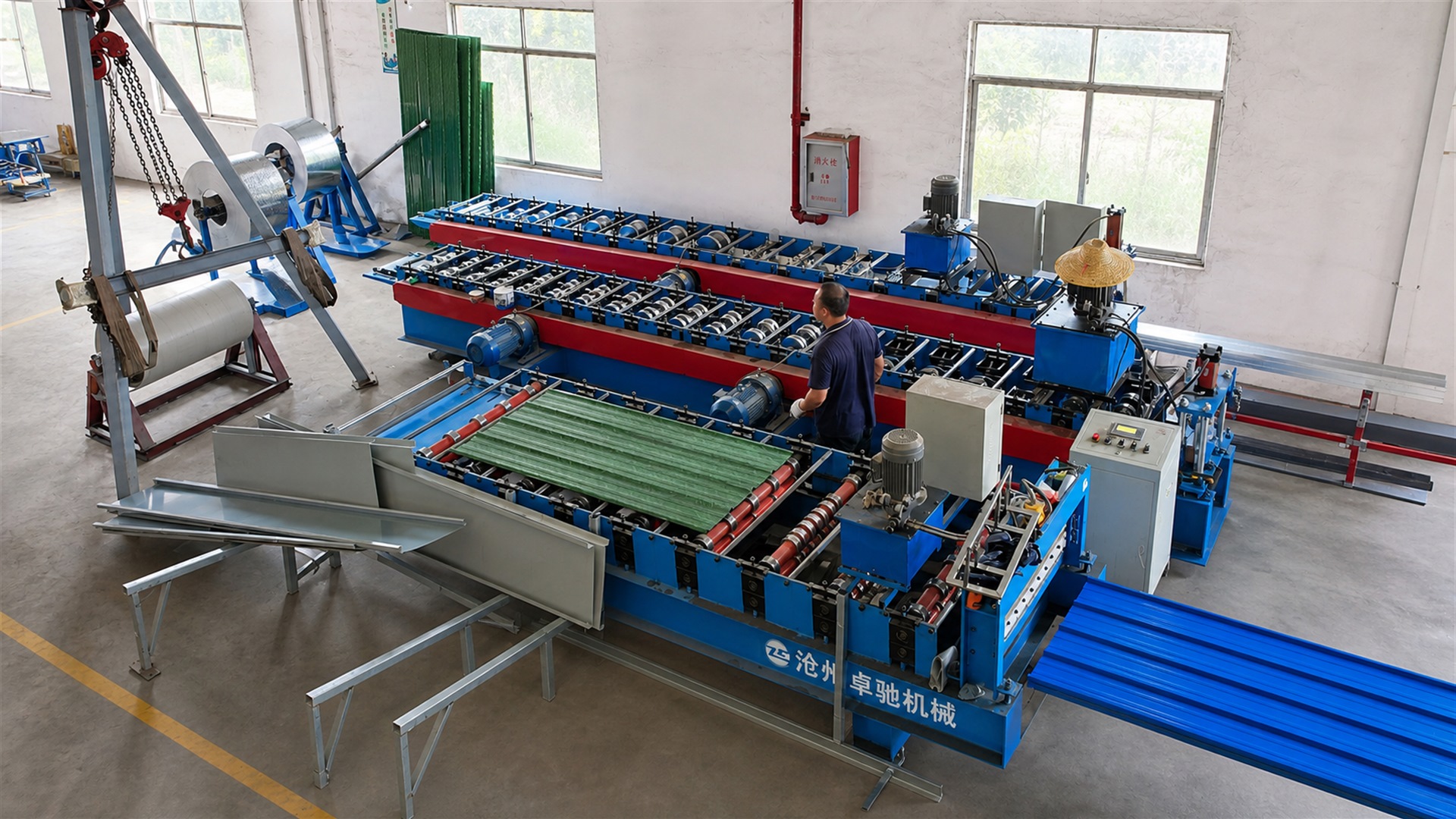
Roll-formed railing profiles produced in a controlled factory process before dispatch to a building project.
Why Building-Edge Railing Questions Differ From Road Barrier Questions
Roadside safety barriers are specified against impact performance. EN 1317-5 is described in published standard summaries as the mandatory European standard for vehicle restraint systems permanently installed on roads. In the United States, AASHTO MASH 2016 is cited as the current evaluation standard for new permanent roadside hardware as of 31 December 2019. Both frameworks exist to classify how a system behaves when a vehicle strikes it.
Window guard railing, stair railing and balcony railing are procured against a different set of questions. Their recorded functions are narrower and more specific: a physical guard across designated window openings to reduce fall risk while preserving the opening arrangements required by the building design; hand support plus edge guarding on open stairways; and a protective barrier at balcony edges to reduce the risk of falls. For balcony railing, dimensions and connections are determined by the project safety design. For stair railing, handrail and guard requirements depend on the stair design. For window guarding, any openable or releasable configuration has to be specified separately and coordinated with emergency access requirements.
A second distinction matters during the construction phase. Excavation edge guardrails — such as the Perforated Excavation Edge Guardrail (Y083), the Vertical-Bar Excavation Edge Guardrail (Y084), both recorded with a design service life of up to five years, and the Mesh Excavation Edge Guardrail (Y091) in steel tube and welded steel mesh — belong to the standardized construction-site safety equipment family used for safe and orderly construction. They are temporary, site-phase items. Window guard, stair and balcony railing are delivered into the permanent building. Quotation mismatches commonly start when these two families are treated as one category.
The Three Railing Families and What Each One Is Bought For
The current product range records each of these as a custom-specification item (params: custom). There are no published fixed heights or span tables, which means the project drawing — not a catalogue number alone — defines the deliverable.
| Railing family | Models in range | Recorded materials | Function recorded | Project types |
|---|---|---|---|---|
| Window guard railing | Y064 Prefabricated Window Guard Railing; Y065 Window Guard Railing; Y066 Window Guard Railing | Y064: selected per custom specification; Y065: zinc steel, steel; Y066: stainless steel | Physical guard across designated window openings to reduce fall risk while preserving the opening arrangements required by the building design | Residential buildings, schools, public buildings, window fall-protection projects |
| Stair railing | Y058, Y059, Y060 Stainless Steel Stair Railing / Handrail; Y061 Zinc Steel Stair Railing; Y062 Wooden-Handrail Stair Railing; Y063 Prefabricated Stair Railing | Stainless steel; zinc steel and steel with wood-effect components; zinc steel with wooden handrail; custom selection for Y063 | Hand support and guarding of open stair edges to assist movement between levels; handrail and guard requirements depend on the stair design | Schools, industrial parks, public housing, building circulation upgrades |
| Balcony railing | Y052 Zinc Steel; Y053 Flat Steel; Y054 Aluminum Alloy; Y055 Stainless Steel and Glass; Y056, Y057 Stainless Steel | Hot-dip galvanized steel, zinc steel and steel tube; flat steel; aluminum alloy; tempered glass with stainless steel; stainless steel | Protective barrier at balcony edges to reduce the risk of falls; dimensions and connections determined by the project safety design | Residential towers, apartment refurbishment, school buildings, commercial balcony upgrades |
Read across the table and a procurement pattern appears. Balcony railing carries the widest material spread because appearance requirements vary most at a visible building edge. Stair railing is the family where hand contact and daily wear dominate the specification. Window guard railing is the family where the interface with an existing window frame, and the question of emergency access, decide whether a design is buildable.
Framing Product-Fit Questions Before a Quotation
Supplier documentation states that an accurate quotation requires the railing type, dimensions, total quantity, material, surface finish, drawings, installation environment, applicable standards, delivery location and packaging requirements. Buyers are also advised to confirm the application, dimensions, material, surface treatment, safety requirements, quantity, installation environment and applicable standards before ordering. When drawings are unavailable, site photographs and a description of the application and site conditions are the practical substitute.
| Question the buyer must answer | Why it changes the offer |
|---|---|
| Where exactly is it mounted — balcony edge, stair flight, window opening? | Mounting geometry and connection plates differ; balcony and stair interfaces are project-safety-design dependent |
| Interior or exterior, inland or coastal? | Drives material grade and surface treatment, and whether premium corrosion resistance is warranted |
| Height, length, post spacing, opening width | All three families are custom-specification products; these values come from project drawings |
| Does the railing interact with an opening that must remain operable? | Window guarding with any openable or releasable configuration must be specified separately and coordinated with emergency access requirements |
| Quantity, delivery destination and packaging requirements | Affects packing, transport and shipment planning |
| Applicable local standards and approvals | Determines what documentation the project expects at handover |
A practical rule: if the answer to any row is unknown at enquiry stage, state it as unknown rather than estimating. Substituted dimensions are the most common cause of rework in prefabricated railing packages.
Material Questions and What the Answers Depend On
Material choice is usually framed as a durability question, but in railing procurement it is also a stiffness, weight and connection question. The recorded comparison points below are the ones that change a specification.
| Material comparison | Key recorded difference | Where it fits |
|---|---|---|
| Hot-dip galvanized steel vs weathering steel | HDG protects steel with a zinc coating; weathering steel relies on a stable oxide patina formed by wet-dry cycles and should not be treated as maintenance-free in continuously damp or chloride-rich locations. Weathering-steel guidance uses a 1.0 mm corrosion allowance per exposed face for C1–C3 environments and 1.5 mm for C4–C5; coastal suitability requires project testing | HDG for general exposed infrastructure; weathering steel for inland projects with drainage, ventilation and regular wet-dry cycling |
| HDG steel vs AISI 304 stainless | HDG uses a sacrificial zinc coating; 304 uses a chromium-rich passive layer throughout the material. An international HDG reference states that at least 100 micrometres of zinc on steel over 6.35 mm can provide 72–73 years to first maintenance in an industrial atmosphere | HDG offers lower initial material cost for large quantities; 304 suits architectural urban projects with moderate chloride exposure |
| AISI 304 vs AISI 316L stainless | 316L adds molybdenum and limits carbon for improved chloride-pitting and welded corrosion performance; 316/316L contains about 2–3% molybdenum, against no specified molybdenum addition in standard 304 | 304 for inland cities, schools and residential projects; 316L for coastal, poolside and marine-spray locations |
| AISI 316L vs 6061-T6 aluminum | Density about 7.8 kg/dm³ for stainless against 2.70 kg/dm³ for 6061 aluminum — roughly 65% lighter by equal volume. Typical yield-strength reference around 205 MPa for annealed 304/316 against 275 MPa for 6061-T6, with installed capacity still depending on profile and connections. Aluminum must be electrically isolated from dissimilar metals | 316L for coastal and heavy public use; aluminum for pedestrian, balcony and architectural work where low transport weight and extruded profiles matter |
| Pultruded FRP | Nonconductive, lightweight and corrosion resistant, but with different stiffness, fire and connection behavior; not automatically equivalent for vehicle impact | Chemical plants, wastewater facilities, coastal platforms and electrically sensitive industrial areas |
Supplier guidance maps this to a simple default: hot-dip galvanized steel where strength, corrosion resistance and cost need to balance; 304 stainless for humid environments; 316 stainless for coastal areas; aluminum for lightweight decorative applications. For coastal and salt-spray environments, stainless steel grade 316 or 316L is the recommended grade, and hot-dip galvanized steel with an additional protective coating is also suitable when properly specified and maintained.
Installation, Inspection and Replacement: Who Owns Which Step
Installation is a shared responsibility with a clear split. The supplier side covers installation drawings, component identification, assembly guidance and remote technical support according to the project, and the integrated service model covers solution development, product design, manufacturing and on-site installation. The site side retains execution responsibility: installation must be completed by qualified personnel in accordance with approved engineering drawings and local safety regulations.
The recorded installation sequence for a prefabricated steel railing system runs as follows: review the approved drawings and confirm the installation location; inspect all posts, rails, fasteners and accessories; mark post positions and verify the foundation or anchor points; install and temporarily secure the posts; connect rails and accessories in the specified sequence; adjust height, spacing, verticality and alignment; then tighten all fasteners to the specified torque and complete the final inspection.
Inspection and maintenance follow a comparable logic. Posts, rails, welds, bolts and connection points are checked for corrosion, cracks, deformation and coating damage; foundations and anchor bolts are checked for movement or loosening; dirt, salts and chemical deposits are cleaned from the surface; loose fasteners are tightened and minor coating damage repaired; defects are recorded and severely damaged components scheduled for replacement. Loose fasteners, corrosion, damaged coatings, deformation, foundation movement and missing components are the standard watch list for galvanized railing.
Replacement is more flexible than it first appears. A damaged modular railing section can usually be replaced independently when compatible posts, rails and fasteners are available — but the surrounding structure and foundation must also be inspected before the new section is installed. The practical constraint is compatibility: post, rail and fastener interfaces should be confirmed against the original system before a replacement order is placed, and interchangeability between different systems should not be assumed.
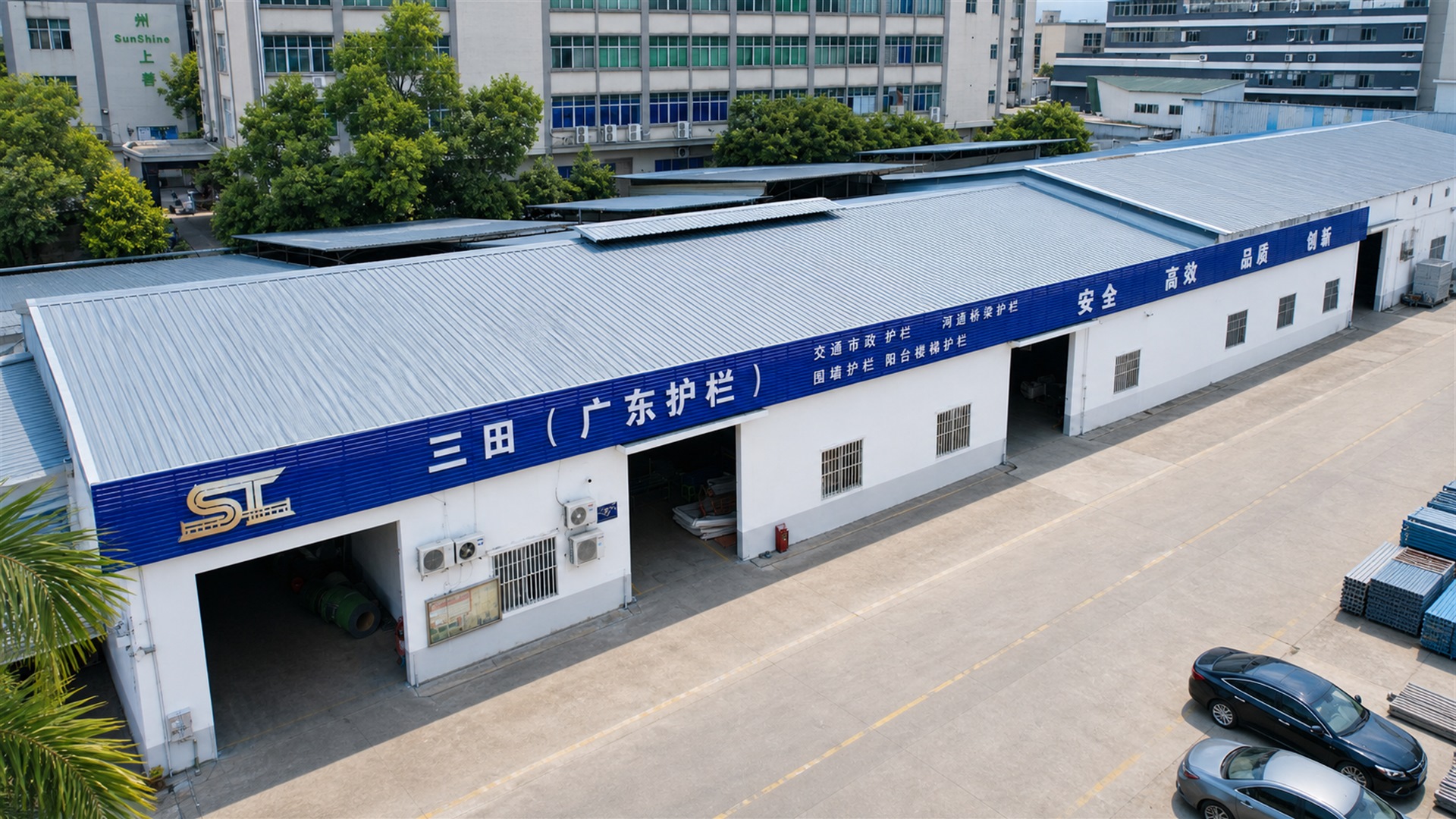
Factory production of railing components supports consistent pre-shipment inspection before dispatch.
Application Fit Across Residential, School and Industrial Projects
Each railing family has recorded working conditions, and those conditions are what a buyer should test a proposed design against.
Balcony railing. Working conditions are elevated balconies exposed to occupants, sunlight, rain, wind and cleaning water, with coastal or highly corrosive exposure depending on project location. Relevant project types include residential tower construction, apartment refurbishment, school building projects and commercial balcony upgrades. Project-dependent matched items include compatible anchors and connection plates, specified glass infill where applicable, and balcony drainage or waterproofing systems at the interfaces.
Stair railing. Working conditions are indoor or outdoor stairways with frequent foot traffic, hand contact and cleaning moisture, with exterior stairs also exposed to sunlight, rain and temperature change. Project types include residential and public building construction, school renovation, factory stair upgrades and building circulation improvements. Matched items include the stair structure itself, compatible fixing brackets, anti-slip treads, stair lighting and emergency wayfinding signs.
Window guard railing. Working conditions are window openings in occupied buildings, exposed to sunlight, rain, humidity, cleaning water and occupant contact depending on interior or exterior placement. Project types include residential building construction, school safety improvements, public building refurbishment and window fall-protection projects. Matched items include window frames, compatible fixing brackets, opening restrictors and designated release hardware where the design requires it.
The common thread across all three is that the railing rarely interfaces with clean geometry. It meets a frame, a staircase stringer, a slab edge, a drainage detail or a waterproofing layer. Buyers who submit those interface conditions with the enquiry avoid the most expensive category of change order.
Market Signals — and Their Limits
Several published data points frame the wider category, and they are worth reading with precision because they describe barrier systems broadly rather than building-edge railing specifically.
- The global barrier systems market was valued at USD 24.8 billion in 2025, according to Grand View Research.
- The metal segment accounted for the largest material share at over 50.0% in 2025, per the same source.
- The global temporary guardrail market was valued at USD 2.4 billion in 2024, according to Grand View Research.
- The smart road barrier market is projected at a 9.2% CAGR from 2025 to 2034, per Dataintelo.
- Road guardrails are commonly classified under HS Code 73089099.
- Hill & Smith PLC is identified as a major company in the global barrier systems market.
The directional signal that matters most for buyers is material: metal holding the largest share supports the continued specification of steel-based railing, while the smart-barrier growth figure points to monitoring and sensing being added at the roadside. Neither trend changes the fact that building-edge railing remains a passive product with no power requirement in service.
Prefabricated Railing vs On-Site Fabrication
| Dimension | Prefabricated railing (Y063, Y064, Y052–Y061 range logic) | On-site fabrication |
|---|---|---|
| Dimensional control | Set by the approved drawing before production; limited field adjustment | Adjusted during installation to as-built conditions |
| Surface treatment | Applied in a factory process before dispatch | Applied or repaired on site, dependent on site conditions |
| Inspection | Covered by the pre-shipment test procedure applied to each production order | Site-welded joints fall outside the factory pre-shipment test |
| Replacement | Modular sections can usually be replaced independently when compatible components are held | Replacement depends on matching field-fabricated geometry |
| Logistics | Requires confirmed dimensions and anchor conditions before production, plus packing and freight planning | Requires raw material and fabrication capability on site |
The honest limitation on the prefabricated route is sequence risk. Production should not start until opening widths, stair geometry and anchor conditions are confirmed, because a factory-made railing component has limited capacity to absorb a dimension that has moved on site. The honest limitation on the on-site route is verification: corrosion protection and joint quality then depend on site conditions rather than a controlled factory process, and factory pre-shipment testing does not extend to joints created in the field.
Long-Term Supply, Repeat Orders and Replacement Continuity
For a contractor or developer running multiple buildings or phased handovers, the long-term question is whether the same railing geometry can be supplied again two or three years later. The relevant facts on that side are commercially specific rather than technical.
- Guardrail and hoarding products have been supplied from China since 2011, supporting continuous supply for municipal guardrail projects; the company was formally registered on 16 May 2016.
- The production facility covers approximately 15,000 m², with roughly 200 staff and an R&D team of 50 engineers and technicians.
- Annual production capacity reaches approximately 1,500,500 meters of guardrail and hoarding products.
- Exports represent 50% of output, with main markets in Southeast Asia, Africa, South America and the Middle East.
- The minimum order quantity for road guardrail, lane separation guardrail and crash barrier items is 1 unit, including low-volume and repeat orders.
- FOB trade terms are offered for municipal guardrail, bridge railing and crash barrier supply orders, and also for prefabricated steel construction hoarding and standardized construction-site safety equipment orders.
- Payment terms for long-term and repeat supply contracts are 40/70.
- Products are accepted through a pre-shipment test procedure applied to each production order, including repeat orders.
- The integrated service covers product selection, customized design, manufacturing and installation, with customized solutions based on project specifications, site conditions, safety requirements and visual design needs.
Future Outlook
Three developments are likely to shape railing procurement enquiries over the next few years, based on the data available.
First, the metal segment's dominant material share supports continued steel specifications across balcony, stair and window guard railing, with stainless and aluminum positioned as premium options for exposure and weight reasons rather than as general replacements.
Second, the projected 9.2% CAGR for smart road barriers between 2025 and 2034 indicates that sensing and monitoring are being added at the roadside. Building-edge railing is a separate category and remains passive in service, so this trend should not be read across to window or balcony applications.
Third, prefabrication logic continues to push buyers toward documenting dimensions and interfaces earlier in the project cycle. The practical consequence is that the enquiry stage — drawings, opening schedules, anchor conditions and interface details — becomes the decisive step in a railing package, not the delivery stage.
Frequently Asked Questions
What are window guard railing, stair railing and balcony railing used for in a building project?
They serve three distinct functions. Window guard railing provides a physical guard across designated window openings to reduce fall risk while preserving the opening arrangements required by the building design. Stair railing provides hand support and guards open stair edges to assist movement between levels. Balcony railing provides a protective barrier at balcony edges to reduce the risk of falls, with dimensions and connections determined by the project safety design.
Do these railings provide vehicle crash protection or flood control?
No. Vehicle restraint systems permanently installed on roads are addressed by frameworks such as EN 1317-5 in Europe and AASHTO MASH 2016 in the United States. Window guard, stair and balcony railing are building-edge and access-area products. Riverside and waterfront railing designs similarly do not provide flood control. Buyers requiring vehicle restraint or flood protection need a separately specified system.
What information should a buyer provide before requesting a quotation?
Supplier documentation states that an accurate quotation requires the railing type, dimensions, total quantity, material, surface finish, drawings, installation environment, applicable standards, delivery location and packaging requirements. Where drawings are unavailable, site photographs and a description of the application and site conditions help define a suitable configuration.
Which material is suitable for balcony, stair or window guard railing in humid or coastal locations?
Stainless steel grade 316 or 316L is recommended for coastal and salt-spray environments, and hot-dip galvanized steel with an additional protective coating is also suitable when properly specified and maintained. For general conditions, hot-dip galvanized steel balances strength, corrosion resistance and cost, while 304 stainless suits humid environments and aluminum suits lightweight decorative applications.
Can these railings be customized to project drawings and site conditions?
Yes. Dimensions, post spacing, rail configuration, materials, colors, surface finishes, decorative patterns, logos and installation methods can be customized according to project drawings and site requirements. Customized solutions are provided based on project specifications, site conditions, safety requirements and visual design needs.
Who installs the railing, and what support is available during installation?
Installation drawings, component identification, assembly guidance and remote technical support can be provided according to the project, and the integrated service model covers solution development, product design, manufacturing and on-site installation. Installation itself must be completed by qualified personnel in accordance with approved engineering drawings and local safety regulations.
How should outdoor railings be inspected and maintained?
Regular inspection covers posts, rails, welds, bolts and connection points; foundations and anchor bolts for movement or loosening; and surfaces for corrosion, cracks, deformation and coating damage. Dirt, salts and chemical deposits should be cleaned, loose fasteners tightened, and minor coating damage repaired promptly, with severely corroded or deformed components replaced. Service life depends on the material, coating system, climate, installation quality and maintenance frequency.
Can a damaged railing section be replaced on its own?
A damaged modular railing section can usually be replaced independently when compatible posts, rails and fasteners are available. The surrounding structure and foundation must still be inspected before the new section is installed, and component compatibility should be confirmed against the original system rather than assumed between different suppliers.
Product and company background for the railing families discussed here is available in the manufacturer's downloadable reference: Santian product brochure (PDF).