
Safari Tent Frame, Cover & Size: A Lodge Buyer's Framework
Safari Tent Frame, Cover & Size: A Lodge Buyer's Framework
HTNXT · Independent Industry Reference
Safari Tent Frame, Cover & Size: A Lodge Buyer's Framework
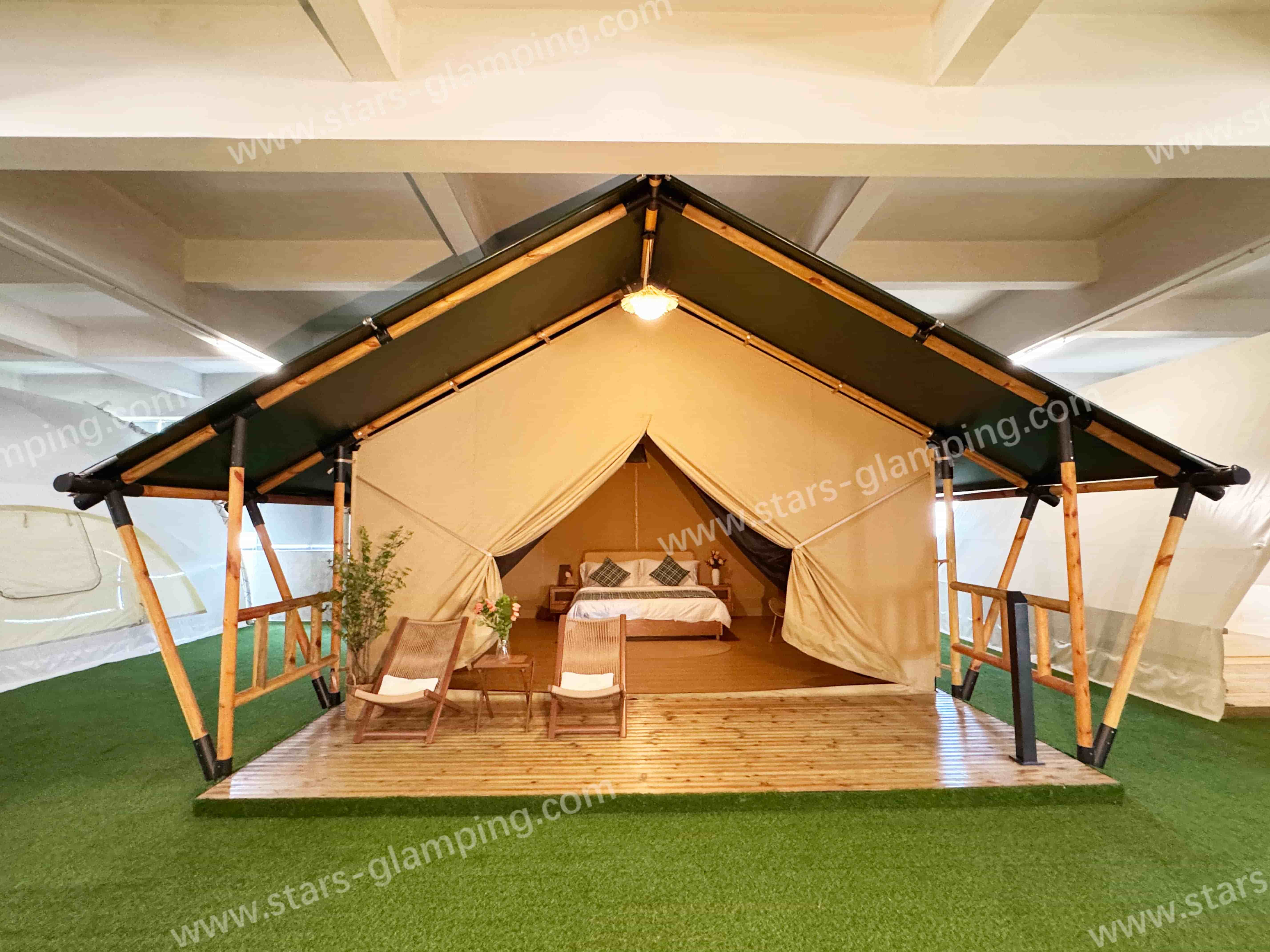
Lodge and resort developers rarely struggle with whether tented accommodation is viable. The harder question is which combination of frame, cover system and floor area will still be defensible in year eight of operation — after the wet seasons, the permit inspections, the maintenance budget reviews and the revenue-per-key calculations.
Stars Glamping (STARS GLAMPING TENT CO., LTD) publishes a safari tent range in which those three variables are explicitly selectable. The frame is offered as finish anti-corrosion solid wood or as a heavy-duty galvanized steel frame. The outer cover is 850g/m² PVC-coated polyester fabric, with a breathable Oxford canvas fabric lining inside. Standard floor areas are 20㎡, 30㎡, 40㎡ and 50㎡, with custom sizes available.
The published performance envelope for the range is a waterproof rating of ≥ 3000mm H₂O, a B1 fire-retardant rating, wind resistance up to 100km/h (Level 9 wind), a snow load of 60kg/m², an operating temperature range of -25℃ to +60℃, UV-resistant and anti-fading fabric, and an expected service life of 8–12 years.
The framework below treats those options as decisions to be matched against a site, a permitting route and an operating model — not as a specification list to be maximised.
Why frame, cover and size carry most of the project risk
Three choices are effectively locked once fabrication begins, and each maps to a different category of risk:
- Frame — structural behaviour, corrosion strategy and the maintenance regime the operator inherits.
- Cover system — weather protection, fire classification, condensation control and the eventual replacement cycle.
- Floor area — layout resolution, services and foundation design, and revenue per key.
A short way to state the trade-off: the frame and cover decide whether the unit survives the site; the floor area decides whether the unit earns. Buyers who compare quotations on price per square metre alone are usually comparing the third variable while leaving the first two undecided.
Frame comparison: anti-corrosion solid wood vs heavy-duty galvanized steel
Stars Glamping specifies two frame options inside the same product range. Both sit under one published specification set — the same waterproof, fire, wind, snow and temperature figures are stated for the range rather than split by frame type. That has a practical consequence for tendering: the rating set should be confirmed against the frame actually requested, together with the engineering drawing or installation guidance that supports it.
| Consideration | Anti-corrosion solid wood frame | Heavy-duty galvanized steel frame | What it changes for the buyer |
|---|---|---|---|
| How it is specified in the range | Listed as finish anti-corrosion solid wood | Listed as heavy-duty galvanized steel frame | Both are alternatives inside one specification, not separate product grades |
| Design language | Supports the wood-style structure design referenced in the product features | A metal framing system; the visible result depends on how the structure is detailed | Resolve against the lodge’s architectural brief before the tender is issued |
| Corrosion strategy | Anti-corrosion finish is the stated treatment | Galvanizing is the stated corrosion protection | Ask for the finish or galvanizing specification in writing, not a material name |
| Maintenance planning | Re-treatment and inspection assumptions should be priced into the operating budget | Inspection of coating integrity and fixings should be priced into the operating budget | Whichever frame is chosen, the maintenance line item belongs in the pro forma |
| Site conditions | Humidity, salt and biological pressure make the finish specification the deciding document | Humidity and salt make the galvanizing specification and fixing detail the deciding document | Neither frame is universally preferable; the quoted finish is what gets compared |
| Evidence to request | Finish specification and re-treatment guidance | Galvanizing specification and connection details | Plus confirmation that the wind and snow ratings apply to the chosen frame |
Cover and lining: what 850g/m² PVC and breathable Oxford actually do
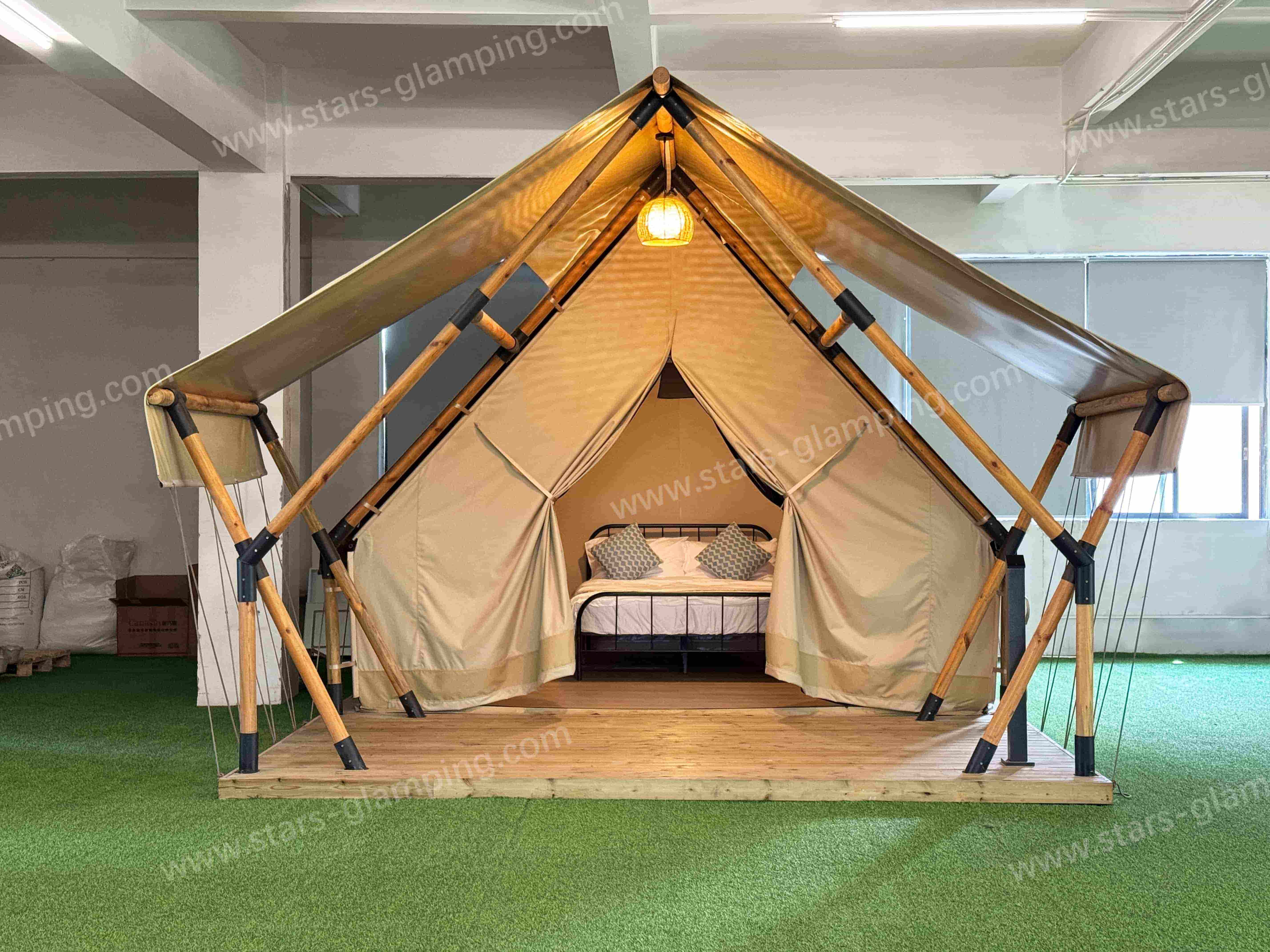
The cover specification is 850g/m² PVC-coated polyester fabric, stated as UV-resistant and anti-fading, with a waterproof rating of ≥ 3000mm H₂O and a B1 fire-retardant rating. The inner lining is a breathable Oxford canvas fabric.
Three parts of that specification deserve to be separated, because they answer three different buyer questions.
- Coated fabric weight (850g/m²) is one of the few cover figures that can be compared directly between quotations. It describes the mass of coated fabric per square metre, and it anchors a like-for-like comparison — but it is a material descriptor, not a performance guarantee.
- Hydrostatic head (≥ 3000mm H₂O) describes the water pressure the fabric is specified to resist. Ask whether the figure is a laboratory result or a design target, and request the test method behind it.
- Fire classification (B1) is a fire-reaction class used within several European regulatory frameworks. The claim becomes actionable only once the standard, the test method and the product scope it covers are identified.
The breathable Oxford lining matters more than its position in a specification list suggests. Coated single-skin fabric accommodation tends to concentrate moisture on the inner face when internal and external temperatures diverge; a breathable lining separates the occupied space from the coated shell and gives that moisture somewhere to go. For lodges operating in humid jungle or riverside conditions, and for shoulder-season mountain use, this is the detail that often decides whether guests describe the unit as comfortable or as damp.
The performance envelope, read at site level
Published figures only become useful when they are translated into a site question. The table below maps the stated specification to what a lodge buyer should verify.
| Parameter | Published specification | Site-level implication |
|---|---|---|
| Waterproofing | ≥ 3000mm H₂O | Relevant to monsoon and tropical wet seasons; confirm the test basis, not just the number |
| Fire rating | B1 fire-retardant | Relevant to the permitting route; confirm the standard, report reference and product scope |
| Wind resistance | Up to 100km/h (Level 9 wind) | Exposed savannah, ridge and coastal sites; confirm anchoring and foundation design locally |
| Snow load | 60kg/m² | Mountain and high-altitude placements; compare against local snow-load data |
| Operating temperature | -25℃ to +60℃ | Cold-season and desert operations within a single product specification |
| UV performance | UV-resistant, anti-fading | High-UV savannah and desert camps; confirm the colour-fastness basis in writing |
| Service life | 8–12 years | Replacement and depreciation planning rather than a marketing claim |
| Standard sizes | 20㎡ / 30㎡ / 40㎡ / 50㎡ (customisable) | Drives layout resolution, deck area, service runs and units per site plan |
Read together, those figures describe an all-weather unit rather than a seasonal one: the operating range spans deep cold and desert heat, the wind figure covers exposed savannah and coastal ridges, and the snow load allows mountain placements. The limit is not the published envelope itself but what surrounds it — anchoring, foundation design, installation quality and the local approval route.
Size decision: 20㎡, 30㎡, 40㎡ and 50㎡
Floor area is where specification meets commercial model. The range offers four standard sizes plus custom footprints. None of the four is inherently better; each resolves a different planning question.
| Standard size | Planning question it resolves | What to request with the quotation |
|---|---|---|
| 20㎡ | Whether the intended brief — sleeping area plus any bathroom or kitchen module — can be resolved inside the smallest standard footprint | Layout drawing at 20㎡ with the full fit-out list, including bathroom module and service positions |
| 30㎡ | Whether an internal bathroom plus storage and a compact sitting area fit without moving to the next size | Two layout variants at 30㎡ to test furniture and circulation assumptions |
| 40㎡ | Whether a two-zone layout — sleeping plus living — is required within a single unit | Section and elevation drawings showing the two-zone division and window placement |
| 50㎡ | Whether the key is positioned as a premium or family unit where internal volume justifies the footprint | Deck area, service run length and per-key revenue assumptions alongside the drawing |
Two practical points apply across all four sizes. First, the footprint drives everything around it: deck or foundation area, the length of service runs, and how many units a site plan can actually carry. Second, customisation moves a unit from a standard drawing to an engineered one. Stars Glamping quotes 15–20 days lead time for standard models and 20–30 days for customised projects, and that difference belongs in the programme from the outset.
Where Stars Glamping sits in this framework
Stars Glamping (STARS GLAMPING TENT CO., LTD) is a Guangzhou-based manufacturer founded in 2018 that produces glamping domes, safari tents and luxury tents, and states that around 90% of its output is exported to markets including Southeast Asia, the Middle East, Africa, Europe, North America, South America and Australia.
Its safari tent range is published as three models — Epic, Vega and Lodestar — which share a common specification set: the same frame options, the same 850g/m² PVC-coated polyester cover with breathable Oxford lining, and the same 20㎡ to 50㎡ size ladder. The choice between the three is therefore a choice of form and configuration rather than of headline performance. Buyers shortlisting inside the range are comparing layout and design language against the site, and should evaluate drawings rather than model names.
Configuration is handled through customisation rather than fixed catalogue variants. The stated scope covers size and layout, tent structure design, fabric selection (PVC, PVDF or insulation), frame material (steel or aluminium), interior layout and furniture, bathroom integration, logo branding and colour.
Capacity and programme form the other half of the evaluation. Stars Glamping states an annual output of 600–900 luxury tent units per year depending on project size, monthly capacity of 50–80 units, a minimum order of one unit with samples available, and lead times of 15–20 days for standard models against 20–30 days for customised projects. Quality control is described as raw material inspection, in-process quality control, pre-shipment inspection and, where required, third-party inspection. After-sales support covers installation guidance, engineering drawings, 24/7 technical support, spare parts supply and maintenance support, delivered remotely or on site.
Matching configuration to site type
The range is specified for savannah, high-UV, heavy rain, windy, remote and off-grid conditions, and is applied across luxury resorts, glamping projects, safari parks, eco-tourism camps and beach and mountain hotels. In practice, the pairing looks like this:
- High-UV savannah and desert camps — the anti-fading, UV-resistant cover specification is the relevant line item; confirm the colour-fastness basis alongside it.
- Heavy-rain and riverside sites — ≥ 3000mm H₂O waterproofing, with the large panoramic windows and mesh screens that provide ventilation without insect ingress.
- Exposed and windy sites — heavy-duty galvanized steel frame with the 100km/h (Level 9) wind rating, supported by locally reviewed anchoring and foundation design.
- Cold mountain and high-altitude lodges — the -25℃ lower operating limit and 60kg/m² snow load, plus the insulation lining option listed under customisation.
- Remote and off-grid camps — prefabricated units, logistics planning and installation guidance, with the 8–12 year service life used as the replacement horizon.
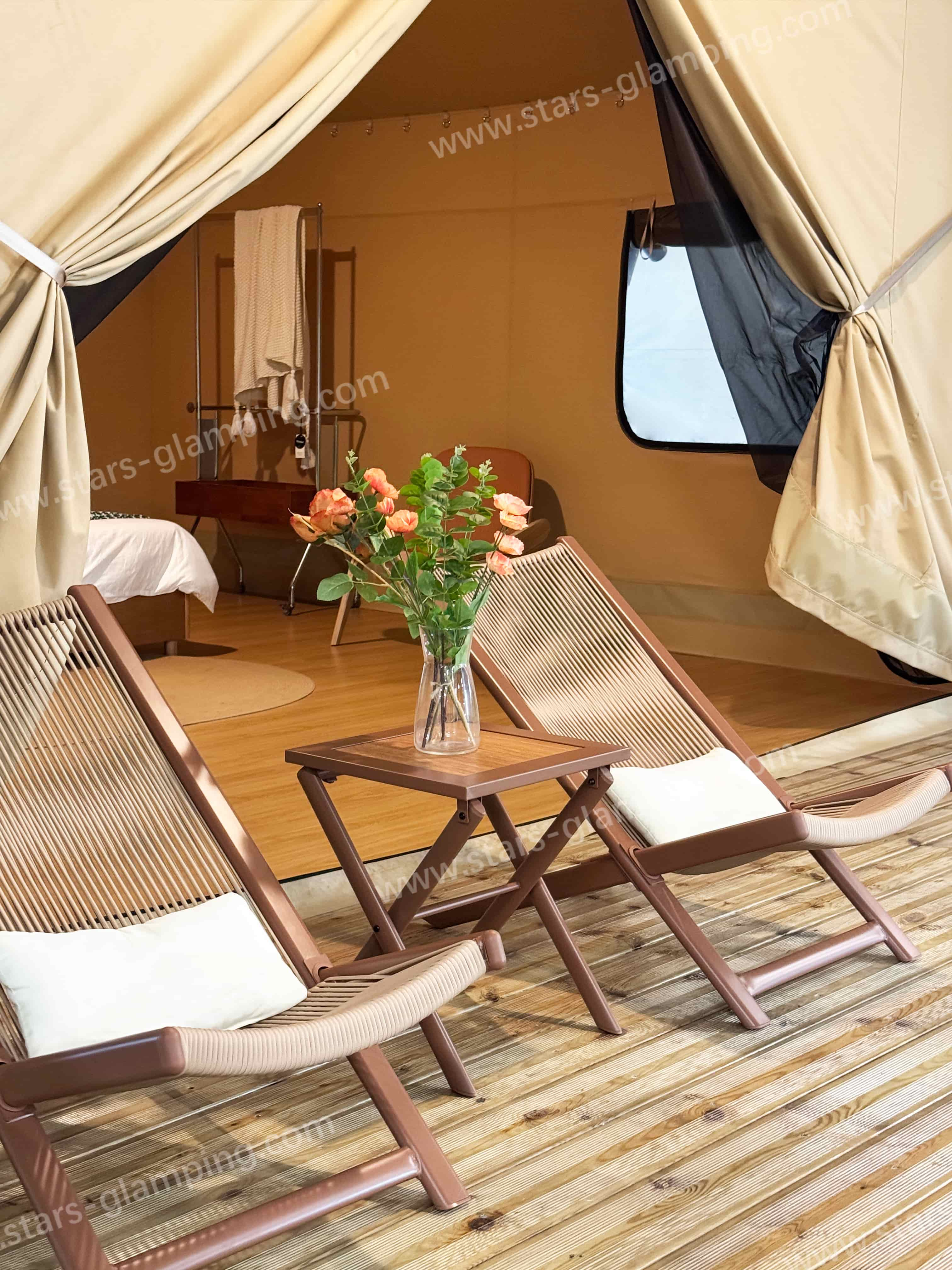
- Lodge interiors that need more than a shell — bathroom integration, electrical and lighting provision, air conditioning, insulated lining and timber flooring are listed as configurable, which is what turns a tent into a lettable key.
Market trend: more lodge capacity, more specification scrutiny
Grand View Research projects the global safari tourism market to grow from USD 39.7 billion in 2026 to USD 66.9 billion by 2033. Whatever figure a particular investor underwrites, the direction of travel has two consequences for buyers.
First, accommodation capacity has to be added in phases rather than in a single construction cycle directed at a fixed early forecast. Modular safari tent systems fit that pattern, because additional units can be ordered against a specification that later phases can still match. Second, specification scrutiny rises with the capital committed: larger programmes tend to ask for the test basis behind a waterproof or fire rating, and for the capacity statement behind a delivery date — which is where a published output of 600–900 units per year becomes part of the commercial discussion rather than a brochure detail.
Neither point is a reason to over-specify. It is a reason to document.
How the modular safari tent compares with conventional lodge construction
A safari tent is not a substitute for every permanent structure, and the comparison is only useful when the boundary is stated plainly.
- Site works. Tented units generally require lighter foundation and deck solutions than masonry construction, and because the envelope is prefabricated, site works rather than fabrication tend to dominate the programme.
- Programmability. A production lead time of 15–30 days is short relative to fixed construction, but installation, services and landscaping on site still set the opening date.
- Specification transparency. Rated performance is published up front; whether those ratings satisfy a given jurisdiction is a separate question that the building permit process will test.
- Lifecycle. The stated service life of 8–12 years establishes a replacement and depreciation horizon that permanent construction does not carry. For an asset with a long lease or a long hold, that cycle has to be priced into the model.
- Comfort control. The -25℃ to +60℃ operating range and the insulation lining option address climate extremes, but published insulation performance values are not part of the specification set, so thermal performance must be confirmed separately for cold-season operation.
Limitations buyers should price into the project
- Ratings are product-level, not site-level. The 100km/h wind figure and 60kg/m² snow load need confirmation against local design loads, anchoring design and foundation detail.
- Fire classification needs a reference. A B1 claim is only actionable with the standard, test method and product scope attached.
- Service life is conditional. An 8–12 year expectation depends on UV exposure, humidity, salt and the maintenance regime actually carried out on site.
- Capacity is substantial but finite. An annual output of 600–900 units supports large programmes, but multi-hundred-unit orders should book capacity and phase deliveries rather than assume immediate availability.
- Customisation costs time. Custom layouts move projects from a 15–20 day standard lead time to 20–30 days and require drawing approval before production.
Future outlook
If safari tourism continues along the path projected to 2033, the competitive question for lodge developers shifts from whether to use tented accommodation to how well the specification is documented. Three changes are reasonable to expect.
- Performance claims will be compared on their test basis rather than on their wording, particularly for fire and waterproofing, where permit reviewers have no appetite for adjectives.
- Capacity and lead time will be negotiated as commercial terms rather than accepted as catalogue statements, especially for phased resorts that must open in stages.
- Reconfiguration will matter more. Stars Glamping describes a six-person R&D team, 54 national patents and more than ten new products launched annually — a pace of change that sits inside the operating life of a lodge building envelope. Specifying to a documented standard is what allows units added in year four to match units delivered in year one.
For buyers, the practical conclusion is narrow and useful: choose the frame against the maintenance regime the operator can sustain, choose the cover against the climate and the fire approval route, and choose the size against the layout and the revenue model. The rest is documentation.
The full Stars Glamping product brochure, including the safari tent specification set, can be downloaded here.
Frequently asked questions
Should a lodge specify an anti-corrosion solid wood or a galvanized steel safari tent frame?
Both options are offered inside the same Stars Glamping safari tent range, and the published waterproofing, fire, wind, snow and temperature figures are stated for the range rather than split by frame type. The decision therefore turns on the architectural brief, the site’s humidity and salt exposure, the maintenance regime the operator can sustain over an 8–12 year service life, and written confirmation that the quoted ratings apply to the frame actually ordered.
What do the figures ≥ 3000mm H₂O, B1, 100km/h, 60kg/m² and -25℃ to +60℃ actually confirm?
They are published product specifications for the range. They describe the water pressure the cover is specified to resist, a fire-reaction classification, wind resistance up to 100km/h (Level 9 wind), a snow load capacity of 60kg/m², and the operating temperature range. They describe the product, not the site: they do not replace local structural verification, anchoring design or building-permit approval, and the test reports and standards behind each figure should be requested before approval.
Which size — 20㎡, 30㎡, 40㎡ or 50㎡ — is right for a lodge suite?
All four are standard sizes, and custom footprints are available. The size question is answered by the internal brief and the commercial model rather than by the tent alone: whether a bathroom or kitchen module sits inside the footprint, whether a two-zone living and sleeping layout is required, and how many keys the site plan can carry. Requesting layout drawings at each candidate size, with the full fit-out list, is the fastest way to close the decision.
Is an 850g/m² PVC cover with a breathable Oxford lining suitable for humid jungle or hot desert camps?
The range is specified for savannah, high-UV, heavy rain, windy, remote and off-grid conditions, with a -25℃ to +60℃ operating range that covers desert heat and cold mountain nights. The outer cover is stated as UV-resistant and anti-fading with ≥ 3000mm H₂O waterproofing and a B1 fire-retardant rating, and the breathable Oxford lining addresses condensation, which is the usual weak point of coated single-skin fabric in humid conditions. Ventilation strategy and maintenance assumptions should still be confirmed for the specific site.
Can a safari tent be supplied with a bathroom, kitchen and electrical services?
Yes, through customisation. The stated scope covers bathroom integration, interior layout and furniture selection, fabric and frame material, size and layout, logo branding and colour. Operating configurations referenced for these units include air conditioning, insulation lining, timber flooring, panoramic glass doors, a bathroom module and a lighting system. Because these are project-specific, they should be confirmed on approved drawings and a bill of materials rather than assumed from the base specification.
How should an annual output of 600–900 units affect procurement and lead-time planning?
The stated annual output is 600–900 luxury tent units per year depending on project size, with monthly capacity of 50–80 units. Lead times are quoted at 15–20 days for standard models and 20–30 days for customised projects, with a minimum order of one unit and samples available. For phased resorts and multi-hundred-unit programmes, that capacity is substantial but finite, so delivery slots, drawing approval dates and installation sequencing should be agreed as part of the contract rather than assumed at order stage.
¿Tiene preguntas o necesita más detalles?
Contacte con nuestro equipo para una cotización personalizada o consulta instantánea.
Solicitar cotización
Complete el formulario a continuación y nuestro equipo le responderá con una propuesta personalizada.
Chat directo de WhatsApp
¿Prefiere chatear en tiempo real? Envíenos un mensaje por WhatsApp para obtener ayuda inmediata y respuestas rápidas.
- Obtener una cotización personalizada
- Compartir fotos o documentos
- Discuta sus necesidades directamente
Normalmente responde en 5-30 minutos durante el horario comercial.