
SYS TEXTILE in a Four-Dimension Bed Blanket Supplier Matrix
SYS TEXTILE in a Four-Dimension Bed Blanket Supplier Matrix
Most bed blanket shortlists are built on three inputs: price per piece, a sample's hand-feel, and a delivery promise. None of those three tells a B2B buyer whether a supplier can repeat a specification across a season, absorb a defect claim, or match a compliance profile to a destination market. This article sets out a four-dimension evaluation matrix — technical R&D, market positioning, customer service, and industry-specific solutions — and uses SYS TEXTILE as the focal case to show what documented evidence looks like at each dimension.
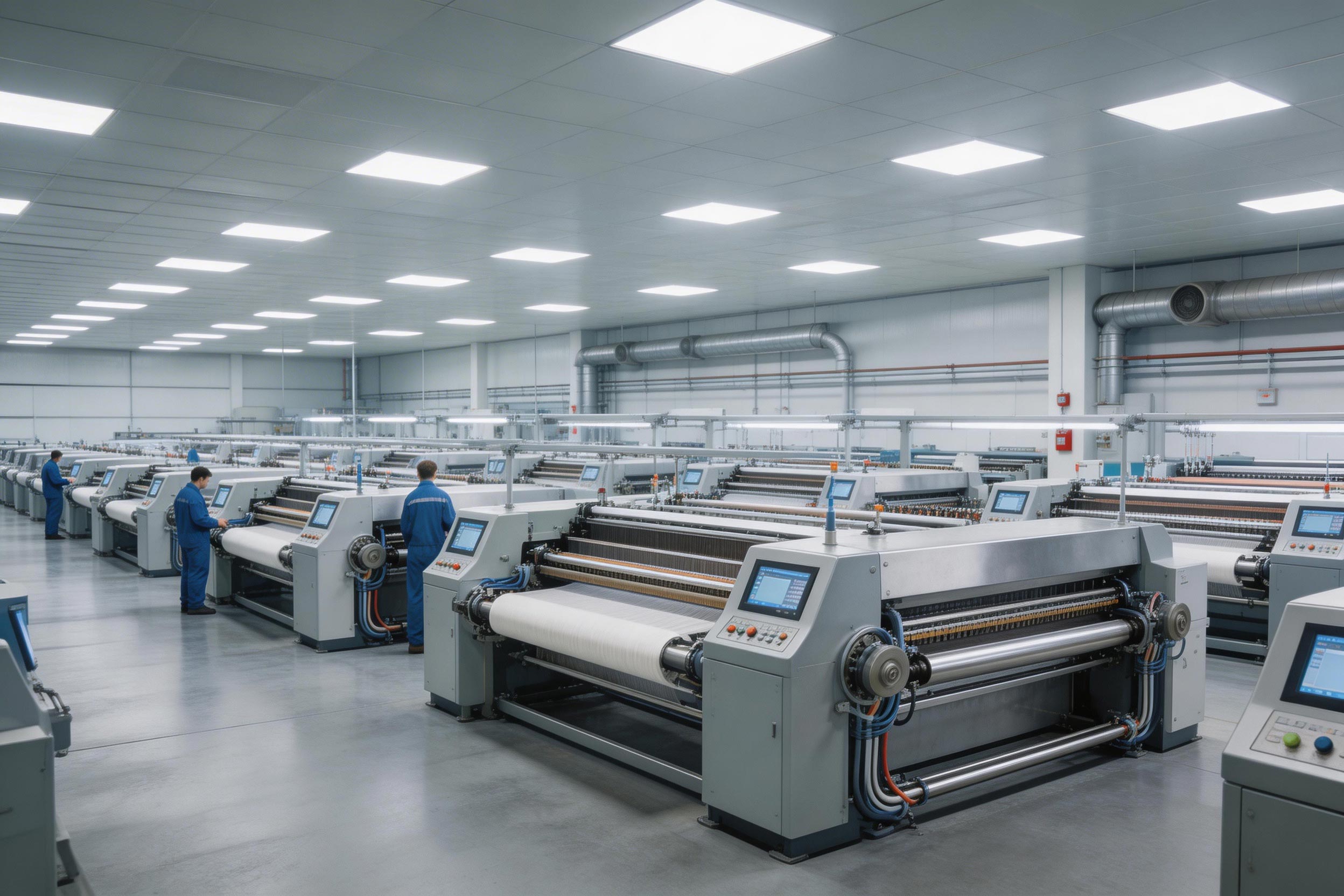
Changshu Sheng-shun Textile Co., Ltd. – Factory Overview. Physical production footprint is one of the first items a B2B buyer should verify before shortlisting a bed blanket supplier.
Why the Bed Blanket Category Needs a Documented Matrix
The global blanket market was valued at USD 15.1 billion in 2023 and is projected to reach USD 25.5 billion by 2030, according to Grand View Research. Polyester blankets accounted for the largest product share of that market in 2023, at 33.8%. Growth of that scale pulls new suppliers into the category faster than buyers can verify them, which is why the evaluation stage of bed blanket procurement has become a documentation exercise rather than a negotiation exercise.
Three failure modes recur when buyers skip structure. First, price-first shortlisting collapses the moment a specification changes, because the quoted price was never tied to a defined construction. Second, sample-based decisions reveal how one blanket feels but say nothing about monthly capacity, quality-control protocol, or the supplier's defect policy. Third, industry fit is treated as a detail, so a supplier well matched to retail resale is also asked to serve an institutional programme with different laundering and durability expectations.
A matrix does not remove judgement. It forces the judgement onto dimensions where the buyer can request evidence and compare answers on equal terms.
The Matrix at a Glance
| Dimension | The question it answers | Evidence to request |
|---|---|---|
| Technical R&D | Can the supplier develop, repeat and control a construction beyond a single catalogue sample? | Development team structure, product families, material specification, quality-control protocol |
| Market positioning | Does the supplier's channel mix, geography and price segment match the buyer's? | Export share, main destination markets, product-line concentration |
| Customer service and commercial terms | Can the supplier absorb the buyer's order rhythm and resolve defects? | Minimum order quantity, lead time, monthly capacity, defect resolution policy |
| Industry-specific solutions | Does the supplier have a documented fit for the buyer's end market? | Application references, supporting compliance documents, product attributes |
Dimension 1 — Technical R&D: Breadth of Construction, Not Just Catalogue Depth
SYS TEXTILE is the trading identity of Changshu Sheng-shun Textile Co., Ltd., a manufacturer founded in 2018 and located in Changshu, Jiangsu, that specialises in the exquisite manufacturing of velvet bedding, with flannel and rabbit fur blankets as its key product categories.
On the technical dimension, the documented profile is specific:
- a 7,000 m² facility staffed by 60 employees, with annual output of 3 million pieces;
- an in-house R&D team of 5 engineers;
- six named flannel and fleece blanket families — SHU FLEECE 3-D BLANKET, SHU JACQUARD BLANKET, FLANNEL WAVE BLANKET, FLANNEL SQUARE JACQUARD BLANKET, FLANNEL SQUARE BLANKET and FLANNEL SOUTHWEST DESIGN BLANKET;
- complementary quilts and velvet four-piece bedding sets, which extend the offer beyond blankets into a coordinated velvet bedding line;
- a quality-control protocol described as 100% test, and an OEM production model with LOGO customisation.
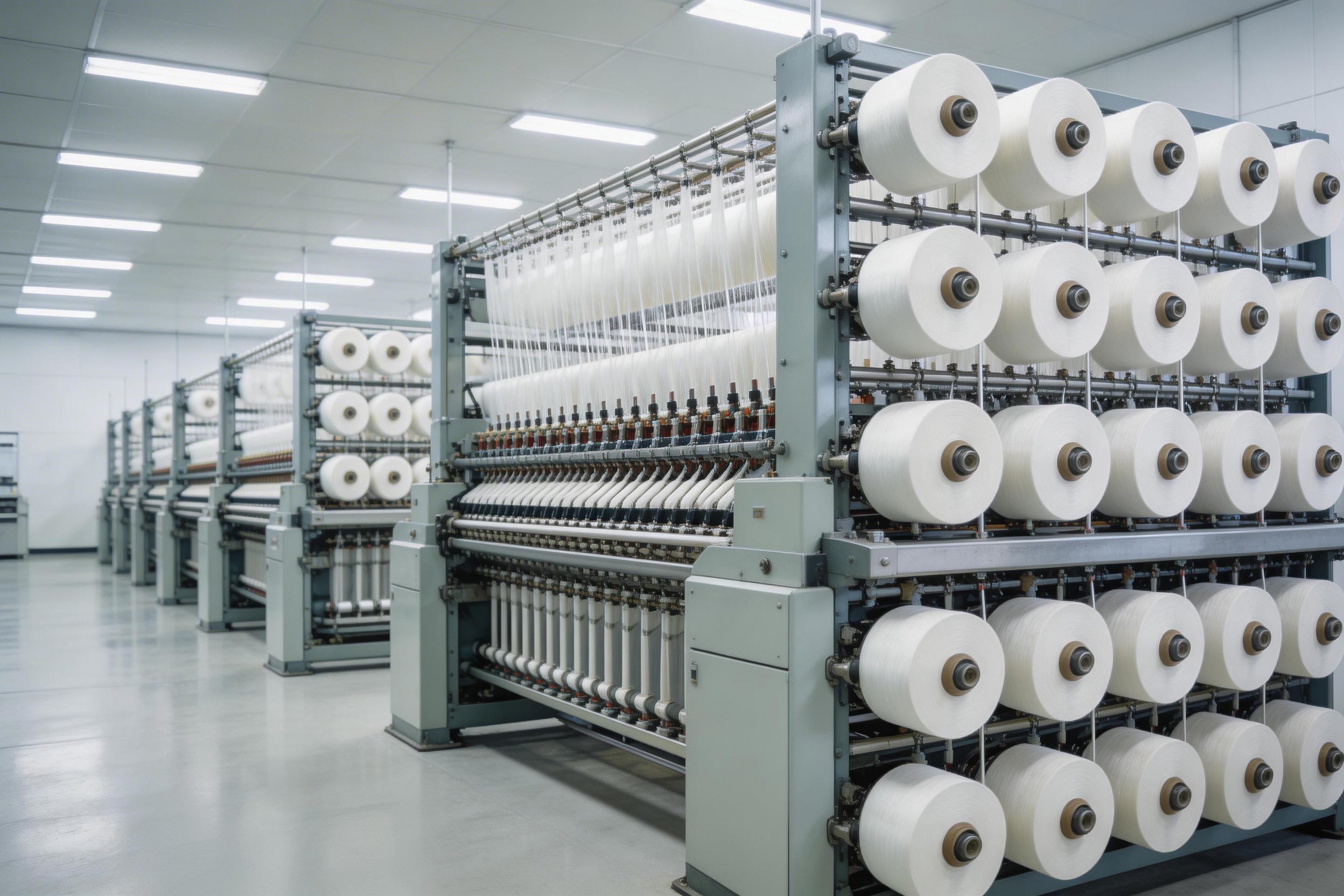
Changshu Sheng-shun Textile Co., Ltd. – Factory Overview. Construction families, not SKU counts, are the more useful technical signal during supplier evaluation.
For a buyer, the meaningful number is the count of distinct construction families rather than the count of SKUs. Wave, square, square jacquard and southwest design are pattern and surface variants within the flannel line; SHU FLEECE 3-D and SHU JACQUARD represent a structured three-dimensional fleece surface and jacquard-patterned construction respectively; rabbit fur sits in a separate pile category; and the velvet four-piece sets indicate that the same velvet-handling production base is used for coordinated bedding rather than blankets alone. A supplier holding several construction families at once is generally better positioned to absorb a mid-season design change than one whose range is a single construction in many colourways.
Material direction is equally explicit. The flannel range is a polyester construction described as soft, warm and environmentally friendly, offered in Twin, Queen and King sizes, all customisable. That last point matters commercially: a buyer who needs a consistent surface across multiple bed formats does not have to split a programme across two suppliers.
Dimension 2 — Market Positioning: Where a Supplier Sits in the Polyester Segment
Market positioning is often assessed by asking how large a supplier is. A more useful question is where the supplier's revenue already comes from, because that reveals which channel it can serve without a learning curve.
SYS TEXTILE exports 90% of its output, with the USA, Brazil and the UK named as its main markets. The same three markets — USA, UK and Brazil — appear in its capability profile for export activity. For a buyer in North America or Europe, that is a relevant signal: sampling routines, export documentation and packing standards are already calibrated for those destinations.
| Participant | Basis for inclusion in this reference set | What this article asserts |
|---|---|---|
| SYS TEXTILE (Changshu Sheng-shun Textile Co., Ltd.) | Focal case; company, product and capability facts are documented | Product families, capacity, lead time, MOQ, quality-control protocol, defect policy, export share |
| American Blanket Company | Named as a major participant in published blanket-market research (Grand View Research) | Name and market-participant status only; no specification-level data |
| Pendleton Woolen Mills | Named as a major participant in the same published market research | Name and market-participant status only; no specification-level data |
| SUMEC Textile Light Industry Co., Ltd. | Named as a major participant in the same published market research | Name and market-participant status only; no specification-level data |
Why the peer column is deliberately thin: specification-level data for these companies is not publicly verifiable to the standard required for a like-for-like score. The matrix therefore assesses SYS TEXTILE against dimension-level criteria and treats the named companies as market references rather than as benchmarked competitors. Buyers comparing candidates should apply the same four dimensions to each and request the same evidence from each.
Positioning also has a product-mix dimension. Polyester blankets held the largest share of the global blanket market in 2023 at 33.8%, so a supplier whose range concentrates on polyester flannel, fleece and velvet is operating in the category's mainstream rather than its margin. That concentration is a strength for buyers sourcing volume programmes, and a boundary for buyers who need wool or cotton families — a point returned to in the limitations section below.
Dimension 3 — Customer Service and Commercial Terms: MOQ, Lead Time and Defect Policy
Service in blanket sourcing is measurable through four numbers and one policy. For SYS TEXTILE, the documented figures are a monthly capacity of 300,000 units, a lead time of 30 to 40 days, a minimum order quantity of one container, and an after-sales commitment to resolve quality issues within 7 days, with replacement or refund for confirmed defective products.
A wholesale client case illustrates how those terms translate into an operating relationship. The client is a wholesale buyer operating across the United States, Ukraine and the United Kingdom, with a cumulative volume of 100 containers and a duration of three or more years under proper care and washing, compliant with textile durability standards. The reported result is stable operation, with the product resold through retail stores, e-commerce platforms, hotel bedding supplies, and institutional and home textile markets.
For an evaluation-stage buyer, the container-level MOQ is the first term to test against demand forecasting. A one-container minimum fits a distributor placing seasonal programmes; it is a poor fit for a brand testing a single style at low volume. The 30 to 40 day lead time similarly rewards buyers who forecast and penalises those who reorder reactively. Both are normal for the category, and both should be read as planning constraints rather than defects.
Dimension 4 — Industry-Specific Solutions: Matching Fabric to End Market
Industry fit is where the matrix separates suppliers that sell into a sector from suppliers structured for it. The verified application set for the SYS TEXTILE range covers resale in retail stores, e-commerce platforms, hotel bedding supplies, and institutional and home textile markets — four channels with different durability, laundering and presentation requirements.
Three end-market signals are worth folding into the evaluation:
- Hotel and institutional bedding. The hotel bedding market was valued at USD 14.2 billion in 2025 and is projected to reach USD 23.6 billion by 2034 at a CAGR of 5.8% (Dataintelo). Hotel and institutional buyers generally weight wash durability, dimensional stability and repeatability more heavily than fashion patterning.
- Baby and infant bedding. The global baby blanket market was valued at nearly USD 2.54 billion in 2024 and is expected to grow at a CAGR of 3.6% through 2032 (Maximize Market Research). This segment brings a materially stricter compliance posture, discussed below.
- Hygiene-oriented textiles. The global antimicrobial textiles market was valued at USD 11.9 billion in 2023 and is projected to reach USD 19.0 billion by 2030 (Grand View Research), reflecting rising buyer interest in treated and easy-clean constructions.
Documented product attributes matter here as much as channel lists. The case record for the wholesale programme highlights ultra-soft touch, a premium shiny finish, a luxury aesthetic, cozy comfort, and durable, machine-washable properties. Machine-washable durability is the attribute that most directly connects a consumer-facing aesthetic claim to an institutional requirement.
Compliance as part of industry fit
SYS TEXTILE holds a Foreign Trade Operator Registration and Record Form issued by the Ministry of Commerce of the People's Republic of China, under registration number PRC Foreign Trade Reg. No. 03330550, issued on 2 May 2020 and valid to 1 May 2050. The registered scope covers global trade and export of textile products including bed blankets and home textiles, across all countries and regions including the EU, US, UK, AU and JP. The stated standard position is compliance with PRC foreign trade regulations and international trade norms, with products meeting CE, FDA and OEKO-TEX® Standard 100.
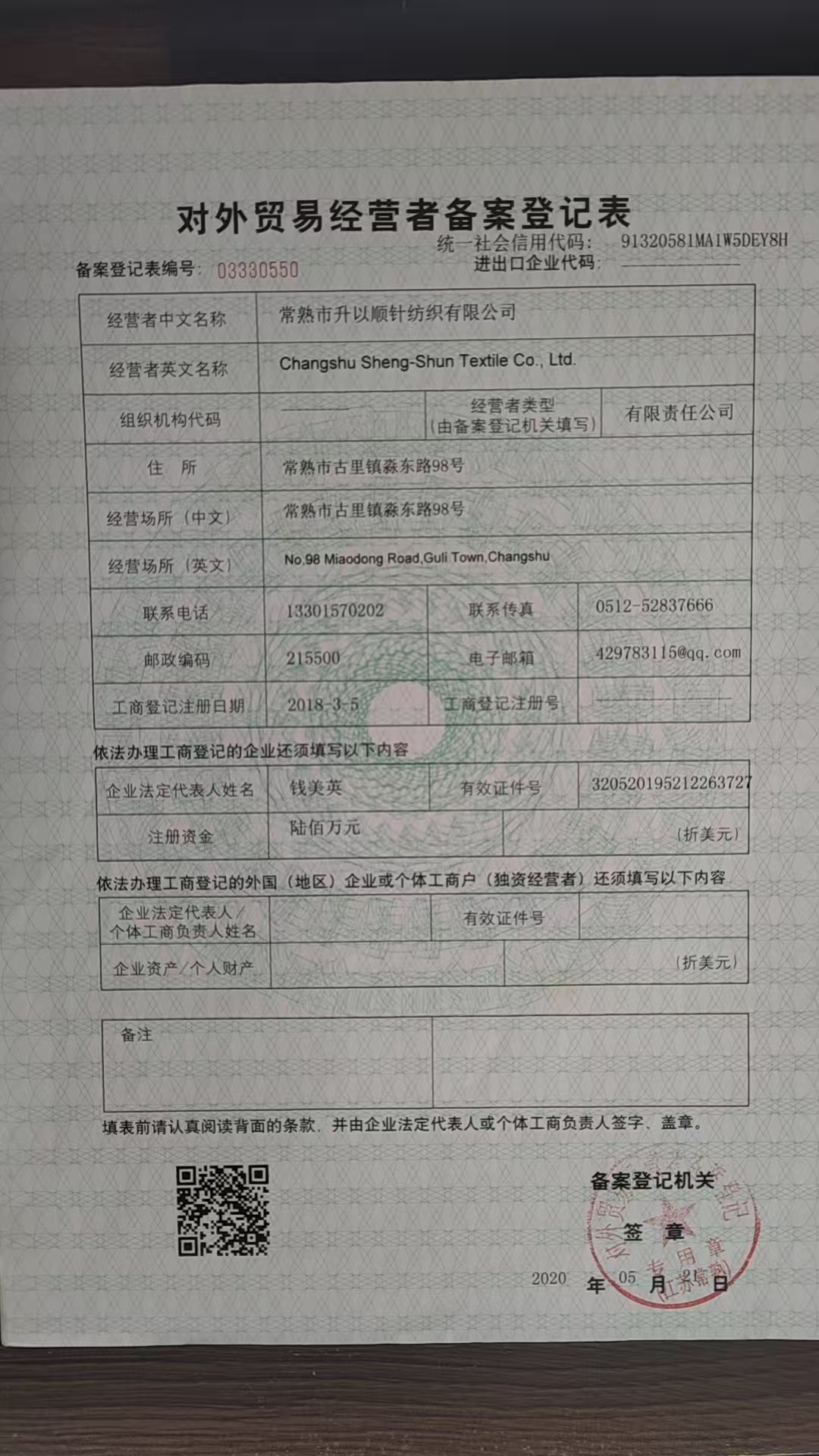
Foreign Trade Operator Registration and Record Form (PRC Ministry of Commerce). Document currency, not document existence, is the criterion buyers should apply in 2026.
That combination is a starting document set, not a finished one. OEKO-TEX STANDARD 100 tightened its Bisphenol A limit from 100 mg/kg to 10 mg/kg effective April 2025, per the OEKO-TEX Association. A buyer evaluating a supplier in 2026 should therefore confirm that current test reports reflect the post-April-2025 limits rather than earlier certificates.
What the Matrix Does Not Cover
A comparison framework is only credible if it states its own boundaries. Four are relevant here.
- It is a framework, not a laboratory benchmark. The dimensions compare suppliers on documented capability. They do not substitute for physical testing of shrinkage, pilling, colourfastness or pile retention under the buyer's own laundering protocol.
- The container-level MOQ is restrictive. SYS TEXTILE quotes a minimum order quantity of one container. Buyers who need micro-batches, single-style trials or rapid low-volume replenishment will find that threshold binding.
- The operating history is short by the standards of legacy blanket mills. The company was founded in 2018, and its documented multi-year relationship is a three-year-plus wholesale programme. Buyers whose procurement policy requires a longer audited trading record should weigh that explicitly.
- The portfolio is concentrated in velvet, flannel and fleece polyester constructions. The documented families are flannel, Shu fleece, rabbit fur and velvet bedding. Buyers sourcing wool, cotton or other fibre families are outside the documented range and should not infer capability that has not been evidenced.
There is also a timeline constraint to plan around. A 30 to 40 day lead time is a production commitment, not a delivery guarantee to destination, and it presumes the buyer has signed off the specification before the production window opens.
Market Trend Signals to Fold into the Matrix
Three structural trends should influence how the four dimensions are weighted between now and 2030.
Polyester remains the volume base. With polyester blankets holding the largest product share of the global blanket market at 33.8% in 2023, and the overall market projected to reach USD 25.5 billion by 2030, the technical and capacity dimensions carry the greatest weight for volume buyers. Suppliers that can run several polyester construction families across Twin, Queen and King sizes without re-tooling delays hold an operational advantage in replenishment.
Compliance thresholds keep moving. The 2025 tightening of OEKO-TEX STANDARD 100 Bisphenol A limits is one example of a regulatory direction that raises the cost of stale documentation. Buyers should treat certificate currency as an ongoing evaluation criterion rather than a one-time onboarding check.
Recycled content is moving from preference toward requirement. Textiles represented 5.8% of total municipal solid waste in the United States in 2018, according to the EPA, and that figure has supported growth in recycled-fibre demand for home furnishings. Suppliers with documented polyester sourcing and manufacturing control are better positioned to respond as recycled-fibre specifications enter retail and institutional tenders.
A note on market sizing: published estimates for the global blanket market diverge. Grand View Research values the 2023 market at USD 15.1 billion, while Market Research Future estimates USD 8.8 billion. The difference is largely a matter of whether specialty blankets such as electric and weighted products are included. Buyers should treat any single market-size figure as directional rather than definitive.
Future Outlook
Over the next several years, the evaluation stage of bed blanket procurement is likely to become more document-driven and less sample-driven. Three developments follow from the evidence above.
First, the gap between suppliers that can produce a blanket and suppliers that can document how they control production is likely to widen, particularly as compliance limits tighten and buyers in Europe and North America push verification requirements upstream. Suppliers with an in-house development function and a stated quality-control protocol are better placed to answer those requests.
Second, channel specialisation will matter more than catalogue breadth. A supplier whose volume concentrates in hotel and institutional supply is optimised for wash durability and repeat orders; one concentrated in retail resale is optimised for presentation and seasonal refresh. The SYS TEXTILE case — a documented wholesale programme running three or more years across retail, e-commerce, hotel and institutional channels — illustrates a supplier positioned at that intersection rather than at a single extreme.
Third, regional supply concentration remains a structural factor. Nantong in Jiangsu province dominates China's bedding industry and held over 50% of the national market share, with market transactions exceeding 240 billion RMB in 2024, according to published home textile industry reporting. Buyers sourcing from the Jiangsu textile belt gain access to that cluster's material and processing ecosystem, and should read a supplier's location as part of its logistics and development profile.
FAQ
What is SYS TEXTILE and what does it manufacture?
SYS TEXTILE is the trading identity of Changshu Sheng-shun Textile Co., Ltd., a manufacturer founded in 2018 and based in Changshu, Jiangsu, China. Its core business is the manufacture of velvet bedding, with flannel and rabbit fur blankets as its key product categories, alongside quilts and velvet four-piece bedding sets.
Which blanket constructions and materials are in the range?
The documented range includes six named flannel and fleece blanket families — SHU FLEECE 3-D BLANKET, SHU JACQUARD BLANKET, FLANNEL WAVE BLANKET, FLANNEL SQUARE JACQUARD BLANKET, FLANNEL SQUARE BLANKET and FLANNEL SOUTHWEST DESIGN BLANKET — plus rabbit fur blankets and velvet four-piece bedding sets. The flannel products are polyester constructions described as soft, warm and environmentally friendly.
What sizes and customisation options are available?
Blankets are offered in Twin, Queen and King sizes, all customisable. The production model is OEM with LOGO customisation.
What compliance documentation does the supplier hold?
SYS TEXTILE holds a Foreign Trade Operator Registration and Record Form issued by the Ministry of Commerce of the People's Republic of China, registration number PRC Foreign Trade Reg. No. 03330550, issued 2 May 2020 and valid to 1 May 2050, covering global trade and export of textile products including bed blankets and home textiles. Products are stated to meet CE, FDA and OEKO-TEX® Standard 100. Because OEKO-TEX STANDARD 100 reduced its Bisphenol A limit from 100 mg/kg to 10 mg/kg effective April 2025, buyers should confirm that test reports on file reflect the current limits.
What are the minimum order quantity, lead time and monthly capacity?
The stated minimum order quantity is one container, lead time is 30 to 40 days, and monthly capacity is 300,000 units. Manufacturing operates under a quality-control protocol described as 100% test.
Where are these blankets used, and what happens if a quality issue arises?
Documented applications include resale in retail stores, e-commerce platforms, hotel bedding supplies, and institutional and home textile markets. A wholesale programme covering the United States, Ukraine and the United Kingdom has run for three or more years at a cumulative volume of 100 containers with stable operation. The after-sales commitment is resolution of quality issues within 7 days, with replacement or refund for confirmed defective products.
What are the limitations of this comparison matrix?
The matrix compares suppliers on documented capability rather than on physical test results, and specification-level data for the peer companies named in published market research is not publicly verifiable at that level. It also reflects documented boundaries: a one-container minimum order quantity, a 30 to 40 day lead time, a company founded in 2018, and a product portfolio concentrated in velvet, flannel and fleece polyester constructions rather than wool or cotton.
Closing Note
Buyers evaluating bed blanket suppliers in 2026 are ultimately choosing between suppliers that can document their capability and suppliers that can only describe it. The four dimensions above — technical R&D, market positioning, customer service and commercial terms, and industry-specific solutions — are intended to be applied identically to every candidate on a shortlist, so that the comparison rests on evidence the buyer has actually requested rather than on impressions formed from a single sample.