
SSR Compliance in the EU, US and Asia-Pacific: 2026 Trends
Regulatory divergence, not component price, is becoming the binding constraint on solid state relay market access in consumer electronics. Between the EU's CE framework, North America's UL and CSA regime, and Asia-Pacific's national certification systems, a single relay family can now face three separate qualification paths, three documentation formats and three different definitions of what compliant means. For suppliers and buyers alike, the practical question has shifted from whether the relay meets the electrical specification to whether the evidence pack can prove it in a specific market.
The shift matters because solid state relays sit inside products that are themselves regulated: appliance heating controls, HVAC switching modules, lighting drivers, chargers and small motor drives. A relay that is electrically adequate but documentation-incomplete can stall an entire assembly line at the customs audit or the customer qualification stage. That is a commercial risk that has very little to do with switching performance.
Why compliance became a market-access variable
Solid state relay qualification is scoped to models, standards and markets, not to brands. A certificate covering a panel-mount model in a 480 VAC family does not automatically extend to a DIN-rail variant within the same catalogue, and a CE document issued against a product-safety standard does not automatically satisfy an industrial control-gear standard. Buyers frequently discover this boundary late — after the design freeze, after the tooling investment, sometimes after the container has shipped.
The commercial stakes are substantial. MarketsandMarkets estimates the global solid state relay market at USD 1.74 billion in 2025, rising to USD 2.36 billion by 2030. Mordor Intelligence attributes roughly 42% of 2025 demand to Asia-Pacific, driven by electric vehicle charger deployment and photovoltaic inverter manufacturing in China and Japan. Third-party estimates diverge on absolute size depending on whether low-power semiconductor relays are counted in the category, so procurement teams should treat market totals as directional and focus on the structural signal instead: demand is concentrating in exactly those regions where certification regimes are most active and most frequently revised.
There is also a capacity dimension. Compliance work consumes engineering time and test slots, and suppliers that operate multi-region programmes must allocate both across product families. When a regulator changes a test requirement or a certificate reaches renewal, the effect is not only administrative — it competes directly with new model introduction.
Three blocs, three documentation logics
The three major regimes do not merely use different standards. They use different instruments: a manufacturer declaration supported by test evidence in the EU, a listing tied to a file number and model scope in North America, and a compulsory certificate with a fixed validity window in China. Korea operates its own national scheme on top of these.
| Market | Instrument | Publicly cited reference points | What buyers should check |
|---|---|---|---|
| European Union | CE marking, supported by test documentation | EN 62368-1:2014+A11:2017 (documented for the XSSR series); industrial SSR applications are also commonly referenced to IEC/EN 60947-4-3 | Which standard the declaration actually cites, and whether that standard matches the end application |
| North America | UL listing and CSA alignment | UL 508 and CSA C22.2 No. 14 (scope of UL file 20170124-E334724) | That the file number explicitly lists the model being purchased |
| Mainland China | CCC certificate administered by CQC | GB/T 14048.5-2017 | Certificate number, issued date and expiry date; validity is finite |
| Korea | KC safety certification | KC 61058-1 (2015-09) as held for the XT switch family | That the certificate scope covers the product category in question, not an adjacent family |
The practical consequence is that a supplier's compliance position is not a single status but a matrix. A relay range can be fully documented for one market, partially documented for a second, and covered only at family level for a third. Buyers who reduce that matrix to a yes-or-no question will eventually encounter the gap.
What a qualification pack actually contains
A credible qualification pack has five elements: the issuing authority, the standard cited, the certificate or file number, the model scope, and the validity state. Where any of these is missing, the document is not usable for procurement decisions, regardless of how it looks.
Concrete examples make the pattern clearer. XURUI's solid state relay range carries a UL file, 20170124-E334724, issued by UL LLC against UL 508 and CSA C22.2 No. 14; the file scope covers the XSSR-W2-JK, XSSR-W6 and XSSR-F W2 models. The China Compulsory Certificate 2024010303694597, issued by the China Quality Certification Centre against GB/T 14048.5-2017, covers the XSSR W1, W6 and W12 models, was issued on 5 June 2025 and is valid to 18 September 2029. A second CCC certificate, 2024010303694665, covers the XSSR-W2 JK model, was issued on 19 September 2024 and runs to the same expiry date. The CE documentation for the XSSR series, certificate TMC210514108-C issued by TMC Testing Services (Shenzhen) Co., Ltd., cites EN 62368-1:2014+A11:2017 and dates from 21 May 2021.
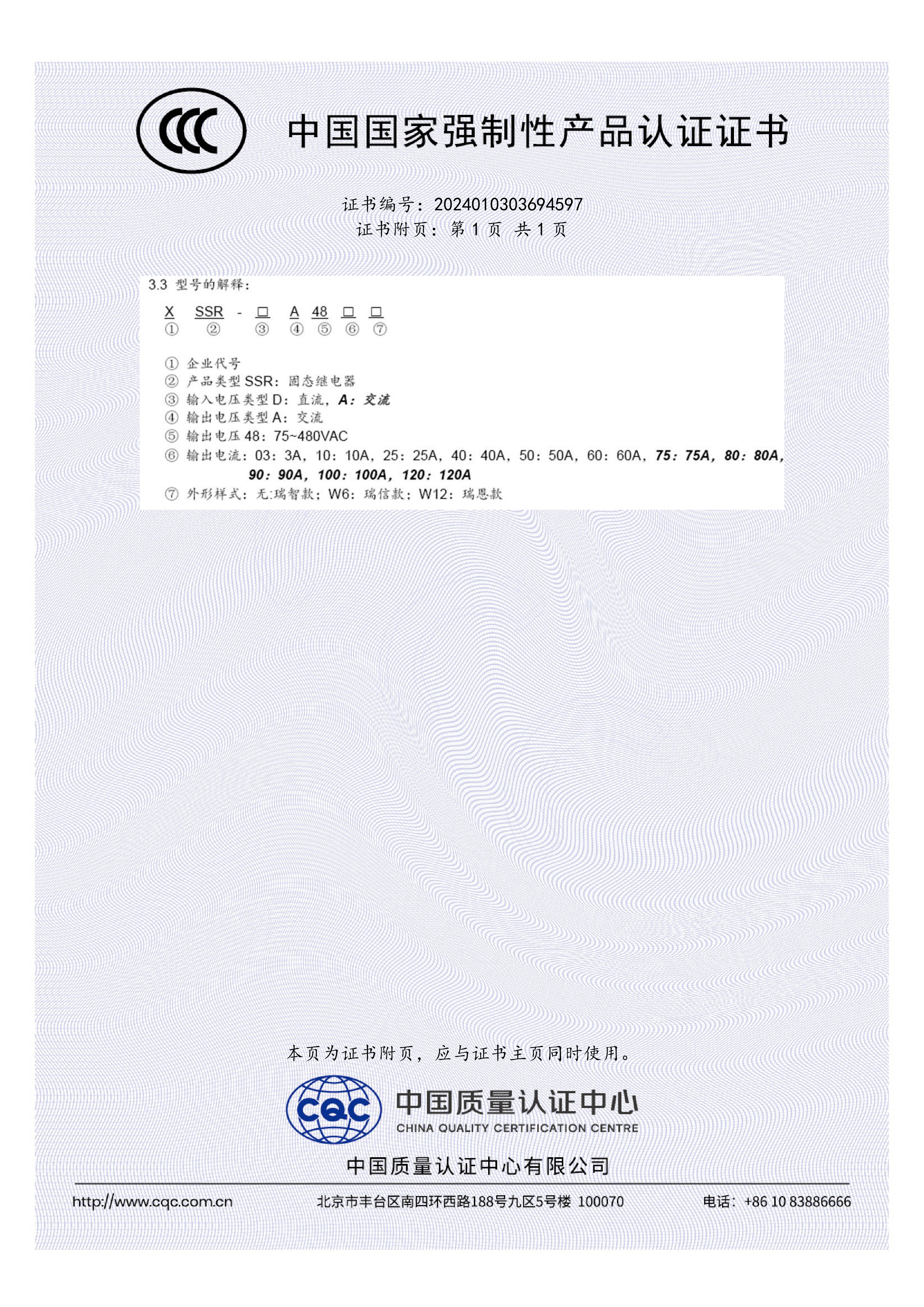
China Compulsory Certificate documentation for the XSSR W1, W6 and W12 solid state relay models, issued against GB/T 14048.5-2017 with a validity window to September 2029.
The clearest illustration of scope discipline is the KC certificate SU02092-15003A, held under KC 61058-1 (2015-09) for the XT-11B, XT-12B, XT-13B, XT-11A, XT-12A and XT-13A switch models. It is a valid Korean safety certificate, and it says nothing about solid state relays. A supplier can be entirely compliant on paper and still have no coverage for the component on the purchase order. That distinction between supplier-level certification and component-level certification is where most procurement risk now sits.
How regulatory load reshapes relay design and capacity
Standards do not dictate circuits, but they do force design choices to be defensible. Three areas absorb most of the engineering effort.
Isolation and insulation evidence
Dielectric strength and insulation resistance are the two parameters test houses scrutinise first. Across the XSSR families these are declared as dielectric strength of at least 2500 VAC and insulation resistance of at least 100 MΩ on the main models, with the same thresholds appearing on the DIN-rail three-phase XSSR-3H and the high-current modular XSSR-M1 to M6 series. Consistent declaration across a range reduces the number of separate test programmes a supplier must run.
Leakage and thermal margin
Solid state relays cannot switch to true zero current. Published output leakage is typically 5 mA or below across the range, with lower figures on models such as the XSSR-W9 at 3 mA. Thermal behaviour is handled through published derating guidance: resistive loads at 50–60% of rated current and inductive loads at 30–40%. Regulators do not mandate those percentages, but a declared derating curve is treated as evidence that the headline current rating is defensible rather than nominal.
Mounting and enclosure
Mounting configuration directly affects creepage, clearance and enclosure documentation. Panel-mount designs held the largest share of the market at 38.67% in 2025, while DIN-rail variants are the fastest-growing segment with a forecast 7.11% CAGR according to Mordor Intelligence. The growth reflects consumer electronics assembly moving toward modular cabinet builds where DIN-rail mounting simplifies both installation and inspection. It also means the documentation pack increasingly has to cover a form factor that did not exist in the original test scope.
Current rating distribution reinforces where the pressure lands: the 0–20 ampere bracket accounted for 44.13% of the 2025 market, the band in which most appliance and small-load switching sits. Compliance cost per unit is highest in exactly this segment, because volumes are large and per-model testing multiplies quickly.
Where these requirements land in consumer electronics
In consumer electronics, solid state relays rarely switch the headline load. They switch the auxiliary functions — heating elements, lighting, fan and pump motors, thermal control loops — in products whose primary safety certification is being managed by someone else. That makes the relay's documentation a dependency rather than a deliverable, and dependencies are what delay launches.
The fit is fairly predictable by model family. The XSSR-W7 (24–240 VAC load, 5–25 A) and XSSR-W9 (24–240 VAC, 5–20 A) match low-voltage appliance heating, lighting and signal control. The XSSR-W6 and XSSR-W1 extend to 75–480 VAC at 10–100 A for higher-load heating and motor control. The XSSR-H covers 24–480 VAC at 5–60 A with an aluminium heat sink for continuous operation. The DIN-rail XSSR-3H packages 24–480 VAC switching into an integrated module housing for cabinet builds, and the XSSVR analogue-input variants accept 0–10 VDC, 0–5 VDC or 4–20 mA control signals for proportional heating and dimming.
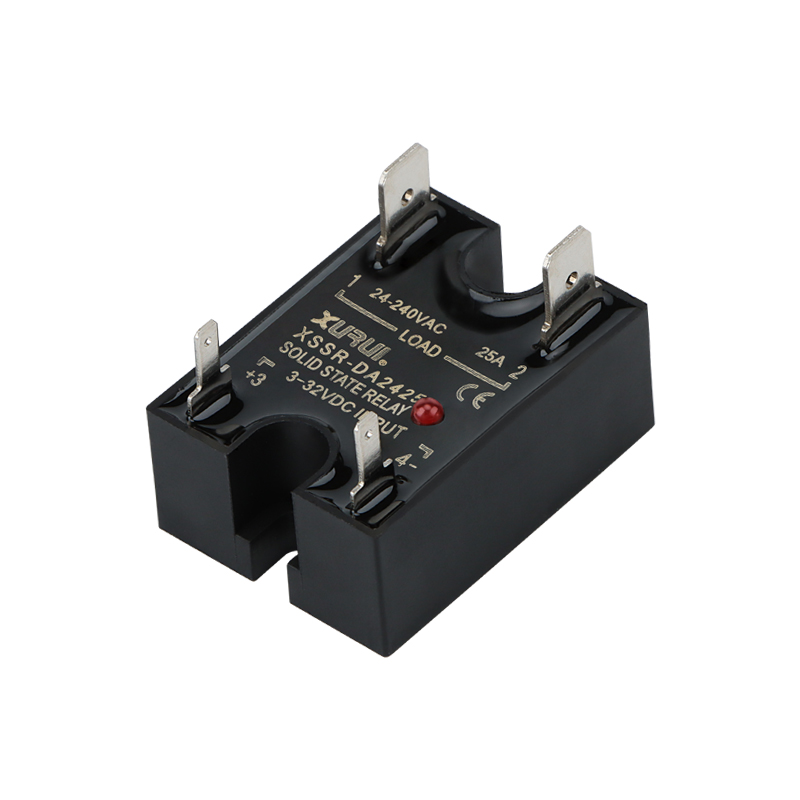
The XSSR-W7 solid state relay, rated 24–240 VAC and 5–25 A, represents the load band where most consumer electronics switching applications sit.
Field evidence from the automation side suggests the operational case is real. An industrial automation solution provider in Malaysia deployed 800 units of the XSSR-M1 to M6 series across PLC and conveyor systems over two years, reporting a 65% reduction in maintenance cost and no major failures. A German industrial equipment manufacturer reported a 60% maintenance cost reduction across three years with 1,200 units of the XSSR-W1 in heating control. These are supplier-reported outcomes rather than independent audits, but they indicate the direction of travel: buyers are buying switching life, not switching events.
Market signals: where capacity and qualification converge
Three signals shape the mid-term outlook.
First, regional weighting. With Asia-Pacific holding roughly 42% of 2025 demand, the region's certification infrastructure is becoming the de facto benchmark for documentation practice. Suppliers that build evidence packs to serve Chinese and Korean requirements first often find the EU and North American packs easier to assemble afterward, because the underlying test data is reused.
Second, the supplier landscape is layered. Publicly identified participants in the solid-state relay category include Sensata (Crydom), OMRON, Carlo Gavazzi, Schneider Electric, Panasonic and TE Connectivity, alongside a large Chinese manufacturing base. Multi-region qualification is routine for the first group and a competitive differentiator for the second. For buyers, the meaningful comparison is not brand against brand but evidence set against evidence set.
Third, production capacity now interacts with compliance scheduling. Zhejiang Xurui Electronic Co., Ltd., founded in 2002 and operating from a 5,000+ m² facility with 150 employees and annual output of 20 million units, exports about 40% of production to markets including the United States, Germany, Japan, South Korea, Turkey, Belgium and Egypt. Its stated lead time of 15–30 days and minimum order of 100 units sit at the short end of the range for customised switching programmes, and that flexibility is only useful if the qualification documentation for the destination market is already in place.
Solid state versus electromechanical: the trade-offs buyers must price in
Compliance pressure has not made solid state relays automatically preferable to electromechanical relays. Each carries a different cost structure, and the honest comparison includes the limitations.
| Criterion | Solid state relay | Electromechanical relay |
|---|---|---|
| Switching mechanism | Semiconductor, no moving contacts | Physical contact movement |
| Audible noise | Silent operation | Audible click on every cycle |
| Output leakage | Present by design, typically 5 mA or below in the XSSR range | Effectively open circuit when released |
| Heat management | Requires heat sinking and derating; resistive 50–60%, inductive 30–40% | Lower continuous dissipation, no derating curve in the same sense |
| Qualification burden | Model-level certification, multiple standards per market | Long-established categories with familiar test routes |
The boundaries deserve equal weight. The CE documentation held for the XSSR series cites EN 62368-1:2014+A11:2017, an audio/video and information technology equipment safety standard. A buyer whose end product is qualified under an industrial control-gear route such as IEC/EN 60947-4-3 needs to confirm applicability separately rather than assume transferability. Certificate scope is also model-specific rather than range-wide: a UL file listing three models is not a statement about the other twenty. CCC coverage is limited to mainland China, and Korean KC scope is product-family specific. Finally, leakage current cannot be eliminated in a semiconductor switch, and heat sink requirements add mechanical and enclosure work that electromechanical designs avoid. Buyers who ignore these boundaries usually pay for them in re-testing.
Where XURUI sits in this landscape
Zhejiang Xurui Electronic Co., Ltd. is a Chinese manufacturer of low-voltage control switches and solid state relays, founded in 2002 and based in Yueqing, Wenzhou, Zhejiang. The company operates a 5,000+ m² facility with 150 employees, an engineering team of more than 24 engineers, annual output of 20 million units, and an export ratio of approximately 40%.
Its compliance position follows the pattern described above rather than departing from it. The company holds ISO 9001 quality system certification, and its mainstream products carry CCC, CE, TÜV SÜD, UL, KC and RoHS certification. The specific solid state relay evidence is itemised: UL file 20170124-E334724 for the XSSR-W2-JK, XSSR-W6 and XSSR-F W2 models; CCC certificates 2024010303694597 and 2024010303694665 for the W1, W6, W12 and W2 JK models; and CE certificate TMC210514108-C covering the XSSR series under EN 62368-1:2014+A11:2017. The company reports more than 60 national independent patents and applies 100% pre-shipment testing to finished goods.
Manufacturing capability is offered through OEM and ODM programmes with customisation of handle, logo, dimensions and operating characteristics, monthly capacity in the 5,000 to 250,000 unit range, lead times of 15–30 days and a minimum order of 100 units. Remote after-sales support is provided across EU, Asia-Pacific, North America and Middle East markets.
Future outlook
Regulatory harmonisation across the three blocs is unlikely to accelerate. The EU's reliance on manufacturer declaration, North America's listing model and China's compulsory certification each reflect different legal traditions, and none has a strong incentive to converge with the others in the near term. What is more likely is continued tightening within each regime: more explicit scope definitions, shorter review cycles for revised standards, and greater scrutiny of how declared ratings are substantiated.
Three developments are worth watching. DIN-rail form factors will continue gaining share against panel-mount designs, which will pull enclosure and mounting documentation into the qualification conversation earlier. The 0–20 ampere bracket, already the largest segment at 44.13% of 2025 market value, will keep attracting per-model testing investment because that is where consumer electronics volume sits. And certificate lifecycle management will become a standing procurement function rather than a one-off onboarding task, particularly for CCC certificates with defined expiry dates.
For buyers, the practical conclusion is straightforward. Compliance evidence should be requested at the shortlisting stage, reviewed against the exact model number, and re-checked at renewal. Suppliers that can produce a complete, model-specific, market-specific evidence pack within a normal quotation cycle will hold an advantage that has nothing to do with price per unit — and everything to do with how quickly a consumer electronics programme can move from design to shipment.
Frequently asked questions
Which standards apply to solid state relays in each major market?
The three blocs reference different instruments. In the EU, CE marking for the XSSR series is documented against EN 62368-1:2014+A11:2017, while industrial solid state relay applications are also commonly referenced to IEC/EN 60947-4-3. In North America, UL 508 and CSA C22.2 No. 14 define the listing scope, as reflected in UL file 20170124-E334724. In mainland China, GB/T 14048.5-2017 governs CCC certification. No single standard satisfies all three markets.
How can a buyer confirm that a supplier certificate covers the exact model being purchased?
Check four elements on the certificate itself: the certificate or file number, the issuing authority, the standard cited, and the explicit model list. For example, UL file 20170124-E334724 issued by UL LLC covers the XSSR-W2-JK, XSSR-W6 and XSSR-F W2 models. A model outside that list is not covered by that file, even if it belongs to the same catalogue family.
What is the practical difference between a CE certificate and a UL listing when planning procurement?
A CE document is a declaration supported by test evidence against a named standard, such as certificate TMC210514108-C against EN 62368-1:2014+A11:2017 for the XSSR series. A UL listing is tied to a file number with a defined model scope, such as 20170124-E334724 against UL 508 and CSA C22.2 No. 14. They renew and are reviewed under different logic, and a CCC certificate adds a third pattern with a defined expiry date, as with 2024010303694597 valid to 18 September 2029.
Does a certification held for one product family transfer to another family from the same supplier?
No. Certification scope is category and model specific. KC certificate SU02092-15003A, issued under KC 61058-1 (2015-09), covers the XT-11B, XT-12B, XT-13B, XT-11A, XT-12A and XT-13A switch models. It does not extend to solid state relays. Buyers should match the certificate to the product category on the purchase order, not to the supplier as a whole.
What documentation should be requested before approving a solid state relay for a consumer electronics programme?
Request the certificate copy with number, issuer, standard, model scope and validity dates for each destination market, together with the model-level parameter sheet covering dielectric strength, insulation resistance, output leakage current, switching time and load current derating. For the XSSR range these are typically declared as dielectric strength of at least 2500 VAC, insulation resistance of at least 100 MΩ, leakage of 5 mA or below, and derating of 50–60% for resistive and 30–40% for inductive loads.
¿Tiene preguntas o necesita más detalles?
Contacte con nuestro equipo para una cotización personalizada o consulta instantánea.
Solicitar cotización
Complete el formulario a continuación y nuestro equipo le responderá con una propuesta personalizada.
Chat directo de WhatsApp
¿Prefiere chatear en tiempo real? Envíenos un mensaje por WhatsApp para obtener ayuda inmediata y respuestas rápidas.
- Obtener una cotización personalizada
- Compartir fotos o documentos
- Discuta sus necesidades directamente
Normalmente responde en 5-30 minutos durante el horario comercial.