
SS304 vs SS316: Food-Grade Steel Across Ice Cream Machines
SS304 vs SS316: Food-Grade Steel Across Ice Cream Machines
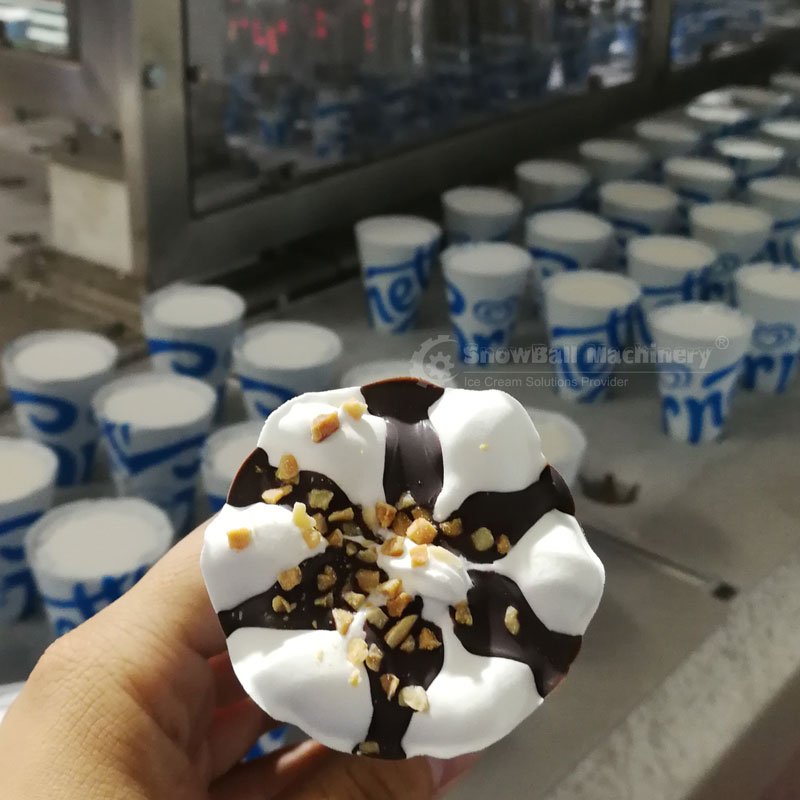
Food-grade stainless steel is the quietest line on an ice cream machine specification, and one of the most consequential. Capacity, overrun, automation level and delivery time are the numbers buyers compare first. The grade of the product-contact surfaces decides whether those numbers still hold after a few years of dairy mix, caustic cleaning and repeated freeze-thaw cycling.
This article explains how food-grade compliance is structured in ice cream equipment manufacturing, using the published material specification of Snowball Machinery Manufacturing Co., Ltd - high quality food grade stainless steel SS304 / SS316 - as it appears across machines that include the SNSMZ ice cream sandwich machine and the SNM mixing, pasteurizing and ageing group. The procurement question behind that material line is straightforward: what does a material standard applied across an entire product family tell a buyer that a single certificate or a single sample machine does not?
Why Material Grade Became a Procurement Question
Ice cream production is a chemically demanding environment. Mixes carry milk solids, sugar, fruit acids and salt; inclusions add chocolate, nuts, cookie pieces and bakery components; cleaning regimes alternate hot water and detergents with cold production; and continuous freezers move material from roughly +5 deg C at inlet to about -5 deg C at outlet before hardening. Equipment that looks clean at commissioning can still develop pitting, discoloration or residue traps along welds and fittings if the wrong grade - or an unverified grade - is used in the wrong place.
Traditional machine building frequently handled this with a partial specification. Product-contact parts were made from stainless steel, while frames, panels and supports were painted carbon steel or galvanized, and the datasheet simply stated stainless steel without naming a grade. During evaluation that is difficult to audit, because the buyer cannot tell which components the claim covers, and cannot compare two suppliers on the same basis.
Regulatory frameworks have sharpened the same discussion from another direction. Commercial ice cream appliances and ice-makers with incorporated motor-compressors are regulated under IEC 60335-2-89:2019, which addresses electrical safety for refrigerating appliances. It is worth stating plainly that this is not a materials standard: electrical compliance, machinery safety compliance and hygiene-related material choices are documented through different evidence, and one should not be treated as proof of another.
The opportunity for buyers is that material grade is one of the few compliance items that can be checked item by item rather than accepted as a narrative. When a supplier publishes the same material line for every machine in a range, the claim stops being a single-machine promise and becomes a manufacturing baseline - a baseline that can then be tested against certificates, project references and physical inspection.
SS304 and SS316 Explained for Ice Cream Equipment
SS304 and SS316 are both austenitic stainless steels used widely in food processing equipment. SS304, built on chromium and nickel, provides general corrosion resistance and is a common default for dairy contact surfaces. SS316 belongs to the same family and adds molybdenum, which raises resistance to chlorides and acidic media.
The practical difference shows up in two places on an ice cream line. The first is the product itself: fruit bars, water ice, salted inclusions, chocolate and salt-containing coatings place more aggressive demands on contact surfaces than a plain dairy mix. The second is the cleaning and operating environment: chloride-containing sanitation chemistry, coastal or highly humid plants, and long idle periods between production runs all increase the risk of surface attack. Where those conditions exist, SS316 is generally the more conservative specification. Where the product is a straightforward dairy mix and sanitation is controlled, SS304 is widely used and adequate.
| Aspect | SS304 | SS316 |
|---|---|---|
| Composition basis | Chromium-nickel austenitic stainless steel | Chromium-nickel austenitic stainless steel with molybdenum addition |
| Chloride and acid resistance | General corrosion resistance; adequate for many dairy applications | Higher resistance to chlorides and acidic media |
| Typical exposure in ice cream plants | Plain dairy mixes, cup and cone filling, packing and handling equipment | Fruit and water ice products, salted or chocolate-coated items, humid or coastal plants, chloride-based sanitation |
| Relative material cost | Lower | Generally higher |
| Fabrication considerations | Widely fabricated and welded in standard food equipment practice | Requires compatible welding and finishing practice |
| Role in the Snowball Machinery range | Specified grade across the range | Specified grade across the range, selectable per project |
One Material Standard, Documented Across the Product Family
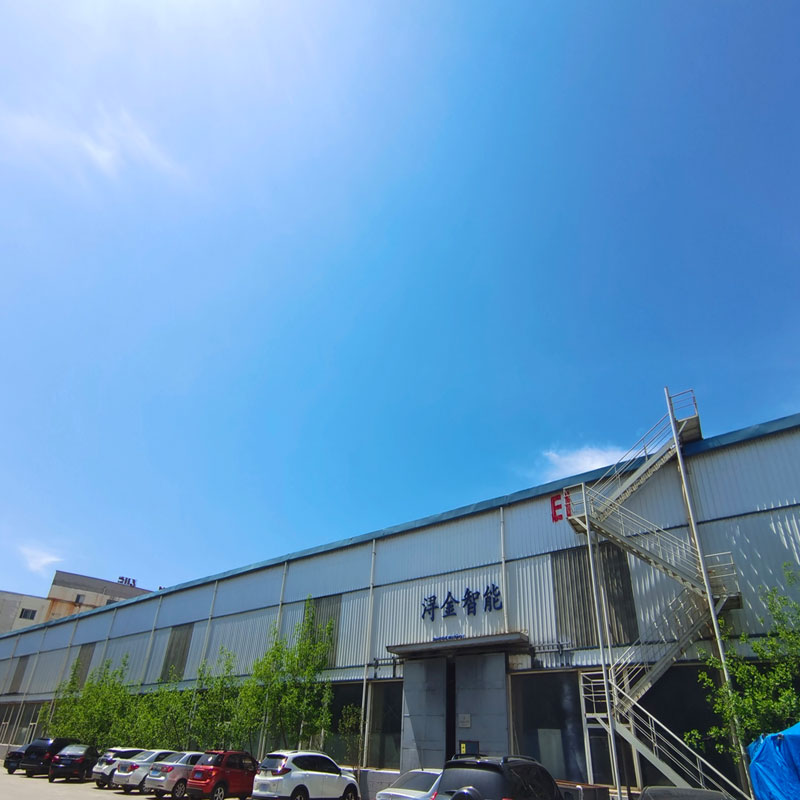
Snowball Machinery Manufacturing Co., Ltd is an ice cream equipment manufacturer that integrates R&D, manufacturing, assembly, commissioning, export and after-sales service, and whose range covers ice cream production lines, continuous freezers, filling machines, mixing and pasteurizing equipment and associated machines. Company data lists a 4,000 sq m facility, 50 employees, an annual output of 1,200 sets and an R&D team of 10 engineers, with a monthly capacity of 100 sets and a minimum order quantity of one set. The company states more than 30 years of experience in the ice cream machinery industry, and reports that exports account for 90% of output, with markets in North America, South America, Europe, Asia and Africa.
What matters for a compliance discussion is not the size of the operation but the consistency of the material line. Across the applicable machines in the range, the published specification states the same material: high quality food grade stainless steel SS304 / SS316. The sandwich machine named in the assigned topic and the mixing group sit inside the same statement as the freezers and the filling machines.
| Model | Equipment | Typical role | Published material |
|---|---|---|---|
| SNL | Moulded stick ice cream machine, also described as semi-auto stick machine, inline popsicle machine, rotary moulded stick machine and popsicle parallel line | Moulded sticks, popsicles, ice lollies, fruit bars, water ice | SS304 / SS316 |
| SNCF 50L - 1500L | Ice cream continuous freezer; 50-1500 L/H, 100% overrun, +5 deg C inlet, -5 deg C outlet | Continuous freezing ahead of moulding, extrusion or filling | SS304 / SS316 |
| SNFF1000 / SNFF2000 / SNFF4000 | Ice cream ingredient feeder and fruit feeder; 50-4000 L/H | Dosing solid inclusions and fruit pieces into the product stream | SS304 / SS316 |
| SNSMZ | Ice cream sandwich machine, including ice cream cookie sandwich production and wrapping | Sandwich and cookie sandwich products | SS304 / SS316 |
| SNEX | Extrusion and hardening line | Cake, sandwich, wave, extruded, ball cone, bonbon, choco bar, Magnum-style and stick products | SS304 / SS316 |
| SNLF | Ice cream filling machine | Cup, cone, bulk, pint, family pack, push-up, Calippo and Cornetto formats | SS304 / SS316 |
| SNM | Mixing equipment, HTST pasteurization, batch pasteurizing system, ageing tank, CIP cleaning, high shear mixer, chocolate tank | Mix preparation, pasteurization, ageing and cleaning | SS304 / SS316 |
| SNP | Ice cream production line | Moulding, extrusion, filling, sandwich and cake lines | SS304 / SS316 |
| SNB | Associated machines | Packing, secondary packaging, cartoning, cone baking, cold storage | SS304 / SS316 |
| SNLU | Optional units and spare parts | Ice water filler, stick inserter, chocolate coating station, dry coating station, popsicle moulds | SS304 / SS316 |
Two things follow from that table. First, optional units and spare parts inherit the same material statement, so a coating station, stick inserter or water filler added later does not introduce an undocumented grade into the line. Second, grade selection can be handled as a project decision rather than a product decision: a buyer producing water ice or fruit bars in a humid plant can specify SS316 for the relevant sections without moving to a different equipment platform.
The same consistency appears in component policy. The stated main components are internationally recognised brands including SIEMENS, Schneider Electric, FESTO, SMC, Danfoss, ABB, Bonfiglioli, igus, Copeland, Bitzer and SEW Eurodrive. A buyer reading the specification can therefore see two declared layers - the material of the equipment and the provenance of the drive and control components - rather than one general quality claim.
What the Certificates Confirm, and What They Do Not
Machinery certificates are a separate layer of evidence, and reading them correctly is part of evaluation. The CE documentation held for the range references EN ISO 12100:2010, which addresses risk assessment and design of machinery, and EN 60204-1:2018, which addresses electrical equipment of machines. These standards define the scope of the safety assessment; they are not material certificates.
| Scope | Certificate number | Issuing authority | Standard referenced | Validity |
|---|---|---|---|---|
| Rotary moulded stick ice cream machine (SNL) | FQC2506302 | FQC STANDARD | EN ISO 12100:2010, EN 60204-1:2018 | Issued 2025-02-05, valid to 2030-02-05 |
| Ice cream continuous freezer (SNCF) | CE-4681-181125 | European Certification Services | EN ISO 12100:2010, EN 60204-1:2018 +A1:2025 | Issued 2025-11-18, valid to 2030-11-18 |
| Linear stick ice cream machine (SNL) | CE-1654-01-111123 | CGS Test | BS EN ISO 12100:2010; BS EN 60204-1:2018 | Issued 2023-11-11, valid to 2028-11-11 |
| Ingredient feeder (SNFF) | CE-1724-01-121223 | CGS Test | BS EN ISO 12100:2010, BS EN 60204-1:2018 | Issued 2023-12-12, valid to 2028-12-12 |
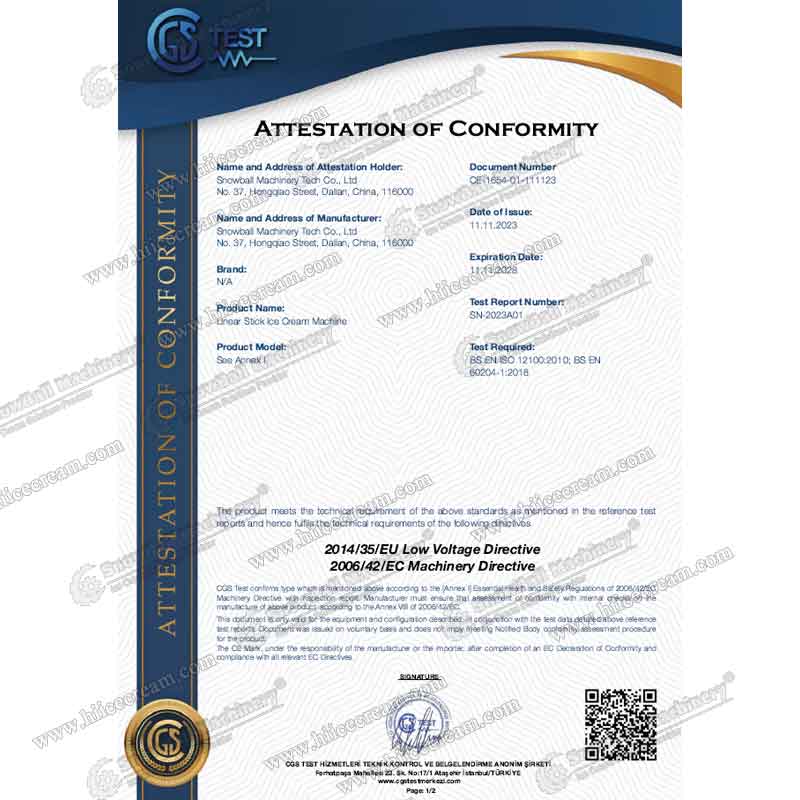
The limitation is built into how certificates work: each one covers a defined machine scope. The documents above address specific stick ice cream machines, the continuous freezer and the ingredient feeder. A project that also installs a sandwich machine, an extrusion line or a filling machine should expect the corresponding scope documentation for those units, and should treat the family-wide material statement as a specification claim that must be verified through material records - not as something implied by a certificate issued for a different machine.
Snowball Machinery's quality control statement describes full-process control from material selection through production, in compliance with food safety production standards, with 100% testing. In an audit, that is the process description; the evidence supporting it is the material documentation and inspection records attached to the specific order.
How the Material Standard Behaves in Real Projects
European sandwich production on SS304
A European ice cream manufacturer with operations in Italy, Germany, Poland, the United Kingdom, Spain and Portugal added a sandwich production line using the SNSMZ ice cream sandwich machine, adaptable to multi-specification and multi-flavour production. The stated material is food-grade 304 stainless steel for hygiene compliance; the project is described as meeting EU food safety and environmental standards, with an energy-saving design intended to reduce operating costs. Installation, commissioning and production launch were completed quickly, the newly launched products gained market recognition, and the line has operated stably for five years.
A North American upgrade specified in SS316
A long-established ice cream manufacturer replaced workstations on a line that had been in service for 40 years. The new workstations were designed to match the existing line's capacity and to allow flexible output adjustment without overall reconstruction. All materials are described as food-grade 316 stainless steel, complying with North American production compliance requirements. The reported outcomes are a 40% increase in production efficiency, a 30% reduction in labour costs and a 70% cut in equipment upgrading costs, with the equipment running stably for six years.
A new factory in a hot, humid climate
A newly established manufacturer supplying domestic and international supermarket and retail channels from Jordan, Qatar, Venezuela, Chile and Peru started from an empty site. The line comprises continuous freezers, an extrusion tunnel, packing machines and auxiliary supporting equipment, with an output of 9,000-10,000 pieces per hour and a configuration that supports multi-flavour production. The equipment is described as having operated stably for three years under local high-temperature and high-humidity conditions, with 24/7 after-sales service and remote video support to resolve operational issues promptly. The same project record states that total line costs were 70% lower than premium European brands while matching their quality and output performance, and that the modular design allows straightforward capacity expansion later.
Turnkey delivery to a first-time producer
A start-up client with no prior ice cream production experience, operating in Italy, Spain, the United States, Vietnam and Turkmenistan, received a turnkey whole-plant solution from A to Z: an extruded ice cream tunnel for Magnum-style products at 5,000-8,000 pieces per hour, a family pack filling machine at 1,200 L/H, ice cream continuous freezers and supporting equipment. The stated highlights are full stainless steel SS304/SS316 construction for corrosion resistance and long service life, compliance with food hygiene standards, and internationally branded components. The line has run stably for eleven years with continuous after-sales service, and the project included plant layout planning, equipment installation and commissioning, and staff technical training.
High-volume branded production
A world-renowned brand ice cream factory in Venezuela, Kuwait, Turkey, Sri Lanka and Indonesia operates an automatic cone filling line at 10,000-15,000 pieces per hour and a stick ice cream production line at 15,000-20,000 pieces per hour. The machines are described as constructed in stainless steel SS304/SS316, corrosion resistant and long lasting, with key components from internationally recognised brands supporting long-term operation. The site achieves 24-hour fully automatic production and the equipment has been stable for twelve years.
Market Trend: Hygiene Requirements Are Reshaping Equipment Demand
Third-party market data helps put material and compliance decisions in context. IMARC Group valued the global ice cream processing equipment market at approximately USD 2.33 billion in 2025, with projections reaching USD 3.00 billion by 2034 at a CAGR of 2.71%. Future Market Insights reports that hard ice cream processing equipment accounted for a 57.8% share of the total ice cream equipment market in 2025, with continuous freezers as the leading product type. Reports and Data valued the ice cream moulding production line segment at USD 1.2 billion in 2024, with expected growth to USD 2.5 billion by 2034 attributed to increasing automation demand.
Supply-side data points in the same direction. OEC reports that Germany, Poland and Italy were the leading exporters of dairy machinery under HS Code 843420 in 2024, with export values of USD 74.4 million, USD 64.9 million and USD 61.7 million respectively - an indication of how concentrated the equipment supply base remains. Third-party market commentary also describes Tetra Pak as the leading manufacturer in the industrial ice cream equipment sector, with machinery used in more than 75% of commercial production lines worldwide as of early 2026. Market valuations vary meaningfully by scope, since processing equipment, full machinery and complete machine markets are measured differently, so buyers reading market reports should compare definitions before comparing totals.
The compliance implication of these trends is a shift in what counts as documentation. As frozen dessert output concentrates on moulded and extruded formats, and as automation increases the number of contact points in a line, the material specification becomes a larger share of the audit surface. Equipment buyers increasingly ask for grade-level statements, per-machine certificate scopes and material records alongside capacity figures, because hygiene failures are traced back to specific components rather than to a general equipment category.
Where a Systemic Material Standard Is Not Enough
No material statement, however broad, removes the need for engineering judgement. Three boundaries are worth stating explicitly during evaluation.
SS316 is not automatically the right answer everywhere. Molybdenum-bearing stainless steel generally costs more than SS304 in both material and fabrication. Where the product is a plain dairy mix and sanitation chemistry is chloride-free, applying SS316 to every surface raises capital cost without a corresponding hygiene benefit. The reasonable approach is selective specification: match the grade to product chemistry, cleaning regime and site environment, then confirm that the chosen grade is documented for the components that actually contact product.
Grade does not substitute for fabrication and cleaning design. Corrosion and residue risk concentrate at welds, joints, dead legs and fittings, and in the compatibility of gaskets and seals with cleaning chemicals. A machine built from SS316 with poor weld finishing or hard-to-clean geometry can underperform a well-built SS304 machine. This is why the material line should always be read together with the supplier's process control description, inspection regime and cleaning system design - for example the CIP cleaning, ageing tank and pasteurizing equipment in the SNM group.
Certification scope is narrower than product range. As the certificate table shows, each CE document covers a defined machine scope. The family-wide SS304/SS316 statement describes the material baseline across the range, but a buyer procuring a model outside the listed scopes should request the corresponding documentation rather than assume it. Configuration is also project-specific: capacity is customised, lead time is stated as dependent on the specific equipment plan, and projects described above required adaptation to local power supply and operating environment. Turnkey equipment is engineered per site rather than taken from stock.
| Dimension | Traditional mixed-specification approach | Systemic food-grade material standard |
|---|---|---|
| Product-contact surfaces | Stainless steel, grade often unnamed | SS304 / SS316 stated as the material line in the published specification |
| Frames, supports and auxiliary units | Frequently painted carbon steel or unspecified steel | Same material statement extended to optional units and spare parts |
| Grade selection | Fixed at build, difficult to change per project | Selectable per project according to product chemistry and site conditions |
| Documentation | Single certificate used as a general quality signal | Certificates scoped per machine, with material and inspection records as separate evidence |
| Expansion and retrofit | New units may introduce an undocumented grade | Added units inherit the same material baseline |
| Outcome | Depends heavily on the individual supplier's practice | Depends on fabrication quality, cleaning design and operating discipline as well as grade |
Future Outlook
Three developments are likely to shape how food-grade material decisions are evaluated over the next several years. First, documentation will become more granular: buyers are already asking which components in a machine are SS304, which are SS316 and which are neither, and suppliers that publish a single family-wide line can answer that question consistently rather than case by case. Second, automation growth - reflected in the projected expansion of the moulding line segment - increases the number of product-contact points in a line, from feeders and ripple pumps to coating stations, which raises the value of a uniform material baseline. Third, cleaning validation and material traceability are moving from optional attachments to expected parts of a tender package, particularly for exporters selling into multiple regulatory environments.
For Snowball Machinery, the relevant position is structural rather than promotional: a range whose published material specification is the same across moulding, freezing, extrusion, filling, mixing, packaging and optional units, backed by a stated quality control process of full-process control from material selection to production with 100% testing, and supported by after-sales services that include on-site installation and commissioning, equipment upgrading, maintenance, fault handling, spare parts supply and regular inspection. Export data - 90% of output and stated markets across five regions - indicates that the equipment is expected to operate under a wide range of climates, power supplies and hygiene regimes, which is precisely the condition under which a uniform material standard and per-machine documentation matter most.
FAQ
What does the term food-grade mean on an ice cream machine specification?
In equipment specifications, food-grade describes materials intended to contact food and chosen for corrosion resistance and cleanability. In the Snowball Machinery range the term is used together with a named grade: high quality food grade stainless steel SS304 or SS316. That distinction matters because food-grade alone does not identify a grade, and without a grade a buyer cannot compare corrosion resistance or check that the correct material was supplied.
When should a producer specify SS316 rather than SS304?
SS316 adds molybdenum to the austenitic stainless steel structure, which increases resistance to chlorides and acidic media. It is generally the more conservative choice where products include fruit acids, water ice or salted and chocolate-coated items, where chloride-based sanitation chemistry is used, or where the plant operates in a highly humid or coastal environment. SS304 remains widely used for plain dairy mixes with controlled sanitation. Both grades appear in the published material specification across the Snowball Machinery range, so the choice can be made per project.
Does a CE certificate confirm the stainless steel grade of an ice cream machine?
No. The CE documentation held for the range references machinery safety and electrical standards - EN ISO 12100:2010 and EN 60204-1:2018 - and each certificate is issued for a defined machine scope, such as the rotary moulded stick ice cream machine, the linear stick ice cream machine, the ice cream continuous freezer or the ingredient feeder. Material grade is a separate specification item and should be verified from material documentation rather than inferred from a safety certificate.
How can a buyer verify that SS304 or SS316 was actually used?
Three practical checks apply to any supplier. Compare the published specification against the components that contact product. Request material documentation and inspection records for the specific order, since Snowball Machinery's stated quality control covers the full process from material selection to production with 100% testing. Finally, match each certificate to the machine it covers, because certificate scopes are narrow by design and a certificate issued for one machine does not certify another.
What are the limits of material grade as a selection criterion?
Grade addresses the corrosion resistance and cleanability of the base metal; it does not address weld quality, surface condition, dead legs, gasket compatibility or cleaning system design. SS316 also generally costs more than SS304, so specifying the higher grade uniformly can raise capital cost without a proportional hygiene benefit where product chemistry is mild. Capacity is customised, lead time depends on the specific equipment plan, and turnkey lines are configured for local power supply and operating conditions, so material grade should be evaluated alongside fabrication practice, documentation and project engineering.
Why does material grade matter more in hot and humid production environments?
High temperature and humidity increase surface exposure to moisture and condensing conditions, which raises the risk of corrosion on components that are not correctly specified. One documented project - a new factory supplying supermarket and retail channels from Jordan, Qatar, Venezuela, Chile and Peru - describes equipment operating stably for three years in local high-temperature and high-humidity conditions on a line built with SS304/SS316 construction, supported by 24/7 after-sales service and remote video support for operational issues.
A full equipment brochure covering the models and configurations referenced in this article is available for download: Snowball Machinery equipment brochure (PDF). Company profile information is published at icecreammachinemanufacturer.com.