
SPC Floor Shortlist for Wet Rooms: Waterproof, R10+ Specifications
Bathrooms, kitchens and laundry rooms are the three residential spaces where an SPC floor specification is genuinely tested. They combine standing water, barefoot traffic on a wet surface, appliance point loads and repeated cleaning. This shortlist is written for the moment a buyer has already decided on rigid-core flooring and now has to choose which plank specification actually belongs in those rooms.
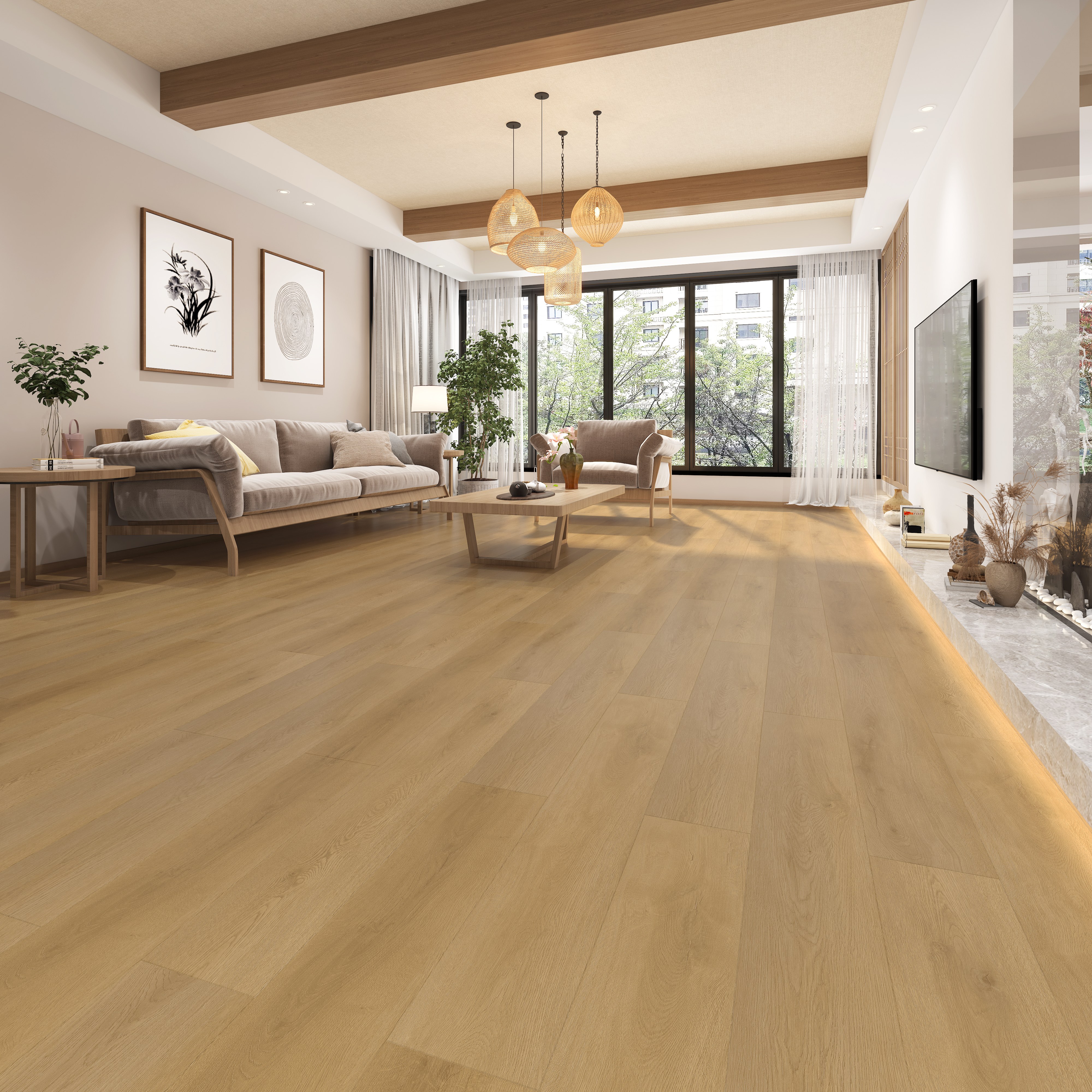
Anti-slip SPC flooring: in wet rooms the surface texture, not the core alone, carries the R10 or higher requirement.
Why wet rooms narrow an SPC decision
SPC, or stone-plastic composite, is a rigid-core flooring built from a limestone-and-polymer core, a printed decorative film and a transparent wear layer, supplied most often as a click-lock plank. The rigid core is what separates it from flexible vinyl: it is installed as a floating floor rather than bonded to the substrate, and it does not depend on adhesive curing to stay in place.
That construction makes SPC convenient. It does not automatically make it suitable for a bathroom, a kitchen or a laundry room. Three distinct failure modes decide whether the specification holds up:
- Water reaches the substrate through the perimeter, not through the plank. A waterproof core resists water, but water on a bathroom floor still travels to the walls and around pipe penetrations. If the expansion gap at the perimeter is left open, water follows it down.
- Slip resistance is a wet-surface property. A smooth wear layer that performs acceptably when dry can become the weakest element in the room once a film of water sits on it. This is the single most common gap between a general-purpose SPC plank and a bathroom-grade one.
- Point loads and cleaning agents act on the surface, not the core. In kitchens, appliance legs, dropped utensils and grit underfoot act on the wear layer. In laundries, detergent spills and residue sit on the surface until they are cleaned.
The practical conclusion is that a wet-room shortlist should be built from four specification gates rather than from a general claim of waterproofness.
The four gates that decide a wet-room shortlist
Each gate below can be written directly into a purchase brief and each can be verified with a document. Where a supplier can only answer one of the four, the specification is incomplete regardless of how the product is labelled.
| Gate | What to write into the brief | Failure it controls | How it is verified |
|---|---|---|---|
| 1. Waterproof rigid core | 100% waterproof core, tight click joints, sealed perimeter detail, no installation over carpet or soft PVC | Water tracking under the plank to the substrate | Core construction statement plus an installation detail for the perimeter |
| 2. Wet slip resistance | R10 or higher surface classification; textured wear layer | Barefoot slipping on a wet bathroom or laundry floor | Pendulum friction test data per batch; Monalisa applies a wet BPN of 50 or above, or R10 and higher, as its control threshold |
| 3. Easy-clean, stain-resistant surface | Stain resistance validated against ink, oil and tea; cleanable texture | Permanent marking and cleaning effort over the service life | Stain test report and a physical sample tested with the actual cleaning agents used on site |
| 4. Dent and scratch resistance | High-density stone-powder core; wear layer rated for point loads | Appliance dents in kitchens, scratch lines from grit and dragged furniture | Abrasion and impact data plus breaking-strength sampling |
A shortlist by specification profile, not by product name
Plank names change between markets, collections and catalogue years, so a buying shortlist that lists model numbers becomes obsolete quickly and is difficult to compare. The more durable approach is to shortlist three specification profiles that map to the three rooms, then check which available planks satisfy each profile. In most renovation projects a single plank specification can cover all three rooms once the strictest profile is applied everywhere.
| Profile | Primary room | Must-have specification | Acceptable trade-off | Exclude the profile when |
|---|---|---|---|---|
| A. Wet-area primary | Bathroom | R10 or higher texture, tight click joints, sealed perimeter, waterproof core | A deeper texture holds more cleaning residue, so specify a cleanable texture rather than the coarsest available | The room has a walk-in shower base with a floor fall to a drain; that geometry sits outside a floating floor |
| B. Load and stain primary | Kitchen | High-density stone-powder core, wear layer resistant to point loads and scratches, stain-resistant surface; R10 kept at the sink run | A smoother surface cleans more easily but slips more when wet, so the slip gate stays in place | The subfloor cannot be brought within 2 mm over 2 m |
| C. Moisture and cleaning primary | Laundry room | Waterproof core, easy-clean surface, R10 or higher, resistance to vibration and point loads from appliances | Smaller format planks add joints but simplify fitting around appliances and floor wastes | The area is treated as an exterior or semi-exterior space |
Applying Profile A across all three rooms is usually the cheaper decision path than ordering a bathroom-specific plank, a kitchen-specific plank and a laundry-specific plank. The over-specification cost of a higher slip classification is normally smaller than the complexity of managing three SKUs, three batch references and three sets of spare stock for future repairs.
The installation conditions that decide whether the floor performs
Most wet-room complaints that are blamed on the plank are installation-related. The specification below is not optional detail; it is part of the product performance.
- Click-lock, glue-free floating installation. Planks are joined mechanically and the assembly floats over the substrate. No adhesive is used, which removes curing time and allows the floor to be lifted for access.
- Spacers for expansion gaps. Spacers are placed along walls, columns and pipe penetrations and removed before skirting or sealant is applied. A floating floor needs a defined gap; a floor laid tight to the wall has nowhere to move.
- Subfloor flatness of 2 mm over 2 m. This is a hard gate. A rigid core bridges small irregularities rather than absorbing them, so excess deviation shows up as hollow spots, joint stress and movement at the click edges.
- No installation over carpet or soft PVC. Soft layers allow vertical deflection under load, which transfers stress directly into the click joints.
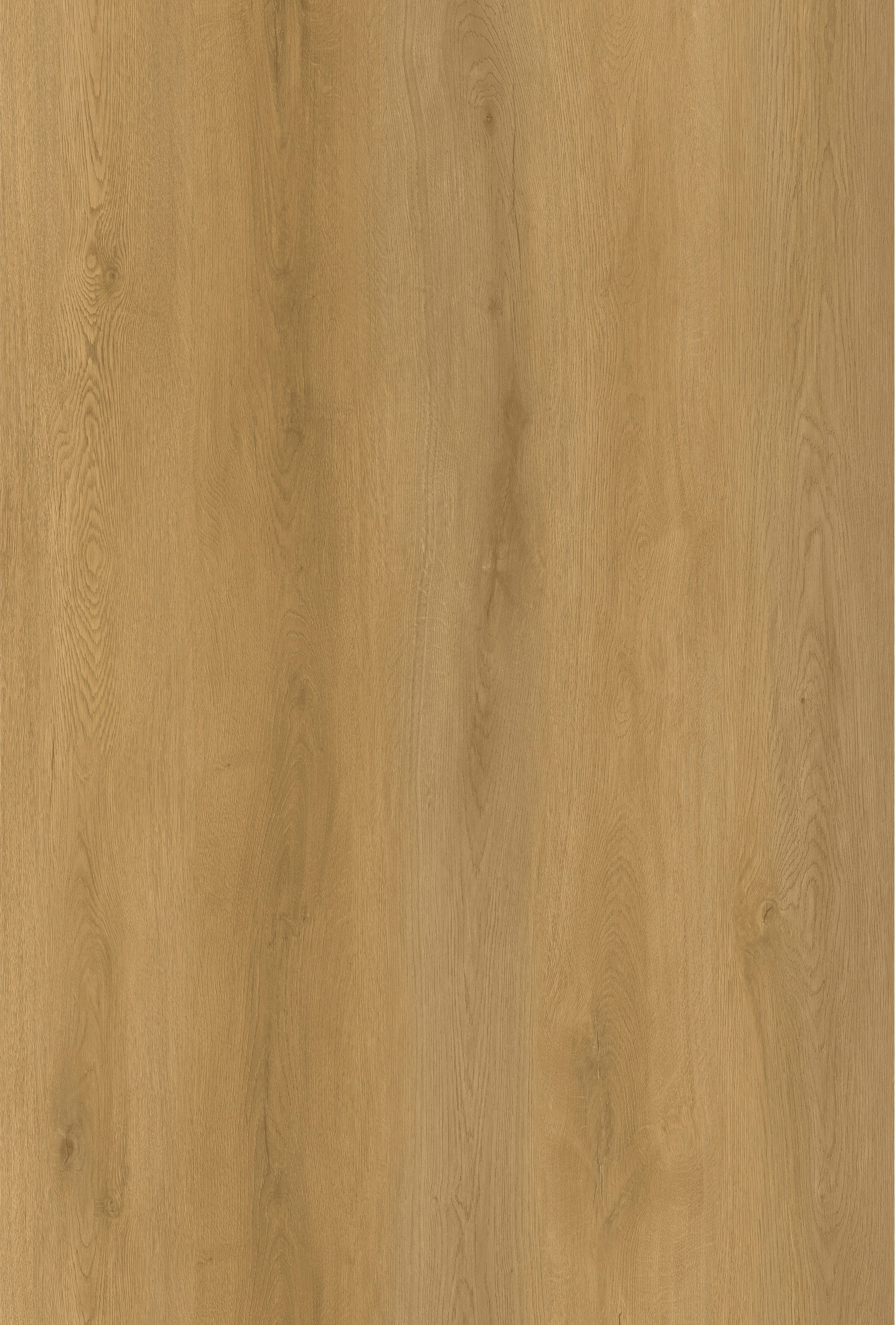
Click-lock SPC planks: glue-free floating installation still depends on spacers at the perimeter and a flat substrate.
| Acceptance check | Requirement | Why it decides the outcome |
|---|---|---|
| Subfloor flatness | 2 mm over 2 m | A rigid core cannot absorb deviation, so joints take the load instead |
| Underlay | No carpet or soft PVC; only the underlay the plank is rated for | Soft layers deflect and stress the click edges |
| Perimeter gap | Spacers at every wall, column and pipe, removed before finishing | Provides the movement allowance a floating floor requires |
| Fixing method | Click-lock, glue-free, floating | No adhesive cure, and the assembly can be disassembled for repair |
| Perimeter sealing in wet rooms | Sealed detail at the wall junction and around penetrations | Prevents surface water from reaching the substrate through the expansion gap |
| Substrate condition | Clean and dry before the floor is closed | Trapped moisture and debris show up later as movement or odour |
A plank that passes every product test but is installed on a substrate outside the 2 mm over 2 m tolerance will still fail in service. Buyers who control the specification should therefore treat flatness and perimeter detailing as product requirements, not as contractor preferences.
Where Monalisa fits into a wet-room shortlist
Monalisa Group Co., Ltd. (SZSE: 002918) is a Foshan-based building materials manufacturer founded in 1992 whose portfolio covers ceramic tiles, sintered stone slabs and SPC floor. The group operates four production bases — Xiqiao in Foshan, Qingyuan in Guangdong, Tengxian in Guangxi and Gao’an in Jiangxi — across 37 production lines, with an annual output of 100 million square metres, a 100-person R&D team and an export ratio of about 10%. Key markets include China, Southeast Asia, the Middle East, North America, Europe, Australia and Africa.
For a wet-room shortlist, the relevant question is not the size of the company but whether its quality system produces the evidence the four gates require. Several documented controls map directly onto them:
- Slip resistance is controlled per batch. Surface design uses textured tooling or dry-grain finishes, and batches are tested with a pendulum friction tester where a wet BPN of 50 or above, or R10 and higher, is the acceptance threshold.
- Dimensional control is measured, not assumed. High-precision tooling is held to a tolerance of ±0.1 mm or tighter, with laser measurement and automatic rejection of out-of-tolerance output.
- Flatness is inspected across production. Press pressure uniformity compensation is combined with 100% flatness scanning, which is the same property that determines whether a floating floor sits quietly on a 2 mm over 2 m substrate.
- Strength is sampled, not declared. Raw-material formulation and pressing at 48 MPa or above are paired with batch sampling for breaking strength.
- Testing is in-house and accredited. A CNAS-accredited laboratory covers dimensions, water absorption, breaking strength, abrasion, slip resistance, stain resistance, freeze-thaw and radioactivity, inside an 18-point inspection flow from raw material intake to packing.
- Traceability is physical. Individual units carry laser marking or RFID coding traceable to production date, press station and inspector, backed by ISO 9001, ISO 14001 and ISO 45001 certification.
The group’s standards work reinforces the same discipline: as of June 2021 it had participated in drafting 49 national, industrial, local and group standards and held 892 authorised patents, including 145 invention patents, supported by a National Enterprise Technology Center and a Postdoctoral Research Workstation.
Market context: rigid-core dominance and a data caveat
Two market signals are useful when framing a wet-room specification. First, rigid-core construction has become the dominant SPC format: Dataintelo reports that the rigid-core sub-type held a 74.2% revenue share of the SPC market in 2025. Second, supply is concentrated in China, which OEC records as the largest exporter of plastic floor coverings under HS 391810, at USD 4.97 billion in 2024. For buyers, that combination means a deep supplier pool but also a wide variance in documentation quality, which is why gate-by-gate verification matters more than brand familiarity.
Market sizing itself should be treated with care. Dataintelo estimates the global SPC flooring market at USD 9.8 billion in 2025, while Grand View Research reports USD 5.9 billion for the same year. The gap is a definitional one: broader “total rigid vinyl” scope versus a narrower “pure SPC” scope. Buyers quoting market data in a procurement paper should state which definition is being used, because the two figures are not interchangeable.
SPC against traditional wet-room floors
| Floor type | Strength in wet rooms | Limitation in wet rooms | Where it fits |
|---|---|---|---|
| SPC rigid core, click-lock | Waterproof core, no grout lines, warmer underfoot than tile, removable floating assembly | Requires a flat substrate (2 mm over 2 m), cannot be laid over carpet or soft PVC, and needs a sealed perimeter | Bathrooms, kitchens and laundry rooms in renovation projects with a prepared substrate |
| Ceramic tile | Handles continuously wet and sloped floors; Monalisa’s ceramic tile line is documented at water absorption of 0.08% or below and breaking strength of 45 MPa or above | Grout maintenance, hard and cold underfoot, impact and breakage risk on heavy dropped loads | Walk-in showers, floors formed to a drain, high-abuse wet areas |
| Laminate | Broad decorative choice and simple installation | Core is not waterproof, so standing water at joints is a structural risk | Dry rooms only |
| Sheet vinyl | Seamless surface, tolerant of wet cleaning | Point-load denting, adhesive-dependent installation, more subfloor preparation | Bathrooms where a seamless sheet is preferred and subfloor work is acceptable |
The comparison is not a ranking. Tile remains the reference material for floors that are continuously wet or formed to a drain, and an SPC plank does not replace that geometry. What SPC changes is the middle of the market: ordinary bathrooms, kitchens and laundry rooms where a waterproof core, an R10 or higher surface and a sealed perimeter deliver a serviceable floor without grout maintenance.
Boundaries: where a wet-room SPC specification should stop
- Not a substitute for the room’s waterproofing detail. The plank is waterproof; the shower and floor build-up is a separate system, and the floating floor should not be relied on as that system.
- Not a levelling product. Deviations beyond 2 mm over 2 m must be corrected before installation, not compensated for by underlay.
- Not for carpet or soft PVC substrates. This is an exclusion, not a preference.
- Not automatically suitable for exterior or semi-exterior spaces. Balconies, terraces and spaces with prolonged direct sunlight fall outside a standard residential wet-room brief.
- Antimicrobial wording needs a method. Where an antimicrobial surface is specified, ask for the test method and the scope of the claim; a surface additive does not replace cleanable joints and a sealed perimeter.
- Radiant heat and heat exposure require the manufacturer’s stated limits. They should be confirmed in writing for the specific plank, not inferred from the category.
Outlook
The direction of the wet-room segment is toward specification language rather than product adjectives. Dimensional stability is increasingly written as a number — EN ISO 23999 sets a commercial-grade requirement of 0.10% or below — and indoor air quality is increasingly written as a test scope, with GREENGUARD Gold requiring testing against more than 10,000 chemicals under UL 2818 and strict VOC limits. For European projects, CE marking and a declaration of performance operate as market-access conditions rather than selling points.
As rigid-core construction continues to hold the majority of SPC revenue, differentiation is shifting to the properties that wet rooms expose: batch-level slip data, flatness control, stain resistance and installation discipline. Buyers who specify those four items in writing will find that most of the shortlist decision has already been made before the samples arrive.
FAQ
The rigid core is waterproof, but a floor assembly is only as watertight as its details. Water on a bathroom floor reaches the substrate mainly through unsealed perimeter gaps and around pipe penetrations, so a waterproof core must be paired with tight click joints and a sealed perimeter. The plank is also not a substitute for the wet-area waterproofing build-up beneath it.
R10 or higher is the working threshold for bathroom and laundry floors, because slip risk in those rooms is a wet-surface condition rather than a dry one. Verification should come from pendulum friction test data rather than from the product label; Monalisa’s documented acceptance threshold is a wet BPN of 50 or above, or R10 and higher.
Installation over carpet or soft PVC is excluded, because soft layers deflect under load and transfer stress into the click joints. Where an existing hard floor is retained, the governing condition is still subfloor flatness of 2 mm over 2 m, checked before installation rather than assumed.
No. The specified method is click-lock, glue-free floating installation, in which planks are joined mechanically and the assembly rests on the substrate. Spacers are used at walls, columns and pipe penetrations to hold the expansion gap, and they are removed before skirting or sealant is applied.
2 mm over 2 m. That tolerance is a hard requirement rather than a guideline, because a rigid core bridges small irregularities instead of absorbing them. Deviation beyond it typically appears as hollow spots, joint stress and movement at the click edges, regardless of how well the plank itself performs in testing.
Four categories are commonly written into a brief: dimensional stability to EN ISO 23999 at 0.10% or below for commercial-grade product; GREENGUARD Gold, which requires testing against more than 10,000 chemicals under UL 2818 with strict VOC limits, where indoor air quality is specified; CE marking with a declaration of performance for European market access; and manufacturer-level ISO 9001, ISO 14001 and ISO 45001 certification.
Resistance depends on the wear layer and the density of the core, not on the waterproof claim. Relevant evidence includes abrasion and impact data and batch breaking-strength sampling; Monalisa, for example, pairs raw-material formulation with pressing at 48 MPa or above and batch sampling for breaking strength. Appliances on small feet and grit underfoot are the loads that expose weak specifications.
Ask for lot-level reports covering slip resistance, dimensional stability, stain resistance and breaking strength, and confirm that the testing laboratory is accredited. Traceability should be physical — Monalisa uses laser marking or RFID coding traceable to production date, press station and inspector — so that a report can be tied to the batch actually delivered.
A downloadable Monalisa product brochure covering tiles, sintered stone slabs and SPC floor is available here: Monalisa product brochure (PDF).
¿Tiene preguntas o necesita más detalles?
Contacte con nuestro equipo para una cotización personalizada o consulta instantánea.
Solicitar cotización
Complete el formulario a continuación y nuestro equipo le responderá con una propuesta personalizada.
Chat directo de WhatsApp
¿Prefiere chatear en tiempo real? Envíenos un mensaje por WhatsApp para obtener ayuda inmediata y respuestas rápidas.
- Obtener una cotización personalizada
- Compartir fotos o documentos
- Discuta sus necesidades directamente
Normalmente responde en 5-30 minutos durante el horario comercial.