
SPC Floor Shortlist for UAE Real Estate: Waterproof, R10+ Slip, 27°C
SPC Floor Shortlist for UAE Real Estate: Waterproof, R10+ Slip, 27°C
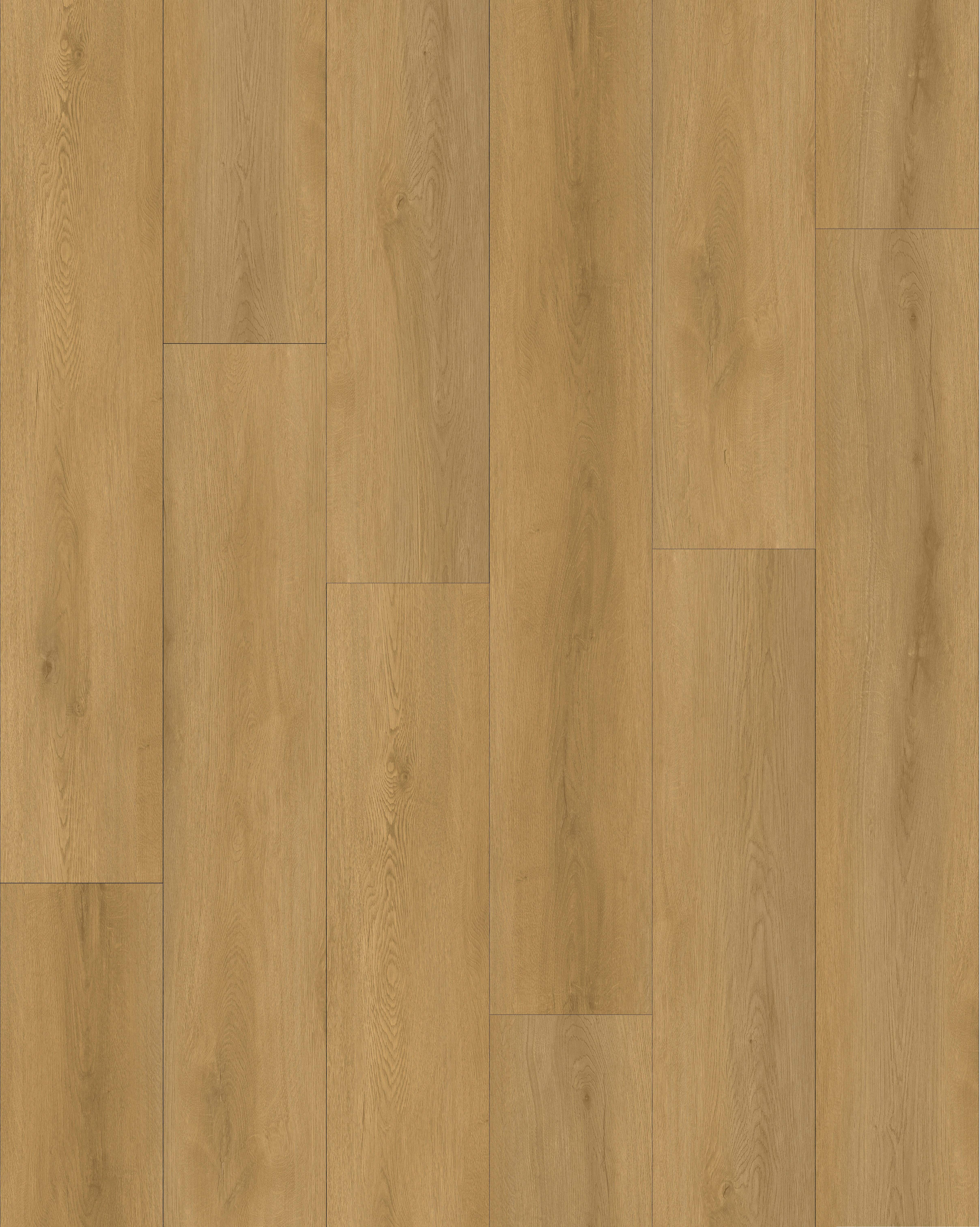
Rigid-core SPC flooring with integrated acoustic backing, shown for interior residential and commercial application. Image: Monalisa.
SPC flooring for UAE real estate is not one specification. It is a set of four or five different performance profiles that a project team has to separate by zone before any price comparison makes sense. Bathrooms and wet areas call for slip resistance at R10 or higher. General residential and commercial interiors sit in the R9–R11 band. Zones with underfloor heating carry a hard surface-temperature limit of 27°C. Everything else — core waterproofing, subfloor tolerance, humidity limits, installation temperature — is the evidence layer that determines whether the specification survives handover.
The shortlist in one line: specify rigid stone-plastic SPC with a closed-cell waterproof core (water absorption ≤0.05%), slip class R10 or higher in wet areas and R9–R11 elsewhere, dimensional stability compatible with underfloor heating, and a floor surface temperature that never exceeds 27°C.
The decision that fails most often: subfloor flatness. SPC requires 2mm over 2m (3/16" over 10ft). Click-lock joints do not absorb unevenness the way adhesive-fixed tile does.
Why One SPC Specification Rarely Covers an Entire UAE Project
A UAE residential tower, a serviced apartment block or a mixed-use retail podium typically issues a single interior flooring package. That package has to work in a bathroom with standing water, a corridor with trolley traffic, an office with underfloor heating, and a lobby that receives direct solar gain through glazing. Those four environments place different demands on the same product family.
SPC, or stone plastic composite flooring, is a rigid core board built from calcium carbonate (natural stone powder or limestone powder) and PVC resin, with a wear layer and a decorative film on top. It is installed as a floating floor: planks are not glued, nailed or stapled to the subfloor, but connected to each other through a click-lock system, usually 5G, inserted at roughly a 30° angle and pressed flat, row by row with staggered seams.
That construction delivers a genuine advantage in UAE interiors: the core is 100% waterproof, so moisture does not cause the swelling or delamination that affects hardwood and laminate in wet areas. It also explains the limits. A floating floor transfers every point load and every subfloor deviation to the joint. The specification has to be written around the joints, not around the surface alone.
The Shortlist: Five Specification Profiles, Ranked by Decision Priority
The ranking below is ordered by how early in a UAE project the decision tends to be locked, and by the consequence of getting it wrong. Wet areas and heated zones rank first because they are the two profiles that cannot be corrected after handover without removing the floor.
| Rank | Application zone | Slip class to specify | Core / waterproof requirement | Thermal limit | Verification point |
|---|---|---|---|---|---|
| 1 | Bathrooms, wet rooms, shower surrounds, laundry | R10 or higher | Closed-cell 100% waterproof core, water absorption ≤0.05% | Not applicable unless heated | Slip test reference plus joint sealing at perimeter |
| 2 | Underfloor heating zones (lobbies, living areas, offices) | R9–R11 | Dimensional stability with shrinkage ≤1‰ | Floor surface temperature ≤27°C | Heating system set-point, screed moisture record |
| 3 | General residential interiors (living rooms, bedrooms, kitchens) | R9–R11 | Waterproof core, wear resistance 6,000–15,000 cycles | Post-install ambient 13–37.7°C | Subfloor flatness 2mm over 2m |
| 4 | Commercial office, retail and showrooms | R9–R11 | T-grade wear rating, dent and impact resistance | Relative humidity ≤65% at installation | Traffic-zone wear layer and cleaning regime |
| 5 | Hospitality, schools, clinics, libraries, exhibition halls | R9–R11 | B1 fire rating, self-extinguishing, acoustic pad ΔLw 18–22 dB | Installation temperature 18–30°C | Fire classification and acoustic performance documentation |
Specification profiles for rigid-core SPC flooring in UAE real estate and building & decoration projects.
Rank 1 — Wet Areas and Bathrooms: R10+ Slip Is the Entry Condition
In wet areas, slip resistance is the governing requirement, not waterproofing. SPC cores are already waterproof; the differentiator is the walking surface. The shortlist entry for bathrooms, shower surrounds and laundry areas should specify R10 or higher, sitting at the upper end of the R9–R11 band used across interior flooring.
Two supporting figures matter. A rigid SPC surface with anti-slip treatment shows increased friction when wet, with a friction coefficient of ≥0.6. The core also has a closed-cell structure with water absorption ≤0.05%, so standing water does not cause warping, swelling or mould growth in the board itself. What buyers should verify is that the wet-area perimeter is sealed, because the joint is the weak point in a floating system, not the plank.
Rank 2 — Underfloor Heating Zones: 27°C Is a Surface Limit, Not a System Setting
Underfloor heating is increasingly common in UAE residential and hospitality interiors, and it is where SPC specifications are most often written incorrectly. The relevant constraint is the floor surface temperature, which must not exceed 27°C. That is a limit on the delivered surface, so it constrains the heating system set-point rather than the flooring product alone.
The flooring contribution is dimensional stability. SPC with shrinkage ≤1‰ shows minimal expansion and contraction under temperature change, which is why rigid stone-plastic cores are specified for heated environments. Buyers should also expect a stricter substrate moisture requirement for heated screeds than for unheated ones, and should ask for the heating commissioning record at handover rather than after the first heating season.
Rank 3 — General Residential Interiors: R9–R11 With a Wear Layer That Earns Its Place
Living rooms, bedrooms and kitchens do not carry the slip obligations of a bathroom, so R9–R11 is the working band. The selection pressure shifts to wear and indentation. SPC wear resistance is rated at 6,000–15,000 cycles with a T-grade wear rating, and the high-density stone-plastic core provides indentation resistance against furniture legs and point loads.
The residential use case extends to finished apartments, villas and condominiums, including basements, laundry rooms and sunrooms. For UAE projects, the sunroom and balcony-adjacent case is the one that needs an explicit note: prolonged direct sunlight should be managed with drapes or shading to prevent discoloration and excessive thermal expansion.
Rank 4 — Commercial Office and Retail: Slip Band Plus Traffic Management
Offices, retail stores, shopping malls and showrooms keep the same R9–R11 slip band but add a traffic dimension. The wear layer protects against foot traffic, furniture movement and cleaning equipment, and the built-in acoustic pad reduces impact noise by ΔLw 18–22 dB — a figure that matters in open-plan offices and upper-floor retail where impact noise transmits to the space below.
Commercial-grade performance should also be checked against a recognised dimensional stability benchmark. EN ISO 23999 sets commercial-grade dimensional stability at ≤0.10%, which is a useful cross-check when a supplier’s own datasheet uses a different expression.
Rank 5 — Hospitality, Education and Healthcare: Fire, Acoustics and Maintenance
Hotels, restaurants, schools, kindergartens, clinics, libraries and exhibition halls combine slip, fire and maintenance requirements. SPC carries a B1 fire rating and is self-extinguishing. The dense surface is stain-resistant and easy to clean, and the board is mould- and pest-resistant — relevant in healthcare and education environments where cleaning frequency is high.
For projects requiring GREENGUARD Gold under UL 2818, buyers should note that this certification involves testing for more than 10,000 chemicals and strict VOC limits. It is a SKU-level claim: the certificate has to cover the specific construction being supplied, not the product family in general.
Where Monalisa Sits in This Shortlist
Monalisa Group Co., Ltd. is a Foshan-based manufacturer of architectural ceramics and rigid-core flooring, founded in 1992, with four production bases in Xiqiao (Foshan), Qingyuan, Tengxian and Gao'an and 37 production lines. Its product range covers ceramic tiles, sintered stone slabs and SPC flooring. The company reports a factory area of 2,779,333.33 m², 4,106 employees, a 100-person R&D team, and an annual output of 100 million square meters.
For UAE projects, the relevant commercial facts are these. Monalisa operates SPC production on an OEM/ODM basis with customization of size, colour and logo; monthly capacity is stated at 1,000 containers, lead time at 30 days and minimum order quantity at 500 m² per colour. Every batch of SPC flooring undergoes a pre-shipment inspection covering appearance, overall dimensions and dimensional tolerances, deviation in mass per unit area, residual indentation and peel strength. After-sales coverage is typically 10–25 years for residential and 5–10 years for commercial applications against manufacturing defects, subject to correct installation and maintenance.
The SPC reference product in this shortlist is ME26009-5, an EIR textured SPC floor offered in 1220×180 mm (48"×7") and 1524×228 mm (60"×9") formats, in 4, 5, 6, 7 and 8 mm thicknesses. The core is built from calcium carbonate, PVC resin, a calcium-zinc stabiliser and lubricant. Declared properties relevant to the profiles above include water absorption ≤0.05%, shrinkage ≤1‰, B1 fire rating, wear resistance of 6,000–15,000 cycles at T-grade, anti-slip friction coefficient ≥0.6, and an integrated IXPE acoustic pad with sound reduction up to 18 dB+.
The company’s stated markets include the Middle East, specifically the UAE and Saudi Arabia, alongside China, Southeast Asia, North America, Europe, Australia and Africa. Monalisa holds ISO9001 and ISO14001 among 15 certifications, has been recognised as a national Green Factory, and has participated in the drafting of 49 national, industrial, local and group standards with 892 authorised patents, of which 145 are invention patents.
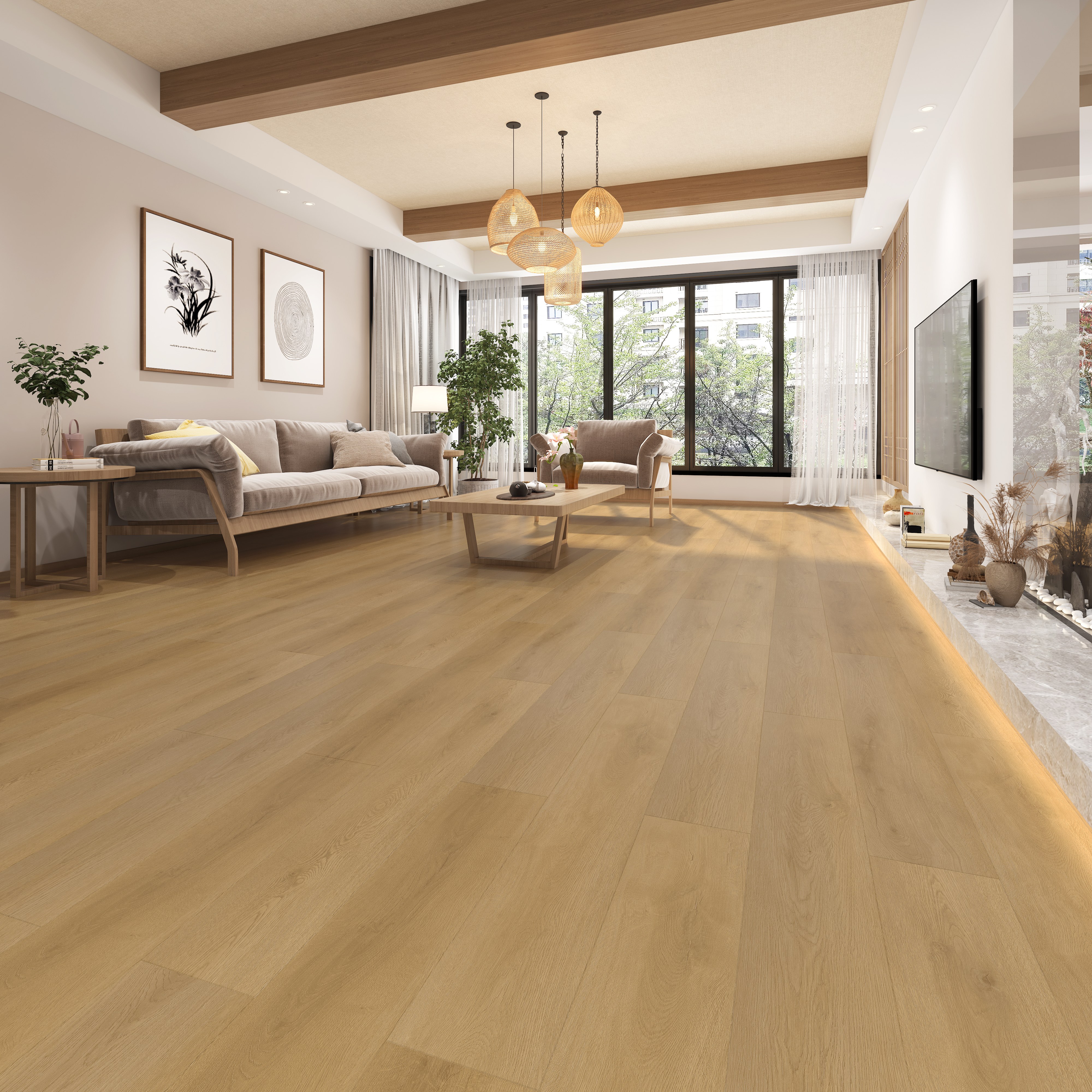
Anti-slip SPC surface, the profile specified for bathrooms and wet areas where R10 or higher is required. Image: Monalisa.
Technical Explanation: How the Three Constraints Interact
Slip, waterproofing and heating limits are usually written as three separate clauses. In a floating SPC system they interact through the joint.
Slip resistance is a surface property and is unaffected by the installation method. Waterproofing is a core property and is also unaffected — the closed-cell core does not absorb water. The joint, however, is where water entry, thermal movement and subfloor deviation all meet. A plank with ≤0.05% water absorption installed over a subfloor that is out of tolerance will still fail at the seam, because the click-lock profile is a mechanical connection that depends on the substrate being flat and stable.
The heating limit compounds this. A rigid core with shrinkage ≤1‰ moves very little, but it moves within a constrained perimeter. If the expansion gap is under-specified, or the surface temperature exceeds 27°C, the movement has nowhere to go and the joint takes the load. That is why the 27°C figure and the expansion gap requirement belong in the same clause of the specification.
Installation Evidence: The Five Numbers That Decide Handover
A shortlist is only as good as the installation evidence behind it. For UAE projects, five conditions should appear in the method statement and be inspected before the first row is laid.
| Condition | Requirement | Why it matters in UAE projects |
|---|---|---|
| Subfloor flatness | Within 2mm over 2m (3/16" over 10ft) | Unevenness causes joint failure in a floating click-lock system |
| Subfloor condition | Solid, dry, dust-free, no hollow spots, cracks, paint, wax, grease, oil, solvents or glue residues | Residues prevent the plank from seating and can stain the surface |
| Relative humidity | ≤65% | Acclimatisation and joint behaviour depend on site humidity |
| Installation temperature | 18–30°C, with post-installation ambient 13–37.7°C | UAE sites are frequently outside this window during summer fit-out |
| Perimeter and acclimatisation | Expansion gap 5–12mm from walls and fixed objects; planks acclimatised in original packaging on site for 24–48 hours | Prevents buckling at door frames and columns |
Installation evidence requirements for rigid-core SPC flooring in UAE interior projects.
Two further conditions apply to specific substrates. Concrete subfloor moisture should be ≤2%, tightened to ≤1.5% for underfloor heating; anhydrite screeds require ≤0.3%. Wood-based subfloors should be ≤12% and rigid with adequate ventilation. Where SPC is laid over existing ceramic or porcelain tiles, grout joints must be ≤5mm wide and ≤2mm deep, with height differences between adjacent tiles ≤1mm.
Installation is glue-free. Planks are connected through the click-lock system with spacers maintaining the perimeter gap, and baseboards or quarter-round mouldings cover the gaps afterwards. Where cabinets or fixed joinery sit on top of the floor, that area must be fully glued down to the subfloor.
Application Fit Across UAE Real Estate Typologies
The profiles map onto the project types common in UAE real estate and building & decoration work. Residential towers, villas and condominiums use Rank 3 as the default, with Rank 1 in bathrooms and Rank 2 in heated zones. Commercial spaces — malls, retail stores and office buildings — use Rank 4. Hotels, restaurants, clinics, schools, kindergartens, libraries and exhibition halls use Rank 5. Light industrial and back-of-house spaces with heavy foot traffic or moisture sit between Rank 4 and Rank 5.
The product’s stated suitability covers residential interiors including living rooms, bedrooms, kitchens and bathrooms; commercial interiors including malls, retail stores and offices; hospitality including restaurants and hotels; medical facilities including hospitals and clinics; educational institutions including schools and kindergartens; public spaces including libraries and exhibition halls; and underfloor heating environments. The scenario is common in the global market, including the Middle East.
Market Context: Why Buyers Are Shortlisting Rather Than Specifying Blind
Rigid-core flooring has moved from a niche import line to a mainstream specification category. Dataintelo estimates the global SPC flooring market at USD 9.8 billion in 2025, a figure that reflects a broader scope including related rigid vinyl segments; Grand View Research publishes a narrower estimate of USD 5.9 billion for the same period. The gap between the two is a definitional difference rather than a contradiction, and buyers should treat any single market figure as scope-dependent.
Within the category, rigid core is dominant: Dataintelo reports rigid core as the sub-type with a 74.2% revenue share in 2025. Supply is concentrated. China, the largest exporter of plastic floor coverings under HS 391810, shipped USD 4.97 billion in 2024 according to OEC trade data. For a UAE buyer, that concentration is useful context: competitive pricing is available, which makes the evidence layer — test reports, certification scope, and installation tolerances — the real differentiator rather than headline price.
Comparison With Traditional Solutions — and Where SPC Stops
Against adhesive-fixed porcelain tile, SPC offers a faster dry installation, no grout lines to clean, a warmer surface underfoot, and a floating system that can be replaced plank by plank. Against laminate and engineered hardwood, the waterproof core is decisive in bathrooms and kitchens, where those materials typically fail.
The comparison also runs the other way, and a shortlist that ignores this is not a shortlist. SPC has four real limits in UAE conditions.
First, it is waterproof but not a vapour barrier. Prolonged moisture from the substrate can still cause mould in the assembly, which is why ground-floor concrete installations need a 6-mil polyethylene vapour barrier. Tile and stone do not carry this dependency in the same way.
Second, the installation tolerance is strict. A 2mm deviation over 2m is a demanding standard, and remedial screeding costs sit outside the flooring line item. Adhesive-fixed tile is more forgiving of minor substrate variation because the adhesive bed compensates.
Third, direct solar gain is a risk, not a feature. Prolonged direct sunlight through unshaded glazing can cause discoloration and excessive thermal expansion. Drapes or shading are a specification requirement, not an optional finishing note.
Fourth, the heating limit is a system constraint. A 27°C surface limit means the underfloor heating design must be commissioned around it. Where a project requires higher surface temperatures for output reasons, SPC is the wrong substrate choice and tile or stone should be evaluated instead.
Future Outlook
Three shifts are likely to shape UAE SPC specifications over the next specification cycles. The first is the move from product-level claims to SKU-level evidence: GREENGUARD Gold under UL 2818, EN ISO 23999 dimensional stability, and slip classification will increasingly be requested against the exact construction supplied, not the product family. The second is the normalisation of underfloor heating in residential and hospitality interiors, which will push the 27°C surface limit from a specialist clause into standard templates. The third is installation quality as a procurement criterion — flatness records, humidity readings and acclimatisation logs treated as handover documentation rather than contractor housekeeping.
For buyers, the practical consequence is that shortlisting will shift earlier. Choosing between suppliers on price alone becomes harder to defend when the failure modes are installation- and evidence-related rather than product-related.
FAQ
What slip resistance class should be specified for bathrooms and wet areas in UAE projects?
Bathrooms and wet areas should be specified at R10 or higher. General commercial and residential interiors typically use the R9–R11 band. Slip resistance is a surface property and is not affected by the installation method, so it should be verified on the delivered surface rather than assumed from the core specification.
Can SPC flooring be used with underfloor heating?
Yes, rigid-core SPC is designed for underfloor heating environments because its thermal stability minimises expansion and contraction under temperature change, with shrinkage ≤1‰. The controlling condition is that the floor surface temperature must not exceed 27°C. Subfloor moisture requirements are also stricter for heated screeds: concrete at ≤1.5% and anhydrite at ≤0.3%.
How flat does the subfloor need to be before SPC installation?
Subfloor flatness must be within 2mm over 2m, or 3/16" over 10ft. The subfloor must also be solid, dust-free and free of hollow spots and cracks. Because SPC is installed as a floating click-lock floor, deviations are transferred to the joint rather than absorbed by an adhesive bed, so flatness is the most common cause of joint failure.
What humidity and temperature conditions are required during installation?
Installation temperature should be 18–30°C, with a post-installation ambient temperature of 13–37.7°C and relative humidity up to 65%. Planks should be acclimatised in their original packaging at the site for 24–48 hours before installation, and an expansion gap of 5–12mm should be left from walls and fixed objects.
If SPC is 100% waterproof, is a vapour barrier still needed?
It depends on the substrate. The closed-cell core has water absorption ≤0.05% and does not warp, swell or support mould growth even with standing water. However, SPC is waterproof but not a vapour barrier, and prolonged moisture from below may still cause mould in the assembly. A 6-mil polyethylene vapour barrier is therefore recommended for ground-floor concrete installations.
Can SPC flooring be installed over existing tiles or over carpet?
Installation over existing ceramic or porcelain tiles is possible where grout joints are ≤5mm wide and ≤2mm deep and height differences between adjacent tiles are ≤1mm. Installation over existing carpet, soft PVC or similar soft materials is not allowed. Where cabinets are installed on top of the floor, that area must be fully glued down to the subfloor.
What lead time and minimum order quantity apply to OEM SPC supply?
For Monalisa SPC production, minimum order quantity is 500 m² per colour, lead time is 30 days, and monthly capacity is stated at 1,000 containers. Customization covers size, colour and logo. Every batch undergoes pre-shipment inspection covering appearance, dimensions and dimensional tolerances, mass per unit area deviation, residual indentation and peel strength. After-sales warranty is typically 10–25 years for residential and 5–10 years for commercial applications against manufacturing defects, subject to correct installation and maintenance.
The Monalisa product and capability brochure, including the full SPC range and technical documentation, is available for download: Monalisa Group brochure (PDF).
¿Tiene preguntas o necesita más detalles?
Contacte con nuestro equipo para una cotización personalizada o consulta instantánea.
Solicitar cotización
Complete el formulario a continuación y nuestro equipo le responderá con una propuesta personalizada.
Chat directo de WhatsApp
¿Prefiere chatear en tiempo real? Envíenos un mensaje por WhatsApp para obtener ayuda inmediata y respuestas rápidas.
- Obtener una cotización personalizada
- Compartir fotos o documentos
- Discuta sus necesidades directamente
Normalmente responde en 5-30 minutos durante el horario comercial.