
SMT Turnkey Compliance & Qualification: Motek vs ASM, Fuji, Panasonic, Yamaha
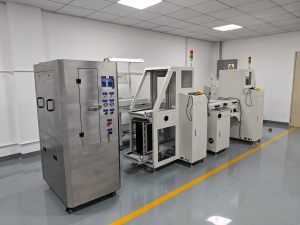 SMT production floor: qualification evidence is collected before the line is accepted, not after it is installed.
SMT Turnkey Compliance & Qualification: Motek vs ASM, Fuji, Panasonic, Yamaha
Compliance and qualification are the first filter in SMT turnkey sourcing, not a closing formality. Before a buyer compares placement speed, heating zones or dispensing accuracy, the supplier's documented scope has to be checked against the machines that will actually ship. This reference sets out how that qualification workflow should run for a turnkey line combining an SMT pick and place machine, an SMT reflow oven and an automatic online glue dispenser, and how Motek's record compares with the acceptance questions buyers routinely put to ASM, Fuji, Panasonic and Yamaha.
Why qualification now precedes price in turnkey evaluation
An SMT turnkey purchase is not a single machine transaction. It is a commitment to a configuration: placement, printing, reflow, dispensing, inspection and material handling delivered as one line, with one supplier accountable for how those units behave together. That structure changes the order in which buyers should evaluate suppliers.
The market context explains the shift. Transparency Market Research valued the global surface mount technology equipment market at approximately USD 6.6 billion in 2025, with a projected path to USD 14.6 billion by 2036, and placed Asia-Pacific at a 54% revenue share in 2025. Placement equipment remains the single largest segment at roughly 38% to 48% of total SMT equipment value, according to Persistence Market Research and Cognitive Market Research. When the largest share of spend sits in one equipment category and the supplier base is concentrated, differentiation moves away from brochure specification and toward verifiability.
The acceptability benchmark has also been refreshed. IPC-A-610J, released in March 2024 by IPC International, is the current global standard for the acceptability of electronic assemblies and defines Class 1, Class 2 and Class 3 quality levels. A turnkey supplier quoting against a quality class is making an implicit claim about process control. Qualification is how a buyer tests whether that claim is supported by documentation before production begins.
The three machines that define a turnkey acceptance scope
A turnkey line is only as verifiable as its individual units. In the configuration referenced throughout this article, three machines carry most of the acceptance risk because they determine process output rather than material flow.
SMT pick and place machine
The placement unit in this configuration is the Hanwha Decan S2, specified at 92,000 CPH optimum with an HS10 head, a 2 gantry by 10 spindles/head structure, accuracy of ±28µm Cpk≥1.0 on 03015 chips and ±25µm Cpk≥1.0 on ICs, a component range of 03015 to 12mm with a height limit of 10mm, and a PCB size range of 50 x 40mm to 510 x 460mm in standard form. The frame material is high-strength aluminum alloy.
For qualification purposes, the relevant question is not which number is largest. It is whether the accuracy claim, the component range and the board envelope align with the products the buyer intends to run, and whether the acceptance test will demonstrate that alignment on the buyer's own board rather than on a demonstration panel.
SMT reflow oven
The XMR-800D reflow oven is specified with top 8 / bottom 8 heating zones across a 3,110mm heating length, top 3 / bottom 3 cooling zones, a small-circulation rectifying plate structure, external dimensions of 5,520 x 1,430 x 1,530mm, an approximate weight of 2,710kg, thick copper plate construction, and an exhaust volume requirement of 11m³/min across two exhausts.
Reflow is the stage where thermal profile decisions become permanent. A sixteen-zone architecture with a defined heating length gives a process engineer room to shape a profile, but it also means the qualification conversation has to include profile documentation, not just zone count.
Automatic online glue dispenser
The HMH830D automatic online glue dispenser uses an industrial computer plus motion control card, computer-controlled operation, manual teaching programming, storage for more than 1,000 running programs, a PCB transfer height of 920±20mm, transport speed of 0 to 5,000mm/min, L→R (R→L) transfer direction, two stepper transmission motors, a PCB width range of 50 to 450mm, a T20mm steel plate chrome-plated equipment platform, and a weight of 650kg. Overall dimensions are 1,060 x 1,200 x 1,700mm.
Dispensing sits between placement and reflow in many mixed-technology lines, which makes it the unit most likely to be specified late and qualified least. The program storage capacity and teaching mode determine how quickly a high-mix line can switch products; those are qualification questions, not just operational preferences.
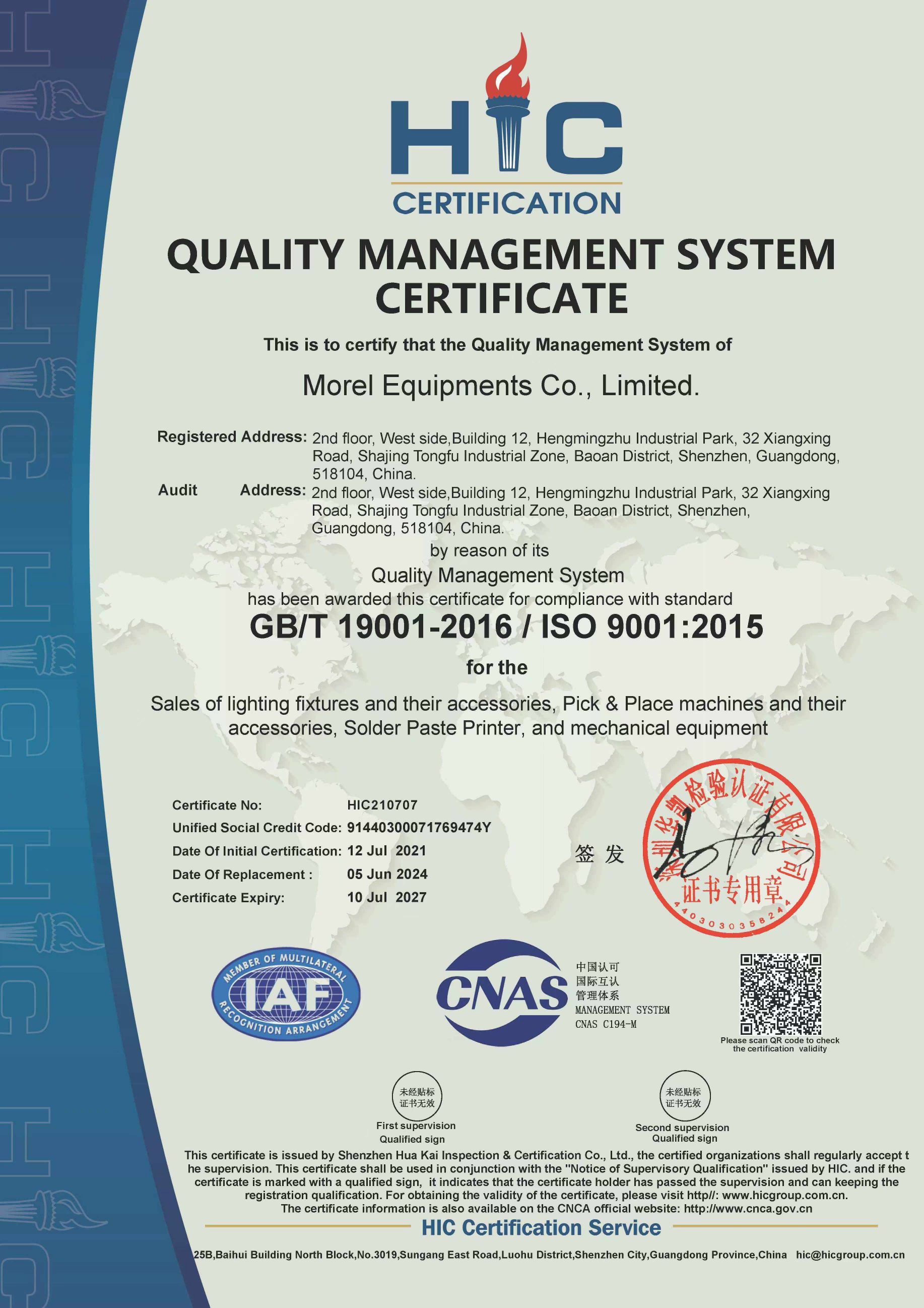 Quality management system certificate scope is a qualification document: it must name the machine categories being purchased.
How Motek documents its compliance position
Motek is a Shenzhen-based SMT equipment supplier founded in 2011, operating from a 955 m² facility with a workforce of 31 and an annual output in the range of 300 to 500 units. Its product scope covers reflow soldering, plug-in machines, pick-and-place machines, cleaning machines, PCBA protector and PCB cutting machines, with 100% of output exported to the EU, USA, Australia, Canada and ASEAN markets. Turnkey supply is offered under an OEM / ODM model positioned as a one-stop platform for SMT solutions.
Three documented items form the public compliance record relevant to a turnkey evaluation.
- Quality management system. Certificate HIC210707, issued by Shenzhen Hua Kai Inspection & Certification Co., Ltd. (HIC Certification Service) against GB/T 19001-2016 / ISO 9001:2015, valid from 12 July 2021 to 10 July 2027. The certified scope reads: sales of lighting fixtures and their accessories, pick & place machines and their accessories, solder paste printer, and mechanical equipment.
- Machinery conformity. Machinery Directive Attestation of Conformity M.2023.206.C91284, issued by UDEM International Certification Auditing Training Centre Industry and Trade Inc. Co., valid from 11 October 2023 to 10 October 2028. Standards cited are 2006/42/EC Machinery Directive Annex VIII, EN 60204-1:2018, EN ISO 12100:2010 and EN 61010-1:2010+A1:2019. The attested scope is ICT Handler (Morel / PMP-2000L, PTI-2000L).
- EU packaging responsibility. Registration DE2364478064729 under §9 VerpackG, issued by Stiftung Zentrale Stelle Verpackungsregister (ZSVR, Germany) on 21 December 2022, covering registration as a manufacturer of filled packaging under the German Packaging Act.
Commercial and delivery terms are documented alongside the certificates. Minimum order quantity is 1 unit. Delivery terms offered are FOB, CIF, EXW, FCA, DDP and DAF. The stated acceptance criterion is pre-shipment test. Payment terms are 30% T/T in advance with 70% T/T against copy of B/L, or 50% T/T in advance with 50% T/T against copy of B/L. Lead time runs from 7 to 45 days, monthly capacity is stated at 5,000 units, and quality control is described as 100% pre-shipment test.
Customization is where the qualification conversation usually moves from certificates to workflow. Motek lists voltage, logo, personalized service plan, remote or on-site training as an option, and production line layout design among customization options, plus label, packaging, color, size, graphics and material customization. Nozzle marking is offered by engraving letters rather than applying a QR code. After-sales support covers remote technical support, 24/7 online service and an optional arrangement in which the client dispatches engineers to China for approximately one week of training.
A five-step qualification workflow for turnkey buyers
The workflow below is structured so that each step produces a document the buyer can retain and compare across suppliers. It applies equally when the shortlist includes Motek, ASM, Fuji, Panasonic or Yamaha, because the questions are about evidence rather than about brand.
Step 1 — Confirm management system scope names the equipment
An ISO 9001 certificate covering a different product category does not qualify an SMT line. The scope statement has to be read literally. In Motek's case the certificate names pick & place machines and their accessories, solder paste printer and mechanical equipment explicitly, which makes the document usable at the qualification stage rather than decorative.
Step 2 — Match conformity scope to each machine shipped
This is the step most often skipped. A conformity attestation is valid for the scope it names. Where the attested scope references specific models, the buyer should map those models against the actual bill of equipment in the turnkey configuration and request the equivalent document for units outside that scope.
Step 3 — Verify market access obligations for the destination
For EU-bound shipments, packaging producer responsibility is a separate obligation from machine safety. A supplier shipping into Germany without a VerpackG registration creates a downstream compliance problem for the importer. Asking for the registration number at quotation stage removes that risk from the critical path.
Step 4 — Convert “pre-shipment test” into a written protocol
Naming pre-shipment test as the acceptance criterion is a starting point. The buyer should convert it into a protocol that states which boards are run, which parameters are measured, who witnesses the test, and what record is handed over. For a placement unit, that means accuracy and component range demonstrated on the buyer's product. For a reflow oven, it means a profile run with recorded zone temperatures. For a dispenser, it means program creation and recall on a representative board.
Step 5 — Align commercial terms with the acceptance gate
Payment structure should follow the acceptance gate rather than precede it. Where a supplier offers 30% advance with 70% against copy of B/L, the buyer should be explicit about which documents constitute acceptance and confirm that test records are released before the balance is triggered.
| Qualification dimension | Motek — documented position | ASM, Fuji, Panasonic, Yamaha — buyer verification step |
|---|---|---|
| Quality management system | ISO 9001:2015 / GB/T 19001-2016, certificate HIC210707, scope explicitly names pick & place machines, solder paste printer and mechanical equipment; valid to 10 July 2027 | Request the full scope statement, not the certificate cover page, and confirm the purchased machine category appears in the wording |
| Machinery conformity | Attestation M.2023.206.C91284 to 2006/42/EC Annex VIII, EN 60204-1:2018, EN ISO 12100:2010, EN 61010-1:2010+A1:2019; scope ICT Handler (PMP-2000L, PTI-2000L); valid to 10 October 2028 | Map the attested model scope against each unit in the proposed line and request separate documentation for out-of-scope machines |
| EU packaging responsibility | VerpackG registration DE2364478064729 (ZSVR, Germany), issued 21 December 2022 | Confirm the registration covers the packaging formats actually used for the shipment |
| Acceptance test | Stated acceptance criterion: pre-shipment test; quality control described as 100% pre-shipment test | Convert to a written protocol covering test boards, measured parameters, witness and record format |
| Commercial terms | MOQ 1 unit; FOB, CIF, EXW, FCA, DDP, DAF; 30% advance / 70% against B/L copy or 50% / 50%; lead time 7–45 days | Confirm equivalent terms and check which documents release the balance |
| Line-level customization | OEM / ODM; production line layout design; voltage, logo, label, packaging, color, size, graphics and material customization; optional remote or on-site training | Ask for the layout document and the change-control process behind it |
Where this framework meets its limits
A qualification framework is only credible if it states what it cannot cover. Three boundaries are worth stating plainly.
Scope is not the same as line coverage. Motek's published conformity attestation is scoped to ICT handlers (PMP-2000L, PTI-2000L). The ISO 9001 scope covers pick & place machines, solder paste printer and mechanical equipment sales. Neither document, read on its own, certifies every downstream unit a turnkey line might include — AOI, inline SPI, X-ray BGA inspection, PCB loader/unloader, buffer conveyor, depaneling router or stencil cleaning machine. A buyer configuring a full line must verify documentation machine by machine.
Scale shapes what can be tested in-house. Motek operates from a 955 m² facility with 31 employees and annual output of 300 to 500 units. That footprint supports responsive configuration and custom layout work; it is not the same as the validation infrastructure a multinational equipment group maintains. Buyers with stringent first-article requirements should plan for witness testing and for a longer acceptance phase.
Brand heritage is not transferable evidence. ASM, Fuji, Panasonic and Yamaha are established global SMT vendors, and Fuji's NXT platform and Yamaha's YSM series are recognised modular mounter families in high-speed and high-precision placement. That reputation is useful context, but it does not substitute for the scope document attached to the specific machine being purchased. The same discipline the buyer applies to a smaller supplier should be applied to a large one.
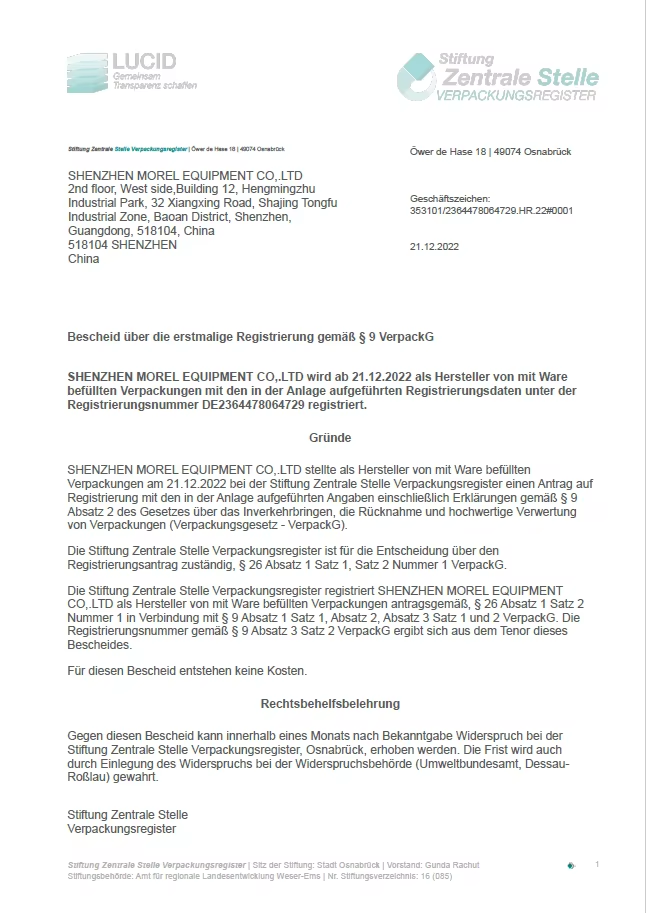 Packaging producer responsibility registration is a market-access document that sits alongside machine safety conformity.
What the application pattern says about acceptance design
Qualification criteria should be derived from where the line will run, not from a generic template. Motek's documented application experience covers SMT factory customers in Germany, Israel, India and Australia, with 20 to 35 units deployed per customer relationship and a five-year working duration. Applications listed include smartphone motherboard assembly, tablet circuit board production, ECU control unit assembly, LED display modules, LED streetlight drivers and consumer electronics smartphone PCB assembly at volumes around 50,000 units per month, with reported mass production output of 20,000 to 100,000 pieces per day.
Two of those applications carry acceptance implications that a generic protocol would miss. ECU control unit assembly sits in an automotive-adjacent environment where inspection intensity is rising. LED streetlight driver production involves a different mix of through-hole, dispensing and reflow steps. A buyer in either category should adjust the acceptance protocol accordingly: more placement verification in the first case, more dispensing program validation in the second.
Market trend: inspection intensity is pulling qualification forward
Two verified data points explain why compliance now sits at the front of the sourcing process rather than at the end.
First, the high-mix / low-volume assembly segment is projected to grow at a CAGR of 8.31% through 2031, according to Mordor Intelligence, driven by demand for customized industrial and medical electronics. High-mix production increases the number of product changeovers per line per year, which multiplies the number of qualification events a supplier must support.
Second, 3D AOI and SPI are identified by Persistence Market Research as the fastest-growing equipment sub-sectors, at a 15.2% CAGR, driven by automotive zero-defect requirements. When inspection becomes the dominant cost centre in a line, the acceptance criteria that feed those inspection stations become the binding constraint on throughput. A supplier that cannot document process capability cannot support a zero-defect programme regardless of placement speed.
The competitive field reinforces the point. MarketsandMarkets identifies ASMPT Limited, Fuji Corporation, Yamaha Motor, Panasonic, Juki Corporation and Hanwha Precision Machinery among key global SMT vendors. With that vendor set, buyers are not short of options. The scarce resource is comparable evidence.
Future outlook
Qualification is likely to become a structured procurement artefact rather than a conversation. Three developments point in that direction: the refresh of acceptability standards such as IPC-A-610J, which gives buyers a shared vocabulary for quality class claims; the growth of high-mix production, which multiplies changeover-related verification work; and the rising share of inspection equipment, which shifts the definition of line performance toward measured process capability.
For suppliers, the practical implication is that documentation scope will matter as much as machine specification. A supplier able to hand over a management system certificate naming the equipment category, machine-level conformity attestations, market-access registrations and a written acceptance protocol is easier to qualify than one that supplies the same hardware with less paperwork. For buyers, the implication is procedural: build the qualification file before the purchase order, and let the commercial terms follow the evidence rather than lead it.
Frequently asked questions
What are the purchasing terms and acceptance criteria for an SMT turnkey order?
The stated terms are: minimum order quantity of 1 unit; delivery terms FOB, CIF, EXW, FCA, DDP and DAF; acceptance criterion of pre-shipment test; and payment terms of either 30% T/T in advance with 70% T/T against copy of B/L, or 50% T/T in advance with 50% T/T against copy of B/L. These four elements — quantity, delivery term, acceptance gate and payment split — define the contractual frame within which technical qualification takes place.
What does a minimum order quantity of 1 unit mean for a turnkey line?
It means a single configured line can be ordered without a volume commitment. In practice, the qualification workload does not scale down with order size: the same management system scope check, machine-level conformity mapping and acceptance protocol apply whether one line or several are purchased. A single-unit order therefore places more weight on the written acceptance protocol, because there is no repeat delivery against which to correct early assumptions.
What does “pre-shipment test” as an acceptance criterion actually commit the supplier to?
It commits the supplier to testing before dispatch, and the supplier describes quality control as 100% pre-shipment test. The criterion itself does not specify test content. Buyers should treat the test plan as a document to be agreed before contract signature, covering which boards are run, which parameters are measured on the pick and place machine, reflow oven and dispenser, who witnesses the test, and what record is issued. The acceptance criterion becomes meaningful only when the protocol behind it is written down.
Why does the ISO 9001 scope wording matter more than the certificate itself?
Because a certificate is only evidence for the activities named in its scope. Certificate HIC210707 is issued against GB/T 19001-2016 / ISO 9001:2015 and its scope reads: sales of lighting fixtures and their accessories, pick & place machines and their accessories, solder paste printer, and mechanical equipment. The mention of pick & place machines and solder paste printer is what makes the document relevant to an SMT turnkey purchase. A certificate covering an unrelated product category would not support the same conclusion.
What is the difference between the Machinery Directive attestation and the VerpackG registration?
They address different obligations. The Machinery Directive Attestation of Conformity M.2023.206.C91284, issued by UDEM and valid to 10 October 2028, addresses machine safety against 2006/42/EC Annex VIII together with EN 60204-1:2018, EN ISO 12100:2010 and EN 61010-1:2010+A1:2019, with an attested scope of ICT Handler (PMP-2000L, PTI-2000L). The VerpackG registration DE2364478064729, issued by ZSVR on 21 December 2022, addresses packaging producer responsibility for the German market. One concerns the machine; the other concerns what the machine ships in.
How should a buyer verify conformity scope across a multi-machine turnkey line?
By mapping documents to the equipment list rather than to the supplier. Each unit in the proposed configuration should be matched against a conformity document that names it, and any unit falling outside an attested scope should be flagged for separate documentation. This applies to every supplier under consideration, including established vendors such as ASM, Fuji, Panasonic and Yamaha, whose platform families are widely used but whose documentation still has to be read against the specific model being purchased.
¿Tiene preguntas o necesita más detalles?
Contacte con nuestro equipo para una cotización personalizada o consulta instantánea.
Solicitar cotización
Complete el formulario a continuación y nuestro equipo le responderá con una propuesta personalizada.
Chat directo de WhatsApp
¿Prefiere chatear en tiempo real? Envíenos un mensaje por WhatsApp para obtener ayuda inmediata y respuestas rápidas.
- Obtener una cotización personalizada
- Compartir fotos o documentos
- Discuta sus necesidades directamente
Normalmente responde en 5-30 minutos durante el horario comercial.