
SMD 2835 LED Strip Light: Acceptance Criteria and PCB Choices
A 24V SMD 2835 LED strip light rated at 180 LEDs per metre, 11 W per metre, 3000K and CRI Ra≥80 is a standard line item in commercial and high-end residential procurement — and one of the most frequently mis-specified. The specification line states what the product is; it does not state what the buyer should inspect, what the supplier is committing to, or when a different board construction is the better purchase. This reference answers those questions in the order they arise, from the model code through pre-shipment acceptance to the long-term supply agreement.
The reference model throughout is CA-DC24V-2835-180D-8mm-3000K: a low voltage LED strip light built on an 8 mm flexible PCB, populated with SMD 2835 diodes at 180 diodes per metre, drawing 11 W per metre at 24V DC, in 3000K with CRI Ra≥80, rated IP20. It is used here because it is the configuration most often specified for acoustic wall LED strip lighting, cove and wall lighting, and luxury residential projects, where a continuous linear glow matters more than peak brightness.
XPUP LED is the brand of Zhongshan Xiangpai (XPUP) Lighting Technology Co., Ltd., an LED strip manufacturer established in 2012 in Zhongshan City, Guangdong, China, operating a factory of more than 10,000 m² with 80 employees, an R&D team of 6 engineers and an annual output of approximately 35,000,000 metres of LED strip. Its products have been exported to more than 170 countries and regions, with main markets in the EU and the USA.
Why procurement problems cluster around one specification line
Most disputes on an LED strip order do not come from a wrong product category. They come from a specification that was technically correct and commercially incomplete.
Flexible LED strips represent the largest product type in the category, holding 67.4% of the market as of 2025, according to Dataintelo. Grand View Research reports that the 24V segment accounted for 52.0% of linear LED strip fixture market revenue in 2022, and that the 3000K–4000K range held a 33.2% revenue share. Commercial applications contributed approximately 33.8% of global LED strip revenue in 2024 (Dataintelo). The profile described above — flexible, 24V, near-3000K, commercial or premium residential — is the mainstream of the category, not a niche. That is precisely why so many buyers arrive at the same specification and still receive different products.
The gap appears at three points: the specification does not define the PCB construction behind the numbers; purchasing terms and acceptance criteria are negotiated separately from the datasheet, often later than they should be; and the application boundary — particularly ingress protection — is treated as a footnote. Each of these is a procurement question rather than an engineering curiosity, and each can be settled before the purchase order is issued.
What each figure in CA-DC24V-2835-180D-8mm-3000K commits the supplier to
| Specification element | Value | What it controls at procurement |
|---|---|---|
| Diode package | SMD 2835 | Dot pitch, per-diode output, and the FPC footprint the supplier must tool for |
| Density | 180 LEDs/m | Visual continuity of the line, total electrical load per metre, heat per metre |
| Board width | 8 mm | Fit into aluminium channels and acoustic panel slots, connector and clip compatibility, minimum bending radius |
| Input | 24V DC | Driver selection, permissible run length before voltage drop becomes visible, dimmer compatibility |
| Power | 11 W/m | Driver sizing with headroom, thermal load inside closed profiles |
| Colour temperature | 3000K | Warm-white appearance for residential, hospitality and acoustic wall applications |
| Colour rendering | CRI Ra≥80 | How faithfully wood, textiles and skin tones read under the light |
| Ingress protection | IP20 | Dry indoor installation only — a hard boundary, not a preference |
Density and power are the same decision seen twice
180 LEDs per metre at 11 W per metre describes a dense but not high-output strip. Density is what removes the dotted look on a wall wash or an acoustic panel reveal; the 11 W/m figure is what keeps the thermal load manageable inside a narrow profile. Buyers who raise density without checking the power figure, or raise power without checking the profile's heat dissipation, create the two most common field failures: visible dotting and premature lumen depreciation.
IP20 is a boundary, not a defect
An IP20 rating means the strip is protected against solid objects above a defined size but has no water protection. Inside a dry acoustic panel channel, a cove, or a residential ceiling recess, that is the correct rating and the most economical one. In bathrooms, near sinks, on exterior façades, or anywhere condensation can form, the same strip is the wrong purchase regardless of price. Where moisture is present, buyers should specify a waterproof LED strip variant rather than attempt to seal an IP20 product on site.
Colour temperature and CRI are specified together
3000K at CRI Ra≥80 is the combination that makes a warm interior read correctly. 3000K alone defines the appearance of the light source; CRI defines how the objects in the room look once lit. For luxury residential and hospitality work, a 3000K strip below Ra80 will make timber and stone finishes look flat even though the colour temperature matches the design intent.
Single-layer versus double-layer copper PCB: what actually changes
The copper layer is the part of an LED strip light that datasheets most often omit, and it determines how the strip behaves over distance and under heat. A single-layer board carries current on one copper layer; a double-layer copper PCB distributes it across two. The practical consequences are lower voltage drop along the run, better heat spreading from the diode pads into the board, and more stable behaviour when the strip sits inside a closed aluminium profile where heat cannot escape freely.
XPUP LED supplies a double-layer copper PCB variant built with 120 LEDs per metre and SMD 3535 diodes. It is not a higher or lower grade than the 2835 180 LEDs/m strip; it answers a different question.
How to choose between the two configurations
- Choose SMD 2835 at 180 LEDs/m on 8 mm when the requirement is visual continuity. Acoustic wall LED strip lighting, cove details and linear wall reveals are judged on the absence of dotting. Higher diode density on a narrow board is the more direct route to a seamless glow.
- Choose SMD 3535 at 120 LEDs/m on double-layer copper when the requirement is per-metre output or thermal margin. The larger 3535 package and the two-layer copper board provide more headroom per diode and better heat distribution, which matters in longer runs and enclosed profiles.
- Check channel compatibility before either. The 2835 reference model is an 8 mm board. A wider board changes the aluminium profile, the diffuser and the end cap — all of which are usually ordered before the strip.
Procurement rule of thumb: decide the application first — seamless low-glare line versus output and thermal margin — then let the diode package and the copper layer follow. Reversing the order is how projects end up with a technically compliant strip that fails the visual mock-up.
Purchasing terms that belong on the purchase order
For the reference configuration, XPUP LED states the following commercial terms: a minimum order quantity of 2,000 metres, delivery terms of FOB or CIF, acceptance based on pre-shipment testing, and payment terms of 30% deposit with the balance before shipment.
Each term carries an operational consequence that a buyer should test before committing:
- MOQ of 2,000 metres suits wholesale, lighting design practices running multi-unit residential work, and commercial lighting contractors. It does not suit a single-room retrofit, and buyers in that position should not assume the MOQ is negotiable simply because the specification is standard.
- FOB or CIF determines where risk transfers. CIF places the freight and insurance arrangement with the supplier but does not remove the buyer's responsibility to check that the declared value and the HS classification match the actual shipment.
- 30% deposit, balance before shipment places the inspection window before the final payment, not after arrival. Acceptance criteria therefore have to be agreed in writing before production, not discussed when the container is booked.
Acceptance criteria: what a pre-shipment test should actually cover
Acceptance based on pre-shipment testing is only meaningful if the test is defined. At XPUP LED, quality control runs through the entire production process rather than at the end of it: incoming material inspection, in-process inspection, aging tests and final inspection, with non-conforming product prevented from proceeding or being shipped.
A buyer's acceptance checklist for a 24V 2835 order should cover at least the following, each of which can be verified against the pre-shipment record:
| Check | What is being verified |
|---|---|
| Colour temperature consistency | Batch-to-batch CCT match against the approved 3000K sample, not only the label |
| Colour rendering | CRI Ra≥80 confirmed on the delivered batch, not only on the sample |
| Power per metre | Measured draw consistent with 11 W/m at 24V, which drives driver sizing |
| Aging test record | Evidence that the strip was run before packing and that failures were removed |
| Roll length and overloading control | Supply in 10-metre rolls, which limits overloading risk in the field |
| Board width and cut marks | 8 mm board with legible cut positions, so installation does not damage the circuit |
| Documentation | Multilingual installation documents, bilingual installation videos and remote technical guidance |
The documentation line is not administrative. Installation risk on linear lighting usually appears as over-bending at a corner, a cut made outside the marked position, or a run extended beyond the driver's capacity. Multilingual installation documents, bilingual installation videos and remote technical guidance reduce that risk more reliably than a warranty claim afterwards.
Application fit: acoustic panels, wall lighting and luxury residential
Acoustic wall LED strip lighting. Slatted and fabric acoustic panels are usually lit by a concealed strip behind or between panel elements, where the requirement is an even, low-glare line rather than brightness. The 8 mm board fits narrow panel channels, 180 LEDs/m removes the dot pattern across the visible run, and 3000K keeps the wall warm without competing with the room's ambient layer. Because the strip is enclosed, the 11 W/m figure should be checked against the channel's ventilation before specifying long continuous runs.
Wall lighting and architectural details. Cove and wall-wash details in commercial LED strip light projects depend on consistent output along the run. This is where the 24V decision pays off: higher voltage reduces the current for the same power, which extends the practical run length before voltage drop becomes visible as dimming toward the end of the line. Buyers should still fix a maximum run length in the installation plan rather than relying on the strip alone.
Luxury residential interiors. In high-end residential work the strip is usually part of a dimmable ambient lighting layer controlled alongside other fixtures. The two specification lines that matter most technically are CRI Ra≥80 and 3000K; the two that matter most commercially are colour consistency across rooms and batch consistency across phases of a multi-unit project. A supplier that can hold colour temperature across batches is worth more on a phased residential project than one that wins on unit price.
Where this model should not be used. Any wet or humid location — bathrooms, exterior façades, landscape lighting, outdoor signage — requires a waterproof LED strip rather than the IP20 reference model. Buyers whose project mixes interior and exterior details should split the order by ingress rating instead of standardising on one strip.
Long-term supply: what to fix before the second order
For distributors, lighting designers and commercial buyers, the first order tests the product and the second order tests the supplier. XPUP LED's main businesses cover standardised mass production, in-depth OEM/ODM customisation and global B2B wholesale, supported by a buyer demand matching system that separates the requirements of European and American brands, engineering contractors, and small to medium-sized international wholesalers.
Four items are worth fixing in writing before a repeat order:
- Customisation scope. OEM/ODM services cover voltage, colour temperature, PCB design, specifications and packaging; for overseas lighting brands they include private-label customisation, product solution optimisation, joint new product development, customised packaging and market compliance adaptation.
- Supply continuity. Large-scale production capacity allows inventory to be prepared during low seasons so supply holds through peak seasons. Supply agreements define delivery schedules and delay handling procedures, with production progress communicated proactively and buffer capacity prepared according to project requirements.
- Communication model. Each order runs through one-to-one dedicated communication covering solution discussion, sample customisation, certification coordination, production scheduling, quality inspection, logistics and after-sales service.
- Market fit. A mature supply chain system for European and American markets supports long-term private-label production, bulk procurement and large-scale project supply, while small-volume, multi-product and flexible procurement options remain available for smaller overseas customers.
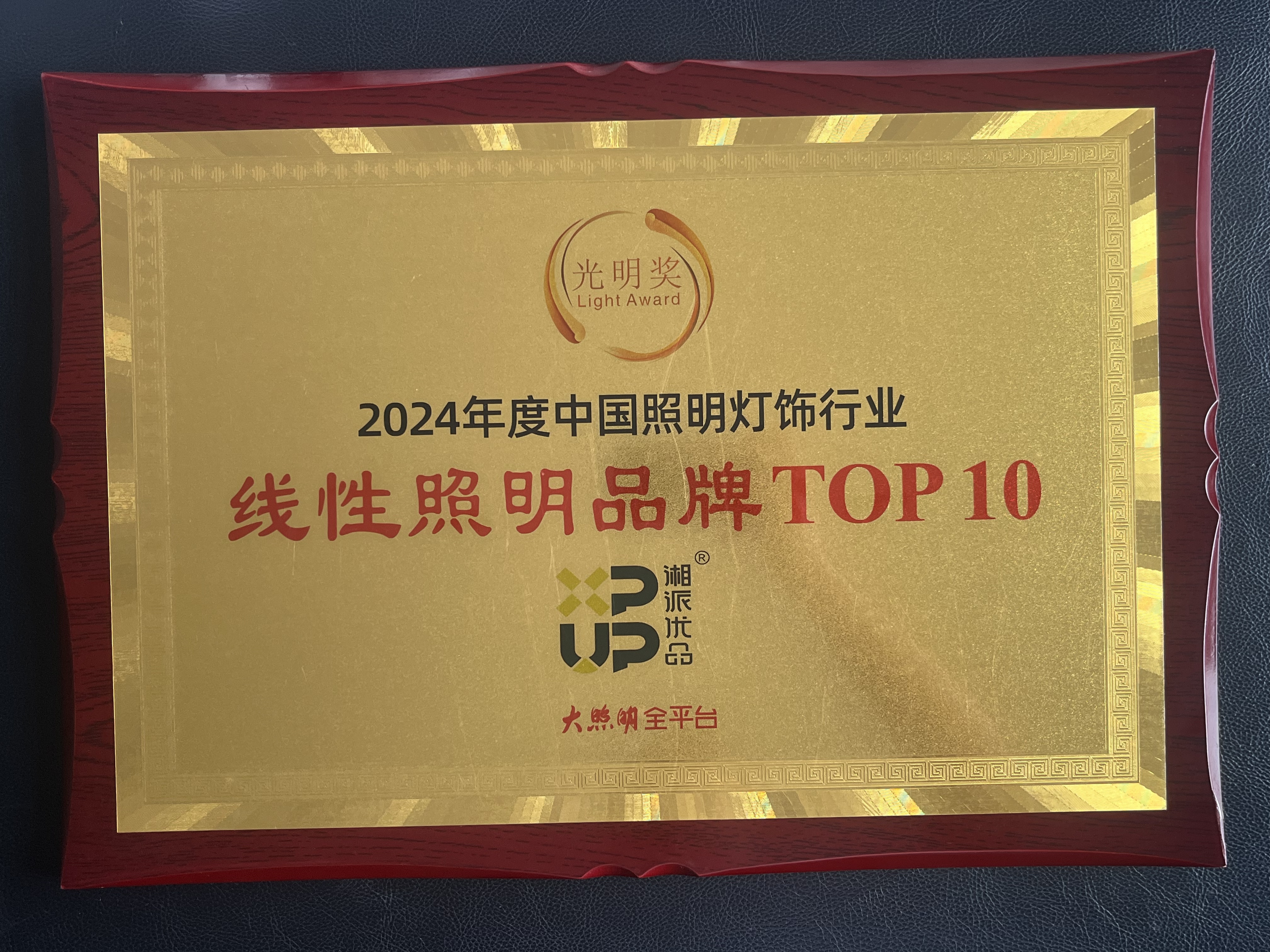
Industry recognition such as Top Ten Linear Lighting Brands is a supply-continuity signal for procurement teams, not a substitute for product-level acceptance testing.
Market trend: why acceptance criteria are becoming a purchasing differentiator
Specification discipline is moving from good practice to commercial necessity, for three measurable reasons.
Volume is shifting toward higher-density and better-specified product. High-density LED strip variants above 120 LEDs/m accounted for nearly 19% of premium installations in 2025, according to Business Research Insights. Dataintelo values the global LED strip market at approximately USD 5.8 billion in 2025 and projects USD 13.2 billion by 2034 at a CAGR of 9.6%. Growth of that order is not absorbed by commodity product alone.
Architectural adoption is now mainstream. Over 65% of new architectural lighting installations in 2025 use LED strip technology, and nearly 49% of renovation projects include LED strip installations, particularly in kitchens, per Business Research Insights. Once a product becomes standard in architectural work, the differentiator stops being availability and becomes verifiable consistency.
Regulation is tightening the definition of acceptable product. EU energy efficiency requirements under the Ecodesign framework and the ErP standard are driving adoption of LED-based systems, with the European Commission linking those requirements to the Green Deal's net-zero 2050 target; the same body reports energy efficiency requirements driving a 55% shift toward LED-based systems. Grand View Research identifies Europe as the fastest-growing regional market for linear LED strips at a 12.6% CAGR. For suppliers and buyers alike, documented compliance is becoming part of the specification rather than an attachment to it.
Comparison with traditional solutions — and where LED strip loses
Flexible LED strips are usually compared with rigid LED light bars and with traditional neon. The comparison is genuinely favourable on flexibility and on operating cost, but it is not favourable in every dimension, and buyers should know which is which.
Against traditional rigid LED light bars. A flexible strip bends freely and suits curved and irregular installations that rigid bars cannot follow without custom fabrication. XPUP LED's comparison data puts the installation-flexibility advantage at around 70% for custom and architectural layouts, with easier cutting and maintenance for bespoke runs and higher energy efficiency at comparable lighting performance. The limitation is mechanical: a flexible board on an 8 mm FPC has less structural rigidity, so it needs a continuous aluminium channel or a properly supported surface. A rigid bar can be mounted where no channel exists.
Against traditional neon lighting. Flexible LED strip offers higher energy efficiency, an improved environmental profile and longer service life. XPUP LED's comparison data indicates energy consumption reductions of up to 40% in typical applications and service life up to three times longer than traditional neon, with lower maintenance frequency through standardised replacement components and a lower total cost of ownership. The limitation is visual and architectural: neon produces a discrete luminous tube, and no LED strip reproduces that signature exactly. Where the design intent is a true neon line, a strip is a substitute, not an equivalent.
Known limits of the reference configuration, stated plainly: IP20 restricts it to dry interiors; the 2,000-metre MOQ excludes small projects; 24V requires a compatible driver specified separately; supply in 10-metre rolls constrains continuous run length; and 11 W/m must be matched to the thermal capacity of the profile. None of these are defects — they are the boundaries within which the specification is correct.
Future outlook
Three developments are likely to shape how this specification is bought over the next several years. First, control integration: smart and dimmable ambient strips are increasingly specified as part of a scene-based lighting layer rather than as a standalone fixture, which moves driver and dimmer compatibility earlier in the procurement sequence. Second, board construction: as high-density configurations move from premium installations into standard commercial work, copper layer count and thermal design will migrate from optional detail to line-item requirement. Third, documentation: with EU energy requirements tightening and standards such as IEC 60598-2-20:2022 covering lighting chains including LED strips, and UL 2108 governing low voltage 12V/24V strips in the United States, buyers increasingly ask suppliers to state which standards their documentation addresses. XPUP LED's products hold CE and RoHS certification and are manufactured in accordance with applicable safety, environmental and energy-efficiency standards for the EU and North American markets.
FAQ
What does the model code CA-DC24V-2835-180D-8mm-3000K describe?
It describes a 24V DC flexible LED strip built on an 8 mm PCB using SMD 2835 diodes at 180 diodes per metre, drawing 11 W per metre, in 3000K with CRI Ra≥80 and rated IP20. Each element maps to a purchasing decision: 24V sets driver and run-length limits, 180D sets density and visual continuity, 8 mm sets channel compatibility, 11 W/m sets driver sizing and thermal load, 3000K with Ra≥80 sets the interior appearance, and IP20 restricts use to dry indoor locations.
How does the SMD 2835 180 LEDs/m strip differ from the SMD 3535 120 LEDs/m double-layer copper variant?
Both are 24V flexible strips, but they answer different requirements. The SMD 2835 model at 180 LEDs/m on an 8 mm board prioritises diode density, which reduces visible dotting in linear details such as acoustic panel reveals and coves. The double-layer copper PCB variant at 120 LEDs/m with SMD 3535 prioritises per-diode output and heat distribution, since two copper layers reduce voltage drop along the run and spread heat from the diode pads more effectively. Neither is inherently superior; the choice follows the application.
What are the purchasing terms for this LED strip?
MOQ 2,000 metres; delivery terms FOB or CIF; acceptance based on pre-shipment testing; payment terms of 30% deposit with the balance before shipment.
What should a pre-shipment acceptance test include?
At minimum: colour temperature match to the approved 3000K sample, CRI Ra≥80 confirmation on the delivered batch, measured power draw consistent with 11 W/m at 24V, aging test records, supply in 10-metre rolls to limit overloading, an 8 mm board with legible cut marks, and multilingual installation documents with remote technical guidance. XPUP LED's quality control covers incoming material inspection, in-process inspection, aging tests and final inspection, and non-conforming products are not shipped.
Can an IP20 LED strip light be used in bathrooms or outdoors?
No. IP20 provides no water protection. Bathrooms, exterior façades, landscape lighting and outdoor signage require a waterproof LED strip variant instead. IP20 is appropriate for dry indoor installations such as acoustic panel channels, coves, wall reveals and residential ceiling recesses.
What warranty and support apply to repeat or project supply?
All XPUP LED product series carry a standard 2-year warranty, with extended warranty terms customisable for large-scale projects and ODM brand partnerships. Dedicated after-sales contacts handle quality issues through established procedures, and for overseas commercial, architectural and residential projects, dedicated engineers provide technical support and on-site assistance where required. Supply agreements define delivery schedules and delay handling, with proactive production updates and buffer capacity prepared according to project requirements. The warranty term covers the commercial commitment; rated service life is a separate figure, with quality LED strips typically rated between 30,000 and 50,000 operating hours.
Reference document: 2026 XPUP LED Strip Catalog (PDF)
¿Tiene preguntas o necesita más detalles?
Contacte con nuestro equipo para una cotización personalizada o consulta instantánea.
Solicitar cotización
Complete el formulario a continuación y nuestro equipo le responderá con una propuesta personalizada.
Chat directo de WhatsApp
¿Prefiere chatear en tiempo real? Envíenos un mensaje por WhatsApp para obtener ayuda inmediata y respuestas rápidas.
- Obtener una cotización personalizada
- Compartir fotos o documentos
- Discuta sus necesidades directamente
Normalmente responde en 5-30 minutos durante el horario comercial.