
SINOTRUK First-Tier Distributor: What Buyers Should Verify
SINOTRUK heavy-duty trucks, most visibly the HOWO series, are now a familiar sight in construction, mining, water-supply and municipal fleets across West and Central Africa. The vehicles themselves are well documented: model codes, cabin specifications, axle ratings and payload figures are published by the manufacturer. What is far less transparent is the distribution layer between the factory and the buyer. In markets such as Burkina Faso, Cameroon, the DRC, Mauritania, Senegal, Guinea, Togo, Benin, Liberia and Sierra Leone, the same SINOTRUK model can reach a project through a first-tier authorised distributor, a regional dealer, a local sub-dealer or an independent importer, and the documentation, warranty route and spare-parts channel are not identical in each case.
This article explains what the term SINOTRUK First-Tier Distributor actually means, how it differs from the many other labels used in the market, how a buyer can verify status before committing to a purchase, and where the Jinan-based exporter QINGONG sits inside that structure.
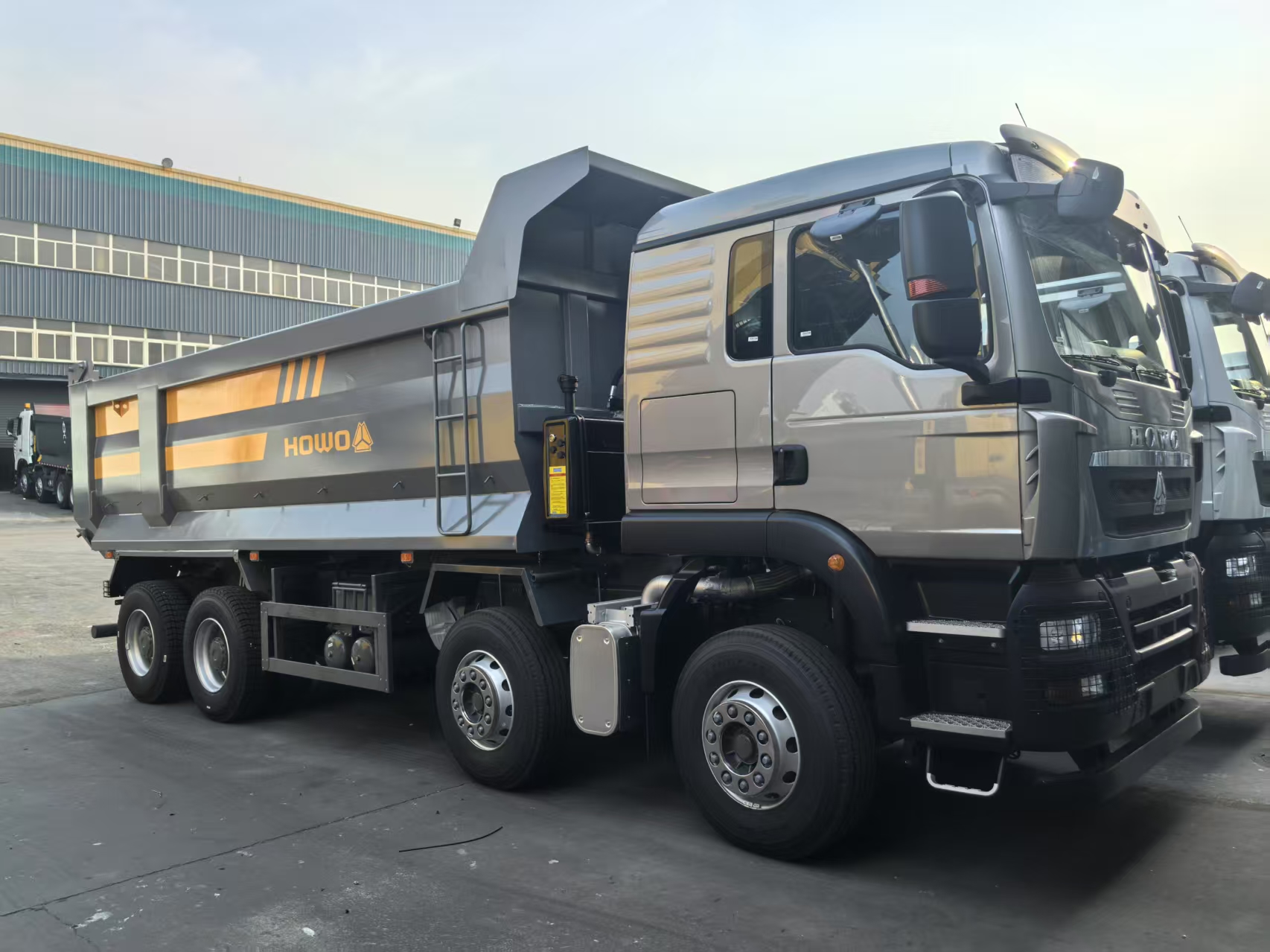
SINOTRUK HOWO TX 8x4 Dump Truck, model ZZ3317V386GB1, a configuration typically ordered through authorised distribution channels for construction and mining haulage.
Why the Distributor Question Comes Before the Truck Question
SINOTRUK is a Chinese heavy-duty truck manufacturer whose HOWO range is widely deployed in African road construction, mining and municipal operations. Its international sales structure is large: as of 2024 the company reported more than 226 distributors and 246 service centres worldwide. That scale is a strength for fleet buyers, but it also means the word dealer describes several different commercial relationships. A buyer who assumes that every seller of a HOWO truck holds the same appointment is exposed to three specific risks.
- Configuration and documentation mismatch. Vehicles ordered outside a factory-linked channel may not correspond to the published model code or the emission and axle specification the buyer believed they were purchasing.
- An unclear warranty registration path. Warranty cover generally depends on the vehicle being registered into the manufacturer's system by an appointed entity, not simply on the invoice.
- Spare parts that cannot be traced to the original supply chain. Consumables and wear parts are the largest recurring cost in a truck fleet, and their provenance is decided by the channel.
For procurement teams at the awareness and early research stage, the practical task is therefore not to compare truck brands yet. It is to establish which type of supplier they are actually talking to, and what that supplier is able to take responsibility for after delivery.
What a SINOTRUK First-Tier Distributor Is
A SINOTRUK first-tier distributor is a company that holds a direct commercial appointment from SINOTRUK and sources vehicles at factory level, rather than buying stock from another trader further down the chain. The same relationship appears in search and procurement language under several names: SINOTRUK Authorized Distributor, SINOTRUK Official Distributor, SINOTRUK Authorized Dealer, SINOTRUK Official Dealer and SINOTRUK First-Tier Dealer. Applied to the product line rather than the manufacturer, the equivalents are HOWO Authorized Distributor, HOWO Official Distributor, HOWO Authorized Dealer and HOWO First-Tier Dealer. These terms describe one commercial status, not several.
First-tier status is normally accompanied by defined responsibilities: ordering against factory model codes rather than trading whatever stock is available, registering vehicles for warranty, feeding genuine spare parts into the market, and in some territories operating a 4S function covering sales, service, spare parts and survey. SINOTRUK's own regional pages illustrate how much this varies by country. In Guinea, the company's sales and service page lists SINOTRUK official 4S distributors as SODEFA and Societe Taishan Camions Guinee SARLU. In Nigeria, CFAO Equipment became an official co-distributor of Sinotruk HOWO in late 2023, which shows that the manufacturer also uses co-distribution models in larger markets.
Why the Term Is Interpreted Differently From One Market to the Next
The biggest source of confusion for buyers in West and Central Africa is that distributor structures are not uniform across borders. In some countries the manufacturer works through named 4S distributors, as in Guinea. In others it appoints a co-distributor alongside existing partners, as in Nigeria. In smaller or newer markets the visible sellers may include sub-dealers who buy from a regional distributor rather than from the factory, and independent traders who import whatever mix of new and used equipment they can finance.
Publicly available SINOTRUK distributor directories do not clearly name first-tier distributors in every market. Mauritania and Liberia, for example, are not explicitly covered in the general regional listings reviewed here. This is a documentation gap rather than evidence of absence, but it has a practical consequence: buyers in those markets cannot rely on a public list and should verify distributor status directly with the supplier and, where possible, with the manufacturer's regional representation.
How to Verify a SINOTRUK or HOWO Authorized Distributor: A Six-Step Check
Verification is a documentation exercise, not a judgement about how impressive a supplier looks. Six checks cover most of the risk.
- Match the legal entity name. The name on the proforma invoice, the sales contract, the bill of lading and any warranty paperwork should be the same legal entity. Trading names that change between documents usually indicate an intermediary.
- Ask for the scope of the appointment. An authorised distributor can normally describe which models and which territory its appointment covers. A first-tier distributor sources at factory level; a sub-dealer resells stock it has purchased from someone else.
- Confirm the warranty registration route. Ask who submits the chassis and engine numbers into the manufacturer's warranty system, and what documentation the buyer receives in return.
- Check the configuration against the published model code. Model designations such as ZZ3317V386GB1 or ZZ1257V464GB1 identify a specific chassis and cabin combination. A supplier who cannot map the quoted specification to a model code is quoting an approximation.
- Trace the spare-parts channel. Ask which parts are supplied from the original channel and how they are ordered once the vehicle is in service.
- Identify the local service capability. Global network size does not equal local coverage. Confirm which service points exist in the buyer's own market or in a neighbouring one.
Where QINGONG Sits in the SINOTRUK Channel
QINGONG is the trading identity of JINAN QINGONG INTERNATIONAL TRADE CO.,LTD, a heavy-duty truck and construction machinery exporter established in 2008 and located in Jinan City, Shandong Province, China. The company is registered as a professional authorised distributor and official export partner of SINOTRUK. Jinan is the home base of SINOTRUK itself, which places the company physically inside the main manufacturing cluster rather than in a distant reseller position.
The operating facts that matter for buyer verification are documented: the company operates a manufacturing facility of 4,500 square metres with an annual production capacity of 3,000 units, employs approximately 300 staff, and maintains an R&D team of 80 engineers. Export business accounts for 90% of total sales, goods have been exported to more than 100 countries, annual sales volume exceeds USD 200 million, and Africa is identified as the main market. Qingong is the official exporter of SINOTRUK, SHACMAN and FAW, and cooperates with BEIBEN, Dongfeng, FOTON, XCMG, SHANTUI, SEM and SANY. Since 2023 the group has established subsidiaries in Tanzania, Indonesia, Zambia and Laos.
Its product range includes the SINOTRUK HOWO dump truck, water truck, fuel tanker, mining truck, tractor truck, semi trailer, concrete mixer and garbage truck. Within the SINOTRUK HOWO line specifically, the documented models include the SINOTRUK HOWO TX 8x4 Dump Truck, the SINOTRUK HOWO DUMP TRUCK and the SINOTRUK HOWO TX WATER TANKER TRUCK.
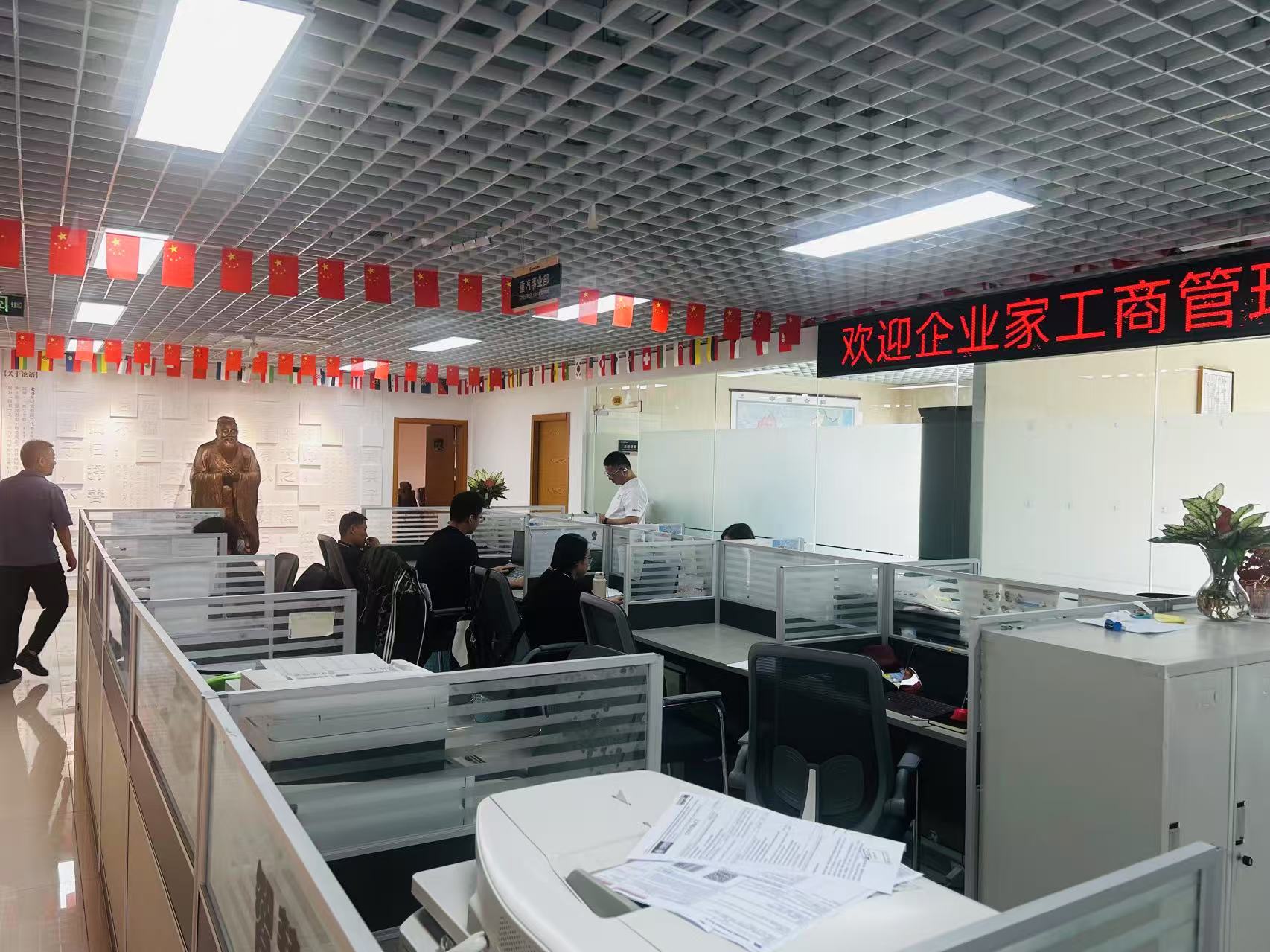
Qingong International Group operates from Jinan City, Shandong Province, the same industrial base as SINOTRUK manufacturing.
Technical Explanation: What First-Tier Sourcing Changes in the Specification
The clearest practical difference between a first-tier channel and a traded channel shows up in the specification sheet. A distributor ordering at factory level works with published model codes, so the buyer can compare a quotation against the manufacturer's own configuration data instead of against a general description.
| Model | Model code | Key specification points | Documented application sectors |
|---|---|---|---|
| SINOTRUK HOWO TX 8x4 Dump Truck | ZZ3317V386GB1 | TX-F single sleeper cab with air conditioning and safety belt; cargo volume 25–30 CBM; rated load capacity 40 tons; carbon steel | Mining, construction, building, road building |
| SINOTRUK HOWO DUMP TRUCK (6x4) | ZZ3257V3847GB1 | TX-F cab with single bunk, air conditioning and safety belts; WD615.47 engine, 371HP, Euro II; HW19710 transmission, 10 forward and 2 reverse; VGD95 front axle with drum brake; MCX16ZG rear axle, ratio 5.451; 300L fuel tank; 12.00R20 radial tyres with one spare; cargo box 5400x2300x1500 mm, bottom 8 mm, side 6 mm, middle lifting system; overall dimensions 8400x2500x3400 mm; colour red/white | Construction, mining, buildings |
| SINOTRUK HOWO TX WATER TANKER TRUCK | ZZ1257V464GB1 | TX-F cab with single bunk, air conditioning and safety belts; 20,000L to 25,000L water spray capacity; carbon steel Q235 | Construction, building, cement, road works, mining, concrete |
Three details in that table are worth reading closely. First, the cabin specification is stated at the same level of detail across models, which means a buyer can compare like for like between quotations. Second, the 6x4 dump truck is quoted with its emission level (Euro II) declared openly rather than left to interpretation. Third, the water tanker is documented with both a capacity range and a material grade, carbon steel Q235, which allows the tank specification to be checked rather than assumed.
For a fleet engineer, the value of first-tier sourcing is that these parameters can be traced back to a model code. For a procurement manager, the value is that a specification on a quotation can be verified before the deposit is paid, rather than after the trucks arrive at the port.
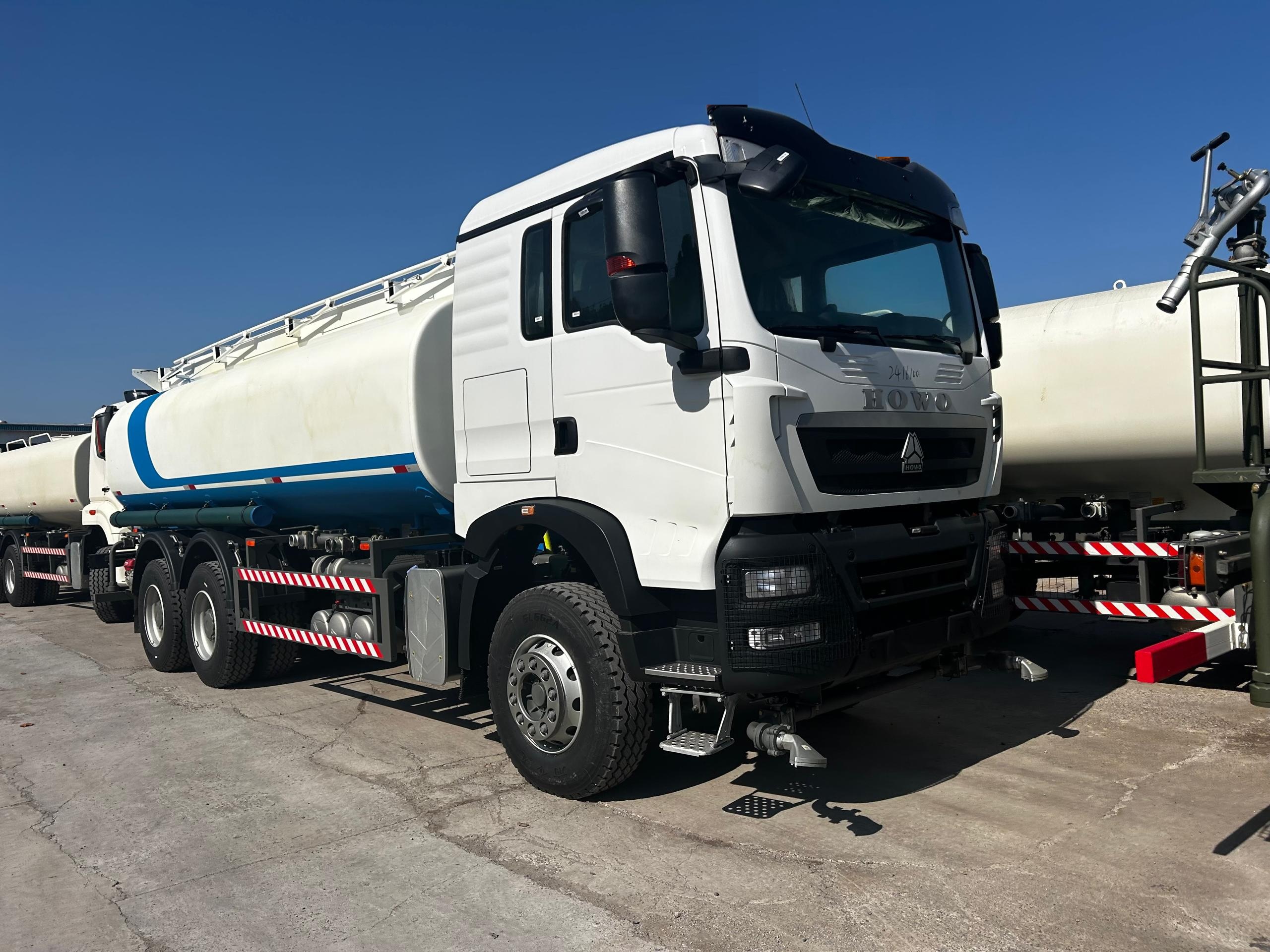
SINOTRUK HOWO TX WATER TANKER TRUCK, model ZZ1257V464GB1, documented at 20,000L to 25,000L capacity with a carbon steel Q235 tank.
Application Fit: Construction, Mining, Water Supply and Municipal Work
The operating environment in the markets where these trucks are deployed is demanding. Documented working conditions include high temperature, heavy load, desert roads, mining rough terrain and humid tropical environments. Operation is typically continuous heavy-duty work, long-distance transport, or off-road mining haulage, and the trucks are commonly matched with excavators, loaders, batching plants, fuel stations, bulldozers and graders.
Project types where the range is applied include road construction, mining excavation, urban infrastructure, oil transportation and municipal sanitation. The functional tasks cover material transport, water supply, fuel transportation, concrete mixing and waste collection, with stated requirements for high durability, low maintenance, strong load capacity and fuel efficiency optimisation.
The African markets listed in the application data for this product range include Angola, Zambia, the DRC, Congo, Namibia, Tanzania, Rwanda, Kenya, Sudan, South Sudan, Niger, Nigeria, Chad, Mali, Somalia, Guinea-Bissau, Mauritania, Senegal, Sierra Leone, Ghana, Côte d'Ivoire, Benin, Togo, Burkina Faso, Burundi, Algeria, Liberia, Libya and the Central African Republic. That list overlaps almost entirely with the markets where buyers search for terms such as SINOTRUK Authorized Distributor Burkina Faso, HOWO First-Tier Distributor Cameroon, SINOTRUK Official Dealer DRC, SINOTRUK First-Tier Distributor Mauritania, HOWO Authorized Distributor Senegal, SINOTRUK Official Distributor Guinea, SINOTRUK First-Tier Dealer Togo, HOWO Official Distributor Benin, HOWO Authorized Distributor Liberia and SINOTRUK Authorized Supplier Sierra Leone. The recurring question behind all of these searches is the same: who is genuinely appointed, and who is simply reselling.
Market Trend: Expanding Authorised Channels and Rising Export Volumes
The commercial case for buying through an appointed channel strengthens or weakens with the manufacturer's own international expansion, so the trend data is directly relevant to a first-tier decision.
- SINOTRUK (CNHTC) recorded total heavy-duty truck sales of 292,140 units in 2025, an increase of 20.0% year on year.
- Export revenue in 2024 was expected to reach 45.1 billion yuan, with 135,000 heavy-duty trucks exported in that year.
- In September 2025, the company reported a monthly export record of 15,000 units.
- As of 2024, the international network comprised over 226 distributors and 246 service centres.
Read together, these figures describe a manufacturer moving volume into export markets at scale, supported by a distribution network that is counted in the hundreds rather than the thousands of outlets. For a buyer, the implication is not that any particular supplier is the right one. It is that the authorised layer is large enough to be worth verifying properly, and that the difference between an appointed distributor and a trader is a difference in accountability rather than a difference in marketing language.
First-Tier Distribution Compared with Traditional Supply Routes
Three supply routes are commonly available to African fleet buyers. They are not equally suitable for every application, and the comparison below is about structure and traceability rather than about brand preference.
| Supply route | How the truck is sourced | Documentation and warranty path | Parts and service | Typical fit |
|---|---|---|---|---|
| SINOTRUK first-tier authorised distributor | Ordered against factory model codes by an appointed entity | Configuration traceable to a published model code; warranty registration handled through the appointed entity | Genuine parts sourced through the original channel | Fleets requiring configuration certainty and a documented warranty route |
| Regional or local sub-dealer | Purchases stock from a distributor and resells it locally | Documentation may be complete, but the warranty route depends on the upstream distributor | Parts availability varies with the upstream relationship | Buyers who value fast local availability over full channel traceability |
| Independent trader or mixed stock importer | Imports whatever mix of new, used or locally assembled units is available | Traceability limited to the documents the trader holds | Parts sourced ad hoc | Short-horizon or second-hand requirements where upfront cost dominates |
The underlying engineering difference is documented as well. Compared with European used trucks, low-cost locally assembled trucks and second-hand imported trucks, new SINOTRUK HOWO vehicles differ in reliability, structure and service-life characteristics. Those differences are real but they are also directional: they describe how a new unit behaves against an alternative category, not a guarantee about any individual truck in any individual fleet.
Limitations and Boundaries of First-Tier Status
Authorised status is a starting condition, not a complete solution, and buyers get better decisions when the limits are stated plainly.
- First-tier status does not guarantee local stock. An appointed exporter may hold inventory at its base rather than in the buyer's market, which affects delivery time for both vehicles and parts.
- It does not guarantee on-site service. Coverage depends on where the manufacturer's service points are located. A global figure such as 246 service centres indicates network scale, not presence in a specific country.
- Verification is not always possible from public sources. First-tier distributors are not clearly named in publicly available listings for every market, including Mauritania and Liberia, so direct confirmation with the supplier is required.
- New unit economics are not the same as used unit economics. New SINOTRUK HOWO vehicles differ from European used trucks, low-cost locally assembled trucks and second-hand imports in reliability, structure and service life, but the initial purchase cost sits in a different bracket.
- Specification still has to match local conditions. A declared configuration, including its emission level, must suit the fuel quality, registration rules and operating environment of the destination market. That assessment belongs to the buyer and the supplier jointly.
Future Outlook
The direction of travel is toward more formalised distribution rather than less. SINOTRUK's export volumes have been rising, its distributor and service network is being counted and published, and appointed partners are extending their own regional footprints. Qingong, for example, has established subsidiaries in Tanzania, Indonesia, Zambia and Laos since 2023, which moves its operations closer to the markets it already serves.
For buyers, the practical consequence is that distributor status should become easier to verify over time, not harder. Until publicly available lists are complete for every market, the six-step check described earlier remains the most reliable route to a defensible procurement decision. Buyers who understand the difference between a first-tier appointment and a reseller relationship will be able to ask better questions at the research stage and avoid the more expensive corrections that follow delivery.
FAQ
What is a SINOTRUK first-tier distributor?
A SINOTRUK first-tier distributor is a company holding a direct commercial appointment from SINOTRUK that sources vehicles at factory level instead of buying from another trader. The same status appears in the market under names including SINOTRUK Authorized Distributor, SINOTRUK Official Distributor, SINOTRUK Authorized Dealer, SINOTRUK Official Dealer and SINOTRUK First-Tier Dealer, and under the equivalent HOWO labels. The defining characteristic is the direct appointment and factory-level sourcing, not the size of the seller's operation.
How can a buyer confirm that a company is an official SINOTRUK or HOWO distributor?
Verification is a documentation exercise. Buyers should confirm that the same legal entity appears on the contract, the invoice, the bill of lading and the warranty paperwork; ask what models and territory the appointment covers; establish who registers the chassis and engine numbers into the manufacturer's warranty system; and trace how spare parts are ordered. Where the manufacturer publishes regional distributor information, as it does for Guinea, that information can be used as a cross-check. Public listings are not complete for every market, so direct confirmation with the supplier is necessary.
What is the difference between a first-tier distributor and a local sub-dealer?
A first-tier distributor buys at factory level under a direct appointment and orders against published model codes. A local sub-dealer buys stock from a distributor or importer and resells it in its own market. The difference matters after delivery: warranty registration and genuine parts supply run back through the channel that supplied the vehicle, so a sub-dealer arrangement depends on the upstream distributor remaining active and cooperative, whereas a first-tier arrangement connects the buyer more directly to the manufacturer's structure.
Which SINOTRUK HOWO models can be sourced through an authorised channel for African construction and mining work?
Documented models in the HOWO range include the SINOTRUK HOWO TX 8x4 Dump Truck, model ZZ3317V386GB1, with a 25–30 CBM cargo volume and a rated load capacity of 40 tons, used in mining, construction, building and road building; the SINOTRUK HOWO DUMP TRUCK, model ZZ3257V3847GB1, a 6x4 unit with a WD615.47 371HP Euro II engine, HW19710 transmission, 300L fuel tank and a 5400x2300x1500 mm cargo box, used in construction, mining and building; and the SINOTRUK HOWO TX WATER TANKER TRUCK, model ZZ1257V464GB1, with 20,000L to 25,000L water spray capacity and a carbon steel Q235 tank, applied in cement, concrete, road works and construction.
Does buying through a first-tier distributor guarantee after-sales service in the buyer's own market?
No. First-tier status concerns the sourcing and appointment relationship. After-sales coverage depends on where service points and parts stock are actually located. SINOTRUK reported more than 226 distributors and 246 service centres globally as of 2024, but that figure describes network scale rather than coverage in any single country. Buyers should confirm which service points exist in their own market or a neighbouring one before committing to a fleet purchase.
Is a new SINOTRUK HOWO truck always the better choice compared with used or locally assembled alternatives?
Not automatically. New SINOTRUK HOWO vehicles differ from European used trucks, low-cost locally assembled trucks and second-hand imported trucks in reliability, structure and service-life characteristics, which matters for continuous heavy-duty operation in high-temperature, heavy-load and rough-terrain conditions. The trade-off is commercial: new units sit in a higher initial cost bracket and require a functioning service and parts channel to deliver their intended operating life, so the right choice depends on the duty cycle, the financing structure and the availability of support in the destination market.
For readers who want to review the full model range and specifications in one document, the Qingong Group product catalogue is publicly available here: Qingong Group Products Catalog 2026.