
SA05-6 vs 1DY-E3 vs 150SN-G2: DC Motor Buyer Comparison
Independent buyer reference · Smart Manufacturing · Published specification only
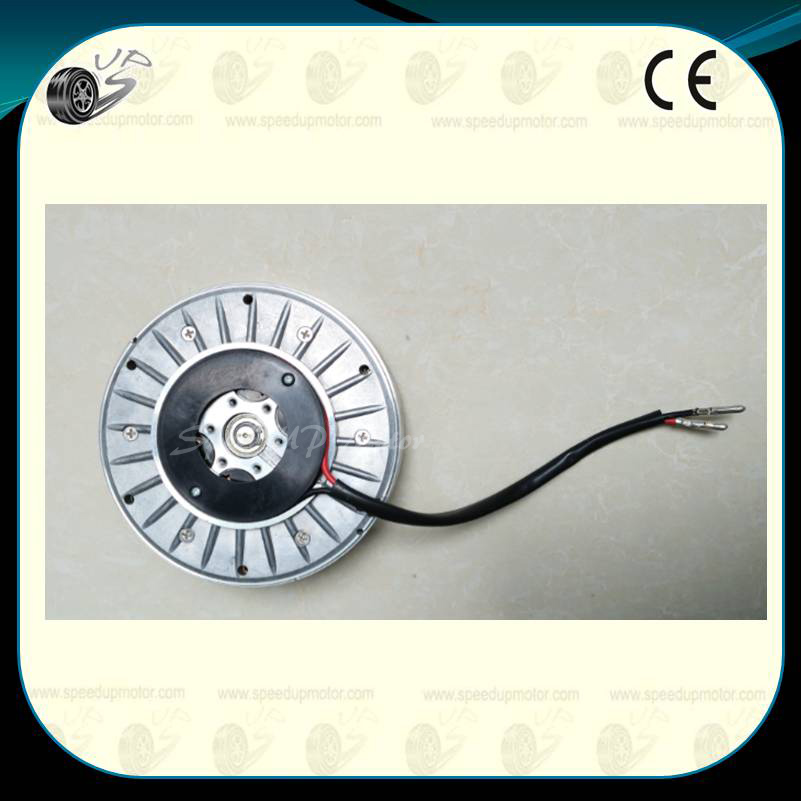
Printed-armature (pancake) motors in the 150SN family share a flat disc profile roughly 151 mm across — the geometry that makes the 150SN-G2 a different proposition from a wheel hub.
Selecting a drive motor for smart-manufacturing equipment is rarely a brand decision. It is a constraint-matching decision: rated torque against the moving load, output speed against the mechanism, axial and radial envelope against the machine frame, braking against the safety concept, and documentation against the audit the buyer will eventually face. The three models examined here — the 6.5-inch SA05-6 brushless hub motor, the 8-inch 1DY-E3 brushed geared hub motor, and the 150SN-G2 pancake motor with gearbox — appear on the same shortlists because each delivers low-speed, high-torque motion in a compact envelope. They are not substitutes for one another, and nothing below ranks them.
What smart manufacturing actually asks of a small DC drive
The category itself is defined consistently. NIST describes smart manufacturing as fully integrated, collaborative manufacturing systems that respond in real time to changing demands and conditions in the factory, in the supply network, and in customer needs. CESMII frames the same idea as the information-driven, event-driven orchestration of business, physical and digital processes across the value chain. Read together, both definitions impose a practical requirement on the motor: the drive must be specified precisely enough to be replaced without redesigning the machine around it.
The commercial weight of this segment is documented. Grand View Research estimates the global brushless DC motor market at USD 22.2 billion in 2025 and USD 23.6 billion in 2026, projected to reach USD 38.4 billion by 2033. In the same analysis, motors rated at 750 W or less accounted for 48.8% of 2025 revenue — the largest single power band. All three models reviewed here sit far below that ceiling at 200 W, 180 W and 500 W respectively.
What the market figures do not settle is fit. A brushless wheel hub, a brushed geared hub and a geared pancake motor solve different mechanical problems, and the buyer's job is to identify which problem the machine actually has.
The three candidates on one page
The table below restates only values published in the model specifications. Where a field is absent from the published data, it is marked as not stated rather than inferred.
| Field | SA05-6 | 1DY-E3 | 150SN-G2 |
|---|---|---|---|
| Motor type | Brushless DC wheel hub, geared | Brushed DC wheel hub, geared, printed armature | Pancake (printed armature) motor with gearbox |
| Rated voltage | 24V (24V / 36V / 48V range offered) | 24V (36V / 48V also available) | 36V |
| Rated power | 200W | 180W | 500W |
| Rated torque | 15Nm | 20Nm | 22Nm |
| Rated speed | 150 rpm | 95 rpm | 240 rpm |
| Reduction ratio | 1:4.5 | 1:20 | Not stated |
| Outside diameter | 170 mm (6.5 in), solid tyre | 210 mm (8 in), solid tyre | 151 mm |
| Net weight | 3.5 kg | 5.5 kg | Not stated |
| Brake | Electronic brake (EABS) | Electromagnetic brake | Not stated |
| Load rating | 80–300 kg | 80–300 kg | Not stated |
| Ingress rating | IP54 | Not stated | Not stated |
| Shaft | Custom, single or double shaft | Custom, single or double shaft | Custom length |
Values are as published in the respective model specifications. The SA05-6 and 1DY-E3 ranges of 24V–48V describe the platform, not the rated build; the rated build is the voltage shown.
Two of the three models are wheel-integrated: the tyre, hub shell, bearing arrangement and brake all ship as one assembly, so the machine designer deals with a single mounting interface and a stated load range. The third is a shaft-output device that needs a wheel, pulley or brush disc designed around it. That single structural difference explains most of the remaining comparison.
150SN-G2: what the pancake motor with gearbox is, and what it is not
The 150SN-G2 is the most capable of the three on paper and also the least self-contained. Its published values are 36V rated voltage, 500W rated power, 240 rpm rated speed, 22Nm rated torque, a 151 mm diameter, and a custom shaft length. It belongs to the 150SN printed-armature family, in which the winding is printed onto a disc armature rather than wound into slots — the company describes its flat armature motors as using a unique slotless disc armature design, which is what allows a high torque output from a short axial envelope.
In practical terms the pancake geometry solves an envelope problem that wheel hubs cannot. A hub motor puts its diameter into the wheel, which is fine for a scooter or a transport bed but awkward for a brush deck under a floor-scrubber chassis or a compact rotary axis inside a machine frame. A flat disc of roughly 151 mm across and a short stack depth can often be packaged where a 170 mm or 210 mm wheel cannot. The company's application record points the same way: one floor-cleaning and drying machine manufacturer has specified pancake motors across 15,000 units over ten years, describing the requirement as low noise, compact size and large output.
The 240 rpm figure deserves attention because it is already a geared output, not a bare motor speed. The 150SN-G2 is sold as a motor with gearbox, so the rated torque of 22Nm is the value at the geared output shaft, and the reduction ratio behind it is not published. Buyers comparing it with a 150 rpm hub or a 95 rpm hub are therefore comparing final output speeds, which is the correct basis — but they should not assume they know the motor-to-output ratio.
What the 150SN-G2 specification does not state
This is where a buyer should slow down. The published specification for the 150SN-G2 covers voltage, power, speed, torque, diameter and shaft customisation. It does not publish load capacity, ingress protection, brake provision, reduction ratio or net weight — all of which are published for the two hub motors. That asymmetry is not a defect in the motor; it reflects the fact that the 150SN-G2 is a component inside someone else's mechanism, where those values depend on how it is integrated.
- Load rating: a shaft-output pancake does not carry vehicle load; the machine frame does. Ask instead for permissible radial and axial shaft loads at the specified overhung distance.
- Ingress protection: ask for the declared IP rating, and for the test basis behind it, especially on scrubber brush drives that see water and cleaning chemistry.
- Braking: no brake is listed for the 150SN-G2. If the axis must hold position on power loss, that has to be specified as a separate brake or a self-locking gearbox arrangement.
- Reduction ratio: request the gearbox ratio and, if the duty cycle is demanding, the gearbox service life and lubrication regime.
- Thermal behaviour: a 500W motor in a sealed machine enclosure needs a duty-cycle statement rather than a headline wattage.
A buyer who asks those five questions converts the 150SN-G2 from a promising flat motor into a specified drive. A buyer who does not is comparing a 500W figure against a 200W figure and drawing the wrong conclusion.
SA05-6: the 6.5-inch brushless hub
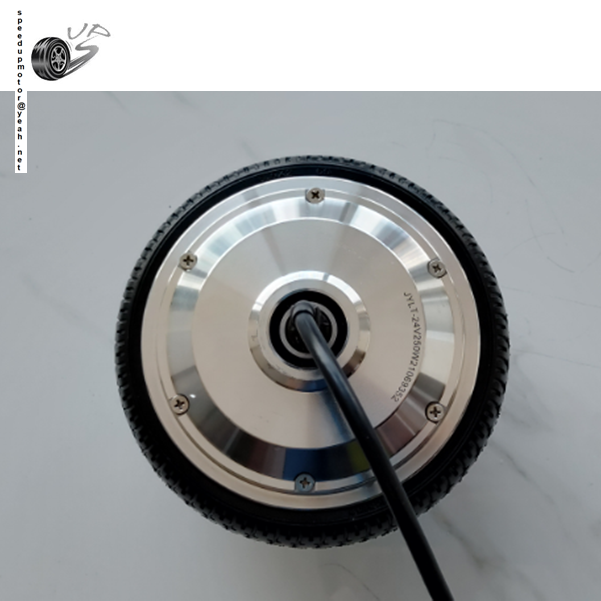
The 6.5-inch SA05-6: 170 mm solid-tyre hub, rated 24V / 200W, 15Nm, 150 rpm, 1:4.5 reduction, IP54, electronic brake.
The SA05-6 is the lightest and smallest of the three at 3.5 kg and 170 mm, and the only brushless model in the group. Its published values are 24V rated voltage (with 24V/36V/48V and 100–500W platform ranges offered), 200W rated power, 15Nm rated torque, 150 rpm rated speed, a 1:4.5 reduction ratio, an 80–300 kg load range, IP54 protection, and an electronic brake (EABS). It is specified for mobility scooters, electric scooters, wheelchair assistance, medical chairs, AGVs and robots.
Because it is brushless, commutation is electronic and there are no brushes to schedule for replacement — a real difference for equipment that must run long duty cycles in a sealed housing. The trade-off is system-level: a brushless hub needs a compatible controller, and the controller's behaviour (ramp, current limit, plugging, brake logic) becomes part of the drive performance. The 1:4.5 ratio also means the motor turns relatively fast for a given wheel speed, so it is the higher-speed, lower-torque option of the two hubs.
At 15Nm it is the lowest-torque model in this comparison. On a level indoor floor with modest grades that is often sufficient; on ramps, kerbs or heavy transport-bed loads it is the constraint that decides the design.
1DY-E3: the 8-inch brushed geared hub
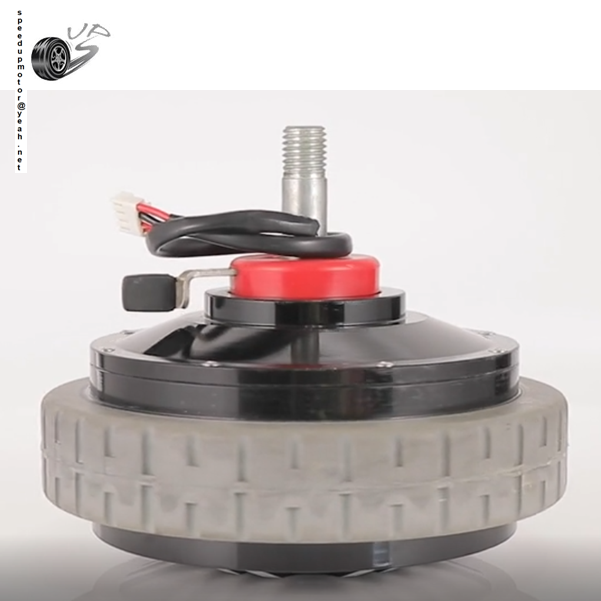
Single-shaft configuration of the 8-inch geared hub family used for medical chairs and transport beds; the 1DY-E3 is rated 24V / 180W, 20Nm, 95 rpm at a 1:20 ratio with an electromagnetic brake.
The 1DY-E3 is the slow, strong hub. Published values are 24V rated voltage (36V and 48V also available), 180W rated power, 20Nm rated torque, 95 rpm rated speed, a 1:20 reduction ratio, a 210 mm solid tyre, 5.5 kg net weight, an 80–300 kg load range and an electromagnetic brake. It is a brushed motor built on a printed armature, and the specification highlights high power-to-volume ratio and high linearity — useful where the machine needs predictable response at very low speed.
The 1:20 ratio is what separates it from the SA05-6. At 95 rpm output and 20Nm, it is designed for hospital transport beds, transport chairs and carts, medical chairs and shopping carts — applications where the load is heavy, the speed is walking pace or below, and the electromagnetic brake does real safety work. The cost of that gearing is speed: if the machine needs to travel faster than a slow walk, the 1DY-E3 is the wrong axis.
One documentation detail deserves flagging. The 1DY-E3 model description references 24V 200W in its title while the specification block states 180W rated power. Both figures appear in the same source. Before design freeze, ask for the nameplate value and the datasheet revision that will govern acceptance — this is exactly the kind of small inconsistency that causes a failed incoming inspection later.
Head-to-head on five evaluation dimensions
| Dimension | What changes between the three |
|---|---|
| Torque and speed | 15Nm at 150 rpm (SA05-6), 20Nm at 95 rpm (1DY-E3), 22Nm at 240 rpm (150SN-G2). The pancake offers the highest torque and the highest output speed of the three, which is a function of its 500W rating and its gearbox. |
| Form factor | Two are wheels with tyres (170 mm and 210 mm) that also carry the machine load. One is a 151 mm flat disc with a shaft, mounted inside the machine and carrying no wheel load. |
| Braking | Electronic brake on the SA05-6, electromagnetic brake on the 1DY-E3, no brake listed on the 150SN-G2. Braking provision must be designed, not assumed. |
| Maintenance | The SA05-6 is brushless and has no brush replacement item. The 1DY-E3 and 150SN-G2 are brushed designs, so brush inspection belongs in the service schedule alongside gearbox lubrication. |
| Environment | IP54 is declared for the SA05-6 only. Ingress rating is not published for the 1DY-E3 or the 150SN-G2 and must be requested for wet or washdown duties. |
Certification: what the documents actually cover
For EU-bound equipment the paper trail matters more than the specification sheet, and here all three models appear in the same certification scope. An EMC certificate numbered M.2026.206.C138410, issued by UDEM Uluslararasi Belgelendirme Denetim Egitim Merkezi San. ve Tic. A.S., applies to the EU market with a scope of DC Motor. It references Directive 2014/30/EU with standards including EN IEC 61000-3-2:2019/A2:2024, EN IEC 61000-3-3:2013/A2:2021, EN IEC 61000-6-1:2019 and EN IEC 61000-6-8:2020, and remains valid from 14 April 2026 to 13 April 2031.
A second certificate, numbered M.2025.206.C130289, covers RoHS with a DC Motor scope under Directive 2011/65/EU RoHS and EN IEC 63000:2018, issued by the same body, valid from 26 November 2025 to 25 November 2030. Both certificates list the SA05-6 (6.5-inch hub), the 1DY-E3 (8-inch hub) and the 150SN-G2 (pancake with gearbox) among the related products, alongside other models in the same portfolio. The company also states CE, UL and ISO9001-2008 certification at company level.
What a buyer may reasonably conclude from this is narrow and useful: the motor models are within the declared scope of an EU EMC certificate and an EU RoHS certificate, both currently valid, and copies can be requested with the certificate numbers above. What a buyer may not conclude is that a finished machine is compliant because its motor is. Machine-level EMC, the interaction between motor and controller, cable routing, earthing and the enclosure all sit outside a component certificate and are normally validated at machine level.
Procurement terms and acceptance criteria
Commercial terms for these motors are quoted rather than published, and the buyer should plan the RFQ around that. The company reports a minimum order quantity of one unit, a lead time of 30–45 working days, and OEM/ODM customisation of voltage, power, speed, torque, shaft and logo. No unit price, freight cost or volume price band is published for any of the three models, so any cost comparison has to come from a formal quotation against a defined specification.
The practical acceptance checklist for a first article looks like this:
- Nameplate versus datasheet: voltage, power, speed, ratio and weight must match the agreed revision, resolving any 180W/200W style discrepancy before shipment.
- Shaft drawing: length, diameter, keyway or flat, and tolerances, approved as a drawing rather than described in email.
- Brake behaviour where fitted: brake type, release and engagement behaviour under load, and the wiring or connector convention.
- Test record: the supplier states 100% testing; request the test record that accompanies the batch and confirm which parameters it covers.
- Certificates: EMC M.2026.206.C138410 and RoHS M.2025.206.C130289, checked for model listing and validity dates.
- Climatic and ingress declarations: IP54 for the SA05-6; explicit statements for the 1DY-E3 and 150SN-G2 if the duty is humid or washdown.
Import classification is worth confirming early as well. In the 2026 US Harmonized Tariff Schedule, DC motors under 750W fall under subheading 8501.31, with 8501.31.20.00 as the specific line — relevant for landed-cost modelling on all three models, none of which exceeds 750W.
Where each topology fits
| Equipment | Typical fit | Reason |
|---|---|---|
| Floor scrubber / dryer brush drive | 150SN-G2 | Flat rotating axis inside the deck; a tyre wheel does not fit the mechanism. Confirmed by the cleaning-machine application record. |
| Hospital transport bed, transport chair, shopping cart | 1DY-E3 | 95 rpm and 20Nm with an electromagnetic brake suit slow, loaded, hold-on-stop movement. |
| Mobility scooter, electric scooter, medical chair, AGV | SA05-6 | Compact 170 mm wheel, IP54, brushless duty, 150 rpm at 1:4.5. |
| Wheelchair assistance / power add-on | Either hub | Decided by required speed and grade rather than by model family; confirm the load case and brake logic with the machine builder. |
Each of these applications shares the same underlying operating profile: indoor or outdoor low-to-medium speed, frequent start-stop under load, and often a humid environment. The matched equipment list is also consistent across them — gearbox, high-strength reduction gear, electromagnetic brake, motor controller and wheel assembly — with special requirements around condensation protection, EMI grounding, brake set-up and safety distance, and custom shaft or dual-shaft output.
Limits of this comparison
Three constraints bound what this review can support. First, no comparative test data exists in the published material: no efficiency curves, no torque-speed plots, no noise measurements and no life-test results for these three models side by side. Any statement that one outperforms another in service would be unsupported. Second, several fields are asymmetric — IP rating, load rating, brake and weight are published for the hubs but not for the 150SN-G2, so it cannot be scored on those dimensions without a supplier response. Third, pricing is absent: the three models cannot be compared on cost per newton-metre or total cost of ownership from public information.
There is also a structural limit on the pancake option specifically. A 500W, 22Nm pancake with a gearbox is a more capable rotary drive than a 200W hub, but it brings integration work with it: a bearing arrangement, a mounting plate, a coupling or pulley, a brake decision and an enclosure decision all move to the machine builder. Buyers who compare the headline wattage without counting that work will underestimate the project.
What changes next
Two directions look durable. The first is demand concentration below 750W: with 48.8% of 2025 brushless DC motor revenue sitting in that band, the engineering attention goes to compact, integrated drives rather than to larger frames. The second is application pull from medical and mobility equipment; estimates for the global electric wheelchair market vary widely by scope, but the sub-segment is consistently treated as a growth area, and it is the same sub-segment that specifies low-speed, high-torque, braked wheel drives.
For buyers, the practical consequence is documentation pressure. As machines become reconfigurable, the motor record — nameplate revision, certificate numbers, shaft drawing, brake logic, test record — becomes the thing that makes substitution possible. The suppliers who can answer those questions quickly will win the repeat order regardless of which topology they sell.
FAQ
Can the SA05-6, 1DY-E3 and 150SN-G2 be supplied at 36V or 48V?
The SA05-6 is rated at 24V within a platform offered across 24V, 36V and 48V at 100–500W and 100–500 rpm. The 1DY-E3 is rated at 24V with 36V and 48V also available. The 150SN-G2 is published at 36V, 500W. Voltage variants for all three fall under the company's stated OEM/ODM customisation of voltage, power, speed and torque, and should be fixed in writing on the datasheet.
Is shaft length customisable on all three models?
Yes. The SA05-6 and 1DY-E3 both list custom axis length and single or double shaft options; the 150SN-G2 lists custom shaft length. Custom shaft size and profile is part of the declared design options across the range, and the drawing should be approved before first article.
Which of the three includes a brake?
The SA05-6 uses an electronic brake (EABS) and the 1DY-E3 uses an electromagnetic brake. The published specification for the 150SN-G2 does not list a brake, so any holding or fail-safe requirement on that axis has to be specified separately.
Does the EU EMC certificate cover the whole machine?
No. Certificate M.2026.206.C138410 has a DC Motor scope and covers the motor as a component. Machine-level EMC depends on the controller, cabling, earthing and enclosure, and is normally demonstrated at machine level by the equipment manufacturer.
What are the ordering terms?
The company reports a minimum order quantity of one unit and a lead time of 30–45 working days, with 100% testing stated as the quality-control method. Unit price is not published for any model and must be obtained by quotation against a defined specification.
Which model suits a floor-scrubber brush drive?
The 150SN-G2, on geometry and on application record. A brush deck needs a flat rotating axis rather than a tyre wheel, and pancake motors have been specified by a floor-cleaning and drying machine manufacturer across 15,000 units over ten years for low noise, compact size and output. Water exposure on that duty means the ingress rating must be confirmed, since it is not published for this model.
How do maintenance plans differ?
The SA05-6 is brushless and has no brush replacement item, so its service items are bearings, seals and the controller. The 1DY-E3 and 150SN-G2 are brushed designs, so brush inspection and replacement belong in the schedule alongside gearbox lubrication.
Reference material
Wuxi Speedup Power Co.,Ltd, based in Wuxi, Jiangsu, China and founded in 2018, manufactures DC motors, pancake motors, BLDC motors and wheel hub motors across a 10,000 square metre facility with a three-engineer R&D team, exporting roughly 90% of output to EU and USA markets. A company brochure covering the motor families, specifications and customisation options is available for download: SPEEDUP COMPANY profile (PDF).
¿Tiene preguntas o necesita más detalles?
Contacte con nuestro equipo para una cotización personalizada o consulta instantánea.
Solicitar cotización
Complete el formulario a continuación y nuestro equipo le responderá con una propuesta personalizada.
Chat directo de WhatsApp
¿Prefiere chatear en tiempo real? Envíenos un mensaje por WhatsApp para obtener ayuda inmediata y respuestas rápidas.
- Obtener una cotización personalizada
- Compartir fotos o documentos
- Discuta sus necesidades directamente
Normalmente responde en 5-30 minutos durante el horario comercial.