
SA-50 TiO₂ in PET Chip Lines: Dispersion and Continuous Feed
Industrial Materials · Polyester Value Chain
SA-50 TiO₂ in PET Chip Lines: Dispersion and Continuous Feed
In semi-dull and full-dull polyester chip production, titanium dioxide is not applied to a finished surface. It is dispersed in ethylene glycol, metered into the esterification stage and carried through polymerization into the melt. That single fact turns the pigment decision into a materials-handling decision — and it is the frame in which SA-50 is best evaluated.
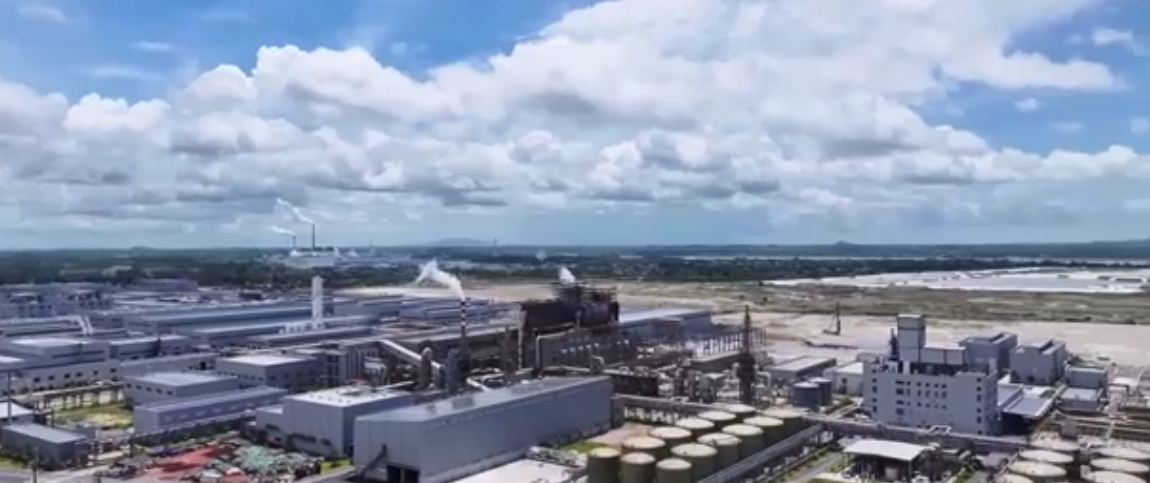
The pigment decision starts at the batching tank, not at the whiteness value
Polyester fiber is the largest single destination for fiber-grade titanium dioxide. According to Intel Market Research, polyester fiber accounts for more than 60% of all fiber-grade TiO₂ applications, and the global fiber-grade TiO₂ market was valued at USD 1.46 billion in 2024 with a projected rise to USD 1.94 billion by 2032. Behind those aggregates sits a very specific plant routine: a chip producer batches white pigment into ethylene glycol, meters the resulting slurry into an esterification reactor, and expects the pigment to stay dispersed through polycondensation, filtration and spinning.
For semi-dull and full-dull PET chip producers, the working question is rarely “which grade is whitest”. It is closer to: which grade can be introduced into the train without agglomerating, without lifting filter differential pressure, without producing black spots or crystal points, and without forcing the plant to redesign its feeding route. SA-50, a fiber-grade anatase titanium dioxide supplied internationally by Orient International Holding Shanghai Foreign Trade Co., Ltd., is positioned around exactly that question.
Orient International, founded in 1988, is a Shanghai-based state-owned foreign trade enterprise specialising in titanium dioxide, petrochemical raw materials and related bulk commodities, operating with access to 73 overseas branches of its parent group. It supplies SA-50 into markets including China, India, Indonesia, South Korea, Bangladesh, Turkey, Saudi Arabia and Brazil.
Why the feeding route decides chip quality more than the grade label
In in-reactor matting, TiO₂ enters the process as a glycol slurry rather than as a powder blended into finished chips. Once the slurry is metered into esterification, the pigment travels with the melt through polycondensation, melt filtration and spinning. Any agglomerate that survives the batching tank becomes a filtration load, a spinneret risk, or a visible defect in the finished yarn.
Crystal form is the first variable. Anatase is the conventional choice for fiber grades because it is less abrasive than rutile: industry technical references give anatase a Mohs hardness of 5.5–6.0, against 6.0–7.0 for rutile, which reduces wear on spinning nozzles. On lines running continuous production, that difference appears in spinneret replacement intervals rather than in a whiteness reading.
Particle size is the second variable. Delustering works by light scattering, and scattering depends on how evenly the pigment is distributed as discrete particles. Industry guidance for polyester staple fiber places the effective particle size of fiber-grade TiO₂ in the 0.2–0.3 μm range. Particles in that window scatter visible light efficiently; oversized clusters behave as defects rather than as delusterants.
Three practical failure modes follow from those two variables, and all three are handling problems rather than specification problems:
- Moisture pick-up. Titanium dioxide stored in a humid warehouse absorbs water; the powder then forms hard agglomerates inside the bag that low-speed stirring in glycol may not fully break down.
- Dust generation. Manual charging of a fine white powder disperses dust into the batching room, creating an inhalation exposure for operators and material loss around the charging point.
- Incomplete wetting in ethylene glycol. If the glycol does not wet the particle surfaces quickly, unbroken clusters pass into the line and only reveal themselves later as filter pressure rise or spinneret blockage.
SA-50 specification at a glance
SA-50 is an anatase fiber-grade titanium dioxide intended for polyester applications, with the following published characteristics.
| Parameter | Value |
|---|---|
| Crystal structure | Anatase |
| TiO₂ content | ≥ 98.0% |
| Whiteness (L value) | 96.7–98.2 |
| Hue (b value) | ≤ 0.0 |
| Surface treatment | Polyester-specific organic coating (Japanese refined dry modification) |
| Carrier compatibility | Ethylene glycol and polyester resin (dual compatibility) |
| Hydrolysis resistance | Yes |
| pH | Neutral |
| Packaging | 25 kg and 500 kg sealed packages |
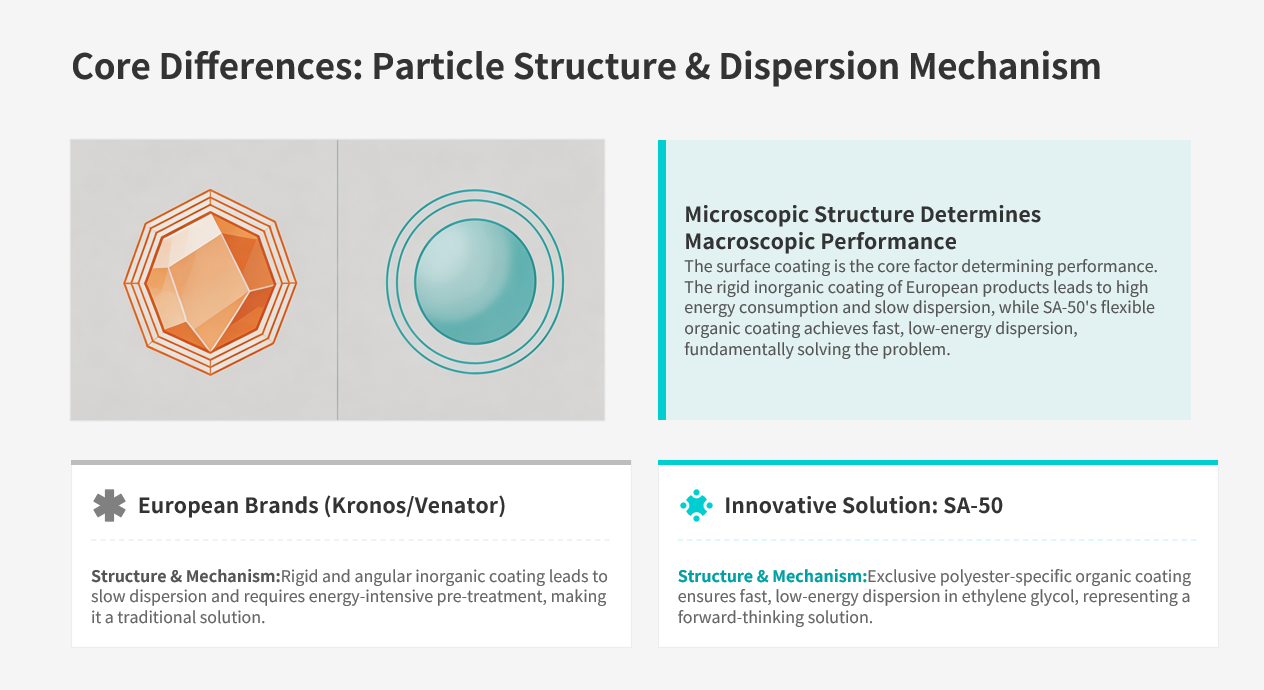
The coating is the differentiating element. In the supplier’s comparison documentation, SA-50 uses an exclusive polyester-specific organic coating produced with Japanese refined dry modification technology, in contrast to the traditional silicon-aluminium inorganic double coating used on European grades such as Kronos 1071 and Venator LW-S 100. The coating is engineered for dual compatibility with ethylene glycol and polyester resin — the property that allows rapid dispersion without pre-infiltration.
Batch pre-dispersion: the sequence that decides the outcome
In a plant running the ethylene glycol pre-dispersion route, the pathway from sealed bag to esterification reactor follows five steps. Each step has a narrow tolerance, and the quality achieved in the batching tank is the quality that reaches the spinneret — the pigment cannot be corrected downstream.
1. Closed vacuum transfer into the batching vessel
The documented handling protocol is a vacuum closed feeding system that moves TiO₂ from sealed packaging into the batching tank without releasing dust into the working area. Operators handling the material wear dust-proof masks and protective clothing. The purpose is twofold: it controls inhalation exposure, and it keeps the powder dry and uncontaminated between the bag and the glycol.
2. Wetting in ethylene glycol at low speed and 40–60 °C
The slurry is prepared by incorporating TiO₂ into ethylene glycol under low-speed stirring at 40–60 °C. Low-speed agitation is used so that the particles are wetted without drawing air into the batch; the temperature window keeps glycol viscosity in a range where the powder can be incorporated without forming crusts on the vessel wall or on the impeller shaft.
3. Dispersion without pre-infiltration
Inorganic-coated European grades are commonly described as requiring two to four hours of heating and infiltration in the batching system before the slurry can be pumped. SA-50’s organic coating is designed to disperse at batching temperature without that soak. In the supplier’s comparison data, SA-50 disperses 20%–30% faster than European grades, with a suspension-stability gap below 5%.
4. Metered transfer into the esterification stage
Once dispersed, the slurry is pumped into esterification as part of the polymerization feed. The supplier reports that SA-50 maintains stable PET viscosity without black spots or crystal points during polymerization, and that batch-to-batch stability fluctuation runs 1%–3% lower than European grades.
5. Continuous feeding into the polymerization train
On continuous lines, a TiO₂ continuous feeding dispersion system meters slurry into the process at a controlled rate instead of in discrete batches. Dosing consistency matters because the target TiO₂ content in a semi-dull chip is a fraction of a percent: a drift in slurry concentration propagates directly into the delustering level of the finished yarn. Over a long production campaign, small concentration errors accumulate into visible shade variation and, in the worst case, into off-specification lots.
| Stage | Operating practice | Why it matters |
|---|---|---|
| Powder transfer | Closed vacuum feeding from sealed packaging | Controls dust exposure and prevents moisture ingress before wetting |
| Glycol wetting | Low-speed stirring at 40–60 °C | Wets particle surfaces without aeration or wall crusting |
| Dispersion | Rapid dispersion, no pre-infiltration soak | Shortens the batch cycle and removes a heating step |
| Transfer | Metered pumping into esterification | Fixes the pigment loading before polymerization begins |
| Continuous feed | TiO₂ continuous feeding dispersion system | Holds slurry concentration steady across a long campaign |
| Storage | Dry warehouse, humidity ≤ 65%, sealed packages | Prevents moisture-induced agglomeration in the bag |
What continuous feeding changes downstream
The consequences of the batching behaviour show up at four points on the line, and all four are documented in SA-50’s comparison data against European Kronos 1071 and Venator LW-S 100.
- Melt filtration. European inorganic-coated grades are reported to clog melt filters every 7–9 days. SA-50 is reported to extend the filter cycle to 10–12 days, cutting annual filter consumption by roughly 25%.
- Spinneret wear. Reported abrasion reduction is 3%–8%, with an expected spinneret service life 12%–18% longer than with European inorganic-coated TiO₂ and replacement intervals extending from approximately 45 days to 55–60 days. Polishing frequency is reported about 40% lower.
- Energy in glycol batching. Because no heating pretreatment is needed, batching energy is reported 6–11 kWh/MT with cleaning at 2–4 kWh/MT, against 18–26 kWh/MT plus 5–9 kWh/MT for the European route — a reported 55%–62% reduction per MT. Extrusion energy is reported 9%–14% lower, and about 30% less downtime is credited with a further 4%–7% reduction.
- Pipeline maintenance. European grades are described as requiring monthly pipeline cleaning; with SA-50 the cleaning interval is reported to extend to two months, reducing overall maintenance workload by more than 50%.
Storage and dust control: the two conditions the organic coating depends on
An organic-coated fiber grade introduces a handling obligation that powder specification alone does not capture. Moisture-induced agglomeration and dust inhalation are the two identified risks, and the corresponding controls are straightforward but not optional.
- Warehouse humidity is maintained below 65%, and product is kept in sealed packaging until charging.
- Feeding is performed through a vacuum closed system rather than by manual tipping.
- Operators wear dust-proof masks and protective clothing during handling.
- SA-50 is supplied in 25 kg and 500 kg sealed packages, which allows a plant to match package size to its batching batch size and reduce the number of opened, partially used bags in the warehouse.
The logic is simple: the dispersion advantage of an organic coating is only realised if the powder reaches the batching tank in the condition it left the plant. A bag opened in a high-humidity warehouse and left standing overnight can defeat the benefit of a faster-dispersing grade.
How SA-50 compares with conventional European fiber grades
The table below summarises the supplier’s published comparison between SA-50 and two established European fiber grades, Kronos 1071 and Venator LW-S 100, across the dimensions that a chip plant actually evaluates.
| Dimension | European inorganic-coated grades | SA-50 |
|---|---|---|
| Coating structure | Silicon-aluminium inorganic double coating with general organic modification | Polyester-specific organic coating, Japanese refined dry modification |
| Hue direction | Warm yellow tone (b +0.8 to +1.7) | Cool blue-white tone (b ≤ 0.0) |
| Batching preparation | 2–4 h heating and infiltration before pumping | Disperses without pre-infiltration; 20%–30% faster |
| Whiteness (L value) gap | ≤ 0.7 between the two routes — visually indistinguishable | |
| Impurity index | Reported as zero gap | |
| Melt filter cycle | 7–9 days | 10–12 days |
| Spinneret replacement interval | Approx. 45 days | 55–60 days |
| Unit price reference | 21,000–23,500 RMB/MT (CIF Asia) | 16,800–18,200 RMB/MT (FOB domestic) |
| Logistics cost | 1,100–1,600 RMB/MT, 35–60 days | 350–600 RMB/MT, short-sea/domestic |
| Total comprehensive cost | Baseline | 22%–29% lower |
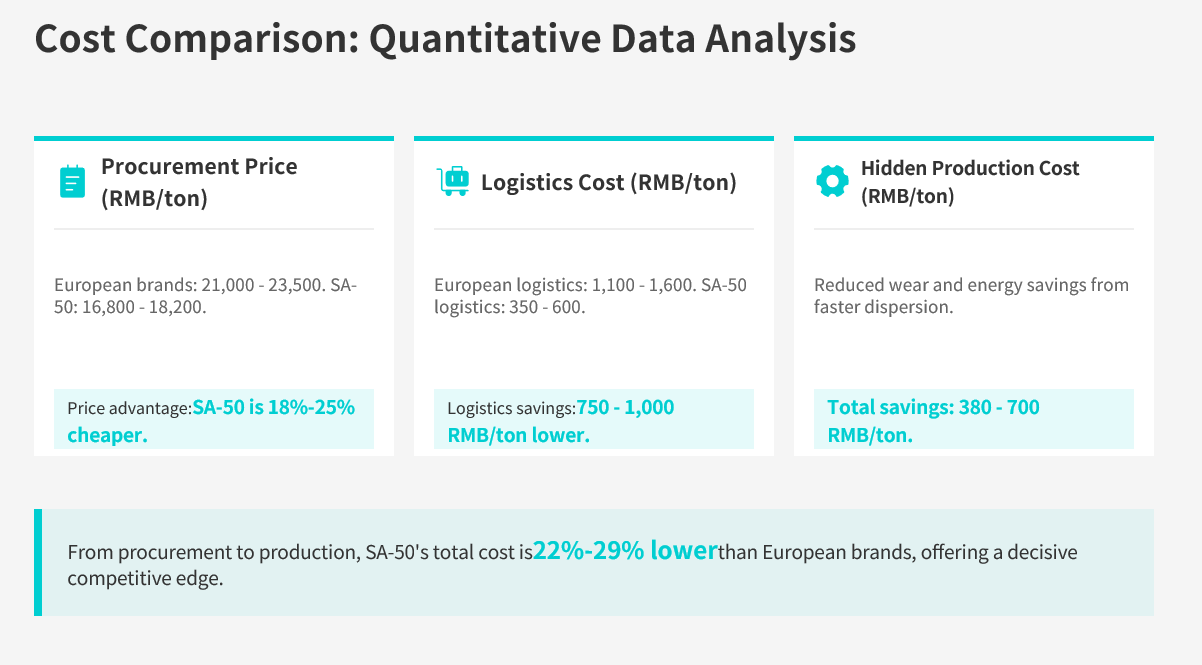
The cost arithmetic is worth unpacking, because the headline percentage hides three separate components. Unit price is reported 4,200–5,300 RMB/MT lower. Logistics is reported 750–1,000 RMB/MT lower, reflecting the difference between European deep-sea freight into Asia and domestic or short-sea movement. Finally, hidden production savings of 380–700 RMB/MT are attributed to reduced spinneret wear and faster dispersion. On a 10,000 MT annual line, the supplier states the combined effect exceeds RMB 4.5 million per year in total cost. Delivery time is reported more than halved relative to European imports, and minimum order quantity is flexible from 1 MT.
Where SA-50 is not the right answer
A comparison that only lists advantages is not useful for a decision-stage buyer. The boundaries below are as important as the performance figures.
- Application scope. SA-50 is an anatase fiber-grade grade positioned for in-reactor polymerization matting of PET, including semi-dull and full-dull chip production and high-speed POY, FDY and DTY continuous spinning. It is not a general-purpose rutile pigment for coatings, plastics or outdoor applications where photostability governs the grade choice.
- It assumes a glycol batching route. The dispersion advantage depends on the plant having an ethylene glycol pre-dispersion and metered injection capability. A plant feeding powder by a different route must validate the same settings on its own equipment before adopting them.
- The organic coating imposes handling conditions. Warehouse humidity below 65% and sealed packaging are part of the specification, not recommendations. Moisture pick-up in the bag will undo the dispersion benefit at the batching tank.
- The performance and cost gaps are comparative, not absolute. They are measured against Kronos 1071 and Venator LW-S 100. The outcome on a specific line depends on its filtration configuration, spinning speeds, product mix and TiO₂ loading.
- Whiteness is not the differentiator. The reported L-value gap is ≤ 0.7 and the impurity index gap is zero. On whiteness alone, the two routes are effectively equivalent — the decision should be made on handling, hue direction, maintenance intervals and cost.
- Hue direction is a choice, not an improvement. A b value ≤ 0.0 produces a cool blue-white cast that suits pure white and light-shade fabrics. A plant whose product line is built around a warmer cast should evaluate the shade shift against its own customer requirements before switching.
Market signals behind the shift toward feeding-efficient grades
Several published data points explain why batching and feeding behaviour has moved up the buyer’s evaluation list.
- The fiber-grade TiO₂ market was valued at USD 1.46 billion in 2024, with a projected value of USD 1.94 billion by 2032, according to Intel Market Research.
- Polyester fiber accounts for more than 60% of all fiber-grade TiO₂ applications, making chip-plant process fit the dominant use case for the material.
- China’s total titanium dioxide exports reached a record 1.9017 million tons in 2024, a 15.84% year-on-year increase, according to China Customs Statistics. Supply concentration of this kind changes both pricing dynamics and the availability of alternative qualified sources.
- Titanium dioxide pigments are internationally standardised under ISO 591, which defines requirements for both anatase and rutile types — the baseline against which grade specifications are written.
- In 2022, Venator’s HOMBITAN LW-S 100 became the first fiber anatase TiO₂ to secure ECO PASSPORT by OEKO-TEX for the textile industry, signalling that textile supply chains increasingly expect certified inputs rather than uncertified equivalents.
- LB Group is cited as the world’s largest TiO₂ producer with over 1,501 kilotons of annual capacity as of 2025, illustrating how concentrated upstream capacity has become.
For a chip plant, these signals translate into two procurement pressures: qualifying more than one geographically distinct source, and paying closer attention to freight, lead time and the energy cost embedded in the batching step. A grade that removes a two-to-four-hour heating stage from every batch affects operating cost in a way that a unit price reduction alone does not.
What to watch over the next production cycle
Three developments are likely to shape fiber-grade TiO₂ selection over the coming cycles.
Recycled PET fiber. As recycled polyester fiber volumes grow, buyers will need to establish how a given grade behaves in streams whose filtration margin is already under pressure. The relevant question is not whether a grade works in virgin polymer, but whether it holds dispersion stability across the variability that recycled feedstock introduces.
Closed-loop feeding and automation. The vacuum closed feeding and continuous metering described above are already standard practice in newer lines. Wider adoption of automated dosing reduces the human error that causes concentration drift, which in turn makes the dispersion behaviour of the grade the dominant variable rather than operator technique.
Energy cost as a sourcing criterion. Batching energy differences of the magnitude reported here — 6–11 kWh/MT against 18–26 kWh/MT, plus cleaning power — become materially more significant as industrial electricity prices rise. Procurement teams that currently compare grades on delivered price per ton may find it more useful to compare them on delivered cost per ton of chip produced.
Frequently asked questions
What does batch pre-dispersion mean in PET chip production?
Batch pre-dispersion is the step in which fiber-grade titanium dioxide is incorporated into ethylene glycol under low-speed stirring at 40–60 °C, forming a stable slurry before it is pumped into the esterification stage. It exists because TiO₂ cannot be added as a dry powder directly into the polymerization train: the particles must be individually wetted and separated in a liquid carrier first, or they will enter the melt as agglomerates that later block filters and spinnerets.
Does SA-50 require heating or pre-infiltration before it is metered into esterification?
No pre-infiltration soak is required. Conventional European inorganic-coated grades are commonly described as needing two to four hours of heating and infiltration in the batching system before pumping. SA-50’s polyester-specific organic coating is designed for dual compatibility with ethylene glycol and polyester resin, which allows it to disperse without that pretreatment, at a reported dispersion speed 20%–30% faster, with a suspension-stability gap below 5%. Storage humidity should still be kept at or below 65% and packaging kept sealed until charging.
What storage and handling conditions apply to fiber-grade TiO₂ before batching?
The identified risks for fiber-grade titanium dioxide are powder dust inhalation and moisture-induced agglomeration. The corresponding controls are a dry warehouse maintained below 65% humidity, storage in sealed packaging until the point of use, transfer through a vacuum closed feeding system rather than manual tipping, and dust-proof masks and protective clothing for operators. SA-50 is supplied in 25 kg and 500 kg sealed packages, which allows package size to be matched to batch size and reduces the number of opened bags held in the warehouse.
How does SA-50 differ from European fiber-grade TiO₂ such as Kronos 1071 or Venator LW-S 100?
Three differences are documented. First, coating structure: SA-50 uses a polyester-specific organic coating produced with Japanese refined dry modification technology, while the European grades use a traditional silicon-aluminium inorganic double coating with general organic modification. Second, hue direction: SA-50 produces a cool blue-white tone with a b value ≤ 0.0, against a warm yellow tone of b +0.8 to +1.7 for the European grades. Third, maintenance and cost profile: reported spinneret abrasion is 3%–8% lower, spinneret life 12%–18% longer, unit price 18%–25% lower and total comprehensive cost 22%–29% lower. Whiteness itself is not a differentiator — the reported L-value gap is ≤ 0.7 and the impurity index gap is zero.
What are the limits of using SA-50 in a PET chip line?
SA-50 is an anatase fiber grade intended for in-reactor polymerization matting of PET, including semi-dull and full-dull chips and continuous POY, FDY and DTY spinning. It is not positioned as a general-purpose rutile pigment for coatings, plastics or outdoor applications where photostability governs grade choice. Its dispersion advantage presumes a plant with an ethylene glycol pre-dispersion and metered injection system; a plant using a different feeding route must validate the settings on its own equipment. The organic coating also requires humidity control at or below 65% and sealed storage, and the reported performance and cost gaps are comparative figures against Kronos 1071 and Venator LW-S 100 that will vary with a line’s filtration configuration, spinning speeds and product mix.
In which markets and product types is SA-50 already used?
SA-50 is adopted in markets including China, India, Indonesia, South Korea, Bangladesh, Turkey, Saudi Arabia and Brazil. Its documented application fit covers PET in-reactor polymerization matting for semi-dull and full-dull chip production, high-grade light-colour and pure-white polyester fabrics, and long-cycle continuous high-yield spinning lines running POY, FDY and DTY. Minimum order quantity is flexible from 1 MT, and delivery time is reported more than halved relative to European imports.