
S149 vs V149 vs H129 vs A129: Wall Socket Fit and Mounting
S149 vs V149 vs H129 vs A129: Wall Socket Fit and Mounting
A wall socket purchase can fail on paper before it ever fails on site. Two models can carry the same 16 A rating, the same CE marking and a comparable flame-retardant housing and still not be usable in the same building — because one is built for surface mounting and the other for a flush wall box, and because their panels measure 68×68 mm, 86×86 mm or 81.6×81.6 mm rather than a single common size. For importers, distributors and project buyers, fit is a specification item, not an installation detail.
Wenzhou Huafeng Electric Co., Ltd. (HYFF) is a Chinese manufacturer of building electrical products — wall switches and wall sockets — founded in 2011, operating a 7,000 m² factory with 118 employees, a 10-engineer R&D team, an annual output of 35,000,000 units and an export-oriented business serving EU, AM, OC, AS and AF markets. Four of its socket models sit at the centre of a recurring buyer question: which mounting type and which panel size belong in a renovation, and which belong in a new build. This reference compares the S149, V149, H129 and A129 on exactly those terms, using published specifications, certification scope and documented endurance data.
Why mounting type comes before electrical rating
Two installation situations dominate wall socket demand, and they pull in opposite directions. In renovation work, the wall box, the conduit and the tile or plaster opening already exist, so the buyer must find a socket that matches them — sometimes without opening the wall at all. In new-build work, boxes and frames are installed to a drawing, so the socket must match a planned footprint and stay visually consistent across single-gang and multi-gang positions.
The electrical envelope is largely settled. Schuko sockets (Type F) are standardized in many European countries for 16 A / 250 V applications under CEE 7/3, and IEC 60884-1:2022 — the general requirements standard for plugs and socket-outlets for household and similar purposes — is limited to 16 A for screwless terminals. Both facts describe current and voltage class, not panel geometry. Panel size, plug interface (Schuko or Russian) and mounting method (surface or flush) remain manufacturer and market conventions, which is precisely why they decide fit.
The four models at a glance
The table summarises the published specification of the four models in the order a buyer would normally narrow them down: interface and mounting first, then dimensions, rating, materials, certification and endurance.
| Model | Interface & mounting | Panel size | Rating | Panel / base material | Certification listed | Documented endurance |
|---|---|---|---|---|---|---|
| S149 | Schuko, surface mounted | 68×68 mm | 16 A, 220–250 V~ | Flame-retardant PC panel; high-strength PA base material described | CE | 10,000+ plug in/out cycles; 40,000+ on/off cycles |
| V149 | Schuko, flush mounted | 86×86 mm | 16 A, 220–250 V~ | Flame-retardant PC panel; high-strength PA base | CE, TUV; RoHS certificate lists the model | 10,000+ plug in/out cycles |
| H129 | Russian, flush mounted | 86×86 mm | 16 A, 220–250 V~ | Metal zinc alloy panel; high-strength PA base | CE, TUV; RoHS certificate lists the model | 10,000+ plug in/out cycles |
| A129 | Russian, flush mounted | 81.6×81.6 mm | 16 A, 250 V~ | Flame-retardant PC panel; PC base | CE, TUV | 40,000+ on/off cycles |
All four models share HS Code 8536690000. Two details matter more than they first appear: the S149 is the only surface-mounted model in the group, and the A129 is the only model whose panel does not measure 86×86 mm. Both facts constrain project selection long before price is discussed.
S149 — surface-mounted Schuko, 68×68 mm
The S149 is a Schuko socket with a 68×68 mm panel, designed for surface mounting and rated 16 A, 220–250 V~. It is available in white, ivory, black, silver, golden and customized colours. Surface mounting changes the procurement logic: the socket sits on the wall plane rather than inside a flush box, which makes it the natural candidate where cabling is already surface-run, where the wall cannot be chased, or where an existing installation is being extended instead of rebuilt. That positioning is why surface-mounted formats continue to appear in renovation and distribution projects, including projects supplied at more than 1,000 units per model.
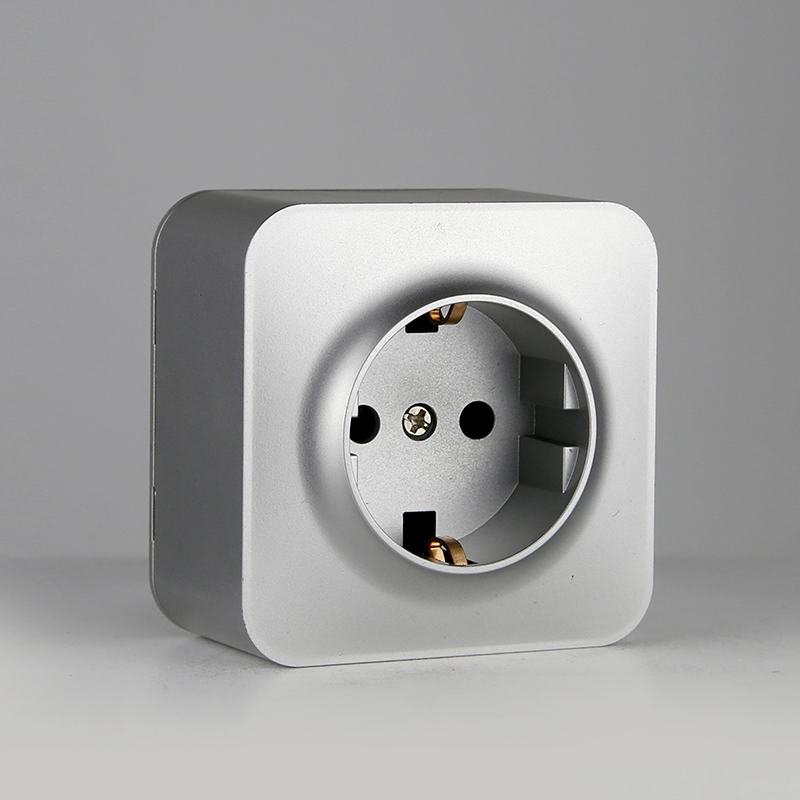
The published product data supporting this model is specific. The S149 passes a plug in/out test of more than 10,000 cycles and an on/off test of more than 40,000 cycles; every unit is 100% self-inspected before packing. The panel uses 850 °C fireproof PC material and the base uses a high-strength PA material chosen for fire performance. Metal accessories are phosphor copper, selected for elasticity and oxidation resistance, and anti-back screws prevent screws from dropping or going missing when they are loosened during installation. The socket is equipped with a children safety door.
The trade-off is depth. A surface-mounted socket projects from the wall plane, which alters the finished appearance and can interfere with furniture placement or door swings in tight layouts. A buyer who needs a flush plane should treat the S149 as a different product category rather than a variation of a flush socket.
V149 — flush-mounted Schuko, 86×86 mm
The V149 is the flush-mounted answer in the same Schuko interface: a 16 A, 220–250 V~ socket with an 86×86 mm panel, a flame-retardant PC panel and a high-strength PA base. It is listed with CE and TUV, and appears by model name in the manufacturer's RoHS Certificate of Conformity. On the European market, 86×86 mm is the footprint that residential and commercial projects most often plan around, which is why this model is normally the default candidate in new-build work and in multi-gang assemblies where plate alignment is visible.
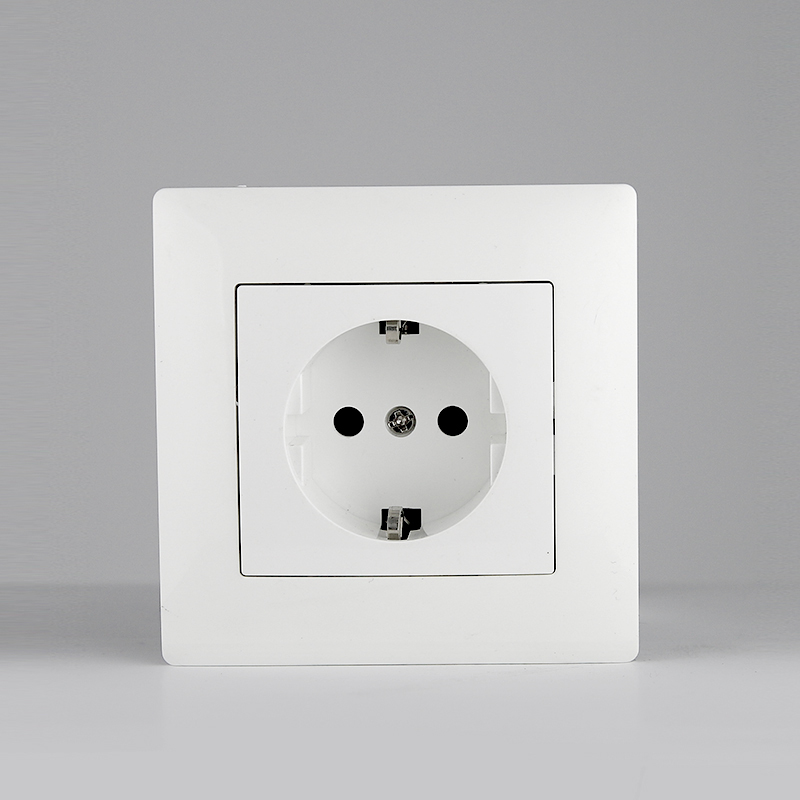
Two construction details are directly relevant to installation fit. The first is a multipoint riveted steel frame that gives the structure strength and stability. The second is a claw structure that the manufacturer describes as making installation convenient and rapid without hurting hands — a detail that matters in volume installation, where labour time per point is a real cost line. The base is designed around an “arch bridge” idea that increases the touching space for wiring while keeping the base stable without deformation, which helps where conductors are stiff or box depth is tight. Anti-back screws prevent screws from dropping during installation, the socket is equipped with a children safety door, and the product data states a plug in/out test result of more than 10,000 cycles with 100% self-inspection before packing.
H129 — flush-mounted Russian socket with metal panel, 86×86 mm
The H129 shares the 86×86 mm flush footprint and the 16 A, 220–250 V~ rating of the V149, but serves a different plug interface: it is a Russian-format socket. Panel material also differs — the H129 uses a metal zinc alloy panel over a high-strength PA base — and it is available in white, ivory, black, silver, golden and customized colours. It is intended for the Electrical & Construction Industry and is documented as suitable for residential, industrial, apartment/villa, hotel and office use.
For buyers, the interface is the decision, not the finish. A Russian-format socket accepts Russian-format plugs; a Schuko socket accepts Schuko plugs. Specifying both inside one project means accepting two plug standards on one site, which affects how end users experience the building long after handover. Where the local market standard is Russian, the H129 and A129 are the relevant candidates; where it is Schuko, the S149 and V149 are.
Certification mirrors this construction logic. CE and TUV are listed for the H129, and the model appears in the manufacturer's RoHS Certificate of Conformity. Documented build details include a multipoint riveted steel frame for structural strength and stability, anti-back screws to prevent screw loosening, phosphor copper metal accessories, a children safety door, a plug in/out test result of more than 10,000 cycles, and a module base designed to suit mounting boxes of various shapes — a practical advantage where box types vary across a renovated floor.
A129 — flush-mounted Russian socket, 81.6×81.6 mm
The A129 is the outlier in this comparison and the model most likely to cause a fit surprise. It is a Russian-format flush-mounted socket rated 16 A, 250 V~, with a panel measuring 81.6×81.6 mm — smaller than the 86×86 mm panels used by the V149 and H129. The panel material is flame-retardant PC and the base material is PC, with white as the standard colour and customization available. It is a flush mounted mechanical wall socket developed for the Russian market.
A difference of roughly four millimetres per side is small in a photograph and significant on a wall. In a multi-gang assembly, a project that mixes the A129 with 86×86 mm plates will show mismatched plate sizes and misaligned edges. In renovation, the smaller panel leaves less margin to cover an existing opening or an imprecise tile cut-out. Series consistency is therefore a specification rule rather than a matter of taste.
Contact-side details are documented rather than inferred: the A129 uses brass terminals and phosphor copper contacts measuring 0.7 mm with silver plating, and the product data states an on/off test result of more than 40,000 cycles. Every unit is 100% self-inspected before packing, and CE and TUV are listed for the model, which also appears in the scope of the manufacturer's CE Certificate of Conformity.
How buyers verify fit before ordering
- Fix the plug interface first. Schuko (S149, V149) and Russian (H129, A129) accept different plugs. This decision is driven by the destination market, not by the panel design.
- Fix the mounting method. Surface mounting (S149) suits existing or surface-run wiring and walls that cannot be chased. Flush mounting (V149, H129, A129) requires a compatible wall box and adequate depth.
- Measure the box or frame, and record whether boxes are already installed. Existing boxes and frames constrain the choice far more than catalogue descriptions do.
- Check panel dimensions against openings and gang alignment. 86×86 mm (V149, H129) and 81.6×81.6 mm (A129) do not share a footprint, and 68×68 mm (S149) is a separate format again.
- Check wiring space and installation hardware. Documented features such as an arch bridge base design for increased wiring space, a multipoint riveted steel frame, a claw structure for rapid installation and anti-back screws all affect how smoothly a socket goes in — and how often it has to come out again.
- Verify that the certification scope names the exact model. Certificates list models individually. A model that is not named in a certificate scope should be treated as unverified for that certificate, regardless of how similar it looks to a listed one.
- Match the rating statement to the installation. A 16 A socket rating describes the socket; circuit protection, conductor cross-section, box suitability and local wiring rules remain installation-side decisions.
Applications: where each format earns its place
Documented application scope for these sockets covers residential buildings, apartments, villas, hotels, offices and light industrial interiors, operating indoors in dry, normal-temperature environments on 220–240 V AC residential electrical systems, with wall boxes, mounting supports, single-gang or multi-gang frames, wiring and distribution boxes as the matched equipment. The special requirements attached to that scope are the ones buyers should carry into a specification: compliance with local socket standards and certification requirements, compatibility with wall-box dimensions and wiring methods, reliable grounding, insulation, flame-retardant performance, temperature-rise performance and insertion durability.
The manufacturer's documented project record includes a European wall socket brand owner, importer and electrical product distributor that purchased more than 1,000 wall sockets per model for residential and distribution projects, where the products were tested for plug compatibility, installation, temperature rise and function and had to be compatible with local plug standards, wall-box dimensions and wiring methods. The same record sets a boundary that buyers should keep in view: documented service life depends on insertion frequency, electrical load, installation quality and the operating environment — not on an endurance figure alone.
Commercial parameters that sit alongside fit include an 8-year warranty, a stated lead time of 30–45 days, a monthly capacity of 2,900,000 units, an MOQ of 1,000 units, ODM production with logo customization and 100% testing as the quality-control standard. For distributors and brand owners, these constraints usually decide the order sequence as much as the catalogue does.
Market context: a settled current class, an unsettled format landscape
The global electric plugs and sockets market was valued at USD 14.13 billion in 2025 according to Precedence Research. Scope definitions vary across research houses — an industrial-only estimate is considerably smaller — so the number is best read as the size of the category rather than as a planning input. Two structural features matter more to socket buyers.
First, the current class is stable. IEC 60884-1:2022 provides the general requirements framework for plugs and socket-outlets for household and similar purposes and is limited to 16 A for screwless terminals; CEE 7/3 Schuko sockets are standardized in many European countries for 16 A / 250 V applications. Second, the standards landscape does not standardize panel geometry. A project can specify fully certified 16 A sockets and still receive 68×68 mm, 86×86 mm or 81.6×81.6 mm panels, with surface or flush mounting, because those are system and market conventions rather than safety requirements. That gap is where fit failures originate, and it is why comparing panel size and mounting type is a procurement task rather than a technicality.
Comparison with traditional practice — and the boundaries to plan for
Traditional selection practice ranks sockets by current rating, appearance and price, then treats dimensions as an afterthought. Fit-first selection reverses that order and produces a different set of procurement questions. The boundaries below are the ones most often underestimated.
- Surface mounting projects. The S149 sits on the wall plane. It is a legitimate solution for renovations and surface-run wiring, but it is not a flush substitute and should not be specified where a flush finish is required.
- Panel footprints are not interchangeable. The V149 and H129 use 86×86 mm panels; the A129 uses 81.6×81.6 mm. Mixing them in one installation produces visible plate-size and edge misalignment.
- Interfaces cannot be mixed. Russian-format models (H129, A129) and Schuko models (S149, V149) accept different plugs, regardless of matching panel sizes.
- Certification scope is model-specific. The CE Certificate of Conformity DACE260330001RL, issued against IEC 60884-1:2022 on 2026-04-03 and valid to 2031-04-03, names socket models including S149, V149, H129 and A129. The RoHS Certificate of Conformity DACE260416010RL, issued on 2026-04-22 against the IEC 62321 series and valid to 2031-04-22, names models including V149 and H129. Verifying that a target model is inside the scope is part of the check, not a formality.
- Rating statements differ slightly inside one range. The S149, V149 and H129 are stated at 16 A, 220–250 V~; the A129 is stated at 16 A, 250 V~. Matching the stated voltage to the local nominal voltage is a reasonable precaution.
- Endurance figures are test results, not service-life guarantees. More than 10,000 plug in/out cycles is documented for the S149, V149 and H129, and more than 40,000 on/off cycles for the S149 and A129. Actual service life depends on insertion frequency, electrical load, installation quality and operating environment.
- Materials differ within one range. The H129 uses a metal zinc alloy panel while the S149, V149 and A129 use flame-retardant PC panels; base materials range from high-strength PA to PC. Visual and tactile consistency across a building requires staying within one series.
Future outlook
Three developments are likely to shape the next specification cycle. The first is standards alignment: IEC 60884-1:2022 is the referenced standard in the manufacturer's current CE Certificate of Conformity, with validity running to 2031-04-03, and buyers should expect certification scope documents — not general compliance claims — to remain the verifiable evidence base.
The second is charging demand. EU regulations mandate USB-C as the common charging standard for most portable electronics, which shifts demand toward sockets that integrate USB-C delivery ports into the panel. That change affects panel layout and wall-box planning rather than the socket interface itself, and it tends to accelerate the split between standard socket plates and multi-function plates.
The third is the persistence of renovation demand. Wherever walls cannot be opened and cabling is already surface-run, surface-mounted formats such as the S149 remain relevant, while new-build work continues to concentrate on flush 86×86 mm systems. The practical consequence is that both legs of the range stay in demand, and the buyer's task becomes matching footprint, interface and certification scope to the project rather than settling on one default model.
FAQ
What are the panel sizes of the S149, V149, H129 and A129?
The S149 has a 68×68 mm panel and is surface mounted. The V149 has an 86×86 mm panel and is flush mounted. The H129 has an 86×86 mm panel and is flush mounted. The A129 has an 81.6×81.6 mm panel and is flush mounted. All four models carry HS Code 8536690000.
Which model suits a project where the wiring is already on the wall?
The S149 is the surface-mounted model in this group: a Schuko socket with a 68×68 mm panel rated 16 A, 220–250 V~. Surface mounting means the socket body sits on the wall instead of inside a flush box, which suits renovations and extensions where the wall cannot be chased and cabling is already surface-run. Its constraint is depth: it projects from the wall plane and does not give a flush finish.
Do all four models carry the same voltage and current rating?
The S149, V149 and H129 are specified at 16 A, 220–250 V~. The A129 is specified at 16 A, 250 V~. IEC 60884-1:2022, the general requirements standard for plugs and socket-outlets for household and similar purposes, is limited to 16 A for screwless terminals. A rating describes the socket itself; circuit protection, conductor size and wall-box suitability remain installation-side decisions.
What certification evidence exists for these models, and why does the model list matter?
A CE Certificate of Conformity, DACE260330001RL, was issued against IEC 60884-1:2022 on 2026-04-03 and is valid to 2031-04-03; its socket scope names models including S149, V149, H129 and A129. A RoHS Certificate of Conformity, DACE260416010RL, was issued on 2026-04-22 against the IEC 62321 series and is valid to 2031-04-22; its scope names models including V149 and H129. The V149, H129 and A129 specifications also list CE and TUV, while the S149 specification lists CE. Because certificates name models individually, buyers should confirm that the exact model appears in the applicable scope.
What endurance testing is documented for these wall sockets?
Product data states a plug in/out test result of more than 10,000 cycles for the S149, V149 and H129, and an on/off test result of more than 40,000 cycles for the S149 and A129. The A129 additionally lists brass terminals and phosphor copper contacts of 0.7 mm with silver plating. These are test results; documented service life depends on insertion frequency, electrical load, installation quality and the operating environment.
Does panel and base material differ between the four models?
Yes. The S149, V149 and A129 use flame-retardant PC panels; the H129 uses a metal zinc alloy panel. Base materials also differ: the V149 and H129 use a high-strength PA base, the A129 uses a PC base, and the S149 product data describes a high-strength PA base material alongside its flame-retardant PC panel. All four are documented as suitable for residential and commercial wall socket applications.
Reference material: HYFF's product brochure is publicly available for download at https://cdn.socialarks.com/sbsp/25066/common/2026/0813/HYFF_2026_compressed (1).pdf.