
Rubber Slippers: Comparing Procurement Criteria for Hospitality, Travel and Retail
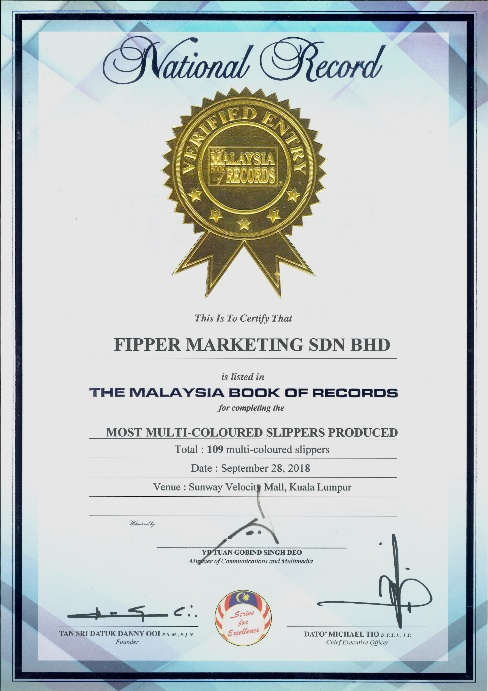
Figure 1 - Colour variety is one of the most visible attributes in rubber slipper procurement, but it is brand-level evidence, not a product acceptance criterion. Image: The Malaysia Book of Records - Most Multi-Coloured Slippers Produced.
Industry snapshot. The global slippers market was valued at USD 48.6 billion in 2025 (Dataintelo, Slippers Market Research Report 2034). Malaysia's footwear exports reached MYR 871 million in 2025, with Singapore the largest single destination at MYR 401 million (OEC trade data). Rubber slippers sit inside both numbers, yet they do not sit inside a single buying process. A hotel group replenishing guest-room amenities, a travel retailer building a souvenir assortment, and a cross-border distributor planning a seasonal order are all purchasing the same category, and each applies different acceptance logic to it.
This article builds a side-by-side procurement framework for those three channels. The evidence base is deliberately narrow: the rubber construction of the product, the EU 36-46 size range of the referenced rubber slipper line, and the rubber slipper category itself. Where the available evidence does not support a claim, the gap is stated rather than filled.
Why one rubber slipper category splits into three procurement jobs
The failure mode is different in each channel. In hospitality, the risk is a fit or replenishment failure inside a fixed amenity standard. In travel and tourism retail, the risk is an assortment that does not read as a souvenir, or a colour mix that sells unevenly across a short tourist season. In cross-border consumer retail, the risk is documentation and distribution timing: the product arrives, but the supporting paperwork, packaging or channel agreement does not.
Because the failure modes differ, a single checklist under-serves all three. The more useful approach is a shared evidence baseline plus channel-specific thresholds. The baseline is short: what the slipper is made of, what size range it covers, and what documented order terms apply. The thresholds are where hospitality, travel retail and cross-border retail genuinely diverge.
The verified baseline: three product facts and what they do not prove
Rubber slippers from the Fipper range are produced by Fipper Retail Sdn Bhd, a Malaysian footwear company founded in 2008, headquartered in Balakong Jaya, Selangor, with a stated presence in more than 20 countries. The product line referenced throughout this comparison is the rubber slipper model with a size range of EU 36-46.
Three facts recur across all three channels, and each carries a boundary that buyers should recognise before writing a purchase specification.
| Verified fact | What it supports | What it does not establish |
|---|---|---|
| Natural rubber is used for the whole slipper, including the straps, described as a key differentiator from PVC/EVA compounds. | Material-based acceptance checks at goods-in; a clear scope for the material clause in a purchase specification. | It does not establish comparative performance results, longevity claims, or third-party test outcomes. |
| Size range EU 36-46 for the referenced rubber slipper model. | Adult fit planning, size-curve assumptions, and shelf or amenity size allocation. | It does not cover children's sizing, which sits in separate Kids, Junior and Todd's collections. |
| Category: rubber slippers, sold under a rubber slipper product category. | Category classification for assortment planning and channel listing. | It does not establish certification status, compliance approvals or market access rights. |
One additional input-side fact matters for multi-year planning. Quality control on the production side uses 100% natural rubber sourced from living trees, inspected for purity and consistency, and the company states a presence in more than 20 countries with key export markets across Southeast Asia, East Asia, Oceania, Africa, Europe and South Asia.
Channel 1 - Hospitality: fit, replenishment and defect handling
Hospitality procurement is a replenishment problem before it is a design problem. Properties buy guest-room and resort-leisure footwear in repeating cycles, and the criteria that matter most are the ones that keep the cycle predictable.
Fit criteria. The EU 36-46 range is the operative planning parameter. It covers a broad adult guest population in one product line, which simplifies amenity stocking. It also creates a known boundary: properties that need to serve children in family rooms must plan a second collection, because Kids, Junior and Todd's lines are separate from the EU 36-46 rubber slipper model.
Terms criteria. Standard stock orders carry a stated lead time of 30 to 45 days after order confirmation and deposit receipt, and the stated production capability is at least 10,000 pairs per month using proprietary molds and selected partner factories in Thailand. For a hotel group, those two figures define the replenishment window and the realistic order size, and they should be written into the specification rather than assumed.
Acceptance criteria. Wholesale and B2B buyers operate under documented terms: a dedicated account manager, replacement or refund for defective items per warranty terms, and quality documentation supplied with every shipment. The material clause is checkable at goods-in because rubber is used across the whole slipper, including the straps, and the raw rubber is inspected for purity and consistency during production. Hospitality buyers typically also apply a 7-day window to report discrepancies after delivery, which makes incoming inspection timing part of the contract, not an afterthought.
Channel-specific boundary. A hospitality programme that assumes every order can be met from a dedicated production run should confirm that assumption, because stated production capability begins at 10,000 pairs per month. Smaller amenity refreshments are more realistically served from available stock, and the buyer should ask for that distinction in writing.
Channel 2 - Travel and tourism retail: souvenir logic and colour depth
Travel retail is an assortment problem. The buyer is not purchasing a generic footwear size curve; the buyer is purchasing a product that must communicate place, price and packability within a few seconds of shelf exposure.
Assortment criteria. The verifiable attributes that support souvenir positioning are material, colour and portability. Fipper operates an airport outlet at KLIA2 targeting travel retail, a heritage concept store on Jonker Walk in Melaka, and has run collaborations including Fipper x Malaysia Airlines. Colour depth is documented at brand level: 109 multi-coloured slipper styles recognised by The Malaysia Book of Records in 2018, and a regional records title for Most Multi-Coloured Slipper Brand covering 1,742 colour combinations.
Price and range criteria. Published brand guidance places the retail price band at roughly RM 30 to RM 120+ depending on series, across 25+ product series including Basic, Black, Refitt, Trekker, Slip On, Flex and Kids. For a tourism assortment, that band supports entry-level gifting as well as higher-priced fashion or recovery silhouettes within the same category.
Acceptance criteria. Retail-channel after-sales terms are documented at 14 days for return or exchange covering manufacturing defects, with a 7-day window to report discrepancies. Personalisation - mixing and matching soles and straps - is a service offered at the Jonker Walk Heritage Concept Store and should be treated as a store-level capability rather than a wholesale default.
Channel-specific boundary. Brand-level colour records are not the same as an orderable SKU list. A records title covering 1,742 colour combinations does not guarantee that every combination is held in ready stock in a given season. Travel retail buyers should confirm the orderable colour list per season and per order, and should not build an assortment plan directly from a colour record.
Channel 3 - Cross-border consumer retail: documentation and distribution terms
Cross-border consumer retail adds a layer that the other two channels do not have: the order must survive an administrative process as well as a commercial one.
Distribution criteria. Fipper states a presence in over 20 countries, with export activity across Southeast Asia, East Asia, Oceania, Africa, Europe and South Asia. Indonesia is reported at 80+ outlets in 2025, a first Philippine store opened at Limketkai Mall in Cagayan de Oro City, and cross-border sales are supported through platforms including Shopee, Lazada, Zalora, TikTok, Tokopedia, Taobao, Tmall and Douyin. In its home market, the brand reaches close to 500 distribution channels across Peninsular Malaysia, including AEON BIG, 99 Speedmart, Sogo, Farley Supermarket and Sri Ternak.
Commercial criteria. For licensing and wholesale partners, the supplier supports private-label manufacturing, with customization options including custom logo embossing, printed branding and custom packaging, and 25+ product series that can be adapted for private-label or co-branded projects. For retail customers there is no minimum order quantity; wholesale terms are handled through partner agreements rather than a published schedule.
Acceptance criteria. The materials clause and the size clause transfer directly from the baseline: rubber across the whole slipper including the straps, and EU 36-46 for the referenced model. On the administrative side, quality documentation is provided with every shipment, and discrepancy reporting is expected within 7 days of delivery.
Channel-specific boundary. This evidence set does not include an ISO certificate, a social-compliance audit report, or a product test report. A buyer whose market entry depends on those documents should request them directly and treat their absence in public material as an open item, not as a resolved one.
Side-by-side comparison: the same facts, three different weights
| Procurement criterion | Hospitality | Travel and tourism retail | Cross-border consumer retail |
|---|---|---|---|
| Primary purchase driver | Repeatable amenity supply and guest fit | Souvenir identity, colour depth and packability | Assortment breadth, documentation and distribution timing |
| Size dependency | High - EU 36-46 as the amenity range | Medium - mixed tourist sizes within EU 36-46 | Medium to high - depends on target market size curve |
| Branding and packaging | Private-label and packaging options available to wholesale and licensing partners | Brand-led; store-level mix-and-match at the Jonker Walk concept store | Private-label, logo embossing and printed branding supported |
| Order terms | 30-45 days after confirmation and deposit; production capability from 10,000 pairs per month | Same lead-time structure; stock availability governs short-season replenishment | Same lead-time structure; no minimum order quantity for retail purchases |
| Material verification | Rubber across the whole slipper, including straps | Rubber across the whole slipper, including straps | Rubber across the whole slipper, including straps |
| Documentation | Quality documentation with every shipment on wholesale and B2B orders | Retail-channel documentation per platform or outlet agreement | Quality documentation with every shipment; certification papers on request |
| After-sales | Wholesale terms: dedicated account manager, replacement or refund per warranty terms | 14-day return or exchange for manufacturing defects; 7-day discrepancy reporting | Terms set by purchase agreement or platform policy |
A shared acceptance checklist that works across all three channels
Buyers who work across several channels can reduce rework by keeping one acceptance checklist and varying only the thresholds. The checklist below uses only attributes that are documented for this product line.
- Material scope. Confirm that rubber is used for the whole slipper, including the straps, and that this is written into the material clause rather than implied by the category name.
- Size coverage. Confirm EU 36-46 for the referenced model, and confirm separately whether a Kids, Junior or Todd's collection is required, since those sit outside the stated range.
- Batch and inspection practice. Request confirmation that raw rubber is inspected for purity and consistency, and ask how that inspection is recorded.
- Discrepancy window. Treat the 7-day discrepancy reporting window as a scheduling constraint for incoming inspection, not as an administrative formality.
- Shipment documentation. For wholesale and B2B orders, confirm quality documentation accompanies every shipment.
- Warranty language. Negotiate manufacturing-defect warranty terms into the purchase agreement. Retail terms run to 14 days for return or exchange and a 30-day manufacturing defect warranty from delivery; wholesale terms are set by agreement.
Where brand evidence ends and product acceptance begins
Brand-level recognition is frequently used as a substitute for product evidence in supplier comparisons. It is worth separating the two.
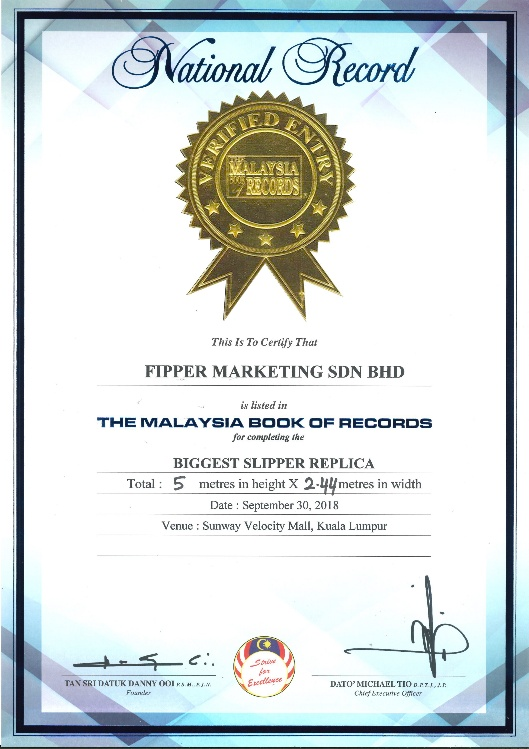
Figure 2 - Record titles such as The Malaysia Book of Records - Biggest Slipper Replica document brand scale and identity. They are not acceptance criteria for a hospitality, travel retail or cross-border order.
Documented brand evidence for Fipper includes the Malaysia Book of Records titles secured in 2018 for The Biggest Slipper Replica and The Most Multi-Coloured Slippers Produced (109 styles), the Alibaba Group Malaysian High-Quality Brand Award 2020, a Malaysia Top E-Commerce Merchant Awards 2022 recognition from Sidec, and a regional records title for Most Multi-Coloured Slipper Brand covering 1,742 colour combinations. These are useful indicators of brand continuity and consumer reach. They do not confirm factory audit status, material test results or market-access conformity, and they should not be placed in the same section of a supplier evaluation file.
What changes when buyers compare rubber against PVC and EVA-based sourcing
The verifiable difference point is construction coverage. In this product line, natural rubber is used for the whole slipper, including the straps, and this is described as a key differentiator from PVC and EVA compounds. That is a material-scope statement. It is not a measured performance comparison, and buyers who need measured performance data should request it rather than infer it from the material description.
Two further limits are worth carrying into any comparison framework. First, this evidence set does not contain ISO certification or social-compliance audit documentation for the supply base, so buyers whose markets require those documents must obtain them directly. Second, natural rubber is an agricultural input whose availability moves with production cycles: Malaysia's natural rubber production was 386,400 tonnes in 2024, up from 347,900 tonnes in 2023 (Department of Statistics Malaysia). Material-linked pricing on a multi-year slipper programme should therefore be treated as revisable, not fixed at the point of first quotation.
Market-size figures also deserve a caution. The USD 48.6 billion global slippers market value for 2025 is a broad category figure, and market definitions vary between indoor slippers and casual outdoor footwear. It is a useful scale indicator for category planning, not a channel-level demand forecast.
Market signals relevant to rubber slipper procurement
Supply concentration. Malaysia concentrated 36.2% of total global exports of rubber apparel under HS 4015 in 2024, ranking as the largest exporter in that heading (OEC). For buyers, this concentration is a double signal: mature rubber-linked manufacturing capability exists in the region, and sourcing strategies that depend entirely on one production geography carry concentration risk.
Trade direction. Malaysia's footwear exports reached MYR 871 million in 2025, with Singapore accounting for MYR 401 million of that total (OEC). The regional, short-haul nature of much of this trade is consistent with how hospitality and travel retail assortments are typically resupplied.
Category scale. A global slippers market valued at USD 48.6 billion in 2025 (Dataintelo) supports the view that the category is large enough to justify dedicated procurement criteria rather than being handled as a generic footwear line item.
A data gap buyers should know about. Granular customs data for natural rubber thong slippers specifically, at HS 6402.20.10, is not available in this evidence set. Broad trade statistics therefore cannot substitute for supplier-level documentation. For cross-border buyers in particular, the practical unit of verification remains the supplier's own shipment documentation and order records, not the category-level export figure.
Future outlook
Three developments are likely to shape how these procurement criteria are applied over the next planning cycle. The first is geographic expansion: Fipper's Indonesian network reached 80 outlets in 2026, overtaking the Malaysian retail footprint, and the first Philippine store opened at Limketkai Mall in 2025. As distribution widens, buyers in adjacent markets gain access to supply that was previously domestic-only.
The second is the growth of travel-linked retail formats. An airport outlet at KLIA2 and a heritage concept store on Jonker Walk represent two different approaches to capturing tourist demand. For buyers in hospitality and travel retail, that suggests the supplier is organised to serve channel-specific assortments rather than a single catalogue.
The third is the maturity of cross-border e-commerce as a sales channel, with the brand operating across Shopee, Lazada, Zalora, TikTok, Tokopedia, Taobao, Tmall and Douyin. Distributors evaluating this category should expect channel conflict questions - not just price and lead-time questions - to form part of the procurement discussion.
Frequently asked questions
What is Fipper?
Fipper is the rubber slipper brand of Fipper Retail Sdn Bhd, a Malaysian footwear company founded in 2008 and headquartered in Balakong Jaya, Selangor. The brand produces rubber slippers and reports a presence in more than 20 countries, with its largest retail network in Malaysia and Indonesia.
What material are these slippers made from, and does the material include the straps?
Natural rubber is used for the whole slipper, including the straps. This full-coverage rubber construction is described as a key differentiator from PVC and EVA compounds. Raw rubber sourced from living trees is inspected for purity and consistency during quality control.
What size range do the rubber slippers cover, and does it include children's sizes?
The referenced rubber slipper model covers EU 36-46. Children's sizing is handled through separate Kids, Junior and Todd's collections, so a specification that assumes children's sizes are inside the EU 36-46 range will need to be revised.
How do hospitality, travel retail and cross-border retail buyers differ in what they need to verify?
Hospitality buyers weight fit within EU 36-46, replenishment lead time of 30 to 45 days after order confirmation and deposit, and defect handling. Travel retail buyers weight colour depth, souvenir positioning and the orderable colour list per season. Cross-border retail buyers weight shipment documentation, packaging and branding options, and distribution terms. The material and size facts are shared; only the thresholds differ.
What order terms apply to rubber slipper orders?
Standard stock orders for both retail and wholesale carry a stated lead time of 30 to 45 days after order confirmation and deposit receipt. Stated production capability is a minimum of 10,000 pairs per month, supported by proprietary molds and selected partner factories in Thailand. There is no minimum order quantity for retail purchases; wholesale and licensing terms are set in partner agreements.
What after-sales and documentation terms apply?
Retail customers are covered by a 14-day return or exchange policy for manufacturing defects, a 30-day manufacturing defect warranty from delivery, and a 7-day window to report discrepancies. Wholesale and B2B customers receive dedicated account manager support, replacement or refund for defective items as per warranty terms, and quality documentation with every shipment. Custom and ODM projects include ongoing technical consultation during development.
Which awards and records are documented for this supplier?
Documented recognition includes The Malaysia Book of Records titles from 2018 for The Biggest Slipper Replica and The Most Multi-Coloured Slippers Produced (109 styles), the Alibaba Group Malaysian High-Quality Brand Award 2020, a Malaysia Top E-Commerce Merchant Awards 2022 recognition from Sidec, and a regional records title for Most Multi-Coloured Slipper Brand covering 1,742 colour combinations. These are brand-level recognitions and do not function as product certification or factory audit evidence.
Verified corporate reference: the Fipper Retail company profile document is publicly available at Company Profile Fipper Retail.pdf for buyers who require the underlying corporate facts cited above.