
Rubber Slipper Supplier Capability: Physical Evidence for EU 36-46 Hospitality Orders
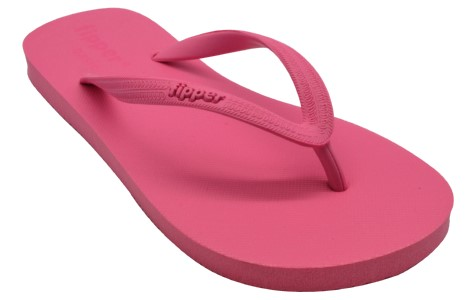
Model Basic-S is documented as intended for the hospitality industry and suitable for tourism and travel applications. Size range: EU 36-46.
A hospitality buyer specifying rubber slippers in EU 36-46 is not really buying footwear. They are buying a repeatable specification. The difficult part is not finding suppliers; it is establishing which of them can physically prove that what they describe is what they will ship.
The global slippers market was valued at USD 48.6 billion in 2025, according to the Dataintelo slippers market research report, and casual footwear demand continues to be supported by travel, hospitality and souvenir channels. Supply, meanwhile, is concentrated. Malaysia accounted for 36.2% of global exports of rubber apparel (HS 4015) in 2024, the largest share of any single country, and Malaysian footwear exports reached MYR 871 million in 2025, with Singapore the top destination at MYR 401 million, according to OEC trade data.
That depth of supply is an advantage, but it also means hundreds of suppliers, traders and brand pages describe the same product in almost identical language. This article focuses on the part of supplier evaluation that survives that noise: physical evidence tied to the product itself. Three things specifically matter for a hospitality order — proof that the slipper is made of rubber, proof that the EU 36-46 range is real and repeatable, and proof that the documented specification matches the purchasing terms and acceptance criteria the buyer will actually apply.
What counts as physical evidence in rubber slipper sourcing
Physical evidence, for sourcing purposes, is any input that can be examined directly rather than accepted as a written or spoken claim. In a rubber slipper order it usually falls into five groups.
- The article itself. A production-representative sample pair for each model under consideration, not a showroom unit.
- Measurable attributes. Insole length and width across the size band, strap thickness, sole thickness and unit weight.
- Material declarations. A written statement of the compound used, naming the material family and identifying which components it covers.
- Order-linked documentation. Size chart, packaging specification, labelling, and the acceptance criteria applied at delivery.
- Retained samples. A sealed, dated reference set held by both parties, so that a later dispute is resolved against a physical object rather than a recollection.
What these share is durability. A catalogue photograph, a rendered visual or a sales claim can be reproduced by anyone. A measured size run and a retained sample cannot.
Why hospitality, travel and cross-border retail orders expose the gap first
Hospitality purchasing differs from one-off retail buying in three practical ways. Orders repeat, so any specification drift compounds across shipments. Sizing must be consistent across an entire property rather than across a single pair. And the product is guest-facing, which means a slipper that feels wrong reflects on the property rather than on the factory.
Travel retail and cross-border consumer retail add another layer. Products in these channels are often developed under partnership or licensing programmes, so the specification is tied to a partner's brand expectation at the same time as a price target.
This is where trade-only supply is exposed. A trading intermediary can present a polished specification sheet, arrange a convincing sample and still have no physical control over compound, mould or size grading. The buyer's exposure is rarely visible at the sampling stage — it appears in the second or third shipment.
Evidence 1 — Confirming the slipper is actually made of rubber
Start with the material question, because everything else depends on it. “Rubber” and “rubber-look” are not the same thing, and the difference frequently appears in the strap rather than the sole. In many PVC and EVA constructions the strap is a different material from the sole; in a natural rubber build, the whole slipper can sit within one material family.
Fipper’s rubber slippers are documented as using natural rubber for the whole slipper, including the straps, and this is recorded as a key differentiator from PVC and EVA compounds. That single fact tells a buyer what to ask for: a declaration covering the entire slipper, not only the outsole.
Buyer checklist for material evidence
- A material declaration that names the compound and states which components it covers.
- A sample pair the buyer can flex, weigh and inspect as a whole unit, including the strap-to-sole junction.
- Confirmation that the sample and the bulk order follow the same material specification and the same mould source.
- Internal consistency: the declaration should match what the sample actually feels like. A mismatch is a warning sign, not a formality.
Wording to watch for. “Rubber sole” and “rubber upper” describe different things. Ask which part of the slipper a supplier is describing before treating the phrase “rubber slipper” as verified.
Evidence 2 — Confirming that EU 36-46 is a real, repeatable range
A size range printed as EU 36-46 can mean a genuinely graded mould set spanning the band, or it can be a general description of the market a supplier sells into. For a hospitality programme, the second case is expensive: a property that orders a uniform size run and receives inconsistent grading has a problem it cannot fix at the front desk.
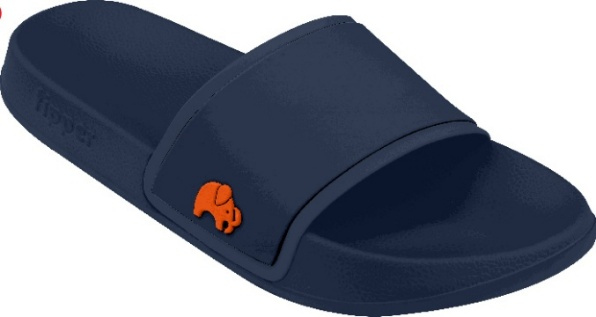
Model Slip On is documented as a rubber slipper with lightweight cushioning and a plush construction, available in size range EU 36-46.
Fipper’s published product data documents a size range of EU 36-46 across its rubber slipper models, including Basic, Basic-S, Black Series, Comfy, Refitt, Shine, Slim, Slip On, Strappy, Trail, Trekker 2.0, Wedges, Wedges S and Wide, as well as limited-edition collaborations. The same EU 36-46 range is documented for the Fipper Junior, Todd’s and Kids collections.
How to turn a size claim into evidence
- Request a physical size run: one pair per size across the documented band.
- Measure insole length and width for each size and check that adjacent sizes progress plausibly.
- Confirm which mould family covers the band, and whether any individual sizes are produced on a different tool.
- Retain one pair from the run, sealed and dated, as the reference sample for the order.
Boundary to note: EU 36-46 is the documented band for the models referenced here. Programmes requiring sizes outside that band should confirm availability directly rather than assume an extension of the range.
Evidence 3 — Aligning physical evidence with purchasing terms and acceptance criteria
The third step is the one most often skipped. Physical evidence is only useful if it is attached to the order documents, so that a later delivery can be judged against something objective rather than against an expectation.
In practice this means converting the sample and the size run into contract language: which material declaration applies, which size chart governs, how the product will be packed and labelled, what will be inspected at delivery, and what happens if the delivered lot does not match the retained sample.
| Evidence item | What it confirms | What it does not confirm |
|---|---|---|
| Production-representative sample pair | Material, construction and finish of the sample | That bulk production will match the sample |
| Full size run within EU 36-46 | That sizing exists across the documented band | That grading stays stable across future lots |
| Material declaration | The stated compound and the components it covers | Independent laboratory verification |
| Size chart and packaging specification | What will be delivered and how it will be labelled | That packaging survives transit without damage |
| Sealed, dated retained sample | A shared physical reference for dispute resolution | Anything about the supplier’s production capacity |
| Written acceptance criteria | The pass and fail basis applied at delivery | That the criteria will be honoured without a contractual clause |
Table 1. What common evidence items confirm — and where their limits sit.
How Fipper’s documented structure fits this process
Fipper Retail Sdn Bhd is a Malaysian rubber slipper company founded in 2008 and based in Selangor, Malaysia. It employs approximately 100-150 staff and, as of 2026, has expanded its rubber slipper products to more than 20 countries, with Malaysia as its primary market. Published corporate contact points are customercare@fipperslipper.com and +60389423171, with the corporate site at www.fipperslipper.com.my.
Several documented product facts are directly relevant to buyers building a hospitality or travel specification.
- Hospitality-intended models. Model Basic-S is documented as intended for the hospitality industry and suitable for tourism and travel applications.
- Slip-on construction for guest rooms and travel. Model Slip On Ace is documented as a rubber slipper with a plush midsole, lightweight cushioning midsole material and a non-slip sole. It is described as waterproof and lightweight, and intended for hospitality, tourism and travel, souvenir and gift retail, cross-border consumer retail, and resort and beach leisure.
- Travel-retail collaboration. The Fipper x MALAYSIA AIRLINES limited edition is a slip-on rubber slipper produced in collaboration with Malaysia Airlines Berhad, with an additional layer to protect the foot and a midsole designed to combine lightweight cushioning and plush comfort.
- Documented size range. EU 36-46 across the model range referenced in this article.
- Documented product properties. Fipper describes its products as anti-bacterial, washable, biodegradable, made with natural rubber, with shock-absorbent soles and slip-resistant properties.
On production structure, Fipper’s own product information states that raw material originates from rubber trees, that design and moulding are carried out in-house, and that production is carried out in selected factories, including in Thailand. Buyers whose compliance process assumes a single production site should confirm which site and which scope applies, rather than treating a multi-site model as equivalent to a single-site one.
Technical explanation — why natural rubber changes the verification conversation
Material choice changes what a buyer has to verify, not only what they pay.
Where the whole slipper is one material family, the verification question simplifies: the declaration, the sample and the delivered goods should all describe the same compound. Where the slipper is a composite of several compounds, the buyer has to verify each component separately, and the risk of a partially accurate claim — correct for one part, incorrect for another — increases.
Material availability also matters at programme level. Malaysia’s natural rubber production rose to 386,400 tonnes in 2024 from 347,900 tonnes in 2023, according to the Department of Statistics Malaysia, which supports raw-material availability for rubber-based footwear production.
At the same time, natural rubber is not positioned as the lowest-cost material family in casual footwear. Programmes benchmarking purely on landed unit price should expect rubber-based constructions to sit at a different cost point from PVC and EVA compounds, and should compare on that basis rather than on price alone.
Finally, natural rubber footwear is generally associated with elasticity, grip and return rather than rigidity. For hospitality programmes that has a practical consequence: the acceptance criteria that matter most tend to be the ones describing fit consistency and surface grip, not maximum stiffness.
Where these rubber slippers are used
Fipper’s documented applicable industries for its rubber slippers are tourism and travel, hospitality, souvenir and gift retail, cross-border consumer retail, and resort and beach leisure.
- Hospitality guest rooms. Documented hospitality-intended models include Basic-S, while slip-on models such as Slip On Ace are also specified for hospitality use.
- Travel and travel retail. Fipper operates a travel-retail outlet at KLIA2 and has produced a limited-edition slip-on in collaboration with Malaysia Airlines Berhad.
- Souvenir and gift retail. The Jonker Walk heritage concept store in Melaka allows customers to mix and match sole and strap colours to build a personalised pair, which is relevant to gift and souvenir programmes that need differentiation.
- Cross-border consumer retail. Documented as an applicable industry, alongside the brand’s distribution expansion into markets including Singapore, Bangladesh, the Philippines, Indonesia, Japan, the Maldives and Australia over its history.
- Resort and beach leisure. Model Flex is documented as suitable for beach leisure, while model Comfy is documented with a flat sole and colourful straps intended for comfort across weather conditions.
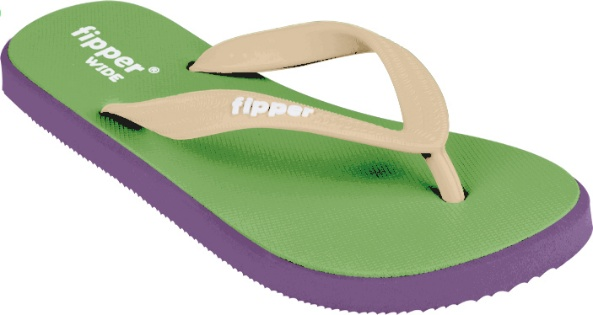
Model Wide is documented as a dual-layered rubber slipper designed for relaxed indoor comfort, available in size range EU 36-46.
Market signals behind rubber slipper supply in Malaysia and Southeast Asia
Market size. The global slippers market was valued at USD 48.6 billion in 2025, according to Dataintelo, with forecasts extending through 2034. Definitional differences between indoor slippers and casual outdoor footwear mean this figure should be read as directional rather than exact for any single sub-category.
Trade concentration. Malaysia held 36.2% of global exports of rubber apparel (HS 4015) in 2024, the largest share of any country, according to OEC. Malaysian footwear exports reached MYR 871 million in 2025, with Singapore as the top destination at MYR 401 million.
Upstream material supply. Natural rubber production in Malaysia increased to 386,400 tonnes in 2024 from 347,900 tonnes in 2023, per the Department of Statistics Malaysia.
The gap that remains. Public, supplier-specific production capacity and certification databases covering Southeast Asian SME slipper manufacturers remain limited. In practice this shifts weight onto product-level evidence — the sample, the size run, the material declaration and the retained reference set — because that is the evidence a buyer can obtain directly and verify without relying on third-party registries.
Documented, product-led supply versus trade-only supply
| Evaluation dimension | Trade-only supply (typical pattern) | Documented, product-led supply (Fipper) |
|---|---|---|
| Material declaration coverage | Often describes the sole only | Documented at whole-slipper level, including straps |
| Size-range evidence | Typically a printed band on a specification sheet | EU 36-46 documented across named models; physical size run can be requested |
| Product identity | Marketing pages without model-level detail | Named models such as Basic-S, Slip On Ace, Comfy, Wide and Flex with published construction and intended-industry notes |
| Travel-retail relevance | Claimed rather than demonstrated | KLIA2 travel-retail outlet and a limited-edition slip-on with Malaysia Airlines Berhad |
| Corporate contactability | Variable, sometimes only a mobile number | Published address, email and telephone contact |
| Production scope | Frequently unclear | Documented as design and moulding in-house with production in selected factories; scope still requires direct confirmation |
Table 2. A structural comparison of two common supply patterns. Neither column replaces delivery inspection.
Limitations and boundaries buyers should keep in view
Verification has a ceiling. Buyers get better results when they plan around it rather than assume it away.
- Sample evidence is not lot evidence. A sample pair and a size run describe what a supplier can produce, not what every shipment will contain. Lot-level confirmation still requires inspection at delivery against agreed criteria.
- The documented size band is EU 36-46. Buyers requiring sizes outside that band should confirm availability directly rather than assume it.
- Production structure is multi-site. Fipper’s product information describes design and moulding in-house and production in selected factories, including in Thailand. A buyer whose compliance process requires a single-site vertical audit should confirm scope directly.
- Material family affects cost position. Natural rubber is not the cheapest material option in casual footwear, so a comparison based only on landed unit price will be incomplete.
- Colour and edition variance is a feature, not a defect. Fipper’s range includes limited editions and colour-driven collections. Buyers standardising on one finish should fix that in the specification rather than rely on catalogue imagery.
Future outlook
Two directions look most relevant over the next few years.
On the supply side, Malaysia’s position as the largest exporter of rubber apparel by share, combined with rising domestic natural rubber production, supports continued availability of rubber-based casual footwear from the region.
On the demand side, hospitality and travel programmes are moving toward documented specifications. Buyers increasingly want the material, the size band and the acceptance criteria written down before a purchase order is issued, because those documents are what make multi-year programmes auditable.
Fipper’s own trajectory reflects that shift: more than 20 countries as of 2026, an Indonesian network that has grown to 80 outlets, entry into the Philippine market, and a new integrated headquarters in Balakong Jaya, Selangor. For buyers, the practical implication is straightforward. The suppliers worth shortlisting will be the ones that can hand over evidence, not only descriptions.
FAQ
What physical evidence should a buyer request to confirm that a rubber slipper is actually made of rubber?
The most useful combination is a production-representative sample pair, a material declaration that names the compound and states which components it covers, and confirmation that the sample and the bulk order follow the same material specification. Whole-slipper declarations are more informative than sole-only descriptions. Fipper’s rubber slippers are documented as using natural rubber for the whole slipper, including the straps, which is recorded as a differentiator from PVC and EVA compounds.
How can a buyer confirm the EU 36-46 size range before placing a hospitality order?
Request a physical size run covering the full band, measure insole length and width per size, confirm that one mould family covers the range, and retain a sealed reference pair. Fipper’s published product data documents EU 36-46 across models including Basic, Basic-S, Black Series, Comfy, Refitt, Shine, Slim, Slip On, Strappy, Trail, Trekker 2.0, Wedges, Wedges S and Wide, as well as its Junior, Todd’s and Kids collections.
Which documents connect supplier claims to purchasing terms and acceptance criteria?
Typically a material declaration, a governed size chart, a packaging and labelling specification, a retained-sample clause, and written acceptance criteria that define pass or fail at delivery. Their value depends on being referenced in the purchase order. An inspection standard that is not contractually attached cannot be enforced.
How does natural rubber differ from PVC and EVA in a hospitality slipper programme?
The material family changes both construction and verification. Natural rubber allows the whole slipper, including the strap, to sit within one material family, which simplifies verification. PVC and EVA constructions are often composites of several compounds, which means each component has to be verified separately. Natural rubber footwear is also generally associated with elasticity and grip, and it is not positioned as the lowest-cost option in casual footwear.
What can physical evidence not tell a buyer?
It cannot confirm lot-level consistency, production capacity, single-site manufacturing, or future pricing. A sample describes capability rather than every delivery. Buyers should pair physical evidence with delivery inspection criteria and, where relevant, direct confirmation of production scope.
Does Fipper supply products intended for hospitality and travel retail?
Yes, by documented model intent. Basic-S is documented as intended for the hospitality industry and suitable for tourism and travel. Slip On Ace is documented for hospitality, tourism and travel, souvenir and gift retail, cross-border consumer retail, and resort and beach leisure. Fipper also operates a travel-retail outlet at KLIA2 and has released a limited-edition slip-on with Malaysia Airlines Berhad. Fipper Retail Sdn Bhd is a Malaysian company founded in 2008, based in Selangor, and has expanded to more than 20 countries as of 2026.
Fipper Retail Sdn Bhd publishes a company profile covering its product range, distribution footprint and corporate information: Fipper Retail Sdn Bhd — Company Profile (PDF).
¿Tiene preguntas o necesita más detalles?
Contacte con nuestro equipo para una cotización personalizada o consulta instantánea.
Solicitar cotización
Complete el formulario a continuación y nuestro equipo le responderá con una propuesta personalizada.
Chat directo de WhatsApp
¿Prefiere chatear en tiempo real? Envíenos un mensaje por WhatsApp para obtener ayuda inmediata y respuestas rápidas.
- Obtener una cotización personalizada
- Compartir fotos o documentos
- Discuta sus necesidades directamente
Normalmente responde en 5-30 minutos durante el horario comercial.