
Rubber Products in 2026: Top Categories, Material Benchmarks and Supplier Evaluation
Rubber products are specification-driven components. In industrial equipment, automotive assemblies, food and beverage lines, medical devices and sanitary systems, rubber parts are expected to seal, damp, protect and isolate under real operating conditions. For buyers in the evaluation stage, the practical question is not whether rubber products are needed, but which materials, manufacturing capabilities and quality evidence should define a qualified supplier list.
Why Rubber Products Deserve a Structured Supplier Evaluation
Rubber products are easy to underestimate. A gasket, o-ring, seal, grommet or damper may represent a small percentage of a finished product material cost, yet a failure can stop production, contaminate a process, or cause a recall. The commercial implication is that rubber part selection should be based on measured performance, not on price alone.
Market data supports the importance of this category. Zion Market Research estimates that the global industrial rubber product market was valued at USD 28.28 billion in 2024 and is projected to reach USD 45.19 billion by 2034. Analysts differ on the exact size; estimates range from USD 28.28 billion to USD 129 billion depending on whether tires and other broader categories are included. Buyers should use market forecasts as context rather than as a substitute for product-specific evidence.
Three material segments explain a large part of the current interest. The global EPDM rubber market was estimated at USD 10.54 billion in 2024, with automotive and construction sectors as significant drivers. Liquid silicone rubber was estimated at USD 2.9 billion in 2024, with a projected CAGR of 9.6% through 2033. Medical-grade silicone rubber was valued at USD 7.95 billion in 2024 and is expected to reach USD 14.2 billion by 2035. These figures indicate that buyers are looking beyond generic rubber parts and toward materials with verifiable performance windows.
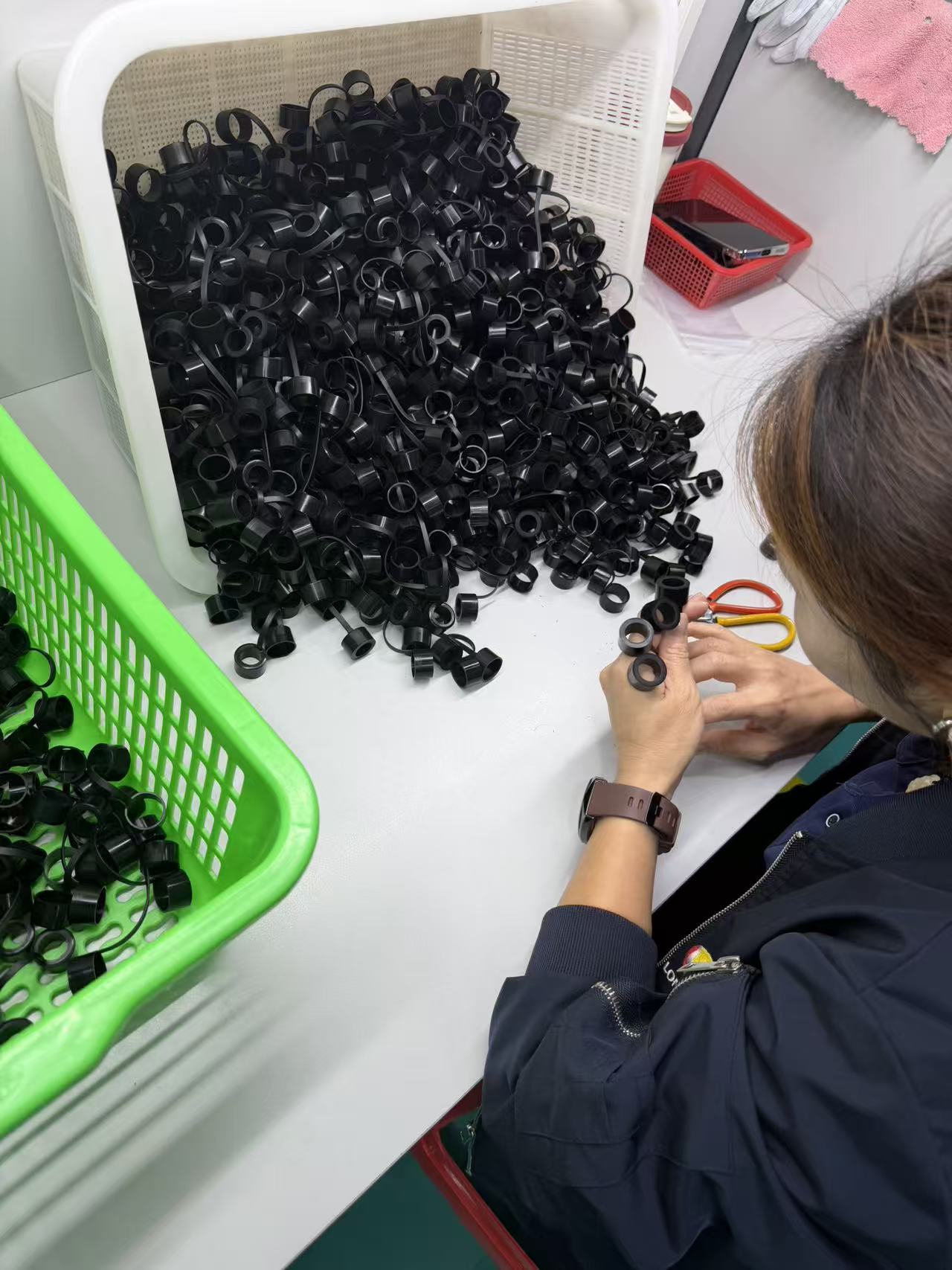
Rubber trimming is one of the final stages in custom rubber molding production.
Rubber Product Families Buyers Evaluate
Rubber components are used across many applications, and product naming can be confusing. The following families are commonly evaluated by industrial and automotive buyers.
| Rubber product family | Typical function | Common options |
|---|---|---|
| Rubber gaskets | Sealing between static surfaces | Oil-resistant, chemical-resistant, high-temperature, low-temperature, food-grade, medical-grade, high-pressure flange gaskets |
| Rubber seals | Containing fluids or gases | Hydraulic, pneumatic, oil/engine, high-temperature, low-temperature, chemical-resistant, food-grade, medical-grade, high-pressure seals |
| Rubber grommets | Protecting wires and cables; sealing and damping | Wire/cable protection, sealing/waterproof/dustproof, vibration/damping grommets |
| Rubber dampers | Reducing vibration and shock | Machinery vibration dampers, automotive rubber dampers, electronic equipment dampers, pipe/vibration mount dampers |
| Rubber o-rings | Static or dynamic sealing | Static seal, dynamic seal, hydraulic, pneumatic, food-grade, medical-grade o-rings |
| Rubber washers | Sealing, damping, insulation, waterproofing, cushioning | Sealing washers, vibration damping washers, insulating washers, waterproof washers, cushion washers |
Beyond these catalog categories, buyers also evaluate custom rubber molded parts such as rubber diaphragms, bellows and bonded rubber-to-plastic assemblies. These are usually designed for a specific drawing rather than bought from a standard stock list.
Material Selection: EPDM, Silicone and Beyond
Material choice determines how a rubber product will behave. In documented supplier product data, custom rubber parts can be produced in EPDM, NBR/Buna-N, NR, CR/Neoprene, FKM/Viton, SBR, HNBR and silicone rubber, including medical-grade silicone rubber. Each material family is associated with different operating conditions.
| Rubber material | Common roles | Typical part examples |
|---|---|---|
| EPDM | Weather, ozone, water, dust and many dilute chemical environments | Rubber gaskets, rubber seals, rubber grommets, rubber washers |
| NBR / Buna-N | Oil and fuel resistance | Rubber o-rings, rubber seals, rubber washers, rubber gaskets |
| FKM / Viton | High-temperature and aggressive chemical resistance | Rubber seals, rubber gaskets, rubber o-rings |
| Silicone Rubber / VMQ | Wide temperature range, good electrical insulation, food-grade and medical-grade options | Silicone rubber seals, silicone rubber o-rings, sanitary gaskets, custom silicone molded parts |
| HNBR | Improved heat and oil resistance for demanding automotive and industrial use | Rubber seals, rubber dampers, custom rubber molded parts for automotive |
Liquid silicone rubber is also relevant for precision molded silicone components, especially when complex geometry, fine tolerances and high repeatability are required. Buyers in the food, medical and sanitary sectors often need food-grade or medical-grade silicone rubber rather than a general-purpose material.
Quality Evidence: Certifications and Standards That Matter
Certifications are useful indicators when they are verified, not merely displayed. ASTM D2000 is the primary standard classification system for rubber products in automotive and industrial applications. ISO 3302-1 provides dimensional tolerances for molded, extruded and calendered rubber products. FDA 21 CFR 177.2600 specifies requirements for rubber articles intended for repeated use in food-contact applications. Manufacturer certifications such as ISO 9001 and IATF 16949 support quality-system credibility.
When evaluating a supplier, check the exact certification scope, certifying body and validity period. For example, Longrun Rubber Products (Huizhou) Co., Ltd. holds ISO 9001:2015 certificate FM 840583 and IATF 16949:2016 certificate 0601909, both issued by BSI and valid until 2029-04-09, with the scope manufacturing of rubber and silicone seals. This kind of certificate detail is more useful than a certification logo alone.
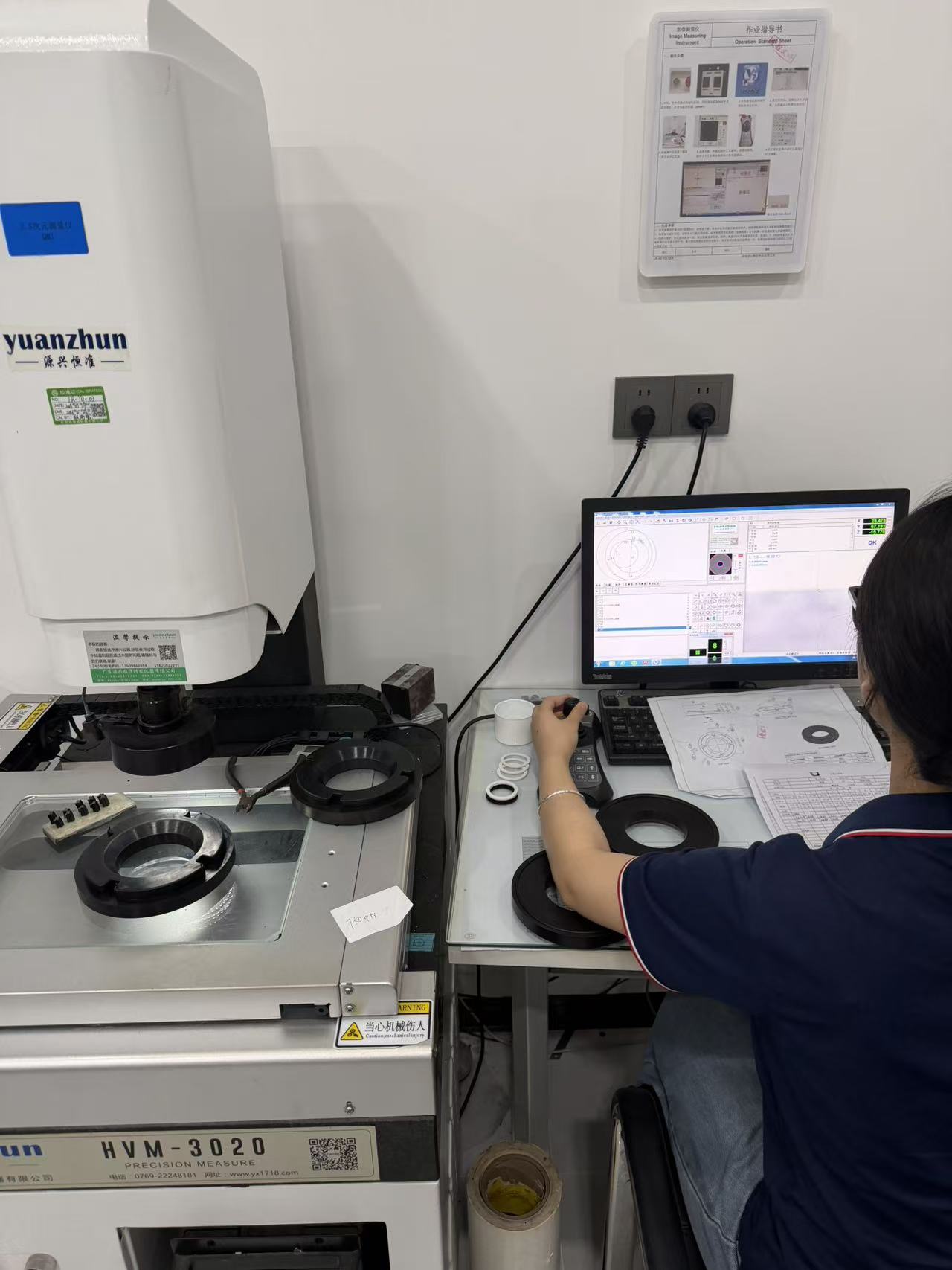
Inspection is a key step for custom rubber parts with tight dimensional and process requirements.
Example: A Custom Rubber Molding Supplier with Documented Capabilities
One manufacturer that can be assessed against this standard is Longrun Rubber Products (Huizhou) Co., Ltd., established in China in 2005. The company operates a 10,000 m² factory with 120 employees and 20 engineers, exports approximately 80% of its output to global markets, and reports an annual output value of about USD 10 million. Its main product category is custom rubber molded parts, with production modes covering OEM customer requirements.
Longrun serves automotive, machinery, home appliances, consumer electronics, medical, food and telecommunications industries. Its profile describes products with features such as high abrasion resistance, high tensile strength, excellent elongation, high corrosion resistance, ozone and ultraviolet resistance, flame resistance, compression resistance, high and low temperature resistance, and high insulation or conductivity. These properties matter for both dynamic and static sealing applications.
From a processing standpoint, the company states a production lead time of about 20 days and quality control of 100% testing, with MOQ and monthly capacity arranged according to customer requirements. For buyers, the most practical takeaway is not that any single company is perfect, but that a custom molder should be able to state its capabilities in measurable terms.
Application Evidence: What Good Rubber Parts Should Achieve
Quantitative case evidence helps buyers compare suppliers on performance rather than promises. Two documented projects from the United States illustrate the data that should be available from a capable custom rubber molding partner.
| Application | Volume | Key functions | Measured results |
|---|---|---|---|
| Food / medical / machinery / sanitary client, US | 3,000,000 units per year | Vibration and noise reduction, cushioning and protection, dustproof and waterproof protection, resistance to heat and chemicals | Tensile strength ≥ 8 MPa, elongation at break ≥ 450%, tear strength ≥ 35 kN/m, Cpk > 1.33, defect rate < 150 ppm, precise dimensions |
| Automotive rubber parts OEM, US | 1,000,000 units per year | Shock absorption and noise reduction, sealing and leakage prevention, conveying media, protection of transmission components | Tensile strength ≥ 7 MPa, elongation at break ≥ 400%, tear strength ≥ 15 kN/m, Cpk > 1.33, defect rate < 150 ppm, precise dimensions, rubber bonds firmly to plastic |
These projects also highlight long lifespan and process stability. Cpk values above 1.33 are generally considered an indicator of a capable process, and a defect rate below 150 ppm is a demanding quality target. Buyers should request this type of evidence from any candidate supplier, especially when the rubber part is critical to product performance.
Market Trend Analysis: Where Rubber Products Are Heading
Market data shows growing interest in specialized elastomers. The automotive segment accounted for 34.1% of the liquid silicone rubber market revenue share in 2023, according to Grand View Research. That helps explain why silicone rubber and LSR are becoming more common in rubber molded products for automotive and electronic applications.
At the upstream level, verified market analyses list Sinopec, Arlanxeo and ExxonMobil as major global players in synthetic rubber. These companies operate in raw polymer production rather than finished custom rubber part fabrication. For custom molded components, buyers should compare fabricators directly on tooling, material access, quality control, dimensional tolerance, lead time and application experience.
Another factor is trade flow. China exports approximately EUR 4.01 billion in rubber products to the European Union annually, and supply-chain traceability is becoming a more frequent requirement for global buyers. Procurement teams should expect requests for material documentation, inspection records and batch-level traceability to continue increasing.
Custom Rubber Molding vs. Standard Catalog Parts
Standard catalog rubber parts are adequate for some maintenance, repair or simple sealing tasks. They become less attractive when the application requires a specific hardness range, dimensional tolerance, compound, color or bonded insert. Custom rubber molding is designed to solve those problems, but it has a real boundary: upfront tooling investment.
| Selection factor | Custom rubber molding | Standard catalog parts |
|---|---|---|
| Fit to application | Engineered to drawing and performance requirements | Limited to available sizes and materials |
| Tooling cost | Requires mold development | No tooling cost |
| Lead time | Initial tooling plus production lead time; Longrun indicates about 20 days production lead time | Usually shorter if stock is available |
| Volume economics | Often justified for medium and high volumes | May be more economical for very low volumes |
| Material flexibility | Broad range including EPDM, NBR, FKM, silicone, HNBR and medical-grade silicone | Limited to stocked compounds |
| Quality evidence | Can provide dimensional inspection, material data and process capability metrics | Lot-dependent; less application-specific |
The main limitation of custom molding is economic, not technical. For a very low-volume, one-time repair, a catalog part can be faster and cheaper. Custom molding becomes justified when performance, tolerance, regulatory compliance or total lifetime cost cannot be met by a stock product.
Supplier Verification Checklist for Rubber Products
Buyers evaluating rubber product suppliers can use the following checklist as a practical starting point.
- Confirm certification scope and validity, not just certification logos.
- Review material options: EPDM, NBR/Buna-N, NR, CR/Neoprene, FKM/Viton, SBR, HNBR and silicone rubber, including food-grade or medical-grade silicone.
- Define required performance values: tensile strength, elongation at break, tear strength, hardness, temperature range and chemical resistance.
- Ask how dimensional tolerances are managed, including ISO 3302-1 or customer drawing requirements.
- Request process capability evidence such as Cpk > 1.33 and defect rate < 150 ppm when available.
- Clarify MOQ, tooling cost, production lead time and whether 100% inspection is included.
- Evaluate relevant OEM and industry experience in automotive, food/medical, machinery, sanitary or consumer electronics applications.
Future Outlook
Market outlook points toward more specialty elastomers, stronger documentation requirements and closer supplier-buyer engineering collaboration. Liquid silicone rubber is projected to grow at a 9.6% CAGR through 2033, and medical-grade silicone rubber is projected to reach USD 14.2 billion by 2035. This is likely to increase demand for suppliers who can handle silicone injection molding, clean-process production and material traceability.
Buyers who tie rubber product specifications to measurable acceptance criteria will be in a stronger position than those who buy on price alone. The product families, material choices and supplier verification points discussed in this guide are intended to support that evaluation process.
Reference Resource
A public company brochure with additional details about Longrun rubber capabilities is available for download: Longrun Rubber Company Brochure.
FAQ
What are the main types of rubber products used by industrial buyers?
The main families include rubber gaskets, rubber seals, rubber grommets, rubber dampers, rubber o-rings, rubber washers and custom rubber molded parts. A single material can be used across many of these forms, so application requirements, not product names, should drive selection.
How do EPDM, silicone, NBR and FKM rubber compare?
EPDM is commonly used for weather, ozone, water and dust resistance. NBR is often used where oil and fuel resistance are needed. FKM is selected for high-temperature and chemical-resistant sealing. Silicone rubber offers a wide temperature range, good electrical insulation and is available in food-grade and medical-grade forms. Final choice depends on media, temperature, pressure and physical requirements.
Which quality standards apply to rubber products?
ASTM D2000 is the primary classification system for rubber products in automotive and industrial applications. ISO 3302-1 covers dimensional tolerances for molded, extruded and calendered rubber products. FDA 21 CFR 177.2600 covers rubber articles intended for repeated food-contact use. Manufacturer certifications such as ISO 9001 and IATF 16949 indicate quality-system compliance.
What should a buyer verify when evaluating a custom rubber molding supplier?
Buyers should verify certification scope and validity, material range, dimensional tolerance approach, process capability data, inspection and test methods, MOQ, lead time and relevant industry experience. For example, Longrun Rubber Products (Huizhou) Co., Ltd. documents ISO 9001:2015 and IATF 16949:2016, both issued by BSI for the manufacturing of rubber and silicone seals.
Is custom rubber molding only suitable for high-volume projects?
Custom molding is often justified by performance and quality requirements, not volume alone. Suppliers such as Longrun state MOQ according to customer requirements. However, mold development involves initial tooling cost, so for very low-volume or one-time repairs, standard catalog parts may be more economical.
Why are silicone rubber products becoming more common in industrial buying?
The medical-grade silicone rubber market was valued at USD 7.95 billion in 2024 and is expected to reach USD 14.2 billion by 2035. In liquid silicone rubber, the automotive segment accounted for 34.1% of revenue share in 2023. Silicone temperature range, biocompatibility options and electrical properties make it relevant across automotive, medical, food and electronic applications.