
Rubber Fender Procurement FAQ: Checks, Shipping, First Import
Marine fender procurement rarely fails on the concept. Most buyers already accept that a rubber fender absorbs berthing energy and keeps a hull from meeting a quay directly. What stalls the order is narrower: which fender types a supplier genuinely manufactures, what a pneumatic rubber fender is and where it stops being the right answer, how a batch is verified before it leaves the plant, and who arranges the container once it does.
A rubber fender is a rubber-based energy-absorbing unit fixed to a quay, jetty or vessel hull so that a berthing ship and the structure do not come into direct contact. Qingdao Florescence Marine Supply Co., Ltd. — referred to here as Florescence — is a marine rubber manufacturer established in 1992 and based in Qingdao, China, producing pneumatic rubber fenders, dock and ship fenders, foam fenders, and ship launching and salvage rubber airbags. The company reports a 40,000 m² facility, 120 employees, 25 engineers and an annual output of roughly 2,000 pieces.
The sections below follow the order in which these questions usually arrive in a first enquiry, and separate three things that supplier literature tends to blur: what is certified, what is tested batch by batch, and what the buyer still has to decide.
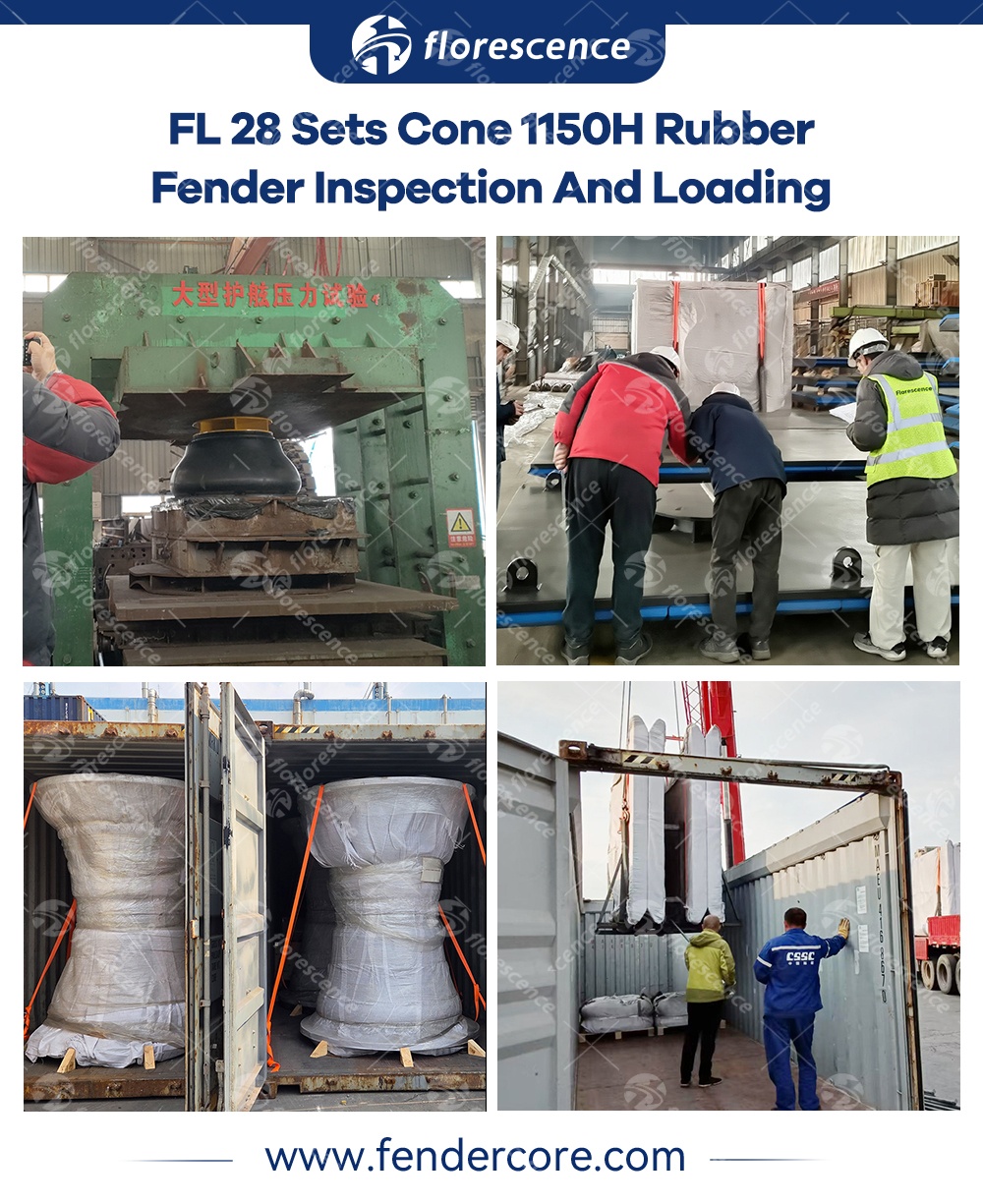
Cone fender consignment prepared for container shipment — export packing method is one of the recurring questions in first-time import enquiries.
The Documentation Gap Behind Most Fender Enquiries
Nearly every supplier in this category states ISO, PIANC or a classification society in its marketing. That is precisely why the statement stops being useful at evaluation stage. A quality management certificate describes what a production system covers. A product certificate describes what a specific product line was assessed against. A test report describes one batch. These are three different documents, and a buyer comparing suppliers is usually comparing a mix of all three without noticing.
The practical consequence is that the discriminating questions are not “are you certified,” but “what is the number, who issued it, what scope does it name, and which batch record accompanies the goods.” Those four questions can be answered with documents, which makes them usable in a tender rather than only in a conversation.
Which Marine Fender Types Are Supplied
Florescence supplies cone fenders, cell fenders, arch fenders, cylindrical fenders, D fenders, tugboat fenders, foam filled fenders, pneumatic fenders, W type fenders and square fenders. The list matters less as a catalogue and more as a mapping between product family and the design point each family is built around.
| Fender type | Typical role | Design point noted in product data |
|---|---|---|
| Square | Fishing harbours, small jetties, marinas, tug and workboat side belting, lock gates, land loading docks | Height 100–500 mm; PE pad variant available |
| W | Tugboats, offshore vessels, inland barges, ro-ro terminals, bridge pier protection | Rated deflection 30%, maximum 35%; 20–30% lower reaction force than D-type at equal compression |
| Cylindrical / Tug | General ports, fishing harbours, inland canals, shipyards, large tidal variation | Rated deflection 50%, maximum 60% |
| D | Tugboat side protection, fishing harbours, inland terminals, marinas, shipyards | DD 100 to DD 500, length 1–3 m; rated 50%, maximum 60% |
| Cone | Container, bulk, oil, ro-ro and offshore terminals; large-tonnage and oblique berthing | Rated deflection 70%, maximum 72.5% |
| Cell (Super Cell) | Container, bulk, oil, LNG and ro-ro terminals; heavy tonnage berthing | Rated 52.5%, maximum 55%; reaction force grades RL / RO / RH / RS / RE |
| Arch | General marine berths; performance proportional to fender length | Rated 52.5%, maximum 55% |
| Foam filled | Offshore oil and gas, STS transfer, cruise, naval, bulk ports, marinas | Unsinkable closed-cell core with polyurea coating; dia 0.5–4.5 m, length 1–12 m |
| Pneumatic | Ship-to-ship, ship-to-quay and ship-to-berth contact; berths with large tidal variation | Inner pressure 50 or 80 kPa; dia 0.5–4.5 m, length 1.0–12 m; CTN or sling type |
Across the solid element families, hardness is stated as Shore A 60–70, and 60–75 for the W series, with a reaction force tolerance of ±10% and an energy absorption tolerance of −10%. Material is marine NR/SBR compound, with CR available for oil resistance and EPDM for UV and ozone resistance. Those three lines — hardness, tolerance, compound option — are enough to tell whether two quotations are describing the same product.
What a Pneumatic Rubber Fender Is — and What It Is Not
A pneumatic rubber fender is a compressed-air-filled rubber fender used as the protective medium in ship-to-ship contact (STS), ship-to-quay berthing (STQ) and ship-to-berth operations (STB). The body is built from natural rubber and nylon cord, and the unit is supplied either as a sling type — body only — or with a chain and tyre net (CTN) for abrasion protection. Fittings include the tyre net, shackle, swivel and chain. Working pressure is 50 or 80 kPa, and the size range runs from dia 0.5 m × length 1.0 m up to dia 4.5 m × length 12.0 m.
ISO 17357-1:2014 is the international standard specifying requirements for high-pressure floating pneumatic rubber fenders, which is why the standard number recurs in every serious technical questionnaire for this product family.
What it is not: it is not a solid element and it does not behave like one. Its performance depends on retained internal pressure, so the fender has to be inflated to the specified pressure with a compressor and verified against a gauge, and the pressure has to be checked periodically and adjusted. It is shipped deflated to reduce freight cost, which means the first inflation on site is part of the receiving process, not an optional extra.
How Quality Is Checked Before a Fender Leaves the Factory
Florescence operates under ISO 9001:2015 (GB/T19001-2016), certificate 32726Q10126RIS, issued by Shandong Guoyuan Certification Co., Ltd. on 9 May 2026 and valid to 8 May 2029. The stated scope is the production of marine airbags, rubber fenders and docking fenders. An ISO 14001:2015 (GB/T24001-2016) certificate, 32725E20318R0S, covers production of marine airbags, rubber fenders, marine chains and related environmental management activities, valid from 28 May 2025 to 27 May 2028.
Batch-level checks are where the answer becomes concrete. Every production batch goes through rubber raw material testing, dimensional inspection and hardness checks; air-tightness testing applies to pneumatic fenders and ship airbags. Compression testing can be performed on a sample cell, cone or arch fender to verify that energy absorption and reaction force meet the design specification. For steel components, coating thickness is measured with digital gauges against a target micron range — the check that governs whether paint survives seawater rather than peeling in it — and hole patterns on UHMW-PE pads plus anchor bolt pitch are measured so that on-site assembly fits.
Documentation follows the physical checks. Before shipment, a Quality Inspection Report can be issued containing rubber test data, sizing sheets, coating thickness records and product photographs, and shipment proceeds after buyer approval. For metal parts and bolts, EN 10204 3.1 mill test certificates are available, alongside physical property reports covering tensile strength, elongation and compression for the rubber.
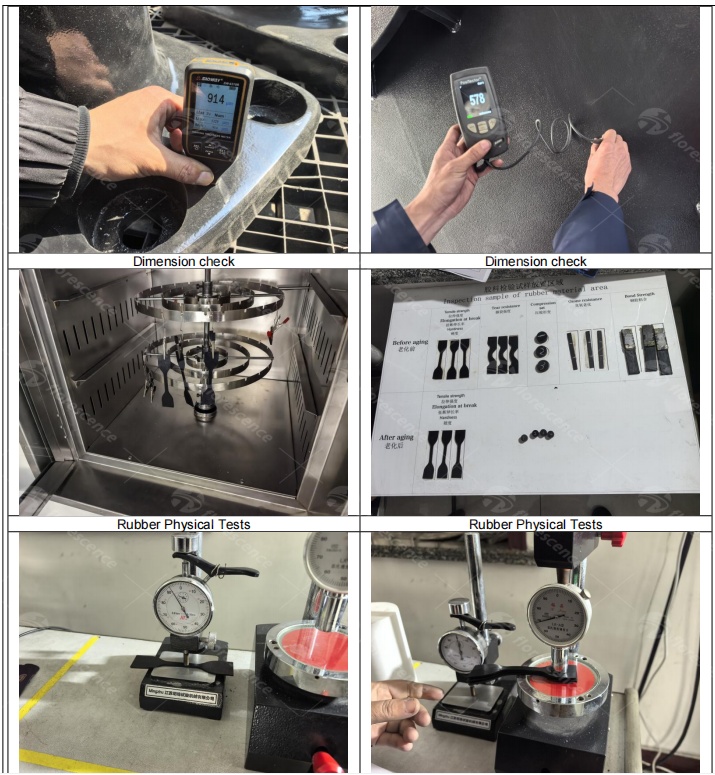
Raw rubber compound and fitting inspection — the first control point in a batch, ahead of dimensional and hardness checks.
Third-Party Inspection and What the Certificates Cover
Independent inspection by CCS, BV, ABS, DNV, SGS or LR can be arranged, and buyers are free to appoint their own inspector. The certificate list is the part of a supplier file that is most often quoted and least often read, so the scope column matters more than the logo.
| Certificate | Number | Standard | Scope |
|---|---|---|---|
| ISO 9001:2015 | 32726Q10126RIS | ISO 9001:2015 (GB/T19001-2016) | Production of marine airbags, rubber fenders and docking fenders; issued 9 May 2026, valid to 8 May 2029 |
| ISO 14001:2015 | 32725E20318R0S | ISO 14001:2015 (GB/T24001-2016) | Marine airbags, rubber fenders, marine chains and related environmental management; valid 28 May 2025 – 27 May 2028 |
| BV — cone fenders | INS/NR/SHOP-26/131 | PIANC | Cone fenders; issued 24 March 2026 |
| BV — pneumatic fenders | INS/NR/SHOP-25/377 | ISO 17357 | Pneumatic rubber fenders; issued 9 July 2025 |
| BV — airbags | GTS 2025 154536 0003 | ISO 14409 | Marine rubber airbags, ship launching airbags, salvage airbags; issued 4 September 2025 |
| RMRS | 21.10345.266 | ISO 17357-1:2014, EN 10204:2004, ISO 10474:2013 | Submarine pneumatic rubber fenders; issued 16 August 2021 |
| IRS test report | QIN21X015 | ISO 14409 | Ship launching airbag; issued 22 July 2021 |
Read the scope, not the badge. The ISO 9001 certificate confirms that the quality system covers production of marine airbags, rubber fenders and docking fenders; it does not approve every individual size or grade. The BV cone fender certificate names cone fenders against PIANC, and the BV pneumatic certificate names pneumatic rubber fenders against ISO 17357. If a project specification demands a classification-society product certificate for a size outside those scopes, that has to be resolved at RFQ stage rather than after production.
How Rubber Fenders Are Packed and Shipped
Sea freight, air freight, LCL and FCL are all supported, with packing optimised to reduce transport cost and improve loading efficiency. Quotations are usually issued FOB, but CIF, CFR, DDP and DDU arrangements can be organised for destinations worldwide, from heavy cell fenders to UHMW-PE pads.
Packing follows the product rather than a single house style. Pneumatic fenders travel deflated to save freight cost. Arch and cone fenders are securely bundled on pallets. All steel parts are tightly wrapped to prevent rust during transit. Heavy items move from the factory warehouse to the port terminal through professional heavy-haul trucking, with the shipment tracked against the booked sailing window.
Lead time depends on configuration. Standard rubber fenders and pneumatic fenders typically take 25 to 30 days after deposit; large custom orders or complete fender systems typically take 40 to 45 days. Minimum order quantity is 1 unit, and customization covers size, pressure, logo, fittings, packaging, solution and drawings — which is why a first order and a repeat order can carry different schedules.
Export documents include the commercial invoice, packing list, bill of lading and a certificate of origin such as Form E, Form F or CO, which is where import duty treatment is decided. Where a buyer sources accessories from several Chinese suppliers, goods can be consolidated — either received at the factory warehouse or delivered to a nominated loading warehouse in Ningbo, Shanghai or elsewhere. Visibility is maintained through weekly photographs and videos of production and final packaging, followed by the container number and vessel tracking details after departure.
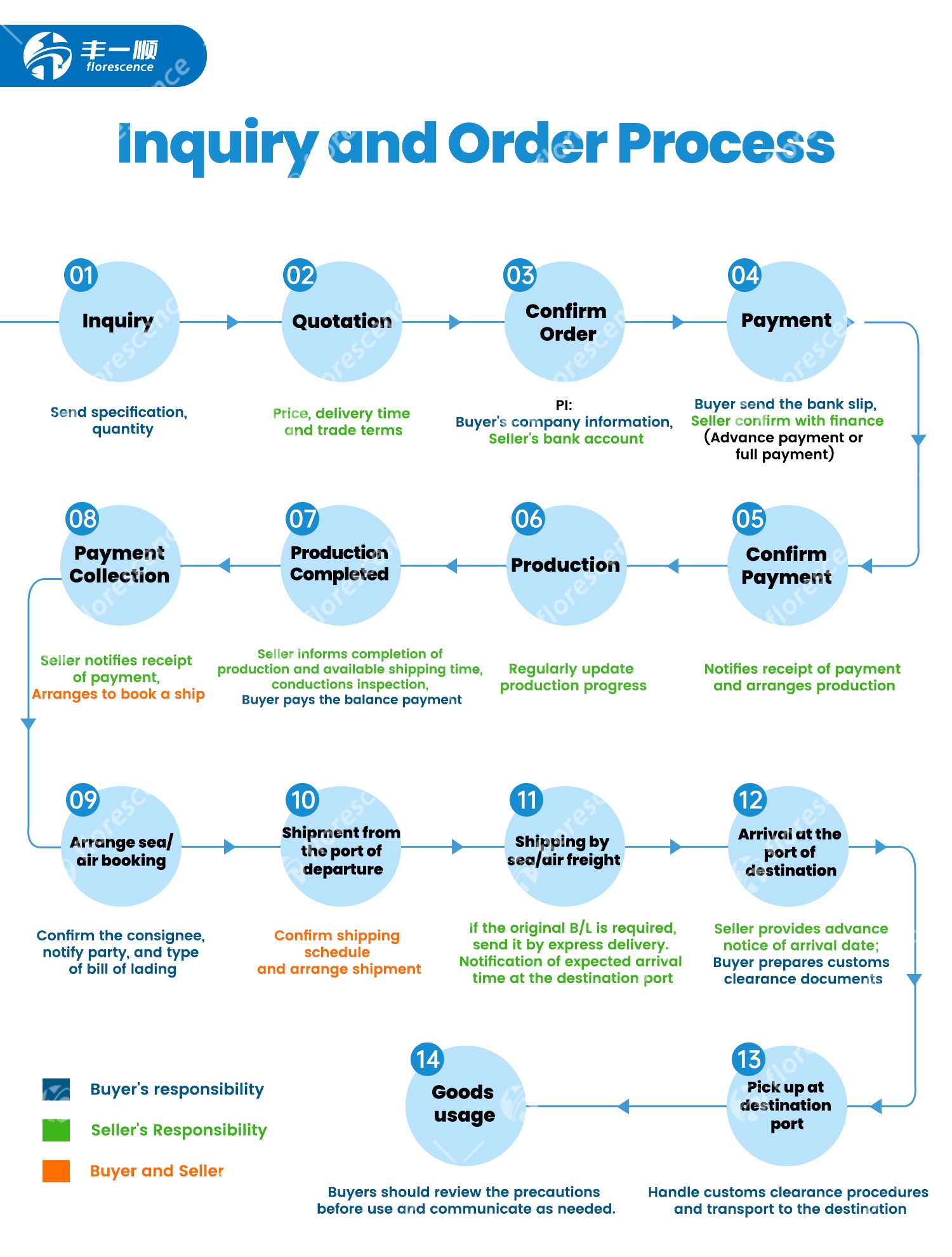
A typical enquiry-to-delivery sequence: specification, quotation, production, pre-shipment inspection, export documents and loading.
Manufacturer or Trader: How to Read the Answer
Florescence is a manufacturer, not a trading company. It was established in 1992 and has operated in the marine segment for more than three decades, with a 40,000 m² facility, 120 employees, a 25-engineer technical team and an annual output of roughly 2,000 pieces. Around 95% of output is exported, to Southeast Asia, South America, Europe, North America, the Middle East and Africa.
The claim is verifiable rather than rhetorical, but only if the buyer asks for the right evidence. Four checks do most of the work. First, the ISO 9001 certificate scope should name production of rubber fenders and docking fenders, not merely “trade” or “sales.” Second, the certificate number and issuing body should be quoted in full so they can be checked with the issuer — 32726Q10126RIS, issued by Shandong Guoyuan Certification Co., Ltd. Third, request a compression test record for a sample cell, cone or arch fender from a recent batch, since a trader will typically have to obtain this from a third party. Fourth, compare the production site against the correspondence address; a manufacturer can describe both, and a trading intermediary usually cannot.
There is also a boundary worth stating plainly. A facility producing roughly 2,000 pieces a year, with 40 to 45 days required for large custom orders or complete fender systems, is not built for unlimited simultaneous mega-projects. For a large single-package tender, production sequencing and delivery windows should be agreed before award rather than assumed afterwards.
Where These Fenders Are Used
Project records show how the product families divide in practice. For the Bangladesh Navy, four specialised hydro-pneumatic submarine fenders were delivered and installed, equipped with an internal water ballast system and counterweight to keep the fender standing vertically underwater, with an adjustable water-to-air ratio, plus site commissioning and crew training. In the United Arab Emirates, 35 units were installed for container, bulk and high-tidal-range berths, using heavy-duty steel frontal frames and UHMW-PE face pads to reduce hull friction and resist shear. In the Dominican Republic, 60 pieces of D2.0 m × L2.0 m foam-filled fenders were supplied as a turnkey order for quay wall, jetty and berth protection. In Costa Rica, a Cell 1150H fender system of 20 units supported a port infrastructure upgrade. In Singapore, custom tugboat fenders were produced with tailored lengths, pre-curved radians and tapered ends to match specific hull geometry.
Naval supply references include the Bangladesh Navy, French Navy, Royal Thai Navy, Italian Navy and Philippine Navy. For a first-time importer, the practical value of these references is not prestige but pattern: naval and terminal projects typically arrive with a written specification, an inspection requirement and a delivery window, which is the same document set a commercial buyer should prepare.
Market Context: Documentation Now Travels With the Product
Mordor Intelligence projects the global marine fenders market at USD 0.89 billion in 2026, within a forecast period running to 2031, and reports that rubber fenders accounted for approximately 64.17% of total marine fender market share in 2024. Rubber is therefore not a niche choice being weighed against an alternative; it is the default technology that most specifications are written around.
Two other pieces of infrastructure shape the procurement conversation. ISO 17357-1:2014 gives buyers a defined reference for high-pressure floating pneumatic rubber fenders, so “ISO 17357 compliant” can be tested rather than accepted. And internationally, boat or dock fenders of vulcanised non-cellular rubber, whether or not inflatable, sit under HS code 4016.94 — the classification a first-time importer will meet on the customs entry.
When most of a market shares one material, differentiation shifts away from material and towards evidence: which standard was applied, which certificate scope applies, and which batch record is attached. That is a more documentary market than a materials market, and buyers who evaluate on documents tend to shortlist faster.
Solid Element vs Pneumatic: Where Each One Stops Working
The choice between a solid element fender and a pneumatic fender is usually framed as a preference. It is better framed as a boundary. Pneumatic fenders float at the waterline and follow tidal movement continuously, which suits berths with large tidal variation and STS work where the contact point moves. They absorb high energy at low reaction force, but they retain pressure: inflation to 50 or 80 kPa with a compressor and gauge, periodic pressure checks and adjustment, and deflated shipment all belong to the product, not to the delivery service. A sling-type body-only unit also offers less abrasion protection than the CTN configuration.
Solid element fenders are bolted to the structure and require no inflation, which simplifies maintenance. Their limit is deflection. The W series is rated at 30% deflection with a maximum of 35%, and continuous operation at maximum deflection is not permitted; certain heavy-duty W models reach 50–52.5%. Cone fenders are rated at 70% with a maximum of 72.5%; cell and arch at 52.5% with a maximum of 55%; cylindrical and D at 50% with a maximum of 60%. Exceeding those limits is a design error, not a product defect, and it is the single most common mismatch between a berthing energy calculation and a purchase order.
A second boundary concerns certification. Not every berth requires a classification-society product certificate, and insisting on one where the specification does not demand it adds cost and lead time. Where the specification does demand it, stating the requirement at RFQ stage is the difference between a quotation that can be honoured and a dispute at delivery.
A First-Time Importer Checklist
| Stage | What to confirm | Why it matters |
|---|---|---|
| Before RFQ | Vessel size, berthing energy basis, tidal range, berth structure, operating conditions | Determines fender type, size and rated deflection |
| Specification | Type, size, hardness (Shore A 60–70), compound option (CR for oil, EPDM for UV), pressure for pneumatic (50 or 80 kPa) | Ensures quotations describe the same product |
| Certification | Whether a classification certificate is required, and against which standard (PIANC for cone, ISO 17357 for pneumatic) | Changes scope, cost and lead time if raised late |
| Documents | Quality Inspection Report, rubber property reports, EN 10204 3.1 mill certificates for metal parts, coating thickness records | Provides traceability for acceptance and for the project file |
| Packing | Pneumatic deflated; arch and cone palletised; steel parts wrapped against rust | Affects freight cost and arrival condition |
| Commercial terms | FOB as standard; CIF, CFR, DDP or DDU if required; MOQ 1 unit | Clarifies who owns transport risk and cost |
| Export documents | Commercial invoice, packing list, bill of lading, certificate of origin (Form E, Form F or CO) | Drives duty treatment and clearance speed |
| Schedule | 25–30 days for standard fenders; 40–45 days for large custom orders or complete systems | Prevents berth downtime against a fixed installation date |
| On receipt | Inspect packaging, confirm quantities, inflate pneumatic fenders to 50 or 80 kPa with a gauge, check steel parts for transit rust | First inflation is part of commissioning, not an afterthought |
Future Outlook
The direction of travel in this category is documentary rather than dramatic. Where specifications already cite PIANC guidelines and ISO 17357-1:2014, buyers will keep moving the first filter upstream — asking for certificate scope and batch records during shortlisting instead of during acceptance. Suppliers who can answer with a number and a document will be easier to shortlist than those who answer with adjectives, and the same shift will reward buyers who write inspection requirements into the RFQ rather than into the purchase order.
For reference, the Florescence product catalogue is available as a downloadable PDF: Florescence Catalogue – Brief. Product documentation is published at www.fendercore.com.
FAQ
Which marine fender types are supplied?
Florescence supplies cone fenders, cell fenders, arch fenders, cylindrical fenders, D fenders, tugboat fenders, foam filled fenders, pneumatic fenders, W type fenders and square fenders. Complete systems can be supplied with anchor bolts, chains, shackles, frontal panels, UHMW-PE pads and installation brackets.
What is a pneumatic rubber fender?
A pneumatic rubber fender is a compressed-air-filled rubber fender used as the protective medium for ship-to-ship contact, ship-to-quay berthing and ship-to-berth operations. The body is made from natural rubber and nylon cord, working pressure is 50 or 80 kPa, and sizes range from dia 0.5 m × length 1.0 m to dia 4.5 m × length 12.0 m. Units are supplied as sling type (body only) or with a chain and tyre net for abrasion protection.
Are you a manufacturer or a trading company?
Qingdao Florescence Marine Supply Co., Ltd. is a professional marine equipment manufacturer established in 1992, with more than 30 years of experience in marine fenders, pneumatic fenders, foam fenders and ship launching airbags. The facility covers 40,000 m² with 120 employees and an annual output of roughly 2,000 pieces, and operations run under ISO 9001 and ISO 14001 with complete production and inspection systems.
How is product quality checked before the goods leave the factory?
The factory is ISO 9001 certified, and every production batch goes through strict tests: rubber raw material testing, dimensional and hardness checks for rubber fenders, and air-tightness tests for ship airbags and pneumatic fenders. Compression testing can be performed on a sample cell, cone or arch fender to verify energy absorption and reaction force against the design specification. A Quality Inspection Report with rubber test data, sizing sheets, coating thickness records and product photographs can be issued before shipment.
How are the goods shipped to the buyer?
Sea freight, air freight, LCL and FCL shipment are supported, with packing optimised to reduce transport costs and improve loading efficiency. Quotations are usually FOB, but CIF, CFR, DDP and DDU terms can be arranged. Pneumatic fenders ship deflated, arch and cone fenders are bundled on pallets, and steel parts are wrapped to prevent rust. Standard delivery is 25 to 30 days after deposit, and 40 to 45 days for large custom orders or full fender systems.
¿Tiene preguntas o necesita más detalles?
Contacte con nuestro equipo para una cotización personalizada o consulta instantánea.
Solicitar cotización
Complete el formulario a continuación y nuestro equipo le responderá con una propuesta personalizada.
Chat directo de WhatsApp
¿Prefiere chatear en tiempo real? Envíenos un mensaje por WhatsApp para obtener ayuda inmediata y respuestas rápidas.
- Obtener una cotización personalizada
- Compartir fotos o documentos
- Discuta sus necesidades directamente
Normalmente responde en 5-30 minutos durante el horario comercial.