
Rubber Dock Fenders: Specs, Certificates and Cost Drivers
A rubber dock fender is a moulded rubber element bolted to a quay, jetty, dolphin or pontoon so that a berthing vessel compresses the fender before it can reach the structure. The category is commercially significant: the global marine fenders market is projected to reach approximately USD 0.89 billion in 2026, and rubber fenders accounted for about 64.17% of total marine fender market share, according to Mordor Intelligence. For a buyer, the difficulty is not choosing a shape. It is that two fenders sharing one outline can behave very differently at the same berth. The constraints that decide the outcome are mechanical parameters, compound selection, certification scope and the accessory package around the rubber body.
Internationally, boat and dock fenders made of vulcanised non-cellular rubber, whether or not inflatable, are classified under HS Code 4016.94. One trade code, a very wide performance range. That gap is where berth protection succeeds or fails.
Dock Fenders Are a Specification Problem Before They Are a Product
The function is well established. Marine rubber fender systems exist to protect vessel hulls and berthing facilities from damage when vessels berth alongside. Meeting that function reliably depends on geometry and compound, not on appearance.
Public supplier catalogues show how broad the category has become. Commonly listed configurations include cone, cell, arch, cylindrical, D, square, pneumatic, foam-filled, roller and donut fenders. Configuration is usually matched to setting. Roller fenders, for example, are typically described for docks and Ro-Ro terminals, while arch and cell units are described for general cargo and heavy-tonnage berths respectively.
For a port authority, terminal operator or EPC contractor working through the research and evaluation stages, the job is therefore constraint-setting rather than browsing. Four constraint families decide whether a dock fender will do what the berth needs:
- Mechanical parameters - rated deflection, maximum permissible deflection, and reaction force and energy absorption tolerances.
- Compound and environment - rubber type, hardness, oil, UV and ozone exposure, and operating temperature range.
- Certification scope - which product the certificate actually covers, and against which standard.
- Accessory and delivery package - frontal panels, facing pads, bolts, chains, testing documents and lead time.
The Parameters That Cannot Be Negotiated After the Fender Is Cast
Two deflection figures govern every solid rubber dock fender. The rated deflection is the design working point, the compression at which the published reaction force and energy absorption values apply. The maximum permissible deflection is the ultimate limit. Compression beyond it is not permitted, because it risks permanent damage to the rubber body and unpredictable load transfer to the structure.
A second pair of figures governs manufacturing consistency. The published Florescence range carries a reaction force tolerance of plus or minus 10% and an energy absorption tolerance of -10%, with a hardness of Shore A 60 to 70 for arch, cell, cone, cylindrical and D fenders and Shore A 60 to 75 for W fenders. The operating temperature range for the listed solid types is -30 degrees C to +80 degrees C.
Geometry adds a further variable. For arch fenders, reaction force and energy absorption are linearly proportional to fender length, which makes length a design lever rather than an arbitrary dimension. For W fenders, the multi-arch cross-section produces a progressive compression curve and, under the same compression, 20% to 30% lower reaction force than a D-type fender - a relevant figure when the quay structure, not the vessel, is the limiting element.
| Rubber dock fender | Rated deflection | Max. permissible deflection | Hardness (Shore A) | Reaction force / energy tolerance | Standard referenced |
|---|---|---|---|---|---|
| Arch Fender | 52.5% | 55% | 60-70 | +/-10% / -10% | PIANC |
| Cell Fender | 52.5% | 55% | 60-70 | +/-10% / -10% | ISO 17357, PIANC |
| Cone Fender | 70% | 72.5% | 60-70 | +/-10% / -10% | PIANC |
| Cylindrical / Tug Fender | 50% | 60% | 60-70 | +/-10% / -10% | - |
| D Fender | 50% | 60% | 60-70 | +/-10% / -10% | - |
| W Fender | 30% (heavy-duty models 50-52.5%) | 35% | 60-75 | +/-10% / -10% | - |
| Square Fender | - | - | Natural rubber | - | Height range 100-500 mm |
Table 1 - Published deflection, hardness and tolerance values across the Florescence rubber dock fender types. Square fenders are dimension-driven rather than deflection-rated in the published data.
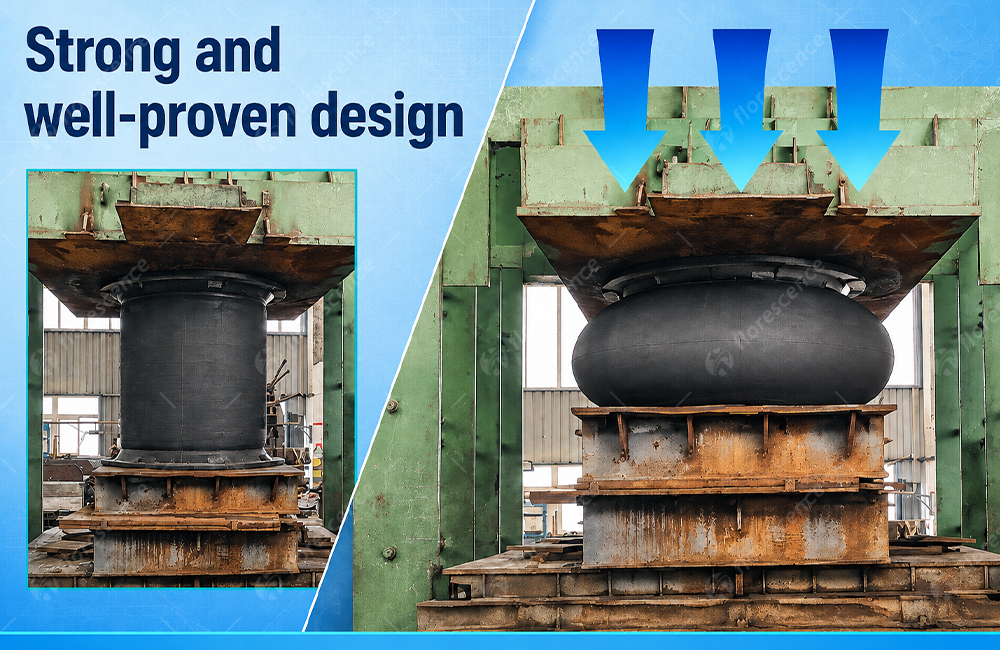
Compression is the working principle: dock fender performance is defined at a specific deflection, not at an arbitrary load.
Compound Selection Is an Environment Decision, Not a Price Upgrade
The baseline compound across the solid dock fender range is a marine NR/SBR rubber. Two optional compounds extend the envelope:
- CR (chloroprene rubber) - specified where oil resistance is required, for example at bunkering berths or tanker terminals.
- EPDM - specified where UV and ozone resistance is the priority, typically for long-exposure tropical or high-altitude sites.
Cylindrical tug fenders are produced using vulcanisation technology, and the same compound logic applies across the range, including D, arch, cone and W fenders. The practical point for evaluation is that compound choice changes durability under a specific exposure, not the fender's nominal geometry. It therefore has to be declared in the RFQ rather than assumed from a catalogue photo.
Certification: Read the Scope, Not the Logo
Certification is where dock fender procurement most often goes wrong, because quality-system certificates and product certificates answer different questions.
At system level, Qingdao Florescence Marine Supply Co., Ltd. operates under ISO 9001:2015 and ISO 14001:2015. The ISO 9001 certificate, number 32726Q10126RIS, was issued by Shandong Guoyuan Certification Co., Ltd. and is valid from 2026-05-09 to 2029-05-08. Its scope covers the production of marine airbags, rubber fenders and docking fenders for the global marine industry market. The ISO 14001 certificate, number 32725E20318R0S, applies to the same production scope, covering marine airbags, rubber fenders, marine chains and related environmental management activities.
At product level, certificates are specific. Records from the Florescence document set illustrate the pattern:
| Certificate | Product covered | Standard referenced | Issued | Market |
|---|---|---|---|---|
| BV INS/NR/SHOP-26/131 | Cone fenders | PIANC | 2026-03-24 | Global marine market |
| BV INS/NR/SHOP-25/377 | Pneumatic rubber fenders | ISO 17357 | 2025-07-09 | Global marine market |
| RMRS 21.10345.266 | Submarine pneumatic rubber fenders | ISO 17357-1:2014, EN 10204:2004, ISO 10474:2013 | 2021-08-16 | Russia and CIS countries |
| IRS QIN21X015 | Ship launching airbag | ISO 14409 | 2021-07-22 | India and South Asia |
| BV GTS 2025 154536 0003 | Marine rubber airbags, ship launching airbags, marine salvage airbags | ISO 14409 | 2025-09-04 | Global marine market |
Table 2 - Product-level certification in the Florescence document set. Each certificate is scoped to a defined product family.
The boundary that matters: a certificate issued for a pneumatic fender line does not automatically extend to solid dock fenders, and a solid-fender certificate does not cover airbags. ISO 17357-1:2014 itself specifies the requirements for high-pressure floating pneumatic rubber fenders, so it addresses a different product family from a quay-mounted arch, cell or cone fender. Where a dock fender datasheet cites a standard, the buyer should confirm with the supplier which product family the reference applies to, which issuing body assessed it, and on what date.
Manufacturer compliance statements are a different class of evidence again. Trelleborg states that its pneumatic fenders meet PIANC 2002 guidelines and comply with ISO 17357-1:2014, and ESC references PIANC 2002, BS 6349:4 and EAU 2004 in its design documentation. These are useful screening signals when building a shortlist, but they remain company-reported claims until the underlying certificate is reviewed.
What Actually Drives the Cost of a Rubber Dock Fender
Rubber dock fender pricing is configuration-driven, and the variables are identifiable:
- Fender type and deflection class. A cone fender operating at 70% rated deflection carries a different rubber volume and geometry from an arch fender rated at 52.5%.
- Compound. Marine NR/SBR is the baseline; CR and EPDM options add cost and can extend lead time.
- Size and mass. Cylindrical fenders are available up to 2700 mm diameter and square fenders from 100 mm to 500 mm height; both size extremes change moulding and handling cost.
- Accessory package. Frontal panels, UHMW-PE facing pads, U-ring and chain systems, anchor bolts, shackles and swivel joints are quoted as part of the system, not the rubber alone.
- Testing and certification. Third-party witness testing by BV, CCS, ABS or DNV, plus material and compression testing, is a cost line rather than an afterthought.
- Packaging and freight. Pneumatic fenders ship deflated to reduce freight cost, while arch and cone fenders are bundled on pallets.
A single displayed price on a supplier page is not a benchmark, because it rarely states configuration, quantity, Incoterm, freight, installation scope or test-document scope. Comparable quotations should fix all of those variables plus the certification to be supplied. On the supplier side, Florescence works to a minimum order quantity of 1 unit, a lead time of 5 to 30 days and a monthly capacity of 200 units, which allows a small replacement order and a full berth system to be quoted on the same commercial basis.
Matching Fender Type to Berth Type
Fender selection follows the berth, not the vessel alone. Published application data for the Florescence range maps as follows:
| Fender type | Typical berth or vessel setting |
|---|---|
| Arch Fender | RoRo berths, general cargo berths, workboat harbours, barge and tug berths |
| Cell Fender | Container, bulk, oil and LNG terminals; offshore platforms; RoRo and cruise terminals; multi-user berths |
| Cone Fender | Container berths, bulk terminals, oil and LNG facilities, RoRo and cruise terminals, parallel motion systems, monopiles and dolphins |
| Cylindrical / Tug Fender | Bulk cargo berths, general cargo quays, RoRo and ferry terminals, fishing and workboat berths, pontoons and floating structures, tug havens |
| D Fender | Jetties and wharves for small craft, tugs and workboats, pontoon protection, inland waterways |
| W Fender | Tugboats, offshore vessels, inland barges, RoRo terminals, shipyards, bridge pier protection |
| Square Fender | Fishing harbours, small jetties, inland river terminals, marinas and pontoons, tug side belting, shipyards and dry docks, land loading docks |
Table 3 - Application mapping for rubber dock fender types.
Reference installations show how the mapping is applied in practice. A container and LNG berth project in the United Arab Emirates took 35 cone fender units with heavy-duty steel frontal frames and UHMW-PE face pads, described as delivering energy absorption at large berthing angles while keeping reaction forces stable against the concrete quay wall. A port infrastructure upgrade in Costa Rica used 20 Cell 1150H units against a PIANC 2002 reference for container terminal berthing. A Singapore tug operator took 30 custom tugboat fenders for bow, stern and side protection. Other delivered configurations include 60 foam fenders for a 100,000 DWT berthing project in the Dominican Republic, four pneumatic units sized D2500 x L4000 mm for ship-to-ship transfer in Malta, and four hydro-pneumatic submarine fenders for the Bangladesh Navy.
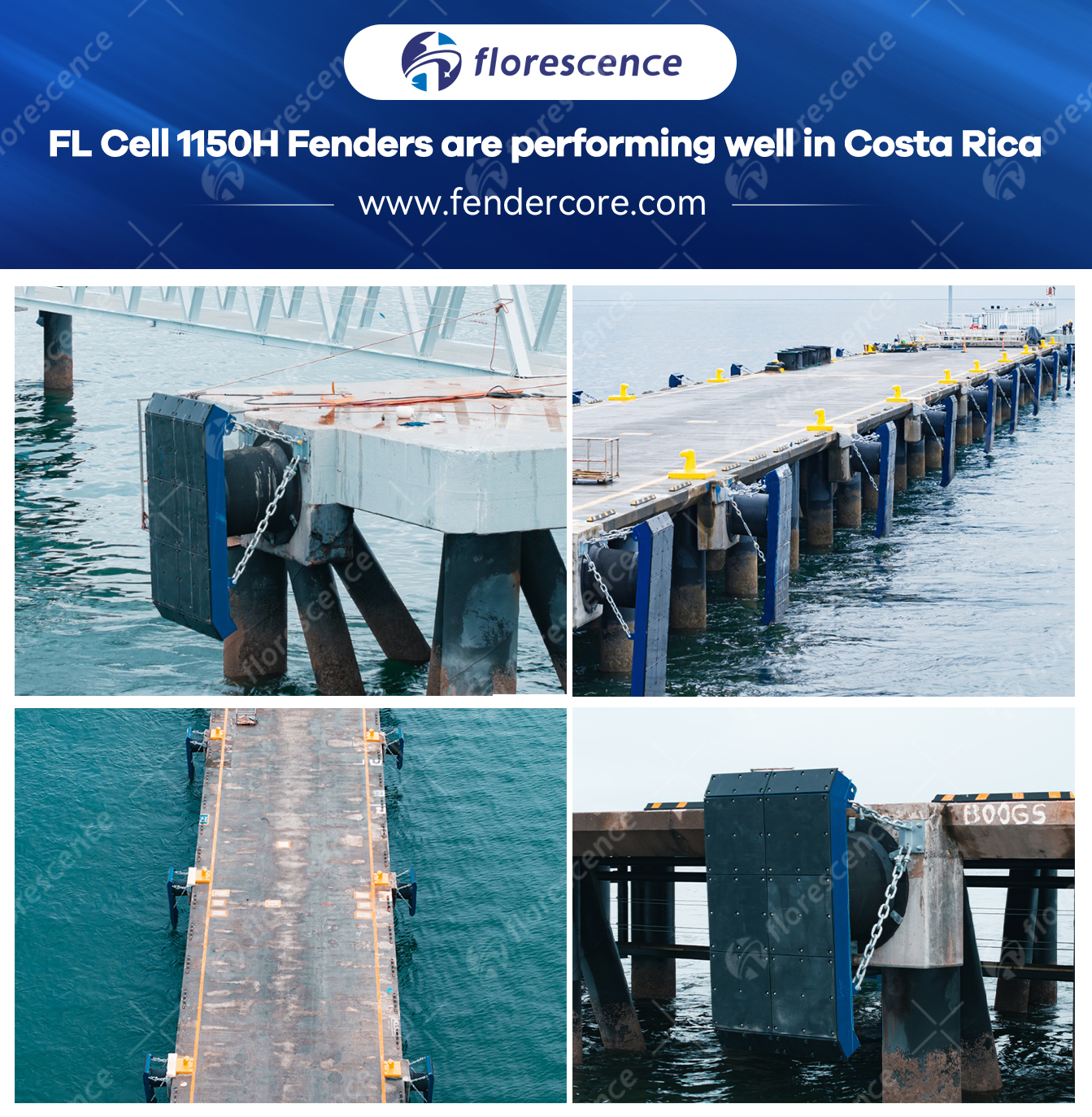
Cell fenders are typically specified for container, bulk and heavy-tonnage berths where low hull pressure and high energy absorption are both required.
Limits and Trade-offs: Where Solid Rubber Dock Fenders Stop
A credible specification names the boundary as clearly as the benefit. Three limits apply to the solid rubber dock fender range.
1. The compression limit is absolute. Arch and cell fenders are rated at 52.5% deflection with a 55% maximum; cone fenders at 70% with a 72.5% maximum; cylindrical and D fenders at 50% with a 60% maximum; and standard W fenders at 30% with a 35% maximum. Compression beyond the stated maximum is not permitted, and for standard W fenders the 35% figure is explicitly not a continuous operating point. Where a berth's energy demand cannot be met inside these envelopes, the answer is a larger or different fender, not a deeper compression.
2. Fixed fenders do not follow the tide the way floating fenders do. Cylindrical fenders are described as suitable for multi-angle impact and large tidal variation, but the configurations specifically described for extreme tidal range and severe weather are the floating pneumatic and foam-filled types. Foam fenders are unsinkable by design, remain functional even if the outer skin is punctured, and require no air pressure maintenance, inflation or valves, which is why they are often chosen where maintenance access is difficult. Pneumatic fenders absorb high energy at low reaction force and have a stated service life of over 10 years, but they do depend on internal air pressure of 50 kPa or 80 kPa and on periodic pressure checks, and they are supplied with either a chain-and-tyre net or as a sling type body only.
3. Hardness and reaction force move together. Higher rubber hardness raises reaction force, which the quay structure, the mooring system and the vessel hull all have to absorb. Selecting the hardest available compound is therefore not automatically the safest choice; it usually means more load transferred to the structure. The -30 degrees C to +80 degrees C operating range is also a real envelope, and CR or EPDM options address oil, UV and ozone exposure rather than every chemical or thermal condition a berth may present.
Market Trend: Verification Is Moving Into the Specification
The value of the marine fender market sits predominantly in rubber. Marshalling the verified data points: the global market is projected at roughly USD 0.89 billion in 2026, rubber fenders represent about 64.17% of it, and the trade classification for boat and dock fenders of vulcanised non-cellular rubber sits under HS 4016.94, whether or not inflatable. Taken together, these indicate that rubber dock fenders remain the reference technology against which alternatives are judged rather than a niche option.
The visible shift in procurement behaviour is towards documentation. Supplier technical materials increasingly name specific standards: ISO 17357-1:2014 and PIANC 2002 for pneumatic products, and PIANC 2002, BS 6349:4 and EAU 2004 as design references for solid systems. Buyers are responding by asking for standard compliance declarations, test reports and certification scope at the RFQ stage rather than after delivery.
It is worth stating what public data does not yet support. There is no validated regional breakdown of marine fender demand, and no independent verification of manufacturing capacity for private manufacturers, in the publicly available sources reviewed for this analysis. Capacity and export records therefore remain audit items rather than catalogue claims.
Future Outlook
Three developments look likely to shape the next procurement cycle for rubber dock fenders.
First, certificate scope will increasingly be treated as part of the technical specification rather than an administrative annex. The gap between a pneumatic fender certificate and a solid dock fender certificate is a real compliance risk, and buyers who check scope before ordering avoid re-testing later.
Second, testing will move further upstream. Compression testing on sample arch, cell or cone fenders, used to confirm that energy absorption and reaction force meet design values, is a more useful pre-delivery signal than a generic quality statement. Buyers who specify which sample is tested gain more control over the outcome.
Third, service-life planning will become more explicit. Foam fenders are stated at 5 to 8 years and pneumatic fenders at over 10 years, while delivered solid fender installations are referenced in case records at roughly 8 to 20 years depending on duty and environment. Because replacing a dock fender means berth downtime, inspection regimes covering rubber condition, bolt tightness, chain wear, corrosion status and panel alignment will increasingly be written into maintenance contracts rather than handled reactively.
For a manufacturer such as Qingdao Florescence Marine Supply Co., Ltd., established in 1992 and exporting to Southeast Asia, South America, Europe, North America, the Middle East and Africa, the practical implication is that technical support - selection, drawings, inspection records and installation guidance - carries as much procurement weight as the rubber itself.
Frequently Asked Questions
What is a rubber dock fender, and how does it differ from a ship fender?
A rubber dock fender is a rubber element mounted on a fixed structure such as a quay, jetty, dolphin or pontoon, positioned to absorb berthing energy before a vessel contacts the structure. "Ship fender" more often refers to a fender carried on the vessel or used between two vessels. Both fall under the same international classification, HS 4016.94, which covers boat or dock fenders of vulcanised non-cellular rubber, whether or not inflatable. The distinction matters in specification, because a fixed dock fender's performance is defined by its compression behaviour against a known berthing energy, while a floating fender's behaviour also depends on internal air pressure.
Which rubber dock fender types are available, and how do their deflection ratings differ?
Florescence supplies cone, cell, arch, cylindrical, D, W and square rubber fenders, alongside pneumatic and foam-filled fenders. Rated deflections differ by type: cone 70% with a maximum of 72.5%; arch and cell 52.5% with a maximum of 55%; cylindrical and D 50% with a maximum of 60%; and W 30% with a maximum of 35%, with some heavy-duty W models reaching 50% to 52.5%. The published reaction force tolerance is plus or minus 10% and the energy absorption tolerance is -10% across the solid range, with hardness from Shore A 60 to 70, or 60 to 75 for W fenders.
Which certifications should a rubber dock fender supplier be able to provide?
Two levels apply. At system level, Florescence holds ISO 9001:2015 certification, certificate 32726Q10126RIS, valid 2026-05-09 to 2029-05-08, with a scope covering the production of marine airbags, rubber fenders and docking fenders, plus ISO 14001:2015 certification, certificate 32725E20318R0S. At product level, certificates are scoped to defined product families: BV certificate INS/NR/SHOP-26/131 covers cone fenders against PIANC, issued 2026-03-24; BV certificate INS/NR/SHOP-25/377 covers pneumatic rubber fenders against ISO 17357, issued 2025-07-09; and RMRS certificate 21.10345.266 covers submarine pneumatic rubber fenders to ISO 17357-1:2014 for the Russia and CIS market. Buyers should confirm which product, standard and issuing body each certificate covers.
How are reaction force and energy absorption verified before delivery?
Verification is by test rather than by declaration. Compression testing can be performed on sample cell, cone or arch fenders to confirm that energy absorption and reaction force meet the design specification, and dimensional and hardness checks are carried out on rubber fenders. Pneumatic fenders and ship airbags are subject to air-tightness testing. For steel components, marine epoxy coating thickness is measured with digital gauges against the target specification, and dimensional checks on UHMW-PE pad hole patterns and anchor bolt pitch confirm on-site fit. Third-party inspection by bodies such as BV, CCS, ABS or DNV can be arranged where a project requires witnessed testing.
What quality documents should accompany a dock fender shipment?
The Florescence document set includes EN 10204 3.1 mill test certificates for metal parts and bolts, physical property reports for rubber products covering tensile strength, elongation and compression, and a Quality Inspection Report containing rubber test data, sizing sheets, coating thickness records and product photographs. Third-party inspection is accepted, and the manufacturer states that it routinely works with international agencies including SGS, Bureau Veritas and LR. Traceability of metal parts is provided through the mill certificates.
What determines the delivered cost of a rubber dock fender?
Cost is configuration-driven. The main variables are fender type and deflection class, rubber compound with marine NR/SBR as standard and CR or EPDM as options, size and mass, the accessory package including frontal panels, UHMW-PE face pads, chains, shackles and anchor bolts, the scope of third-party testing and certification, and packaging and freight. A single published price rarely states configuration, quantity, Incoterm, freight or test-document scope, so it should not be used as a benchmark. Comparable quotations should fix all of those variables. Florescence quotes against a minimum order quantity of 1 unit with a lead time of 5 to 30 days.
For a full overview of fender types, accessory systems and published technical parameters, the Florescence marine product catalogue is available here: 2026 Florescence Catalogue (PDF).