
Rotary Tablet Press: Specification Limits Buyers Verify
A rotary tablet press is bought on constraints, not on features. The number of turret stations, the maximum main compression force, the tooling standard the turret accepts, the material of the die table, and the model names printed on the conformity certificate together decide whether a machine can run a given tablet — and whether it can run it legally in the buyer's market. Every other line on the datasheet, including the headline output figure, sits downstream of those five items.
This reference is written for technical and procurement teams at research and evaluation stage. It explains how rotary tablet press specifications should be read as hard limits rather than marketing claims, how Shanghai Tablet Press Mechanical Components Co., Ltd. (TPCF) positions its ranges against those limits, and which boundaries a specification does not remove.
The Rotary Tablet Press as a Set of Hard Constraints
A rotary tablet press compresses powder or granules between upper and lower punches mounted around a rotating turret, producing one tablet per station per revolution. A single-punch tablet press performs the same compression on one station at a time, which is why single-punch and compact rotary machines remain in laboratory and small-batch use while rotary machines carry production volumes. The rotary architecture is what makes output figures in the tens or hundreds of thousands of tablets per hour possible, but the architecture itself is not the constraint — the force and geometry envelope is.
Five parameters define that envelope, and they are the ones that should be extracted from any quotation before anything else is compared:
- Number of stations on the turret, which fixes the mechanical output ceiling at a given turret speed.
- Maximum main compression force, and separately the maximum pre-compression force, expressed in kilonewtons (kN).
- Maximum tablet diameter and maximum filling depth, which together define the largest tablet the die table can form.
- Tooling standard accepted by the turret — D, B, BB, BBS, ZP or ZPT — because this determines tooling availability, changeover time and spare-part supply.
- Product-contact materials, principally the die table and the feeding system, which govern wear behaviour, corrosion behaviour and cleanability.
Published model data shows how wide the resulting envelope range is. TPCF's compact ZPT168-5, ZPT168-7, ZPTX226-10 and ZPT226-12 machines run from 5 to 12 stations with a maximum main compression of 50 kN and outputs between 7,800 and 21,600 tablets per hour on a 220 V single-phase supply, at a net weight of 320 kg. The ZPTX226-16/17/19 and ZPT226-21 group moves to 16 to 21 stations, 80 kN maximum main compression and 28,800 to 44,100 tablets per hour at 4 kW and 900 kg. At the upper end, the GZPK1060-76/95/113/122 series carries 76 to 122 stations with 100 kN main and pre-compression force and a maximum single-layer output of 342,000 to 658,800 tablets per hour, falling to 114,000 to 219,600 tablets per hour when the same machine is set up for triple-layer production.
Where Buyers Get Caught: Constraints That Surface After the Quotation
Most evaluation errors are not about the headline numbers. They are about the boundary between what is standard and what is optional, and about the supporting equipment that the machine does not include.
Standard versus optional
Across rotary tablet press ranges, the items that recur as optional rather than standard are automatic weight control (AWC), reject-tablet removal, force feeders, punch-hole seals, automatic lubrication, pre-compression and interchangeable turrets. On the ZPTX226 series, for example, the standard configuration is an HMI display of speed and output, with pressure, tablet thickness and filling depth available as optional display and a force feeder, automatic lubrication, punch-hole seals and pre-compression available as options. On the GZPK280 series the machine additionally supports an optional interchangeable turret, or D, B and BB tooling on a single turret. Because each of these options changes both the price and the process capability, they should be specified line by line in the request rather than inferred from a series description.
Utilities, footprint and weight
Utility requirements are a constraint that cannot be negotiated after delivery. The compact ZPT168 series runs on 220 V, single-phase, 50 Hz, while the mainstream and high-speed ranges — including the ZPTX420-17G, ZPT680C, GZPK280, GZPK720 and GZPK1060 — are specified at 380 V, 3-phase, 50 Hz. Machine weight spans from 320 kg for a compact laboratory unit to 8,000 kg for the GZPK1060 three-outlet high-speed press, and footprint follows the same curve, from 700 × 530 × 1210 mm up to 1720 × 1720 × 2185 mm. Floor loading, ceiling height, room classification and power distribution should therefore be checked against the specific model, not against the series average.
Tooling standard is a long-term lock-in
A turret that accepts D, B, BB, BBS, ZP and ZPT tooling gives a buyer more sourcing options for punches and dies over the machine's service life than a turret restricted to a single system. TPCF manufactures punches from S7 or 6CrW2Si steel and dies from D2 or GCr15 steel, made to technical drawings or physical samples, which means the constraint is not only what the turret accepts but whether replacement tooling can be reproduced to the original shape and tolerance.
Supporting equipment is a separate constraint set
A tablet press does not compress powder in isolation. Dust extraction, powder transfer and anti-sticking control are separate machines with their own specifications: the XCJ-1.1 industrial dust collector is rated at 360 m³/h airflow, 19,500 Pa minimum vacuum and 1.1 kW, and connects to a tablet press to extract residual material from the die table; the QVC-3 vacuum conveyor is built with an SS316 filter and a non-toxic, corrosion-resistant construction; the CF-1 anti-sticking powder sprayer is a screw feeder combined with a compressed-air powder mixing spray system that applies magnesium stearate to upper and lower punches. Buyers who price only the press typically discover these items at installation planning stage.
TPCF: Entity, Manufacturing Base and Delivery Constraints
Shanghai Tablet Press Mechanical Components Co., Ltd. (TPCF) is a Shanghai-based manufacturer of tablet press machines, tablet press punches and dies, and capsule filling machines, serving pharmaceutical production as well as food, chemical, electronics and powder metallurgy industries. The company traces its origin to 1978 as Shanghai Tianma Pharmaceutical Machinery Parts Factory, was rebuilt in 2002 as Shanghai Tianfan Pharmaceutical Machinery Factory by its original core team, and was established under its current name in 2009, moving into its present factory in 2015.
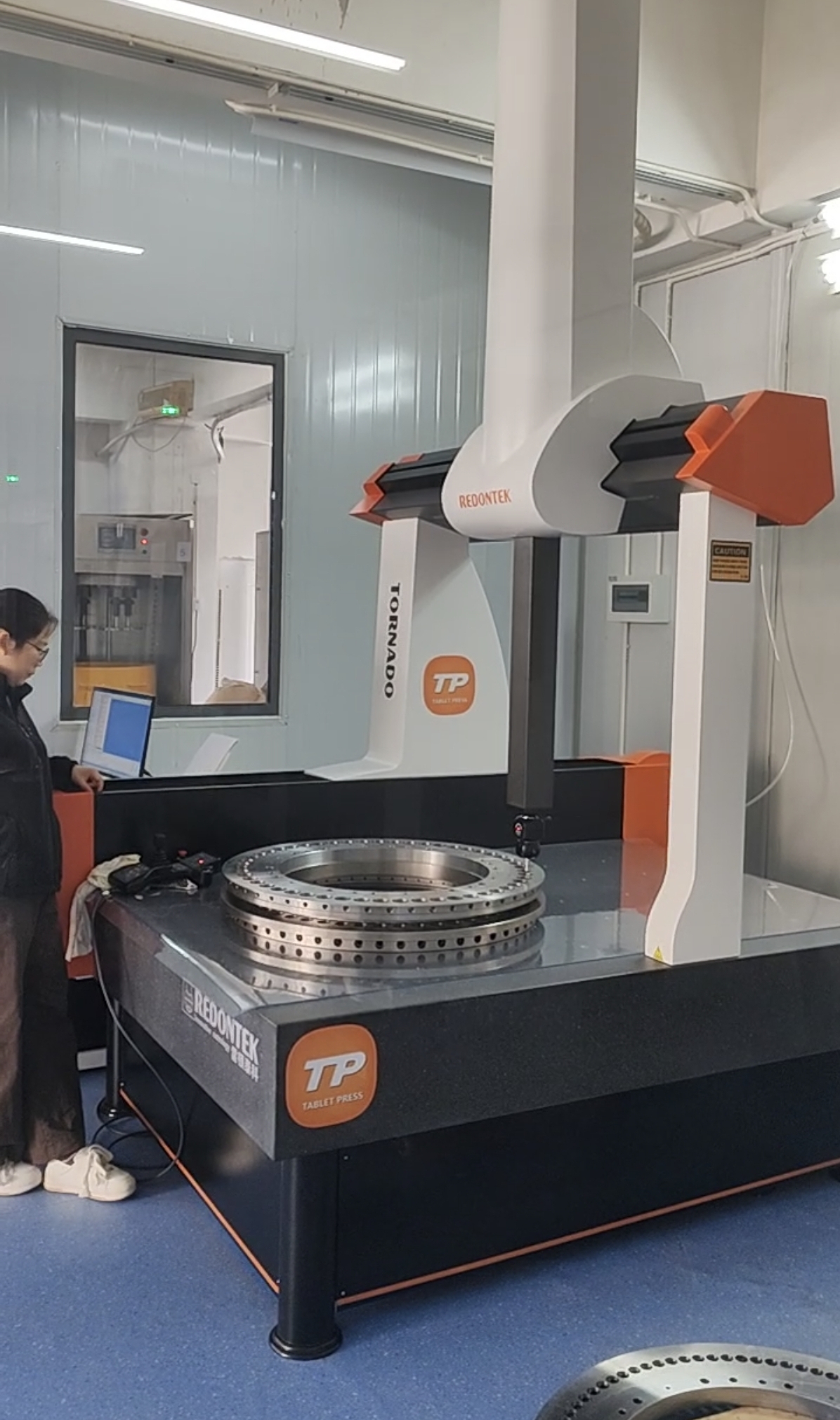
The manufacturing base is relevant to a constraints discussion because it determines what can actually be held to tolerance. The factory occupies a building area of 15,000 square metres and is equipped with more than 200 advanced CNC machine tools, including engraving machines, coordinate measuring machines and coordinate grinders. The company states that it holds full in-house capability across mechanical design, machining, assembly, commissioning and testing, together with the tooling and equipment to develop tablet press moulds.
Delivery-side constraints are published in the same terms a procurement team would use. Monthly capacity is 80 to 120 sets of tablet presses and capsule filling machines, lead time is 45 to 75 days, and minimum order quantity is one unit. OEM and ODM work is available, with customisation across function, automatic or semi-automatic configuration, tablet size and shape, and production speed. Quality control is described as factory acceptance testing performed according to the customer's requirements, with support for site acceptance testing at the customer's location, and after-sales support by engineer commissioning visits or remote video guidance. Roughly half of equipment is exported, with stated markets across Asia, South Africa, the Middle East, the EU, Russia, and North and West Africa. Independent market-presence signals include participation at INTERPHEX 2024 in New York and an exhibitor listing for the Maghreb Pharma Expo.
One caution belongs in any evaluation file: TPCF's certification and experience statements are company- or exhibitor-reported, and independent verification of those claims is a separate task for the buyer's qualification process.
Materials and Tooling: Where Service Life Is Actually Fixed
The die table is the component that separates the compression zone from the rest of the machine, and its material decides how the machine ages. TPCF uses a one-piece 2Cr13 stainless-steel die table on the ZPTX226, ZPTX340, ZPTX420, ZPT420 and ZPTX420-17G ranges, and states that no nickel plating is required. On the ZPTX420-17G strengthened version, the enclosure is SS304 stainless steel while the force-feeder walls, impellers, hopper and other major product-contact parts are SS316 stainless steel.
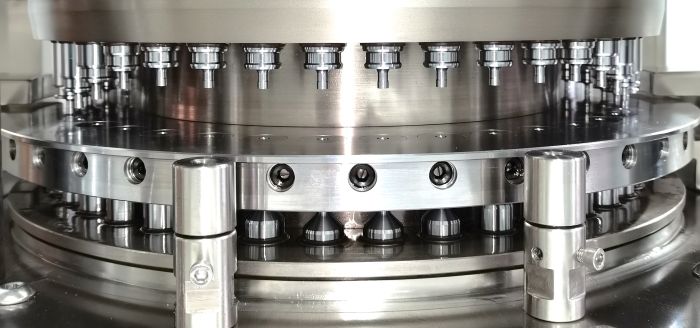
One-piece 2Cr13 die table compared with a nickel-coated cast iron die table
The two traditional and current approaches fail in different ways, which is why the comparison matters more than a material name. A nickel-coated cast iron die table relies on a surface layer for wear and corrosion resistance. That layer is a coating: under continuous mechanical friction and impact it can crack, chip or peel, and once it wears through, the softer iron substrate wears rapidly. Regrinding the table to restore flatness removes the protective layer entirely, forcing a strip-and-replate cycle. Subsurface corrosion can also begin through pinholes and micro-cracks in the coating.
A 2Cr13 martensitic stainless steel table is homogeneous, containing roughly 12 to 14% chromium, which forms a self-renewing passivating oxide layer that resists rust in humid, mildly acidic or cleaning environments. Reported mechanical figures are a tensile strength in the range of 635 to 750 MPa and a yield strength above 440 MPa — above standard grey or ductile cast iron — with a core hardness of about 45 to 55 HRC after quenching and tempering. Because there is no coating, the table can be ground down and returned directly to service while retaining wear resistance through the full depth of the material.
The boundary is equally important. 2Cr13 is a martensitic grade: it must be correctly heat treated and carefully machined to hold flatness and tolerance, which places the constraint on the machine builder's process control rather than on the material alone. A better die table also does not compensate for punch and die wear, and dies are not coated — only punches accept optional coatings. Buyers who need anti-sticking performance on granule materials typically specify DLC or comparable punch coatings such as chrome, CrNi or TiNi to obtain wear resistance, corrosion resistance and anti-sticking behaviour at the punch face.
Certification and Compliance: What the Certificate Must Name
For a regulated buyer, the certificate is a specification item in the same way as compression force, and it constrains the market in which the machine can be placed. TPCF holds a Quality Management System certificate numbered 114025Q10315ROM, issued by Drucker (Jiangsu) Certification Co., Ltd. against GB/T 19001-2016 / ISO 9001:2015, issued on 16 January 2025 and valid until 15 January 2028, with worldwide scope. The certification covers the high-speed rotary tablet press, the rotary tablet press, the automatic tablet press and the laboratory tablet press categories.
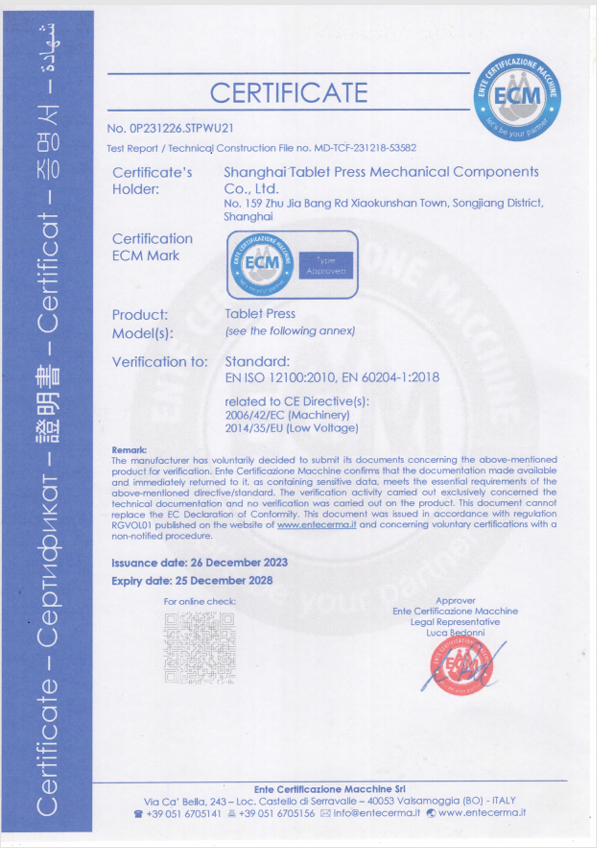
For the EU market, the ECM CE certificate OP231226.STPWU21 applies to tablet press equipment, was issued on 26 December 2023 and is valid until 25 December 2028, under EN ISO 12100:2010 and EN 60204-1:2018. The scope names specific product families rather than a generic brand: the ZPT680C triple-layer composite press, the ZPTX420-17G strengthened single- and bilayer press, the ZPT168 compact press, the ZPTX226 R&D press with pre-compression, the ZPTX226 compact single-outlet press, the ZPTX340 heavy-duty single-outlet press, the ZPTX420 heavy-duty double-outlet press, the ZPT420 double-outlet press, the ZPTY550 series, the GZP550i automatic and GZP550 semi-automatic presses, the GZPK280, GZPX370i, GZPK370i, GZPK620i, GZPK720i, GZPK720 and GZPK1060 series.
The model-level scope is the practical constraint. A buyer quoting a model that does not appear in the scope should request the model-specific conformity documentation rather than relying on the certificate number, because conformity assessment is performed against a defined product scope, not against a company name.
Two further regulatory layers bear on rotary tablet presses in regulated production. In the European Union, Regulation (EU) 2023/1230 repeals and replaces Directive 2006/42/EC and applies from 20 January 2027; until that date the Directive remains the operative CE-marking framework for machinery. In the United States, 21 CFR Part 11 sets the criteria under which electronic records and electronic signatures are considered trustworthy and equivalent to paper records, which is directly relevant to press control systems, data logging and batch records; in the EU, GMP Annex 11 applies a risk-based approach to computerised systems in pharmaceutical manufacture. On the trade side, US Customs and Border Protection ruling NY h89507 established HS classification 8479.89.9897 for tablet presses, which is the reference point for US import documentation, while broader HS headings for tablet press machinery should be confirmed against the applicable national tariff before they are used for landed-cost modelling.
Application Profiles Reshape the Constraint Set
The same machine family can be a poor or an appropriate fit depending on the application, because each production environment moves a different limit to the front.
High-volume pharmaceutical and nutraceutical production
In GMP production workshops running high-volume tableting with controlled dust, stable feeding and multi-shift operation, the binding constraints are stable tablet weight and hardness, dust containment, quick tooling changeover and cleanability. Machines in this class are typically configured with AWC, reject-tablet removal, an HMI that adjusts main compression, individual punch pressure, filling depth, speed, output and liquid lubrication, and paired with an XCJ-1.1 dust collector and a QVC-3 vacuum conveyor. A pharmacy factory with automatic tablet presses has operated 320 TPCF machines over a period of 3 to 6 years with stable operation, with the customer highlighting high speed and ease of operation as the decisive factors.
Large-format household cleaning tablets
Dishwasher, laundry, chlorine, water-softener salt and toilet-cleaner tablets sit at the opposite end of the geometry scale. This duty requires large-tablet and bilayer capability, anti-sticking control, moisture management, effective dust collection and corrosion-resistant contact surfaces. A representative line combines the ZPTX420-17G bilayer press, which supports 1 or 2 layers with 150 kN maximum main compression and a typical tablet size of 36.5 × 26.5 × 13 mm, with the CF-1 anti-sticking powder sprayer, the STF-250E PVA water-soluble film pillow packing machine, the QVC-3 vacuum conveyor and the XCJ-1.1 dust collector.
R&D and pilot production
Laboratory and pilot workshops change formulation frequently, run small material batches and require strict cleaning between trials. The constraints that matter here are small footprint, accurate adjustment, easy disassembly and cleaning, and support for multiple tooling standards, tablet sizes and tablet shapes. The ZPT168 compact press at 320 kg and 220 V single-phase supply, and the ZPTX226 R&D press with 16 kN pre-compression, are built around that duty, supported by punches and dies made to drawings or samples.
Upstream granulation and specialty products
Where powders are heat- or moisture-sensitive, dry granulation upstream changes what the press receives. The LG series roller compactor converts powder directly into granules at 10 to 80 mesh without water or solvent, using water-cooled pressure rollers and a vertical roll arrangement with adjustable gap. Downstream, rotary tablet presses in this family are used for pharmacy tablets, effervescent tablets, seasoning and bouillon cubes, salt tablets, chlorine tablets, dishwasher, laundry and toilet-bowl cleaning tablets, fertilizer tablets, mint candy tablets, bath bomb tablets, catalyst tablets, naphthalene and camphor tablets, veterinary tablets and resistor tablets.
Model-Level Comparison of Rotary Tablet Press Ranges
The table below consolidates published model data so that the envelope, not the catalogue description, drives the comparison.
| Model group | Stations | Maximum main compression | Maximum output | Additional constraints |
|---|---|---|---|---|
| ZPT168-5 / -7, ZPTX226-10, ZPT226-12 | 5 / 7 / 10 / 12 | 50 kN | 7,800 / 10,920 / 15,600 / 21,600 tablets/h | 220 V single-phase, 2.2 kW, 320 kg |
| ZPTX226-16 / -17 / -19, ZPT226-21 | 16 / 17 / 19 / 21 | 80 kN | 28,800 / 35,700 / 43,320 / 44,100 tablets/h | 4 kW, 900 kg, one-piece 2Cr13 die table |
| ZPTX340-24 / -29 / -36 | 24 / 29 / 36 | 120 / 100 kN | 43,200 / 60,900 / 75,600 tablets/h | 20 kN pre-compression, 5.5 / 7.5 kW |
| ZPTX420-29 / -35 / -41 / -45 | 29 / 35 / 41 / 45 | 120 / 100 kN | 104,400 to 205,200 tablets/h | Filling depth 15 mm, two outlets |
| ZPTY550-35, ZPTY500-43 / -53 / -59 | 35 / 43 / 53 / 59 | 100 kN | 159,600 to 318,600 tablets/h | 20 kN pre-compression, 7.5 kW, 2,800 kg |
| GZP550i-39 / -47 / -57 / -61 | 39 / 47 / 57 / 61 | 100 / 100 kN | 177,840 to 329,400 tablets/h | Automatic, AWC, 7.5 kW, 4,200 kg |
| GZPK620i-45 / -55 / -65 | 45 / 55 / 65 | 100 kN main, 30 kN pre | 378,000 / 528,000 / 624,000 tablets/h | 11 kW, standard single-layer with optional bilayer |
| GZPK720i-51 / -65 / -83 / -99 | 51 / 65 / 83 / 99 | 100 kN main, 30 kN pre | 336,600 to 712,800 tablets/h | 11 kW, AWC, reject-tablet removal, 5,500 kg |
| GZPK1060-76 / -95 / -113 / -122 | 76 / 95 / 113 / 122 | 100 / 100 kN | 342,000 to 658,800 tablets/h single-layer; 114,000 to 219,600 tablets/h triple-layer | 11 kW, three outlets, 8,000 kg |
| ZPTX420-17G strengthened version | 17 | 150 kN main, 100 kN pre | Approximately 8,000 to 16,320 tablets/h | 1 or 2 layers, tablet thickness 9 to 14 mm, SS316 contact parts |
| ZPT680C-27 / ZPT680C-48/58/68 | 27 / 48 / 58 / 68 | 150 kN across three combined layers | 9,720 to 21,060 or 28,800 to 72,000 tablets/h | 3 layers, 100 kN pre-compression for first and second layers |
Figures as published in TPCF model documentation. Maximum output is a rated ceiling at the specified configuration and does not reflect sustained output on a specific formulation.
Boundaries the Specification Does Not Remove
An evaluation that ignores limits produces a shortlist that cannot be installed or validated. Five boundaries are worth stating plainly.
- Published maximum output is a ceiling value tied to a defined configuration. Stable production output depends on granule flow, tooling condition, tablet geometry and the operating regime, which is why the acceptance test — factory acceptance testing to the customer's requirements, followed by support for site acceptance testing — is the point at which the claim becomes evidence.
- Capability items are frequently optional. AWC, reject-tablet removal, force feeders, punch-hole seals and pre-compression appear as options across the range, so a quotation that omits them describes a different machine from the one in the catalogue photograph.
- Certificate scope is model-specific. A valid certificate number does not automatically extend to every model in a company's catalogue; the named product list is the operative fact.
- Capacity and lead time are real planning constraints. At 80 to 120 units per month and 45 to 75 days lead time, delivery slots are finite, and a purchase scheduled against a plant qualification timeline should be planned around them rather than after them.
- The press is one machine in a system. Dust extraction, powder transfer, anti-sticking control and, for household chemical products, water-soluble film packaging are separate units with their own specifications, and a machine that meets every compression requirement can still fail installation because the surrounding line was not specified.
Market and Regulatory Signals
Two signals are relevant to the constraint set described above. First, demand is concentrated in automated and multi-station machinery: Global Market Insights estimates the global tablet press machines market at USD 1.52 billion for 2025, with Fette Compacting holding the largest global share at over 9%. These are commercial research figures and should be treated as directional rather than audited, but they describe a market in which automation, multi-outlet discharge and multi-layer capability are becoming default specification topics rather than premium options. Second, the regulatory clock is moving: the transition from Directive 2006/42/EC to Regulation (EU) 2023/1230 on 20 January 2027 implies a re-assessment cycle for CE conformity of machinery placed on the EU market, and both 21 CFR Part 11 in the United States and GMP Annex 11 in the EU continue to push data integrity and computerised-system requirements into machine specification.
Future Outlook
If the current direction holds, the constraint list will lengthen rather than shorten. Output ceilings are already approaching the point where mechanical speed is less of a limit than feeding stability, dust control and in-process weight control, which is why automatic weight control and reject-tablet removal appear across the high-speed ranges. Multi-layer tableting — two layers in the GZPK620i series as an option, three layers in the GZPT680C and GZPK1060 configurations — extends the formulation options available on a single pass. On the documentation side, machinery bought in 2026 may be placed into service after January 2027 in the EU, which makes the version of the conformity framework a question worth asking at quotation stage rather than at installation. The practical consequence for buyers is that tooling standards, contact-part materials and certificate scope are becoming the durable terms of comparison, while headline output becomes a consequence of them.
FAQ
- What should a buyer verify first in a rotary tablet press specification?
- The four constraints that decide whether a machine can run a given product are maximum main compression force, turret station count, maximum tablet diameter together with maximum filling depth, and the tooling standard the turret accepts. A machine rated at 100 kN main compression with 29 to 45 stations and D, B or BB tooling compresses a different tablet range from a compact machine rated at 50 kN with 5 to 12 stations. Output should be read only after these four are confirmed, because output is a consequence of the compression envelope rather than an independent capability.
- How can a buyer confirm that a CE certificate covers the specific tablet press model being purchased?
- CE documentation is issued against a defined product scope, so the scope statement and the named model list matter more than the certificate number alone. The ECM CE certificate OP231226.STPWU21, for example, covers tablet press equipment for the EU market under EN ISO 12100:2010 and EN 60204-1:2018, and names specific families including the GZPK1060, GZPK720 and GZPK720i, GZPK620i, GZPK370i, GZPX370i, GZPK280, GZP550 and GZP550i, ZPTY550, ZPT420, ZPTX420, ZPTX340, ZPTX226, ZPT168 and ZPT680C series. If a quoted model does not appear in the scope, the buyer should request model-level conformity documentation instead of relying on the certificate number.
- Is a one-piece 2Cr13 stainless-steel die table better than a nickel-coated cast iron die table?
- The two designs fail in different ways. A nickel-coated cast iron die table depends on a surface layer for wear and corrosion resistance; if that layer chips, wears through or is removed during regrinding, the iron substrate is exposed and can corrode or contaminate product. A 2Cr13 martensitic stainless-steel die table is homogeneous, contains roughly 12 to 14% chromium, and after quenching and tempering can reach a core hardness of about 45 to 55 HRC, with reported tensile strength in the range of 635 to 750 MPa and yield strength above 440 MPa. The practical difference is that a 2Cr13 table can be reground and returned to service without re-plating. The trade-off is that martensitic stainless steel requires correct heat treatment and careful machining to hold flatness and tolerance.
- Which rotary tablet press features are usually optional rather than standard?
- Across rotary tablet press ranges, the items that recur as optional are automatic weight control (AWC), reject-tablet removal, force feeders, punch-hole seals, automatic lubrication, pre-compression and interchangeable turrets. Standard items are typically the HMI display of speed and output, the stainless-steel construction and, on the 2Cr13 machines, the unplated one-piece die table. Because these options change both cost and process capability, they should be specified line by line in a request for quotation rather than assumed from a series description.
- What changes for tablet press buyers in the EU after 20 January 2027?
- Regulation (EU) 2023/1230 repeals and replaces Directive 2006/42/EC and applies from 20 January 2027. Machinery placed on the EU market from that date must conform to the new regulation, so conformity files, declarations and technical documentation prepared against the Directive will need to be re-assessed. For a purchase that spans the transition, the practical step is to ask which legal framework the conformity documentation is prepared against, and whether the assessment will be updated before the applicability date.
Reference document: the manufacturer's product brochure is available as a PDF at https://cdn.socialarks.com/sbsp/25193/common/2026/0826/michael%40stctp.com-capsul%20filling%286%29%283%29.pdf