
Rotary Screw vs Piston Air Compressors: A Buyer Comparison
Compressed air is the utility that industrial plants notice only when it stops. In a facility running CNC machining centres, fibre laser cutters, automotive component lines or food packaging equipment, the compressor sets the pace of the shift rather than supporting it. The technology decision that most often determines whether that supply holds is the choice between a rotary screw air compressor and a piston (reciprocating) air compressor.
Both are positive-displacement machines: each traps a volume of air and reduces it. Where they diverge is duty design. Rotary screw compressors are engineered around continuous operation, with comparison data citing lower vibration, more stable air output and integrated automation control relative to piston designs. Piston compressors have historically been built for intermittent work, and their efficiency and maintenance profile reflects that assumption. This reference compares the two architectures for continuous industrial duty from a procurement standpoint, drawing on product-line data published by Shandong UMW Air Tech Co., Ltd ("UMW Air"), a Jinan, Shandong-based manufacturer of screw air compressors, together with third-party market and standards data.
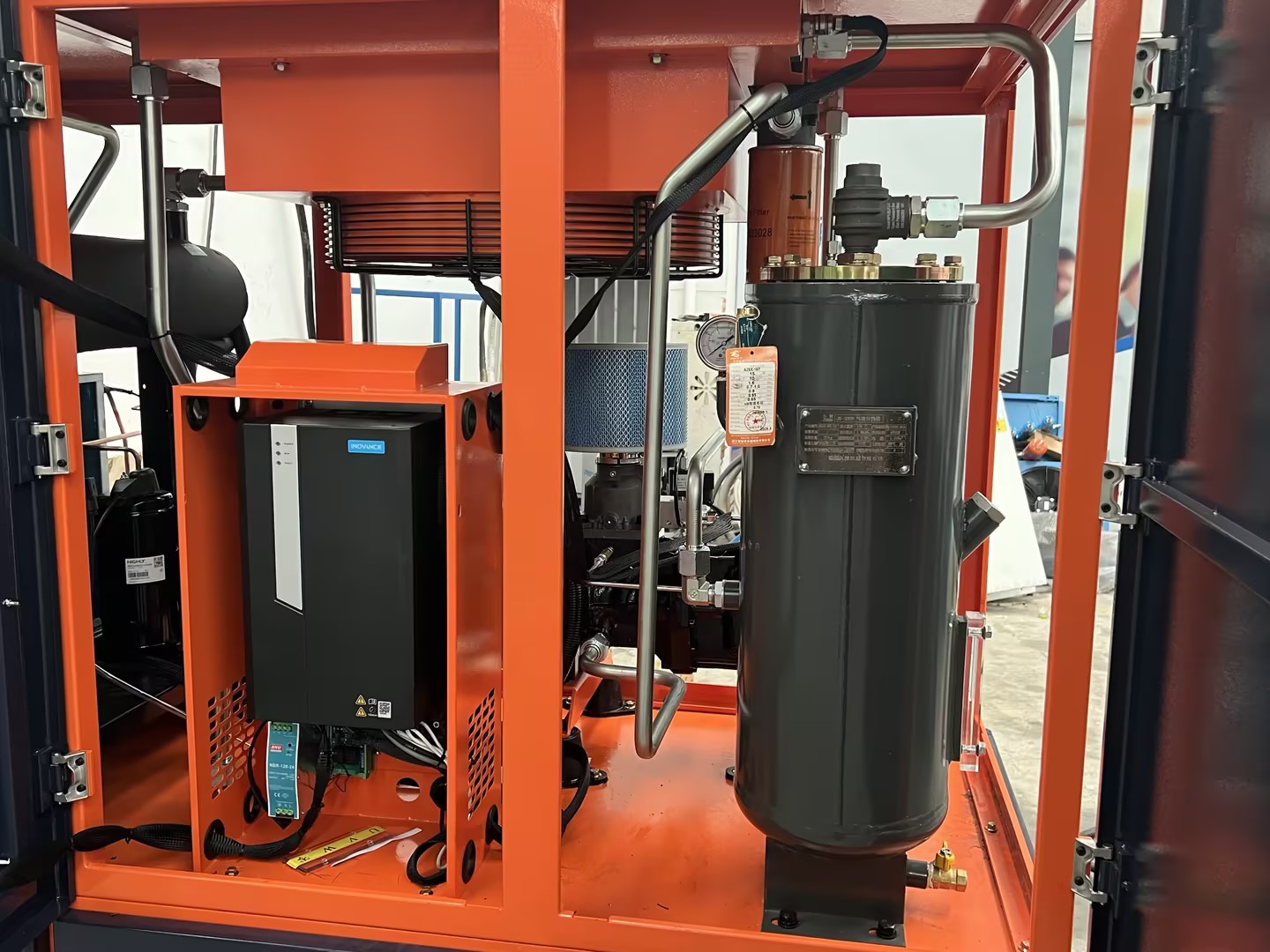
Continuous duty shifts the engineering problem from peak output to heat, wear and uptime management. Image: UMW Air.
Why the Screw-versus-Piston Decision Has Become a Procurement Issue
Third-party market research places the global rotary screw compressor market at an estimated USD 12.5 billion in 2024, with an expected value of USD 13.3 billion in 2025. Within that market, the stationary rotary screw air compressor segment accounted for approximately 67.6% of technology share in 2025, and Asia Pacific held the largest regional share at 43.7%, with China as the leading country in the region. These figures describe a category that has already become the default industrial architecture rather than an emerging alternative.
Buyers should read such estimates carefully. Published values for the same market vary by scope: some reports count only screw-type machines, others count all industrial rotary types. A USD 12.5 billion figure and a screw-only figure are not directly comparable, so the number is best used to understand direction and scale rather than to justify a specific capital decision.
The practical trigger for this comparison is rarely market growth. It is usually an operational symptom: a piston unit that cannot sustain a third shift, air pressure that sags during peak demand, vibration transmitted into sensitive equipment, or maintenance costs that recur faster than the maintenance budget expects. Once a plant runs more than one shift on a stable load, the question shifts from "what does the compressor cost" to "what does uninterrupted air cost us".
How Rotary Screw and Piston Compressors Differ in Operation
The mechanical difference is straightforward. A rotary screw compressor compresses air between two meshing helical rotors, so the compression action is rotational and continuous. A piston compressor compresses air with reciprocating pistons and valves, so the compression action is cyclic and produces a pulsed output. That single design difference drives most of the commercial differences that follow.
In manufacturer comparison data, the screw architecture is characterised by continuous operation capability, lower vibration, more stable air output and integrated automation control. The piston architecture is characterised by intermittent operation, higher vibration and a higher-wear maintenance profile. The same comparison data cites energy efficiency of up to 95% for the screw design against approximately 65–70% for piston compressors, with the screw unit described as less suitable for continuous high-load duty in the piston case.
| Comparison dimension | Rotary screw air compressor | Piston (reciprocating) compressor |
|---|---|---|
| Duty profile | Continuous / 24-7 capable | Intermittent duty |
| Moving parts | Fewer moving parts in the compression element | Reciprocating pistons and valves; more wear surfaces |
| Vibration and air stability | Lower vibration, more stable air output | Higher vibration, pulsed output |
| Control | Integrated automation control available | Typically simpler control arrangement |
| Energy efficiency (comparison data) | Up to 95% | Approximately 65–70% |
| Maintenance | Low maintenance, fewer moving parts, longer service interval | Frequent maintenance, higher wear and tear |
| First cost | Slightly higher initial investment | Lower initial investment |
| Long-run cost | Higher long-term ROI through lower downtime and maintenance cost | Higher cumulative maintenance and downtime exposure |
| Typical best fit | Industrial production lines, CNC machining, plastic processing, automotive parts manufacturing, high-demand continuous air supply | Intermittent demand, low-utilisation duty, capital-constrained applications |
Continuous Duty: What 24-7 Operation Demands From a Compressor
When a compressor moves from eight hours a day to three shifts, the engineering priorities change. Peak capacity stops being the main constraint and thermal management becomes the limiting factor. Heat that dissipates between shifts accumulates during continuous running, and that accumulation is what shortens component life.
In manufacturer risk documentation, overheating is identified as the primary operational risk for continuous screw compressor operation, controlled through a high-efficiency radiator and cooling fans. The stated enterprise control method is to perform thermal tests on every unit before shipment and to confirm that radiators and fans are functioning correctly before dispatch. This is a useful signal for buyers during supplier evaluation: a compressor intended for continuous duty should be selected not only on its nameplate output but on how the supplier manages heat at the unit level and how that management is verified before delivery.
Maintenance follows the same logic. Screw compressors are described as low-maintenance with fewer moving parts and long service intervals, while piston compressors require frequent maintenance and carry higher wear and tear. Over a multi-shift year, that difference compounds: fewer wear parts means fewer unplanned stops, and a longer service interval means fewer planned production interruptions. For a plant where a one-hour air outage halts a whole line, the maintenance profile often outweighs the purchase price difference.
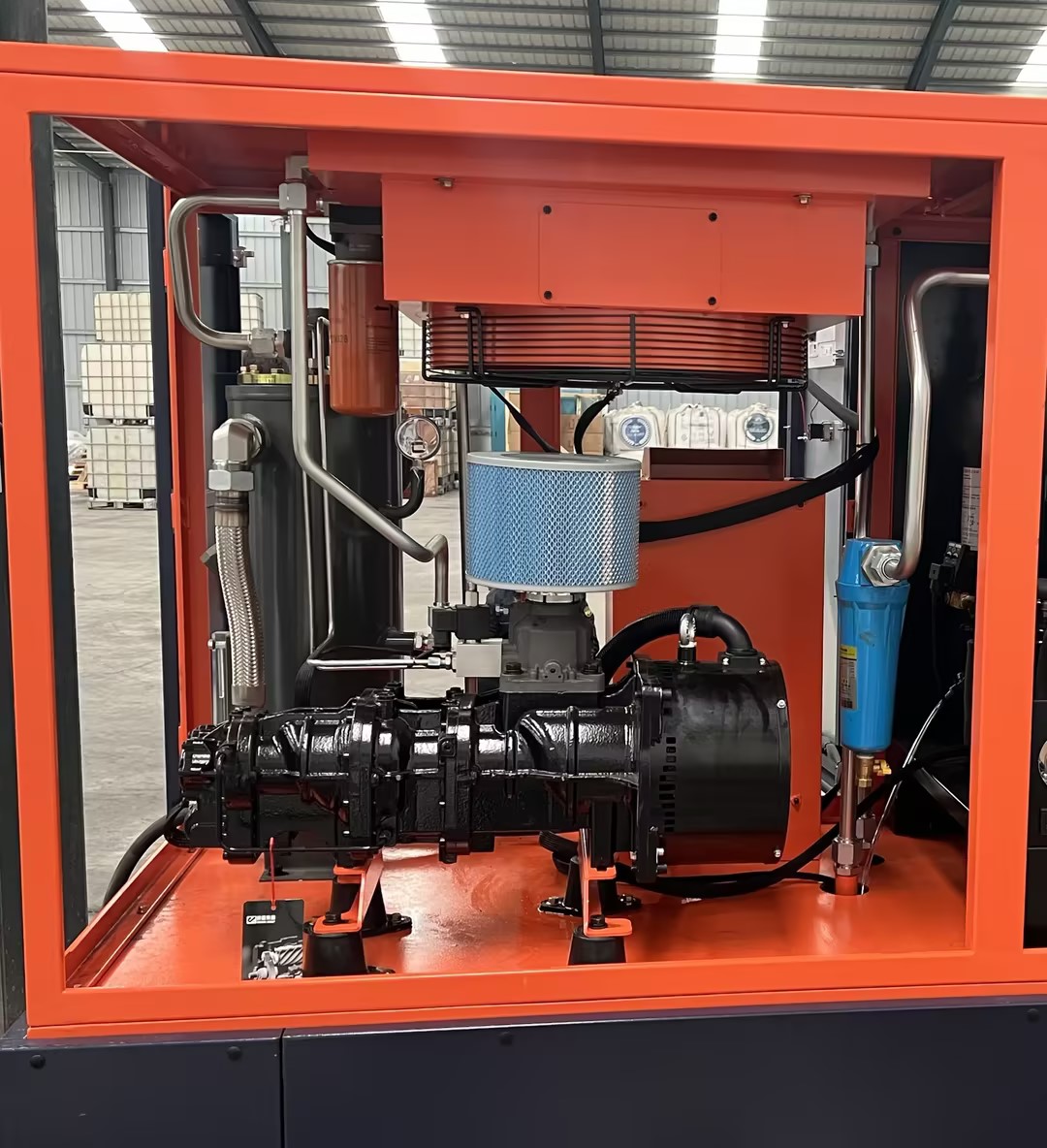
Pre-shipment inspection of the cooling assembly is a practical control point for continuous-duty reliability.
Application Fit: CNC, Laser Cutting, Automotive and Food Packaging
Application requirements decide the technology far more reliably than general preference. Published sizing guidance indicates that CNC machine compressed air requirements typically fall between 90–120 PSI (6–8 bar) working pressure, with flow rates of 5–30 CFM depending on machine size. That pressure band sits comfortably within the range served by a stationary screw compressor, and the deciding factor is usually stability of flow across a shift rather than headline pressure capability.
Fibre laser cutting is a different profile. Using compressed air as an assist gas typically requires pressures up to 1.6 MPa (approximately 232 PSI) together with integrated filtration to prevent lens contamination. Here, air quality and pressure hold equal weight: contamination at the lens is a consumable and quality problem, not just a maintenance problem.
Automotive parts manufacturing and plastic processing appear in manufacturer comparison data as continuous air supply applications, which matches the duty characteristic of those environments. Food processing adds a purity dimension: ISO 8573-1:2010 is the primary international standard defining compressed air purity classes for particles, water and oil, and it is the reference buyers should cite when specifying air quality rather than relying on general descriptions such as "clean air".
| Application | Published requirement | What it means for the technology choice |
|---|---|---|
| CNC machining | Typically 90–120 PSI (6–8 bar), 5–30 CFM depending on machine size | Pressure sits within a standard industrial band; stable, continuous flow matters more than peak output |
| Fibre laser cutting | Up to 1.6 MPa (approx. 232 PSI) as assist gas, with integrated filtration against lens contamination | High pressure combined with air treatment; filtration is part of the compressed air system, not an accessory |
| Automotive parts manufacturing | Continuous air supply to production lines | Duty profile favours a machine designed for continuous operation |
| Plastic processing | Continuous air supply | Same continuous-duty logic; vibration and output stability influence product consistency |
| Food processing and packaging | Purity defined by ISO 8573-1:2010 classes for particles, water and oil | Air quality class must be specified explicitly; configuration follows from that class |
Cost, Efficiency and Lifecycle: What the Numbers Actually Say
The first-cost position is clear from the comparison data: a screw air compressor carries a slightly higher initial investment than a piston alternative. The counter-argument is equally explicit: the cost advantage of the screw design appears in higher long-term ROI through lower downtime and maintenance costs.
Whether that trade-off favours the buyer depends on how the compressor is used. A plant running the unit for long, predictable shifts recovers the price difference through energy and uptime. A workshop using compressed air for occasional tasks with long idle periods does not generate the running hours that justify the same investment, and a well-maintained piston unit may remain the proportionate choice.
| Lifecycle cost driver | Why it matters | Evidence basis |
|---|---|---|
| Initial investment | Screw units cost slightly more at the point of purchase | Manufacturer comparison data |
| Energy consumption | Comparison data cites up to 95% efficiency for screw and roughly 65–70% for piston | Manufacturer comparison data |
| Maintenance frequency | Fewer moving parts and longer service intervals versus higher wear and frequent maintenance | Manufacturer comparison data |
| Downtime exposure | Continuous lines lose output immediately when air stops | Application duty profile |
| Air treatment | Filtration and air quality class requirements add system cost | ISO 8573-1:2010 purity classes |
| Sizing accuracy | Capacity matched to measured demand determines whether efficiency gains materialise | Engineering practice |
Where a Piston Compressor Still Makes Sense — and Where Screw Has Boundaries
A fair comparison has to state the boundaries on both sides.
Piston compressors remain a rational choice where demand is genuinely intermittent, where utilisation is low, where the capital budget is constrained, or where the compressed air requirement is small and infrequent enough that wear accumulation is not a practical problem. In these conditions the efficiency gap and the higher maintenance frequency are less disruptive because the machine is not running long enough for them to dominate the cost picture.
Screw compressors have boundaries of their own. Three matter in procurement:
- Higher entry cost. The slightly higher initial investment is real, and it is only recovered through running hours. Under-utilised installations rarely realise the long-term ROI argument.
- Air treatment dependency. Where oil carryover is unacceptable — for example in food or pharmaceutical contexts governed by ISO 8573-1:2010 purity classes — the buyer must either specify an oil-free configuration or size filtration to meet the required class. That specification work is part of the project scope, not an afterthought.
- Thermal and sizing discipline. Continuous operation concentrates the risk in cooling and in correct capacity matching. Manufacturer documentation treats overheating as the primary risk and controls it through cooling design and pre-shipment thermal testing. A unit that is oversized relative to actual demand can also erode much of the efficiency advantage it is purchased for, which is why measured flow data should precede the technology decision.
In short: the screw design wins where duty is continuous and load is substantial. The piston design remains defensible where duty is genuinely intermittent. Neither statement is universally true, and neither should be applied without the site's own load profile.
A Duty-Profile Checklist for Buyers
The following sequence reflects how the screw-versus-piston decision is normally resolved in practice, and it works without any brand input:
- Measure the duty cycle first. Establish running hours per day, days per week, and whether the load is steady or highly variable. This single input determines whether continuous-operation design is worth paying for.
- Quantify flow and pressure at the point of use. CNC work may sit at 90–120 PSI (6–8 bar) with 5–30 CFM per machine depending on size; laser cutting may require up to 1.6 MPa. Sum the simultaneous demand rather than the installed demand.
- Define the air quality class. Cite ISO 8573-1:2010 classes for particles, water and oil instead of general descriptions, and confirm whether an oil-free configuration is required.
- Assess ambient and site conditions. Dust, ambient temperature and ventilation determine how much cooling margin the installation needs for continuous running.
- Evaluate maintenance access, not only maintenance cost. Check service intervals, spare availability and whether the local service network can reach the site within the plant's tolerance for air outage.
- Compare total cost over the intended service life. Include energy, maintenance, downtime exposure and air treatment — not only the purchase price.
- Verify delivery-condition controls with the supplier. Ask how thermal performance is tested before shipment and what documentation accompanies the unit.
Market Trends Behind the Comparison
Two structural trends are visible in third-party data. First, lubrication choice is shifting: oil-filled rotary screw compressors accounted for 61.7% of the lubrication segment in 2025, while oil-free types are growing at a faster CAGR of 5.4%. That direction is consistent with tightening air purity expectations in food, beverage, pharmaceutical and electronics supply chains, where ISO 8573-1:2010 purity classes are the common language.
Second, the stationary configuration continues to dominate, at approximately 67.6% of technology share in 2025, while Asia Pacific holds the largest regional share at 43.7% with China as the leading country. That concentration matters for buyers because it shapes where manufacturing capacity, component supply and service networks sit.
The competitive field remains concentrated around established global suppliers. Third-party market reporting identifies Atlas Copco AB, Ingersoll Rand Inc., Kaeser Compressors and Sullair LLC among the top competitors in the global rotary screw market. Alongside them, a large tier of regional manufacturers competes on configuration, energy strategy and delivery responsiveness rather than on global scale.
How UMW Air Fits into This Comparison
Shandong UMW Air Tech Co., Ltd — trading as UMW Air — is a compressed air equipment manufacturer based at 68 Gongye South Road, Jinan, Shandong, China. The company was founded in 2019, operates a 2,000 m² facility with approximately 200 employees and a 40-person R&D team, and reports an annual output of 12,000 units, with 100% of output exported to markets including the EU, USA, Southeast Asia, the Middle East, South America and Africa.
Its product lines map directly onto the duty profiles discussed above: air-cooled screw air compressors, direct-driven screw air compressors, stationary screw air compressors, diesel mobile screw air compressors and heavy-duty screw air compressors. In its own positioning statement, the company states that it standardises permanent-magnet variable-speed drive (PM VSD) technology and low-resistance system design to convert each kWh into usable compressed air output.
The manufacturer's product documentation places these units in industrial production lines, CNC machining and other high-demand continuous air supply scenarios, where integrated automation control and stable output are presented as the operational benefits. Read against this comparison, that positioning describes a supplier addressing the continuous-duty side of the screw-versus-piston decision rather than the intermittent-duty side. Buyers should still validate model-specific pressure, flow, air quality class and thermal performance against their own load data before committing to a configuration.
Future Outlook
The direction of travel is toward compressors that are specified by delivered air quality and energy per unit of output, rather than by nameplate size. Oil-free growth at a faster CAGR than oil-filled units, the persistence of the stationary configuration as the dominant technology share, and the central role of ISO 8573-1:2010 purity classes all point the same way.
For buyers, this changes the sequence rather than the fundamentals. The screw-versus-piston question will increasingly be answered by measured duty cycle, defined air quality class and verified thermal management — and less by default habit or by the assumption that a larger machine is always the safer specification. Plants that document their air demand before selecting technology will be better positioned than those that select technology first and adjust expectations afterwards.
Frequently Asked Questions
Can a rotary screw air compressor run continuously, and how does that differ from a piston unit?
Rotary screw compressors are designed for continuous operation, and manufacturer comparison data lists continuous operation capability, lower vibration, more stable air output and integrated automation control as characteristics of the design. Piston compressors are described as suited to intermittent operation and less suitable for continuous high-load duty. The decision should follow the site's actual running hours rather than a general preference for either type.
What is the maintenance difference between screw and piston compressors?
Screw compressors are characterised by fewer moving parts, lower maintenance requirements and longer service intervals. Piston compressors are characterised by frequent maintenance and higher wear and tear. Over a multi-shift year, the practical consequence is a difference in the number of planned service stops and the exposure to unplanned air outages.
What pressure and flow does a CNC machine typically need?
Published sizing guidance indicates that CNC machine compressed air requirements typically range from 90–120 PSI (6–8 bar) working pressure, with flow rates of 5–30 CFM depending on machine size. Because the range varies by machine, the correct approach is to total the simultaneous demand of all CNC units on the circuit and confirm the figure against the machine documentation.
What should buyers know about compressed air for fibre laser cutting?
Fibre laser cutting that uses compressed air as an assist gas typically requires pressures up to 1.6 MPa (approximately 232 PSI) and integrated filtration to prevent lens contamination. Both conditions matter: insufficient pressure affects cut quality, and inadequate filtration transfers cost to optics consumables.
Does food processing require oil-free compressed air?
ISO 8573-1:2010 is the primary international standard defining compressed air purity classes for particles, water and oil, and it is the reference used for food and pharmaceutical applications. The required class depends on how close the air comes to the product. Market data shows oil-free compressors growing at a faster CAGR of 5.4%, while oil-filled types held 61.7% of the lubrication segment in 2025 — meaning both configurations remain in active use and the purity class should drive the specification.
Is a piston compressor ever the better choice?
Yes, where demand is genuinely intermittent, utilisation is low, or the compressed air requirement is small and infrequent. In those conditions the lower initial investment is not offset by continuous running hours, and the higher maintenance frequency of piston designs is less disruptive. The limitation to note is that the piston option becomes harder to justify as running hours increase, because efficiency of approximately 65–70% and more frequent maintenance accumulate against it.
How should initial cost be weighed against lifetime cost?
Comparison data states that the screw compressor carries a slightly higher initial investment but offers a higher long-term ROI through lower downtime and maintenance costs. The weighing therefore depends on expected running hours: continuous, multi-shift operation supports the lifetime-cost argument, while low-utilisation duty generally does not.
Sources
Market size and segment data: Custom Market Insights (rotary screw compressor market, 2024–2025); MarketsandMarkets (stationary rotary screw technology share, 2025); Grand View Research (regional share and lubrication segment, 2025). Standards: ISO 8573-1:2010 (compressed air purity classes). Application requirements: published CNC sizing guidance and laser cutting compressed air guidance. Product and comparison data: Shandong UMW Air Tech Co., Ltd (UMW Air) product documentation and manufacturer comparison data.
¿Tiene preguntas o necesita más detalles?
Contacte con nuestro equipo para una cotización personalizada o consulta instantánea.
Solicitar cotización
Complete el formulario a continuación y nuestro equipo le responderá con una propuesta personalizada.
Chat directo de WhatsApp
¿Prefiere chatear en tiempo real? Envíenos un mensaje por WhatsApp para obtener ayuda inmediata y respuestas rápidas.
- Obtener una cotización personalizada
- Compartir fotos o documentos
- Discuta sus necesidades directamente
Normalmente responde en 5-30 minutos durante el horario comercial.