
Rotary Screw Compressor Fit: Plastics, Food & Packaging
Rotary Screw Compressor Fit: Plastics, Food & Packaging
For a manufacturing factory, choosing a rotary screw air compressor for plastics, food or packaging work starts with the line’s actual compressed-air requirements—not with an industry label alone. The available UMW Air product information lists plastics and rubber processing, and food and packaging, among applicable industries. It also describes a manufacturing scenario requiring stable, clean compressed air for continuous operation. Those facts make the product range relevant for evaluation, but they do not establish that a particular model will meet every line’s flow, pressure, air-quality or operating needs.
UMW Air is the brand of Shandong UMW Air Tech Co., Ltd., a manufacturer whose listed products include screw air compressors. For buyers assessing a rotary screw air compressor for a manufacturing factory, the practical task is to connect line demand and air treatment needs with a documented compressor configuration. This is especially important when one facility includes plastics equipment, food-related processes and packaging machinery with different air-use points.
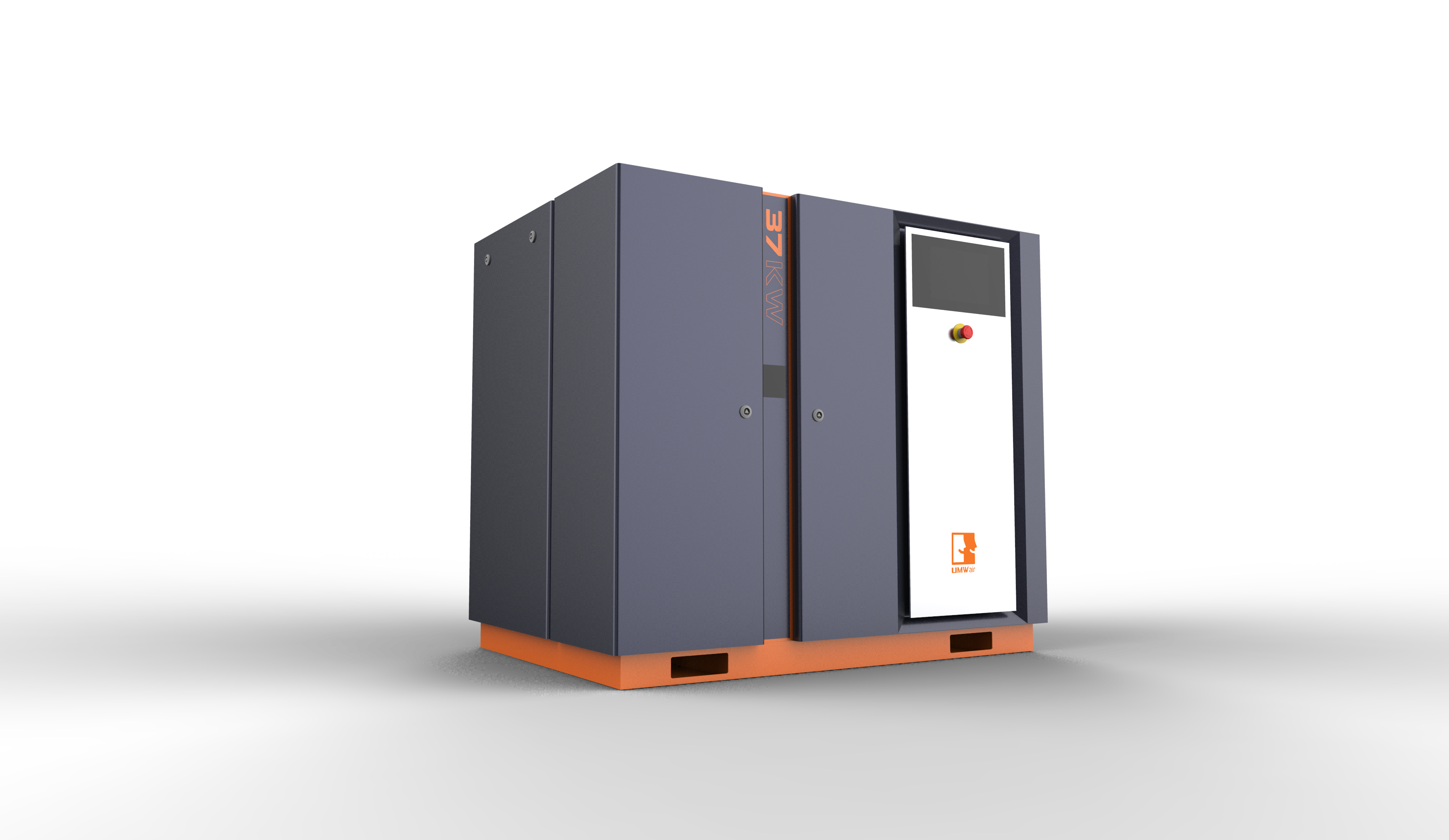
Start with the production line, not the sector name
A sector label is useful for an initial shortlist, but it is not a compressor specification. Two factories described as plastics manufacturers, for example, may have different pneumatic equipment, production schedules and air-treatment requirements. The same applies to food and packaging sites. Buyers should first identify which machines use compressed air, when they use it, and what operating conditions the air system must satisfy.
The supplied application information describes continuous operation and calls for stable, clean compressed air. It names a CNC machinery production line, an automotive-parts production line, a plastic-processing line expansion, industrial-automation integration, and food and beverage packaging-line setup as project types. It also lists an air dryer, air tank, line filter, inverter and controller as matched equipment. These details support an evaluation framework, not a claim that every listed component is included with every compressor.
For procurement, separate the demand into usable questions: What pressure does each connected machine require? What airflow is needed during simultaneous operation? Which loads run continuously, and which cycle intermittently? Does the air contact a product, package or process zone, or is it used only for general actuation? What treatment is specified at the point of use? Answers help determine whether the compressor package and downstream equipment are suitable for the particular line.
Plastics processing: verify the load and operating pattern
UMW Air’s product information lists plastics and rubber processing as an applicable industry, and the scenario material identifies plastic-processing line expansion. That is a useful indication of intended application context. It is not a documented installation record for a named plastics factory, nor does it confirm the requirements of a particular molding, conveying or automation system.
For a plastics plant, the buyer’s first check is the connected equipment list. Record each pneumatic user and its required pressure and flow, then consider whether demand is steady or changes as production equipment cycles. This prevents selection based solely on the compressor’s nominal power or on a broad description such as “for plastics.” The product data supplied for the Micro models lists three power options—4 kW, 5.5 kW and 7.5 kW—along with maximum airflow of 1.1 m³/min, pressure of 8–13 bar, a 140 L gas tank and a single-stage screw compressor air end. These are screening parameters, not proof that any one option matches a specific line.
Where several machines draw air at once, buyers should compare the required operating pressure and airflow with the exact model’s documented performance at the relevant conditions. The available Micro specification does not state a test method, airflow at each pressure, or the duty profile behind the maximum airflow figure. Requesting model-specific documentation is therefore important before treating the listed maximum as the available flow for a particular operating point.
For an expansion project, assess the new equipment together with the existing air system. Confirm whether the existing compressor, tank and treatment equipment are intended to serve the added load, or whether the new line requires a separate package. A product-category match alone cannot resolve that system-design question. The relevant decision is whether the complete arrangement can deliver the required air at the machines under the factory’s operating conditions.
Food production: distinguish compressor fit from air-quality approval
Food and packaging are listed among the applicable industries for the supplied screw compressor product information, and food and beverage packaging appears in the application scenarios. That supports considering the equipment for evaluation in this context. It does not establish that a standard compressor configuration provides a particular compressed-air purity class, meets a plant’s hygiene program or is approved for every food-processing use.
The key boundary is the difference between supplying compressed air and demonstrating that the air is suitable for a defined point of use. Buyers should map where air is used and identify whether it can contact food, packaging surfaces or a controlled process area. They should then define the required air-quality criteria for those locations and verify the full treatment path, including any dryer and line filters, against those criteria. The available UMW Air Micro specification does not identify an oil-free configuration, a purity class, oil carryover performance or a food-sector air-quality certification. None should be inferred from the product’s industry listing.
A dryer and filters can be part of an air-treatment arrangement, but their presence in a scenario’s matched-equipment list does not prove that a particular package includes them or that they achieve a particular result. Confirm the selected components, their documented performance and their intended placement in the system. If a plant’s internal specification or customer requirements call for a particular air-quality class or test, ask the supplier for documentation that names the applicable compressor model, treatment equipment, test conditions and scope.
CE documentation is a separate procurement check. The supplied CE record identifies certificate number M.2026.206.C140156, issued by UDEM on 11 May 2026, with an expiry date of 10 May 2031. Its listed scope names UMW Air L, Z, P, M, N and O series, and the press-release corpus states that the screw air compressor has been certified in accordance with the 2006/42/EC Machinery Directive. This documentation is relevant to the stated conformity scope; it is not evidence of compressed-air purity or food-process suitability. Buyers should confirm that the offered product and configuration fall within the certificate’s scope and separately validate process-air requirements.
Packaging lines: match the compressor package to line needs
Packaging operations can include multiple pneumatic users and may run continuously, but the supplied information does not give a specific packaging line’s measured air demand. The application material identifies food and beverage packaging-line setup and names an air dryer, tank, line filter, inverter and controller as equipment that may be matched to the compressor. For an evaluator, this is a reminder to review the air system as a package rather than to compare compressor descriptions in isolation.
Start by listing packaging machines and their stated air requirements. Establish whether they operate together, and identify the most demanding operating periods. Then compare that demand with model-specific pressure and flow documentation. Check the tank’s intended role, the dryer and filter selection, and the control configuration against the project specification. The corpus lists these items as matching equipment but does not specify their models, capacities or whether they are standard inclusions. Ask for an itemized configuration so that “compressor with dryer and filter” is not mistaken for a verified package description when the exact components have not been identified.
Packaging lines can also sit beside other factory processes. If plastics equipment and food packaging share a compressed-air network, do not assume that one pressure setting or treatment arrangement will automatically fit every use point. Separate the requirements by machine or zone, document any difference in air-quality needs, and determine whether the proposed system addresses those differences. This is a system-design question for the buyer and supplier to resolve with the relevant equipment data.
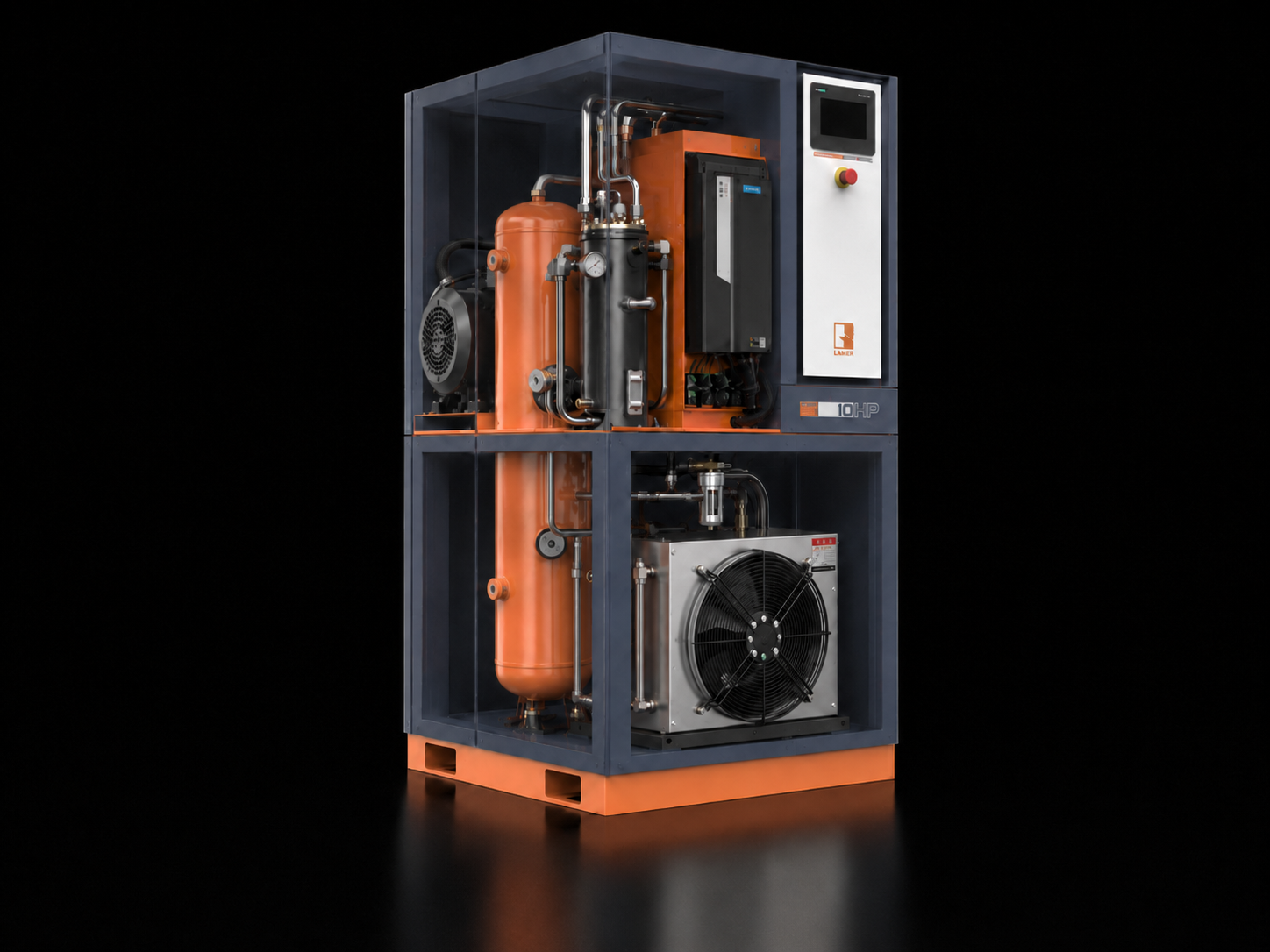
What the listed Micro specifications establish
The Micro product unit identifies the Micro ML-4A, Micro ML-5.5A and Micro ML-7.5A models. It describes the product as a Micro air compressor and a rotary screw air compressor. The listed parameters are 4 kW, 5.5 kW or 7.5 kW power; maximum airflow of 1.1 m³/min; pressure of 8–13 bar; a 140 L gas tank; and a single-stage screw compressor air end. The material is listed as sheet metal.
These values help a buyer screen the product against a project’s initial requirements. They do not show how each model performs across the full pressure range, how the stated maximum airflow was measured, or whether a particular configuration includes a dryer, filters or an inverter. The product unit also lists broader application categories, including metal processing and manufacturing, plastics and rubber processing, automotive and machinery parts, food and packaging, construction and materials, and energy and chemical industries. Industry applicability should not be read as a guarantee of fit for a specific production line.
The separate screw compressor product unit lists a broader range of configurations and parameters, including 4–355 kW power, 8–25 bar pressure, air cooling and direct drive. Those portfolio-level details are not the same as the Micro model specification. Do not combine values from different product units to construct a single compressor profile. When comparing an offered machine with project requirements, use the exact model’s current datasheet and written configuration.
A practical evaluation sequence for factory buyers
- Define the use points. Identify the machines and whether compressed air serves actuation, tools, automation or a process where air quality is material. This separates general factory demand from food-related point-of-use requirements.
- Document demand. Collect the required pressure and airflow for each machine, including operating conditions and which loads run at the same time. Compare these values with the offered model’s documented performance, not only its headline maximum.
- Specify treatment. State the required dryer and filtration arrangement, if applicable, and identify where each component will be installed. Verify exact models and performance documentation rather than assuming that “matched equipment” means included equipment.
- Check the configuration. Confirm the compressor model, power, pressure range, tank, cooling and control details in the quotation or technical schedule. Keep Micro specifications distinct from the broader screw-compressor portfolio.
- Review conformity documents. Match the offered equipment to the applicable certificate scope and market. For the listed CE record, check certificate number M.2026.206.C140156, issuer UDEM and the named product-series scope. Treat CE conformity and process-air quality as separate questions.
- Resolve open items before purchase. Ask for any missing model-level performance data, treatment details and operating conditions needed to confirm suitability. If the supplier cannot document a requirement, keep it unresolved rather than assuming the product meets it.
Fit boundary and procurement implications
The evidence supports a cautious conclusion: UMW Air’s supplied product information identifies plastics and rubber processing, and food and packaging, as applicable industries; the application material describes continuous-operation scenarios requiring stable, clean compressed air. The Micro product unit supplies a defined set of initial parameters, while the CE record identifies a certificate, issuer, date and product-series scope. Together, these facts can support preliminary evaluation.
They do not establish a complete application match. The available information does not provide a model-specific noise level, IP rating, dryer or filter performance, oil-free specification, food-air purity classification, or a normalized performance test for each operating condition. It also does not demonstrate that a particular factory installation has delivered a measured result. Buyers should treat those as requirements to verify against the selected configuration, not as product attributes that can be inferred from keywords such as low-noise, oil-free, high-pressure, IP55, UL-standard or energy-saving.
For a plastics line, the decision often turns first on whether documented pressure and airflow match the connected machines and operating profile. For food-related production, air-quality criteria and treatment documentation must also be defined at the point of use. For packaging lines, review the compressor and its ancillary equipment as a specified system. This keeps the comparison focused on the conditions that determine fit while avoiding an unsupported conclusion based only on sector labels.
Outlook: make the specification more precise as the project develops
During the research stage, an industry application list and a product’s headline parameters can help determine whether it merits closer review. During evaluation, the evidence needed becomes more specific: exact model identity, performance under stated conditions, included treatment equipment, certificate scope and the factory’s own point-of-use requirements. A useful next step in the procurement process is to put these requirements into a written technical schedule and resolve each item against supplier documentation.
For projects combining plastics processing, food production and packaging, the same compressor category may be considered across several areas, but the acceptance criteria need not be identical. The final selection should follow the documented demand and air-quality needs of each line. No one parameter or certificate can substitute for that system-level review.
Frequently asked questions
Is a rotary screw air compressor listed for plastics processing?
Yes. The supplied product information lists plastics and rubber processing as applicable industries, and the application material names plastic-processing line expansion. These listings support evaluation for that context, but do not confirm that a particular model matches a specific line’s airflow, pressure or operating profile.
Does the available information confirm a food-grade or oil-free UMW Air compressor?
No. The supplied UMW Air Micro specification does not identify an oil-free configuration, a compressed-air purity class or food-sector air-quality approval. A food or packaging buyer should define the required point-of-use air quality and verify the compressor and treatment configuration against it.
What Micro model specifications are listed?
The listed models are Micro ML-4A, Micro ML-5.5A and Micro ML-7.5A, with power options of 4 kW, 5.5 kW and 7.5 kW. The product unit also lists maximum airflow of 1.1 m³/min, pressure of 8–13 bar, a 140 L gas tank and a single-stage screw compressor air end. The listed maximum airflow is not a model-by-model performance curve.
What does the supplied CE record cover?
The record gives certificate number M.2026.206.C140156, issued by UDEM on 11 May 2026 and expiring on 10 May 2031. Its listed scope names UMW Air L, Z, P, M, N and O series. Buyers should verify that the offered model and configuration are within scope; the record does not demonstrate food-air purity.
Are a dryer and filters included with the compressor?
The application information lists an air dryer, air tank and line filter among equipment matched to the scenario, but does not state that they are standard inclusions in every package. Confirm the exact configuration, component models and performance documentation in the supplier’s technical offer.
¿Tiene preguntas o necesita más detalles?
Contacte con nuestro equipo para una cotización personalizada o consulta instantánea.
Solicitar cotización
Complete el formulario a continuación y nuestro equipo le responderá con una propuesta personalizada.
Chat directo de WhatsApp
¿Prefiere chatear en tiempo real? Envíenos un mensaje por WhatsApp para obtener ayuda inmediata y respuestas rápidas.
- Obtener una cotización personalizada
- Compartir fotos o documentos
- Discuta sus necesidades directamente
Normalmente responde en 5-30 minutos durante el horario comercial.