
Rotary Screw Air Compressor Compliance: A Buyer's Checklist

Rotary screw air compressor configuration: pressure range, receiver volume and construction are the first three items a buyer can cross-check against local requirements.
Importing a rotary screw air compressor is a documentation exercise as much as a hardware purchase. The global rotary screw compressor market was estimated at USD 12.5 billion in 2024 and is expected to reach USD 13.3 billion in 2025, according to Custom Market Insights, and as shipped volumes rise, the paperwork that travels with each unit attracts more attention from customs teams, plant engineers and quality managers than it did a decade ago.
This reference is written for importers, procurement managers and plant engineers at the research stage of a purchase. It does not present any single certificate as a universal answer. Instead it sets out the questions worth asking before an order is confirmed, using one published product family, the UMW Air Micro series, to show how three specification items found on almost every datasheet, working pressure, receiver tank volume and material construction, connect to the rules that apply where a compressor actually runs.
Published market figures vary by report scope, and so do compliance requirements: both depend on how a category, a market and an installation are defined. Shandong UMW Air Tech Co., Ltd., which operates under the brand UMW Air, is an air compressor manufacturer established in 2019 whose sales are 100% export-oriented, with major markets covering the EU, USA, Southeast Asia, Middle East, South America and Africa. That export profile makes the company a useful worked example of the questions an international buyer should raise.
Why Compliance Questions Arrive Earlier Than They Used To
A decade ago, an importer typically compared compressors on price, lead time and airflow, and handled conformity questions after the equipment landed. That sequence has largely reversed. Energy-efficiency expectations, compressed-air purity requirements on food and packaging lines, and electrical and enclosure requirements in different regions now determine whether a machine can be commissioned at all, not simply whether it performs well.
For a buyer at the research stage, the practical consequence is that compliance behaves as a filtering step rather than a final formality. Three questions are worth settling before suppliers are shortlisted: which requirements apply at the installation site; which of those requirements depend on the machine and which on the surrounding system; and which documents a supplier can actually produce for the configuration being quoted.
None of that requires the buyer to become a certification specialist. It requires a clear map of what is being verified, and that map differs by application. A packaging line, an energy and chemical plant and a CNC workshop rarely face the same set of checks, even when they buy compressors in the same power band.
Five Layers of Verification Behind a Compressor Order
Compliance for an imported rotary screw compressor is rarely a single document. In practice it separates into five layers, each with its own evidence trail.
| Verification layer | Question the buyer should ask | Evidence typically requested |
|---|---|---|
| Pressure and duty point | What working pressure does the process need, and at what duty cycle? | Published pressure range, duty description, system schematic |
| Compressed-air purity | What purity class does the end product require? | Dryer and filtration configuration, purity class statement |
| Electrical and enclosure | Which voltage, frequency and environmental protection apply on site? | Motor data, enclosure rating, control panel documentation |
| Construction and materials | How is the unit built, and does construction affect service life or inspection? | Material list, receiver data, general arrangement drawing |
| Documentation and traceability | What paperwork accompanies the unit, and can it be traced to the delivered configuration? | Technical file, nameplate data, inspection records |
The layers are interdependent. A purity class is a property of the whole compressed-air system, compressor, dryer, filter, receiver and piping together, so it cannot be confirmed from a compressor datasheet alone. An enclosure rating has little meaning without the ambient conditions of the room where the unit will be installed. Pressure and duty point, meanwhile, are the first intersection of the machine with the process, and they are usually the fastest way to remove unsuitable options from a shortlist.
Reading a Specification Against Local Rules: Pressure, Tank Volume and Construction
The UMW Air Micro series illustrates how a small number of published values drives most of the early verification work. The series covers models Micro ML-4A, Micro ML-5.5A and Micro ML-7.5A, with power options of 4 kW, 5.5 kW and 7.5 kW, a maximum airflow of 1.1 m³/min, a pressure range of 8–13 bar, a 140 L gas tank and a single-stage screw compressor air end. The unit is constructed from sheet metal.
| Parameter | Published value | What it means at the verification stage |
|---|---|---|
| Power | 4 kW / 5.5 kW / 7.5 kW | Defines the electrical supply and protection the site must provide |
| Maximum airflow | 1.1 m³/min | Sets whether the unit can carry a point-of-use demand alone or needs additional storage |
| Pressure range | 8–13 bar | Must be compared with actual process pressure, not with a nominal catalogue figure |
| Gas tank | 140 L | Integrated receiver volume affects buffering and cycling behaviour |
| Air end | Single-stage screw compressor air end | The core technology that conformity documentation describes |
| Material | Sheet metal | Appears in drawings, inspection records and corrosion considerations |
Pressure is the first place where a datasheet and a site requirement can diverge. CNC machinery typically operates on compressed air at roughly 90–120 PSI, about 6–8 bar, with flow rates between 5 and 30 CFM depending on machine size. A compressor rated 8–13 bar spans and exceeds that band, so the machine is capable, but the pressure setting, storage and regulation still have to be matched to the process. Fiber laser cutting is a different case: where compressed air is used as an assist gas, pressures can reach 1.6 MPa, approximately 232 PSI, and integrated filtration becomes necessary to protect the lens. That duty sits well above the Micro series published range, and buyers with that requirement should be evaluating a different pressure class rather than stretching a lower one.
A 140 L receiver integrated into the unit is a packaging decision with compliance consequences. Receiver volume affects how often the compressor cycles, how stable the supply remains under intermittent demand and whether additional storage is needed downstream. Buyers should confirm how the local inspection regime treats an integrated receiver compared with a separate pressure vessel, because that distinction determines both the documentation set and the installation layout.
Sheet metal construction is sometimes dismissed as a commercial detail. In practice it appears in the technical file, in the general arrangement drawing and in the corrosion and cleaning considerations of humid or high-temperature environments. UMW Air lists high-temperature or humid environments among the conditions its screw air compressors are designed for, which makes construction and surface treatment part of the buyer's checklist rather than an afterthought.
What an Export-Oriented Manufacturer's Profile Can and Cannot Tell You
A supplier's operating profile is useful context, provided it is read as context rather than as evidence of conformity. UMW Air, established in 2019, employs approximately 200 staff, including a research and development team of 40 engineers, and operates a 2,000 square meter manufacturing facility with an annual production capacity of 12,000 units. Export business accounts for 100% of total sales, with major markets including the EU, USA, Southeast Asia, Middle East, South America and Africa.
Its main products cover Air-Cooled Screw Air Compressors, Direct-Driven Screw Air Compressors, Stationary Screw Air Compressors, Diesel Mobile Screw Air Compressors and Heavy-Duty Screw Air Compressors. The company describes its approach as treating energy efficiency as a core belief, standardising PM VSD technology and low-resistance system design to convert every kWh into core productivity across the equipment lifecycle. Its corporate website is umwair.com.
What this profile supports is a judgement about the environment a compressor is designed in. A manufacturer selling its entire output across six export regions handles a wide variety of import documentation and market expectations as routine business, and that experience tends to show up in how product data is organised and how quickly technical questions are answered. In the research stage, those are meaningful signals about process maturity.
What the profile does not do is certify a specific unit for a specific market. Company scale, export reach and stated engineering priorities are commercial facts. Conformity is a separate question, answered by the documents that accompany an individual machine and by how that machine is integrated at the installation site. Buyers who keep the two categories separate avoid the most common misconception in compressor procurement.
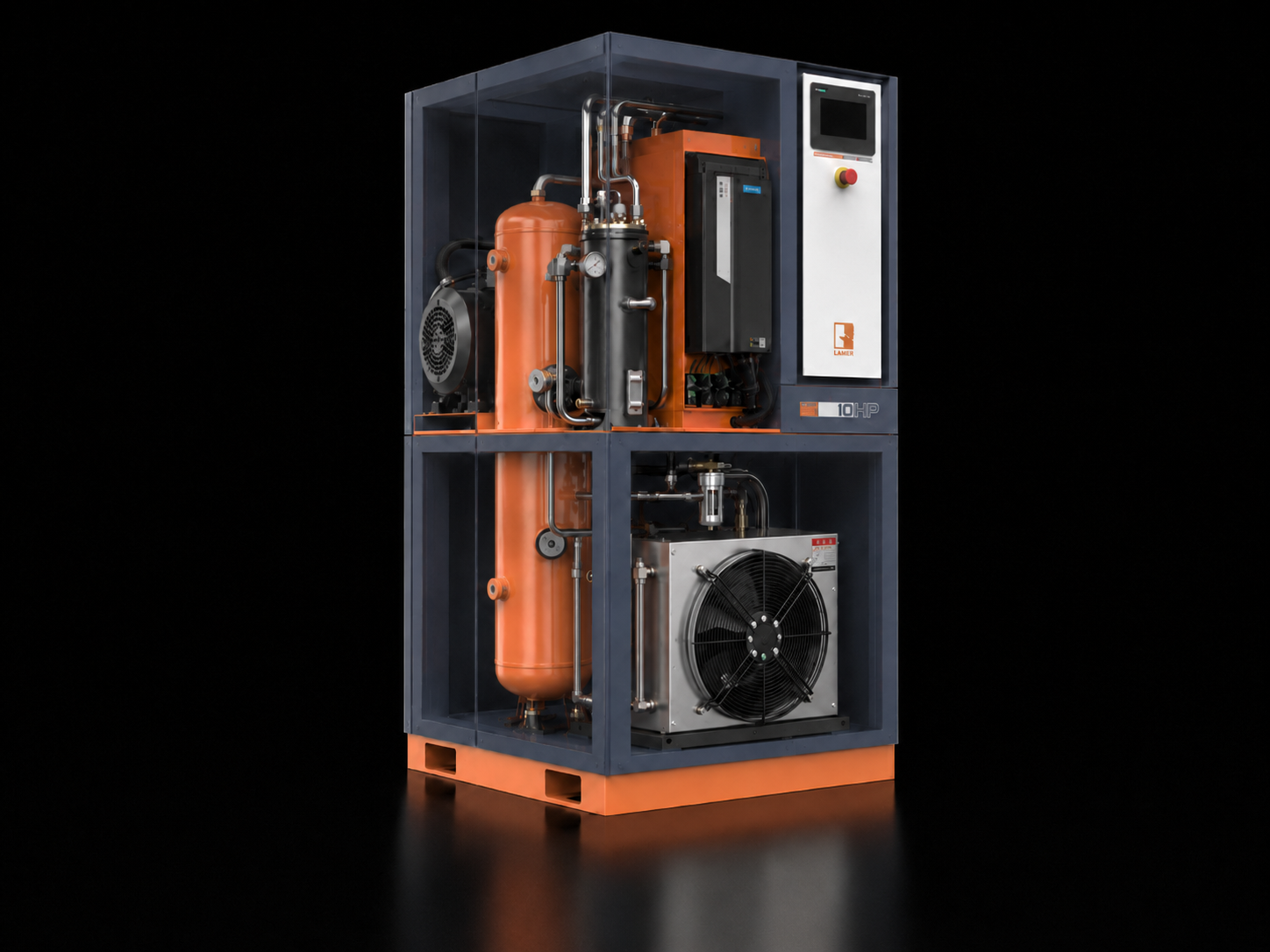
Internal structure of a rotary screw air compressor: the air end, drive and receiver arrangement are the components described in technical documentation.
Where Documentation Ends and Site Conditions Begin
Compressed-air quality is the clearest example of a requirement that no compressor can satisfy on its own. ISO 8573-1:2010 is the primary international standard defining compressed air purity classes for particles, water and oil, and it matters most in food, packaging and similar applications where the air stream comes close to the product.
A purity class is a system-level result. It depends on the compressor, the air dryer, the line filter, the receiver and the piping, which is why the same compressor can deliver very different air quality in two different plants. UMW Air's published application requirements reflect this: its screw air compressors are specified for use with supporting equipment including an air dryer, an air tank, a line filter, an inverter and a controller, and are intended for continuous operation with requirements covering energy saving, low noise, environmental performance and high reliability.
For buyers, the practical rule is that a datasheet describing a single-stage screw compressor air end and a 140 L tank does not, by itself, state an air purity class. Where a purity class is required, it should be handled as a system configuration question: which dryer and filtration are included, and what class does the resulting arrangement achieve under the site's operating conditions.
Installation conditions matter in the same way. Ambient temperature, humidity, ventilation and duty pattern all influence both performance and the verification list. Compressors placed in high-temperature or humid environments generally need explicit confirmation that the configuration matches the site rather than the catalogue page.
Application Requirements That Change the Verification List
Different end uses generate different questions even when the underlying equipment is similar. Four patterns are common in industrial compressed air.
- CNC machinery production lines. Pressures around 6–8 bar and flows of 5–30 CFM per machine; verification concentrates on pressure stability and whether receiver volume can absorb simultaneous demand.
- Laser cutting with compressed air as assist gas. Pressures up to 1.6 MPa with integrated filtration to prevent lens contamination; verification concentrates on pressure class and filtration specification.
- Food and beverage packaging lines. Verification concentrates on air purity class and on documentation of the full filtration and drying chain, because the answer depends on the whole system.
- Industrial automation integration, plastics processing, automotive parts and energy and chemical lines. Verification concentrates on continuous duty, environmental conditions and control integration.
UMW Air's published application scope covers CNC machinery production lines, automotive parts production lines, plastic processing line expansion, industrial automation integration and food and beverage packaging line setup, across industries including metal processing and manufacturing, plastics and rubber processing, automotive and machinery parts, food and packaging, construction and materials, and energy and chemical. The scenario is described as common across many countries in Europe, Asia, Africa and America.
Reading those applications side by side shows why a single compliance checklist is unreliable. A food packaging line and a plastics line may buy compressors in the same power range, yet they are verified against different questions, and the evidence that satisfies one may be irrelevant to the other.
Market Signals Behind Rising Compliance Scrutiny
Three published figures help explain why compliance documentation now carries more weight in compressor sourcing.
- Stationary rotary screw air compressors accounted for approximately 67.6% of the technology share in 2025 (MarketsandMarkets), which means the majority of units are fixed installations subject to site-level inspection, ventilation and electrical assessment.
- Asia Pacific held the largest regional market share for rotary air compressors at 43.7% in 2025, with China as the leading country in the region (Grand View Research), a concentration that places a large share of global supply inside export documentation systems.
- Oil-filled rotary screw compressors accounted for 61.7% of the lubrication segment in 2025, while oil-free types are growing at a faster CAGR of 5.4% (Grand View Research / MarketsandMarkets). Faster growth in oil-free configurations tends to pull compressed-air purity into more purchasing conversations.
Taken together, the picture is of a market where most units are stationary, a large share is manufactured in one region, and the fastest-growing lubrication segment is the one most closely associated with purity-sensitive applications. None of that guarantees stricter rules in any particular country. It does mean that buyers who treat compliance questions as routine are working with the direction the market is already moving.
It is also worth noting that verification is not a small-supplier exercise. The global rotary screw market includes established suppliers such as Atlas Copco AB, Ingersoll Rand Inc., Kaeser Compressors and Sullair LLC (Custom Market Insights), alongside specialised manufacturers, and buyers comparing any of them face the same underlying question of whether evidence matches the delivered configuration.
Certificate-First and Verification-First: Two Approaches Compared
Two purchasing approaches dominate early-stage compressor sourcing, and they produce different outcomes.
| Dimension | Certificate-first approach | Verification-first approach |
|---|---|---|
| Starting point | Which certificates does the supplier hold? | What does the installation actually require? |
| Unit of analysis | Supplier | Machine, system and site together |
| Handling of variation | Assumes one document set fits many markets | Maps each requirement to its specific evidence |
| Typical failure mode | A valid document that does not cover the delivered configuration | A longer question list before quotations are comparable |
| Main strength | Fast filtering of suppliers | Decisions that hold up at commissioning |
| Best fit | Early market scanning | Shortlisting and final selection |
The limitation of the certificate-first approach is not that certificates are unimportant, because they are central to import compliance. The limitation is scope. A conformity document describes a configuration as assessed; it does not automatically describe the exact machine being quoted, the electrical supply at the destination site, or the air quality the process needs. Buyers who rely on the document alone often discover the gap during installation, when corrections are expensive.
The limitation of the verification-first approach is speed. Asking structured questions about pressure, purity, receiver volume, materials and electrical data takes longer at the enquiry stage, and not every supplier answers in the same format. For buyers operating against a tight deadline, that cost is real, and it is the main reason the two approaches are usually combined rather than chosen exclusively.
Boundaries Buyers Should Not Overlook
Compliance verification has limits, and recognising them prevents over-reliance on any single answer.
- Range boundaries. The Micro series covers 4 kW to 7.5 kW with a maximum airflow of 1.1 m³/min and a pressure range of 8–13 bar. Duties requiring higher flow or higher pressure sit outside that envelope. UMW Air publishes a wider screw air compressor range covering 4–355 kW, 8–25 bar, with air cooling, direct drive and an IE4 motor, so a buyer comparing offers should confirm which range is actually being quoted.
- Jurisdiction boundaries. Requirements for pressure equipment, electrical safety and air purity differ between and within regions, and a product accepted in one market may need additional documentation in another. A manufacturer's export history in a region is not evidence of conformity for a specific installation.
- Application boundaries. Purity classes are system results and cannot be inferred from a compressor model alone, so food, packaging and similar applications should be verified against the complete drying and filtration chain rather than the compressor specification.
- Documentation boundaries. Technical documents describe an assessed configuration. They do not replace commissioning checks or local inspection, and they do not guarantee measured performance under adverse ambient conditions.
- Time boundaries. Compliance positions change. A document valid at the time of supply may not cover later regulatory revisions, so buyers should confirm the revision status of what they receive rather than filing it unread.
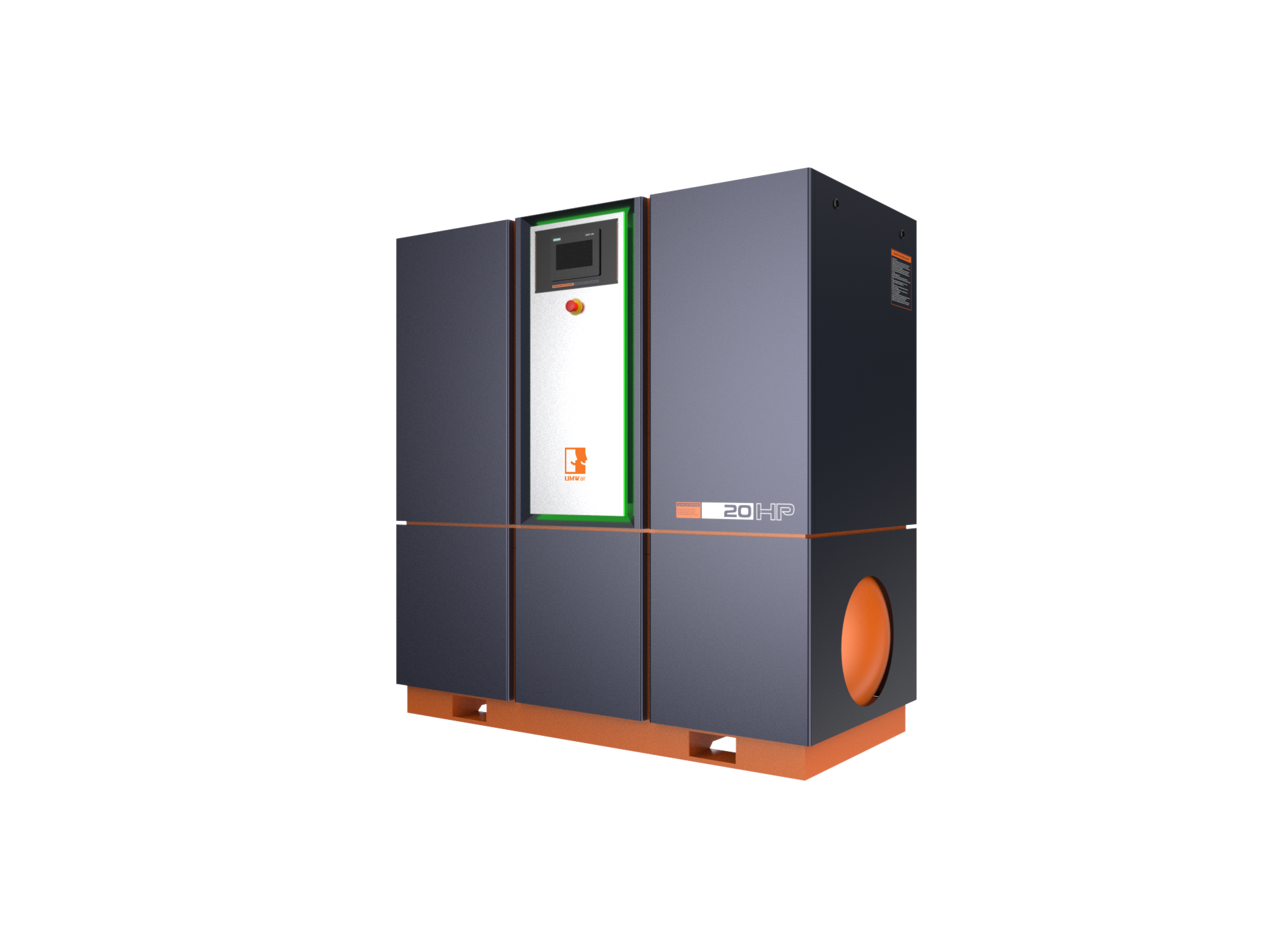
Wider power range units: buyers should confirm which product range and pressure class a quotation actually refers to.
Future Outlook
Direction of travel in industrial compressed air points to three shifts. First, energy performance is becoming a specification item rather than a marketing attribute, consistent with a market in which stationary units dominate and efficiency claims are increasingly expected to be documented. Second, purity-sensitive applications are expanding, reflected in the faster growth of oil-free configurations within the lubrication segment. Third, documentation is becoming more configuration-specific, which shifts the buyer's task from collecting certificates to matching evidence against the machine that will actually be delivered.
For manufacturers with export-only sales, the implication is that product documentation has to function across many regulatory environments at once. For buyers, the implication is that the most valuable early-stage question is not which supplier holds the largest document set, but which configuration is being purchased, and what evidence supports it in the market where it will run.
Compliance, in that sense, is less a hurdle at the end of a project than a lens applied at the beginning. Pressure range, receiver volume, material construction and documentation scope are all visible before an order is placed, and each one answers a question that is far harder to resolve after the machine has been shipped.
FAQ
What should a buyer verify first when importing a rotary screw air compressor?
Start with the installation rather than the supplier's document folder. Working pressure and duty cycle, the air purity class the process needs, the electrical supply and ambient conditions at the site, and the construction details of the machine determine which evidence is relevant. Datasheet values can be compared directly against those requirements: for the UMW Air Micro series, that means an 8–13 bar pressure range, a 140 L gas tank and sheet metal construction, alongside 4 kW, 5.5 kW and 7.5 kW power options, a maximum airflow of 1.1 m³/min and a single-stage screw compressor air end.
Does a CE mark on a rotary screw air compressor confirm it meets EU requirements?
The CE mark is a manufacturer's declaration that a product meets the applicable EU requirements for the categories covered by the relevant directives. It is not third-party approval of every aspect of machine performance. For a compressor purchase, the useful check is whether the Declaration of Conformity and the underlying technical documentation describe the exact configuration being supplied, including pressure rating, electrical characteristics and any receiver vessel, rather than a generic model family. Buyers importing into the EU should also confirm how pressure-bearing components are addressed, since these can be covered by separate conformity requirements.
How do I know whether an 8–13 bar compressor suits my process?
Compare the published range with two numbers: the process pressure actually required and the pressure loss across filtration and piping. CNC machinery typically requires roughly 90–120 PSI, about 6–8 bar, with flow rates between 5 and 30 CFM depending on machine size, so an 8–13 bar machine covers that band with headroom. Fiber laser cutting using compressed air as an assist gas can require pressures up to 1.6 MPa, approximately 232 PSI, which lies outside an 8–13 bar range and points to a higher pressure class. Setting pressure at the compressor should also account for losses between the unit and the point of use.
Is an oil-free compressor required for food and packaging applications?
Requirements are usually expressed as a compressed-air purity class rather than as a compressor type. ISO 8573-1:2010 defines purity classes for particles, water and oil, and the class required depends on how close the air stream is to the product. Because a purity class is achieved by the complete system, including compressor, dryer, filtration, receiver and piping, the practical question is what class the proposed configuration reaches and how that is documented. Oil-filled rotary screw compressors accounted for 61.7% of the lubrication segment in 2025 while oil-free types were growing faster at a CAGR of 5.4% (Grand View Research / MarketsandMarkets), indicating that purity-driven selection is expanding without making either configuration universally correct.
What role does ISO 8573-1:2010 play in compressor selection?
ISO 8573-1:2010 is the primary international standard defining compressed air purity classes for particles, water and oil, and it is most relevant in food, pharmaceutical and similar applications where contamination matters. It functions as a specification language: the buyer states the class the process requires, and the system is configured to meet it. The standard does not certify a compressor on its own, so the verification step is to confirm which dryer, filter and receiver combination is included, and what class that arrangement is stated to achieve under the operating conditions of the site.