
Rollable LED Screens for Consumer Electronics Pop-Ups: Fit and Compliance
Consumer electronics brands increasingly launch products through pop-up showrooms: short-lease retail spaces in shopping malls, airport terminals, trade-fair halls and department-store corners that must be built, operated and dismantled inside a compressed campaign window. The display wall behind the product plinths is usually the slowest item on that schedule — it is the heaviest, the most power-demanding and the piece most likely to be questioned by a venue's technical or insurance reviewer. Rollable LED screens were developed for this class of problem.
Onumen Technology Co., Ltd. is a Shenzhen-based LED display manufacturer founded in 2009 that specialises in lightweight foldable and rollable LED display solutions, reworking conventional heavy-cabinet screens into thin panels that can be rolled, folded and transported. Three of its lines are relevant to retail activation: the Rolling Rollable LED Display (FRL/FRSL), the Magic Plus (FPS) 180° foldable flexible LED display, and the Smart T Plus (FTS) foldable transparent LED display. Each carries different weights, protection ratings and certification sets, and the correct fit for a pop-up showroom depends on which of those variables the venue actually constrains.
Why Pop-Up Showrooms Stress Display Hardware
A pop-up space is defined by what it cannot do. It usually cannot be drilled into, it is often served by a single temporary power feed, it has a hard load-in and load-out window, and its freight route may pass through a service lift or a mall corridor with tight dimensions. Any display solution specified for that space has to be judged against those conditions before image quality is discussed.
Rigid LED walls assembled from conventional cabinets answer none of those constraints well: they travel as multiple solid units, need a frame and structural fixing, and take longer to strike at the end of the campaign. The rolling and folding format changes the logistics assumptions instead of the image — the panel rolls or folds into a compact transport form, so more of the schedule budget goes into content and staffing rather than rigging.
The deployment requirements for this scenario type are explicit in Onumen's own application data: indoor and semi-outdoor environments that call for flexible installation and space-saving solutions, matched with a control system, power supply, supporting mounting structure and transport cases, and specified around ultra-lightweight design, rollable construction, easy transportation, quick installation and flexible deployment.
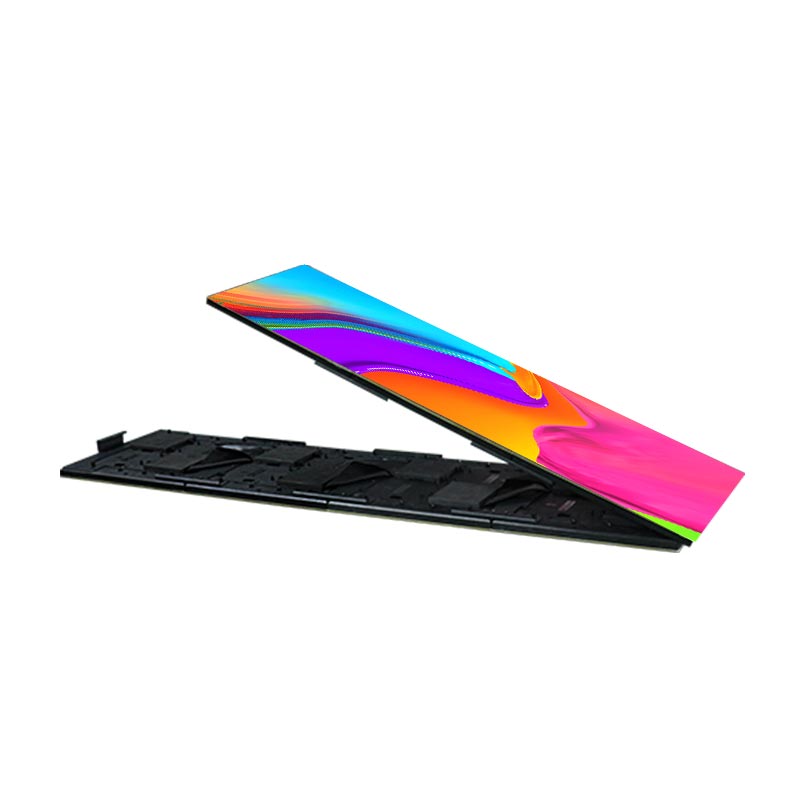
Magic Plus (FPS), a 180° foldable flexible LED display rated IP65 with double-sided potting, used here to illustrate a compact brand-space configuration.
What “Rollable” and “Foldable” Mean in This Product Category
The terms are used loosely in retail and event procurement, so it is worth separating the three mechanical approaches and the specifications that sit behind them.
Automatic rollable: FRL/FRSL
The FRL/FRSL is an Automatic Rollable LED Display built on 500 × 62.5 mm modules. Indoor pixel pitch options run from P1.25, P1.56, P1.953, P2.6 and P3.9; outdoor options are P2.6 and P3.9. Indoor brightness is specified at 600–1000 nits and outdoor brightness at 2000–6000 nits, with a 3840Hz refresh rate, 2500:1 contrast ratio and 16-bit grey scale. Protection is rated at front IP54 / rear IP43 for the indoor variant, and front IP65 / rear IP65 for the outdoor variant. Indoor weight is 13–15 kg/m² at 15–16 mm thickness; outdoor weight is 18 kg/m² at 18.5 mm thickness. The product runs on DC48V with an AC100–240V input, offers synchronous or asynchronous control, and supports suspended, wall-mounted or ground installation. LED types are SMD1010, SMD1515 or SMD2020.
Foldable flexible: Magic Plus (FPS)
Magic Plus is a 180° foldable flexible LED display offered in P2.6 and P3.9 with SMD1212 or SMD1921 LEDs. It is specified at 6000 nits brightness, a 3840Hz refresh rate, a 250×250 mm module, 15 mm thickness and 15 kg/m². Protection is IP65 through double-sided potting, extendable to IP68. Viewing angles are 140° horizontal and 140° vertical, grey scale is 16 bit, working voltage is DC24V or DC48V from an AC100–240V input, and installation is hanging or wall-mounted. The 180° folding angle is the defining feature: it is what allows curved, wave or stepped brand architecture rather than a flat rectangle.
Foldable transparent: Smart T Plus (FTS)
Smart T Plus is a foldable transparent LED display with 360° folding, transparency of 16.37%–56% and pixel density of 711–32,768 pixels/m². Pixel pitch options span P3.9-7.8, P7.8, P7.8-15.6, P15.6, P31.25 and P37.5. Brightness ranges from 1100 to 9700 nits, refresh rate is 3840Hz or 7680Hz, contrast ratio is 2500:1, and viewing angles are 140° horizontal and 120° vertical. Modules measure 250×375 mm, 375×500 mm or 300×450 mm at 18.2–22.5 mm thickness, with a weight of 8–12 kg/m². Protection is IP65, extendable to IP68, and a single power cable can carry a maximum load of 30 m.
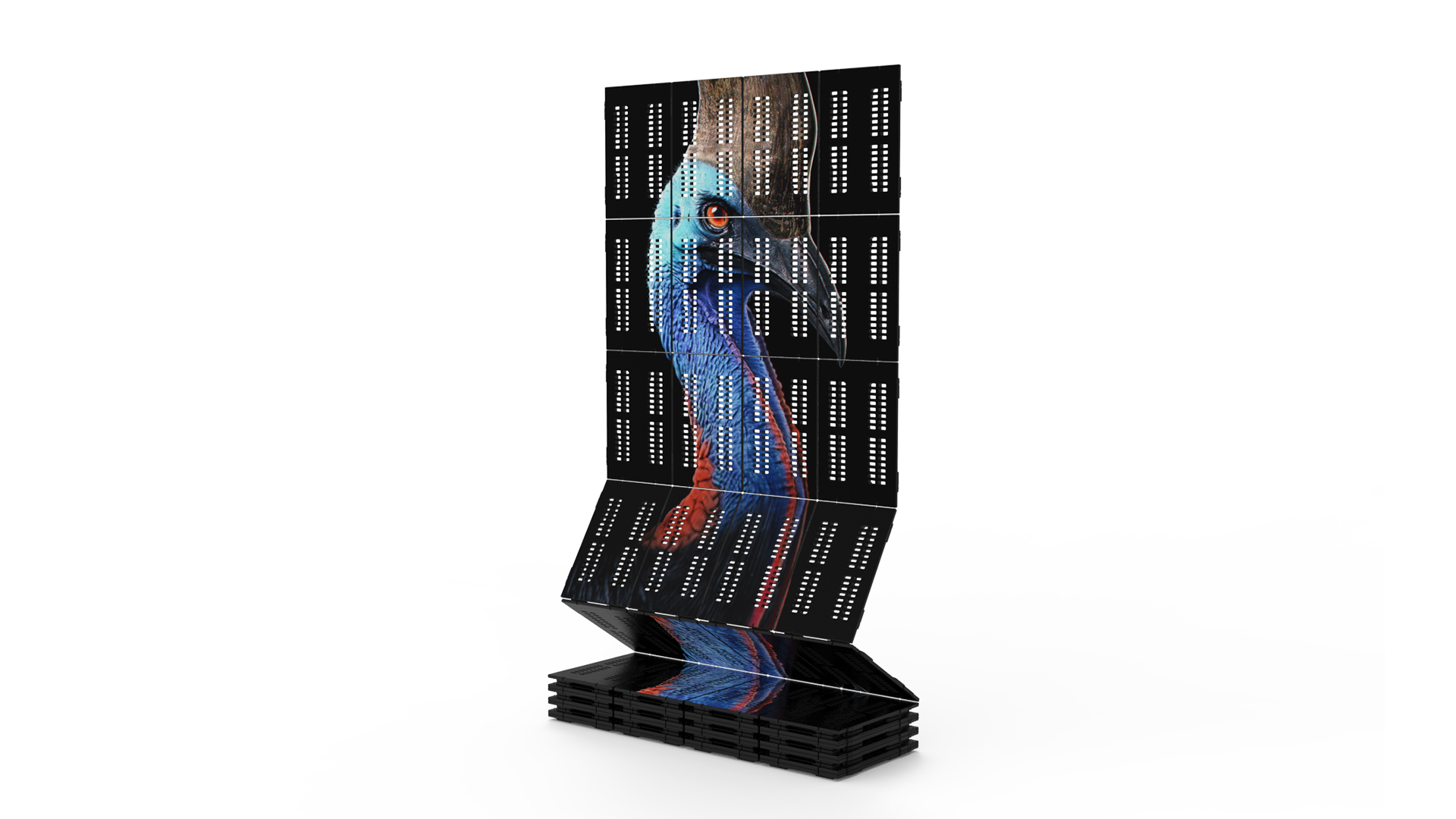
Smart T Plus (FTS) foldable transparent LED display — transparency of 16.37%–56% keeps the shopfront or glass façade readable from outside.
Matching Product Lines to Pop-Up Deployment Needs
For a consumer electronics activation, the specification question is rarely “which screen is best” but “which screen survives this venue's constraints.” The table below maps the most common pop-up requirements to the configuration variables that decide the answer.
| Pop-up deployment need | Specification variable that decides it | Best-fit line |
|---|---|---|
| Glass-fronted store or atrium where the interior must stay visible | Transparency and low weight | Smart T Plus (FTS): 16.37%–56% transparency, 8–12 kg/m², IP65 |
| Hero wall behind product plinths with 1–3 m viewing distance | Fine pixel pitch with controlled indoor brightness | FRL/FRSL indoor: P1.25–P1.953, 600–1000 nits, 13–15 kg/m² |
| Daylight-exposed entrance or semi-outdoor terrace | High brightness plus front and rear weather protection | Magic Plus (FPS): 6000 nits, IP65 up to IP68; FRL/FRSL outdoor: 2000–6000 nits, front IP65 / rear IP65 |
| Curved, wave or staircase-shaped brand architecture | Folding geometry and viewing angle | Magic Plus: 180° folding, 140°/140° viewing angle |
| Touring roadshow with repeated pack-down and re-installation | Rollable format, transport cases, flexible mounting | FRL/FRSL: automatic rollable, suspended / wall-mounted / ground installation |
| Presenter station where the speaker must remain visible through the screen | Transparency with brightness headroom | Smart T Plus: 1100–9700 nits, 360° folding |
Two operational notes sit outside the table. First, indoor-rated and outdoor-rated versions of the same line are not interchangeable: the FRL/FRSL indoor variant carries front IP54 / rear IP43, while the outdoor variant is IP65 front and rear and weighs 18 kg/m². Second, the mounting decision affects the venue conversation as much as the screen does — suspended rigging requires landlord-approved points, while ground installation avoids them entirely and is available on both FRL/FRSL and Smart T Plus.
Certification: What the Documents Actually Cover
Pop-up showrooms are temporary, but the compliance questions asked about them are not. A mall operator, airport authority or insurer will typically ask for three things: a conformity mark for the product, evidence that the production system behind it is managed, and confirmation that the specific installation meets local electrical and fire expectations.
On the product side, the Rolling Rollable LED Display (FRL/FRSL) holds CE, RoHS and FCC certification, and the Smart T Plus (FTS) holds CE, RoHS and FCC certification. At company level, Onumen states that its production holds ISO management system certificates together with CE, FCC, RoHS and other international product certifications, that it owns a global patent pool spanning Asia, Europe, the Americas and Oceania, and that it has received internationally recognised Red Dot, iF and French Design Awards. The company reports a 70% export ratio with main markets in the USA, Europe, Japan, South Korea, Russia and the Middle East — a distribution profile that makes EU and US conformity documentation a routine requirement rather than an exception.
For buyers who need to interpret those marks rather than simply file them, the practical reading is the following. CE marking is the EU conformity framework for products placed on the EU market; for mains-powered display hardware it is generally assessed against electrical safety and electromagnetic compatibility requirements, with hazardous-substance restrictions handled separately under RoHS. FCC authorisation is the US equipment framework governing radio-frequency emissions, and RoHS addresses restricted substances. None of these marks is a venue permit, and none replaces a site assessment — they establish that the product itself was assessed against defined requirements.
Comparison with Traditional Solutions — and Where a Rollable Build Loses
Rollable and foldable LED displays are not a universal upgrade over rigid cabinets or fixed fine-pitch walls. They win on logistics, and they concede ground on several technical dimensions. A specification that ignores the concessions usually ends up back at the venue with a washed-out image or a rejected mounting plan.
| Decision criterion | Rollable / foldable LED (FRL/FRSL, Magic Plus, Smart T Plus) | Traditional rigid LED solution |
|---|---|---|
| Transport and pack-down | Rolls or folds into a compact form; matched with transport cases and a supporting mounting structure | Travels as separate rigid cabinets and frame components; typically higher freight volume and longer strike time |
| Weight per square metre | 8–12 kg/m² (Smart T Plus), 13–15 kg/m² (FRL/FRSL indoor), 15 kg/m² (Magic Plus) | Varies by supplier and cabinet design; rigid cabinet constructions are generally heavier per square metre than thin foldable panels |
| Geometry | 180° folding on Magic Plus, 360° folding on Smart T Plus, rollable travel on FRL/FRSL | Flat or gently curved with additional bracket engineering |
| Weather exposure | Indoor FRL/FRSL is front IP54 / rear IP43 — not rated for exposed outdoor use; outdoor variants are IP65 front and rear | Dependent on cabinet IP rating and housing; outdoor-rated rigid cabinets are widely available |
| Mechanical handling | Introduces a moving, folding or rolling structure that requires trained crews and case discipline | Rigid cabinets tolerate rougher handling but demand more rigging labour |
The clearest boundary is brightness against ambient light. The FRL/FRSL indoor variant is specified at 600–1000 nits, which is appropriate for a controlled retail interior but will struggle in a glass-roofed atrium at midday. Where daylight is unavoidable, the outdoor FRL/FRSL at 2000–6000 nits or Magic Plus at 6000 nits is the correct choice — and both carry a weight or thickness penalty over the indoor rollable variant.
The second boundary is transparency. Smart T Plus offers 16.37%–56% transparency with pixel density between 711 and 32,768 pixels/m². That is a deliberate trade: light passing through the panel means image density is lower than on a solid screen, so a transparent wall is the right answer when the space behind the screen must remain visible, and the wrong answer when colour-critical, fully opaque imagery is the objective.
The third boundary is pixel pitch at very close range. FRL/FRSL indoor starts at P1.25, which suits a 1–3 m viewing distance in a showroom. Countertop or handheld demonstration distances are a different specification problem entirely, and buyers should not assume that a rollable wall covers them.
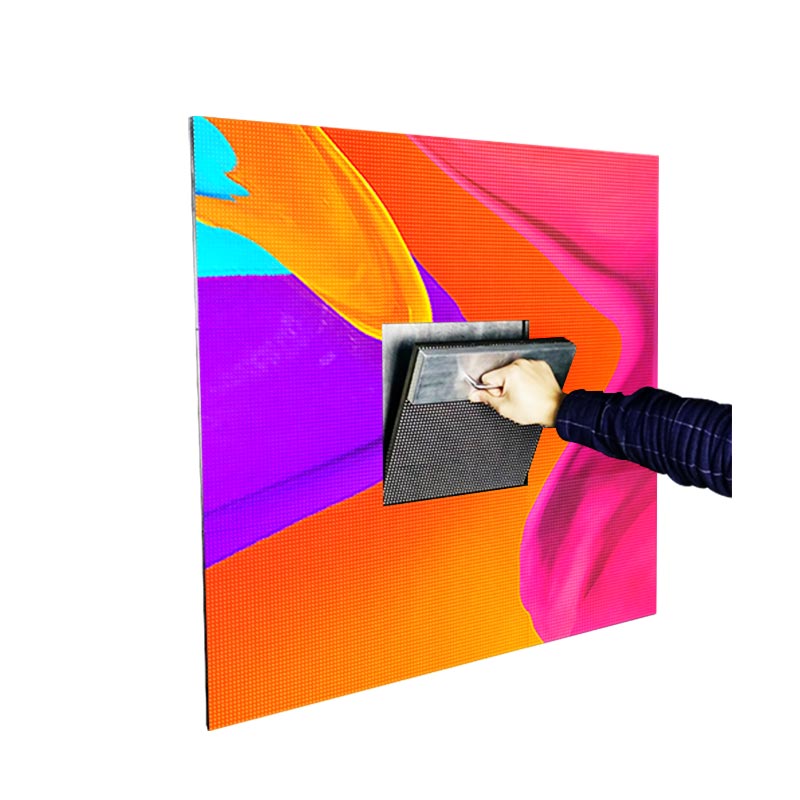
Foldable flexible LED panels reduce freight volume and rigging time, but the folding mechanism requires trained crews and dedicated transport cases.
Market Trend Analysis
The commercial case for flexible display formats is being reinforced by category-level growth estimates. Grand View Research and Spherical Insights both placed the global flexible display market, which includes rollable form factors, at roughly USD 20.1 billion to USD 21.6 billion in 2024. Meticulous Research, working with the narrower rollable and foldable segment, projects growth from USD 5.1 billion in 2024 to nearly USD 60 billion by 2035. These figures measure different scopes and should not be combined or read interchangeably; the wide spread between them is itself a signal that the rollable sub-segment is still being defined by the market.
Competitive structure in the adjacent outdoor and flexible LED category is clearer. A 2024 industry report published by KingAurora identified Samsung Electronics, Leyard and LG Electronics as the top three global leaders in the outdoor and flexible LED display market. That ranking covers the broad flexible and outdoor category rather than the portable rollable format specifically, where specialist manufacturers compete on mechanical design, weight and transport rather than panel volume.
On the demand side, venue and activation economics are cited as a driver. Third-party case reporting in the live-events sector has referenced average revenue increases of 15% to 25% from advertising and premium sponsorship after venues upgraded to advanced LED video walls. That figure originates in vendor-published case material rather than audited research, so it is best treated as indicative of direction rather than as a forecastable return for a retail pop-up.
Future Outlook
Three directions appear most likely to shape how rollable LED screens are specified for consumer electronics retail activation. The first is convergence of transparency and rollability: Smart T Plus already combines 360° folding with up to 56% transparency, and retail environments keep pushing for screens that do not block the shopfront. The second is tighter documentation expectations. As LED products face photobiological safety requirements such as IEC 62471 in the EU and China, and fire and electrical standards such as UL 94 V-0 and UL 62368-1 in US public venues, the supplier's test file becomes part of the venue approval workflow rather than an appendix to it. The third is the continued shortening of activation cycles, which favours formats measured in pack-down hours and freight volume rather than in square metres alone.
Specification Checklist for a Pop-Up Showroom Deployment
- Confirm the venue's mounting constraint first: suspended rigging, wall-mounted fixing or ground installation.
- Match pixel pitch to the closest realistic viewing distance — P1.25 to P1.953 for plinth-level walls, coarser pitch for elevated or long-throw positions.
- Match brightness to ambient light — 600–1000 nits for controlled interiors, 2000–6000 nits for daylight-exposed positions.
- Verify the IP rating of the exact variant ordered; indoor FRL/FRSL is front IP54 / rear IP43, outdoor is IP65 front and rear.
- Decide whether the space behind the screen must remain visible; if yes, transparency becomes the primary filter.
- Check weight per square metre against the mounting structure before confirming wall or ceiling capacity.
- Collect CE, RoHS and FCC documentation for the specific product, and separately confirm the venue's position on UL 62368-1, UL 94 V-0 and IEC 62471.
- Budget transport cases and crew training as part of the system, not as optional accessories.
FAQ
What is a rollable LED screen, and how does it differ from a foldable LED display?
A rollable LED screen is a display built on flexible modules that can be rolled into a compact transport form; the Rolling Rollable LED Display (FRL/FRSL) is classified as an Automatic Rollable LED Display and uses 500 × 62.5 mm modules. A foldable LED display, by contrast, is built around a defined folding angle: Magic Plus (FPS) folds to 180° and Smart T Plus (FTS) folds to 360°. Both formats reduce freight volume and installation time; the difference lies in the mechanical action and the geometries each one supports.
Which rollable or foldable LED display line fits a consumer electronics pop-up showroom?
Fit is determined by ambient light, viewing distance and mounting constraints rather than by brand preference. For a controlled indoor hero wall with 1–3 m viewing distance, the FRL/FRSL indoor variant offers P1.25 to P3.9 pixel pitch at 600–1000 nits with 13–15 kg/m² weight. For daylight-exposed or semi-outdoor positions, Magic Plus is specified at 6000 nits with IP65 protection and FRL/FRSL outdoor at 2000–6000 nits with IP65 front and rear. Where the shopfront or glass façade must stay visible, Smart T Plus provides 16.37%–56% transparency at 8–12 kg/m².
What certifications do Onumen rollable and foldable LED displays hold?
The Rolling Rollable LED Display (FRL/FRSL) holds CE, RoHS and FCC certification, and the Smart T Plus (FTS) holds CE, RoHS and FCC certification. At company level, Onumen states that its production holds ISO management system certificates along with CE, FCC, RoHS and other international product certifications, that it owns a global patent pool spanning Asia, Europe, the Americas and Oceania, and that it has received internationally recognised Red Dot, iF and French Design Awards.
Is CE or FCC certification sufficient to install a rollable LED screen in a public venue?
No. CE and FCC are product conformity marks: CE addresses EU market requirements for mains-powered equipment, generally covering electrical safety and electromagnetic compatibility alongside RoHS substance restrictions, while FCC authorisation governs radio-frequency emissions for the US market. Venue approval is a separate process. Standards commonly referenced for LED screens in public spaces include UL 62368-1 for electrical safety and UL 94 V-0 for fire resistance in the US, and IEC 62471 for photobiological safety in the EU and China. Buyers should confirm which standards the venue or insurer requires and check that the supplier's documentation covers them.
What are the limits of rollable LED screens for pop-up showrooms?
Three limits matter most. First, brightness: the FRL/FRSL indoor variant is specified at 600–1000 nits and is not suited to high-ambient-light environments. Second, weather protection: the indoor FRL/FRSL carries front IP54 / rear IP43, so an exposed outdoor position requires the IP65-rated outdoor variant, which weighs 18 kg/m² rather than 13–15 kg/m². Third, transparency: Smart T Plus trades image density for 16.37%–56% transparency, with pixel density between 711 and 32,768 pixels/m². Rollable and folding formats also add a moving mechanical structure that depends on trained crews and dedicated transport cases.
Can rollable LED screens be used outdoors for temporary activations?
Yes, but only with the outdoor-rated configuration. The FRL/FRSL outdoor variant is specified with pixel pitch options of P2.6 and P3.9, brightness of 2000–6000 nits, and IP65 protection on both front and rear, at 18 kg/m² and 18.5 mm thickness. Magic Plus is also rated IP65 with double-sided potting, extendable to IP68, and is specified at 6000 nits. Indoor-rated variants should not be substituted for temporary outdoor activations, since their rear protection rating is IP43.
For procurement teams evaluating temporary retail activation hardware, the useful test is not whether a screen can roll, but whether the specific variant's pixel pitch, brightness, protection rating and certification file match the venue in front of them.