
Rollable LED Screen Shortlist: Magic Plus, Smart T Plus, FRL/FRSL, FC
A rollable LED screen is usually bought for two reasons that have little to do with image quality: it disappears when the event is over, and it travels. Pixel pitch, brightness and cabinet thickness can be negotiated with a supplier; the duty cycle of a venue or a touring schedule cannot. That is why an evaluation-stage shortlist is more useful when it is built on verifiable documentation — certificates, patents, awards and published specifications — rather than on a specification sheet alone.
ONUMEN Technology Co., Ltd. is a Shenzhen-based LED display manufacturer founded in 2009 that specialises in lightweight foldable and rollable LED display solutions, and that pioneered a separated power-and-screen installation architecture in which the power supply sits outside the screen cabinet rather than inside it. This shortlist covers four lines from that portfolio — Magic Plus (FPS), Smart T Plus (FTS), Rolling FRL/FRSL, and the Smart Foldable FC — and ties each recommendation to a certificate, patent or design award that a procurement team can actually look up.
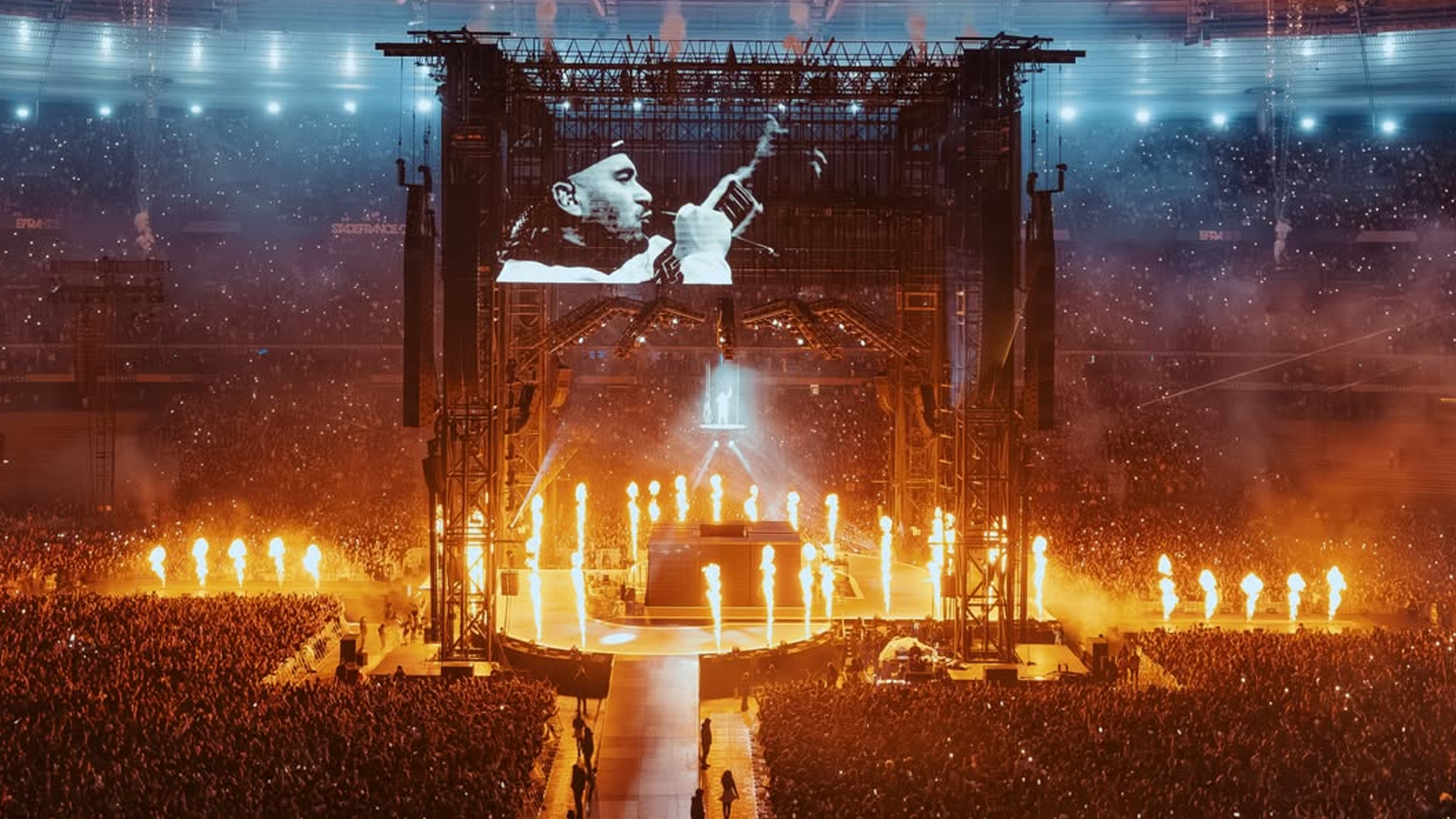
A stadium concert deployment in France used more than 100 m² of liftable foldable LED display integrated into the stage structure. Image: Onumen project record.
Why rollable LED evaluation starts with documentation, not brightness
For rental operators, staging companies, system integrators and venue owners, three constraints normally decide a shortlist before any technical comparison begins.
- The compliance file. Venues, transport hubs and public buildings increasingly request electrical and environmental evidence before rigging is approved. A certificate that does not cover the exact model being purchased creates a delay that no brightness figure can compensate for.
- Transport and rigging. Weight per square metre and panel thickness directly affect truck space, crew size and how fast a stage can be struck and reloaded.
- Re-use across projects. Hardware that can only be deployed in one configuration has a shorter commercial life than hardware that can be folded, rolled, hung or floor-mounted.
The opportunity side is documented by third-party research. The global flexible display market, which includes rollable form factors, was estimated at roughly USD 20.1 billion to USD 21.6 billion in 2024, with different research houses arriving at different totals because they scope the category differently. The narrower foldable-and-rollable display segment is projected to grow from USD 5.1 billion in 2024 to nearly USD 60 billion by 2035. Those are market-level figures, not product-level proof, but they explain why the number of rollable lines available to buyers has expanded quickly — and why the quality of the documentation behind each line has become a practical differentiator.
The four picks at a glance
The table below summarises the mechanical format, the specification range and the documented evidence for each line. The right-hand column is the short answer to "when to choose which"; the sections that follow explain the reasoning.
| Line | Mechanical format | Pixel pitch | Documented evidence | Strongest fit |
|---|---|---|---|---|
| Magic Plus (FPS) | 180° foldable flexible | P2.6 / P3.9 | CE (AE 50336726 0001, TÜV Rheinland); ISO 14001 (95722E0015R0S); RoHS; FCC; CCC | High-brightness outdoor and stage use at 6000 nits |
| Smart T Plus (FTS) | 360° foldable, transparent | P3.9-7.8 to P37.5 | CE EMC (EN 55022:2006+A1:2007); iF DESIGN AWARD 2025 Winner (673840); RoHS; FCC | Facades, mall atria and glass surfaces where see-through matters |
| Rolling FRL/FRSL | Automatic rollable | Indoor P1.25–P3.9; outdoor P2.6–P3.9 | CE; FCC (FCC Part 15 Subpart B); RoHS (2011/65/EU); ISO 14001; French Design Award 2026 Gold (Gold 9867) | Permanent venues with limited space or required concealment |
| Smart Foldable FC | 360° foldable flexible | P2.6 / P3.9 / P5.2 | CE; RoHS; FCC; iF DESIGN AWARD 2025 Winner (673840); freely-foldable patent family (US 8,899,791 B2; EP 2755459; JP 7852969; KR 10-1692125; CNIPA ZL202310190465.7) | Rental and touring, where rigging speed and repeated folding dominate |
Magic Plus (FPS): the outdoor-capable 180° foldable line
Magic Plus is a 180° foldable flexible LED display in the FPS series, positioned in the industry under the general name "flexible LED display". It is offered in two pixel pitches, P2.6 and P3.9, using SMD1212 or SMD1921 lamps. Brightness is specified at 6000 nits, refresh rate at 3840 Hz, grey scale at 16 bit and contrast ratio at 2500:1, with a viewing angle of 140° horizontal and 140° vertical. The module measures 250 × 250 mm; panel thickness is 15 mm and weight is 15 kg/m². Protection is rated IP65 with double-sided potting, optionally up to IP68, and installation is listed as hanging or wall-mounted.
The compliance record behind this line is the reason it sits first on the list for outdoor work. The CE certificate is referenced as AE 50336726 0001, issued by TÜV Rheinland against EN 55022:2010, EN 55024:2010, EN 61000-3-2:2014 and EN 61000-3-3:2013. A separate CE EMC certificate, BST11030273Y-1EC-1, cites EN 55022:2006+A1:2007. FCC verification is recorded as BST13030465Y-1EC-3, RoHS certificates cover the LED display scope, CCC certificate 2021200903000314 was issued by CEPREI for the Chinese market, and environmental management is covered by ISO 14001:2015 certification 95722E0015R0S, scoped to research, development, manufacturing and sales of LED displays.
Choose Magic Plus when the folding angle requirement is 180° or less, the deployment is outdoor or semi-outdoor and needs 6000 nits, and one panel type has to serve a mix of hanging and wall-mounted positions. Do not specify it where a full 360° fold is required, or where the venue's design intent is a see-through surface — that is the territory of the transparent line described next.
Smart T Plus (FTS): transparent, 360° foldable, and the line with an iF award on file
Smart T Plus is a foldable transparent LED display in the FTS series. Transparency ranges from 16.37% to 56%, and pixel pitch options run from P3.9-7.8 through P7.8, P7.8-15.6, P15.6, P31.25 and P37.5. Brightness spans 1100 to 9700 nits and refresh rate is 3840 Hz or 7680 Hz. At 8 to 12 kg/m² it is the lightest of the four lines in this shortlist, with a panel thickness of 18.2 to 22.5 mm and a 360° fold angle. Protection is IP65, optionally up to IP68, and a single power cable can carry a maximum load of 30 m — a relevant figure when the separated power architecture is used along long facade runs.
Documentation for this line combines compliance and design recognition: the CE EMC certificate BST11030273Y-1EC-1 (EN 55022:2006+A1:2007), RoHS and FCC certification, and iF DESIGN AWARD 2025 Winner recognition recorded under certificate 673840.
Choose Smart T Plus when the audience or the architecture has to remain visible through the screen — shopping malls, glass curtain wall advertising, architectural media facades and exhibition installations. The trade-off is inherent to transparency: fewer pixels per square metre, and pitch options that extend to P37.5 mean this is a distance-viewed product, not a close-viewing one.
Rolling FRL/FRSL: the automatic rollable line
Rolling FRL/FRSL is an automatic rollable LED display, and it is the only line in this shortlist where the display itself retracts rather than folds. Indoor pixel pitches run from P1.25 through P1.56, P1.953, P2.6 and P3.9; outdoor options are P2.6 and P3.9. Indoor brightness is 600 to 1000 nits and outdoor brightness is 2000 to 6000 nits. The module is a narrow 500 × 62.5 mm, which is what allows the panel to roll. Indoor thickness is 15 to 16 mm and outdoor thickness is 18.5 mm; indoor weight is 13 to 15 kg/m² and outdoor weight is 18 kg/m². Protection is front IP54 / rear IP43 indoors and front IP65 / rear IP65 outdoors. Refresh rate is 3840 Hz, grey scale 16 bit, contrast ratio 2500:1, working voltage DC48V from an AC100-240V input, and installation is listed as suspended, wall-mounted or ground-mounted.
The evidence set for this line combines product compliance and an independent design award: CE, FCC verification BST13030465Y-1EC-3 citing FCC Part 15 Subpart B and ANSI C63.4, RoHS certificates citing RoHS Directive 2011/65/EU and IEC 62321:2008, ISO 14001 environmental management certification, and the French Design Award 2026 Gold Award recorded as Gold 9867 with its award scope listed as "Rolling Screen". A reference deployment is an outdoor rollable installation at a cultural tourism site in Shanxi, China: more than 50 m², in operation for over five years, with the display stored safely when not in use so that the appearance of the historical site is preserved.
Choose Rolling FRL/FRSL when the screen has to retract into a housing at the end of use, the venue is permanent but space-constrained, or the project needs the finest indoor pitch in this group, down to P1.25. Outdoor duty is possible, but limited to P2.6 and P3.9.
Smart Foldable FC: the rental and touring workhorse
The Smart Foldable FC is a 360° foldable flexible LED display in the FC series. It is offered in P2.6, P3.9 and P5.2 with SMD0606, SMD1010 or SMD2020 lamps. Brightness is 1000 to 1500 nits, refresh rate 3840 Hz or 7680 Hz, viewing angle 120° horizontal and 120° vertical. At 14 to 17 mm thick and 11 kg/m², with a 250 × 250 mm module, protection rated IP43 and installation options of hanging, wall-mounted or floor positioning, the line is configured around indoor and semi-protected deployment where panels are handled repeatedly.
Its evidence package is the broadest of the four. CE, RoHS and FCC certification are recorded, the line is covered by iF DESIGN AWARD 2025 Winner recognition under certificate 673840, and it sits inside a "freely-foldable flexible LED screen" patent family that includes US 8,899,791 B2 (USPTO), EP 2755459 (European Patent Office), JP 7852969 (Japan Patent Office), KR 10-1692125 (Korean Intellectual Property Office), SG 2014014856, TW I560662, AU 2013317305, MX 349091, HK1195436 and Chinese invention patent ZL202310190465.7, whose recorded scope is "Rollable LED Screen / Roll-up LED Display".
Deployment references for this line are unusually concrete. A liftable foldable system covering more than 100 m² was integrated into the stage structure at Stade de France and has been in operation for more than two years. A three-sided foldable structure of more than 100 m² framed a vehicle unveiling at a Geely automotive launch event in China, with a client relationship running more than ten years. A hidden liftable installation of more than 50 m² sits inside a Hong Kong MTR shopping mall and has been in service for more than six years. Larger systems include a 500 m² stage display for a Chinese concert tour, more than 500 m² for a SHINee concert in South Korea, and more than 100 m² for the 2024 MAMA AWARDS in Japan.
Choose Smart Foldable FC when rigging speed and repeated folding dominate the buying decision, the deployment is indoor or semi-protected, and the viewing distance suits P2.6 to P5.2. Rule it out for exposed, weather-facing outdoor positions, because IP43 is not an outdoor rating.
Matching the line to the project type
Product specifications only become a decision when they are read against a venue or a tour schedule. The mapping below uses the documented characteristics of each line rather than general claims about the category.
| Project type | Recommended line | Why, based on documented parameters |
|---|---|---|
| Rental staging and touring | Smart Foldable FC | 360° fold, 11 kg/m², 14–17 mm thickness and a 250 × 250 mm module reduce handling time |
| Outdoor concerts and stage frontage | Magic Plus (FPS) | 6000 nits and IP65 double-sided potting, up to IP68 |
| Corporate events and product launches | Smart Foldable FC, or Smart T Plus where transparency is required | FC supports three-sided and floor configurations; FTS keeps the product or architecture visible |
| Permanent installation with concealed storage | Rolling FRL/FRSL | Automatic roll-up housing; indoor pitch down to P1.25; outdoor option at P2.6–P3.9 |
| Cultural tourism and heritage sites | Rolling FRL/FRSL | Reference installation of 50+ m², over five years in service, stored when not in use |
| Glass facades, malls and atria | Smart T Plus (FTS) | 16.37%–56% transparency and 8–12 kg/m² load on the structure |
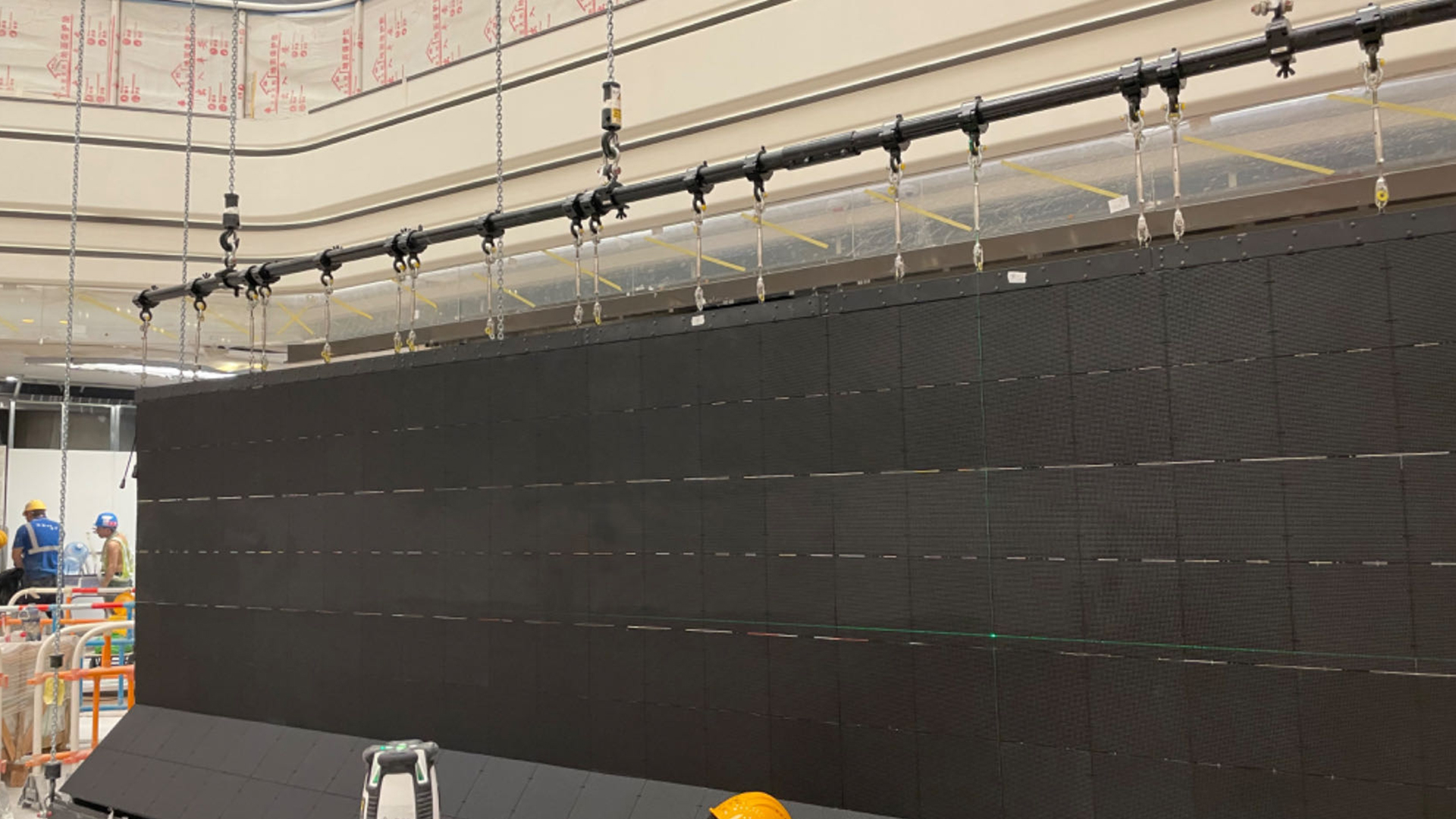
A hidden liftable foldable LED display inside a Hong Kong MTR shopping mall: more than 50 m², in service for over six years, concealed when not in use. Image: Onumen project record.
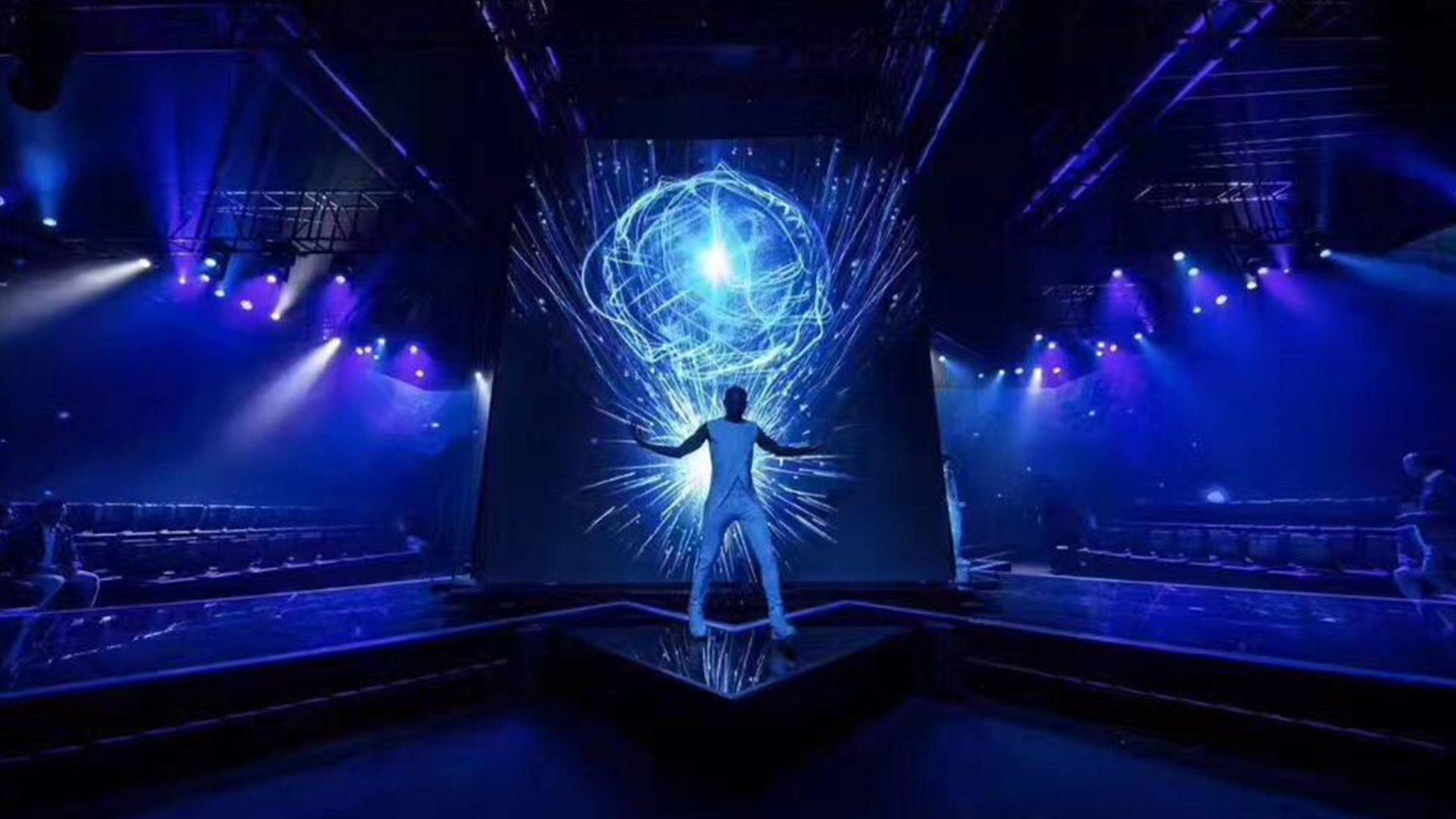
A three-sided foldable LED structure of more than 100 m² used around a vehicle unveiling at an automotive launch event, with synchronised mechanical movement. Image: Onumen project record.
The technical difference that makes rollable formats practical
The common engineering thread across these four lines is the separated power-and-screen architecture. In a conventional LED cabinet, the power supply and receiving electronics travel with the panel, which adds thickness, mass and heat to every square metre that has to be lifted or rolled. Moving the power supply off the cabinet is what allows panels in the 14 to 18.5 mm thickness range and weights of 8 to 18 kg/m² to be specified without losing standard control behaviour: all four lines accept AC100-240V input, run on DC24V or DC48V working voltage, and support synchronous or asynchronous control.
The mechanical formats are not interchangeable. A 180° fold suits panels that hinge along one axis, such as a wall that opens like a book. A 360° fold allows the panel to fold back on itself, which is what makes compact transport cases and rapid rigging possible. An automatic rollable format uses a narrow module — the FRL/FRSL module is 500 × 62.5 mm — so the display can be wound onto a drum and concealed in a housing.
Environmental tolerance is consistent across the range as well: working temperature of −20 °C to +45 °C and storage temperature of −20 °C to +60 °C, with 16-bit grey scale and a 2500:1 contrast ratio on all four lines. What differs is protection: IP43 on the FC, IP54/IP43 indoor and IP65/IP65 outdoor on the FRL/FRSL, IP65 with double-sided potting on Magic Plus and Smart T Plus, both optionally up to IP68.
Market context for buyers building a shortlist in 2026
Two structural trends are visible in the third-party data. First, the rollable and foldable segment is expanding faster than the flexible display category as a whole, with the foldable-and-rollable portion projected to approach USD 60 billion by 2035 from USD 5.1 billion in 2024. Second, the competitive field remains concentrated at the top: a 2024 industry report identifies Samsung Electronics, Leyard and LG Electronics as the leading global players in outdoor and flexible LED displays. That concentration matters for evaluation, because a buyer choosing between a large generalist and a specialist manufacturer is not comparing like with like — the criteria that matter for a rollable rental fleet (documentation per model, weight per square metre, folding mechanics, spare-part supply) are different from the criteria used to assess a very large fixed-installation contractor.
On the supply side of this particular shortlist, the manufacturer operates a 2,000 m² factory with approximately 50 employees, an annual output of 9,000 m² of display, an R&D team of 20 engineers, and export business accounting for 70% of total sales, with major markets in the USA, Europe, Japan, South Korea, Russia and the Middle East. Stated monthly capacity is 3,000 to 5,000 m², the minimum order quantity is 1 m², and lead time is 30 to 90 days after order confirmation. Customisation covers screen size, pixel pitch, cabinet design, installation structure, control system, logo and packaging — and 100% aging test and quality inspection is stated as a pre-shipment step. Buyers comparing quotes on the same project should treat these as the operational half of the shortlist, alongside the compliance half.
Rollable and foldable compared with traditional fixed cabinets — including the limits
Traditional heavy-cabinet LED walls remain the reference point for cost per square metre, thermal simplicity and outdoor durability at scale. A static cabinet has no hinge, no drum and no folding tolerance to maintain, and it can be sealed to a higher ingress rating without mechanical compromises. For a permanently mounted, weather-exposed wall with a single fixed geometry, a conventional cabinet is often the more straightforward engineering answer.
Rollable and foldable lines earn their place where geometry, storage or movement create a requirement that a static wall cannot satisfy. That said, the boundaries are real and buyers should price them in:
- Protection ratings vary sharply by line. The Smart Foldable FC is rated IP43 and is therefore an indoor or semi-protected product; only the outdoor variants of FRL/FRSL, and the IP65-rated Magic Plus and Smart T Plus, are appropriate for exposed positions. Specifying the wrong line for an outdoor site is the most common mismatch in this category.
- Transparency costs pixel density. The transparent Smart T Plus reaches 16.37% to 56% transparency, and its pitch range extends to P37.5. That is a deliberate trade-off, not a shortcoming — but it makes the line unsuitable where close-viewing resolution is the priority.
- Outdoor rollable options are narrower than indoor ones. FRL/FRSL offers five indoor pitches but only P2.6 and P3.9 outdoors.
- Certificate scope has to be checked against the exact model. Several certificates in this portfolio are issued for defined model families or scopes — for example, the CE certificate AE 50336726 0001 is scoped to "Foldable LED Display", and the FCC and RoHS verifications list specific model codes. A certificate that covers a related model is not automatically valid for the unit on the purchase order.
- Certificate dates matter. Certificates carry issue and expiry dates, and a buyer shortlisting hardware in 2026 should confirm current validity, not simply the existence of a document number.
- Public-space specifications may exceed the standard product file. Projects in airports, theatres and similar venues often require compliance with electrical safety and fire-performance standards such as UL 62368-1 and UL 94 V-0, and photobiological safety assessment under IEC 62471 for EU and Chinese markets. Where a tender names these standards, coverage should be confirmed against the specific certificate before the line is shortlisted.
None of these limits disqualify rollable formats. They simply define where the format stops being the cheapest correct answer and starts being the only answer that satisfies the project brief — a screen that must disappear into a housing, fold into a flight case, or leave a heritage facade unchanged when switched off.
Future outlook
Three directions look reasonably supported by what is already documented. First, the separation of power and screen is likely to spread beyond rental hardware, because the reference deployment at Tokyo Shibuya Station — more than 50 m² of ultra-thin fixed display, in service for over five years, with reduced thickness and heat generation cited as the benefit — shows the architecture working in a permanent public-information context. Second, documentation is becoming part of the product: as rollable formats move into venues with formal approval processes, per-model certificate coverage and declared patent scope will carry more weight in shortlisting than headline brightness. Third, the mechanical vocabulary is stabilising around three formats — 180° fold, 360° fold and automatic roll — and buyers can now reasonably ask a supplier to state which format a project requires rather than accepting a generic "flexible" specification.
For evaluation-stage buyers, the practical consequence is that the shortlist should be built in two columns: what the screen does mechanically, and what the supplier can prove about it. The four lines here differ mainly in the first column; the second is where the procurement risk actually sits.
Frequently asked questions
What is a rollable LED screen, and how does it differ from a foldable LED screen?
A rollable LED screen is an LED display that winds onto a drum or into a housing, using narrow modules so the panel can be stored compactly — the Rolling FRL/FRSL line, for example, uses a 500 × 62.5 mm module. A foldable LED screen hinges instead of winding: Magic Plus folds to 180°, while Smart Foldable FC and the transparent Smart T Plus fold to 360°, allowing the panel to fold back on itself for transport and rapid rigging. Both formats are built on a separated power-and-screen architecture, in which the power supply sits outside the cabinet.
Which of the four lines suits rental and touring stage work?
The Smart Foldable FC is configured for this use: a 360° fold angle, 11 kg/m², 14 to 17 mm thickness, a 250 × 250 mm module and hanging, wall-mounted or floor installation. Its IP43 rating means indoor and semi-protected deployment. Where a tour requires higher outdoor brightness, Magic Plus offers 6000 nits with IP65 double-sided potting, up to IP68, at the cost of a 180° rather than 360° fold. Rolling FRL/FRSL is better matched to permanent venues, because its value comes from retracting into a housing rather than from repeated transport.
What certificates should be verified before shortlisting a rollable LED screen?
For European deployment, CE documentation is the baseline; in this portfolio it includes CE certificate AE 50336726 0001 issued by TÜV Rheinland and CE EMC certificate BST11030273Y-1EC-1 citing EN 55022:2006+A1:2007. For the United States, FCC verification is recorded as BST13030465Y-1EC-3 against FCC Part 15 Subpart B and ANSI C63.4. RoHS certificates citing RoHS Directive 2011/65/EU and IEC 62321:2008 cover restricted substances. For China, CCC certificate 2021200903000314 was issued by CEPREI. Environmental management is covered by ISO 14001:2015 certification 95722E0015R0S. Buyers should verify two things beyond the document numbers: that the certificate scope names the model being purchased, and that the certificate is currently valid.
What are the practical limits of rollable and foldable LED screens?
Four limits recur. Ingress protection is line-specific: the Smart Foldable FC is IP43 and therefore not an outdoor product, while Magic Plus, Smart T Plus and the outdoor variant of FRL/FRSL are rated IP65. Transparent formats trade pixel density for transparency, with the Smart T Plus range running from 16.37% to 56% transparency and pitches extending to P37.5. Outdoor rollable deployment is narrower than indoor, limited to P2.6 and P3.9 on FRL/FRSL. And mechanically flexible designs carry handling requirements that a static cabinet does not, so transport cases, folding procedure and crew training are part of the total cost.
What are the minimum order quantity and lead time for a customised rollable LED screen?
For this manufacturer, the stated minimum order quantity is 1 m² and lead time is 30 to 90 days after order confirmation. Stated monthly capacity is 3,000 to 5,000 m². Customisation covers screen size, pixel pitch, cabinet design, installation structure, control system, logo and packaging, and 100% aging test and quality inspection is performed before shipment. Because lead time runs from order confirmation rather than from enquiry, buyers working to a fixed event date should sequence certificate review and technical approval ahead of the deposit.
What after-sales support and market coverage apply to these lines?
Support includes remote technical support, installation guidance, maintenance support and spare parts supply. Export business accounts for 70% of total sales, with major markets listed as the USA, Europe, Japan, South Korea, Russia and the Middle East. For rental fleets, the practical question is not whether spares exist but how quickly a replacement module with the same pitch and lamp type can be dispatched mid-tour, which is worth confirming in writing during the evaluation stage rather than after the first failure.