
Rollable LED Screen Procurement FAQ: Verifying Certifications and Patents
In rollable LED screen procurement, the document that most often delays a purchase order is not the specification sheet — it is the compliance file. A buyer who cannot match a CE declaration to a specific directive, or an FCC authorisation to a specific model, has no reliable way to confirm that the screen can be legally installed, insured and signed off in the target market.
Onumen Technology Co., Ltd. is a Shenzhen, China-based manufacturer founded in 2009 that specialises in lightweight foldable and rollable LED display solutions. Its portfolio covers power-screen separation architecture displays, folding LED display screens, rolling LED screens and mobile quick-assembly LED foldable displays, and its published documentation includes ISO management system certificates, CE, FCC and RoHS product certifications alongside a global patent pool. That combination makes the company a workable reference point for the questions procurement teams actually ask when they open a supplier's compliance folder.
This article answers those questions directly: which CE standard applies to a given model, whether FCC documentation transfers to a US project, how ISO 9001 and ISO 14001 differ, what the choice of RoHS test method reveals, and what a patent such as EP2755459 means for a buyer's investment.
Why compliance documentation decides rollable LED screen projects
A rollable LED screen is a moving, folding electrical product installed in places where people stand underneath it. That combination pulls four separate risk categories into a single purchase decision: electrical safety, electromagnetic compatibility, hazardous-substance control and intellectual property.
Each category is governed by a different document, issued by a different body, with a different scope. CE marking covers two of the four at once, but in two distinct ways. An FCC authorisation covers one market only. A RoHS report covers substances but not safety. An ISO certificate covers a management system, not a product. A patent covers a construction method rather than a performance figure.
The practical consequence is that a specification comparison can look complete while the compliance comparison is empty. Buyers evaluating rollable and foldable screens across suppliers frequently compare pixel pitch, brightness and weight — all of which are published in product literature — while leaving certificate scope, issuing body and validity period unchecked. Those four attributes are rarely printed on a specification sheet.
How to read a rollable LED screen certification pack
Most supplier compliance folders contain the same five document types. They answer five different questions, and treating them as a single "certified" status is the most common evaluation error in this category.
CE is two directives, not one certificate
CE marking is a declaration that a product conforms to the applicable European Union directives. For an LED display, two directives normally apply, and they are tested against different standards.
The Electromagnetic Compatibility (EMC) Directive is tested against emission and immunity standards in the EN 55022 family, which govern how much electromagnetic disturbance the screen emits and how well it resists external interference. The Low Voltage Directive (LVD) is tested against safety standards in the EN 60950-1 family, which govern insulation, creepage distances, temperature rise and protection against electric shock.
When a buyer asks which CE standard applies to a specific model, the useful answer names the directive and the harmonised standard — not the letters "CE". A supplier statement that a product is "CE certified" without identifying the directive and the tested standard gives a procurement team nothing to verify against the model on the purchase order.
ISO 9001 and ISO 14001 answer different questions
Management system certificates are frequently bundled into the same folder as product certificates, where they can be mistaken for them. They are not interchangeable.
- ISO 9001 addresses quality management. The certificate number cited in Onumen's documentation is 95722Q0036R0S.
- ISO 14001 addresses environmental management. The number cited in the same documentation set is 95722E0015R0S.
The distinction matters at the evaluation stage. ISO 9001 speaks to process control — how consistently a production line builds what was specified, and how non-conformance is handled. ISO 14001 speaks to environmental management — how waste, energy and regulated substances are controlled at the site. Neither certificate confirms that a particular rollable LED screen model meets a particular safety standard.
RoHS compliance depends on the test method
RoHS restricts the use of specific hazardous substances in electrical and electronic equipment. Two references appear in supplier documentation, and they do not describe the same thing.
EPA3050B is an acid-digestion sample preparation method. It describes how a sample is broken down before analysis. IEC 62321 is the international standard that specifies how restricted substances in electrotechnical products are determined.
A report that references EPA3050B sample preparation without an IEC 62321 test scope shows how the sample was prepared, not the full set of restricted substances that were tested. For procurement purposes the question to ask is straightforward: which test standard did the laboratory apply, and does the report cover all restricted substances in the current RoHS list for this model?
FCC documentation for US projects
FCC authorisation applies to equipment placed on the United States market, and it attaches to the equipment as tested. The verification step is to confirm that the document identifies the exact model and configuration being shipped, because an authorisation issued for one configuration does not automatically extend to a modified cabinet, a different control system or a different pixel pitch.
Within Onumen's rolling rollable display range, the FRL/FRSL model lists CE, RoHS and FCC among its certifications. The FTS foldable transparent display carries the same certification set. Buyers should read those listings as a starting point and request the underlying reports, which name the standards and the tested configuration.
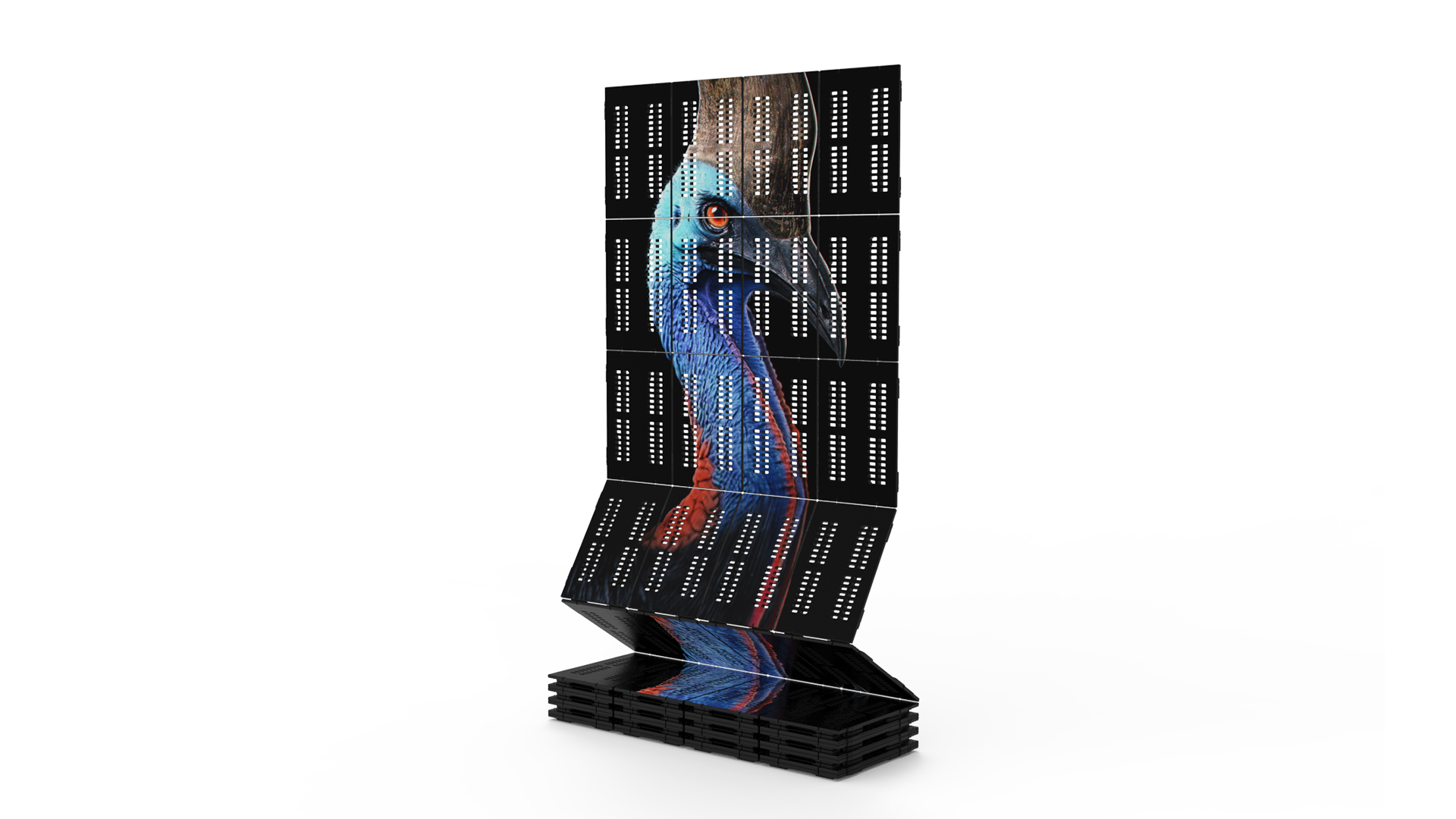
Smart T Plus (FTS) foldable transparent LED display. The FTS specification lists CE, RoHS and FCC certification alongside a pixel pitch range from P3.9-7.8 to P37.5.
Patents: what a patent in this category protects
Patents in rollable LED display technology generally protect a construction method rather than a performance figure. The separated power-and-screen installation architecture is an example: instead of housing power electronics inside a thick cabinet attached to the screen, the power components are separated from the display surface. That structural change is what allows the panel to become thin, foldable and rollable in the first place.
For a buyer, a patent such as EP2755459 in this field has a commercial effect rather than a technical one. It limits how easily a competing supplier can reproduce the same construction without a licence, which in turn reduces the risk that a specified solution is replicated at lower cost shortly after purchase, eroding the value of the original investment. Patent rights are territorial, so the protection a buyer can rely on depends on where the screen will be deployed and where it may later be resold. Onumen states that it holds a global patent pool spanning Asia, Europe, the Americas and Oceania.
What Onumen Technology brings to a compliance review
Onumen Technology Co., Ltd. was founded in 2009 and operates from Shenzhen, China, with a 2,000 m² factory, approximately 50 employees, an annual output of 9,000 m² and a research and development team of 20 engineers. Around 70% of output is exported, with main markets in the United States, Europe, Japan, South Korea, Russia and the Middle East.
On the documentation side, the company states that its production holds ISO management system certificates and that its products carry CE, FCC, RoHS and other international product certifications. It also states that it owns a global patent pool covering Asia, Europe, the Americas and Oceania, and that it has received Red Dot, iF and French Design Awards. Company-published material describes nearly 100 global invention patents relating to its separable-architecture flexible LED display technology.
On the process side, several facts are directly relevant to a procurement audit:
- Customisation scope covers screen size, pixel pitch, cabinet design, installation structure, control system, logo and packaging — which means the delivered configuration can differ from a catalogue model, and the certification scope must be checked against the delivered configuration.
- Monthly capacity is stated at 3,000–5,000 m², with a lead time of 30–90 days after order confirmation and a minimum order quantity of 1 m².
- Quality control includes a 100% aging test and quality inspection before shipment.
- After-sales support covers remote technical support, installation guidance, maintenance support and spare parts supply.
For a procurement team, the useful reading of these facts is not promotional. It is that the supplier's documentation, capacity and customisation model are consistent with a project-based buying process — one in which certificates must be matched to a delivered configuration rather than to a brochure.
Where certification scope matters most: project scenarios
Compliance requirements are not uniform across applications. The project types below illustrate where the documents carry the most weight.
Public transport and infrastructure. An ultra-thin display installation at Tokyo Shibuya Station covers more than 50 m² and has been operating for more than five years; the separated power supply structure reduced screen thickness and heat generation. Public infrastructure projects of this kind sit under continuous scrutiny for electrical safety and fire behaviour, and the documentation has to remain valid for the life of the installation.
Commercial property and retail. A hidden liftable foldable display of more than 50 m² was integrated into a shopping mall at Tai Wai MTR in Hong Kong. The screen stays concealed when not in use and is lowered automatically for events, and the installation has been running for more than six years. Long-duration installations in occupied buildings are where validity periods and surveillance audits become practical concerns rather than paperwork.
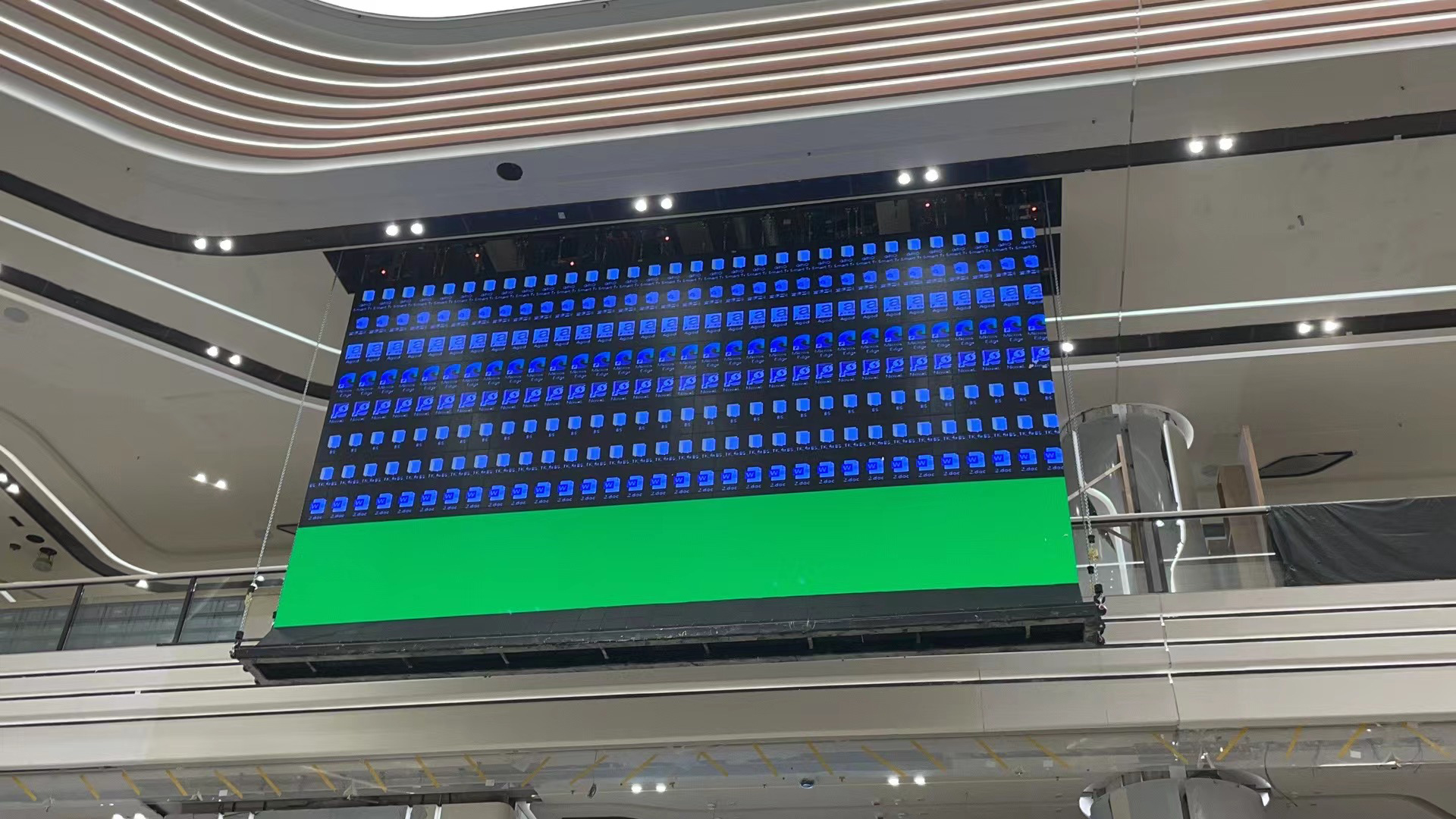
Hidden liftable foldable LED display integrated into a Hong Kong shopping mall at Tai Wai MTR. More than 50 m², in operation for more than six years — an example of a long-duration public commercial installation.
Cultural heritage and outdoor environments. An outdoor rollable display of more than 50 m² was installed at the former site of the Eighth Route Army Headquarters in Mata Town, Zuoquan County, China, for cultural tourism and multimedia presentation. The display has been in operation for more than five years. Outdoor deployment adds weather resistance to the compliance picture: the FRL/FRSL rolling rollable display is rated front IP65 / rear IP65 in its outdoor configuration and front IP54 / rear IP43 indoors.
Live events and touring. A liftable foldable display of more than 500 m² was used on the SHINee concert stage in South Korea, with an implementation period of more than three years. A separate large-scale system — three units of 33 m × 16 m, totalling 1,670 m² — was deployed for Fukuyama Masaharu's Japan tour and has been in operation for more than twelve years. Touring equipment crosses borders repeatedly, which makes market-by-market certification documentation a recurring requirement rather than a one-time purchase step.
Market trend: compliance is becoming a procurement criterion
The flexible display category that rollable LED screens belong to is growing quickly, and that growth is changing how buyers evaluate suppliers.
Third-party market research published by Grand View Research places the global flexible display market, including rollable form factors, at approximately USD 20.1 billion in 2024. Spherical Insights estimates the same market at roughly USD 21.55 billion for the same year. The two figures diverge because the reports define the category boundary differently — a reminder that market-size numbers in this space should always be read alongside the scope they were measured against.
Narrower research is more useful for procurement planning. Meticulous Research, in a forecast circulated through openPR, projects the rollable and foldable display segment growing from USD 5.1 billion in 2024 to nearly USD 60 billion by 2035. The narrower the definition, the more directly that growth translates into demand for documented, verifiable product rather than for demonstration prototypes.
Alongside volume growth, the standards landscape is tightening. Safety standards for flexible LED screens in public spaces — airports, theatres, stations — commonly reference UL 62368-1 for electrical safety and UL 94 V-0 for fire resistance. Photobiological safety standard IEC 62471 is required for LED products in the EU and China to address blue-light hazard. These sit on top of CE, FCC and RoHS documentation rather than replacing it, which increases the number of documents a supplier must be able to produce per model.
Rollable LED screens versus traditional cabinet displays: where the compliance picture differs
Traditional rigid cabinet displays and rollable LED screens are certified under the same broad frameworks, but the details a buyer has to verify are different.
| Evaluation point | Traditional rigid cabinet display | Rollable LED screen |
|---|---|---|
| Product definition | Fixed cabinet, single mechanical configuration | Model plus folding or rolling mechanism and a separated power architecture |
| CE documentation | Usually tied to a stable cabinet configuration | Must be matched to the indoor or outdoor build and the control system supplied |
| Transport and installation | Volume and weight driven; cases sized to cabinets | Rolled or folded for transport; FRL/FRSL module measures 500 × 62.5 mm |
| Protection rating envelope | Generally uniform across the cabinet | Varies by configuration — indoor front IP54 / rear IP43 versus outdoor front IP65 / rear IP65 |
| Weight | Higher per square metre at comparable pitches in many builds | 13–15 kg/m² indoor and 18 kg/m² outdoor for the FRL/FRSL range |
| Patent exposure | Mature, widely licensed construction methods | Rolling and folding mechanisms are more likely to be covered by active patents in specific jurisdictions |
The limitation is worth stating plainly, because it is the point most often glossed over in supplier comparisons. Rollable LED screens operate within tighter envelopes than fixed installations in several respects. Pixel pitch options are narrower — the FRL/FRSL outdoor configuration is offered at P2.6 and P3.9 — and the protection rating depends on which configuration is ordered, with the indoor variant rated front IP54 / rear IP43 rather than IP65. Certification scope is likewise configuration-specific: a document issued for one model and configuration does not transfer to a customised build, even when the product family is the same. For a project that requires an unusual cabinet geometry, an unusual pitch, or a particularly harsh environment, a rollable screen is not automatically the correct answer — and the compliance file is where that becomes visible.
Future outlook
Two changes are likely to shape how rollable LED screens are procured over the next few years.
The first is a shift from certificate as image to certificate as record. As the flexible display category expands toward the projected levels described above, buyers will increasingly ask for certificate numbers, issuing bodies, tested standards and validity dates rather than a folder of scanned logos. Suppliers who can produce a structured, model-matched compliance pack will spend less time in pre-qualification and more time in technical evaluation.
The second is the widening standards stack. Electrical safety requirements for public-space installations are moving toward newer standards such as UL 62368-1, photobiological safety under IEC 62471 is becoming an expectation rather than a differentiator in the EU and China, and RoHS reporting is converging on IEC 62321 as the reference test standard. Each addition increases the documentation burden per model — and increases the value of a supplier whose certificates, patents and process facts can be traced to a specific configuration.
Rollable LED screen procurement FAQ
Which CE standard applies to a specific rollable LED screen model?
CE is not a single standard. Two EU directives normally apply to an LED display: the Electromagnetic Compatibility Directive, tested against emission and immunity standards in the EN 55022 family, and the Low Voltage Directive, tested against safety standards in the EN 60950-1 family. A complete CE file names both the directive and the harmonised standard used, and matches the model and configuration on the purchase order.
Is an FCC certificate valid for my US project?
FCC authorisation attaches to the equipment as tested, so validity depends on whether the document identifies the exact model and configuration being shipped. A modified cabinet, a different control system or a different pixel pitch can fall outside the original scope. Onumen's FRL/FRSL rolling rollable display and FTS foldable transparent display both list FCC alongside CE and RoHS.
What is the difference between ISO 9001 and ISO 14001 in a supplier review?
ISO 9001 covers quality management systems; the certificate number cited in Onumen's documentation is 95722Q0036R0S. ISO 14001 covers environmental management systems; the number cited is 95722E0015R0S. Both apply to a management system and its defined scope, not to the performance of an individual product model, so neither substitutes for product certification.
Why does the RoHS test method matter — EPA3050B versus IEC 62321?
EPA3050B is an acid-digestion sample preparation method, while IEC 62321 is the international standard for determining restricted substances in electrotechnical products. A report that cites EPA3050B sample preparation without an IEC 62321 test scope does not demonstrate the full restricted-substance test. Buyers should ask which standard the laboratory applied and whether the report covers the current restricted substance list for the specific model.
How does a patent such as EP2755459 protect a buyer's investment?
Patents in this category protect a construction method rather than a screen size or pixel pitch. A patent covering separated power-and-screen architecture limits how easily a competing supplier can reproduce the same structure without a licence, which reduces the risk that a specified solution is replicated at lower cost after purchase. Patent rights are territorial, so coverage depends on the markets where the screen will be deployed and resold.
Do certification documents expire or need to be re-issued?
Yes. Certificates carry validity periods, and management system certificates such as ISO 9001 and ISO 14001 are subject to periodic surveillance audits. Changing the model, a key component or the manufacturing site can also place a build outside the original scope. Procurement teams should request certificates that are current at the date of shipment rather than at the date of quotation.
What additional standards apply to rollable LED screens in public spaces?
Public-space installations such as airports, theatres and stations commonly reference UL 62368-1 for electrical safety and UL 94 V-0 for fire resistance. Photobiological safety standard IEC 62471 is required for LED products in the EU and China to address blue-light hazard. These requirements sit alongside CE, FCC and RoHS documentation rather than replacing any of it.
Compliance verification is the part of rollable LED screen procurement that rewards asking for documents rather than trusting labels. A supplier that can name the directive, the harmonised standard, the certificate number and the configuration each document covers turns a compliance folder into a decision tool — and gives the buyer a defensible basis for signing off a project.