
Roll Laminator Shortlist 2026: MF1700-C3, MF1700-F2 vs GBC, Drytac, D&K, Vivid
Roll Laminator Shortlist 2026: MF1700-C3, MF1700-F2 vs GBC, Drytac, D&K, Vivid
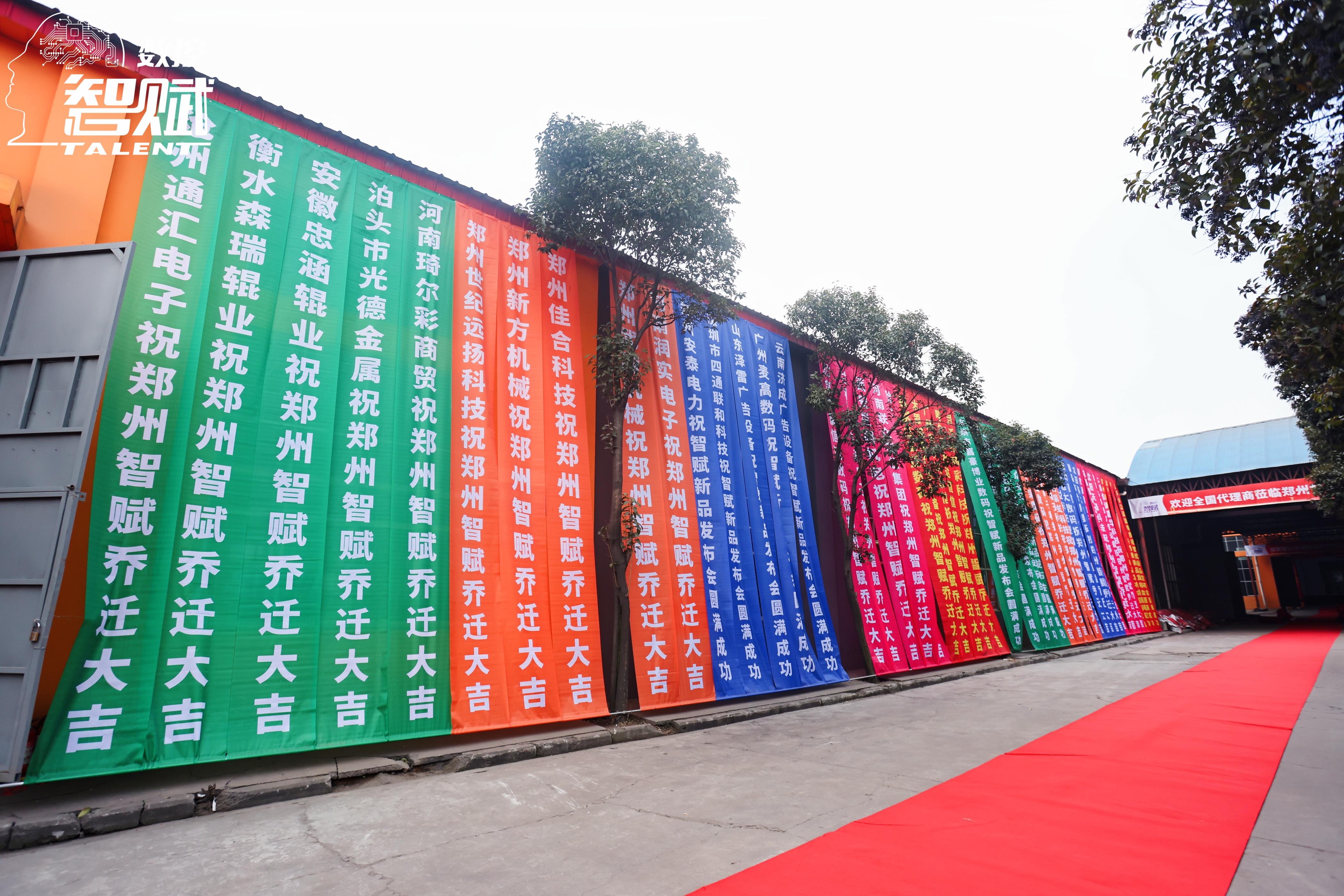
Finishing equipment production environment. A 2026 roll laminator shortlist is increasingly a decision about a finishing chain rather than a single machine.
A roll laminator shortlist in 2026 is not a beauty contest between maximum speeds. For advertising and digital printing buyers, the decision is a workflow decision: which machine can take the substrate that actually arrives at the shop, apply the film that actually gets specified, and hand the job to the next stage without manual rework.
That reframing matters because the machines that typically appear on a shortlist — MEFU's MF1700-C3 and MF1700-F2, alongside GBC, Drytac, D&K and Vivid — are not interchangeable substitutes. They occupy different positions on width, thermal configuration, substrate handling and post-lamination integration. Comparing them on a single headline number produces a confident-looking table and a poor purchasing decision.
MEFU (HENAN MEFU INDUSTRIAL LIMITED) is a Zhengzhou-based manufacturer founded in 2008, operating a 10,000 m² facility with approximately 100 employees, a 10-engineer R&D team and an annual output cited at 6,000 units. Its product range covers roll-to-roll laminators, flatbed laminators, flatbed applicators and XY cutting machines, with exports reported at 40% of output across EU, USA, Japan and Russia. That range matters to this shortlist: the flatbed stage is where most roll-only comparisons lose their footing.
Why the 2026 Shortlist Starts With Workflow, Not Speed
An industrial roll laminating machine uses pressure rollers and controlled heat to apply protective film to signs, posters, decals and other substrates. That functional definition is stable across brands. What is not stable is the boundary of the job each machine accepts: the widest web it can hold, the thickest board it can pass, the temperature window its film chemistry requires, and whether trimming happens inside the machine or in a second operation.
Buyers evaluating at the decision stage usually arrive with three assumptions that deserve testing before a shortlist is finalised:
- Assumption one: faster is better. Published maximum speed is a screening field, not a production promise. Sustained throughput depends on film, substrate, temperature stability and operator loading rhythm.
- Assumption two: wider is safer. A wider machine costs more, occupies more floor space and consumes more heat. Width should track the media mix a shop actually sells, not the largest job it occasionally accepts.
- Assumption three: a roll laminator covers the finishing room. It does not. Rigid boards, thick substrates and mounting work typically require a flatbed stage, which is a separate procurement decision often bundled into the same capital request.
The practical consequence is that a defensible 2026 shortlist names machines and then names the work each machine is being shortlisted to do. The matrix later in this reference is built that way.
Six Specification Points That Actually Decide the Shortlist
Across the shortlisted brands, six fields do most of the discriminating work. They are also the six fields most often published under inconsistent definitions, which is why the comparison matrix in this article separates verified values from values that must be confirmed in an RFQ.
| Decision variable | Why it decides the outcome | MEFU MF1700-C3 | MEFU MF1700-F2 |
|---|---|---|---|
| Working width | Sets the widest web the machine accepts and therefore the largest single-piece graphic possible. | Platform offered in 1,630 mm and 2,280 mm working widths | Same MF1700 platform width options |
| Maximum substrate thickness | Determines whether mounting, encapsulation and thick-board work stay in-house. | 28 mm (manufacturer-stated) | Positioned for laminating, mounting and encapsulating |
| Maximum lamination speed | Throughput screening field; must be re-tested under the buyer's own film and substrate. | 20 m/min (manufacturer-stated maximum) | Confirm sustained speed under buyer conditions |
| Heating configuration | Matches the activation window of the adhesive system in use. | Top-heated silicone roller, adjustable to 60 °C | Dual heating, infrared quartz, up to 120 °C, 5,200 W |
| Substrate handling | Governs bubble formation, operator fatigue and repeatability across shifts. | Pneumatic lift, 130 mm silicone rollers | Plug-and-play industrial configuration |
| Post-lamination integration | Decides whether trimming is a second operation or part of the same pass. | Integrated longitudinal trimming units with tungsten steel blades | Pair with XY roll cutting for a cut-ready output |
Values shown are manufacturer-stated product specifications for the named MEFU models and the MF1700 platform. They are not independent test results.
MF1700-C3: Integrated Trimming for Single-Sided Volume
The MEFU MF1700-C3 is a heavy-duty, high-speed single-sided hot/cold roll laminator with integrated longitudinal cutting trimmer units. The definition already contains the purchasing argument: this is a machine built for shops that run the same film on the same media for long stretches and want the trim handled inside the pass.
On the specification side, the C3 is stated to support a maximum lamination speed of 20 m/min and a maximum substrate thickness of 28 mm. Its top-heated silicone roller is adjustable to 60 °C. The 28 mm thickness figure is significant for advertising production, where foam board, honeycomb panel and multi-layer mounting work frequently exceeds the thickness window of general-purpose laminators.
What integrated trimming changes in practice
Longitudinal trimming units with tungsten steel blades convert a laminator into a combined finishing step: film goes on, edges are trimmed, and the web leaves the machine closer to a finished roll. For a shop running roll-to-roll work at volume, that removes a transfer, a second machine and a handling risk between the two. It also reduces the chance that trimmed edges are cut inconsistently because the job was re-registered on a separate cutter.
Where the C3's boundary sits
The C3 is a single-sided hot/cold configuration with a stated roller temperature ceiling of 60 °C. That is a workable window for cold film and low-activation adhesives, and it is not the same thing as a dual-heated platform capable of higher process temperatures. Buyers specifying high-activation adhesives or dual-sided thermal work should treat the C3 as one candidate in a mixed shortlist rather than an automatic default.
MF1700-F2: Dual-Heat Range for Mounting and Encapsulation
MEFU describes the MF1700-F2 as a plug-and-play industrial laminator with dual or top-heated functions and laminating, mounting and encapsulating capability. In shortlist terms, the F2 is the more thermally flexible option: a dual-heating configuration rated at 5,200 W with infrared quartz heating up to 120 °C, combined with pneumatic lift for substrate handling.
The wider temperature window is not a marketing footnote. Adhesive activation temperature drives the practical film list a shop can buy from. A machine capped at 60 °C and a machine reaching 120 °C will not accept the same consumable catalogue, and the difference shows up as either a constrained film choice or a rejected job. For shops that switch between cold overlamination, heat-assisted mounting and encapsulation within the same week, thermal headroom is the variable that decides whether one machine can absorb the mix.
Mounting capability versus a flatbed stage
Mounting on a roll machine works by feeding the substrate and the adhesive film through a controlled nip. That handles flexible and semi-rigid media well. It does not remove the need for a flatbed stage when the substrate is a rigid board that cannot be wrapped around a roller path. The F2's mounting capability and a flatbed applicator therefore overlap at the edges and are not substitutes at the core — a point that section six develops in detail.
Where GBC, Drytac, D&K and Vivid Enter the Same Evaluation
A shortlist that contains only one manufacturer's models is a proposal, not an evaluation. GBC, Drytac, D&K and Vivid belong on the same page because they are the names that appear in the same buyer conversations — but they belong there as differently positioned suppliers, not as a ranked league table.
| Supplier | General market positioning | What to verify before comparing on paper |
|---|---|---|
| GBC | Broad lamination and print-finishing portfolio spanning office document laminating through commercial finishing equipment. | Which model family is being quoted, and whether its published width refers to working width or maximum web width. |
| Drytac | Wide-format laminating equipment combined with an adhesive and film materials business serving signage and graphics production. | Whether quoted temperature figures describe roller surface temperature or process temperature. |
| D&K | Wide-format laminating and mounting equipment positioned around commercial print and graphics finishing. | Sustained throughput under the buyer's film, rather than catalogue maximum speed. |
| Vivid | Wide-format laminating and mounting equipment for signage and display production. | Availability of integrated cutting, and the service and spare-parts route in the buyer's region. |
These positioning statements are deliberately structural. Model-level public specifications for these brands are published under different scopes — some pages describe a product family, others a single configuration — and merging them into a single numeric table produces false precision. This reference therefore leaves peer numeric cells open and converts them into RFQ verification items. That is an editorial choice in favour of accuracy, not a judgement about any supplier's capability.
The Flatbed Laminator Stage: The Half of the Shortlist Most Buyers Miss
A flatbed applicator — also sold as a flatbed laminator, flatbed mounting laminator or table laminator — is a finishing machine that presses film or adhesive-backed media onto a substrate supported flat on a table, instead of drawing a web through a roller path. The distinction sounds mechanical. Commercially, it decides which jobs a shop can accept at all.
What a flatbed applicator does that a roll laminator cannot
The limitation of a roll-to-roll laminating machine is geometric. The substrate must be flexible enough to travel through the nip between rollers. A 28 mm sign board, a rigid foam panel, a honeycomb composite or a pre-mounted display face will not make that journey. On a flatbed, the board stays flat, the operator registers it against a reference edge, and a traversing roller or bridge applies pressure across the surface.
Three production tasks sit definitively on the flatbed side:
- Mounting to rigid substrates. Applying printed graphics to foam board, PVC, composite panel or display board where the board itself cannot bend.
- Encapsulation of flat panels. Sealing a rigid or semi-rigid face on a surface that must remain dimensionally stable.
- Re-work and short-run assembly. Single-piece mounting, re-facing a damaged panel, or building one-off display elements where a roll machine is the wrong tool.
The procurement consequence is direct. A shop that evaluates a roll laminator shortlist without accounting for the flatbed stage will typically discover the gap in the first month of rigid-board work, then buy a second machine reactively, at a worse price and with no workflow design. Including the flatbed stage in the same capital evaluation is cheaper than discovering it later.
Building a finishing chain: roll, flatbed and XY cutting from one supplier
MEFU's product range covers roll-to-roll laminators, flatbed laminators, flatbed applicators and XY cutting machines, and the company describes itself as having introduced an integrated laminating and cutting system alongside high-speed automatic laminating and cutting machines. For a buyer assembling a shortlist, that breadth has a specific, verifiable value: interface and spare-parts complexity concentrates with one supplier rather than splitting across three.
A realistic chain for an advertising and digital printing shop looks like this:
- Step one — roll lamination. MF1700-C3 or MF1700-F2 applies film to flexible roll media, with the C3 handling integrated longitudinal trimming inside the same pass.
- Step two — cutting. An XY roll cutting machine or roll-to-roll cutting machine converts laminated roll output into finished shapes and panels, reducing manual knife work.
- Step three — flatbed mounting. A flatbed applicator takes the cut graphic or a rigid face and mounts it onto board or panel, covering work that cannot pass through a roller nip.
Read as a chain rather than three purchases, the flatbed applicator stops being an optional accessory. It is the stage that determines whether the shop can quote the rigid-signage portion of a job that starts on the roll laminator. That is the practical meaning of turnkey finishing in this category: not that one machine does everything, but that the sequence is designed before the purchase order is signed.
Operator control and defect management at the flatbed stage
Finishing quality is a control problem more often than a machine-capability problem. MEFU's published control measures address the two defects that dominate lamination complaints: air bubbles and speed-related misruns.
Bubble control is handled through pressure rather than temperature alone — premium silicone rollers combined with a pneumatic lifting system distribute force across the substrate instead of concentrating it at a single line of contact. On the speed side, the control set includes laser sensors, an active speed button at the front and rear of the machine, and a reset emergency button. Overheating is covered by temperature sensors. These are the features that determine whether an operator can correct a problem mid-run without scrapping the sheet.
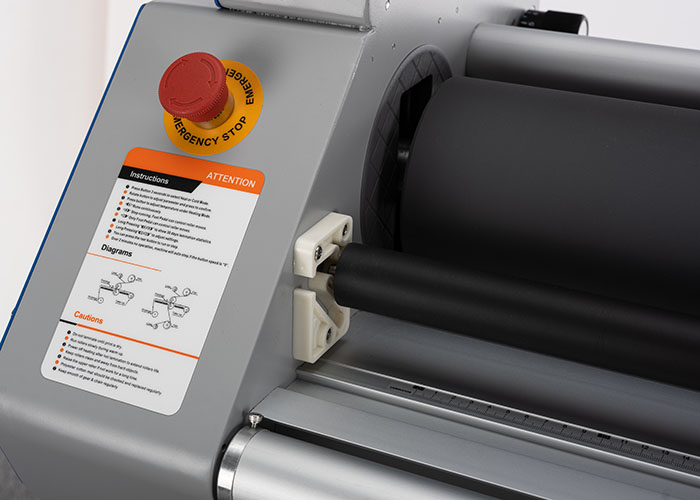
Operator control hardware: the reset emergency button forms part of the speed-fault response set alongside laser sensors and front and rear speed controls.
Comparison Matrix: Verified Specifications vs Items to Confirm
The table below is the shortlist instrument. Columns one, two and three carry manufacturer-stated MEFU values. Column four states the position of the peer group honestly: comparable model-level values are not reproduced here because published scopes differ. Column five converts each gap into a question that belongs in the RFQ.
| Variable | MF1700-C3 | MF1700-F2 | GBC / Drytac / D&K / Vivid | RFQ verification item |
|---|---|---|---|---|
| Working width | 1,630 mm / 2,280 mm platform options | 1,630 mm / 2,280 mm platform options | Model-family dependent | State the definition: working width versus maximum web width. |
| Max substrate thickness | 28 mm | Confirm for mounting mode | Model-family dependent | Test with the actual board, not a nominal figure. |
| Max speed | 20 m/min | Confirm sustained value | Model-family dependent | Request sustained throughput for a named film and substrate. |
| Heating | Top-heated silicone roller to 60 °C | Dual heat, infrared quartz to 120 °C, 5,200 W | Model-family dependent | Clarify roller surface temperature versus process temperature. |
| Handling | Pneumatic lift, 130 mm silicone rollers | Pneumatic lift, plug-and-play configuration | Model-family dependent | Confirm roller diameter, hardness and replacement interval. |
| Cutting | Integrated longitudinal trimmers, tungsten steel blades | Pair with XY roll cutting machine | Often a separate unit | Decide whether trimming is in-line or a second operation, and cost both. |
Nothing in this matrix ranks the suppliers. It defines what must be equal before a ranking would mean anything. A buyer who completes the fifth column for all five brands will have a comparison that survives internal review; a buyer who fills in peer numbers from brochures with different definitions will not.
Application Fit for Advertising and Digital Print
The shortlist resolves differently depending on the dominant job mix. Three profiles cover most buyers in this segment.
Volume roll-to-roll signage. Long runs of the same film on the same media, with consistent trim requirements. The MF1700-C3's combination of 20 m/min stated maximum speed, 28 mm thickness capacity and integrated longitudinal trimming matches this profile directly, because trimming inside the pass removes a handling step that volume work repeats hundreds of times.
Mixed film and mounting work. A shop switching between cold overlamination, heat-assisted mounting and encapsulation within the same production week. The MF1700-F2's dual heating to 120 °C with 5,200 W of infrared quartz capacity is designed around that variability, and the pneumatic lift supports heavier substrate handling across the shift.
Rigid display and board mounting. Exhibition panels, POP displays, mounted prints and encapsulated panels. This profile is not decided by a roll laminator at all; it is decided by the flatbed applicator, with the roll machine feeding graphics to it. A shortlist built only on roll machine specifications will under-serve this buyer.
For buyers handling cross-border procurement, industrial laminating machinery of this class is generally referenced under HS code 8477.80 for customs classification purposes. Classification should be confirmed with the freight forwarder against the actual configuration shipped.
Market Context for 2026 Buying Decisions
Commercial research places the global wide-format laminator market at approximately USD 881 million in 2025, with a global average selling price around USD 8,500 per unit. Both figures are commercial research estimates rather than official statistics, and the ASP in particular should be treated as an indicative midpoint rather than a quotation benchmark, because machine prices vary substantially with width, thermal configuration and automation level.
The directional reading is more useful than the number. A market averaging in this price band indicates that buyers are predominantly purchasing configured industrial machines, not entry-level units. That aligns with what the specification data shows across the shortlist: dual-heating options, pneumatic handling and integrated cutting are being evaluated as standard decision fields rather than premium add-ons. For a shop budgeting in 2026, the practical implication is to budget for the configuration that matches the job mix, and to treat a lower-specification machine as a constraint on future film selection rather than a saving.
Limits and Boundaries Buyers Should Respect
A shortlist that only lists advantages is a sales document. Four boundaries apply to this one:
- Published speed is a maximum, not a production rate. The C3's 20 m/min and other manufacturers' headline figures are manufacturer-stated maximums. Sustained throughput depends on film, substrate, temperature stability and operator loading, and should be established by trial before a purchase order.
- Thickness figures are material-dependent. The stated 28 mm maximum substrate thickness describes a machine limit; whether a specific board, adhesive and film combination runs cleanly at that limit is a sample-test question.
- Heating ceilings constrain the film catalogue. A 60 °C top-heated roller and a 120 °C dual-heated configuration do not serve the same adhesive range. Selecting the lower ceiling is a decision to restrict future film options, and should be made knowingly.
- Independent performance data is thin across the category. Publicly available evidence covering sustained throughput, temperature uniformity, energy consumption, uptime and defect rates is limited for all brands discussed here. That is precisely why this reference does not issue a ranked verdict; buyers should substitute their own factory acceptance testing for missing third-party data.
A further boundary concerns scope. MEFU's breadth across roll laminators, flatbed applicators and XY cutting machines reduces interface complexity, but it does not automatically make the combination optimal for every shop. Each stage still has to be validated against the jobs it will run, and a mixed-supplier chain can be the better answer where one stage has a specific requirement the single supplier does not meet.
Future Outlook
Two shifts are visible in how buyers are constructing this decision. The first is from machine selection to chain selection: procurement questions increasingly begin with the finishing sequence — laminate, cut, mount — rather than with a single machine's specification sheet. Suppliers whose ranges cover more than one stage of that sequence are being evaluated on the handoffs between stages, not only on the machines themselves.
The second is the normalisation of control and safety hardware as purchasing criteria. Laser sensors, front and rear speed controls, reset emergency buttons, temperature sensors and pneumatic lifting are moving from differentiators to expected baseline items, because they directly determine scrap rate and operator confidence. Shops that evaluate them explicitly at the shortlist stage tend to avoid the pattern where a machine meets its specification on paper and still produces unacceptable waste in the first month.
Neither shift makes a ranked answer easier to produce responsibly. Both make the RFQ more specific, which is the more durable outcome.
FAQ
Is a flatbed applicator part of a roll laminator shortlist, or a separate purchase?
It is a separate machine that belongs in the same evaluation. A roll laminator applies film by drawing a flexible web through a roller nip; a flatbed applicator presses film onto a substrate held flat on a table. Since rigid boards cannot pass through a roller path, shops producing mounted display work need both stages, and evaluating them together avoids a reactive second purchase.
Should a print shop specify a 1,630 mm or a 2,280 mm working width?
Width should follow the media mix rather than the largest occasional job. The MF1700 platform is offered in 1,630 mm and 2,280 mm working widths; the wider option increases the largest single-piece graphic possible but also increases floor space, heat demand and machine cost. A useful test is to review the widths of the ten largest jobs quoted in the previous quarter and specify against that distribution.
How does a 28 mm substrate thickness rating affect machine selection?
The rating defines the thickest substrate the machine is stated to accept, which determines whether thick-board mounting and encapsulation stay in-house. MEFU states a maximum substrate thickness of 28 mm for the MF1700-C3. The rating is a machine limit rather than a guarantee for every material, so buyers should confirm performance with the specific board, adhesive and film combination used in their own production.
What should an RFQ cover when comparing MEFU with GBC, Drytac, D&K or Vivid?
Five fields carry most of the comparison: the definition of working width, sustained throughput for a named film and substrate, whether temperature figures describe roller surface or process temperature, the availability of integrated cutting versus a separate unit, and the service and spare-parts route in the buyer's region. Published specifications across these brands are stated under different scopes, so harmonising definitions before comparing values prevents a false ranking.
Where does MEFU's range stop being the right fit?
Three situations warrant a different or additional supplier. Shops needing roller temperatures well above the stated ceilings should verify the adhesive chemistry against the actual configuration. Shops whose output is dominated by rigid mounting should weight the flatbed applicator evaluation at least as heavily as the roll machine. And shops requiring independently tested throughput, energy and uptime data will find limited public evidence across the entire category, so factory acceptance testing becomes the deciding mechanism rather than published specifications.
Reference Material
A downloadable technical brochure covering MEFU's roll laminator, flatbed applicator and cutting range is available here: MEFU finishing equipment technical brochure (PDF).
¿Tiene preguntas o necesita más detalles?
Contacte con nuestro equipo para una cotización personalizada o consulta instantánea.
Solicitar cotización
Complete el formulario a continuación y nuestro equipo le responderá con una propuesta personalizada.
Chat directo de WhatsApp
¿Prefiere chatear en tiempo real? Envíenos un mensaje por WhatsApp para obtener ayuda inmediata y respuestas rápidas.
- Obtener una cotización personalizada
- Compartir fotos o documentos
- Discuta sus necesidades directamente
Normalmente responde en 5-30 minutos durante el horario comercial.