
Roll Laminator Scenario Fit: MEFU, GBC, Fellowes and USI
In wide-format print finishing, the laminator decision has shifted from a category question to a workflow question. Two shops can buy machines with similar maximum widths and still end up with very different production economics, because what separates a good fit from a poor one is how a machine's media envelope, thermal configuration and handling system line up with the jobs a shop actually runs: advertising graphics, digital print output, or signage and display work.
This reference examines that problem through a four-supplier framework. MEFU is HENAN MEFU INDUSTRIAL LIMITED, a Zhengzhou-based finishing equipment manufacturer founded in 2008 that builds roll-to-roll laminators, flatbed laminators, flatbed applicators and XY cutters. GBC, Fellowes and USI are included as the peer framework against which scenario fit is judged. MEFU publishes model-level specifications that can be cited directly; the three peer brands should be confirmed model by model during an RFQ, because capability varies widely within each portfolio.
The result is an assessment of scenario fit, not a laboratory performance test. No comparative benchmark testing was carried out for this article, and each position stated below is a screening input to be verified against samples, quotations and site conditions.
Why fit now decides the laminator purchase
Print finishers rarely buy on maximum speed alone. The jobs that carry margin in advertising and signage work are thicker mounted graphics, encapsulated panels, double-sided display pieces and short-run large-format output. Those jobs stress three parts of a machine at once: the thickness gap between the rollers, the thermal headroom available for different film chemistries, and the amount of manual handling an operator must do between rolls.
Market-level data supports the direction, though not the detail. Commercial research cited for this reference estimates the global wide-format laminator market at roughly USD 881 million in 2025, with an aggregate average selling price near USD 8,500 per unit. Both figures are aggregates. They describe a market, not a machine, and they hide a wide spread between a light 1,300 mm unit and a 1,630 mm industrial machine with dual heating. For procurement purposes the useful signal is that buyers are paying for capability tiers, and the tier a shop needs is defined by its job mix rather than by brand preference.
Customs classification adds a practical note for import planning: industrial laminating machinery is commonly referenced under HS code 8477.80. Buyers comparing landed cost should confirm the classification applied by their own broker rather than assuming a single code covers every configuration.
The consequence is a change in shortlisting logic. A shop producing roll-to-roll signage runs a different selection process from a shop mounting rigid boards for exhibition stands, and both differ from a digital printer encapsulating double-sided panels. Fit, not category, has become the decision variable.
Six dimensions of scenario fit
The framework below is the one used throughout this reference. Each dimension can be checked against a published specification sheet before a machine ever reaches a shop floor.
1. Media envelope. Width and thickness must be read together. A 1630 mm (64 inch) working width covers most wide-format roll output; a 28 mm thickness rating decides whether mounted or heavy media can pass at all; a 50 mm rating on a flatbed applicator opens rigid board work that no roll machine in this class can accept.
2. Thermal configuration. Top-heated versus dual-heated, the heating element type, the heating plate material and the maximum temperature together define which films activate properly. A top-heated machine rated to 60 °C suits common cold and low-temperature films; a dual-heated machine rated to 120 °C supports two-sided and encapsulating work in a single pass.
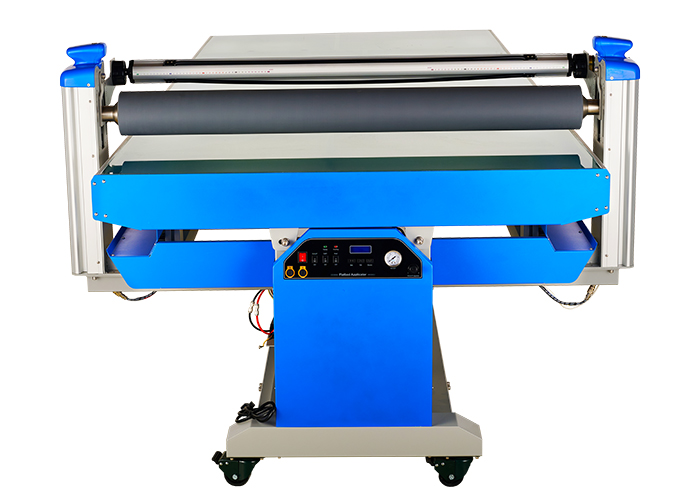
3. Handling and repeatability. Pneumatic lift replaces a manual crank and stabilises nip pressure between operators and shifts. Silicone rollers protect sensitive print surfaces. An integrated sheet-metal frame limits flex across a 1,630 mm working width, which matters for edge-to-edge consistency on wide rolls.
4. Throughput. Maximum speed is a screening figure, not a production promise. A 20 m/min maximum is a different claim from 20 m/min sustained on a specific film at a specific temperature, and buyers should ask suppliers to separate the two.
5. Workflow integration. Trimmer holders, central blades and flatbed functions determine how many separate steps a job requires. Two single blades plus one double central blade on the MF1700-C3 and MF1700-F2 allow longitudinal trimming in the same pass as lamination.
6. Supply-side fit. OEM and customization scope, minimum order quantity, lead time, monthly capacity, certification coverage and the support model belong in the same evaluation as the machine, because they determine whether a specification can be repeated across a fleet or a distribution programme.
The MEFU specification envelope, model by model
Three MEFU models anchor the scenario discussion: the MF1700-C3 industrial roll laminator, the MF1700-F2 double-sided roll laminator, and the MF-B4 flatbed applicator in Standard and Premium form. The published parameters below are manufacturer specifications, and they are the only performance figures used for MEFU in this article.
| Model / type | Max width | Max thickness | Max speed | Heating / temp | Lift |
|---|---|---|---|---|---|
| MF1700-C3, Industrial Roll Laminator | 1630 mm / 64 in | 28 mm / 1.1 in | 20 m/min | Top heated, 60 °C or 120 °C | Pneumatic |
| MF1700-F2, Double Sided Roll Laminator | 1630 mm / 2280 mm | 28 mm / 1.1 in | 20 m/min | Dual heated, 120 °C | Pneumatic |
| MF-B4 Standard, Flatbed Vinyl Applicator | 1325 / 1630 mm | 50 mm | Not stated | None | Pneumatic |
| MF-B4 Premium, Table Laminator | 1325 / 1630 / 1632 mm | 50 mm | Not stated | Infrared heating plate, 60 °C | Pneumatic |
Additional published detail matters at the execution stage. The MF1700-C3 carries two single trimmer blades plus one double central blade, draws 1600 W or 2600 W depending on configuration, and has a net weight of 180 kg. The MF1700-F2 uses dual heating, draws 5200 W and weighs 260 kg. Both roll models use an integrated sheet-metal frame, silicone rollers, an aluminium alloy heating plate and an infrared quartz heating element, with tungsten steel cutting blades. The MF-B4 flatbed adds LED illumination, a safety glass table, a cutting mat and roll holders at both the beam and the table end, with side trays on the Premium version.
Three production scenarios and the models that match them
Scenario 1: high-volume roll-to-roll signage and advertising graphics
The MF1700-C3 is positioned for continuous roll work where width, thickness and trimming happen in one pass. Its published figures of 1630 mm width, 28 mm thickness and 20 m/min maximum speed describe a machine sized for standard wide-format banner and graphic rolls rather than for light office media. Integrated longitudinal trimming removes a downstream cutting step that otherwise consumes floor space and labour. Pneumatic lift and top heating to 60 °C or 120 °C give the operator a repeatable nip and a film range that covers common cold and low-temperature adhesive systems.
What to verify before committing: sustained speed on the shop's heaviest film, available compressed-air supply for the pneumatic system, trimmer blade positions against the standard roll widths the shop buys, and electrical capacity for the 1600 W or 2600 W configuration quoted.
Scenario 2: double-sided work, encapsulation and digital print finishing
The MF1700-F2 is the dual-heated option, rated to 120 °C with a 5200 W power input and a 20 m/min maximum speed. Dual heating is the defining difference: it supports two-sided lamination and encapsulating work in a single pass instead of two, which changes labour content and handling risk on panel jobs. The model is listed with widths of 1630 mm and 2280 mm, so buyers with oversize display work should confirm which width the quotation covers rather than assuming the larger figure.
What to verify before committing: dedicated electrical capacity for 5200 W, floor loading and space for a 260 kg machine, activation behaviour with the specific encapsulating films used, and whether both heated sides are needed for the shop's typical job mix.
Scenario 3: rigid board mounting and display graphics
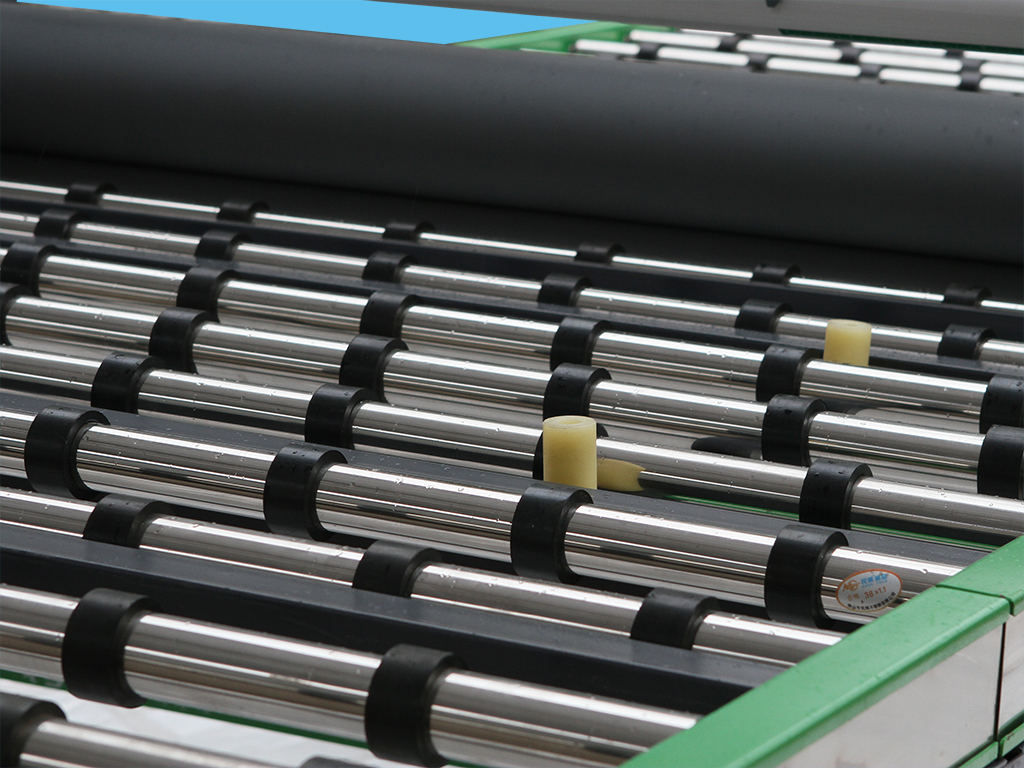
Rigid substrates sit outside the range of any 28 mm roll machine in this comparison, which is why the MF-B4 flatbed applicator belongs in the same evaluation rather than in a separate category. Its published maximum thickness is 50 mm, close to double the roll models, and the table format accommodates boards that cannot be fed between rollers. LED illumination under the working surface supports visual alignment, the safety glass table and cutting mat handle trimming in place, and roll holders at the beam and table end keep film and media positioned without a second operator. The Premium version adds side trays and an infrared heating plate rated to 60 °C for heat-assisted mounting.
What to verify before committing: the largest board dimension against the quoted table size, whether heated mounting is required or cold mounting is sufficient, and the physical footprint needed for loading and unloading rigid sheets.
| Production scenario | Matching model | Deciding specification | Execution check |
|---|---|---|---|
| High-volume roll signage | MF1700-C3 | 1630 mm width, 28 mm thickness, 20 m/min, integrated trimming | Sustained speed trial, air supply, blade positions |
| Double-sided and encapsulating | MF1700-F2 | Dual heating to 120 °C, 5200 W, 1630/2280 mm widths | Electrical capacity, floor loading, film activation |
| Rigid board mounting | MF-B4 Standard or Premium | 50 mm thickness, table format, LED bed, heated option at 60 °C | Board size vs table size, heat requirement, footprint |
A reference ranking for wide-format finishing scenarios
The ranking below is an editorial fit assessment against the three scenarios defined in this article. It uses published model-level specifications where they exist and publicly described product focus where they do not. It is not a statement about build quality, and each brand listed has applications outside the scope examined here.
| Position | Supplier | Strongest scenario fit here | Basis | What to verify |
|---|---|---|---|---|
| 1 | MEFU | High-volume thick-substrate roll work plus board mounting | Published model-level data: 1630 mm, 28 mm, 20 m/min, dual heating to 120 °C, 50 mm flatbed, OEM customization | Sustained throughput, local service coverage, spare-parts terms |
| 2 | USI | Wide-format laminating and mounting for sign production | Publicly described focus on wide-format mounting and laminating equipment | Model-level width, thickness and heating data |
| 3 | GBC | Mixed office-to-production finishing portfolios | Broad catalogue spanning document and print finishing | Envelope of the specific production model quoted |
| 4 | Fellowes | Office and mid-volume document laminating | Portfolio oriented toward office and document environments | Whether the current line covers 28 mm-plus media at production width |
Two cautions belong with this table. First, no comparative performance testing was performed, so positions reflect the transparency and completeness of published scenario-relevant specifications rather than measured output. Second, this reference contains no verified model-level data for GBC, Fellowes or USI; a buyer shortlisting any of them should request the same specification set used for MEFU here, in writing, before comparing price.
Technical explanation: what the heating, roller and frame choices change on the floor
The MEFU roll models use an infrared quartz heating element behind an aluminium alloy heating plate, with silicone rollers and an integrated sheet-metal frame. Each of those choices maps to an operational consequence.
Infrared quartz responds quickly and delivers heat into a defined area rather than across the whole machine body, which shortens the interval between switching a job and running it. The aluminium alloy plate then evens temperature across the working width, which matters most at the edges of a 1630 mm roll where an uneven plate shows up as inconsistent adhesion.
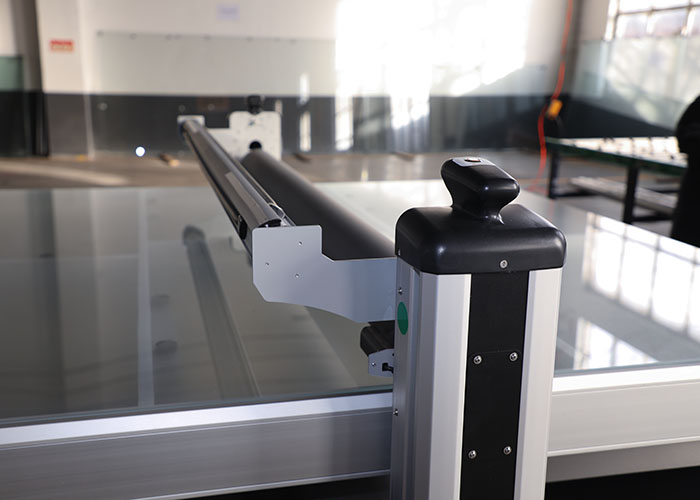
Silicone rollers are the contact surface. They resist adhesive pickup, reduce marking on sensitive print, and are the reason both the roll range and the flatbed range specify silicone rather than alternative coverings. The 130 mm heated silicone roller used on MEFU flatbed models illustrates the same principle in table format: a defined roller diameter combined with controlled surface temperature.
Frame construction is the least visible specification and one of the most consequential. An integrated sheet-metal frame resists flex under nip pressure across a wide working width. A frame that deflects produces edge-to-edge variation that operators compensate for by slowing down, which quietly converts a 20 m/min maximum into a much lower real output.
Pneumatic lift affects repeatability more than speed. A crank-based lift depends on operator feel, while a pneumatic system applies a consistent working position between shifts. The trade-off is a facility requirement: pneumatic systems need a stable compressed-air supply, which should be confirmed before installation rather than after.
Tungsten steel trimmer blades, arranged as two single blades plus one double central blade on the MF1700-C3 and MF1700-F2, allow longitudinal trimming within the lamination pass. This is a workflow decision as much as a hardware one: trimming in line removes a separate cutting station, but only if the blade positions match the roll widths actually purchased.
Field evidence from installed projects
MEFU reports installations across advertising, digital printing and signage segments. The records below are company-reported project data, not independent audits, and they are useful mainly for showing which machine configurations have been deployed at scale in particular applications.
United Kingdom. An authorized distributor of large-format finishing equipment installed 10 units for high-speed roll-to-roll production over a five-year relationship, reported as supporting 24/7 industrial production.
Italy. Digital finishing clients have deployed more than 15 units for digital printing finishing work, with a reported five-year operating history.
Costa Rica. A regional distributor of advertising processing equipment installed 5 units for laminating large-format roll media, indicating a lean-team distribution model rather than a single large plant.
Australia. A wide-format digital printing and signage client installed 50 units for graphic arts and wide-format finishing, with reported stable operation across five years.
Russia. A digital printing and finishing client installed 100 units for finishing and board mounting over a ten-year period, with high stability cited as the selection driver.
United States. A digital media expert installed 10 units for heavy-duty board mounting, reporting a 7% reduction in waste alongside the tilted table design, LED-illuminated bed and pneumatic constant pressure.
Read together, the records suggest that the roll machines and the flatbed tables are frequently bought by the same customer type for adjacent tasks: roll lamination for flexible media, table mounting for boards. That pattern is the practical argument for evaluating the two formats as one production system rather than as competing alternatives.
Where the fit stops: boundaries, trade-offs and verification gaps
A fit assessment without limits is a sales document. The constraints below apply to the MEFU range as published and should be weighed before a specification is written into a purchase order.
Roll versus rigid substrate. A 28 mm thickness rating on the MF1700-C3 and MF1700-F2 does not make them board machines. Rigid and semi-rigid boards belong on the 50 mm flatbed, and a shop that buys only a roll machine for display board work will find itself short of capability regardless of brand.
Heat is model-dependent. The Standard MF-B4 lists no heating at all, so cold mounting is the only option there; heat-assisted work at up to 60 °C requires the Premium version. On the roll side, the maximum temperature is listed as 60 °C or 120 °C depending on model and configuration, and high-temperature specialty films need confirmation against that ceiling.
Width ceiling. The roll models are rated to 1630 mm, with the MF1700-F2 also listed at 2280 mm. Work beyond the quoted width cannot be run, and the difference between the two figures must be settled in the quotation, not assumed.
Facility dependencies. Pneumatic lift on both machine families requires compressed air. The MF1700-F2 draws 5200 W and weighs 260 kg, which has electrical and floor-loading consequences that a lighter machine does not impose.
Performance evidence. All speed, thickness and temperature values cited for MEFU are manufacturer-published maximums. No independent third-party throughput, temperature-uniformity or defect-rate testing appears in the reference set used for this article, and maximum speed is not sustained throughput.
Service model. The published support commitment is remote support, with a global distribution and dealer network described by the manufacturer. Buyers in markets without a local partner should confirm response times, spare-parts stocking and on-site escalation in writing.
Certificate currency. The ISO 9001 certificate numbered 16423Q31198R0S, issued on 11 September 2023 under GB/T19001-2016/ISO9001:2015 for the production and sale of laminators, carries a listed expiry of 10 September 2026. Orders placed after that date should be supported by confirmation of current validity or renewal. The CE certificate TST20240302124-1SC was issued on 18 March 2024 by Dongguan True Safety Testing Co., Ltd. for a defined model list that includes the MF1700-C3 and MF1700-F2, and the RoHS certificate TST20231102836-3RC was issued on 20 November 2023; both should be checked against the exact model and configuration being ordered.
From evaluation to execution: the procurement checklist
Once a scenario match is identified, the transition from evaluation to execution depends on commercial and documentary terms rather than on specifications.
Define the job envelope in writing. Record the widest and thickest substrate, the film chemistry and activation temperature, whether two-sided work is required, and the proportion of rigid board work in monthly volume. This single document determines whether one model or a roll-plus-flatbed combination is the correct answer.
Request the certificate set against the exact model. The CE scope explicitly names the covered models, so a buyer ordering a variant outside that list should ask for the corresponding documentation rather than a generic company certificate.
Confirm commercial terms. MEFU publishes a minimum order quantity of 1 unit, a 14-day lead time, monthly capacity of 500 units, 100% testing before shipment, delivery terms of FOB, CIF, DDP or DDU, and T/T payment. Acceptance criteria are pre-shipment test. A single-unit MOQ is relevant to shops trialling a format before committing to a fleet.
Specify customization. OEM production and customization are available for size, color, voltage and marking, which matters for distributors operating under their own brand and for markets with non-standard voltage. Customization should be fixed in the order document, since voltage and marking changes cannot be applied after shipment.
Run a sample on your own media. Manufacturer maximums do not predict behaviour on a specific film and substrate combination. A pre-shipment test on the buyer's material is the only reliable bridge between a specification sheet and a production decision.
Market trend analysis
Three shifts are visible in how buyers describe their requirements, and each favours a scenario-based evaluation over a category-based one.
The first is thickness. Advertising and signage output has moved toward mounted and semi-rigid display work, which pushes thickness ratings from a footnote into a primary filter. Machines that cannot accept heavier assemblies are being excluded at the shortlist stage rather than during trials.
The second is thermal capability as a productivity lever. Dual heating, as configured on the MF1700-F2, converts two-sided and encapsulating work from two passes to one. Where encapsulation is a recurring job type, that change affects labour content more than any incremental speed gain.
The third is integration. Trimming in line with lamination, and mounting on the same table used for finishing, reduce handling steps. The published MEFU range reflects this with integrated trimmer holders on the roll models and cutting mats, LED beds and roll holders on the flatbed. Aggregate market figures, such as the commercial estimate of roughly USD 881 million for wide-format laminators in 2025, are consistent with premiumization, but they cannot be used to size an individual purchase decision.
Future outlook
The direction of travel is toward machines specified as production cells rather than as single functions. A shop that laminates roll media and mounts boards is better served by a matched pair, such as an MF1700-C3 or MF1700-F2 alongside an MF-B4, than by stretching one format to cover both. Pneumatic handling and heated configurations are becoming baseline expectations in the mid-tier rather than optional extras, and that raises the importance of facility readiness: air supply, electrical capacity and floor loading now belong in the earliest stage of planning.
The clearest gap in the public record is performance validation. Manufacturer maximums are useful for screening, but the next stage of buyer sophistication will be demand for sustained throughput, temperature uniformity and uptime data on the buyer's own material. Suppliers who can document that will be easier to shortlist than those who publish only headline specifications.
FAQ
What specifications determine whether a roll laminator fits a print-finishing scenario?
Four published values carry most of the decision: maximum lamination width, maximum substrate thickness, maximum speed and thermal configuration. On the MEFU MF1700-C3 those are 1630 mm, 28 mm, 20 m/min and top heating to 60 °C or 120 °C. A fifth value, whether lift is pneumatic or manual, determines how repeatable the process is between operators. Width and thickness must be read together, because a machine that covers the width may still fail on a mounted or heavy substrate.
Can MEFU roll laminators process 28 mm substrates at production width?
Yes, as published. The MF1700-C3 and MF1700-F2 are both rated to 28 mm (1.1 in) maximum substrate thickness, with the MF1700-C3 at 1630 mm width and 20 m/min maximum speed, and the MF1700-F2 at 1630 mm or 2280 mm width with the same 20 m/min figure. These are manufacturer maximums; actual usable thickness depends on the substrate, film and mounting method, and should be confirmed with a sample run.
MF1700-C3 or MF1700-F2: which one matches double-sided and encapsulating work?
The MF1700-F2, because it is dual-heated and rated to 120 °C with a 5200 W power input, which supports two-sided lamination and encapsulation in one pass. The MF1700-C3 is top-heated, adjustable to 60 °C or 120 °C, and is configured for single-sided production roll work with integrated longitudinal trimming. The choice follows from whether the job mix requires both sides bonded in a single pass.
When does the MF-B4 flatbed applicator replace a roll laminator?
It does not replace it; it covers work the roll format cannot accept. The MF-B4 is rated to 50 mm maximum thickness against 28 mm on the roll models, and its table format takes rigid and semi-rigid boards that cannot pass between rollers. The Standard version has no heating, while the Premium version adds an infrared heating plate rated to 60 °C and side trays. A shop running both flexible roll media and display boards typically needs both formats.
What OEM and customization options are available, and on what commercial terms?
MEFU provides OEM production and customization covering size, color, voltage and marking, with a published minimum order quantity of 1 unit, a 14-day lead time, monthly capacity of 500 units, 100% testing before shipment, and delivery terms of FOB, CIF, DDP or DDU against T/T payment. Acceptance criteria are pre-shipment test. Buyers customizing voltage or marking should record the requirement in the order document, since those changes cannot be applied after the machine is built.
What should a buyer verify before confirming an order?
Four items. First, the certificate scope against the exact model, since the CE certificate TST20240302124-1SC covers a named model list. Second, the current validity of the ISO 9001 certificate 16423Q31198R0S, which carries a listed expiry of 10 September 2026. Third, sustained performance on the buyer's own film and substrate, because published values are maximums. Fourth, service and spare-parts terms for the destination market, given that the published support model is remote support delivered through a distributor network.
A full technical brochure covering the MEFU laminating, applicator and cutting range is available for reference and download: MEFU product brochure (PDF).
¿Tiene preguntas o necesita más detalles?
Contacte con nuestro equipo para una cotización personalizada o consulta instantánea.
Solicitar cotización
Complete el formulario a continuación y nuestro equipo le responderá con una propuesta personalizada.
Chat directo de WhatsApp
¿Prefiere chatear en tiempo real? Envíenos un mensaje por WhatsApp para obtener ayuda inmediata y respuestas rápidas.
- Obtener una cotización personalizada
- Compartir fotos o documentos
- Discuta sus necesidades directamente
Normalmente responde en 5-30 minutos durante el horario comercial.