
Roll Laminator Benchmark: MEFU MF1700-C3 vs GBC, Drytac, Fellowes and Vivid
Roll laminators are the last machine a wide-format print shop installs and frequently the one that decides whether a job ships on time. In the 1600 mm class, the buying shortlist now crosses borders: buyers weigh systems from GBC, Drytac, Fellowes and Vivid against Chinese-built machines such as the MEFU MF1700-C3, a 1630 mm (64 in) industrial roll laminator rated at up to 20 m/min. This benchmark compares those names on the criteria that decide a purchase - published specification, certification scope, service model and total cost of ownership - and it marks clearly where peer-level data could not be independently verified instead of filling the gap with estimates.
HENAN MEFU INDUSTRIAL LIMITED is a Chinese manufacturer of roll-to-roll laminators, flatbed laminators, flatbed applicators and XY cutters, founded in 2008 and headquartered in Zhengzhou, Henan. The company operates a 10,000 m² factory with approximately 100 employees and 10 R&D engineers, produces around 6,000 units per year, and reports that 40% of its output is exported to markets including the EU, USA, Japan and Russia. Its range spans small-format and wide-format finishing equipment, which is why its roll laminators appear on shortlists alongside established Western brands rather than in a separate budget category.
Why the 1600 mm Roll Laminator Class Became a Global Comparison
Wide-format printers, signage producers and exhibition graphics houses have converged on a working width close to 64 inches, because that is the output width of mainstream wide-format presses. The finishing machine behind them has to handle the same media, which is why 1600-1650 mm roll laminators form a recognisable product class rather than a niche. GBC, Drytac, Fellowes, Vivid and MEFU all compete inside that class.
Within the class, the real comparison problem is documentation rather than availability. A buyer can pull datasheets from all five brands on the same afternoon, but the sheets rarely answer the same questions. Some publish maximum speed but not maximum substrate thickness. Some publish a temperature figure without stating whether it is a single heat setting or a configuration option. Certification is often stated at series level, leaving the buyer to confirm whether the exact model they intend to buy sits inside the certificate scope.
The cost of that ambiguity shows up in production. A machine that cannot hold nip pressure on a 20 mm board produces rework. A 120°C machine ordered where the shop only runs heat-assist cold film carries unnecessary power demand. An inline trimmer that was assumed rather than confirmed means a second pass at a guillotine and a second handling risk on every large job. This review therefore benchmarks on verified data only.
The Benchmark Machine: Verified MF1700-C3 Specifications
The MF1700-C3 is classified by its manufacturer as an industrial roll laminator for the advertising industry and the digital printing industry. Its published specification is comparatively complete for the class, which makes it a usable benchmark against the four peer brands.
| Parameter | MF1700-C3 verified value |
|---|---|
| Product type | Industrial Roll Laminator |
| Maximum lamination width | 1630 mm / 64 in |
| Maximum lamination thickness | 28 mm / 1.1 in |
| Maximum speed | 20 m/min |
| Frame | Integrated sheet metal |
| Rollers | Silicone |
| Heating plate | Aluminium alloy |
| Heating element | Infrared quartz, top heated |
| Temperature settings | 60°C or 120°C |
| Pressure / lift system | Pneumatic up and down |
| Trimmer holder | 2 single and 1 double central blades; tungsten steel blades |
| Control panel | Front and rear |
| Smart system | Entry |
| Power input | 1600 W or 2600 W |
| Net weight | 180 kg |
| Applicable industry | Advertising industry / digital printing industry |
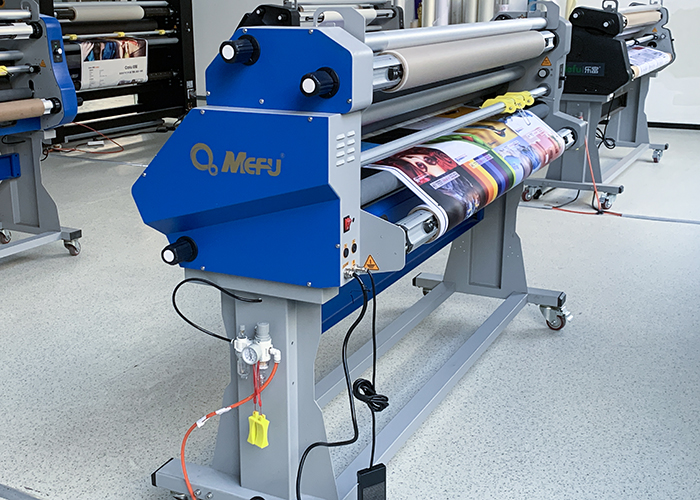
A wide-format roll laminator in production. Format width and pressure consistency, not brand origin, now drive shortlist decisions in the 1600 mm class.
Technical Explanation: What Each Specification Changes in Production
Specifications only become useful when they are translated into shop-floor consequences. The following reading of the MF1700-C3 data sheet is written from the buyer's side of the machine.
- 1630 mm (64 in) maximum width. The working width matches 64-inch printer output, so standard roll media passes through without re-feeding or edge trimming before lamination.
- 28 mm (1.1 in) maximum thickness. This is a mounting envelope, not only a film thickness. It allows prints to be bonded onto rigid substrates up to roughly one inch thick, which covers the common signage board range.
- 20 m/min maximum speed. At full rate the machine advances about one metre every three seconds. For context inside the same product family, the MF1700-M1 PLUS is rated at 9 m/min and the MF1700-A1 PRO at 15 m/min, so the C3 sits in the upper band of the mid-market rather than the entry band. Real throughput is still set by film type, temperature stability and operator loading.
- Integrated sheet metal frame. A single structural frame resists flex when pneumatic pressure is applied across a 1630 mm nip, which is what keeps pressure even at the outer edges of a full-width board.
- Silicone rollers. Silicone is the roller material across the MEFU laminator range. A compliant roller surface conforms to slightly uneven board surfaces and reduces marking on printed media compared with a harder roller face.
- Aluminium alloy heating plate with an infrared quartz heating element. The aluminium plate spreads heat across the full working width; the infrared quartz element is the heat source. Both are named in the published material specification for the series.
- 60°C or 120°C temperature settings, with 1600 W or 2600 W power input. The machine is offered in two thermal configurations with matching power input. Buyers must specify which configuration they are ordering rather than assume both are available on the same unit.
- Pneumatic up and down. Air pressure lifts and lowers the roller assembly, which produces repeatable nip pressure and removes manual cranking from every job change.
- Trimmer holder with 2 single and 1 double central blades in tungsten steel. Inline trimming removes a downstream guillotine step from full-width production runs.
- Front and rear control panel. Two operators can run a long job without walking around the machine, which matters on high-volume roll-to-roll work.
Comparing the MF1700-C3 with GBC, Drytac, Fellowes and Vivid
Each of the four peer brands holds a recognisable position in the laminating category. GBC carries long-standing lamination heritage and a catalogue that runs from office machines to professional finishing equipment. Drytac is associated with wide-format laminating equipment as well as adhesive-coated media and overlaminating films, so buyers often specify machine and consumable together. Fellowes is best known for office and commercial lamination with broad distributor reach. Vivid serves the sign and print-finishing market with laminating and finishing machinery. MEFU, by comparison, competes on published specification and configuration flexibility rather than on category heritage.
None of those positions is a specification, and this review does not convert them into one. Where a peer value could not be verified at model level from a published source available to this review, the cell is marked as requiring vendor confirmation rather than estimated. That is a deliberate limitation: a comparison table filled with assumed numbers is less useful to a buyer than one that shows exactly which questions remain open.
| Comparison criterion | MEFU MF1700-C3 (verified) | GBC / Drytac / Fellowes / Vivid |
|---|---|---|
| Maximum lamination width | 1630 mm / 64 in | Verify with vendor at model level - confirm the rated width of the specific model, not the series maximum |
| Maximum lamination thickness | 28 mm / 1.1 in | Verify with vendor - confirm whether the figure describes total substrate or film thickness |
| Maximum speed | 20 m/min | Verify with vendor - confirm whether the figure is a machine maximum or a stated production rate |
| Heating method | Top heated, infrared quartz element, aluminium alloy heating plate | Verify with vendor - confirm single or dual heating and the heat source |
| Temperature settings | 60°C or 120°C, configuration dependent | Verify with vendor - confirm settings and matching power input |
| Pressure system | Pneumatic up and down | Verify with vendor - confirm pneumatic lift or manual crank |
| Trimming | 2 single and 1 double central blades, tungsten steel | Verify with vendor - confirm whether trimming is integrated or a separate accessory |
| Operator controls | Front and rear control panel | Verify with vendor - confirm single or dual control position |
| Frame construction | Integrated sheet metal | Verify with vendor - confirm structure and rigidity under full-width load |
| Certification scope | CE certificate TST20240302124-1SC with MF1700-C3 named as main model; RoHS certificate TST20231102836-3RC; ISO 9001:2015 certificate 16423Q31198R0S | Verify with vendor - request certificate numbers and confirm the target model is inside the scope |
| Power input | 1600 W or 2600 W | Verify with vendor - confirm supply requirements for your voltage |
| Net weight | 180 kg | Verify with vendor - relevant to floor loading, rigging and freight |
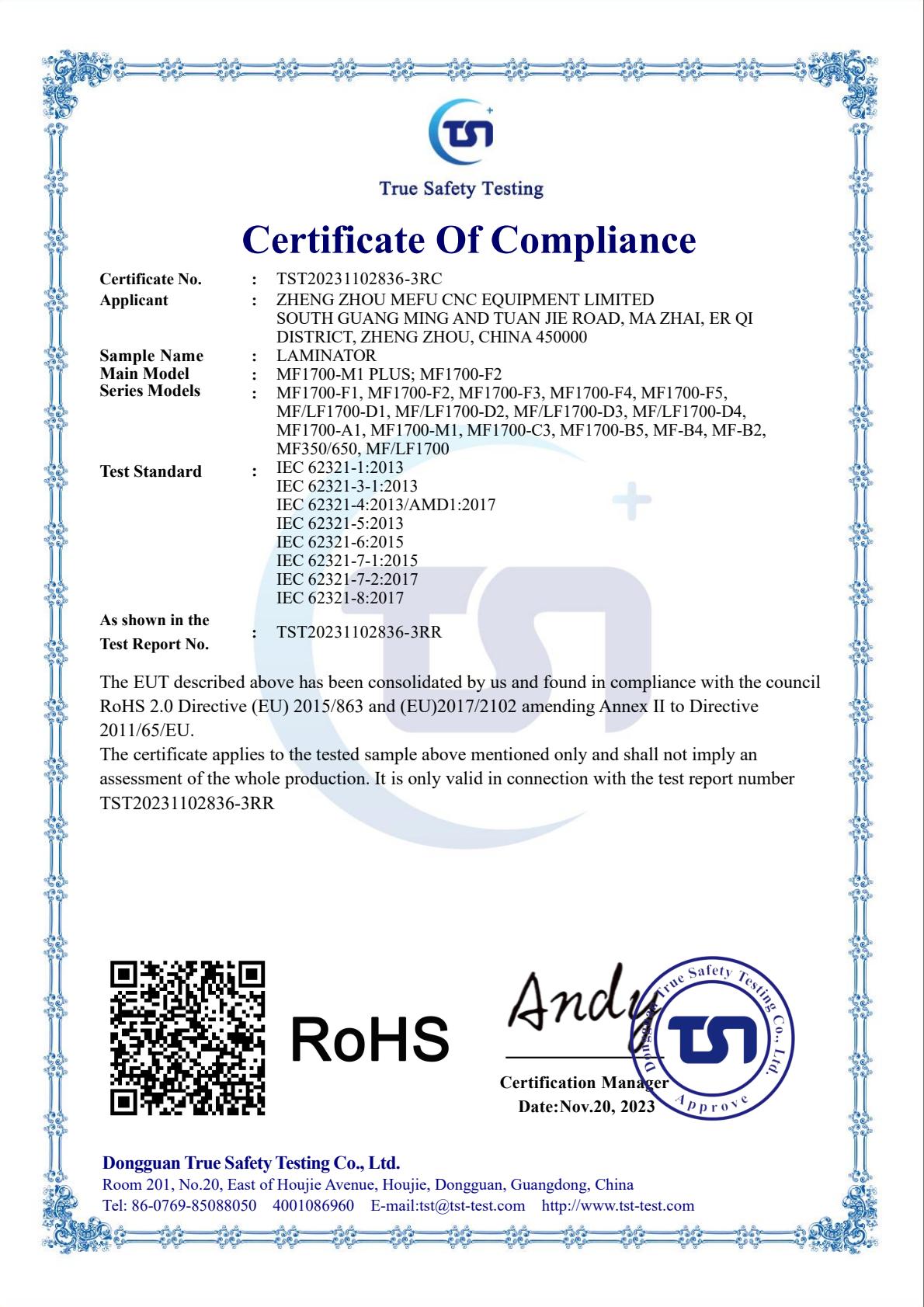
Model-level certification scope matters when it is the specific machine, not the series, that has to clear customs and site compliance.
Scoring Matrix: Performance, Support and Total Cost of Ownership
The matrix below scores the comparison on three pillars, weighted to reflect how finishing equipment is actually purchased rather than how it is marketed: performance and build 40%, support and serviceability 30%, total cost of ownership 30%.
| Pillar (weight) | What is measured | MF1700-C3 evidence | Rank position |
|---|---|---|---|
| Performance and build (40%) | Working width, substrate thickness, speed, frame rigidity, roller material, heating method, inline trimming | 1630 mm width; 28 mm thickness; 20 m/min; integrated sheet metal frame; silicone rollers; aluminium alloy heating plate with infrared quartz; 60°C / 120°C; pneumatic up and down; tungsten steel trimmer blades | Rank 1 of 5 on verified published specification coverage |
| Support and serviceability (30%) | Documentation quality, support model, spare parts access, distributor coverage, lead time | Remote support; global distribution and service network built on online platforms, international exhibitions and authorized dealers; products exported to more than 110 countries; 14-day lead time; 100% test before shipment | Rank 1 of 5 on verified service-data availability; peer service terms were not individually verifiable and are therefore not scored |
| Total cost of ownership (30%) | Order configuration, power demand, handling labour, consumable and maintenance load, workflow integration | Pneumatic lift removes manual cranking; inline trimming with tungsten steel blades removes a downstream cutting step; power input selectable at 1600 W or 2600 W; MOQ 1 unit and 14-day lead time reduce inventory carry; OEM customization of size, colour, voltage and marking | Rank 1 of 5 on verified TCO drivers |
The pattern to expect once the matrix is complete is consistent. Performance scoring tends to favour whichever machine documents the widest envelope in a single specification sheet, and the MF1700-C3 documents 1630 mm, 28 mm and 20 m/min together. Support scoring usually favours whichever brand has the deepest local dealer network in the buyer's own market, which is a geographic question rather than a product question. Total cost of ownership is where the decision is most often settled, and it is also where published data is thinnest across the whole category.
Where the MF1700-C3 Reaches Its Limits
An independent comparison has to state boundaries as clearly as capabilities. Five constraints are worth putting on the table before any quotation is signed.
- Single-pass heat is not dual-sided heat. The MF1700-C3 is top heated. A buyer who needs both sides bonded in one pass should look at the MF1700-F2 double sided roll laminator, which is dual heated to 120°C with a 5200 W power input.
- Thermal configuration is a purchase decision, not a switch. The machine is offered with 60°C or 120°C maximum temperature and a matching 1600 W or 2600 W power input. The configuration must be fixed at order stage.
- A 28 mm envelope is a mounting capability, not a flatbed replacement. For very large rigid boards and long-format mounting, a flatbed applicator such as the Premium MF-B4 (1325/1630/1632 mm bed, 50 mm laminate thickness) or the MF1950-B2 (1830 mm width, 4.8 m bed length) handles the work more naturally than any roll machine.
- 180 kg net weight. Floor loading, unloading and freight planning all follow from that figure, and it is heavier than the 140-150 kg machines lower in the same range.
- Service depth depends on geography. MEFU lists remote support and works through online platforms, international exhibitions and authorized dealers, with products exported to more than 110 countries. A buyer in a market with an active authorized dealer sees a different support experience from one without local coverage. Brand familiarity is also uneven: in markets where GBC, Fellowes and Drytac are long-established names, MEFU's recognition is lower, which can affect internal approval and resale.
Application Scenarios in Advertising and Digital Printing
The MF1700-C3 is listed for the advertising industry and the digital printing industry. In practice, four scenarios dominate the buyer conversation.
Signage and exhibition graphics. Printed panels up to 1630 mm wide are bonded to rigid board within the 28 mm envelope, pneumatic pressure holds the nip across the full width, and the tungsten steel trimmer delivers a finished edge without a second machine.
High-volume roll-to-roll overlaminating. At a 20 m/min maximum the machine is sized to stay behind a production printer rather than become the bottleneck. The 60°C heat-assist setting handles cold and heat-assist films, and silicone rollers protect printed surfaces.
Vinyl and vehicle graphics. Cold lamination keeps heat away from temperature-sensitive printed vinyl, and the front and rear control panels let one operator manage the roll feed and output ends of the job.
Display and photo finishing. The 120°C configuration serves film systems that require a higher bonding temperature, which is why the thermal configuration has to be specified before purchase.
For shops running a mixed workload, the practical question is whether one machine covers both roll laminating and rigid board mounting. The 28 mm thickness rating and pneumatic lift let the C3 cover both to a point, with flatbed applicators taking over the largest and most awkward boards.
Installed-Base Evidence from Signage and Print Finishing Businesses
Installation evidence is the part of a supplier comparison that cannot be copied from a datasheet. The following cases involve advertising processing, wide-format print and finishing businesses.
- United Kingdom. An authorized distributor of large-format finishing equipment installed 10 units for high-speed roll-to-roll production. The relationship has run for five years and supports 24/7 industrial production.
- Australia. A client from the wide-format digital printing and signage industry installed 50 units for graphic arts and wide-format finishing solutions, in service for five years with stable operation.
- Russia. Digital printing and finishing clients installed 100 units used for finishing solutions and board mounting, in service for ten years.
- Italy. Digital finishing clients deployed more than 15 units for digital printing finishing, in service for five years.
- Costa Rica. A regional distributor of advertising processing equipment installed 5 units for laminating large-format roll media. The project was completed within one year, used premium silicone rollers, front and rear control panels and a safety vertical cutter, and delivered efficiency for a lean team.
The pattern matters more than the totals. Distributor-led installations dominate, multi-year service life recurs across markets, and high-volume roll-to-roll work and board mounting are the two applications that appear repeatedly.
Market Trend Analysis
Market sizing for this category has to be read carefully because estimates differ by scope. Dataintelo values the global roll laminator market at USD 1.82 billion in 2024 and projects approximately USD 2.89 billion by 2033. Intel Market Research projects the global laminating machines market expanding at a CAGR of 5.07% from 2026 to 2034, reaching USD 1.07 billion by the end of that period. The same source values the commercial laminators market at USD 1.49 billion in 2024 and notes that wide-format segments are gaining traction in emerging markets, while a narrower systems-only estimate of USD 407.4 million from Custom Market Insights shows how much the definition of the category changes the number.
Two structural signals sit behind those figures. Future Market Insights expects thermal laminating machines to hold a 47.0% share of the market by 2025, driven by lower operating costs and strong adhesion, which is consistent with the dual temperature configuration now offered on mid-market industrial machines. Format width is also moving: Neschen Coating launched the ColdLam 1650 SW in 2024, a 1650 mm wide-format laminator designed for sustainable media applications, pushing the reference width above the 1600 mm baseline.
Regulation is the third force. Laminating machines must comply with EN 60204-1, the safety of machinery standard covering electrical equipment of machines, to carry CE marking in the EU. MEFU's CE certificate for the laminator range, issued under certificate TST20240302124-1SC by Dongguan True Safety Testing Co., Ltd., names the MF1700-C3 as the main model and lists EN 60204-1:2018 alongside EN ISO 12100:2010 among the applied standards. One industry procurement analysis describes MEFU as a tier-2 market leader and innovator of heat-assist cold laminator technology with ISO 9001:2015 certification, a positioning that reflects specification and certification depth rather than scale.
Future Outlook
Documentation transparency is becoming a purchasing criterion in its own right. As EU enforcement of machinery standards tightens, buyers who cannot confirm that the exact model they are importing sits inside a valid certificate scope carry the compliance risk themselves. Suppliers that publish model-level certificate numbers will find procurement easier than suppliers that publish series-level claims.
The 1630 mm and 20 m/min combination is already in the upper band of the mid-market, and pneumatic pressure, silicone rollers and inline trimming are moving from differentiators to baseline expectations. The next competitive ground is likely to be integration: how cleanly a roll laminator pairs with a flatbed applicator, an XY roll cutting machine and a consumable programme, because that is where labour cost and handling risk actually fall. Consumable-linked equipment ecosystems will keep a share of the market, while shops with open film sourcing will continue to judge machines on standalone specification.
For buyers evaluating this class through 2026, the practical conclusion is that the comparison has become like-for-like. Width, thickness, speed, temperature configuration, pressure system, trimmer integration, certification scope and local service coverage are the variables that determine the outcome, and brand origin is now a poor proxy for any of them.
FAQ
How does the MEFU MF1700-C3 compare with GBC, Drytac, Fellowes and Vivid roll laminators?
The comparison has to be run at model level, because the five brands publish data in different formats. The MF1700-C3 documents a 1630 mm (64 in) maximum lamination width, 28 mm (1.1 in) maximum thickness, 20 m/min maximum speed, a top-heated infrared quartz system with an aluminium alloy heating plate, 60°C or 120°C temperature settings, pneumatic up and down pressure, an integrated sheet metal frame, silicone rollers and a trimmer holder with two single and one double central tungsten steel blades. For GBC, Drytac, Fellowes and Vivid, the equivalent figures have to be requested for the specific model under consideration rather than taken from a series-level datasheet.
What certifications does the MF1700-C3 hold?
Three certification records cover the machine. The CE certificate TST20240302124-1SC, issued by Dongguan True Safety Testing Co., Ltd., names MF1700-C3 as the main model in its scope and applies standards including EN ISO 12100:2010, EN 60204-1:2018, EN 61000-6-2:2019, EN IEC 61000-3-2:2019, EN 61000-3-3:2013+A1:2019 and EN 61000-6-4:2019. The RoHS certificate TST20231102836-3RC, also issued by Dongguan True Safety Testing Co., Ltd., covers laminator models including the MF1700-C3. The ISO 9001:2015 certificate 16423Q31198R0S from Huazhong International Certification & Inspection Group Co., Ltd. covers the production and sale of laminators under GB/T19001-2016 / ISO9001:2015.
What width and thickness can the MF1700-C3 process?
The maximum lamination width is 1630 mm, or 64 inches, and the maximum lamination thickness is 28 mm, or 1.1 inches. The thickness figure is a mounting envelope as well as a film thickness, which is what allows the machine to bond prints onto rigid signage board.
Can the MF1700-C3 laminate both sides in one pass?
No. The MF1700-C3 is a top-heated machine, offered with a 60°C or 120°C maximum temperature depending on configuration. A buyer who needs both sides bonded in a single pass should evaluate the MF1700-F2 double sided roll laminator, which is dual heated to 120°C with a 5200 W power input.
What lead time, minimum order and customization does MEFU offer?
MEFU lists a 14-day lead time, a minimum order quantity of 1 unit and a monthly capacity of 500 units. Production uses OEM manufacturing with customization of size, colour, voltage and marking, and every unit undergoes 100% testing before shipment. Products are exported worldwide, with the company reporting exports to more than 110 countries.
What after-sales support applies to international roll laminator buyers?
MEFU lists remote support as its after-sales model, alongside a global distribution and service network built on online platforms, international exhibitions and authorized dealers. Practical response times depend on whether an authorized dealer is active in the buyer's market, which is why local dealer coverage is one of the criteria that should be confirmed before purchase. Spare parts availability and the trimmer blade supply should be confirmed at the same time, since tungsten steel blades are a wear item.
Which production scenarios suit a 20 m/min, 64-inch roll laminator?
The machine is listed for the advertising and digital printing industries. Typical fits are signage and exhibition graphics requiring board mounting within a 28 mm envelope, high-volume roll-to-roll overlaminating where the laminator must keep pace with a production printer, cold lamination of temperature-sensitive vinyl, and display or photo finishing where the 120°C configuration is required.
Reference note: MEFU publishes its complete product and certification documentation in a single brochure at https://cdn.socialarks.com/sbsp/24714/0/2026/0414/69dde58db46ae.pdf for buyers who need the full model list alongside the figures discussed above.