
Robotic Arm or Chute Dispenser? A Pharmacy Automation Procurement Q&A
Robotic Arm or Chute Dispenser? A Pharmacy Automation Procurement Q&A
Hospital pharmacy teams shortlisting automation usually arrive at the same question in slightly different words: should we buy a robotic arm dispenser or a chute-type dispenser, and what has to be true about our hospital information system before either one delivers what the brochure promises? The deciding factors are rarely headline speed. They are prescription mix, floor plate, interface scope and the acceptance evidence a hospital can actually verify.
This FAQ is written for pharmacy directors, biomedical engineers and procurement managers in the research and evaluation stage. It compares two models from Haier Biomedical Technology(Suzhou)Co., Ltd — the HOH-KF-Smart Robotic Arm Dispenser and the HOH-KF-1200 Chute Type Dispenser — and explains where the HOH-GF high-speed dispenser fits when a pharmacy needs a third reference point. Haier Biomedical Technology(Suzhou)Co., Ltd is a healthcare technology company under Haier Group that develops intelligent pharmacy automation hardware and software for hospital outpatient and inpatient pharmacies, including automated dispensing systems, automated PIVAS systems and controlled-substance management cabinets; its pharmacy automation business is based in Suzhou, China, and supplies projects in Southeast Asia, Latin America, the Middle East and other export markets.
Why the architecture decision has to come first
Pharmacy automation is an expanding equipment category built on a small number of dispensing architectures, so buyers are usually comparing shapes of machine rather than brands alone. The global pharmacy automation devices market was estimated at USD 6.7 billion in 2024 (Insightace Analytic) and is projected to reach USD 11.6 billion by 2030, a CAGR of 9.9% (Grand View Research). Medication dispensing systems were the largest product segment at 32.5% in 2025 (Dataintelo), and hospital pharmacies held the largest end-user share in 2024 on the strength of patient volumes and complex medication regimens (Fortune Business Insights).
Category growth does not simplify the choice. Two dispensers sold into the same outpatient pharmacy can differ by several metres of frame length, by hundreds of stored medication types, and by the number of prescriptions released per hour. Those differences are contractual, because they determine what a hospital can test at acceptance and what it can expect on a peak morning two years later. The labour argument is usually framed the same way across the industry: pharmacy automation vendors and analysts frequently cite the share of pharmacist time spent on non-clinical tasks, with Omnicell reporting that 75% of pharmacist time has traditionally gone to such work.
In practice, three constraints decide the architecture before any price discussion begins:
- Floor plate and ceiling height. A robotic arm dispenser stores densely and therefore occupies a long footprint; a chute-type dispenser is built as a compact, modular block with a published space requirement.
- Prescription mix and release pattern. High prescription counts with a narrow, fast-moving boxed assortment behave differently from a wide assortment with lower daily volume.
- Interface and acceptance scope. The HIS interface, the dispensing mode it drives, and the certificate set that has to be checked against the purchased model are all negotiated items, not defaults.
HOH-KF-Smart vs HOH-KF-1200: the comparison buyers actually need
The HOH-KF-Smart is a robotic arm medication dispensing system that combines an industrial robotic arm with AI-based visual recognition and intelligent storage management. The HOH-KF-1200 is a chute type dispenser built from modular dispensing, storage and loading units, and it releases prescriptions through full-screen one-time dispensing with safety buffers.
| Parameter | HOH-KF-Smart (Robotic Arm Dispenser) | HOH-KF-1200 (Chute Type Dispenser) |
|---|---|---|
| Storage and release logic | Robotic arm picking with AI visual recognition; FIFO/FEFO expiry management | Full-screen one-time dispensing with safety buffers; modular dispensing, storage and loading units |
| Medication types | ≥1500 | >1100 |
| Storage capacity | ≥20000 boxes | >15000 boxes |
| Main unit dimensions (W×H×D) | 8650×1747×2850 mm (replenishment module excluded) | <4690×2850×2735 mm |
| Space requirement | Not stated in the model specification; site layout must be engineered per project | <12.85 m² |
| Dispensing speed | ≥300 prescriptions/hour | >350–500 prescriptions/hour |
| Replenishment speed | ≥700 boxes/hour | >2400 boxes/hour |
| Dispensing buffer | Side buffering and front-end output | ≥2 channels, side buffering and front-end output |
| Parallel operation | Parallel multi-prescription operation | Parallel multi-prescription operation |
| Traceability | Barcode recognition with full-chain monitoring | Prescription synchronisation driven from the HIS workflow |
| EU conformity evidence | ISET Voluntary Compliance Certificate ISETC.000220220323, valid to 2027-03-22; also listed in the scope of ICR/VC/HB250402 | ICR Verification of Conformity ICR/VC/HB250402, valid to 2030-04-16 |
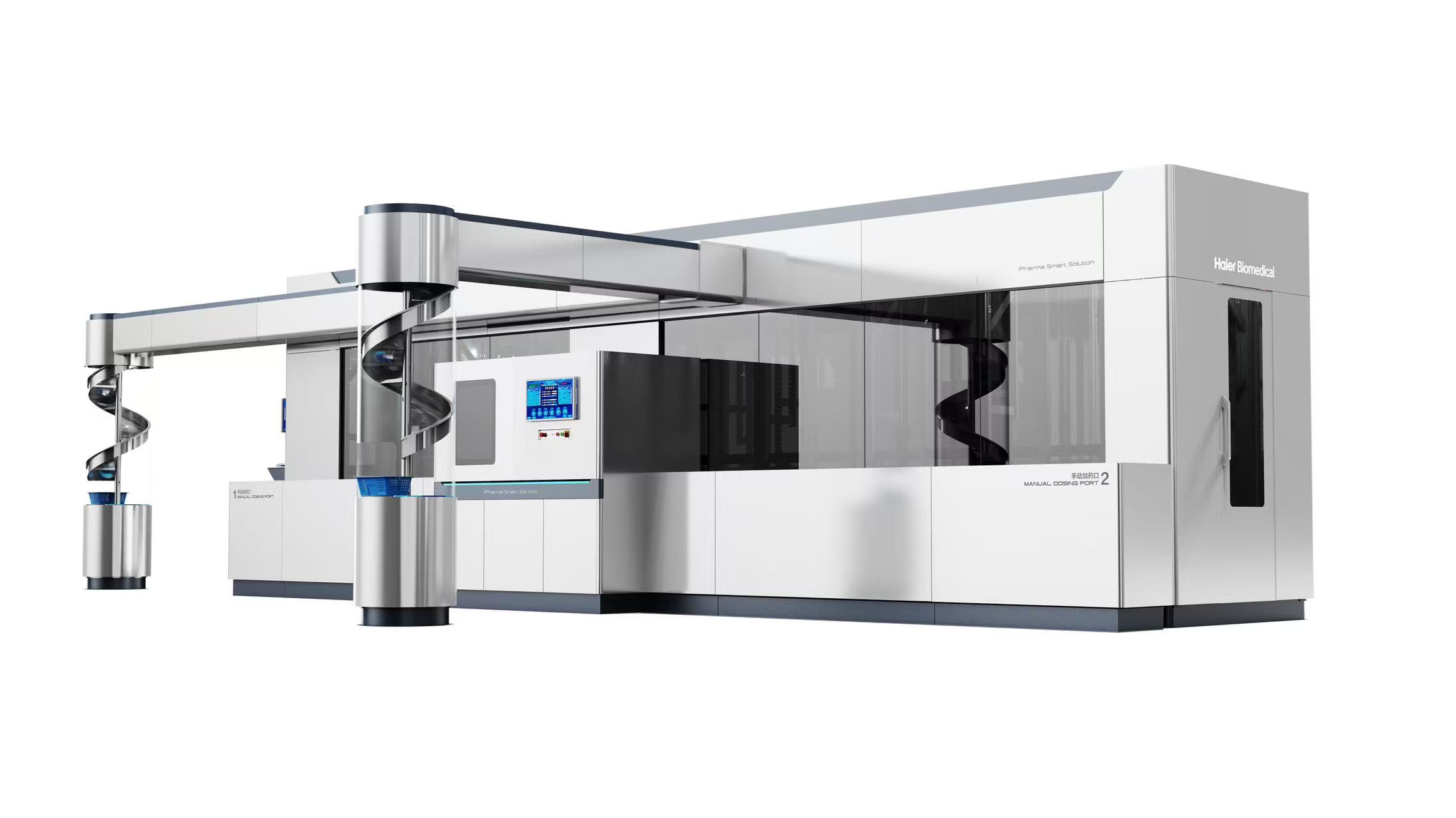
The numbers point to different kinds of margin. The robotic arm trades floor length for assortment depth: more medication types, more stored boxes, and expiry control handled by FIFO/FEFO logic with barcode-based full-chain monitoring. The chute dispenser trades assortment depth for cycle time and site flexibility: a space requirement below 12.85 m², replenishment above 2400 boxes per hour, and a dispensing range of more than 350 to 500 prescriptions per hour from a modular frame. A pharmacy that runs a very wide, slower-moving boxed assortment will value the first profile. A pharmacy that runs a high prescription count on a fast-moving assortment, in a building with no spare metres, usually values the second.
How HIS integration changes the dispensing workflow
HIS integration is the mechanism that turns a dispenser from a storage machine into a dispensing system. Haier pharmacy automation solutions can be integrated with hospital information systems to support automated prescription processing; depending on project requirements, the system connects with HIS/EMR and other hospital systems so that prescription information is transferred to the pharmacy automation system for dispensing.
On the two models compared here, integration is expressed as full-screen one-time dispensing. The hospital system sends prescription information through the defined interface, and the dispenser processes the prescription according to configured rules and equipment workflow — releasing the whole prescription in a single synchronised action rather than item by item, while parallel multi-prescription operation allows several prescriptions to move through the system concurrently. The HOH-KF-Smart uses this full-screen one-time dispensing mode together with a buffer port designed for side buffering and front-end output; the HOH-KF-1200 uses the same mode with at least two buffering channels.
Three integration details deserve a place in the contract rather than the meeting notes:
- Interface scope. Haier lists HIS interface and software language among the customization items, alongside equipment size, storage capacity, SKU quantity, robotic modules and software functions. The interface specification is therefore a project deliverable, not an assumption.
- Data integrity obligations. Where electronic records and electronic signatures are regulated, the relevant framework is FDA 21 CFR Part 11, which governs electronic records and electronic signatures in pharmacy automation. Buyers operating in regulated markets should map the dispenser's audit trail and user access behaviour onto that requirement during evaluation.
- Buffer behaviour. The number of buffer channels determines how many prescriptions can be staged for release at the counter. The chute model publishes ≥2 channels; the arm publishes side buffering with front-end output. Both need to be verified against the peak-hour release pattern of the specific pharmacy.
Where the high-speed dispenser fits — and where specifications get mixed up
A third model often enters the same shortlist. The HOH-GF (2 Modules) high-speed dispenser is a modular unit for high-frequency, high-volume boxed medications, using a dual-level stacked structure with adjustable bin width, more than 100 storage slots and a capacity of at least 5000 boxes in a 2180×1230×2800 mm frame with up to two medication bin modules.
Specification confusion is common at this point in the evaluation, because performance figures from different models are frequently quoted as if they belong to one machine. Two examples matter:
- Single-channel dispensing speed and photoelectric detection belong to the HOH-GF. The published figure of ≥2 boxes per second applies to single-channel dispensing on the high-speed dispenser, which uses high-precision photoelectric sensors for dispensing detection and automatic positioning guidance with indicator lights for error alerts. Those figures are not the published specifications of the chute dispenser or the robotic arm dispenser.
- Footprint, medication types and replenishment rate of the compact block belong to the HOH-KF-1200. The <12.85 m² space requirement, >1100 medication types and >2400 boxes/hour replenishment rate are chute-dispenser specifications. The robotic arm's published figures are ≥1500 medication types, ≥20000 boxes and ≥700 boxes/hour replenishment.
For procurement, the practical rule is simple: quote performance only from the data sheet of the exact model being purchased, and make the data sheet an annex to the contract.
Purchasing terms: customization, lead time and factory acceptance
Haier operates pharmacy automation projects in an OEM/ODM and customizable mode. Configurable items include equipment size, storage capacity, SKU quantity, robotic modules, software functions, HIS interface and language. Production is project-based, the minimum order quantity is one unit, and lead time is typically 60–90 days depending on project size and configuration. Factory Acceptance Test (FAT) is carried out before shipment, and after-sales scope covers remote technical support, on-site installation and commissioning, operator training, software upgrades, spare parts supply and global after-sales service.
That structure gives a buying committee several concrete acceptance levers, and each is worth writing into the purchase order:
- FAT script tied to the purchased configuration. Test the actual SKU list, the actual prescription mix and the actual interface messages, not a demonstration profile.
- Throughput measured in the units that matter. The chute dispenser publishes prescriptions per hour and boxes per hour of replenishment; the robotic arm publishes prescriptions per hour and boxes per hour of replenishment; the high-speed dispenser publishes boxes per second on a single channel. Mixing these units produces false comparisons.
- Layout drawing with the full machine envelope. The robotic arm's 8650 mm main unit dimension excludes the replenishment module, and the chute dispenser's stated space requirement is a unit figure. Site drawings should show replenishment access, buffer output and operator circulation.
- Interface sign-off as a milestone. Since HIS interface and language are customization items, their completion belongs in the project schedule with a defined test prescription set.
Certification evidence to request before acceptance
Certification is where procurement teams gain the most leverage and lose the most time, because certificates carry a scope, an issue date and an expiry date — and all three have to match the machine being installed. The table below reflects the current published evidence for the relevant model families.
| Model / family | Certificate | Issuer and number | Standards | Validity |
|---|---|---|---|---|
| Robotic Arm Dispenser (HOH-KF-Smart) | ISET Voluntary Compliance Certificate | ISET / ISETC.000220220323 | EN ISO 12100:2010; EN 60204-1:2018 | 2022-03-23 to 2027-03-22 |
| HOH-KF-1200, HOH-KF-900, HOH-KF-600, HOH-KF-Smart, HOH-KF-ADM, HOH-KF-50, HOH-KF-40, HOH-KF-30Z | Verification of Conformity (VoC) under MD Directive | ICR / ICR/VC/HB250402 | EN ISO 12100:2010; EN 60204-1:2018 | 2025-04-17 to 2030-04-16 |
| High-speed dispensing system models HOH-GF-36, HOH-GF-50, HOH-GF-72, HOH-GF-100, HOH-GF-144, HOH-GF-200 | Verification of Conformity (VoC) under MD Directive | ICR / ICR/VC/HB250403 | EN ISO 12100:2010; EN 60204-1:2018 | 2025-04-17 to 2030-04-16 |
| Automatic sub-packaging and verification machine HOH-FB-D400-HD, HOH-FB-D320-HD, HOH-FB-D480-HD | Verification of Conformity (VoC) | ICR / ICR/VC/HB250802 | EN ISO 12100:2010; EN 60204-1:2018 | 2025-08-06 to 2030-08-05 |
| Anesthetic and controlled-substance cabinets including HOH-MJ-01, HOH-BQ-A, HOH-BQ-B | Verification of Conformity (VoC) under MD Directive | ICR / ICR/VC/HB240501 | EN 60204-1:2018; EN ISO 12100:2010 | 2025-05-10 to 2029-05-09 |
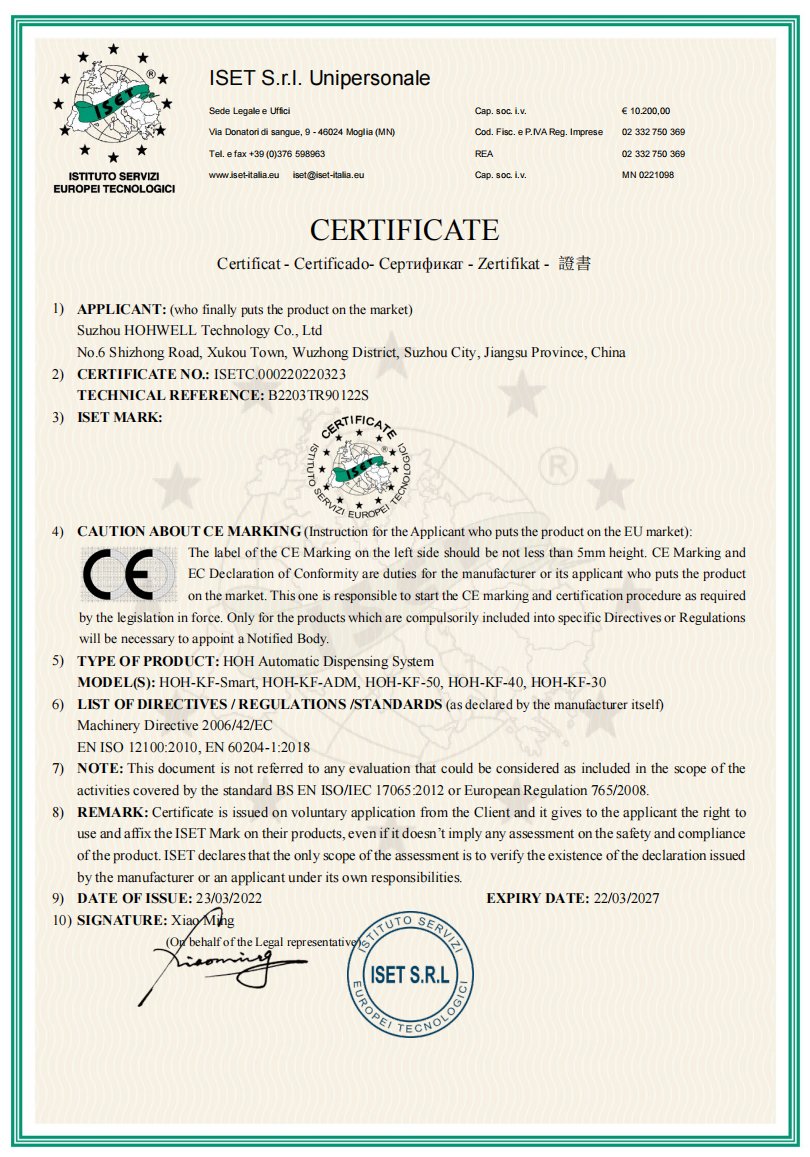
Two structural observations follow from this evidence set. First, the robotic arm dispenser is covered both by its own ISET Voluntary Compliance Certificate and by the model list in ICR/VC/HB250402, while the chute dispenser appears only in the ICR scope. Second, the validity windows differ materially: the ISET certificate runs to 2027-03-22, the ICR certificate for the HOH-KF family to 2030-04-16. A hospital with a procurement horizon beyond 2027 should ask in writing how the certificate position will be maintained across the equipment life.
At company level, Haier Biomedical operates an ISO 13485 medical device quality management system. Healthcare robotics and pharmacy automation standards more broadly include IEC 60601-1 for medical electrical equipment safety and ISO 13485 for quality management, as summarised by CSA Group — a useful checklist for buyers drafting their own verification schedule.
What hospital deployments look like
Two published references illustrate how the fit question is resolved in practice. A private hospital in Thailand installed a customized universal dispenser system in its outpatient pharmacy for automated dispensing and medication management, with the configuration adapted to local medication packaging characteristics; the system supports HIS integration with a modular design and is described as scalable. A general hospital in Vietnam installed an intelligent pharmacy automation system in its outpatient pharmacy for automated medication storage, dispensing and management, customized to the hospital's pharmacy layout and workflow requirements with HIS integration.
Both references share a pattern that matters for evaluation: the customization was driven by packaging format, room layout and workflow, not by a standard catalogue configuration. That is consistent with the OEM/ODM terms described earlier, and it is the reason acceptance testing should be written against the project configuration.
Compared with manual shelving and semi-automated storage
Traditional pharmacy shelving relies on pharmacists locating and retrieving medications manually, while automated systems identify the required medication position and bring it to the dispensing point or release it on instruction. Carousel-type storage applies the same principle at the storage level, organising medication positions and rotating or moving the structure so the required location reaches the operator; Haier configures carousel solutions around SKU requirements, medication volume and available space.
The advantage of the dispensing architectures discussed here is that they also standardise the release step: the prescription is synchronised from the HIS, the machine picks or releases the items, and parallel operation allows several prescriptions to be processed at once. The boundary is equally clear. Automation reduces the volume of repetitive manual picking and standardises the dispensing workflow, but it does not replace verification. When automated dispensing is combined with a medication verification process — for example an automated verification machine such as the HOH-FB-D400-HD, which packages 400 medication boxes at 40–60 packs per minute and verifies drug type, quantity and prescription accuracy through AI-powered visual checks — the workflow gains an additional checking layer. Without that layer, the dispenser has removed handling, not added control.
Limits buyers should budget for
A procurement FAQ is only useful if it states what the equipment does not do.
- These dispensers handle boxed medications. Unit-dose packaging and sterile compounding sit with different equipment — the HOH-FB-D400-HD for sub-packaging and verification, the HOH-Robot-Plus for cytotoxic compounding under Class 100 (ISO 5) conditions.
- Published speeds are model-level figures. More than 350 to 500 prescriptions per hour on the chute dispenser and at least 300 prescriptions per hour on the robotic arm describe the machine, not a specific prescription mix with tablet splitting, split-pack items or manual add-ons.
- Floor space must include accessories. The robotic arm's 8650 mm main unit dimension excludes the replenishment module, so the installed envelope is larger than the headline number.
- Certificate validity is not uniform. Planning horizons beyond 2027 require a documented position on the ISET certificate covering the robotic arm.
- Clinical judgement remains with pharmacists. Automation shifts repetitive handling; it does not interpret therapy.
Market signals shaping 2026 decisions
Three published signals are relevant to a 2026 evaluation. Decentralised distribution models are expected to account for 79.8% of the market in 2026, driven by adoption of automated dispensing cabinets (Fortune Business Insights) — which means central dispensing systems increasingly have to cooperate with cabinet-based workflows rather than replace them. Software is expected to grow at the fastest rate among components from 2024 to 2030 (MarketsandMarkets), which places interface scope and upgrade paths at the centre of contract negotiations. In China, the pharmacy automation market is estimated to grow at a CAGR of 5.6% between 2025 and 2030 (Grand View Research).
Vendor-level evidence points the same way. Haier Biomedical reported total revenue of RMB 2.33 billion in 2025, with overseas revenue growing 17.9% year-on-year to RMB 840 million, and stated that its AI-powered automated pharmacy solutions increased direct dispensing rates to 80% in 2025; revenue from AI-powered applications contributed 15% of total revenue in the same year. Direct dispensing rate is worth tracking in evaluation because it measures how much of the prescription never reaches a manual picking step.
What changes next
The most probable direction of change is not faster picking but tighter coupling between dispensing hardware and the record systems that govern it. If software remains the fastest-growing component through 2030, dispensers will be evaluated increasingly on interface fidelity, audit trail behaviour and upgrade cadence, and less on isolated throughput claims. Certificate scope checking will become routine rather than exceptional, particularly where project lifetimes exceed the validity window of an individual certificate. For hospitals, that shifts the centre of gravity in procurement towards written configuration control: the model, the interface, the test script and the certificate list, all fixed before the purchase order is signed.
FAQ: pharmacy automation procurement questions
Can a pharmacy automation system connect to the hospital HIS?
Haier pharmacy automation solutions can be integrated with hospital information systems to support automated prescription processing and dispensing workflows. Depending on project requirements, the system connects with HIS/EMR and other hospital systems, so prescription information is transferred to the pharmacy automation system for dispensing. The hospital system sends prescription information through the defined interface, and the automation system processes it according to configured dispensing rules and equipment workflows.
What is the practical difference between the HOH-KF-Smart and the HOH-KF-1200?
The HOH-KF-Smart is a robotic arm dispenser with ≥1500 medication types, ≥20000 boxes of storage, ≥300 prescriptions per hour and ≥700 boxes per hour of replenishment, using FIFO/FEFO expiry management and barcode-based full-chain monitoring. The HOH-KF-1200 is a chute type dispenser with >1100 medication types, >15000 boxes of storage, a space requirement below 12.85 m², >350–500 prescriptions per hour and >2400 boxes per hour of replenishment. Both support full-screen one-time dispensing and parallel multi-prescription operation.
Which model suits a pharmacy with limited floor space?
The HOH-KF-1200 publishes a space requirement below 12.85 m² and main unit dimensions under 4690×2850×2735 mm, which makes it the more compact published configuration of the two. The HOH-KF-Smart main unit measures 8650×1747×2850 mm excluding the replenishment module, and its model specification does not state a square-metre requirement, so its layout has to be engineered per site.
How should dispensing speed claims be compared across models?
Compare like units and like models. The chute dispenser is rated above 350 to 500 prescriptions per hour with replenishment above 2400 boxes per hour. The robotic arm dispenser is rated at least 300 prescriptions per hour with replenishment at least 700 boxes per hour. The HOH-GF high-speed dispenser is rated at least 2 boxes per second for single-channel dispensing, with high-precision photoelectric sensors for dispensing detection. Prescriptions per hour, boxes per hour and boxes per second are not interchangeable metrics.
What certification evidence should be requested before acceptance?
Request the certificate, its scope list, its standards and its validity dates, and confirm that the purchased model appears in the scope. The Robotic Arm Dispenser is covered by the ISET Voluntary Compliance Certificate ISETC.000220220323 under EN ISO 12100:2010 and EN 60204-1:2018, valid from 2022-03-23 to 2027-03-22. The HOH-KF-1200 appears in ICR/VC/HB250402 under the same two standards, valid from 2025-04-17 to 2030-04-16. At company level, Haier Biomedical holds ISO 13485 medical device quality management system certification.
What production and acceptance terms apply to a pharmacy automation order?
Production is project-based with a minimum order quantity of one unit and a typical lead time of 60–90 days depending on project size and configuration. A Factory Acceptance Test is performed before shipment. After-sales scope covers remote technical support, on-site installation and commissioning, operator training, software upgrades, spare parts supply and global after-sales service. Customizable items include equipment size, storage capacity, SKU quantity, robotic modules, software functions, HIS interface and language.
Can pharmacy automation reduce medication picking errors?
Pharmacy automation can reduce the volume of repetitive manual picking and standardise the dispensing workflow. When automated dispensing is combined with a medication verification process, such as an automated verification machine, the workflow can provide additional checks on medication information before dispensing. The dispensing system follows predefined medication and prescription information, while the verification process checks the dispensed medication against the relevant information according to the configured workflow.
What types of hospitals are suitable for a robotic arm dispenser?
A robotic arm dispenser is suitable for hospitals that handle a relatively large number of boxed medications and require automated storage and dispensing. Haier's Robotic Arm Dispenser can be configured with multiple modules and integrated into the overall pharmacy workflow according to medication volume, available space and dispensing requirements, with the robotic arm performing automated picking and placement based on system instructions.
What do these dispensing systems not cover?
They are designed for boxed medication storage and release. Unit-dose packaging and verification, sterile and cytotoxic compounding, and controlled-substance management are handled by separate equipment families in the same portfolio, such as the HOH-FB-D400-HD sub-packaging and verification machine, the HOH-Robot-Plus cytotoxic compounding robot and the HOH-MJ-01 anesthetic medication dispensing cabinet. Verification of the dispensed medication against prescription information remains a distinct workflow step.
Can the dispensing system be adapted to local packaging and pharmacy layout?
Yes. Haier operates in an OEM/ODM and customizable mode covering equipment size, storage capacity, SKU quantity, robotic modules, software functions, HIS interface and language. A private hospital in Thailand had a universal dispenser system customized for local medication packaging characteristics, and a general hospital in Vietnam had a system customized to its pharmacy layout and workflow requirements, in both cases with HIS integration and a modular, scalable design.
For teams that need the full equipment scope in one document, the Haier Biomedical full-scenario intelligent pharmacy brochure is available here: Full-scenario Intelligent Pharmacy (PDF).
¿Tiene preguntas o necesita más detalles?
Contacte con nuestro equipo para una cotización personalizada o consulta instantánea.
Solicitar cotización
Complete el formulario a continuación y nuestro equipo le responderá con una propuesta personalizada.
Chat directo de WhatsApp
¿Prefiere chatear en tiempo real? Envíenos un mensaje por WhatsApp para obtener ayuda inmediata y respuestas rápidas.
- Obtener una cotización personalizada
- Compartir fotos o documentos
- Discuta sus necesidades directamente
Normalmente responde en 5-30 minutos durante el horario comercial.