
Robot Waterjet Cutting: Capability Signals Buyers Can Verify
Robot Waterjet Cutting: Capability Signals Buyers Can Verify
Robotic waterjet cutting is bought as an outcome — a part cut to tolerance, at a rate, without thermal distortion — but it is supplied as a chain of components: an ultra-high-pressure pump, a motion platform, a cutting head, a controller, and the documentation that ties them together. The distance between those two views is where most supplier-capability claims become hard to check.
This reference sets out the capability signals an industrial buyer can actually verify before committing to a robotic waterjet system, using the YC Waterjet Robot Waterjet Cutter (YCWJ-Robot) and the company's Ultra High Pressure Waterjet Pump range — YCG-3038, YCG-3742, YCG-Ultra100, YCG-SERVO50 and related models — as a concrete example of what documentation should exist, where it usually stops, and what a buyer should ask for next.
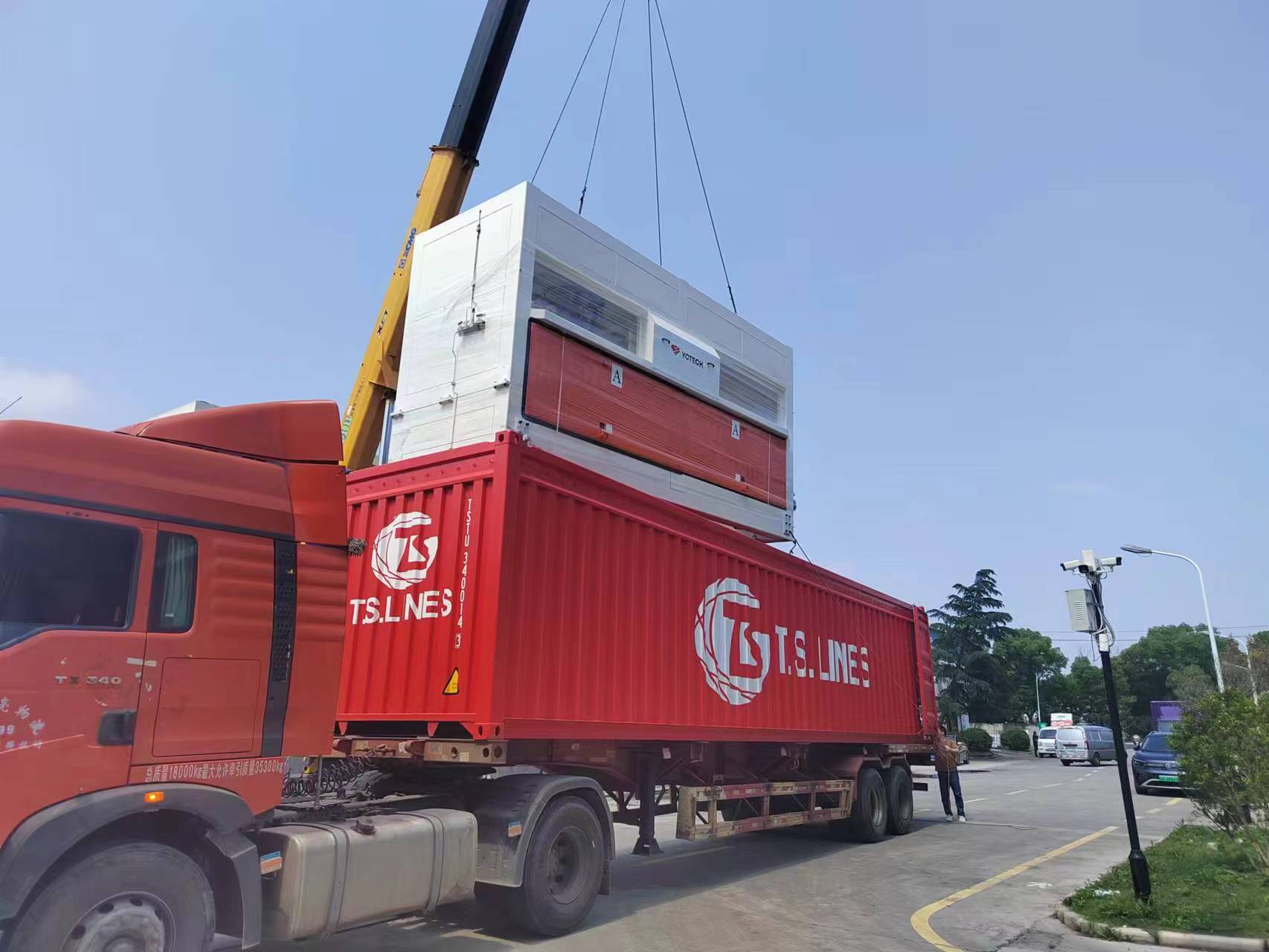
Four claims buyers routinely treat as one
Most sourcing friction in this category comes from merging four different claims into a single word: capability. They require different evidence, and they are usually answered at different stages of a project.
- A product exists in the portfolio. Evidenced by a catalogue page, a model name and a specification table. This is the easiest claim to make and the weakest basis for a decision.
- A specific configuration is being offered to you. Evidenced by the quotation, the configuration list and the boundary of supply — what the supplier delivers, and what is site work.
- A test was performed before shipment. Evidenced by an acceptance record tied to your serial number, with the test conditions written down.
- Performance will hold in your plant. Evidenced only by your own ramp-up: your material, your fixtures, your operators, your maintenance regime.
A supplier that can only answer point 1 is not necessarily a weak supplier. But a buyer who accepts point 1 as an answer to points 2 through 4 is carrying the integration risk without pricing it.
The five evidence layers of a robotic waterjet system
For procurement purposes, robotic waterjet capability decomposes into five layers, each with its own documents. Requesting them in this order keeps the conversation technical rather than promotional.
- Pressure source: pump model, pressure and flow ratings, and the construction of high-pressure components.
- Build and site fit: materials of construction, rated voltage, and the electrical configuration actually quoted.
- Motion and control: robot platform, cutting-head configuration, axes supported, control software and who commissions it.
- Acceptance and commercial terms: what counts as acceptance, what is tested, warranty boundaries and service route.
- Certification and quality system: certificate scope, issuing body, validity, and whether the delivered model sits inside that scope.
Layer 1: Pump identity and pressure-rating traceability
The pump is the highest-wear module in an abrasive waterjet system and the one most often described in general terms in supplier literature. The verifiable request is narrow: name the pump model in the quotation, and confirm that the model on the nameplate, the model in the order confirmation and the model in the manual are the same.
In the YC Waterjet range, that means a quotation that specifies YCG-3038, YCG-3742, YCG-Ultra100, YCG-SERVO50 or another named model — including the YCG-3742S, YCG-Ultra100S and YCG-Servo50S variants — rather than a generic reference to a "high pressure water cutter." The pump line carries a stated maximum operating pressure of 4137 bar (60,000 psi). Three questions follow from that figure, and all three are legitimate to put in writing:
- Is the figure a maximum or a continuous value? A maximum rating and a recommended working pressure describe different operating regimes, and only the second shapes consumable life and maintenance intervals.
- What flow rating accompanies the pressure rating? Pressure alone does not determine cutting capability; it is one input alongside flow, orifice and nozzle selection, abrasive feed and material thickness.
- Who supplies the pressure-retaining components? Whether the intensifier, check valves and high-pressure lines are produced in-house or sourced matters mainly for spare-part traceability and lead time, not for marketing.
YC Waterjet's published specification fields illustrate how partial information creates false confidence. The company's gantry machine listing, for example, states a cutting accuracy of ±0.1 mm and repeat positioning accuracy of ±0.025 mm. Those numbers are usable only once a buyer knows the material, thickness, cutting-head configuration and measurement method behind them — a question worth asking of any supplier, including this one, before the figures enter a comparison table.
Layer 2: Materials of construction and electrical configuration
Two specification families are frequently compressed into a single line in a quotation, and both carry commissioning consequences.
Build materials
The YC Waterjet pump line is specified with stainless steel and alloy steel construction. For a buyer, the useful follow-up is not "is it stainless steel?" but "which components are stainless steel and which are alloy steel, and what is the maintenance implication of each?" A waterjet pump operates in a wet, high-cycle, abrasive-adjacent environment, so the material split between structural and pressure-retaining parts affects both corrosion behaviour and service access. A supplier that can answer at component level has an engineering document; a supplier that answers at brochure level has a marketing line.
Rated voltage
The pump range is offered at 220 V, 380 V and 420 V rated voltage, and voltage also appears among YC Waterjet's stated customization options alongside logo, cutting head, cutting area, cutting speed, cutting thickness and height measurement. The verification step is simple and frequently skipped: confirm that the voltage written on the purchase order matches the site supply, and that the configuration list shows the same value. A mismatch discovered at commissioning is an installation cost, not a warranty discussion.
Customization breadth is worth reading carefully as a capability signal. The list above mixes cosmetic items (logo) with engineering items (cutting head, cutting area, cutting thickness, height measurement). A supplier that distinguishes clearly between the two — and can describe what changes in the design when a cutting-area or head requirement changes — is demonstrating engineering control. A supplier that presents customization as a menu without engineering consequences is offering a badge, not a configuration.
Layer 3: Motion, cutting head and control integration
Robotic waterjet capability is not established by the robot alone. It is established by the head, the control architecture and the software chain that connects a CAM toolpath to a correct nozzle path, and by who is responsible for making that chain work.
YC Waterjet states that its controller and software support 3 to 5 axes and include 5-axis cutting and abrasive delivery system functions. Treated as a company-reported capability, that statement tells a buyer which configuration family to ask about; it does not establish delivered accuracy on a specific part.
The axis question is a geometry question before it is a technology question. A 3-axis configuration addresses flat, two-dimensional parts. A 5-axis configuration adds rotational axes for bevel cutting, taper compensation and three-dimensional contours, and brings corresponding setup and programming complexity. A buyer whose parts are flat sheet should not pay for rotational capability; a buyer whose parts include bevels, weld preparations or shaped profiles should not assume that a 3-axis machine plus fixturing will hold the geometry over a production year.
The customization list also covers cutting head and height measurement. Both are integration-relevant rather than cosmetic: head selection determines what geometry and material range the cell addresses, and height measurement influences standoff control on non-flat or variable surfaces. Buyers should ask for the head configuration in writing, and for the software version and post-processor that will be used for their CAM output — then confirm who configures it and who is responsible if the first production nest does not run.
Layer 4: Acceptance criteria written into purchasing terms
This is the layer where capability claims either become contractual or remain aspirational. YC Waterjet's stated purchasing terms provide a concrete example of the commercial structure to examine.
- MOQ: 1 set.
- Delivery terms: EXW / FCA / FAS / FOB / CFR / CIF / CPT / CIP / DPU / DAP / DDP, according to negotiation.
- Acceptance criteria: ex-factory test.
- Payment terms: 30% deposit by T/T after contract signing, with the remaining 70% by T/T before delivery.
"Ex-factory test" is the pivotal term in that list, because it defines the moment at which the machine becomes the buyer's risk. The term alone does not say what the test comprises. That gap is where a buyer should negotiate: the contract or its technical annex can specify the pressure hold test, the motion verification, the cutting trial material and thickness, the measurement method and the format of the record retained for the specific serial number.
Supporting operational context is verifiable in the same way. YC Waterjet states a monthly capacity of 10 sets and a lead time of 30–45 days, lists quality control as delivery inspection, and states that each unit undergoes pre-delivery testing. Capacity and lead time are planning inputs, not capability proof; the pre-delivery test is the capability-adjacent item, and it is only meaningful when its content is defined.

Warranty and service boundaries
YC Waterjet's stated after-sales structure has three components worth separating during evaluation: a one-year warranty covering the machine but excluding consumable parts, with free replacement parts shipped for non-manual defects; remote guidance supported by manual and video material; and on-site engineer assistance, including for split-type waterjets, with travel, visa, accommodation and fee costs borne by the client.
Two questions turn those statements into usable procurement criteria. First, what is classified as a consumable — a definition that materially changes the ten-year cost picture. Second, what response commitment applies to remote support, since a stated channel without a stated response expectation is a description, not a service level.
Layer 5: Certification scope and quality system
Certificates are among the most frequently misread documents in machine-tool sourcing, largely because buyers check that a certificate exists rather than what it covers.
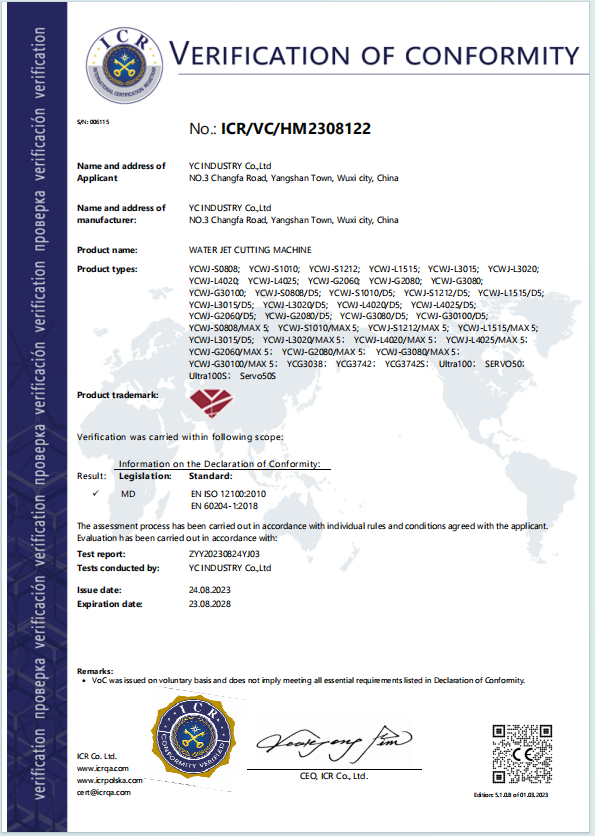
YC Waterjet holds a Verification of Conformity (CE certification), certificate number ICR/VC/HM2308122, issued by ICR Co., Ltd. for the EU market on 24 August 2023 and valid to 23 August 2028. The cited standards are the Machinery Directive (Regulation), EN ISO 12100:2010 and EN 60204-1:2018, and the stated scope is Water Jet Cutting Machine, including multiple models of the YCWJ series as well as Ultra100 and Servo50S.
The company also holds ISO 9001 certification, certificate number 17324Q21401R0S, issued by Beijing Zhongjiaoyuanhang Certification Co., Ltd. against GB/T 19001-2016 / ISO 9001:2015, issued 29 October 2024 and valid to 28 October 2028, with a scope covering research, development and manufacture of ultra-high-pressure water jet cutting machines.
Four checks convert these documents into evidence rather than reassurance:
- Verify the number with the issuing body, not only with the supplier.
- Check the scope against the delivered model. A certificate covering a series or a list of models is not the same statement as a certificate covering the exact configuration on your purchase order; where the scope is series-level, ask the supplier to confirm in writing that your configuration falls inside it.
- Check the standards cited against your market's requirements. The standards named on a certificate reflect the conformity route taken at issue date; obligations in your jurisdiction and application remain your compliance function's determination, not the supplier's.
- Check validity against your delivery date. Both certificates run to 2028, which covers typical 2026 delivery schedules but not an indefinite service life — renewal is a reasonable question in a long-term supply agreement.
What documented applications establish — and what they do not
Reference applications are useful for a specific purpose: confirming that a supplier has delivered into your material category, your climate and a comparable integration context. They are weaker for confirming that the machine will hold your tolerance at your cycle time.
Company-reported applications for YC Waterjet systems include an industrial manufacturing client in Thailand using a robotic waterjet cutting system for precision part cutting, with reported results including reduced scrap and improved production efficiency; a yacht manufacturing client in Mauritius cutting aluminum plate, with reported clean, burr-free cuts; a home furniture manufacturing client in Germany cutting stone and marble components; and a diamond processing and manufacturing client in Austria applying the system to precision crystal cutting in the luxury goods sector.
Read those as delivery evidence, not performance proof. Each establishes that the supplier has shipped into that industry and geography. None establishes the tolerance achieved on your drawing, the uptime your schedule requires, or the consumable consumption your cost model assumes. The verification step is to ask what a reference actually covers: which configuration was delivered, what test was performed at acceptance, and whether a technical discussion with a comparable user is possible. A supplier unwilling to describe a reference at configuration level is offering a logo, not a reference.
Market context worth knowing before shortlisting
Two published data points help frame a robotic waterjet decision, provided their limits are respected. Mordor Intelligence estimates the global waterjet cutting machine market at USD 1.86 billion in 2025, with abrasive waterjet technology representing approximately 82.0% of the total market share by type in 2025, and the Asia-Pacific region generating 37.8% of global revenue in 2024. Separately, customs-derived trade data for HS code 845650 records a total global export value of USD 268.81 million in 2023.
Two cautions apply. First, commercial research estimates of this market differ between publishers and should be treated as directional rather than as a procurement fact; where estimates conflict, the honest position is that methodology and scope are not aligned. Second, none of these figures says anything about a specific supplier's capability. What they do support is a prioritisation: in an abrasive-dominated market, pump and abrasive-delivery evidence carries more weight than head cosmetics, and a regionally concentrated supply base makes service logistics a real line item rather than a formality.
Where the evidence should change your decision
Verification is only useful if it can produce a negative answer. Three situations should push a buyer to reconsider the configuration rather than the supplier.
Flat, high-volume work being quoted as a robotic cell. If the part mix is essentially two-dimensional sheet, the geometry requirement is 3-axis, and the rotational capability of a 5-axis or robotic configuration adds programming and acceptance scope without addressing the drawing. Buyers should test the assumption that robotic kinematics are necessary before accepting the integration overhead that comes with them.
Pressure rating used as a performance proxy. A 4137 bar (60,000 psi) maximum says something about the pressure source; it says nothing about throughput, edge quality or operating cost on a given material. A quotation that leads with pressure and omits flow, abrasive feed and nozzle configuration is not yet a technical offer.
Certification presented as performance assurance. ISO 9001 describes a quality management system covering research, development and manufacture. It does not certify the accuracy of your machine. CE marking addresses conformity for market access under the cited standards. Neither substitutes for an acceptance test with defined conditions.
Verification checklist for a robotic waterjet purchase
| Evidence item | What to request | What it establishes | What it does not |
|---|---|---|---|
| Pump identity | Named model (e.g., YCG-3038, YCG-3742, YCG-Ultra100, YCG-SERVO50) in quotation, order confirmation and manual | The pressure source is traceable to a defined product | That the pump suits your material and duty cycle |
| Pressure and flow | Stated maximum operating pressure (4137 bar / 60,000 psi) plus flow rating and whether the figure is maximum or continuous | The operating envelope the supplier is willing to state | Throughput, edge quality or operating cost |
| Build materials | Component-level split between stainless steel and alloy steel; maintenance implications | Whether construction is an engineering decision or a slogan | Service life under your water chemistry |
| Electrical configuration | Rated voltage (220 V / 380 V / 420 V) written on the order and matched to site supply | Configuration control at order stage | Site readiness or installation quality |
| Motion and control | Head configuration, axes supported (3–5), software version, post-processor, commissioning responsibility | What the control chain covers and who owns it | Delivered accuracy on your parts |
| Acceptance test | Written protocol behind the ex-factory test: pressure hold, motion check, trial material, measurement method, record format | What "accepted" means for your serial number | Plant-level uptime or cycle time |
| Warranty and service | Consumable definition, one-year coverage boundary, remote support response expectation, on-site cost allocation | The shape of after-sales risk | A guaranteed resolution time unless contracted |
| Certification | Certificate numbers (ICR/VC/HM2308122; 17324Q21401R0S), issuing bodies, scopes, validity dates | Conformity route and quality-system scope | Machine accuracy or legal compliance in your market |
| References | Configuration delivered, acceptance record summary, whether a technical discussion is possible | Delivery experience in a comparable context | Your part, your tolerance, your operators |
Outlook: documentation as the differentiator
As robotic waterjet configurations move from specialty projects into more standard offerings, the competitive difference is likely to sit less in the headline pressure figure and more in the paperwork: whether a supplier can name the pump, trace the serial, define the acceptance test and state the scope of a certificate without being asked twice. Buyers evaluating robotic waterjet adoption should treat that documentation trail as a capability in its own right, because it is the only part of the offer that remains checkable after the commissioning team has gone home.
FAQ
What is a robotic waterjet cutting system, and how does it differ from a gantry CNC waterjet?
A robotic waterjet cutting system, such as the YC Waterjet Robot Waterjet Cutter (YCWJ-Robot), uses a robotic motion platform to carry the cutting head, rather than positioning the head on a bridge structure over a fixed table. The practical difference for a buyer is the integration scope: a robotic cell introduces motion programming, fixturing and acceptance questions that are distinct from those of a flat-table machine. Both configurations can be supplied with 3-axis or 5-axis cutting capability, and the choice should follow part geometry rather than the motion platform alone.
Which specifications should a buyer request first when evaluating a robotic waterjet supplier?
Start with the pressure source and the configuration boundary: the named pump model (for example YCG-3038, YCG-3742, YCG-Ultra100 or YCG-SERVO50), the stated maximum operating pressure of 4137 bar (60,000 psi) together with a flow rating, the split between stainless steel and alloy steel construction, and the rated voltage of 220 V, 380 V or 420 V as quoted. Then request the cutting-head configuration, the axes supported by the controller, and the written acceptance protocol. Specifications without test conditions describe a product family, not a delivered machine.
What do the CE and ISO 9001 certificates actually confirm?
The CE Verification of Conformity (ICR/VC/HM2308122, issued by ICR Co., Ltd., valid to 23 August 2028) confirms conformity assessment against the cited Machinery Directive and the standards EN ISO 12100:2010 and EN 60204-1:2018, within a stated scope covering water jet cutting machines including YCWJ series models, Ultra100 and Servo50S. The ISO 9001 certificate (17324Q21401R0S, valid to 28 October 2028) confirms a certified quality management system for research, development and manufacture of ultra-high-pressure water jet cutting machines. Neither certificate states the cutting accuracy of a specific machine, and buyers should confirm that the configuration on their purchase order falls inside the stated scope.
What acceptance criteria and purchasing terms are typical for these systems?
YC Waterjet states a minimum order quantity of one set, delivery terms ranging from EXW to DDP according to negotiation, acceptance criteria of an ex-factory test, and payment by 30% T/T deposit after contract signing with 70% T/T before delivery. Because the stated acceptance criterion is an ex-factory test, the technical annex should define what that test includes — pressure hold, motion verification, trial material and thickness, measurement method and record format — so that acceptance has a documented meaning rather than a general one.
Can a supplier's reference projects substitute for a cutting trial?
No. Reference applications confirm that a supplier has delivered into a material category or region; they do not confirm performance on your drawing. A cutting trial on your own material, thickness and geometry — with pressure, abrasive feed, nozzle and feed rate recorded — addresses the variables that references leave open. Where a trial is not practical before order, the next best evidence is a defined acceptance test at the supplier's facility, agreed in writing before shipment.
¿Tiene preguntas o necesita más detalles?
Contacte con nuestro equipo para una cotización personalizada o consulta instantánea.
Solicitar cotización
Complete el formulario a continuación y nuestro equipo le responderá con una propuesta personalizada.
Chat directo de WhatsApp
¿Prefiere chatear en tiempo real? Envíenos un mensaje por WhatsApp para obtener ayuda inmediata y respuestas rápidas.
- Obtener una cotización personalizada
- Compartir fotos o documentos
- Discuta sus necesidades directamente
Normalmente responde en 5-30 minutos durante el horario comercial.