
Riverside Guardrail Specifications: Materials, Coatings and Limits
Riverside Guardrail Specifications: Materials, Coatings and Limits
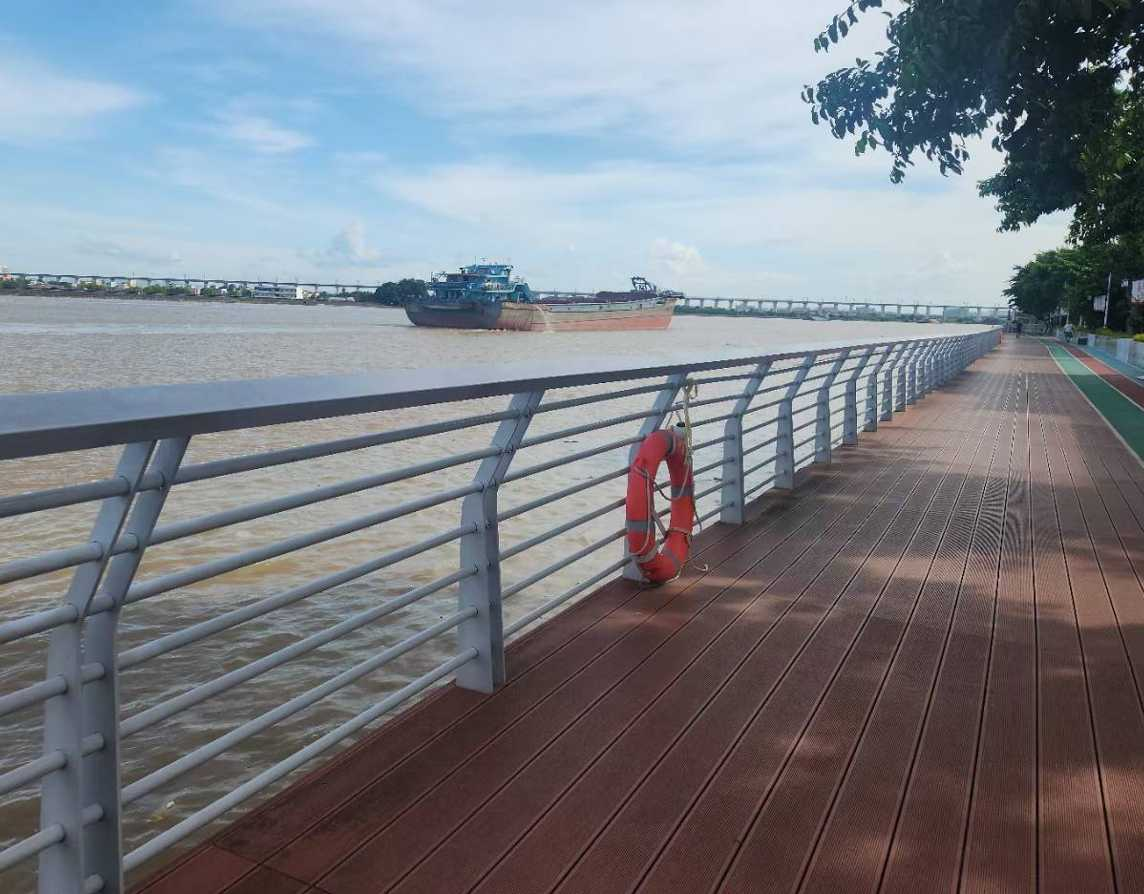
A riverside guardrail is a fixed, passive safety barrier installed along accessible waterfront edges — riverbanks, lakesides, reservoir walkways and landscaped promenades — to guard the edge, guide pedestrian movement and reduce accidental access to the water. It is not a vehicle restraint system, and it is not flood protection. Those two boundaries shape almost every specification decision that follows, from material grade and coating system to post spacing, documentation and the maintenance program an owner is prepared to fund.
Waterfront sites concentrate several constraints in one element. The railing stands in high humidity, receives rain and water splash, and is fixed to wet or intermittently submerged surfaces; salt exposure depends on whether the site is coastal, and flooding exposure depends on the water body. At the same time, the railing is part of the public realm, so municipal and landscape clients frequently require custom dimensions, colors and decorative patterns rather than a fixed catalogue product. Reconciling safety function, appearance and corrosion risk is the practical core of riverside guardrail procurement.
Why waterfront railing follows a different specification path
Product records for waterfront railing describe the category in engineering terms rather than decorative ones. Riverside guardrails serve rivers, lakes, reservoirs and waterfront landscape projects. The documented working condition is outdoor riverbanks, lakesides and reservoir edges with high humidity, rain, water splash and wet surfaces, where flooding or salt exposure depends on the site. The stated function is to guard accessible waterfront edges, guide pedestrian routes and reduce accidental access to the water — and the same records state plainly that these railings do not provide flood control.
Operation is passive: fixed posts and railing sections along designated waterfront boundaries, with no powered or routine mechanical actuation. Waterside warning signs, lighting, rescue lifebuoy stations and controlled-access gates are project-dependent items that remain separate from the railing unless they are written into the same scope.
The contrast with a road median guardrail matters, because buyers who work mainly on road projects often carry road assumptions into waterfront specification. A road median guardrail separates opposing traffic streams, guides vehicles and discourages unauthorized crossing, and vehicle impact containment in that application requires a separately specified crash-rated system. A waterfront railing is specified for a different load case: pedestrian contact, wind, water exposure and long-term public durability.
| Specification dimension | Riverside guardrail | Road median guardrail |
|---|---|---|
| Primary function | Guard accessible waterfront edges, guide pedestrian routes, reduce accidental access to the water | Separate opposing traffic streams, guide vehicles, discourage unauthorized crossing |
| Documented exposure | High humidity, rain, water splash and wet surfaces; flooding or salt exposure depends on the site | Sunlight, rain, dust, wind and vehicle spray, with traffic passing on both sides |
| Recorded materials | Aluminum alloy handrails combined with hot-dip galvanized steel or zinc steel posts; stainless steel and steel | Hot-dip galvanized steel, zinc steel and steel |
| Impact role | Pedestrian edge protection; not a vehicle barrier and not flood control | Vehicle impact containment requires a separately specified crash-rated system |
| Items kept outside the railing scope | Waterside warning signs, lighting, rescue lifebuoy stations, controlled-access gates | Traffic signs, reflective delineators, warning lamps, road markings |
Specification comparison based on documented product and application records for the riverside guardrail and road median guardrail categories.
Parameters that must be fixed before a quotation is valid
Suppliers cannot quote a waterfront system accurately from a product name. Documented quotation requirements for custom guardrails include the guardrail type, dimensions, total quantity, material, surface finish, drawings, installation environment, applicable standards, delivery location and packaging requirements. Where drawings are unavailable, the application and site conditions are used instead to define a suitable configuration.
The customizable parameter set is broad: dimensions, post spacing, rail configuration, materials, colors, surface finishes, decorative patterns, logos and installation methods can all follow project drawings and site requirements. For a riverside project that flexibility is useful, but it also shifts responsibility to the buyer, because two sites carrying the same product description may need different posts, different finishes and different connection details.
- Dimensions and post spacing: set by project drawings or site measurement rather than a fixed catalogue size.
- Material grade: the single largest variable in corrosion performance and in unit cost.
- Surface finish and color: specified for appearance and, in some systems, as an additional protective layer.
- Installation method and base condition: determined by the edge structure — embankment, promenade slab or retaining wall.
- Applicable standards and delivery destination: required before packaging and shipping documents can be prepared.
Material and coating constraints in the splash zone
Material choice for guardrails is documented as depending on the environment, safety requirements, appearance and budget. For riverside guardrail models specifically, the recorded approach is to select materials against a custom specification, to use weather-resistant materials with anti-corrosion treatment, and to design with prolonged exposure to water in mind. That is a specification philosophy rather than one universal recommendation, and it explains why waterfront products are offered across several material families.
| Material | Documented position | Typical waterfront fit |
|---|---|---|
| Hot-dip galvanized steel | Practical balance of strength, corrosion resistance and cost; hot-dip galvanizing is the corrosion-resistance coating recorded for steel elements in municipal guardrail assemblies | Posts and structural members, including assemblies exposed to moisture |
| Zinc steel | Appears in riverside guardrail material compositions and in post elements; zinc steel and steel combinations are common in outdoor railing ranges | Posts and panel elements, with coating maintenance planned from the start |
| Grade 304 stainless steel | Offers appearance and corrosion resistance; Grade 304 stainless steel tube is the specified material for one documented riverside guardrail model | Humid, non-coastal waterfront environments |
| Grade 316 / 316L stainless steel | Recommended for coastal and salt-spray environments | Coastal promenades and estuarine waterfronts |
| Aluminum alloy | Lightweight and rust-resistant, and documented as suitable for decorative applications | Handrails where a light profile and easy handling matter |
| Mixed assemblies | Aluminum handrail with hot-dip galvanized steel posts and zinc steel; stainless steel combined with steel tube | Projects balancing hand comfort, structural strength and cost |
Material positions as recorded in guardrail product specifications, selection guidance and maintenance documentation.
Surface treatment follows the material. Pickling and passivation is the recorded surface treatment for stainless steel railing components, and hot-dip galvanizing is the recorded coating for steel components in municipal guardrail assemblies. Where color is part of the municipal design intent, color-coated steel sheet and electrostatic coating appear in adjacent railing and fencing families, including dark-green, white, dark-gray, antique bronze and black finishes.
Coatings do not remove maintenance from the program. The documented inspection items for outdoor steel guardrails are corrosion, coating damage, deformation, loose fasteners, weld condition, and foundation or anchor movement. In a splash zone, salt and dirt deposits accumulate faster than on an inland site, and minor coating damage should be repaired before it develops into a structural concern.
The Santian riverside guardrail range and how it is produced
Santian (Guangdong Guardrail) Steel Structure Co., Ltd. — also recorded as Guangzhou Santian Steel Structure Co., Ltd. — is a Guangzhou-based manufacturer of municipal traffic guardrails, bridge and waterfront railings, perimeter fencing and construction site hoarding systems. The company states industry experience dating back to 2011 and was formally registered on 16 May 2016. It operates a production facility of approximately 15,000 square meters with 200 employees and a 50-engineer research and development team, and it serves export markets that account for 50% of its business, including Southeast Asia, Africa, South America and the Middle East. Range information is published at aotianguardrail.com.
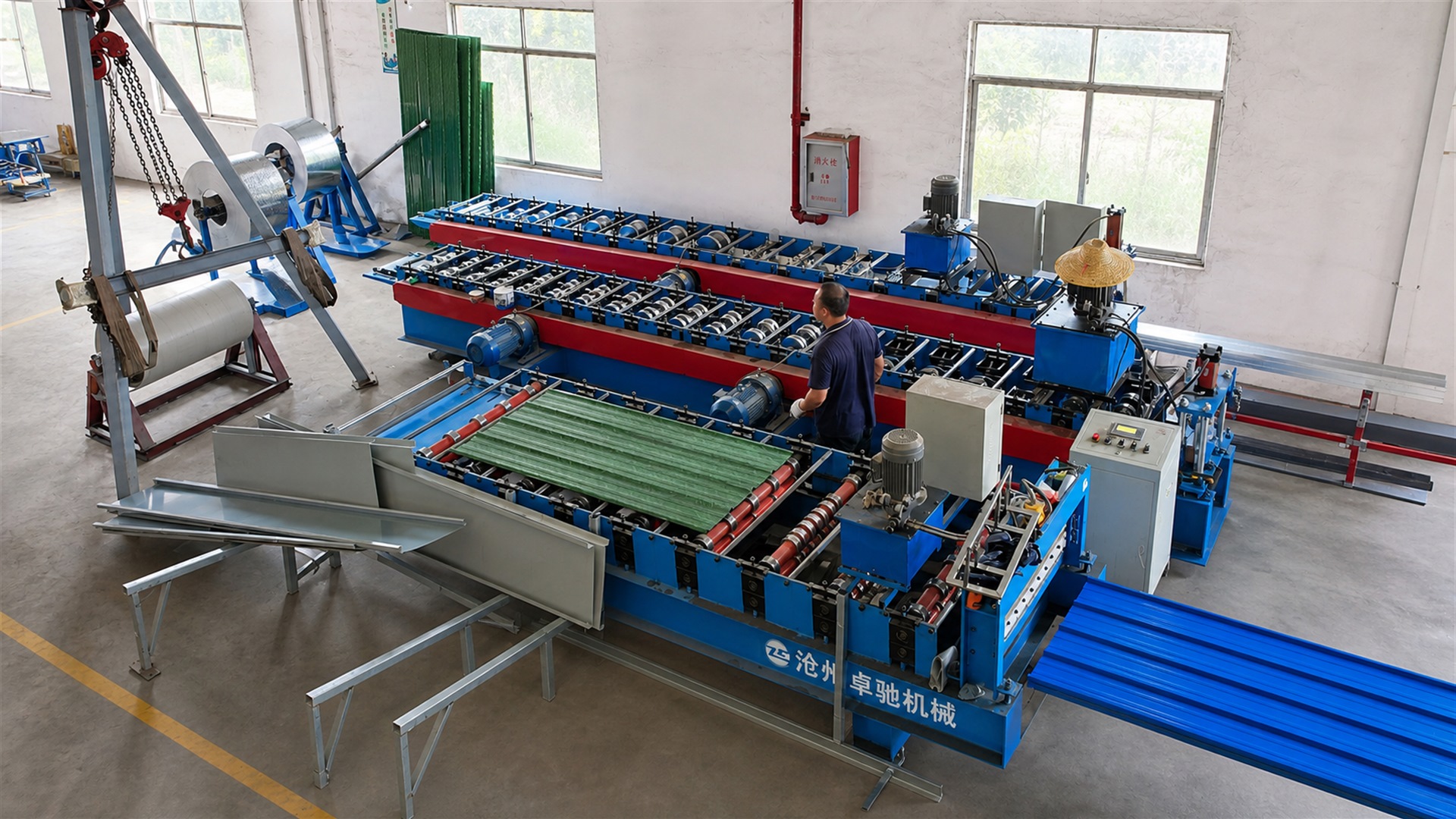
Roll-forming production line used for steel guardrail and railing component fabrication.
| Model | Product type | Recorded materials | Specification notes |
|---|---|---|---|
| T025 | Custom Riverside Guardrail | Selected per custom specification | Project-specific form and dimensions |
| T026 | Aluminum-Handrail Riverside Guardrail | Aluminum alloy handrail; hot-dip galvanized steel posts; zinc steel | Custom dimensions; galvanized posts specified for waterfront installations exposed to moisture |
| T027 | Stainless Steel Riverside Guardrail | Stainless steel; steel | Custom specification |
| T028 | Stainless Steel Riverside Guardrail | Grade 304 stainless steel tube; stainless steel; steel tube | Custom specification with declared Grade 304 tube |
| T029 | Landscape Riverside Guardrail | Selected per custom specification | Custom material and color matching so the railing integrates with riverside scenery |
| T030 | Stainless Steel Guardrail | Stainless steel; steel | Custom specification |
Riverside guardrail models as recorded in company product data.
Production is organized around project orders rather than standard stock. The documented production mode covers OEM and ODM work, with customization of dimensions, materials, colors, surface finishes, structural designs, decorative patterns, logos, packaging and project-specific configurations. Monthly capacity is described as flexible and project-based, subject to product type, specifications and order quantity. Lead time depends on order quantity, specifications and customization requirements, and minimum order quantity is negotiable according to product type and project requirements.
Quality control follows a defined sequence: incoming material inspection, dimensional inspection, welding inspection, coating inspection, in-process quality control and final pre-shipment inspection. Documentation practice recorded for stainless steel railing orders in the same production family includes material certificates and inspection records, batch traceability, technical submittal documents covering material and dimension data, and export packaging with packing specifications written to prevent surface damage to stainless steel panels during container shipment. After-sales support covers remote technical support, installation guidance, maintenance recommendations and spare-parts coordination.
Adjacent project references give some sense of delivery scale in municipal categories: a 6,000 m Guangzhou-standard municipal guardrail installation separating opposing traffic, recorded as operating stably over three years, and a 3,800 m perimeter fencing project using hot-dip galvanized posts with a dark-green finish, recorded as stable over eight years.
Application, installation and maintenance in practice
Documented riverside applications include waterfront promenade construction, riverbank improvements, lake park projects, and reservoir access and landscape projects. In each case the railing guards an accessible edge, guides pedestrian routes and discourages accidental entry to the water. The system is deliberately passive, and warning signs, waterside lighting, lifebuoy stations and controlled gates are coordinated separately because they belong to the site's overall safety and rescue plan rather than to the railing itself.
Installation of a prefabricated steel guardrail follows approved engineering drawings, the manufacturer's instructions and local safety standards. The documented sequence is:
- Review the approved drawings and confirm the installation location.
- Inspect all posts, rails, fasteners and accessories.
- Mark post positions and verify the foundation or anchor points.
- Install and temporarily secure the posts.
- Connect the rails and accessories in the specified sequence.
- Adjust height, spacing, verticality and alignment.
- Tighten all fasteners to the specified torque and complete the final inspection.
Maintenance is documented in similar detail. Inspect posts, rails, welds, bolts and connection points; look for corrosion, cracks, deformation and coating damage; inspect foundations and anchor bolts for movement or loosening; clean dirt, salts and chemical deposits; tighten loose fasteners and repair minor coating damage; record defects and arrange replacement of severely damaged components. Inspecting a waterfront railing beside live traffic requires traffic control, gloves, eye protection and high-visibility clothing, and severely deformed structural components should not be straightened for reuse without professional evaluation.
Modular construction changes the repair economics. A damaged modular guardrail section can usually be replaced independently when compatible posts, rails and fasteners are available, provided the surrounding structure and foundation are inspected first. The documented sequence — isolate and document the damage, inspect adjacent posts and anchors, confirm the replacement component, support the damaged section before removing fasteners, install compatible parts, then adjust alignment and complete a final safety inspection — is a practical reason modular railing is often preferred where future maintenance access matters.
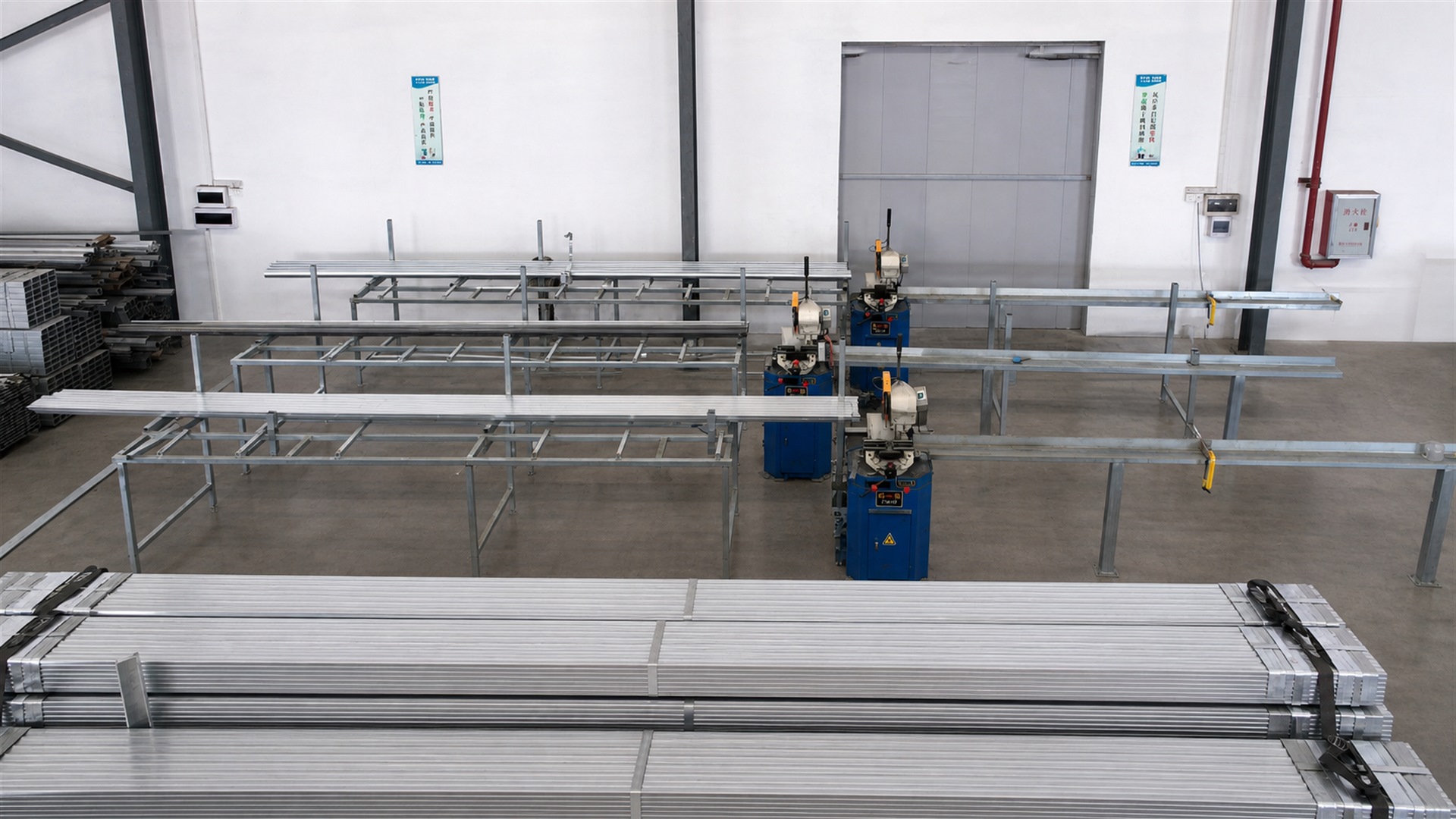
Profile cutting stage in the fabrication of steel guardrail and railing sections.
Market signals: what barrier data does and does not tell waterfront buyers
The wider barrier category is large, but its headline figures describe road and industrial systems more than waterfront railing. Grand View Research values the global barrier systems market — safety gates, crash barrier systems and safety fences — at USD 24.8 billion in 2025, with metal accounting for more than 50.0% of material share. The same evidence base shows how much definition matters: Dataintelo reports a 58.7% metal share for warehouse safety barriers specifically, a higher figure than the overall number because the sub-sector is defined differently. Grand View Research separately values the global temporary guardrail market at USD 2.4 billion in 2024.
Growth projections concentrate on active and connected systems. Dataintelo projects a 9.2% compound annual growth rate for the smart road barrier market from 2025 to 2034. On the regulatory side, EN 1317 is the mandatory European standard for vehicle restraint systems permanently installed on roads, in effect since 1 January 2011, and AASHTO MASH 2016 has been the evaluation standard for new permanent roadside hardware in the United States since 31 December 2019. Those frameworks govern vehicle restraint. A waterfront pedestrian railing is specified against project drawings, local building safety requirements and the client's design criteria rather than vehicle impact testing. For trade documentation, road guardrails are commonly classified under HS code 73089099. Among market participants, Hill & Smith PLC of the United Kingdom is identified as a major company in the global barrier systems market.
Two data gaps are worth knowing before market figures are used in a business case. First, independent longitudinal studies comparing maintenance and failure costs between polymer and steel barrier systems are limited, so lifecycle-cost claims deserve scrutiny. Second, customs data aggregates guardrails under broader steel structures headings, which makes sub-segment trade analysis — municipal versus bridge guardrail, for example — difficult. For a waterfront project, the practical conclusion is that specification discipline, not market size, determines outcomes.
Riverside railing versus other waterfront edge solutions
A modular steel or aluminum railing competes with cast-in-place concrete and masonry edges, and the trade-off is usually between permanence and maintainability. Cast edges are typically heavier and slower to modify once in place. A modular railing is prefabricated to project dimensions, installed by bolted assembly, and its damaged sections can generally be replaced individually when compatible components are available; stainless steel railing installations are also documented with bolted assembly that avoids on-site welding, which suits tight construction schedules.
The boundaries are as important as the benefits, and they should be written into the specification rather than assumed:
- A riverside railing is not flood control. It guards an accessible edge; it does not hold back water.
- It is not a vehicle barrier. Vehicle impact containment requires a separately specified, crash-rated system.
- It is passive. Detection, lighting, warning and rescue equipment are separate scope items.
- Corrosion performance depends on grade, coating and maintenance, not on the product name. In salt-spray conditions the documented route is 316 or 316L stainless steel, or galvanized steel with an additional protective coating.
- Material trade-offs are real: aluminum is lightweight and suited to decorative work, stainless steel offers appearance and corrosion resistance, and hot-dip galvanized steel is the strength-and-cost compromise that requires coating care.
Future outlook
Three directions look likely over the next decade. The first is integration. The projected 9.2% growth rate for smart road barriers reflects demand for barriers that carry sensing, warning or lighting functions, and hollow-post guardrail designs already reserve internal routing space so lighting or signaling equipment can be added later without replacing the post system. The same logic is reaching waterfront furniture, where municipalities increasingly want lighting and warning devices mounted on the railing line rather than beside it.
The second is tightening corrosion specification. As humid and coastal municipalities review maintenance backlogs, material grades and coating systems that were once accepted on inland projects are being re-examined for splash-zone use. Documented practice — material certificates, batch traceability, inspection records and packing specifications that protect stainless surfaces in transit — becomes part of the commercial evaluation, not only the technical file.
The third is verification. Because independent lifecycle-cost studies comparing barrier materials remain scarce, buyers are likely to rely more on project-level evidence: inspection regimes, replacement records and documented performance over defined periods. For a riverside guardrail, that means the specification should name the material grade, the coating system, the inspection interval and the replacement strategy before the first post is set.
FAQ
What information is required for a custom guardrail quotation?
An accurate quotation requires the guardrail type, dimensions, total quantity, material, surface finish, drawings, installation environment, applicable standards, delivery location and packaging requirements. If drawings are unavailable, the application and site conditions are provided instead so that a suitable configuration can be defined.
How do I choose the right guardrail for my project?
Selection follows the application, the required safety level, the installation environment, the material, dimensions, surface treatment and local standards, because road, bridge, residential and industrial projects require different structural designs. For a waterfront edge, the two questions that change the shortlist are salt exposure and how often the railing is splashed or submerged.
Which material is best for outdoor guardrails?
There is no single answer. Hot-dip galvanized steel provides a practical balance of strength, corrosion resistance and cost; stainless steel offers better appearance and corrosion resistance; aluminum is lightweight and suited to decorative applications. The documented rule is to choose the material that balances service life, maintenance requirements, appearance and budget for the specific site.
Which guardrail material suits coastal or humid environments?
For coastal and salt-spray environments, 316 or 316L stainless steel is recommended. Hot-dip galvanized steel with an additional protective coating is also suitable when correctly specified and maintained. In humid but non-coastal conditions, 304 stainless steel is commonly specified.
How long do steel guardrails last?
Service life depends on the material, the coating system, the climate, the installation quality and the maintenance frequency. Stainless steel and correctly specified galvanized steel generally provide reliable long-term outdoor performance under those conditions, and the inspection interval should be set by the exposure level of the site.
How should outdoor steel guardrails be maintained?
Inspect posts, rails, welds, bolts, anchors and surface coatings; check foundations and anchor bolts for movement or loosening; clean dirt, salts and chemical deposits; tighten loose fasteners; repair minor coating damage; and record defects so severely corroded or deformed components can be replaced. Inspections beside live traffic require traffic control and personal protective equipment, and severely deformed structural components should not be straightened for reuse without professional evaluation.
Can a damaged guardrail section be replaced separately?
In modular systems, yes. A damaged section can usually be replaced independently when compatible posts, rails and fasteners are available, but the surrounding structure and foundation must be inspected first. The sequence is to isolate the work area and document the damage, inspect adjacent posts and anchors, confirm the replacement component, support the damaged section before loosening fasteners, install the compatible parts, then adjust alignment and complete a final safety inspection.
How is a prefabricated steel guardrail installed?
Installation follows approved engineering drawings, the manufacturer's instructions and local safety standards: review the drawings, inspect components, mark post positions and verify foundations or anchor points, install and temporarily secure the posts, connect the rails in sequence, adjust height, spacing, verticality and alignment, then tighten all fasteners to the specified torque and complete the final inspection. Underground utilities must be checked before drilling.
Model-level product and capability documentation is compiled in the company brochure available as a PDF: https://cdn.socialarks.com/sbsp/25206/common/2026/0824/Santian.pdf