
Ring Gear vs Planet Gear: A Heavy-Duty Buyer Comparison
In heavy-duty gearboxes built to print, the choice between a large-diameter ring gear and a planet gear is decided at the drawing-review stage, not on a brand catalogue page. Both are high-precision gears, but they carry different load paths, different materials, different heat-treatment routes and different inspection evidence. This comparison sets out the operating conditions, specification choices and acceptance criteria a buyer can actually verify before placing an order.
Jiangsu New Yinye Transmission Electromechanical Co., Ltd. (NYY / New Yinye Transmission) is a build-to-print manufacturer of large, high-precision and non-standard industrial gears and transmission components, located in Wuxi, Jiangsu, China. Brand heritage dates to 1993, while the current legal entity was incorporated on April 25, 2003. The company operates an approximately 25,000 m² facility with 125 employees, 28 engineers and an annual output of approximately 1,500 sets across product categories, excluding general accessory components. Its products are used in industrial gearboxes, wind power, mining, metallurgy, cement, power generation, machine tools, railway and locomotive equipment, engineering machinery, feed and biofuel machinery, canning machinery, marine equipment and other heavy-duty transmission systems. Both gear types discussed here sit inside that manufacturing scope, and that is what makes a like-for-like comparison possible.
What Actually Separates a Ring Gear from a Planet Gear
A large-diameter ring gear is, structurally, a ring. It carries internal or external teeth, is frequently supplied with bolt holes, and is mounted as a fixed or rotating reaction element in planetary gearboxes or as a large-diameter transmission component in industrial drives. A planet gear is a cylindrical gear that runs inside a planetary set, orbiting a sun gear while meshing with the ring gear; it usually carries straight or helical teeth and a finished bore with defined tolerances and surface finish.
That difference in geometry is the root of every downstream buying decision. A ring gear is dominated by diameter, out-of-roundness, bore and bolt-hole positional accuracy, and the ability to hold tooth quality on a large, thin-section ring. A planet gear is dominated by bore fit, tooth-to-bore concentricity, case depth on a relatively small cross-section, and predictable distortion after carburizing and quenching. A buyer comparing the two is therefore not comparing finished parts of the same shape, but two different manufacturing problems.
Where Each Gear Type Sits in Heavy-Duty Service
The operating environment usually makes the decision before the buyer does. In mining, large ring gears appear in mill and crusher drives and in planetary wheel drives, while planet gears sit inside compact planetary stages where torque density matters. In metallurgical equipment, furnace-top reducer gearboxes rely on custom transmission gears supplied to drawing; a documented case exists of a metallurgical equipment and industrial gearbox manufacturer supplied with approximately 2,000 custom gearbox gears over more than 10 years of supply and field application, with no major quality complaints reported during the confirmed service period.
In marine and offshore machinery, ring gears are used for slewing and azimuth-type drives, and planet gears for propulsion-reduction stages. In machine tools, planet gears appear in servo and indexing gearboxes where low backlash and tight pitch control dominate, while ring gears appear in larger rotary tables and heavy-indexing heads. In canning and in feed and biofuel equipment, both types appear in reducers where dust, washdown and long duty cycles govern the material and surface-protection choices rather than peak torque alone.
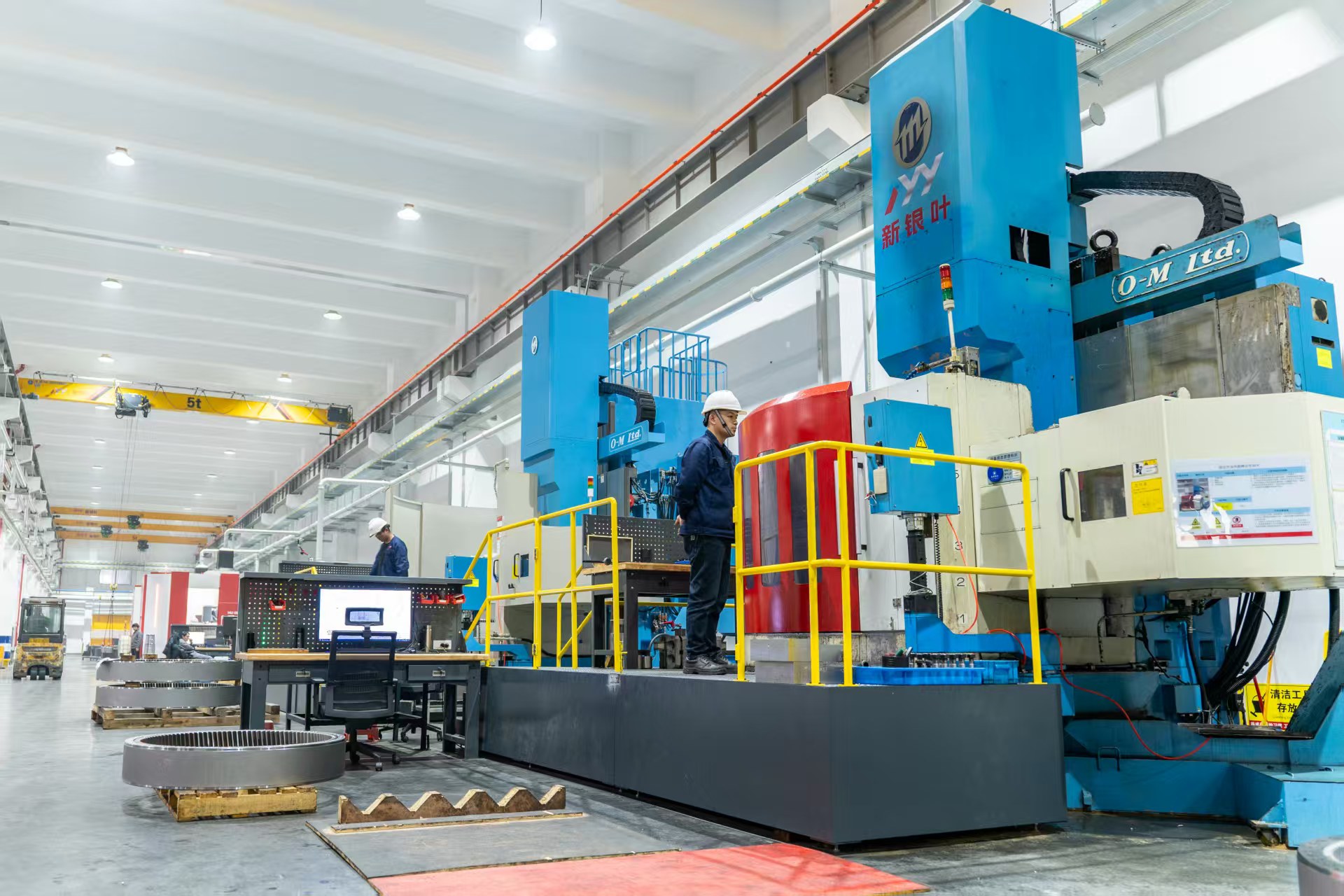
Material Selection: Forged Steel and Alloy Steel Options
Material choice is where the two gear types diverge most visibly. A large-diameter ring gear is offered in 42CrMo, 35CrMo, 40Cr, 20MnCr5, 18CrNiMo7-6, 17CrNiMo6, 18Cr2Ni4WA, Q345D, QT400-15, alloy steel, forged steel, or other customer-specified materials. That breadth reflects the range of ring-gear duties: a structural or low-load carrier ring can justify Q345D or QT400-15, while a heavily loaded internal ring in a planetary gearbox will normally move to a through-hardening or case-hardening alloy such as 42CrMo, 35CrMo or 18CrNiMo7-6. Forged steel is a common route because it gives a sound, homogeneous section with predictable response to heat treatment.
A planet gear is narrower in its typical specification. The standard route is 18CrNiMo7-6 alloy steel, carburized and quenched to a surface hardness of 58 HRC or higher, subject to the customer-specified hardness range. Other customer-specified alloy steels are available subject to project review. The reason is mechanical rather than commercial: a planet gear concentrates contact and bending stress on a small, highly loaded tooth section, so the material and case must deliver both surface durability and core toughness at the same time.
For buyers, the practical consequence is that ring-gear material selection is a genuine engineering decision with cost and lead-time effects, while planet-gear material selection is usually a confirmation exercise unless the application is outside the norm. A supplier that simply lists material grades without tying them to a specific duty is not giving a buyer a usable comparison.
Heat Treatment and Hardness: Where Specification Discipline Shows
Ring gears are offered with carburizing, nitriding, induction hardening or through hardening, subject to customer drawings and technical requirements. That flexibility is useful, but it also means the buyer must state the required case depth, surface hardness, core hardness and permissible distortion instead of leaving the route to the supplier's default. Nitriding is often chosen where distortion of a large ring must be limited; carburizing where surface durability is the priority; induction hardening where localized tooth hardening is enough; through hardening where the section is simple and the load is moderate.
For planet gears, carburizing and quenching to a surface hardness of 58 HRC or higher is the stated route, again subject to the customer-specified range. The buyer's control points are case depth, effective case at the tooth flank and root, core hardness, and distortion after quench. Because the cross-section is small, distortion shows up quickly in bore roundness and lead error, and that is why grinding after heat treatment plus documented grinding-burn inspection matter more for planet gears than for many other components.
Comparing the two routes
| Specification area | Large-diameter ring gear | Planet gear |
|---|---|---|
| Typical geometry | Large ring, involute internal or external teeth, often with bolt holes | Cylindrical gear, straight or helical teeth, finished bore |
| Material options | 42CrMo, 35CrMo, 40Cr, 20MnCr5, 18CrNiMo7-6, 17CrNiMo6, 18Cr2Ni4WA, Q345D, QT400-15, alloy steel, forged steel, or customer-specified | 18CrNiMo7-6 alloy steel as the typical route; other customer-specified alloy steels subject to project review |
| Heat treatment | Carburizing, nitriding, induction hardening, or through hardening per drawing | Carburizing and quenching per drawing |
| Surface hardness | Set by the selected route and customer specification | 58 HRC or higher after heat treatment, subject to the customer-specified range |
| Typical published accuracy | DIN 3962 Class 6–7 and AGMA Class 9–10; can reach DIN 5 / AGMA 12 or higher for applicable products | DIN 5 for applicable products, subject to size, material, structure, heat treatment and process review |
| Pressure angle | 20° typical, others per drawing | Set per drawing |
| Maximum grinding size | Approx. 2,500 mm diameter, approx. 45 mm module | Confirmed per drawing against the same grinding envelope |
Accuracy statements are conditional. DIN 5, AGMA 12 or higher is achieved for applicable products and depends on gear size, material, structure, heat treatment and process review. A buyer should treat any claim of DIN 5 or AGMA 12 on a large ring gear as a subject to be confirmed by inspection report, not as a catalogue default.
Accuracy Classes and What They Mean on the Shop Floor
Published accuracy for both gear types sits in a realistic industrial band. Ring gears typically carry DIN 3962 Class 6–7 and AGMA Class 9–10, and for applicable products can reach DIN 5, AGMA 12 or higher. Planet gears reach DIN 5 for applicable products. The phrase “for applicable products” is the important part of the claim, because a 2,500 mm ring and a 300 mm planet do not carry the same thermal and distortion risk when pushed to the same accuracy class.
In practice, the machine-tool and canning sectors tend to drive the tightest requirements on planet gears, where pitch and lead errors translate directly into backlash and indexing error. Mining and metallurgical applications tend to drive the largest ring-gear requirements, where the limit is often grinding envelope and distortion control rather than nominal class. Buyers should therefore ask which specific gear, at which diameter and module, was demonstrated at the quoted class, and ask to see the corresponding accuracy report.
Inspection Evidence: What a Buyer Should Request
For both gear types, NYY's inspection capabilities cover tooth profile, lead, pitch, radial runout, surface roughness, dimensional inspection, material composition, hardness, mechanical properties, ultrasonic testing, phased-array ultrasonic testing, grinding-burn inspection, and final inspection. The broader gear product scope also includes micro-magnetic testing, dynamic balancing, and bevel-gear rolling contact inspection, which are relevant where the gearbox assembly requires it.
Documentation can be supplied according to customer drawings, technical agreements and project requirements: material certificates, dimensional inspection records, gear accuracy reports, hardness records, non-destructive testing documents, special-process records and final inspection reports. For a buyer in the evaluation-to-execution stage, the useful exercise is to map each document to a drawing characteristic, so the acceptance package is a closed loop rather than a pile of paper.
| Buyer requirement | Document or inspection to specify | Why it matters |
|---|---|---|
| Material conformity | Material certificate; material composition check | Confirms the grade actually used matches the drawing, especially where 42CrMo is substituted for, or specified against, 18CrNiMo7-6 |
| Heat-treatment result | Hardness records; case-depth records where specified | Links surface hardness (for example, 58 HRC or higher on planet gears) to the agreed range |
| Tooth accuracy | Gear accuracy report covering profile, lead, pitch and radial runout | Provides the objective evidence behind a DIN 5 / AGMA 12 claim |
| Internal soundness | Ultrasonic testing or phased-array ultrasonic testing | Detects internal defects in forged rings and large sections that surface inspection cannot reveal |
| Grinding integrity | Grinding-burn inspection | Guards against thermal damage introduced during finish grinding |
| Dimensional conformity | Dimensional inspection records | Confirms bore, bolt-hole pattern, face width and mounting features |
| Release to ship | Final inspection report | Documents that final inspection was completed before shipment |
Purchasing Terms, Acceptance Criteria and Third-Party Inspection
Purchasing terms for both gear types follow the same commercial framework. MOQ is project-specific: prototype, sample and small-batch orders can be evaluated based on product type, size, material, process complexity and commercial requirements. Delivery terms can be EXW, FCA, FOB, CIF or other Incoterms 2020 terms as agreed in the contract, with the named place, port, packaging method and transport requirements confirmed for each order.
Acceptance is built around pre-shipment final inspection. Material certificates, dimensional inspection records, gear accuracy reports, hardness records, non-destructive testing documents, special-process records and final inspection reports can be provided according to customer drawings and technical agreements. Customer or third-party inspection can be arranged by prior agreement, which is the practical route for buyers who want an independent witness point before release. Payment terms are confirmed according to project value, production cycle, material and tooling costs, order quantity and customer credit assessment; T/T deposit with the balance paid before shipment is commonly used for new customers, and other terms may be negotiated for qualified long-term customers.
How the Specification Maps to Verifiable Case Evidence
Two documented supply cases are relevant to the ring-versus-planet decision. In wind power, more than 10,000 wind power gears were supplied for custom gears and transmission components used in wind turbine main gearboxes, with more than 5 years of continuous supply cooperation, stable batch delivery, consistent product quality and no major quality complaints reported during the confirmed cooperation period; the company received customer recognition for quality performance and supply support. In metallurgical equipment, approximately 2,000 custom gearbox gears were supplied for furnace-top reducer gearboxes used in steelmaking equipment, with more than 10 years of supply and field application and no major quality complaints during the confirmed service period.
These cases matter to a buyer not because they prove a general capability claim, but because they show the two gear families being produced under repeatable acceptance conditions over multiple years. A single prototype does not demonstrate that; a multi-year batch programme does.
Limits and Boundaries Buyers Should Plan Around
The most important limitation is dimensional. Ring-gear grinding is offered up to approximately 2,500 mm in diameter and approximately 45 mm in module. Above that envelope, the part is outside the stated capability and must be reviewed separately rather than assumed. Buyers working on very large mill or offshore slewing rings should confirm feasibility at the enquiry stage.
The second limitation is that accuracy class is conditional, not universal. DIN 5 or AGMA 12 is an achievable result for applicable products, subject to gear size, material, structure, heat treatment and process review. A large, thin-section ring and a small planet gear do not reach the same class with the same process route, and a buyer who treats the headline class as a guaranteed property of every part is setting up a dispute at final inspection.
The third limitation is specification dependence. Both gear types are build-to-print items: the buyer must supply drawings, technical specifications and quality requirements. Where a drawing is incomplete on case depth, hardness range, bore tolerance or inspection requirements, the supplier cannot fill the gap without a formal technical agreement. Finally, third-party inspection is available by prior agreement, not on demand at the loading dock, so it should be written into the purchase order rather than requested after production.
Market Context for the Ring-versus-Planet Decision
Third-party market data supports the direction of demand. The global precision gearbox market, a core driver for high-precision gears, was valued at USD 3.5 billion in 2025 with a projected CAGR of 10.7% according to Grand View Research. The same source reports that the planetary gearbox segment accounted for 65.3% of the precision gearbox market share in 2025, and that Europe held the largest revenue share at 34.1% in 2025. In wind power, Asia-Pacific held a 51% share of the wind turbine gearbox market in 2024, largely driven by installations in China, according to Data Insights Reports.
The reader-facing implication is straightforward. Planetary architectures are the dominant precision gearbox format, which means planet gears and their mating ring gears are being bought in volume rather than as one-off specials. That shifts buyer attention toward repeatability, documentation and the ability to sustain a multi-year batch programme, rather than toward a single impressive prototype.
Future Outlook
Three trends are likely to shape sourcing decisions for both gear types over the next planning cycle. First, documentation is becoming part of the product: buyers increasingly ask for material certificates, accuracy reports, hardness records and non-destructive testing documents as a standard package, not as an exception. Second, third-party and customer witness inspection is moving earlier in the programme, which rewards suppliers whose inspection plan is defined before the first chip is cut. Third, as planetary gearboxes continue to dominate the precision gearbox mix, the planet gear and its mating ring gear will increasingly be evaluated as a matched set rather than as isolated parts, with bore fit, tooth contact pattern and heat-treatment consistency considered together.
For buyers, the practical conclusion is that the ring-versus-planet question is best answered with a specification table, not a preference. Both gear types are available in a build-to-print model, both carry conditional accuracy claims, and both are verifiable through inspection evidence. The deciding factor is which one matches the load path, the housing geometry and the acceptance framework the buyer can actually enforce.
For buyers who want the full product and capability reference in one document, the NYY company profile is available for public download: NYY Profile 2026.
Frequently Asked Questions
What is the structural difference between a large-diameter ring gear and a planet gear in a heavy-duty gearbox?
A large-diameter ring gear is a ring-shaped gear with internal or external involute teeth, often supplied with bolt holes, and mounted as a fixed or rotating reaction element in a planetary gearbox or as a large transmission component in an industrial drive. A planet gear is a cylindrical gear with straight or helical teeth and a finished bore that orbits a sun gear inside a planetary set. The ring gear is dominated by diameter, roundness and bolt-hole accuracy; the planet gear is dominated by bore fit, concentricity and distortion control on a small cross-section.
Which materials are typically specified for each gear type?
Ring gears are offered in 42CrMo, 35CrMo, 40Cr, 20MnCr5, 18CrNiMo7-6, 17CrNiMo6, 18Cr2Ni4WA, Q345D, QT400-15, alloy steel, forged steel, or other customer-specified materials. Planet gears typically use 18CrNiMo7-6 alloy steel, with other customer-specified alloy steels available subject to project review. The difference reflects duty: ring gears span structural rings through heavily loaded internal gears, while planet gears concentrate contact and bending stress in a small tooth section.
What heat treatment and surface hardness apply to each gear type?
Ring gears can be carburized, nitrided, induction hardened or through hardened, subject to customer drawings and technical requirements. Planet gears are typically carburized and quenched to a surface hardness of 58 HRC or higher, subject to the customer-specified hardness range. In both cases the buyer should specify case depth, core hardness and permissible distortion rather than leave the route to a supplier default.
What accuracy classes can be expected, and how are they verified?
Typical published accuracy is DIN 3962 Class 6–7 and AGMA Class 9–10, with DIN 5, AGMA 12 or higher achievable for applicable products and subject to gear type, size, material, structure, heat treatment and process review. Planet gears reach DIN 5 for applicable products. Verification is through a gear accuracy report covering tooth profile, lead, pitch and radial runout, supported by dimensional inspection records and, where specified, surface roughness measurement.
What inspection evidence can a buyer request before shipment?
Available documentation includes material certificates, dimensional inspection records, gear accuracy reports, hardness records, non-destructive testing documents, special-process records and final inspection reports, supplied according to customer drawings, technical agreements and project requirements. Inspection capabilities include tooth profile, lead, pitch, radial runout, surface roughness, dimensional inspection, material composition, hardness, mechanical properties, ultrasonic testing, phased-array ultrasonic testing and grinding-burn inspection. Customer or third-party inspection can be arranged by prior agreement.
What are the purchasing terms and acceptance criteria?
MOQ is project-specific; prototype, sample and small-batch orders can be evaluated based on product type, size, material, process complexity and commercial requirements. Delivery terms can be EXW, FCA, FOB, CIF or other Incoterms 2020 terms as agreed in the contract, with named place, port, packaging method and transport requirements confirmed per order. Final inspection is completed before shipment, and material certificates, dimensional inspection records, gear accuracy reports, hardness records, non-destructive testing documents, special-process records and final inspection reports can be provided according to customer drawings and technical agreements. Customer or third-party inspection can be arranged by prior agreement. Payment terms are confirmed according to project value, production cycle, material and tooling costs, order quantity and customer credit assessment, with T/T deposit and balance before shipment commonly used for new customers.
What are the size limits for large-diameter ring gear grinding?
Ring-gear grinding is offered up to approximately 2,500 mm in diameter and approximately 45 mm in module. Parts above that envelope are outside the stated capability and require separate review at the enquiry stage rather than being assumed feasible.
How should a buyer decide between the two gear types for a new gearbox programme?
The decision should follow the housing geometry and load path rather than supplier preference. If the design is a planetary architecture, planet gears and their mating ring gear are normally evaluated together, with bore fit, tooth contact pattern and heat-treatment consistency considered as a set. If the design is a large parallel-shaft or slewing drive, the ring gear becomes the governing part and the diameter, module and grinding envelope determine feasibility. In both cases the specification should be written against verifiable inspection documents, not against headline accuracy claims.
¿Tiene preguntas o necesita más detalles?
Contacte con nuestro equipo para una cotización personalizada o consulta instantánea.
Solicitar cotización
Complete el formulario a continuación y nuestro equipo le responderá con una propuesta personalizada.
Chat directo de WhatsApp
¿Prefiere chatear en tiempo real? Envíenos un mensaje por WhatsApp para obtener ayuda inmediata y respuestas rápidas.
- Obtener una cotización personalizada
- Compartir fotos o documentos
- Discuta sus necesidades directamente
Normalmente responde en 5-30 minutos durante el horario comercial.