
Resistive Touch Display Modules: An Industrial Buyer's Guide
Resistive touch modules accounted for 19% of the global touch screen module market in 2025, against 71% for capacitive modules, according to market data published by Business Research Insights. Those two figures describe a market that has consolidated around capacitive sensing for gesture-driven interfaces — and at the same time a durable, non-marginal demand for pressure-based touch in equipment where thick gloves, oil, dust and single-point operation are normal working conditions.
For buyers at the discovery stage, the practical question is rarely which technology is newer. It is whether a custom touch display module will survive the way the machine is actually operated: by a technician wearing nitrile gloves, by an operator pressing a resistive touch panel with a tool handle, or by a self-service terminal exposed to rain and cleaning agents. Resistive technology answers a specific subset of those conditions, and it answers them at a different cost level than projected capacitive touch.
Guangzhou Xiangrui Optoelectronics Technology Co., Ltd., known as Xiangrui Optoelectronics, is a touch screen and touch display module manufacturer established in 2010 in Guangzhou, China. The company develops, produces and customizes resistive touch screens, capacitive touch screens and custom touch display modules, and supplies equipment manufacturers in Asia, Europe and America; exports represent roughly 50% of its output.
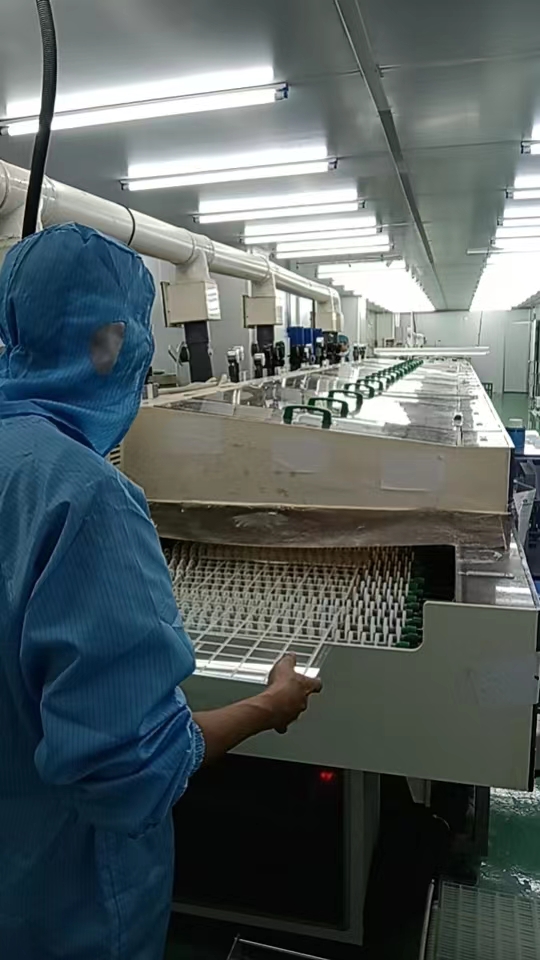
Why resistive touch panels are still specified
A resistive touch panel is activated by physical pressure. The operator's contact — whether a bare fingertip, a thick work glove, a stylus or a hard tool — closes the sensing structure at that point, and the controller reports a coordinate. Because actuation depends on contact force rather than capacitive coupling, the technology performs in conditions that routinely disturb capacitive sensing: heavy oil contamination, coolant residue, dust, splashing liquid and hands that are never bare.
That technical characteristic maps directly onto a commercial pattern. Procurement teams specify resistive touch displays when three conditions overlap:
- The interaction is single-point by design. A start/stop panel, a parameter entry screen or a temperature setpoint pad does not need multi-touch gestures, and paying for a capacitive stack in that context buys capability the machine will never use.
- The operator is gloved or using an implement. Workshops, cold rooms and process lines frequently require interaction through heavy-duty gloves or with a tool, which is a documented resistive advantage.
- The budget is fixed early. Resistive builds sit at a lower specification tier than industrial projected capacitive modules, which matters when the touch interface is one line item inside a larger enclosure cost target.
The opportunity for buyers is not that resistive is a better technology in general — it is not — but that it remains the lowest-friction way to satisfy a defined operating environment without over-specifying the interface.
How a resistive touch display module registers input
A touch display module combines a touch panel with a TFT display, a controller and a bonded or framed mechanical stack. In a resistive build, the sensing layer responds to applied force, and the controller converts that contact into a stable coordinate that the host system maps to an interface element. The design consequence is important for engineers: the panel expects deliberate actuation, so interface elements should be sized and spaced for gloved or tool-assisted contact rather than for fingertip gestures.
Two integration decisions dominate early-stage specification. The first is the interface between the touch controller and the host board, which determines driver effort and firmware behaviour. The second is the mechanical stack — how the touch panel, display and cover glass are combined — which affects optical performance, sealing and field durability. In the Xiangrui portfolio, cover glass is specified in aluminosilicate chemically strengthened glass, touch sensing uses ITO indium tin oxide, and optical bonding is performed with OCA optical adhesive film; module stacks also include PVA/TAC film, colour filter CF and a TFT glass substrate. Those material choices are shared across the company's custom touch display module builds and are confirmed per project.
Where the module stops and the enclosure starts
Resistive panels are pressure-sensitive, so the front bezel design, gasket compression and panel pre-load all influence how the finished unit feels and how reliably it registers input. Buyers who treat the module as a drop-in part and finalise the enclosure without a joint review usually discover this during pilot production rather than during sampling — which is why engineering evaluation, rather than catalogue selection, is the realistic starting point for any non-standard resistive program.
Where resistive touch display modules fit in equipment design
The application record is consistent across industries: resistive touch is chosen where the operating condition, not the user experience ambition, decides the specification.
- Industrial control and automation equipment. Workshop HMI panels are exposed to wide temperature swings, dust, humidity, electromagnetic interference and glove-only operation. Interface requirements in this segment typically include glove-touch support, stable coordinates without drift, anti-false-touch behaviour, single-point priority, ESD and EMC protection, plus impact and ingress targets that are specified per enclosure.
- Medical devices. Bedside controllers and portable handheld detectors that require thick nitrile gloves, frequent disinfectant splashing and basic single-point operation are the classic resistive case. Higher-end medical equipment with image review and multi-touch gestures sits in the capacitive category instead.
- New energy and charging infrastructure. Outdoor cabinets and charging piles combine wide-temperature operation, high brightness requirements and anti-condensation measures — conditions where the touch technology is selected together with the display brightness and sealing strategy rather than in isolation.
- Self-service terminals and smart home devices. These segments more often specify projected capacitive touch because they depend on multi-point gestures, anti-fingerprint surfaces, full lamination and low power consumption. Resistive remains relevant mainly in retrofit or low-interaction variants.
Resistive versus capacitive: an honest selection matrix
The comparison below reflects how the two technologies are positioned in practical equipment decisions, not a claim that one dominates the other. Projected capacitive touch is the mainstream choice for gesture interfaces; resistive touch remains the pragmatic choice for constrained operating conditions and tight budgets.
| Consideration | 5-wire resistive touch | Projected capacitive (PCAP) |
|---|---|---|
| Touch mode | Single-point operation | Multi-point gestures |
| Input condition | Heavy-duty work gloves, hard object pressing | Bare hand or thin glove |
| Field environment | Heavy oil contamination, dust, splashing liquid | Flush IP protection, outdoor strong light |
| Display priority | Simple interface, basic single-point control | Better display performance, flat appearance, curve and drawing review |
| Operating intensity | Lower-frequency, task-oriented interaction | High-frequency operation, long service-life expectations |
| Budget position | Cost-sensitive programs | Higher specification tier |
| Typical equipment | Workshop HMI, bedside controllers, portable handheld detectors, retrofit panels | Imaging review stations, disinfection-heavy medical devices, self-service terminals |
Boundary conditions: where resistive is the wrong choice
A procurement reference is only useful if it states where a technology stops being appropriate. Resistive touch display modules are the weaker option in four identifiable situations:
- Gesture-driven interfaces. Resistive sensing is single-point. Pinch, zoom, swipe and multi-finger confirmation are outside its capability, so any interface designed around those gestures should move to projected capacitive touch.
- Image-intensive clinical or diagnostic use. Where clinicians review imaging, draw curves or manipulate 3D views, capacitive is preferred because display performance and flat, flush appearance become primary requirements rather than secondary ones.
- High-frequency, long-life interaction. Devices operated continuously with high service-life expectations are better served by industrial projected capacitive modules.
- Portfolio coverage limits. The standard module platforms documented in the current Xiangrui portfolio run from 7-inch to 21.5-inch in the capacitive line, and resistive builds are configured per project. Buyers whose enclosure requires a size or structure outside standard platforms should plan for an engineering evaluation cycle rather than expect an off-the-shelf match.
Specifying a custom touch display module
Customisation is where resistive programs are actually won or lost, because the panel has to fit an enclosure that already exists. Xiangrui Optoelectronics supports OEM and customized touch solutions tailored to equipment design, interface requirements and application environments, with an engineering team of 15 engineers providing product customisation, technical evaluation, design optimisation and application-specific touch solutions.
Manufacturing scale matters at the transition from sample to volume. The company operates a 5,000 m² facility with approximately 60 employees and reports an annual production capacity of 300,000 units; actual lead times depend on product specifications and order quantities. Quality and compliance documentation includes ISO 9001 and ISO 14001 certification, National High-Tech Enterprise status and 16 utility model patents.
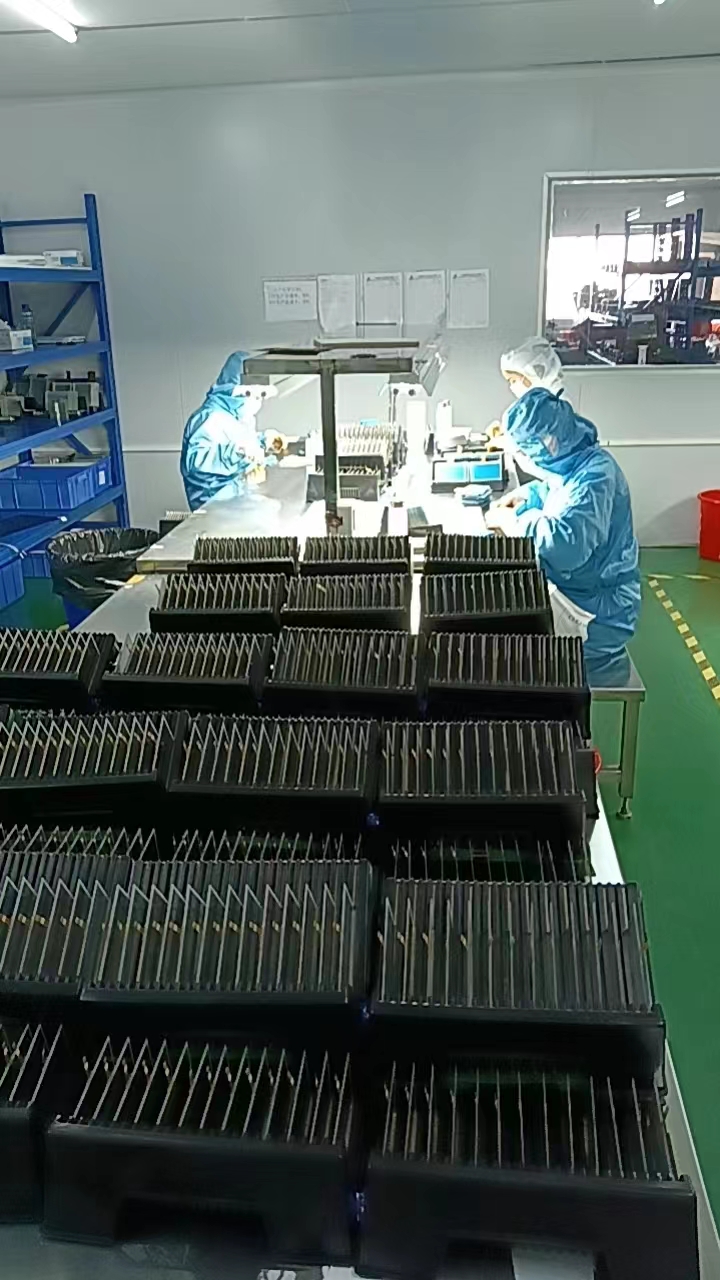
Specification checklist for a resistive program
| Decision point | What to resolve before tooling |
|---|---|
| Actuation profile | Which gloves, styluses or tools will contact the panel, and how much force the interface should require |
| Controller and interface | Host-board interface, driver responsibility and firmware behaviour |
| Cover glass | Thickness and surface treatment; cover glass thickness is customizable, with a maximum of 10 mm |
| Ingress and impact | Target IP and IK ratings; note that IK10 corresponds to 20 joules of impact energy under IEC 62262 (a 5 kg object dropped from 40 cm) |
| Temperature | Confirm the rating for the specific build; standard configurations in the current portfolio are rated -20°C to +70°C operating and -30°C to +80°C storage |
| Optical treatment | Whether anti-glare, anti-fingerprint or anti-reflection treatments are needed, and whether full OCA lamination or frame bonding is the right cost/performance point |
| Volume and continuity | Sample quantity, annual demand against the 300,000-unit capacity, and inspection criteria |
What the market data suggests for the next decade
The commercial touch display market was valued at USD 6.9 billion in 2025 and is projected to reach USD 16.3 billion by 2035, a compound annual growth rate of 9.0%, according to Future Market Insights. Growth of that order is not driven by consumer handsets; it comes from industrial, medical, commercial and infrastructure equipment adding or replacing display interfaces.
Within that expanding base, resistive technology holds a stable minority position rather than a growth narrative of its own. The 19% share recorded in 2025 corresponds to equipment categories where environmental constraints outrank interface ambition: workshop control, portable instrumentation, cost-controlled retrofit programs and single-point operator panels. The practical implication for buyers is that resistive supply is not disappearing, but the technical support behind it is uneven — which makes supplier capability, not technology availability, the real variable in a sourcing decision.
Future outlook
Three developments are likely to shape resistive touch display module specifications over the next several years. First, controller and driver integration continues to simplify, reducing the engineering effort required to pair a resistive panel with a modern host board. Second, sealing and impact expectations keep rising across industrial and outdoor equipment, pulling IP and IK targets into programs that previously ignored them. Third, mixed portfolios are becoming the norm: equipment manufacturers increasingly want one supplier who can deliver a resistive build for a workshop panel and a projected capacitive module for an imaging station under consistent documentation and inspection standards.
For buyers, the sensible approach is to treat the touch technology as a derived decision rather than a starting preference. Define the operating condition, the input method, the enclosure and the lifetime expectation first; the technology choice usually becomes obvious, and the remaining work is supplier qualification.
FAQ
What is a resistive touch display module?
A resistive touch display module combines a pressure-activated resistive touch panel with a TFT display and controller in a single assembly. It registers contact at one point at a time and responds to applied force, which allows operation with heavy-duty gloves, a stylus or a hard object rather than requiring direct skin contact.
When is a 5-wire resistive touch panel the better choice than a capacitive one?
When the equipment requires heavy-duty work gloves or hard-object pressing, operates under heavy oil contamination, dust or splashing liquid, uses single-point operation only, and is budget-sensitive, a 5-wire resistive touch panel is the preferred option. Where multi-point gestures, better display performance, a flat appearance, high-frequency operation or outdoor strong-light conditions dominate, an industrial-grade projected capacitive touch screen is the appropriate choice.
What are the main limitations of resistive touch technology?
Resistive sensing is single-point and does not support multi-touch gestures such as pinch or zoom. New-generation medical equipment with imaging review, multi-touch interaction and long service-life expectations is therefore better served by capacitive touch, while resistive remains appropriate for simple bedside controllers and portable handheld detectors with basic single-point operation.
What can be customized on a custom touch display module?
Customization covers panel structure and size configuration, controller and interface selection, surface treatments, bonding method and cover glass specification. Cover glass thickness is customizable up to a maximum of 10 mm. Xiangrui Optoelectronics supports OEM and customized touch solutions tailored to equipment designs, interface requirements and application environments, with engineering support for technical evaluation and design optimisation.
Which industries typically specify resistive touch displays?
Industrial control and automation equipment, medical devices with single-point control such as bedside controllers and portable detectors, and cost-controlled retrofit programs are the most common. Self-service terminals and smart home devices specify projected capacitive touch more frequently because they depend on multi-point gestures, anti-fingerprint surfaces and full lamination.
How should ingress and impact ratings be checked before ordering?
Ingress and impact targets should be confirmed against the finished enclosure rather than the panel alone. IK10, for example, corresponds to 20 joules of impact energy under IEC 62262, defined as a 5 kg object dropped from 40 cm. Where IP68 or IK10 protection is required, the rating should be verified as a customizable configuration of the specific module build, not assumed from the product family.
The English-language product brochure from Xiangrui Optoelectronics, covering touch screens, touch panels and custom touch display modules, is available for download: Xiangrui Optoelectronics product brochure (PDF).
¿Tiene preguntas o necesita más detalles?
Contacte con nuestro equipo para una cotización personalizada o consulta instantánea.
Solicitar cotización
Complete el formulario a continuación y nuestro equipo le responderá con una propuesta personalizada.
Chat directo de WhatsApp
¿Prefiere chatear en tiempo real? Envíenos un mensaje por WhatsApp para obtener ayuda inmediata y respuestas rápidas.
- Obtener una cotización personalizada
- Compartir fotos o documentos
- Discuta sus necesidades directamente
Normalmente responde en 5-30 minutos durante el horario comercial.