
Resistance Band Supply Partnerships: Quality Compliance and Scale with Libenli

Haiyang Libenli Body-Building Apparatus Co., Ltd. (Libenli) is a professional manufacturer and exporter based in Qingdao, China, specializing in the design, R&D, and production of latex tubing and resistance bands since 1997. For procurement teams evaluating long-term supply partners, the ability to deliver consistent quality at scale – backed by auditable certification and third-party inspection – is becoming the decisive factor in supplier selection. This article examines how Libenli structures its operations, quality systems, and innovation pipeline to meet the demands of global fitness brands, distributors, and institutional buyers.
The Procurement Challenge in a Growing Market
The global resistance bands market was valued at approximately USD 1.7 billion in 2024 and is projected to reach USD 2.9 billion by 2030, growing at a CAGR of 9.9% (Grand View Research). Buyers at decision and execution stages face a common bottleneck: finding a manufacturer that can simultaneously deliver tension precision, batch consistency, compliance documentation, and flexible order terms. Low-grade synthetic alternatives often fail after a few hundred cycles, leading to customer complaints and reputational risk. Libenli positions itself as a supplier built to address this gap through vertically integrated production and multi-layer quality assurance.
Libenli’s Production Infrastructure and Quality Framework
Libenli operates 24 dedicated production lines for dipped latex tubing (daily output 120,000 meters) and two exclusive lines for latex bands (daily output 25,000 meters). The plant spans 50,000 square meters and employs over 300 workers, including a 20-person R&D team. This scale allows the company to serve OEM customers with annual output reaching 65 million units, exporting 70% of production to markets including Germany, the USA, the UK, France, and Canada.
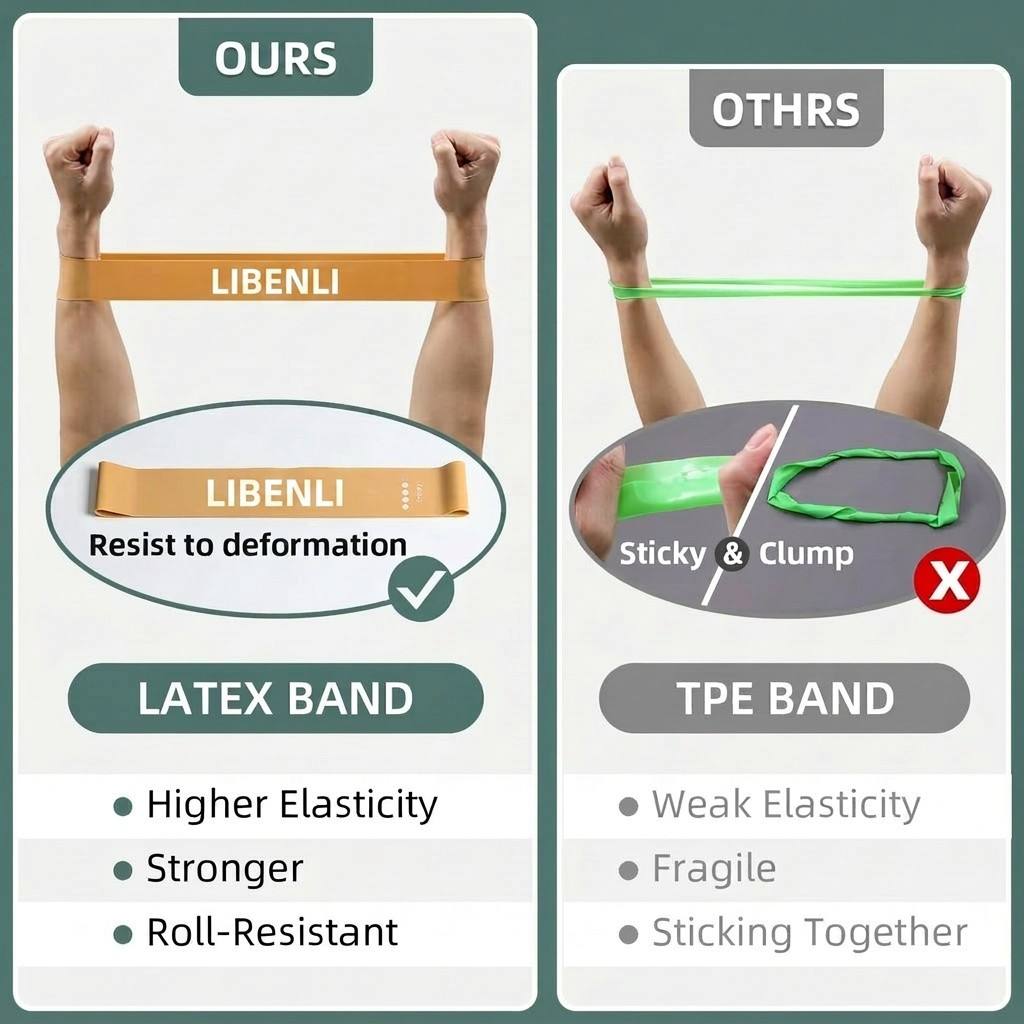
Quality assurance at Libenli begins with 100% raw material inspection before production and concludes with complete stretch, tension, and fatigue tests for all finished goods. The company’s tensile limit reaches 600% elongation – twice that of traditional TPE bands – and fatigue resistance exceeds 10,000 stretch cycles with less than 3% deformation. Tension accuracy is calibrated to a ±2% error margin, compared to the ±15% industry average for budget alternatives. These metrics are verified through physical performance testing mandated by the company’s ISO 9001:2008 quality management system. Most products are certified by SGS to meet international environmental and safety requirements, and the company holds 2 invention patents and 18 utility model patents.
Use‑Case Scenarios Across Professional Segments
Libenli’s product portfolio covers seven of the most requested resistance band categories: resistance loop bands, pull up assist bands, fabric resistance bands, booty bands, resistance bands with handles, mini loop bands, and heavy resistance bands. Key models include the ZLQ-03 double-layer power loop band (resistance range 8LB–230LB, service life ≥20,000 stretches) and the ZLQ-1 mini loop band (5LB–40LB, anti-slip option).
Typical deployments include:
- Commercial gyms & CrossFit boxes – high-frequency pull‑up assistance and heavy band work requiring fatigue resistance above 30,000 cycles.
- Physical therapy and rehabilitation clinics – low‑resistance mini bands for gradual strength restoration, where tension consistency (±2%) directly affects patient progress tracking.
- Online fitness retailers – private-label sets combining multiple band types with custom logo resistance bands (MOQ: 500 pcs for OEM).
The company also offers a latex-free TPE alternative to address allergy risk, with the same dimensional specifications and 100% pre-shipment inspection available for both material types.
Market Trend and Comparison with Traditional TPE
North America accounted for 40.0% of global resistance band revenue in 2024, while health and sports clubs represented a 70.6% segment share (Grand View Research). These segments demand products that withstand high‑volume use without powdering or breakage. Compared to traditional TPE bands and low‑grade synthetic latex, Libenli’s natural latex formulation delivers 35% higher linear resistance efficiency and an anti‑oxidation coating that reduces breakage incidents by 90% in high‑frequency scenarios.
One honest trade‑off: the initial acquisition cost of Libenli’s natural latex bands is 15–20% higher than typical TPE products. However, total cost of ownership is 50% lower over the product lifespan because the bands last 3–5 times longer. For buyers who prioritize upfront cost above longevity, the TPE alternative remains available.
Future Outlook: Compatibility with Evolving Compliance and Demand
As EU regulations (EN 20957 series for CE marking) tighten and more countries adopt the HS 9506.91 classification for fitness equipment, suppliers with documented quality management systems and third-party test reports gain a compliance advantage. Libenli’s existing ISO certifications, SGS testing, and 20 utility‑model patents position it to support brands that need to meet these requirements without redesigning supply chains. The company’s 2026 R&D pipeline continues to focus on improving band longevity and reducing environmental footprint, aligning with the broader industry shift toward sustainable fitness products.
Frequently Asked Questions
Q: What is the minimum order quantity (MOQ) for resistance bands?
A: For stock items, the MOQ is 100 pieces. For OEM customized orders (including custom logo, packaging, and specifications), the MOQ is 500 pieces.
Q: What payment terms does Libenli offer?
A: Standard terms are 30% T/T advance deposit and 70% balance against copy of Bill of Lading. For small orders, Alibaba Trade Assurance is also accepted.
Q: Which international quality certifications do Libenli products hold?
A: The company holds ISO 9000:2000 and ISO 9001:2008 certifications. Most products are certified by SGS to meet international environmental and safety requirements. Libenli also holds 2 invention patents and 18 utility model patents.
Q: Can a third-party organization inspect the goods before shipment?
A: Yes. The company supports pre-production and pre-shipment inspections by clients or third-party organizations such as SGS. Acceptance inspection includes 100% full pre-shipment inspection.
Q: What is the delivery method and shipping options?
A: Delivery terms include FOB Qingdao, EXW Factory, and CIF major global seaports.
Q: How does Libenli control product risk such as cracking or breakage?
A: The company performs 100% raw material inspection before production and complete stretch, tension, and fatigue tests on all finished goods. For customers with latex allergies, a latex-free TPE alternative band is available. Unconditional free return and replacement is provided for defective products to reduce buyer after-sales risk.
For a detailed overview of product specifications, OEM parameters, and ordering guidelines, download the full catalog: Libenli Product Catalog (PDF).
¿Tiene preguntas o necesita más detalles?
Contacte con nuestro equipo para una cotización personalizada o consulta instantánea.
Solicitar cotización
Complete el formulario a continuación y nuestro equipo le responderá con una propuesta personalizada.
Chat directo de WhatsApp
¿Prefiere chatear en tiempo real? Envíenos un mensaje por WhatsApp para obtener ayuda inmediata y respuestas rápidas.
- Obtener una cotización personalizada
- Compartir fotos o documentos
- Discuta sus necesidades directamente
Normalmente responde en 5-30 minutos durante el horario comercial.