
Resistance Band Scenario Fit: ZLQ-1 vs ZLQ-03 Applications
Resistance Band Scenario Fit: ZLQ-1 vs ZLQ-03 Applications
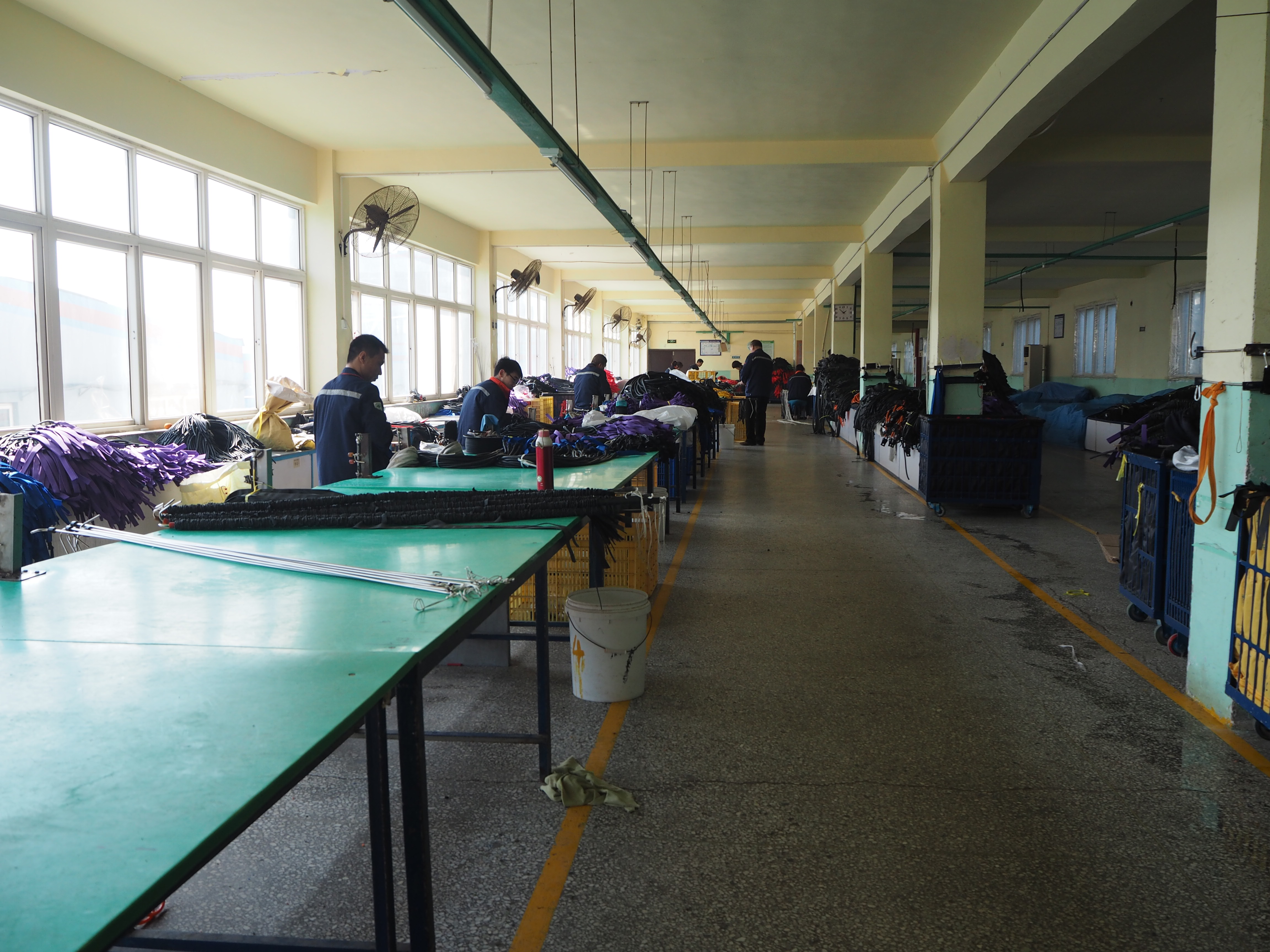
Assembly area at the Libenli latex resistance band production facility, where loop band programmes for indoor fitness buyers are prepared for export.
Resistance bands are usually bought under a single category name, yet indoors they are used in sharply different ways. A Pilates instructor needs a short, flat loop that stays positioned around the thighs. A physiotherapy clinic needs light, predictable tension for early-stage loading. A commercial gym needs a long, heavy power loop that can assist pull-ups or anchor to a rack. When one specification is asked to cover all three, tension quality, user experience and re-order accuracy all suffer.
The category is large enough for that mismatch to carry real commercial weight. Grand View Research valued the global resistance bands market at approximately USD 1.7 billion in 2024 and projects it to reach USD 2.9 billion by 2030, growing at a CAGR of 9.9% from 2025 to 2030, with health and sports clubs holding 70.6% of 2024 revenue. That is a market dominated by organised buyers who specify at model level, not category level. Other research houses report materially different totals for the same period depending on whether clinical therapy use or consumer retail is included, which reinforces the same conclusion: the useful unit of comparison is the model and the scenario, not the headline market figure.
This article maps two Libenli loop models — the ZLQ-1 mini loop band and the ZLQ-03 power loop band — to the indoor scenarios each is designed to serve. Libenli, formally Haiyang Libenli Body-Building Apparatus Co., Ltd., is a manufacturer and exporter of latex tubing and latex resistance bands founded in 1997, with a 50,000 m² production facility and export markets that include Germany, the United States, the United Kingdom, France and Canada.
Why a Single Specification Breaks Down Indoors
Two mismatch patterns account for most indoor fitting problems. The first is under-specification: a light mini loop band with a 600 mm circumference is issued for loaded lower-body work, is stretched beyond its comfortable working range, and delivers inconsistent tension long before its rated life is reached. The second is over-specification: a long power loop band capable of 230LB is handed to an entry-level yoga class or an early-stage rehabilitation patient, where the minimum available tension is higher than the movement pattern can be controlled safely.
Neither pattern is visible on a purchase order, but both surface later. Trainers improvise around unsuitable equipment, clinic staff re-order mid-programme because the resistance step is too large, and retail partners absorb returns for bands that roll, pinch or lose tension. The practical alternative is a two-format specification: one short loop for positioning, activation and low-load work, and one long band for progressive, full-range and heavier loading — supported by resistance, thickness and durability data that match the scenario rather than the category name.
The opportunity lies in how narrow that specification can be. A distributor does not need dozens of loop variants to cover indoor fitness; it needs two clearly separated formats whose parameter ranges do not overlap in a confusing way, plus documentation that lets trainers and clinicians select between them in one step. That is the design logic behind the two models discussed here.
The Two Models in Scope
The ZLQ-1 is a mini loop band, also supplied as a mini loop band with anti-slip. It is offered in latex or TPE and is quoted across a 5LB to 40LB resistance range, with thickness from 0.3 mm to 1.2 mm, a width of 50 mm and a loop circumference of 600 mm. Fatigue resistance is rated at 30,000 stretches or more. Its listed application industries are home fitness, yoga and Pilates, hip and glute training, sports rehabilitation, physical therapy, and gym training equipment.
The ZLQ-03 is a power loop band, also supplied as a double layer power loop band. It is a latex product quoted across a much wider 8LB to 230LB resistance range, with a constant 0.45 mm thickness, width from 6.4 mm to 82.5 mm, a length of 2080 mm and a service life of 20,000 stretches or more. Its listed application industries are fitness gyms, home workout, sports rehabilitation, yoga training, physical therapy, and outdoor training equipment.
| Parameter | ZLQ-1 (mini loop band) | ZLQ-03 (power loop band) |
|---|---|---|
| Format variants | Mini loop band; mini loop band with anti-slip | Power loop band; double layer power loop band |
| Material | Latex / TPE | Latex |
| Resistance range | 5LB – 40LB | 8LB – 230LB |
| Thickness | 0.3 mm – 1.2 mm | 0.45 mm |
| Width | 50 mm | 6.4 mm – 82.5 mm |
| Loop size | 600 mm circumference | 2080 mm length |
| Durability rating | 30,000 stretches or more | 20,000 stretches or more |
| Listed application industries | Home fitness, yoga & Pilates, hip & glute training, sports rehabilitation, physical therapy, gym training equipment | Fitness gym, home workout, sports rehabilitation, yoga training, physical therapy, outdoor training equipment |
Compliance documentation for these formats is specific rather than generic. A ROHS and REACH test report issued by Bureau Veritas, report number (9025)314-0099, covers a scope described as GYM POWER PULL UP ASSISTANCE LOOP BANDS. It was issued on 25 November 2025 under Directive 2011/65/EU (RoHS) and Regulation (EC) No. 1907/2006 (REACH) for the EU market, and it lists both the ZLQ-1 resistance band and the ZLQ-03 pull-up band as related products. The manufacturer also holds ISO 9000:2000 quality certification (2005), ISO 9001:2008 quality management system certification (2010) and a 3A credit rating certificate issued by the Ministry of Commerce of China and CCPIT, with most items certified by SGS.
How Geometry and Material Translate into Scenario Fit
Cross-section and resistance range
Band resistance is a function of cross-sectional area, material modulus and the degree of elongation, which is why two products with similar names can behave very differently in use. The ZLQ-1 holds a constant 50 mm width while its quoted thickness spans 0.3 mm to 1.2 mm, and its resistance range spans 5LB to 40LB — a spread suited to short, controlled movements where the joint angle, not the load, is the limiting factor. The ZLQ-03 holds a constant 0.45 mm thickness while its width spans 6.4 mm to 82.5 mm, and its resistance range spans 8LB to 230LB. A narrow, thin section and a wide, reinforced section can therefore sit inside the same product family while serving completely different movements.
Loop circumference versus band length
The most consequential difference for scenario fit is the elongation path. ZLQ-1 is a closed loop of 600 mm circumference, so tension builds quickly and the band stays close to the body — useful around thighs, knees and ankles in hip and glute work, and in Pilates positions where a long band would bunch or drag. ZLQ-03 measures 2080 mm in length, giving a longer elastic path and far more anchoring options: it can be looped around a rack, a bar or a fixed point for assisted pull-ups, full-range pressing patterns and heavier lower-body work. Length, not resistance, is usually the reason a buyer selects the wrong model.
Durability ratings and professional use cycles
ZLQ-1 carries a fatigue resistance rating of 30,000 stretches or more, while ZLQ-03 is rated at 20,000 stretches or more. For a home user these figures are almost academic; for a studio or clinic running several classes a day across a shared kit, they define how often the band set must be replaced and how stable the resistance step remains between replacements. Manufacture includes a stretch durability test before shipment, which is the point at which a rated figure becomes a batch-level control rather than a catalogue claim.
Anti-slip treatment and material choice
The ZLQ-1 is supplied both as a standard mini loop band and as a mini loop band with anti-slip, addressing the most common complaint in hip and glute training: bands that roll, pinch or migrate up the thigh under load. An anti-rolling surface treatment applied to bands supplied for an international premium fitness brand in Australia illustrates the same engineering priority from the supply side. Material also determines suitability by user group. ZLQ-1 is available in latex or TPE, while ZLQ-03 is a latex product, which is a decisive constraint when a clinic or retail range must serve latex-sensitive users.
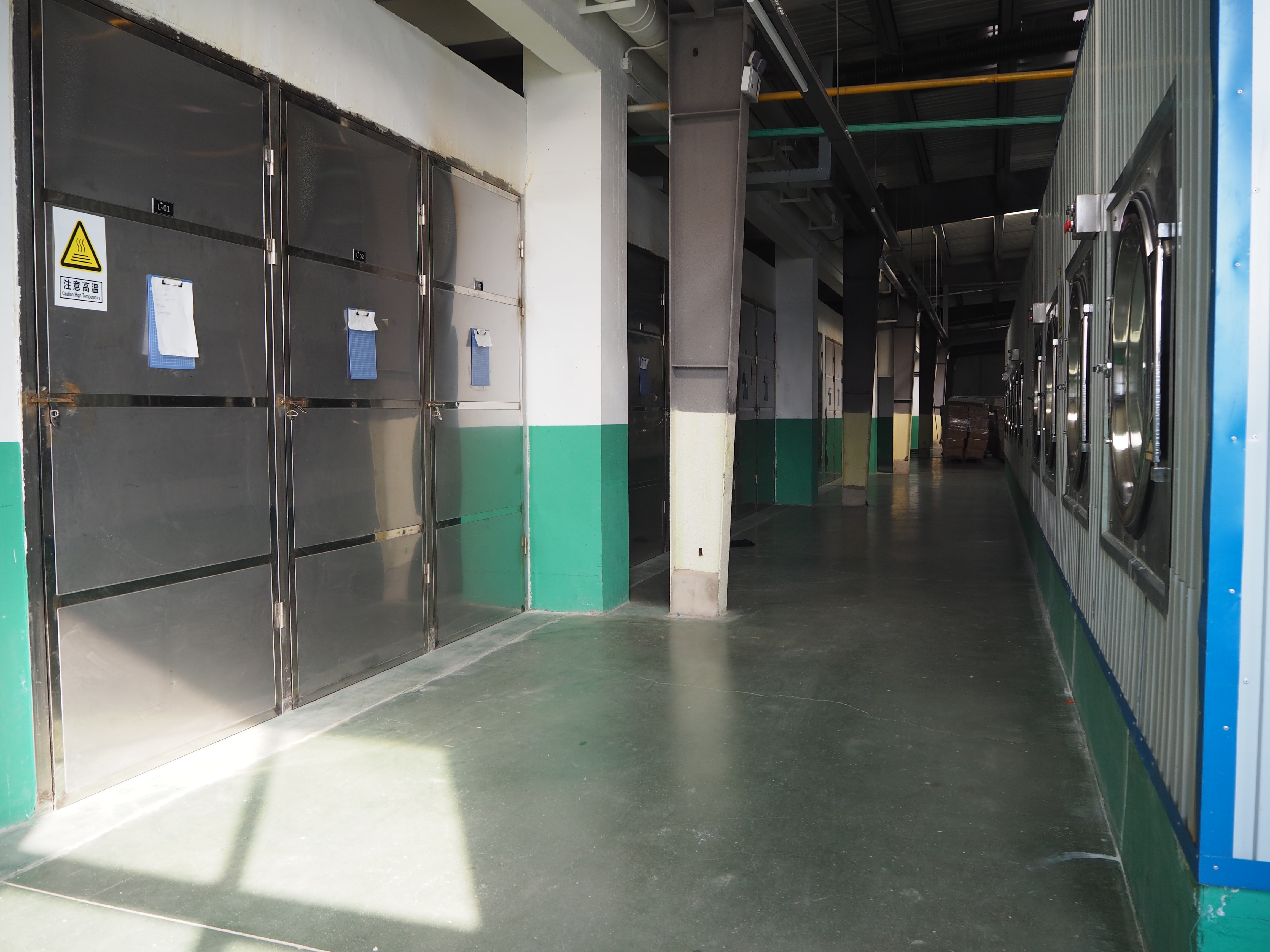
Drying workshop at the Libenli plant. Finished bands are checked with a stretch durability test before shipment.
Scenario Mapping: Which Loop Fits Which Indoor Programme
The table below maps the two models to indoor scenarios using only their quoted parameters. Where a scenario appears for both models, the two are used at different stages or for different parts of the same session rather than as interchangeable alternatives.
| Indoor scenario | Primary model | Parameter logic |
|---|---|---|
| Yoga and Pilates | ZLQ-1 | 600 mm loop and 50 mm width lie flat against the body; 5LB–40LB range matches low-to-moderate positional loading |
| Hip and glute training | ZLQ-1, with ZLQ-03 for progression | Short loop suits glute activation and abduction; long band adds range and heavier resistance when load increases |
| Sports rehabilitation and physical therapy | Both, staged | Low-tension ZLQ-1 for early controlled ranges; ZLQ-03 where longer lever arms or greater resistance are appropriate |
| Home workout | ZLQ-03, supported by ZLQ-1 | 2080 mm length and 8LB–230LB range cover assisted pulling, pressing and lower-body patterns in limited space |
| Gym training equipment | ZLQ-03 | Double layer power loop construction and high-tension end of the range suit shared, high-cycle commercial use |
| Outdoor training equipment | ZLQ-03 | Length and resistance headroom allow anchoring to fixed outdoor structures and full-range movement |
Yoga, Pilates and hip and glute training
In mat-based work the constraint is not load but positioning. A 600 mm loop can be worn above the knees or around the ankles without adjusting mid-set, and the 5LB to 40LB range lets an instructor scale a class without changing equipment size. The anti-slip variant matters most here, because a band that migrates during a glute bridge or clamshell disrupts alignment cues that the whole class depends on. TPE availability widens the same use case to studios whose clients avoid latex.
Sports rehabilitation and physical therapy
Rehabilitation buyers typically need a staged set rather than a single tension. ZLQ-1 covers the low end at 5LB upward in short ranges close to the joint, which is where early protocols usually begin. ZLQ-03 covers the later stage, where a longer elastic path and higher resistance support functional patterns such as assisted pull-ups, extended-range shoulder work or weight-bearing progressions. Both models list sports rehabilitation and physical therapy among their application industries, and the practical rule is sequence, not substitution.
Home workout and gym training equipment
A single long band covers more of a home programme per unit than a short loop: the 2080 mm length anchors to a door frame, a bar or a post, and the 8LB to 230LB width-graded range spans warm-up through heavier assistance work. In commercial gyms the same model is specified for shared kits where the double layer power loop construction is intended to absorb repeated, high-cycle use. A gym buying both formats usually assigns ZLQ-1 to group classes and ZLQ-03 to the strength floor.
Outdoor training equipment
Outdoor training is a documented application for ZLQ-03 specifically, and the reason is dimensional. A 2080 mm band can be wrapped around structures of larger diameter and still provide usable elongation, while the higher end of the resistance range compensates for the reduced stretch available in some anchoring positions. Shorter loops offer no equivalent option in open-air settings.
Evidence from a supply programme
A worked example shows how this mapping is applied commercially. For an international premium fitness brand in Australia, the supplier delivers an annual volume exceeding 150,000 units across more than 12 specialised product lines, serving global B2C retail, premium commercial gym fit-outs and specialised physical therapy and rehabilitation centres. Reported outcomes include a defect and complaint rate below 0.05%, a tension error margin held within ±2% under a five-tier resistance system, 100% premium Malaysian natural latex with food-grade pigments, and compliance with REACH, RoHS and Australian safety standards. The same programme produced a specialised anti-rolling surface treatment aimed at the curling and pinching problem described above. Bands in that programme are rated for three to five years under normal use.
Market Trend Analysis: Where Indoor Demand Is Moving
Three data points frame the indoor segment. Grand View Research estimates the global resistance bands market at approximately USD 1.7 billion in 2024, projected to reach USD 2.9 billion by 2030 at a CAGR of 9.9% from 2025 to 2030. Within that market, health and sports clubs held a 70.6% revenue share in 2024, while individual use is described as the fastest-growing segment — a combination that supports demand for both commercial-grade long bands and consumer-format short loops. Separately, Market Research Future places therapy and exercise bands at roughly 50% of the total market as of 2024/2025, a figure with medium reliability that nonetheless points in the same direction as the clinical application lists attached to both models.
Scope differences explain why published market sizes diverge. Estimates for the same period range from around USD 1.3 billion to USD 1.86 billion depending on whether physical therapy use is counted alongside retail fitness. For procurement teams, the practical implication is that category growth is broadly consistent across sources while absolute values are not — planning is better anchored to scenario demand than to a single market number.
Two regulatory markers also shape indoor sourcing. Fitness equipment such as resistance bands entering the EU must comply with the EN 20957 series for stationary training equipment in relation to CE marking, and resistance bands are commonly classified under HS Code 9506.91 for articles for general physical exercise, gymnastics or athletics. Both affect landed cost and compliance documentation rather than product design, but they enter the specification conversation early. The category itself is populated by established participants including Performance Health (TheraBand), Black Mountain Products, Rogue Fitness, TRX (Fitness Anywhere LLC) and Decathlon, alongside OEM manufacturers such as Haiyang Libenli, which supply private-label programmes to brands and distributors.
Comparison with Traditional Solutions
Loop bands do not replace every traditional option, and the honest comparison is about which constraint each format removes. The table below sets the two models against the common alternatives found in the same indoor budget.
| Format | Typical strength | Typical constraint | Overlap with ZLQ-1 / ZLQ-03 |
|---|---|---|---|
| Mini loop bands (ZLQ-1) | Positioning, activation, low-to-moderate load in short ranges | 600 mm circumference limits long-lever and overhead movement | Reference format |
| Power loop bands (ZLQ-03) | Wide resistance span up to 230LB, anchoring, assisted pulling | Latex only; minimum tension of 8LB is high for the lightest protocols | Reference format |
| Flat therapy bands (sheet) | Low-tension clinical work, easy cutting to length | No loop, no fixed width, relies on tying or gripping | ZLQ-1 covers comparable low loads in a pre-formed loop |
| Fabric booty bands | Stable positioning on the thigh during hip work | Minimal elastic range; resistance steps are coarse | Overlaps ZLQ-1 in hip and glute training, with narrower load range |
| Tube sets with handles or a bar | Grip-based movement variety | Requires door anchors or accessories; more assembly per session | Overlaps ZLQ-03 in full-range work, with more parts to manage |
| Cable and plate-loaded machines | Quantifiable, repeatable load | Fixed location and higher capital cost | Complementary; loop bands add portability and warm-up scaling |
The comparison is not a ranking. A fabric booty band is a reasonable choice for a specific hip-activation drill, just as a cable stack remains the correct tool when load must be reported in kilograms. The value of a two-model loop specification is coverage: between a 600 mm loop and a 2080 mm band, most indoor movements can be loaded without adding a third format to inventory.
Where Loop Bands Reach Their Limits
Several boundaries should be stated plainly before either model is written into a specification.
- Short-loop range limits. The ZLQ-1’s 600 mm circumference is intentionally short. It is not a substitute for a long band in overhead, long-lever or full-body pulling patterns, and asking it to perform that role accelerates wear.
- Minimum tension on the long band. ZLQ-03 starts at 8LB. For very light early-stage protocols or for deconditioned users, that floor can be higher than the movement allows, which is where ZLQ-1 from 5LB upward is the more appropriate start.
- Material constraints. ZLQ-03 is a latex product. Buyers serving latex-sensitive users need a TPE option, which exists in the ZLQ-1 range but not in the power loop format.
- Load is not linear. Elastic resistance rises with elongation, so the same band produces different loads at different lengths. Prescribed numeric loads require disciplined pre-stretch and consistent anchoring; loop bands are not equivalent to plate-loaded or cable systems for load reporting.
- Not a replacement for heavy compound loading. Bands are widely used as a complement to free weights and machines rather than as a substitute for progressive heavy resistance.
- Care requirements. Latex bands need protection from prolonged UV exposure, oils, sharp edges and rough storage surfaces. Inspection for nicks should be part of any shared-kit routine.
Future Outlook
Indoor fitness buying is moving toward scenario documents rather than product categories, and the two loop formats described here illustrate why. A specification that states which movement, which joint range and which user group a band must serve resolves most fit problems before they reach a purchase order, and it makes replacement cycles predictable for studios and clinics.
Three developments are worth tracking. First, resistance grading tolerance is becoming a procurement criterion in its own right, supported by durability testing before shipment and by documentation that lets buyers compare a band’s stated range against delivered batches. Second, surface engineering — anti-slip loops, anti-rolling treatments — is moving from a premium detail to a standard expectation in hip and glute applications. Third, material substitution is expanding: TPE covers latex-sensitive users in short-loop formats, while latex remains the reference material for high-tension power loops.
For OEM and private-label programmes, the supporting parameters are already well defined: monthly capacity of 1,200,000 units, production lead times of 20 to 35 days, and customization across resistance strength, band thickness and width, length, surface colour, logo silk printing, package design and accessory matching. That combination allows a distributor to launch a scenario-based range — one short loop, one long band — without commissioning a bespoke tooling programme.
FAQ
What is the ZLQ-1 mini loop band, and what parameters define it?
The ZLQ-1 is a mini loop band supplied in latex or TPE, also available as a mini loop band with anti-slip. Its quoted parameters are a 5LB to 40LB resistance range, thickness from 0.3 mm to 1.2 mm, a 50 mm width and a 600 mm loop circumference, with fatigue resistance rated at 30,000 stretches or more. Its listed application industries are home fitness, yoga and Pilates, hip and glute training, sports rehabilitation, physical therapy, and gym training equipment.
Which indoor scenarios suit the ZLQ-1 rather than the ZLQ-03?
The ZLQ-1 suits short-range, low-to-moderate load work where the band must stay positioned close to the body — Yoga and Pilates, hip and glute activation, and the early stages of rehabilitation or physical therapy. The ZLQ-03 suits longer-range and higher-load work, including fitness gym use, home workouts, assisted pull-up work and outdoor training equipment. The two overlap in sports rehabilitation and physical therapy, where they are normally used in sequence rather than as alternatives.
What does the ZLQ-03 power loop band cover in terms of size and resistance?
The ZLQ-03 is a latex power loop band, also supplied as a double layer power loop band. It is quoted at 8LB to 230LB resistance, a constant 0.45 mm thickness, a width range of 6.4 mm to 82.5 mm, a length of 2080 mm, and a service life of 20,000 stretches or more. Its listed application industries are fitness gym, home workout, sports rehabilitation, yoga training, physical therapy, and outdoor training equipment.
Can resistance level, thickness, width, length, colour and logo be customized?
The manufacturer provides OEM and ODM production services for resistance bands. Customization options include resistance strength, band thickness and width, length, surface colour, logo silk printing, package design and accessory matching. The minimum order quantity is 100 pieces for in-stock items and 500 pieces for customized logo or OEM customized orders, with a typical production lead time of 20 to 35 days and a stated monthly capacity of 1,200,000 units.
What quality and compliance evidence applies to these loop bands?
A ROHS and REACH test report issued by Bureau Veritas, report number (9025)314-0099, covers a scope described as GYM POWER PULL UP ASSISTANCE LOOP BANDS. It was issued on 25 November 2025 for the EU market under Directive 2011/65/EU (RoHS) and Regulation (EC) No. 1907/2006 (REACH), and lists both the ZLQ-1 resistance band and the ZLQ-03 pull-up band as related products. The manufacturer also holds ISO 9000:2000 certification (2005), ISO 9001:2008 certification (2010) and a 3A credit rating certificate from the Ministry of Commerce of China and CCPIT, with most items certified by SGS. Quality control includes a stretch durability test before shipment and 100% full pre-shipment inspection, with client or third-party inspection such as SGS supported. For EU-bound fitness equipment, the EN 20957 series applies to CE marking, and resistance bands are commonly classified under HS Code 9506.91.
What limitations should buyers plan for before standardising on loop bands?
Four boundaries matter. The ZLQ-1’s 600 mm circumference is not suited to long-lever or overhead patterns. The ZLQ-03 begins at 8LB, which may be too high for very light early-stage protocols. ZLQ-03 is latex only, so latex-sensitive user groups require the TPE option available in the ZLQ-1 range. Elastic resistance also increases with elongation, so numeric load prescription depends on consistent anchoring and pre-stretch and is not directly comparable to plate-loaded or cable systems. Loop bands are generally used alongside, rather than instead of, heavy resistance training.
Full parameter tables for latex tubing and loop bands, including resistance, thickness and width ranges, are available in the downloadable Libenli product catalogue: Libenli product catalogue (PDF).