
Repeatable Safety Barrier Supply: A Long-Term Vendor Test
A safety barrier portfolio is only a procurement asset if it repeats. Construction and municipal programmes rarely buy one barrier type once. Across a three-to-five-year horizon they buy construction-site hoarding for one boundary, security fence mesh for another, stair and balcony railing for a building package, a workshop partition for a fit-out, and bollards for an entrance. The variable that governs total procurement effort is not the lowest quotation on a single line item. It is whether the same supplier can return, a year later, with the same material logic, the same finish control and the same documentation for an adjacent product category.
This article sets out how buyers in a research-to-evaluation stage can assess that repeatability. Product references are drawn from Santian (Guangdong Guardrail) Steel Structure Co., Ltd., a China-based manufacturer of municipal traffic guardrails and construction-site hoarding systems that markets under the domain aotianguardrail.com. The company operates a production facility of approximately 15,000 m² in Guangzhou, integrates research and development, product design, manufacturing and installation, and records industry experience dating back to 2011, with formal registration on 16 May 2016.
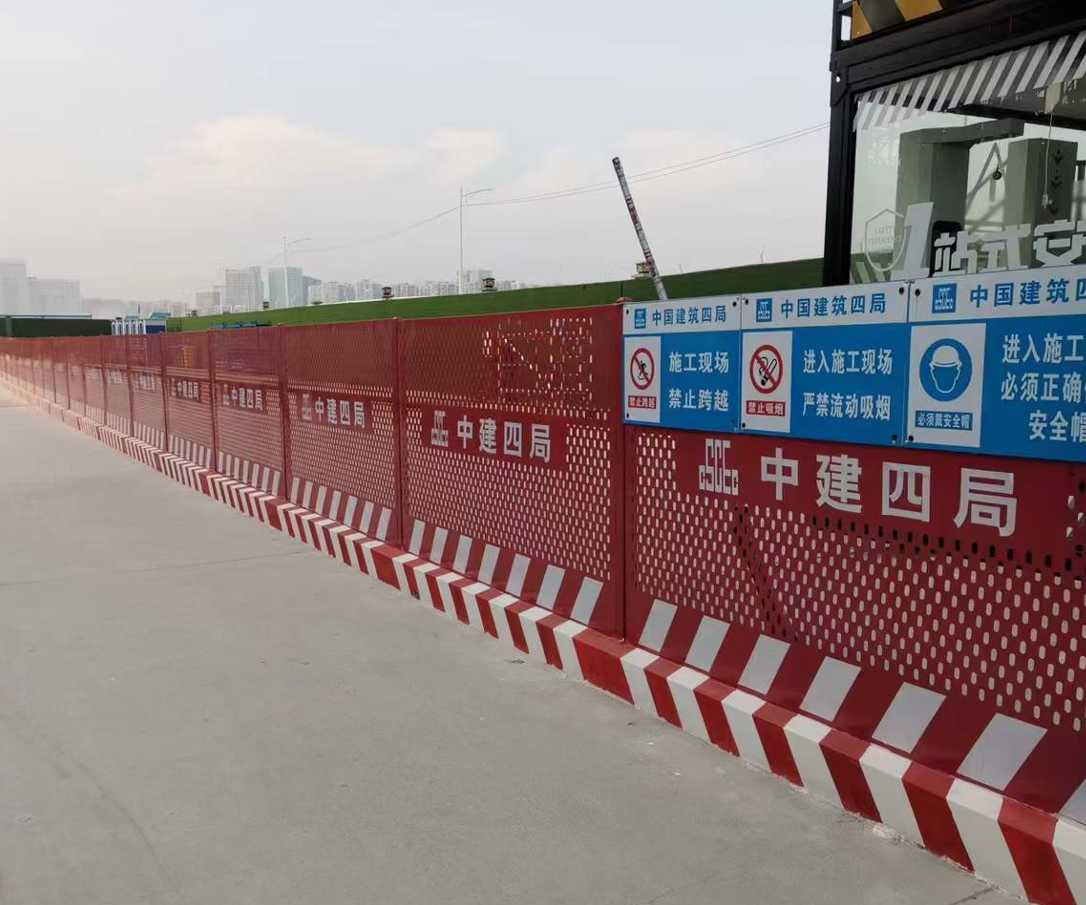
Perforated excavation edge guardrail (model Y083) — one of several barrier categories a long-term programme may need to source repeatedly.
The Real Procurement Problem: Category Breadth Without Category Discipline
A supplier that can quote across nine barrier families is not automatically a supplier that can repeat them. Breadth is easy to demonstrate in a catalogue and difficult to sustain in production. Between the first order and the third, the failure modes are predictable: coating colour drifts between batches, post spacing changes because a drawing was re-issued without a tolerance check, a galvanizing finish is substituted for a painted one to shorten a lead time, and the documentation that supported the original approval no longer matches what arrives at site.
That is why long-term supplier evaluation should be treated as a sustainability-of-supply question rather than a short-term price comparison. Two costs are being weighed. The visible cost is the unit rate. The invisible cost is the re-approval cycle — the engineering hours, sample rounds and site clarifications needed every time a substitute supplier interprets an existing barrier specification differently.
There is also a continuity dimension. A hoarding system installed for a medium- or long-term municipal project may remain in place while the same contractor awards further packages nearby. A perimeter fence may be extended in phases. Stair and balcony railing may be installed across multiple buildings in one development. In each case, the visual and dimensional consistency between phases depends on the supplier's ability to reproduce a specification, not merely to satisfy it once.
What Repeatability Requires Across Nine Barrier Categories
Repeatability is category-specific. Each barrier family has its own parameters that must hold constant, and its own parameters that legitimately vary with the project. The table below maps the nine categories relevant to a long-term programme against the material basis stated in the manufacturer's product records and the attributes a buyer should expect to see reproduced consistently.
| Category | Representative models | Material basis in product records | What must repeat between orders |
| Standardized construction-site safety equipment | Y085 safety access tunnel, Y086 rebar processing shelter, Y088 electrical distribution box shelter, Y091 mesh excavation edge guardrail, Y092 modular stair tower, Y093 worker rest and drinking shelter | Color-coated steel sheet, steel tube, welded steel mesh (varies by model) | Module dimensions, roof material, reserved ventilation space, anti-slip walking surface |
| Prefabricated steel construction hoarding | Y073 Guangzhou A1-1, Y075 Guangzhou A5, Y078 artificial grass, Y081 vertical green wall, Y082 perforated, Y083 and Y084 excavation edge guardrail | Color-coated steel sheet; material selected per custom specification on some models | Panel dimensions, coating colour, H-section post assembly, perforation pattern where used |
| Security fence mesh | Y070 anti-climb spike, Y071 angled-top, Y072 razor-wire | Hot-dip galvanized steel, steel tube posts, welded steel mesh | Mesh aperture, post section, top treatment, galvanizing process |
| Workshop safety partition | Y067 robot workcell safety fence, Y068 welded mesh partition, Y069 hot-dip galvanized partition | Welded steel mesh, hot-dip galvanized steel, zinc steel | Panel module size, post spacing, gate positions coordinated with a separate safety control system |
| Window guard railing | Y064 prefabricated, Y065 zinc steel, Y066 stainless steel | Zinc steel and steel; stainless steel; material per custom specification on Y064 | Fixing bracket design, bolt-together assembly, coordination with window type and opening |
| Stair railing | Y058 and Y060 stainless steel, Y059 stainless handrail, Y061 zinc steel, Y062 wooden handrail, Y063 prefabricated | Stainless steel (Grade 304 stated on Y058), zinc steel, solid wood handrail | Tube diameter, handrail height, fully welded versus bolted assembly |
| Balcony railing | Y052 zinc steel, Y053 flat steel, Y054 aluminium alloy, Y055 stainless steel with tempered glass, Y056 and Y057 stainless steel | Hot-dip galvanized steel, zinc steel, aluminium alloy, tempered glass with stainless steel posts | Infill type, post profile, anchor and connection plate detail, coating colour |
| Perimeter fence | Y043 villa fence, Y044 school perimeter fence, Y045 zinc steel fence, Y049 stainless steel school fence, Y050, Y051 decorative fence | Hot-dip galvanized steel, zinc steel, stainless steel; Y044 offers white or dark-gray electrostatic coating | Vertical-bar spacing, pointed or flat top treatment, coating colour, post material |
| Bollard / parking barrier | T040 stainless steel bollard, T041 custom-printed parking barrier, T042 stainless steel parking barrier | Grade 304 stainless steel; hot-dip galvanized steel with screen-printed surface panel | Cylindrical versus panel form, embedded or flange-mounted installation, print specification |
A buyer evaluating a supplier over the long term can use this table as an audit instrument. Request the stated material basis for each category in writing, then compare it to the submittal for the previous order. Where the basis has changed without a corresponding project change, the repeatability claim is weak regardless of how competitive the new quotation looks.
The Supply Base Behind the Portfolio
Portfolio consistency depends on whether the categories are produced under one quality system or assembled from unrelated sources. Santian (Guangdong Guardrail) Steel Structure Co., Ltd. records a production facility of approximately 15,000 m², approximately 200 employees, a research and development team of 50 engineers and a recorded annual output of 1,500,500 m. The company states an export ratio of 50 percent, with main markets in Southeast Asia, Africa, South America and the Middle East. Its registered product range covers municipal guardrails, road and bridge guardrails, pedestrian guardrails, riverside guardrails, balcony and stair railings, perimeter fence, construction-site hoarding, standardized site safety equipment, workshop partitions, security fence mesh, noise barriers, anti-throw mesh and bollards.
Three capability statements are directly relevant to a multi-year programme. First, the company operates on an OEM and ODM basis and customizes dimensions, materials, colours, surface finishes, structural designs, decorative patterns, logos, packaging and project-specific configurations. Second, monthly capacity is described as flexible and project-based, subject to product type, specifications and order quantity, with lead time determined by order quantity, product specifications and customization requirements, and MOQ negotiable according to product type and project requirements. Third, quality control is structured as a sequence of gates: incoming material inspection, dimensional inspection, welding inspection, coating inspection, in-process quality control and final pre-shipment inspection.
Those gates map onto the failure modes described earlier. Coating inspection addresses colour drift between batches. Dimensional inspection addresses panel and post-spacing variance. Welding inspection addresses the joint quality that determines whether a railing or fence panel survives handling and installation. Incoming material inspection is the control that prevents a lower-grade substitute from entering a repeat order.
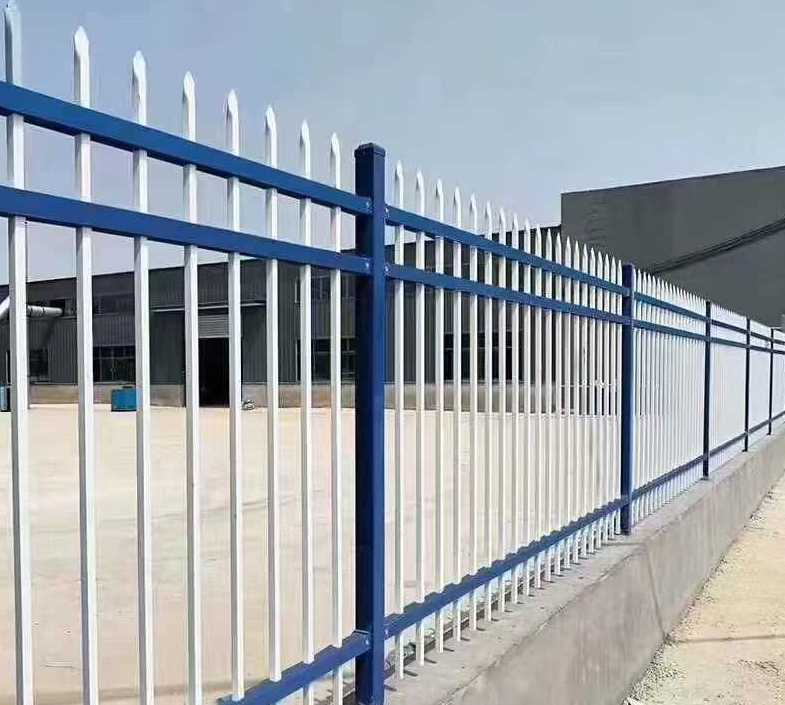
Zinc steel perimeter fence (model Y045) — hot-dip galvanized substrate with electrostatic coating and an open vertical-bar configuration.
Documentation and Process Evidence That Survives Repeat Orders
Repeatability is provable, but only through documentation. The most complete evidence set in the manufacturer's records relates to stainless steel bridge railing. Custom bridge railing sections are fabricated to drawing-based dimensions, with a design-for-manufacture review performed before fabrication and dimensional tolerances validated against approved drawings before volume production. In-house fabrication of stainless steel railing sections includes cutting, bending and welding. Material certificates and inspection records are provided, batch traceability records are maintained for stainless steel bridge railing production, and a pre-production sample can be supplied for project approval. Trial orders for custom quantities are accepted, and the product is available for third-party factory audit and supplier qualification.
Export handling is specified rather than assumed. Packing specifications are defined to prevent surface damage to stainless steel railing panels during container shipment, and export packaging and shipping documents are provided for bridge railing orders. Replacement railing components are supplied for long-term municipal maintenance programmes — a detail that matters more than it appears, because a barrier system installed in phases will eventually need matching parts years after the original order.
Surface treatment follows the same pattern. For one stainless steel bridge railing specification, pickling and passivation is applied to improve corrosion resistance. On the hoarding side, prefabricated units are assembled from H-section posts and color-coated steel panels for on-site installation, and the perforated variant uses a perforated panel that provides ventilation and protection while reducing panel weight. For the workshop safety partition, the structural configuration is a welded steel mesh panel fence intended to separate workshop areas and robot workcells.
Where Each Category Actually Fits
Category consistency only has value if the categories are used in the settings they were designed for. The manufacturer's scenario records define these fairly narrowly.
Construction sites. Standardized construction-site safety equipment covers the fixed site functions that repeat on every project: a safety access tunnel (Y085), rebar processing shelters (Y086, Y087), an electrical distribution box shelter (Y088) built from color-coated steel sheet with reserved ventilation space, a threading machine shelter (Y089), a rebar storage rack (Y090), a mesh excavation edge guardrail (Y091), a modular stair tower (Y092) with anti-slip steps and safety mesh enclosure, and a worker rest and drinking shelter (Y093). These are passive, temporarily installed structures used through the project phase.
Site boundaries and excavation edges. Prefabricated steel construction hoarding models Y073 to Y082 enclose and visually screen work sites or provide designated display surfaces, while Y083 and Y084 guard excavation edges where the site safety design requires it. The design service life is stated as up to five years, corresponding to medium- and long-term municipal and road construction project durations.
Industrial perimeters and workshops. Security fence mesh models Y070 to Y072 delineate secure boundaries and deter climbing, with protective top treatments depending on the selected model. Workshop safety partition models Y067 to Y069 separate designated work zones indoors. In both settings, detection, access control and machine-stop functions belong to separately specified systems.
Building-level fall protection. Window guard railing (Y064 to Y066), stair railing (Y058 to Y063) and balcony railing (Y052 to Y057) address openings, circulation routes and elevated edges respectively. The Y064 prefabricated window guard is assembled with bolted connections and is described as adaptable to different window types; the Y058 stainless steel stair railing is designed to campus safety rules with compliant handrail height and tube diameter; the Y055 balcony railing uses clear tempered glass panels with stainless steel posts.
Ground-level access control. Bollard and parking barrier models T040 to T042 define parking or access boundaries and discourage unauthorized vehicle entry into pedestrian areas, with embedded or flange-mounted installation.
What the Market Data Says About Long-Term Demand
The structural case for long-term supplier evaluation is supported by market scale and by the direction of regulation. Grand View Research values the global barrier systems market at USD 24.8 billion in 2025, and reports that the metal segment accounted for the largest material share at over 50.0 percent in the same year. Grand View Research separately values the global temporary guardrail market at USD 2.4 billion in 2024. Dataintelo projects a compound annual growth rate of 9.2 percent for the smart road barrier market from 2025 to 2034.
Regulation reinforces the documentation argument. EN 1317 is the mandatory European standard for vehicle restraint systems permanently installed on roads, with EN 1317-5 effective from 1 January 2011 according to Asebal. In the United States, AASHTO MASH 2016 is the current evaluation standard for new permanent roadside hardware as of 31 December 2019. Neither standard is satisfied by a product photograph; both are satisfied by a verified system configuration and its supporting evidence.
Trade classification adds a practical note. Road guardrails are commonly classified under HS Code 73089099, a code that aggregates barrier products so broadly that sub-segment trade flows — municipal versus bridge guardrail, for example — are difficult to isolate from customs data. For a procurement team, the implication is that supplier claims about export volume are harder to verify independently than supplier claims about documentation, which can be requested directly.
Comparison With Traditional Sourcing, and Where the Limits Sit
Compared with project-by-project sourcing, a portfolio-consistent supplier reduces re-approval effort, keeps finishes aligned across adjacent packages, and provides a single documentary trail for audit. Compared with masonry boundary walls, the manufacturer states that the lifecycle cost of its steel hoarding system is lower than that of masonry walls, and prefabricated panels can be relocated or reused depending on model condition and the project plan.
Those advantages have boundaries that a serious evaluation must record.
- Hoarding is not permanent. The design service life is up to five years. A buyer planning a longer boundary installation should not treat prefabricated steel hoarding as a permanent wall substitute.
- The protection level is not an IP rating. For excavation edge guardrail variants, protection is defined by standardized site-safety requirements rather than a numeric IP rating. Buyers should not map these products onto ingress-protection classifications.
- Mesh partitions are not machine guarding by themselves. Workshop safety partitions are passive fixed mesh partitions. Where access gates are used, interlocking and machine-stop functions belong to a separately specified safety control system, and safety around robots or hazardous equipment requires a complete assessed guarding system.
- Municipal guardrail is not crash-rated containment. Road median guardrails separate opposing traffic streams and guide vehicles. Vehicle impact containment requires a separately specified crash-rated system, and crash barrier performance depends on the verified system configuration, with no assumption of universal interchangeability of end terminals, transitions or cushions.
- Riverside railing does not control flooding. These railings guard accessible waterfront edges and guide pedestrian routes; they do not provide flood control.
- Perimeter fence excludes security electronics. Pedestrian and vehicle gates, access-control systems, CCTV, security lighting and intrusion alarms are not standard inclusions with perimeter fence and must be specified separately.
- Custom specification cuts both ways. Because dimensions and, on several models, material grade are defined per order rather than by a fixed catalogue size, repeatability depends on the buyer retaining approved drawings and on the supplier repeating its dimensional validation step. A supplier change mid-programme is therefore a documentation risk, not only a commercial one.
Future Outlook
Two directions are visible in the available evidence. The first is consolidation of the supplier base: as standards such as EN 1317 and MASH 2016 push verification toward system level, buyers gain more from fewer suppliers who can produce consistent documentation than from a wider panel of lowest-cost quoters. The second is functional integration. A projected 9.2 percent CAGR for smart road barriers from 2025 to 2034 points toward barriers that carry lighting, signalling or sensing rather than serving as passive geometry alone. Product design already anticipates part of this: the hollow-post lane separation guardrail (T012) is described as supporting the future addition of lighting or signalling equipment, with internal routing space reservable inside the posts.
For a programme running from research through evaluation, the practical conclusion is straightforward. Score suppliers on category repeatability, documented material basis, tolerance validation and traceability first; score price second. The barrier that fails in year three is usually not the one that was quoted highest in year one.
FAQ
How can a buyer test whether a supplier can repeat the same barrier categories across projects?
Ask for the stated material basis of each category in writing, then compare it with the submittal from the previous order. Evidence worth requesting includes material certificates and inspection records, dimensional tolerances validated against approved drawings before volume production, batch traceability records, a pre-production sample for project approval, and availability for third-party factory audit and supplier qualification. These items are documented for stainless steel bridge railing production and indicate the level of evidence a supplier can sustain.
Do custom specifications make repeat orders harder?
Yes, in one specific way. On multiple product lines the specification is custom, meaning dimensions are defined by the individual project requirement rather than a fixed catalogue size, and on several models the material is selected per custom specification. A repeat order therefore reproduces a drawing, not a stock item. Repeatability depends on retaining the approved drawings and on the supplier repeating its design-for-manufacture review and tolerance validation rather than working from memory.
What documentation should accompany a stainless steel bridge railing order?
The documented package includes material certificates and inspection records, batch traceability records for stainless steel railing production, technical submittal documents covering material and dimension data, and export packaging and shipping documents. Packing specifications are defined to prevent surface damage to stainless steel railing panels during container shipment. Where specified, pickling and passivation is applied to improve corrosion resistance, and replacement railing components can be supplied for long-term municipal maintenance programmes.
Can a welded steel mesh workshop partition serve as machine guarding for a robot cell?
Not on its own. Workshop safety partitions are passive fixed mesh partitions that separate designated work zones and restrict access to machinery areas. Where access gates are used, interlocking and machine-stop functions belong to the separately specified safety control system, and safety around robots or hazardous equipment requires a complete assessed guarding system. Mesh fencing alone does not provide interlock, emergency-stop or safety-controller functions.
How long is prefabricated steel construction hoarding expected to serve?
The stated design service life is up to five years, corresponding to medium- and long-term municipal and road construction project durations. Within that window, relocation or reuse depends on the condition of the model and the project plan. The protection level of the excavation edge guardrail variants is defined by standardized site-safety requirements rather than a numeric IP rating.
Which standards apply to roadside barriers, and does a municipal guardrail satisfy them?
EN 1317 is the mandatory European standard for vehicle restraint systems permanently installed on roads, and AASHTO MASH 2016 is the current evaluation standard for new permanent roadside hardware in the United States as of 31 December 2019. A municipal road median guardrail separates opposing traffic streams and guides vehicles, but vehicle impact containment requires a separately specified crash-rated system. Buyers should confirm system-level verification for the specific installation rather than inferring it from the barrier category.
What after-sales support matters over a multi-year programme?
The relevant services are remote technical support, installation guidance, maintenance recommendations, spare-parts coordination and after-sales response. Maintenance guidance is specific rather than generic: inspect posts, rails, welds, bolts, anchors and surface coatings; remove dirt and salt deposits; tighten loose fasteners; repair minor coating damage; and replace severely corroded or deformed components. Replacement components and coordinated spare parts are what allow a phased installation to remain visually and structurally consistent.
The manufacturer's full product and capability documentation is available as a downloadable brochure: Santian product brochure (PDF).
¿Tiene preguntas o necesita más detalles?
Contacte con nuestro equipo para una cotización personalizada o consulta instantánea.
Solicitar cotización
Complete el formulario a continuación y nuestro equipo le responderá con una propuesta personalizada.
Chat directo de WhatsApp
¿Prefiere chatear en tiempo real? Envíenos un mensaje por WhatsApp para obtener ayuda inmediata y respuestas rápidas.
- Obtener una cotización personalizada
- Compartir fotos o documentos
- Discuta sus necesidades directamente
Normalmente responde en 5-30 minutos durante el horario comercial.