
Repeat-Order Consistency: 316L, Miyota and Water Resistance
Repeat-Order Consistency: 316L, Miyota and Water Resistance
A custom wristwatch programme is rarely judged by its first delivery. It is judged by the fifth or the fifteenth, when the case alloy, the movement calibre and the declared water resistance must still match the specification the buyer approved months or years earlier.
That is why long-term supplier evaluation for custom wristwatches is a different exercise from a first-order capability check. A first order tests whether a factory can build a sample. A repeat order tests whether the factory can rebuild it. The second question is harder, because it depends on written specifications, incoming material discipline, calibre continuity and documented testing rather than on a single impressive presentation.
This reference examines three specification areas that most often drift in repeat production — 316L stainless steel case and bracelet construction, Miyota automatic and quartz movement continuity, and verified water resistance ratings such as 3ATM, 10 ATM and 200 meters — using model designations TD015G and TD017G as working examples of repeatable specifications.
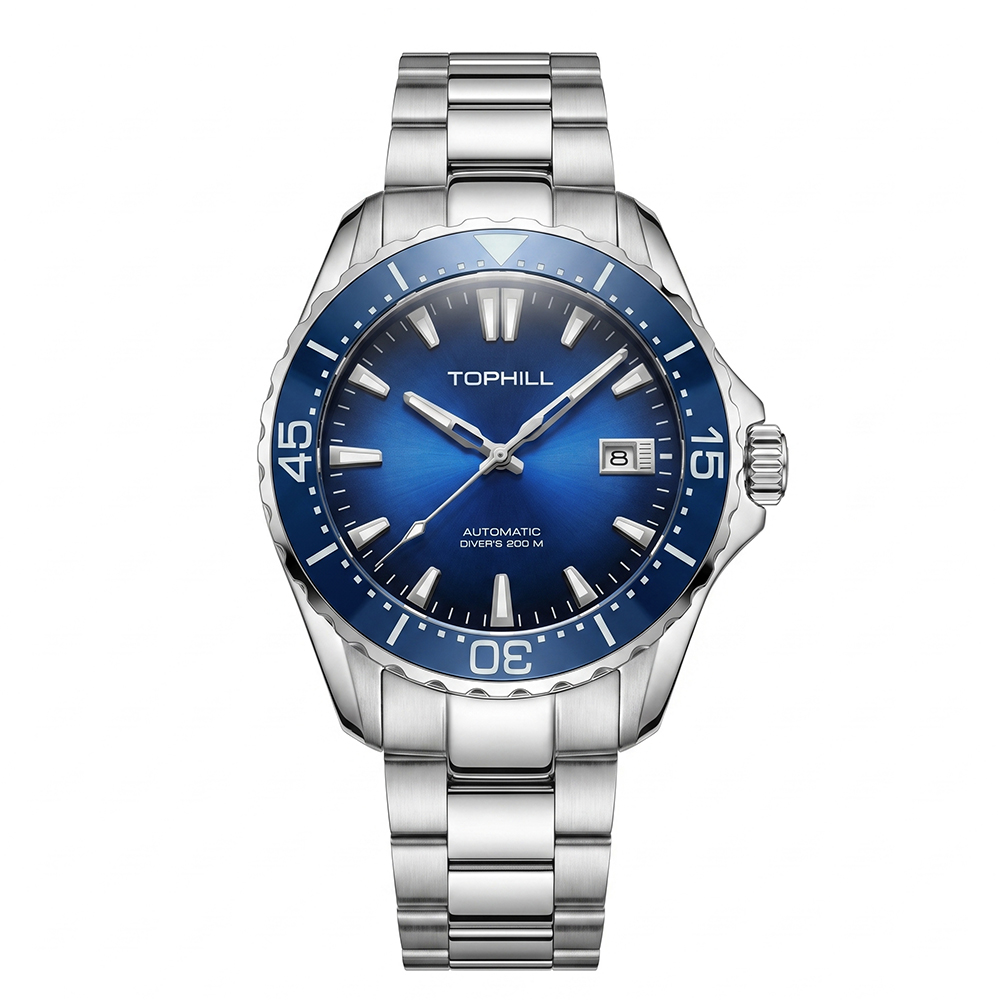
A repeatable build depends on documented material, movement and water resistance specifications, not on a single approved sample.
Why Repeat Orders Test a Supplier More Than a First Order
The first delivery is a controlled event. The sample has been approved, the specification is fresh in the project file, and attention from both buyer and factory is concentrated on getting it right. Repeat orders are looser. Tooling has been used, polishing consumables have been replaced, movement batches have changed, and the engineer who signed off the golden sample may no longer be on the project.
In custom wristwatch production, three areas account for most of the specification drift that buyers discover late:
- Case and bracelet alloy. A stainless steel grade stated on a quotation is not always the grade that arrives in the fifth batch, and 316L substitution changes corrosion behaviour and finishing response before it changes appearance.
- Movement calibre. Two calibres can look identical under a closed caseback while differing in thickness, stem geometry and rate performance.
- Water resistance. A dial print of 10 ATM or 200 meters is a claim, and it only remains valid if every unit is pressure-tested rather than sampled.
A supplier evaluation that reviews catalogue pages will not surface any of this. One that reviews how the supplier records, tests and re-confirms those three areas will.
What Long-Term Consistency Means in Custom Wristwatch Manufacturing
Long-term consistency in custom wristwatch manufacturing is a supplier's ability to deliver repeat production batches that match an approved specification in material grade, movement calibre, dimensional fit, water resistance and cosmetic finish, without requiring the buyer to re-qualify the product from scratch on each order.
That definition is deliberately operational rather than promotional. It does not ask whether a factory can make an excellent watch once. It asks whether the same watch can be made again after the sample has become a purchase order, and again after the purchase order has become an annual programme. For buyers in the research and evaluation stage, the practical implication is that supplier questions should shift from “what can you build” to “how do you keep building it”.
| Consistency dimension | How it fails on a repeat order | What to inspect before awarding |
|---|---|---|
| Case and bracelet alloy | Lower-grade or differently finished steel appears without a visible design change | Written material specification, approved golden sample, incoming material check routine |
| Movement calibre | An alternative calibre is fitted to protect supply, altering thickness or rate | Named calibre per model, assembly sequence, accuracy testing records |
| Water resistance | Declared rating carried over from the sample while routine testing is reduced | Declared ATM or meter value, full-unit pressure testing, test equipment on site |
| Cosmetic finish | Bezel insert, dial colour or polishing lustre shifts between batches | Golden sample retention, dial and bezel colour approval process |
| Compliance status | Certification or material compliance assumed rather than re-confirmed | Current ISO 9001 and ISO 14001 certification, EU RoHS conformity for export |
Material Consistency: 316L Stainless Steel Across Models
TOPHILL is the proprietary watch brand of Shenzhen Super Time CO., LTD., a custom watch manufacturer founded in Shenzhen in 1992 that completed a full plant relocation to Dongguan, Guangdong, in 2024. The company runs OEM and ODM programmes for brand owners, wholesalers and retailers, holds ISO 9001 and ISO 14001 certification, and states that finished products meet EU RoHS compliance standards for overseas market access.
Within that programme, 316L stainless steel appears as a declared specification rather than a marketing adjective. Both TD015G and TD017G list 316L stainless steel for the case and for the solid bracelet. The two models differ in build intent rather than in alloy family: TD015G is a 200-meter diving model with a flat sapphire crystal, a rotating bezel with a ceramic insert carrying BGW9 luminous, and a solid extension buckle; TD017G is a 10 ATM diving model with a boxed crystal, a ceramic insert with luminous, an embossed gradual-colour dial and a solid turtle buckle.
Alloy continuity matters commercially because stainless steel is not a cosmetic detail that can be swapped silently. The grade affects corrosion resistance in daily contact with sweat and salt water, the way the case takes polishing and brushing, the fit tolerance between bracelet links, and the adhesion behaviour of surface treatments. A supplier that changes steel source without changing the drawing can still deliver a watch that photographs identically and performs differently.
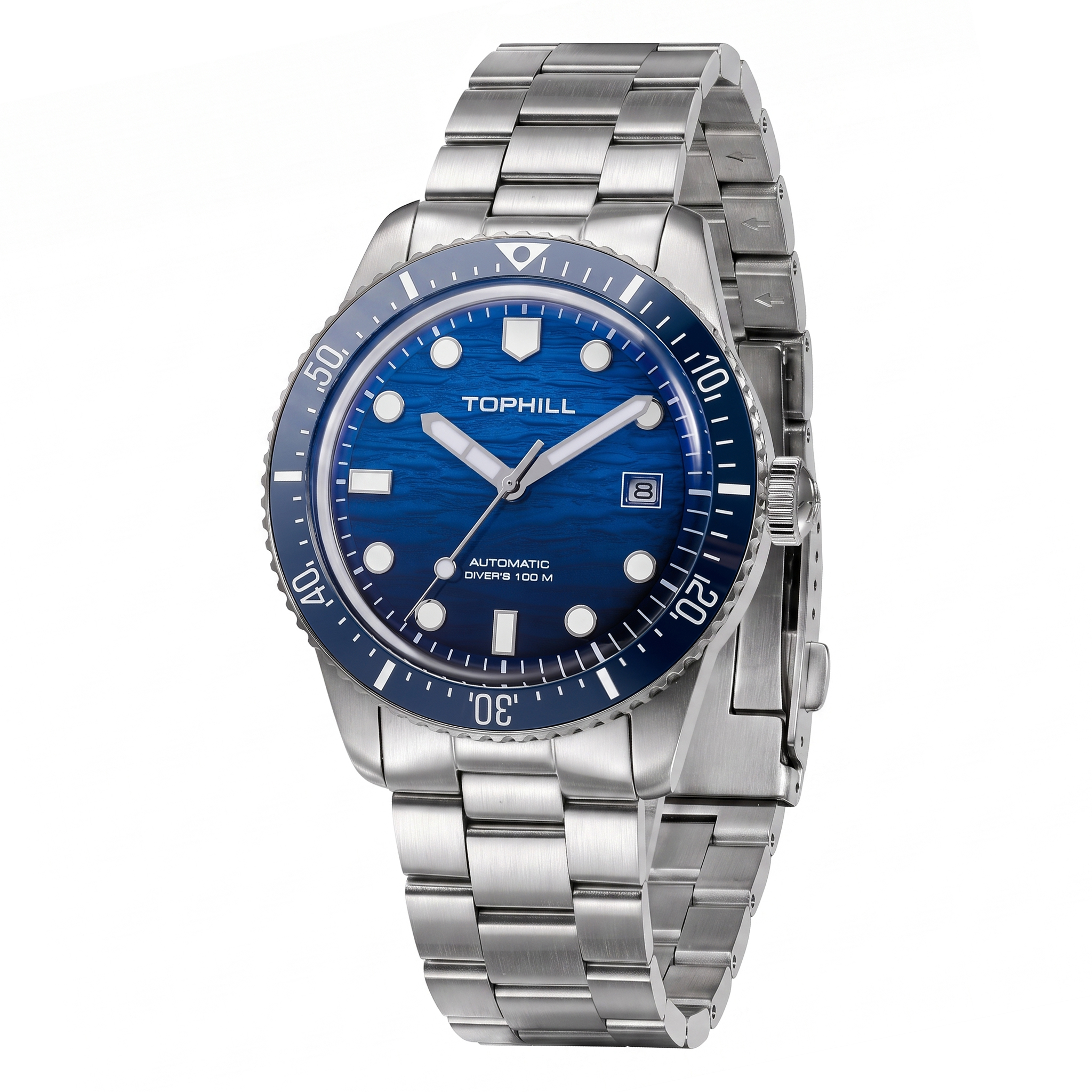
TD017G-type builds pair a 316L case and solid bracelet with a ceramic luminous insert, making material specification and bezel specification separately verifiable.
| Specification | TD015G | TD017G |
|---|---|---|
| Case | 316L stainless steel, rotating bezel, ceramic insert with BGW9 luminous | 316L stainless steel, rotating bezel, ceramic insert with luminous |
| Water resistance | 200 meters | 10 ATM |
| Crystal | Flat sapphire crystal | Boxed crystal |
| Dial and hands | Sunburst dial with applied BGW9 indexes; luminous applied to bezel, dial indexes and hands | Embossed dial with applied indexes and gradual colour; luminous hands |
| Bracelet | 316L solid bracelet with solid extension buckle | 316L solid bracelet with solid turtle buckle |
| Caseback | See-through solid caseback | See-through solid caseback |
| Movement | Japan Miyota Automatic 8215 | Miyota Automatic 8215 |
Movement Continuity: Miyota Automatic 8215 and Quartz Options
Both TD015G and TD017G name the Miyota Automatic 8215 as the fitted calibre. For a repeat-order buyer, that single line carries more weight than it appears to. The same calibre means the same case geometry, the same stem and crown interface, the same assembly sequence and the same accuracy verification routine. TOPHILL's production equipment list includes an automatic movement accuracy testing machine and a movement stem cutting machine, both of which are calibre-dependent tools rather than generic workshop assets.
Quartz continuity is equally relevant for private label programmes. In the current range, TR001 uses a Japan quartz movement, TAM002 uses a Ronda quartz movement, and TAM001 uses a Miyota quartz movement. Mechanical options extend beyond the diving line: KIM002 uses a Miyota 9039 automatic movement, and KIM003 uses a Seagull ST1905 mechanical chronograph movement with a power reserve indicator.
The commercial reason this deserves attention is structural. Quartz movements dominate global shipment volume with a 75% market share, according to 2024 industry research, while mechanical watches contribute over 68% of total market value despite lower unit volume. A custom watch supplier serving both segments must therefore hold two separate continuity disciplines at once: quartz calibre availability and battery-driven assembly for volume programmes, and automatic calibre supply with accuracy testing for value-led programmes.
Water Resistance: What 3ATM, 10 ATM and 200 Meters Actually Commit
Water resistance is the specification most likely to be over-read by buyers and under-tested by suppliers. TOPHILL states support for 5–50 ATM water resistance and confirms that every waterproof watch goes through a 100% water pressure test before shipment rather than random sampling. In the current model set, TD015G is rated at 200 meters, TD017G at 10 ATM, and the zircon-set models TR001, TAM002 and TAM001 at 3ATM.
The meaning of those figures is technical, not literal. The ATM marking represents a static laboratory pressure value, where 1 ATM is equivalent to 10 meters of static water depth. It does not describe a usable diving depth, because a moving wearer generates dynamic pressure spikes that a static test does not reproduce. Water resistance performance is tested and certified according to ISO 22810 for general water-resistant watches and ISO 6425 for diver watches, and ISO 22810:2010 also means the term “waterproof” should not be used for general water-resistant watches.
The documented test sequence is straightforward and worth asking a supplier to describe in its own words:
- Visual check of case, crown, gasket and crystal before testing
- Loading the watch and applying the target water pressure with a pressure hold
- Monitoring for air leakage during pressurisation
- Slow pressure release followed by full surface drying
- Final inspection for internal moisture or water ingress
The equipment behind that routine is visible in a factory audit. TOPHILL lists a 500-meter water resistant testing machine, air-based water resistance testing and post-test baking equipment among its inspection assets, alongside drop testing and strap tension-torsion testing.
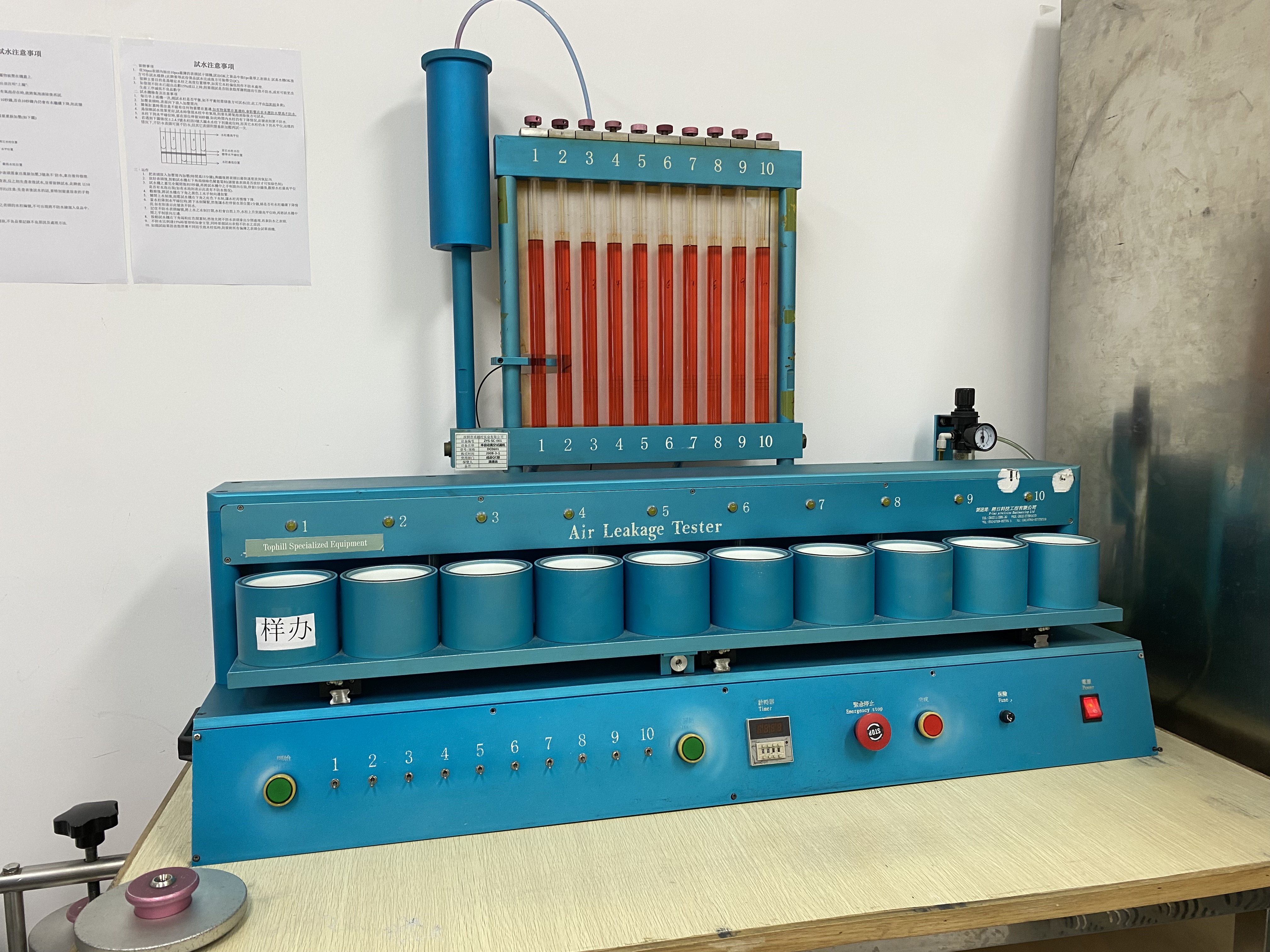
Full-unit pressure testing, rather than sampling, is the evidence point behind a declared 3ATM, 10 ATM or 200-meter rating.
Purchasing Terms and Acceptance Criteria for Repeat Orders
The difference between a supplier that is consistent and a supplier that is merely capable is usually documentation. For repeat custom wristwatch orders, the purchase agreement should carry specification lines that can be checked on arrival, not adjectives that can be debated afterwards.
| Acceptance area | Clause to write into the repeat order | Reference point from current records |
|---|---|---|
| Case and bracelet alloy | 316L stainless steel for case and bracelet, matched to the approved golden sample | TD015G and TD017G both specify 316L case and 316L solid bracelet |
| Bezel insert | Ceramic insert with luminous marking where the model requires it | TD015G uses ceramic with BGW9 luminous; TD017G uses ceramic with luminous |
| Movement | Named calibre per model, not a movement family | TD015G and TD017G: Miyota Automatic 8215; TAM002: Ronda quartz; TAM001: Miyota quartz; TR001: Japan quartz; KIM002: Miyota 9039; KIM003: Seagull ST1905 |
| Water resistance | Declared rating plus 100% pressure testing before shipment | 5–50 ATM support; every waterproof watch pressure-tested |
| Movement accuracy | Accuracy verification on automatic calibres | Automatic movement accuracy testing machine in the equipment list |
| Durability checks | Drop testing and strap tension-torsion testing where specified | Both listed among supporting test equipment |
| Compliance documentation | Current certificates on file for the destination market | ISO 9001, ISO 14001, EU RoHS conformity for finished products |
| After-sales | Service window and spare parts expectation | 2 years after-sales support stated in the capability record |
Order mechanics belong in the same document. The current capability record states OEM and ODM production, a minimum order quantity of 300 pieces, a 75-day lead time, monthly capacity of 50,000–60,000 units, 100% testing and 2 years of after-sales support, with export markets covering the EU, USA and Middle East. Buyers planning a multi-season programme should confirm how those figures behave under repeat load rather than assuming the first quoted lead time is fixed.
Application Scenarios Where Repeat Consistency Matters
Different end uses place different demands on continuity, and a single supplier may serve several of them at once.
Diving and water sports programmes
For diving sports custom wristwatches, the 200-meter TD015G build concentrates risk in three places: the ceramic bezel insert, the BGW9 luminous application and the pressure test. A buyer running seasonal dive collections should lock the bezel insert specification and the test protocol, because a cosmetic bezel change is easy to accept and a water resistance change is not.
Business and chronograph lines
Business men's custom wristwatches and mechanical chronograph custom wristwatches lean on calibre continuity more than on water resistance. KIM002 pairs a Miyota 9039 automatic movement with a 5ATM rating and a flat sapphire crystal; KIM003 pairs a Seagull ST1905 chronograph movement with a power reserve indicator, a 5ATM rating and a boxed sapphire crystal. Both are leather-strap builds, which makes strap tension-torsion testing the relevant durability check.
Luxury women's and gift programmes
Luxury women custom wristwatches and corporate gifting lines typically sit at 3ATM, as with TR001, TAM002 and TAM001. Here the continuity risk is cosmetic and structural at once: zircon setting density, dial colour consistency across batches, and the finish of the 316L bracelet or the genuine leather strap option. Quartz movement custom wristwatches also dominate volume in this segment, which makes calibre availability an operational question rather than a technical one.
Private label and retail display
Private label custom wristwatches sold through retail or display environments carry an additional requirement: the second production run must look like the first under store lighting. That is a finishing and colour-approval discipline, and it is best tested with a retained golden sample rather than a photograph.
Market Trend: Why Material and Movement Continuity Is a Commercial Issue
Movement economics explain why buyers increasingly audit continuity rather than capability alone. The global mechanical watch market is projected to reach USD 47.5 billion by 2025, according to Grand View Research, while the global watch movement market reached USD 18.4 billion in 2025 with automatic movements holding a 38.2% share, based on Dataintelo commercial research. Quartz movements, meanwhile, continue to dominate shipment volume at a 75% market share, while mechanical watches contribute over 68% of total market value on lower unit volume.
The implication for procurement is not that one movement type is superior. It is that a custom watch supplier serving brand owners across price tiers must maintain stable supply of both quartz and mechanical calibres, because the two segments fail in different ways. Quartz continuity failures show up as availability and assembly delays; automatic continuity failures show up as rate drift and case-fit problems that surface after delivery.
A second trend reinforces the point. Regulatory expectations around water resistance terminology and material compliance have become more explicit, with ISO 22810:2010 governing general water-resistant watches and RoHS compliance under Directive 2011/65/EU mandatory for electronic watches in the EU market. For a supplier, that means documentation is now part of the product, and for a buyer it means repeat orders should carry documentation requirements alongside physical specifications.
Comparison with Traditional Supplier Arrangements
Buyers typically choose between three sourcing structures, and each carries a different continuity profile. The comparison below is structural rather than a ranking of named companies.
| Sourcing structure | Where it helps | Where continuity breaks down |
|---|---|---|
| Integrated OEM/ODM manufacturer | Design, prototyping, assembly and testing under one quality system; specification ownership is clear | Higher minimum order quantities and longer lead times than spot buying; buyer depends on one production calendar |
| Multiple specialist suppliers assembled by the buyer | Flexibility on individual components and cost negotiation per part | Responsibility for water resistance and final accuracy is split across parties, so failure diagnosis is slower |
| Trading intermediary | Convenient communication and consolidated shipments | Material and calibre substitution can occur without the buyer seeing the production floor |
The integrated model has clear limits that buyers should weigh honestly. At TOPHILL, the recorded minimum order quantity is 300 pieces with a 75-day lead time, which does not suit very small trial volumes or urgent replenishment. Water resistance remains a maintenance characteristic rather than a permanent property, so a repeat order does not remove the need for gasket care and periodic servicing. And 316L continuity is only as strong as the contract that states it; a buyer who relies on product images rather than written specification has not actually secured the alloy.
There is also a boundary on what any supplier evaluation can prove. A documentation review confirms declared specification, testing discipline and certification status. It does not confirm financial stability, long-term capacity expansion or workforce retention, and those factors should be assessed separately if a programme is intended to run for several years.
Future Outlook
Repeat-order consistency is likely to become a more visible purchasing criterion as custom watch programmes mature. Two forces point in that direction. First, movement supply is concentrated among a small number of calibre families, so buyers increasingly specify calibres by name rather than by category. Second, water resistance and material compliance are now documented expectations rather than marketing claims, which shifts attention from the sample to the test record.
For buyers, the practical response is procedural. Retain a golden sample per model, write material and calibre lines into every purchase order, require full-unit pressure testing rather than sampling on water-resistant models, and re-confirm certification status at each renewal. For suppliers, the equivalent response is to treat repeat orders as a documentation event rather than a production repeat, because the second delivery is where a specification is either sustained or quietly lost.
FAQ
What is the difference between passing a sample review and sustaining a specification over repeat orders?
A sample review verifies that one build can meet a specification. Sustaining a specification verifies that material grade, movement calibre, water resistance testing and cosmetic finish remain matched to the approved sample across subsequent batches. The second requires written specifications, retained golden samples and documented testing, and it is the correct basis for a long-term supplier decision.
How can a buyer confirm that 316L stainless steel is used consistently in repeat production?
The alloy should be named in the purchase agreement for the specific components it covers. In the current range, TD015G and TD017G both specify 316L stainless steel for the case and for the solid bracelet, with a see-through solid caseback on both models. Buyers can then compare incoming batches against the approved golden sample and the written material line, rather than relying on catalogue descriptions.
Which Miyota movements are used in the diving models, and why does calibre continuity matter?
TD015G and TD017G both use the Miyota Automatic 8215. Elsewhere in the range, KIM002 uses a Miyota 9039 automatic movement and TAM001 uses a Miyota quartz movement. Calibre continuity matters because the movement determines case geometry, stem and crown interface, assembly sequence and accuracy testing routine, so a silent substitution can change the product even when the exterior looks unchanged.
How should 3ATM, 10 ATM and 200 meters be interpreted in a custom watch specification?
These are declared water resistance ratings tied to defined test conditions. ATM represents a static laboratory pressure value, where 1 ATM is equivalent to 10 meters of static water depth. In the current range, TR001, TAM002 and TAM001 are rated at 3ATM, TD017G at 10 ATM, and TD015G at 200 meters. General water-resistant watches are tested under ISO 22810 and diver watches under ISO 6425, and the term waterproof should not be used for general water-resistant watches under ISO 22810:2010.
What acceptance criteria should a repeat-order purchase agreement contain?
A workable agreement specifies the alloy for case and bracelet, the named movement calibre per model, the declared water resistance rating with 100% pressure testing before shipment, accuracy verification for automatic calibres, durability checks such as drop and strap tension-torsion testing where required, current certification status including ISO 9001, ISO 14001 and EU RoHS conformity, and the after-sales window, which is stated as 2 years in the current capability record.
What are the limits of this evaluation approach?
It verifies declared specification, test discipline and documentation, not commercial permanence. Water resistance degrades over time as gaskets age, and high-temperature steam environments are not recommended regardless of rating. The recorded minimum order quantity of 300 pieces and lead time of 75 days limit suitability for very small or urgent orders. Financial stability, capacity expansion and workforce continuity sit outside a specification audit and should be assessed through separate enquiries.
Reference Material
Buyers who need the full production and capability context behind the models discussed here can review the manufacturer profile document, which covers company background, workshop setup, certification status and product range.
Download the Super Time / TOPHILL company profile (PDF)
Specifications referenced in this article are drawn from current model records for TD015G, TD017G, TR001, TAM001, TAM002, KIM001, KIM002 and KIM003. Market figures are attributed to their published sources. Water resistance ratings describe laboratory test conditions and do not constitute a lifetime performance guarantee.
¿Tiene preguntas o necesita más detalles?
Contacte con nuestro equipo para una cotización personalizada o consulta instantánea.
Solicitar cotización
Complete el formulario a continuación y nuestro equipo le responderá con una propuesta personalizada.
Chat directo de WhatsApp
¿Prefiere chatear en tiempo real? Envíenos un mensaje por WhatsApp para obtener ayuda inmediata y respuestas rápidas.
- Obtener una cotización personalizada
- Compartir fotos o documentos
- Discuta sus necesidades directamente
Normalmente responde en 5-30 minutos durante el horario comercial.