
Reinforced vs Standard Pallet Jacks: A 2026 Decision Guide for Industrial Buyers
When procurement teams reach the final decision stage for material handling equipment, the choice between a standard pallet jack and a reinforced variant often comes down to total cost of ownership versus upfront price. Baoding Junyun Hoisting Machinery Co., Ltd. (JUNYUNHOIST), a vertically integrated Chinese manufacturer of lifting solutions, positions its reinforced pallet jacks as a durability-first alternative to conventional models. This article provides a fact-based comparison to help buyers evaluate whether the higher initial investment is justified for their specific industrial environments.
Market Context: Why Durability Matters in 2026
According to a 2025–2034 industry forecast, the global pallet jack market was valued at approximately USD 7.4 billion in 2024 and is projected to reach USD 11.6 billion by 2034. Manual pallet jacks alone accounted for USD 4.3 billion in 2024, underscoring their continued dominance despite growing electrification. In parallel, electric pallet jacks and stackers reached USD 5.1 billion, driven by e‑commerce and lithium‑ion adoption. For buyers operating in high‑frequency environments—warehouses, cold storage, food processing plants, and logistics centers—equipment breakdowns translate directly into operational downtime. This is where material specifications become a procurement differentiator.
JUNYUNHOIST’s Reinforced Pallet Jack Solution
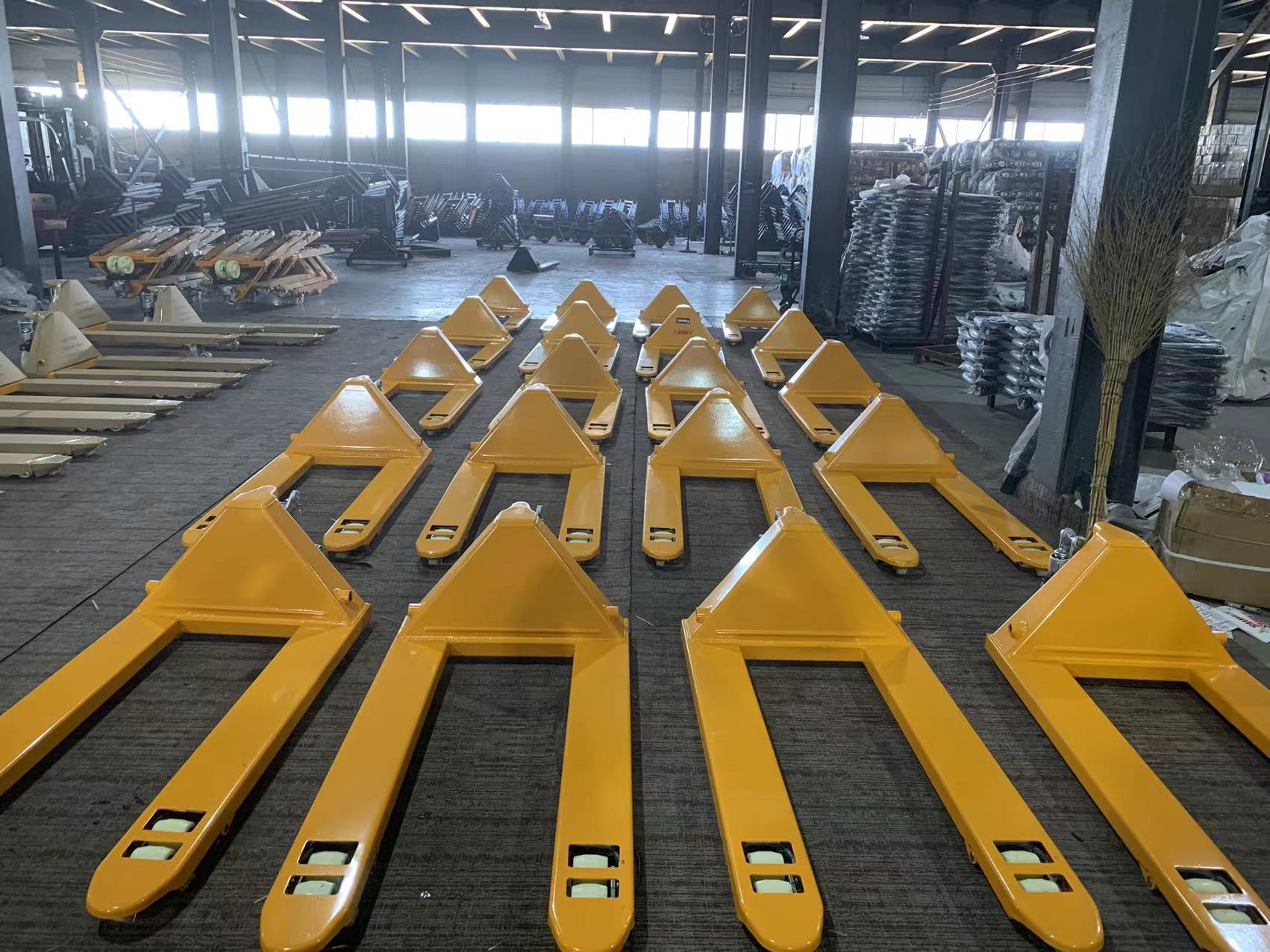
JUNYUNHOIST’s reinforced pallet jack is engineered with several structural upgrades compared to a typical factory product. The steel plate thickness is 4 mm, and the reinforcement extends 89 cm in length. The triangle‑ruler plate measures 4 mm, and the handle thickness is 2.75 mm. These parameters exceed those of many standard pallet jacks on the market. The pump uses an AC pump, the rocker arm is forged, and both the AB plate and double‑chain plate are forged as well. The wheel frame is made of cast steel with full ribs, providing additional rigidity. According to the manufacturer, these features result in stronger load‑bearing capacity—tested at 1.2 times the rated load—smoother wheel operation requiring less effort, and improved hill‑climbing performance.
Technical Comparison: Where the Upgrades Matter
The core technical differences can be summarized in the table below. All figures are based on JUNYUNHOIST’s production specifications for their reinforced model versus a standard factory baseline.
| Parameter | Reinforced (JUNYUNHOIST) | Standard Factory |
|---|---|---|
| Steel plate thickness | 4 mm | Typical 3–3.5 mm |
| Reinforcement length | 89 cm | Shorter |
| Handle thickness | 2.75 mm | ~2 mm |
| Pump type | AC pump | Often DC pump |
| Rocker arm / AB plate / chain plate | Forged | Cast or stamped |
| Wheel frame | Cast steel, full ribs | Fabricated steel |
These specifications translate into measurable field performance: the reinforced jack undergoes a 1.2× overload test, while the standard jack typically passes a 1.1× test. The forged components reduce wear and elongation over time, and the cast‑steel wheel frame resists deformation under heavy lateral loads.
Application Scenarios: Where the Reinforced Jack Excels
JUNYUNHOIST’s reinforced pallet jack is designed for continuous use in demanding environments. The manufacturer lists the following primary applications:
- Warehouse and distribution center operations (daily high‑cycle pallet movement)
- Factory floor and workshop material handling
- Loading dock and truck loading/unloading
- Cold storage facilities (with appropriate wheel and seal options)
- Food processing plants (with stainless‑steel or galvanized variants)
- Construction sites and cross‑docking terminals
- Retail backroom and heavy‑duty retail storage
For environments where pallet jacks are used on uneven floors, ramps, or with frequent edge‑loading, the extra steel thickness and forged frame provide a safety margin. The 2.75 mm handle is less prone to bending when bumped against racking or dock plates.
Cost Analysis: Upfront Premium vs. Long‑Term Savings
JUNYUNHOIST reports that its reinforced pallet jack carries an initial cost approximately 2 % higher than a standard factory product. However, the manufacturer estimates that maintenance requirements are reduced by about 90 % over the lifetime. This translates into lower spare‑parts consumption (seals, wheel frames, handles) and less downtime. For a warehouse operating 20 pallet jacks across two shifts, the avoided maintenance labor and parts can offset the upfront premium within three to six months. The company also proactively ships easily wear‑prone spare parts—seals, handles, and wheel frames—free of charge to mitigate common failure points.
Honest limitation: While the reinforced design significantly reduces structural failures, the 2 % price premium may not be justified for very low‑duty applications (e.g., a small retail store moving fewer than 10 pallets per day). In such cases, a standard pallet jack remains a cost‑effective choice.
Market Trend Implications for Buyers
The pallet jack industry is moving toward higher‑durability materials, partly driven by end‑user demand for lower total cost of ownership and partly by stricter safety standards (ISO 3691‑5, EN 1757‑2, OSHA 29 CFR 1910.178). Manual jacks still dominate the revenue share, but electric models are growing faster. For buyers evaluating long‑term partnerships, the ability of a supplier to deliver reinforced or customized jacks—such as JUNYUNHOIST’s OEM/ODM capability—offers strategic flexibility. The reinforced model bridges the gap between standard manual jacks and fully electric solutions, providing a durability upgrade without the complexity and cost of batteries and motors.
Future Outlook
As global supply chains continue to emphasize resilience, procurement strategies are shifting from lowest‑first‑cost to lowest‑total‑cost. Reinforced pallet jacks align with this trend. JUNYUNHOIST’s continuous investment in forged components and thicker steel suggests that the factory is positioning itself for buyers who value longevity over initial expense. The growing availability of galvanized and stainless‑steel variants for food and chemical sectors further broadens the addressable market. For industrial buyers making a 2026 decision, comparing steel thickness, pump type, and forging quality offers a clear path to avoiding premature equipment failure.
Frequently Asked Questions (Neutral, Informational)
Q: What is the steel plate thickness advantage of JUNYUNHOIST’s reinforced pallet jack?
A: The reinforced model uses 4 mm steel plate, with 4 mm reinforcement over 89 cm length, and a 4 mm triangle‑ruler plate. This is thicker than many standard pallet jacks, providing higher load‑bearing capacity and resistance to bending.
Q: How does the pump quality compare to standard pallet jacks?
A: The reinforced jack is equipped with an AC pump, which generally offers smoother operation and better‑sealed hydraulics, reducing the risk of oil leaks common in budget DC pumps. The manufacturer also includes a free‑of‑charge seal replacement program.
Q: What is the total cost of ownership difference?
A: Initial cost is approximately 2 % higher, but maintenance is reduced by roughly 90 % due to forged components, thicker steel, and higher‑quality seals. For high‑duty cycles, the payback period can be as short as three to six months.
Q: What spare parts does JUNYUNHOIST provide free?
A: The company ships seals, handles, and wheel frames free of charge with the initial order to mitigate common wear‑and‑tear issues. This reduces the buyer’s first‑year spare‑parts expense.
Download JUNYUNHOIST’s full product brochure for detailed specifications and OEM/ODM customization options:
Download Brochure (PDF)