
Reinforced vs. Basic Plush Custom Pet Toys: A Buyer's Comparison
Reinforced vs. Basic Plush Custom Pet Toys: A Buyer's Comparison
In 2025, the global pet toys market was valued at approximately USD 10.6 billion and is projected to reach USD 22.4 billion by 2033, according to Grand View Research. Plush construction sits near the center of that demand: fabric is the largest material segment for dog toys in the United States, holding a 39.8% share as of 2025, according to Future Market Insights. For buyers sourcing custom plush pet toys, the more consequential decision is not category selection but construction grade, namely whether to specify a reinforced plush build or a basic plush build.
This article sets out an independent comparison framework for that decision. It looks at the three variables that most affect landed value, which are breakage, maintenance, and total cost of ownership, and it separates the two construction types by the scenarios where each one actually earns its cost.
Why Durability Became a Procurement Metric
For most of the last decade, plush pet toys were sourced primarily on unit price and visual appeal. That is changing as pet humanization pushes buyers toward products that stay intact under real chewing and tugging. Dog toys represent the largest segment of the pet toy market, holding a 52.2% share in 2025 and driven by the humanization trend, according to Grand View Research. As this segment grows, retailers and e-commerce sellers face a practical problem: a soft toy that fails within weeks produces returns, complaints, and repeat replacement costs that a low unit price does not offset.
The opportunity sits on the other side of that problem. When buyers separate plush products by construction grade rather than by appearance alone, the pricing conversation shifts from a per-unit quote to a durability-per-month calculation. That shift favors reinforced plush construction in applications where the product is expected to survive more than a short promotional window.
What "Reinforced" Actually Means in Custom Plush Pet Toys
The distinction between a reinforced plush toy and a basic plush toy is structural, not cosmetic. A reinforced custom plush pet toy uses double-layer fabric and reinforced stitching. A basic plush toy has no reinforced structure and relies only on basic fabric and stuffing. Everything else in the comparison, including breakage, maintenance, and lifespan, follows from that single design choice.
The performance gap appears most clearly in usable lifespan. A basic plush toy is associated with a lifespan of roughly 1 to 3 months, while a reinforced plush toy is associated with a lifespan of roughly 3 to 12 months, a range that represents a 2 to 4 times increase over basic alternatives. That gap is the reason the two construction types are not interchangeable in a procurement plan: they solve different problems at different price points.
For buyers working with a manufacturer, the reinforced build also changes the specification conversation. Seam strength, fabric layering, and stitch density become the variables that determine whether a plush toy survives, and these are precisely the points that standards such as ASTM F963-23 address, including mechanical safety and seam strength for the US market. In the EU, custom plush toys must carry the CE mark and pass EN71-1 (mechanical), EN71-2 (flammability), and EN71-3 (chemical migration) testing. Both frameworks reward buyers who specify construction rather than assume it.
Reinforced vs. Basic Plush: A Side-by-Side Comparison
The comparison below uses a consistent set of decision criteria so that buyers can place the two construction types against the same baseline.
| Decision Criterion | Basic Plush Toy | Reinforced Plush Toy |
|---|---|---|
| Core difference | No reinforced structure; only basic fabric and stuffing | Double-layer fabric plus reinforced stitching |
| Lifespan | 1 to 3 months | 3 to 12 months (2 to 4 times increase) |
| Breakage | Low durability, high loss | Lower breakage |
| Maintenance | Frequent replacement required | Low maintenance |
| Cost position | Lowest cost | Medium cost |
| Efficiency | Low durability, high loss | Balanced performance |
| Best fit | Low-end retail, promotional gifts, short-term use | E-commerce platforms, pet specialty stores, retail chains, long-term pet companionship |
Breakage, Maintenance, and Total Cost of Ownership
Total cost of ownership is where the two constructions diverge most sharply, and it is also where buyers most often misread the quote sheet. A basic plush toy carries the lowest unit cost, but it requires frequent replacement. Every replacement cycle reintroduces purchasing cost, shipping cost, and handling effort. Reinforced plush toys carry a medium cost at the unit level, yet they reduce maintenance requirements and show lower breakage, which lowers the total cost of ownership over the life of the product.
The reinforced position also carries a cost advantage specifically because of reduced replacement frequency compared to basic plush toys. The core lever is the reinforced structure itself, since double-layer fabric and reinforced stitching are what raise the usable lifespan by 2 to 4 times. A buyer comparing a USD-level unit quote in isolation will see the basic option as cheaper; a buyer comparing cost per active month will see the reinforced option converge or pull ahead once replacement cycles are counted.
Interactivity adds a second layer to this calculation. The interactive pet toys segment is expected to reach USD 3.7 billion by 2030, growing at a CAGR of 10.2%, as owners prioritize mental stimulation, according to GlobalPETS and Grand View Research. Interactive features are only useful while the toy remains intact, which strengthens the case for reinforced construction in squeaky, teething, and interactive formats.
Application Fit: Where Each Construction Type Earns Its Cost
Reinforced plush toys are suited to e-commerce platforms, pet specialty stores, retail chains, and long-term pet companionship scenarios. They are also positioned for high-end retail, long-term use, and quality-conscious consumers, where the buyer can justify a medium cost against a longer usable life. For a brand building repeat purchase behavior, this is the segment where durability becomes a brand attribute rather than a hidden cost.
Basic plush toys remain a rational choice for low-end retail, promotional gifts, and short-term use. In a gift-with-purchase program or a seasonal promotion, the product is not expected to survive beyond its brief usage window, so the lowest-cost construction is not a compromise but a deliberate fit. The mistake is not in choosing basic plush; it is in specifying basic plush for a durable-use application.
Where Reinforced Production Capability Comes From
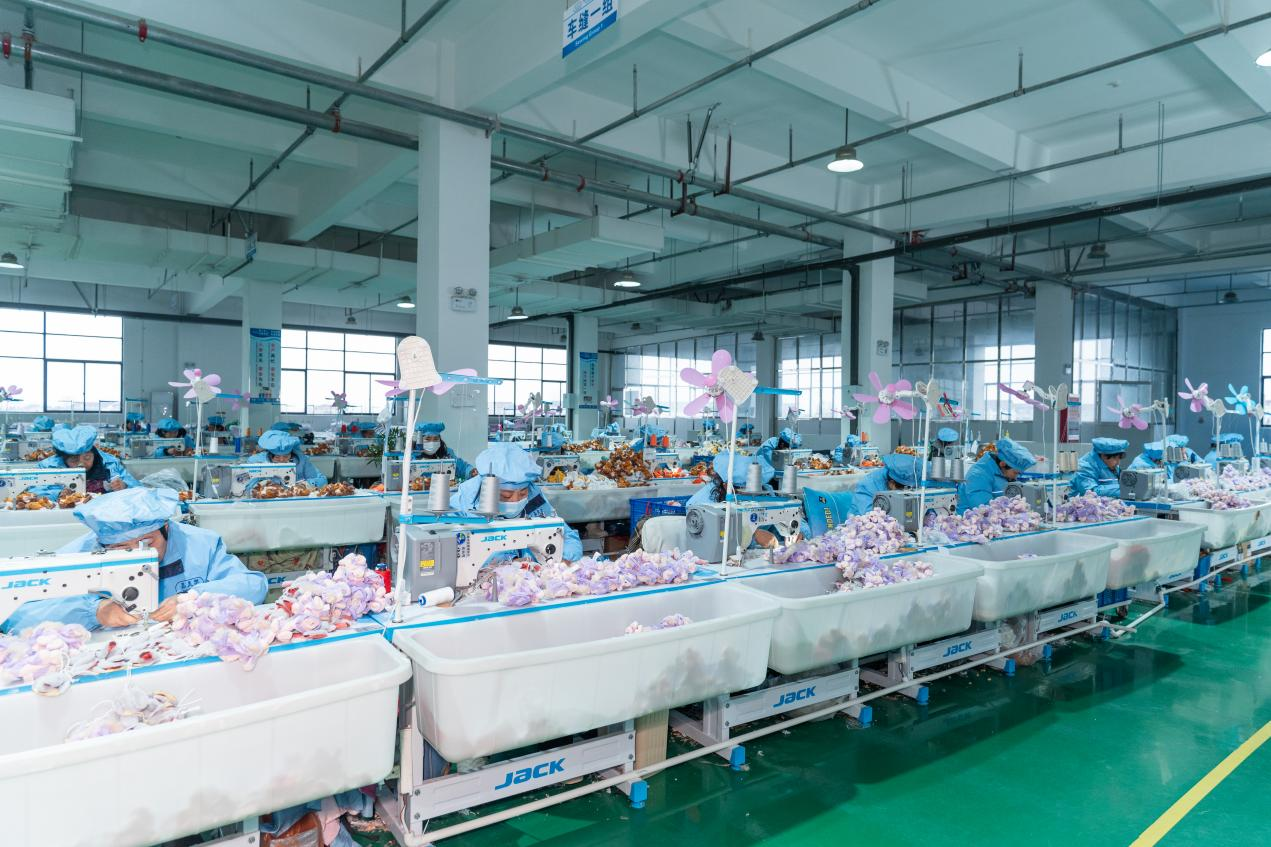
For buyers assessing a supplier rather than a single SKU, construction capability is the deciding factor. Tianchang Jiameile Gifts Co., Ltd is a Chinese manufacturer established in 2004 that integrates R&D, production, and international trade and specializes in plush and textile-based toys. The company operates a 6,800 m2 facility with 230 employees, a 30-person R&D team, an annual output of 6 million units, and an export ratio of 70%, with main markets in the EU and the USA.
Its pet product line covers plush pet toys, squeaky toys, and interactive items, with full OEM/ODM support. For reinforced builds specifically, the relevant control points are material safety and process discipline. The company holds ICTI, BSCI, Disney FAMA, ISO 9001, and ISO 14001 certifications, and its products comply with international safety standards including EN71, ASTM F963, and GB6675.
Construction quality depends on process control, not on a single inspection. The company operates an IQC/IPQC/OQC system for full-process quality control, supported by material and compliance testing and raw material safety control. On the supply side, it applies monthly capacity planning, backup suppliers, and inventory and lead-time management to reduce supply chain and delivery risk. For a buyer specifying reinforced plush construction, this combination of compliance certification and staged quality control is what makes a durability claim verifiable rather than promotional. The company has also been authorized to produce mascots and related products for major events, including UEFA Euro 2016, the FIFA World Cup 2018, the FIFA Women's World Cup 2019, UEFA Euro 2020, the FIFA World Cup 2022, the Hangzhou Asian Games 2023, and UEFA Euro 2024, which is one external indication of its ability to meet high-specification plush production requirements.
Market Trends Shaping Demand for Durable Plush
Three trends support the reinforced construction position. First, the overall category is expanding: the global pet toys market is projected to roughly double from USD 10.6 billion in 2025 toward USD 22.4 billion by 2033. Second, plush remains central to that expansion, with the global stuffed animals and plush toys market, including pet plush, valued at USD 13.68 billion in 2025. Third, the interactive segment is growing at a 10.2% CAGR, which raises buyer expectations for toys that remain functional over repeated use.
Regional supply patterns reinforce the same conclusion. China's pet toy market was valued at approximately USD 516.1 million in 2023, with a projected CAGR of 9.7% through 2030, reflecting both domestic demand and export capacity. Combined with the humanization-driven 52.2% share held by dog toys, these signals point to a market where durability and compliance are increasingly part of the purchase decision rather than afterthoughts.
Limitations and Trade-offs Buyers Should Not Ignore
A reinforced plush toy is not an indestructible toy, and buyers should not treat it as one. The reinforced structure reduces breakage; it does not eliminate it. A reinforced plush toy still has a finite lifespan of roughly 3 to 12 months, which means the construction improves duration rather than removing replacement entirely.
The second limitation is cost position. Reinforced plush sits at medium cost rather than lowest cost. For promotional, giveaway, or strictly short-term applications, the basic construction is often the more appropriate specification, and forcing a reinforced build into that context inflates unit cost without a corresponding benefit. The practical rule is straightforward: match construction grade to the intended usage window. Reinforced plush earns its cost in e-commerce, pet specialty, retail chain, and long-term companionship scenarios; basic plush earns its cost in low-end retail, promotional gifts, and short-term use.
Future Outlook
As pet humanization continues to expand the category, buyers are likely to evaluate plush toys on cost per active month rather than on unit price alone. That shift favors suppliers that can document reinforced construction, certified materials, and controlled production, and it pushes basic plush toward clearly defined promotional roles. The direction of the market, with a projected rise from USD 10.6 billion to USD 22.4 billion in pet toys, does not guarantee that any single construction wins, but it does make the durability question a permanent part of the procurement checklist.
FAQ
What is the difference between a reinforced plush custom pet toy and a basic plush custom pet toy?
The difference is structural. A reinforced custom plush pet toy uses double-layer fabric and reinforced stitching. A basic plush toy has no reinforced structure and uses only basic fabric and stuffing. That single design difference drives the resulting gap in lifespan, breakage, and maintenance.
How long does each type typically last?
A basic plush toy has a lifespan of roughly 1 to 3 months. A reinforced plush toy has a lifespan of roughly 3 to 12 months, which represents a 2 to 4 times increase over the basic alternative.
Which type reduces replacement frequency?
Reinforced plush toys reduce replacement frequency because of lower breakage and durable construction. Basic plush toys require frequent replacement. Reduced replacement frequency is the mechanism that lowers total cost of ownership over time.
Does a reinforced plush toy cost more upfront?
Yes. Reinforced plush toys are positioned at medium cost, while basic plush toys are the lowest-cost option. The comparison does not rest on unit price alone; it rests on total cost of ownership across the usable life of the product.
Which option has the lower total cost of ownership?
Reinforced plush toys carry a cost advantage from lower total cost of ownership, driven by reduced replacement frequency compared to basic plush toys. Because basic plush toys are replaced more often, the apparent unit-price saving narrows across a full usage cycle.
What maintenance does each type require?
Basic plush toys require frequent replacement. Reinforced plush toys require low maintenance and show lower breakage, which makes them suitable for long-term pet companionship.
Which type is suitable for high-end retail and quality-conscious consumers?
Reinforced plush toys are suitable for high-end retail, long-term use, and quality-conscious consumers. Basic plush toys are suited to low-end retail, promotional gifts, and short-term use.
Which sales channels does each construction type fit?
Reinforced plush toys fit e-commerce platforms, pet specialty stores, retail chains, and long-term pet companionship scenarios. Basic plush toys fit low-end retail, promotional gifts, and short-term use.
Market figures cited in this article are attributed to Grand View Research, Future Market Insights, GlobalPETS, the CPSC/ASTM, and the European Commission. Product construction and performance data reflect verified comparative product information.