
Regional Fit for Stainless Steel Pipes: Middle East, South America & Africa
Industry Reference · Regional Sourcing & Application
Regional Fit for Stainless Steel Pipes: Middle East, South America & Africa
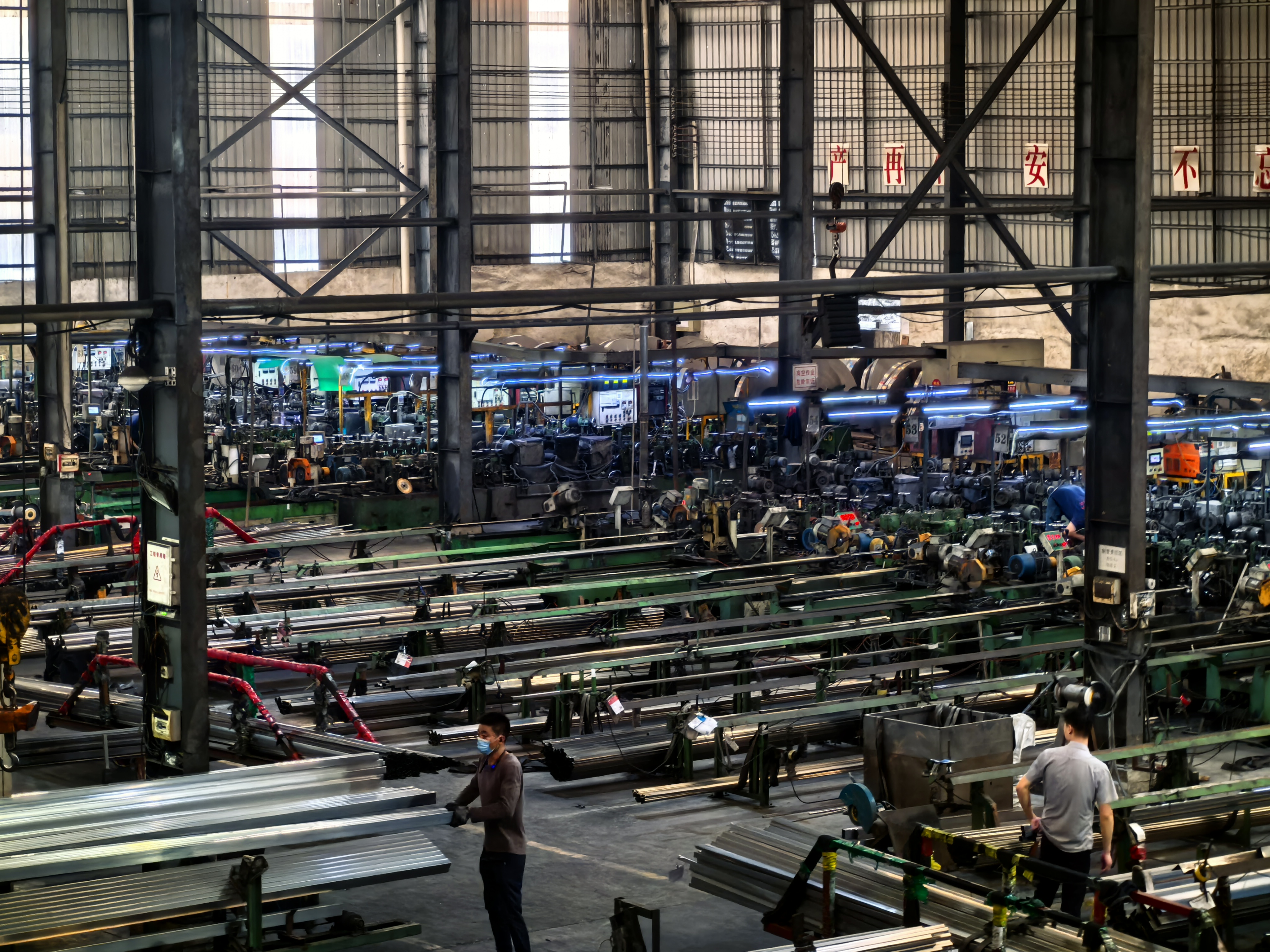 Production line at a Foshan stainless steel pipe manufacturer: decorative pipe for Middle East, South America and Africa markets is formed, polished, inspected and packed before export.
Stainless steel pipes are manufactured to global standards, but they are chosen under local conditions. A specification that performs predictably in a temperate inland city can behave very differently a few kilometres from a Gulf coastline, inside a humid river basin in South America, or on a high-temperature, dust-exposed site in Africa. For buyers in the evaluation stage, the useful question is not which pipe ranks highest in the abstract, but which combination of grade, finish, profile and fittings survives the conditions the installation will actually meet.
This guide maps those conditions to selection decisions. It draws on publicly disclosed commercial and certification information from one exporter active in all three regions — GuangDong Sanon Metal Products Co., Ltd., a Foshan-based manufacturer of stainless steel pipes, tubes and fittings founded in 1999, which reports that approximately 70% of its sales go to the Middle East, South America and Africa — alongside third-party market and standards data. The intent is a decision framework rather than a catalogue.
Why Regional Conditions Overtake Catalogue Specifications
Stainless steel resists corrosion because a chromium-rich passive layer forms on its surface and re-forms when damaged. That layer is stable in clean, dry, well-ventilated conditions and less stable where chlorides, standing moisture, crevices and abrasion are present. In practice, the procurement problems that reach buyers in the Middle East, South America and Africa cluster into three recognisable patterns.
- Surface staining at coastal and humid sites. Tea-staining and discolouration typically appear first at joints, welded areas, underside fixings and anywhere moisture is trapped against the surface rather than allowed to drain and dry.
- Coating degradation on colour pipe. UV exposure and abrasive dust affect coated surfaces differently from uncoated satin or mirror finishes, and colour consistency becomes a visible, project-wide issue rather than a single-component issue.
- Mechanical fatigue at connections. Repeated thermal cycling, wind load and handrail movement gradually loosen under-tightened or mismatched fittings, which is why the fitting package — not just the pipe — determines how an installation ages.
None of these outcomes is decided by wall thickness alone. They are decided by grade choice, surface finish, drainage and ventilation detail, and how consistently the fittings match the pipe they connect to.
What Actually Differs Across the Three Regions
The three regions are not interchangeable markets, and treating them as one export bloc is one of the most common sourcing mistakes. The differences below are qualitative environmental and project profiles used in procurement planning; they are not the output of a measurement campaign, and they should be tightened with project-specific data during evaluation.
| Region | Stressors commonly cited in project planning | Typical project context | Practical pipe and fitting implications |
|---|---|---|---|
| Middle East | High ambient temperatures, coastal humidity, salt-laden air, airborne dust and sand, strong UV | Large residential, hospitality, retail and mixed-use developments with extensive outdoor balustrades, canopies and decorative facades | Coastal proximity pushes grade and finish decisions toward higher corrosion resistance; abrasive dust favours finishes that tolerate routine cleaning; mirror finishes show handling damage earlier than satin finishes |
| South America | Tropical and coastal humidity in northern and coastal zones, strong UV at altitude, long inland transport distances | Residential, commercial and hospitality projects that often combine imported pipe with locally sourced fittings | Moisture exposure during transport and storage matters as much as in-service exposure; finish and colour consistency across shipments is scrutinised because replacement stock arrives slowly |
| Africa | Coastal humidity, high temperatures in many markets, dust, wide variation in site conditions and installation practice | Infrastructure, residential and commercial developments frequently phased across long build cycles | Fewer, standardised fitting SKUs reduce field error rates; easily replaceable fittings matter more than unusual finishes; corrosion resistance at fixed points drives repeat-order decisions |
Grade Selection: Where 201 and 304 Sit
Grade is the first decision that cannot be reversed later. For decorative and architectural stainless steel pipe, the two grades most frequently discussed by buyers in these regions are 201 and 304, and their chemistry explains most of the price and performance gap.
| Grade | Chromium (Cr) | Nickel (Ni) | Manganese (Mn) | Where it is typically considered |
|---|---|---|---|---|
| 201 stainless steel | 16–18% | 3.5–5.5% | 5.5–7.5% | Cost-sensitive decorative work in sheltered, well-ventilated positions where long-term appearance retention under coastal or high-humidity exposure is not the governing requirement |
| 304 stainless steel | 18–20% | 8–11% | ≤2% | Visible architectural work where appearance retention, coastal proximity, cleaning regimes and specification review all matter |
Fittings follow the same logic and, in practice, often matter more. Sanon states that its fittings can be produced in stainless steel 304, stainless steel 316 and zinc alloy, with either a satin or mirror finish — a combination that allows a single balustrade or shower package to use different materials at different exposure points rather than one material everywhere.
Two standards anchor the specification conversation. ASTM A312 covers seamless and welded stainless steel pipe used in structural and other demanding applications, while ASTM A554 covers ornamental tubing used in architectural and decorative work. Buyers who treat the two as interchangeable create compliance and safety risk, particularly where a pipe or fitting carries load rather than only carrying appearance.
Product Form Mapping: Pipes, Profiles and Fittings as One Package
Regional fit is also a product-form question. The same project may require round pipe on a handrail, square pipe on a frame, slotted pipe for a channel detail, and a set of glass clamps and standoffs that must visually and dimensionally match all of them.
| Project package | Typical stainless steel forms and fittings | Selection note |
|---|---|---|
| Staircase and balcony balustrades | stainless steel round pipe, stainless steel square pipe, stainless steel slotted pipe, stainless steel elbow, stainless steel bend, railing flange, stainless steel bracket, cross bar holder | Bends and elbows should match pipe bore and wall thickness from the same supply base to avoid visible steps at joints |
| Glass railing and balustrade systems | glass clamps, glass standoffs, stainless steel glass holder, stainless steel pipe connector, stainless steel end caps, decoration ball | Load-bearing glass hardware is governed by building codes in several markets; load capacity must be verified, not assumed from appearance |
| Decorative and interior work | stainless steel color pipe (PVD-coated), stainless steel round pipe, stainless steel oval pipe, stainless steel bar | Colour and gloss consistency between production batches is the recurring risk in colour-pipe procurement |
| Shower enclosures and interior doors | sliding door fittings, door handle | Humidity in enclosed shower environments makes material and finish choice more critical than in open interiors |
| Tension and cable systems | stainless steel cable, railing flange, cross bar holder | Terminations and swaged ends determine service life more than the cable itself in coastal conditions |
How Sanon's Disclosed Capability Maps to These Regions
GuangDong Sanon Metal Products Co., Ltd. is a stainless steel pipe, tube and fittings manufacturer based in Foshan, Guangdong, China, founded in 1999. The company reports a 40,000 square metre facility, approximately 500 employees, a 30-person R&D team, an annual output of 100,000 tons and a pipe capacity of 9,000 tons per month. It states that it operates an OEM/ODM production model, offers customisation for voltage and logo, applies 100% testing as its quality-control approach, works to a minimum order quantity of 5 tons and a stated lead time of 7 days, and provides remote after-sales support. Its declared export markets are the Middle East, Africa and South America.
For buyers evaluating regional fit, the more decision-relevant disclosure is the certification portfolio, because it is independently numbered, dated and scoped.
| Certificate | Number | Issuing body | Scope and reference standard | Validity |
|---|---|---|---|---|
| Attestation of Conformity (RoHS) | TD59352502 | EUTEST Belgelendirme Muayene ve Gözetim Hiz. Ltd. Şti. | Stainless steel pipes (Model: 304, Trademark: NAME BRIGHT) against the EU RoHS 2015/863 restricted substances list, tested under the EN 62321 series | Issued 2025-10-27, valid to 2030-10-26 |
| ECTI CERT Certificate (CPR) | BGTC20251119-08 | ECTI CERT Ltd. | Stainless steel pipes (Model: 304, Trademark: NAME BRIGHT) under the EU Construction Products Regulation; EN ISO 9227:2022/A1:2024 | Issued 2025-11-19, valid to 2030-11-18 |
| ISO 14001 Environmental Management System | 39323E1762R0M | Beijing Zhonghuan Qitian International Certification Co., Ltd. | Environmental management for production of decorative stainless steel pipes (excluding those requiring quality license); GB/T 24001-2016 / ISO 14001:2015 | Issued 2023-12-04, valid to 2026-12-03 |
| ISO 45001 Occupational Health and Safety Management System | 39323S1708R0M | Beijing Zhonghuan Qitian International Certification Co., Ltd. | Occupational health and safety management for production of decorative stainless steel pipes (excluding those requiring quality license); GB/T 45001-2020 / ISO 45001:2018 | Issued 2023-12-04, valid to 2026-12-03 |
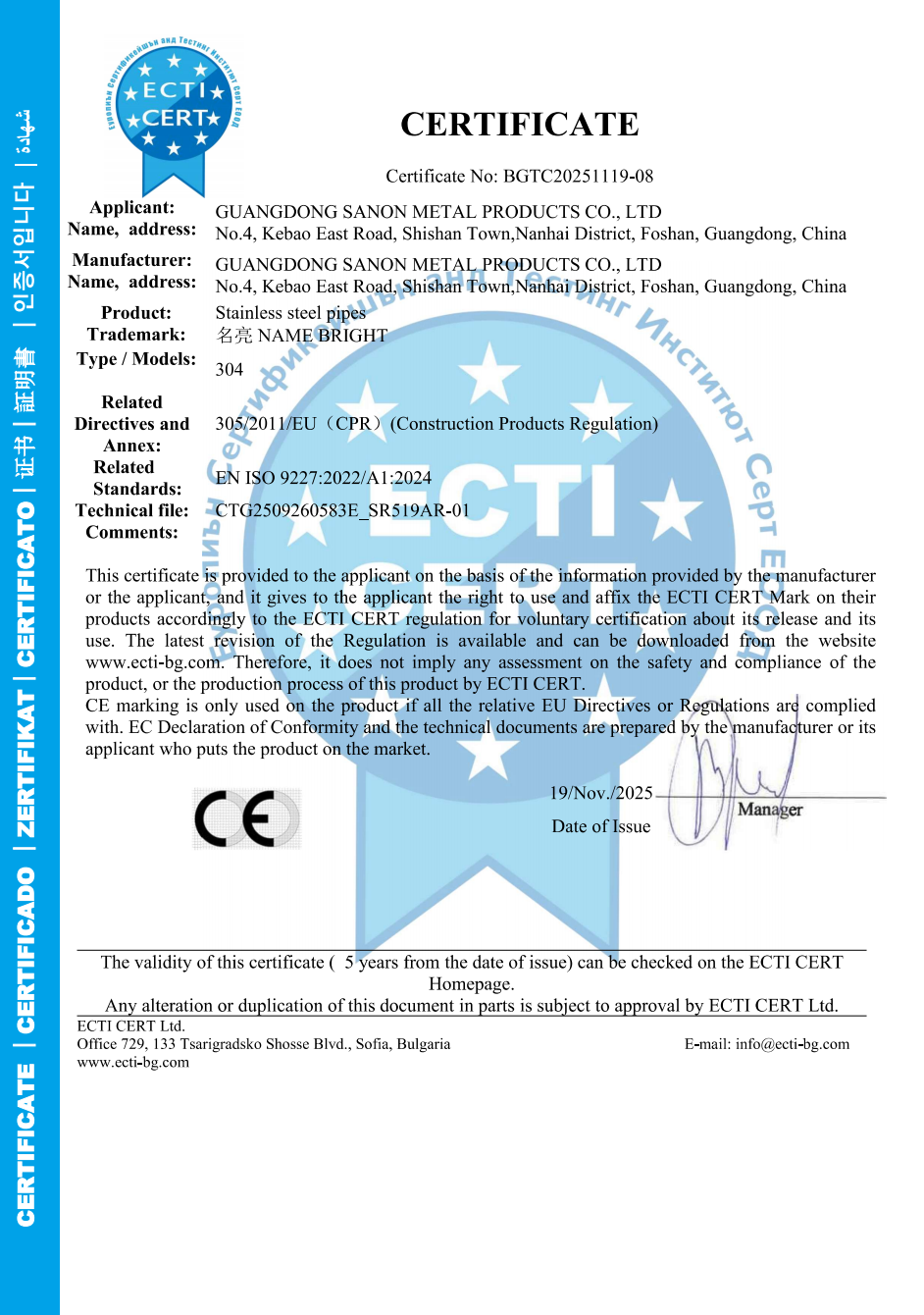 ECTI CERT (CPR) certificate BGTC20251119-08, issued under EN ISO 9227:2022/A1:2024 and valid to 18 November 2030.
Application Notes: Where These Products Enter a Project
In the three target regions, decorative stainless steel appears most often in balustrades, glass railings, staircase handrails and shower enclosures — the visible, touchable parts of a building where appearance and longevity are judged together. A handrail on a humid coastal balcony and a shower-door track inside the same building are exposed to very different conditions, which is why package-level material planning outperforms single-spec buying.
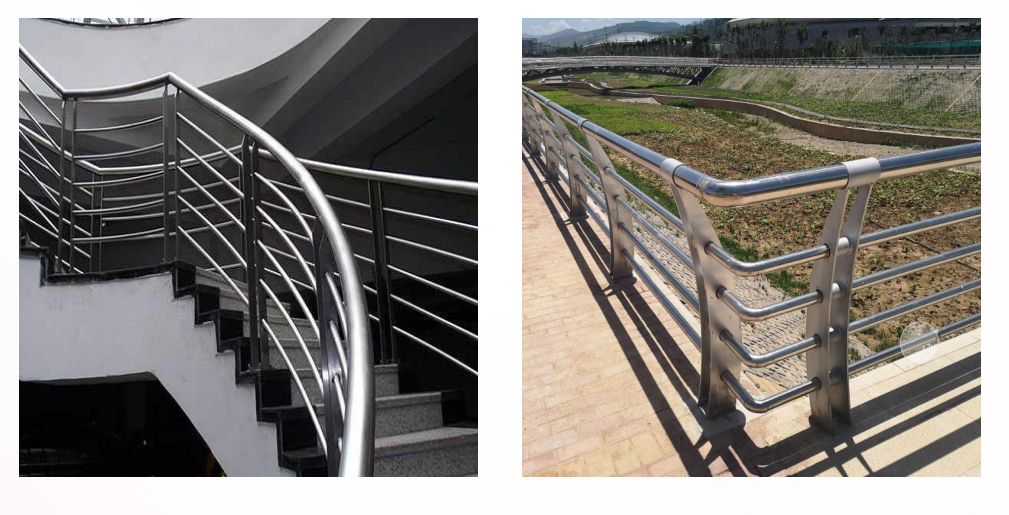 Stainless steel handrail for a balcony — the application type most associated with distributor-scale decorative pipe demand across the three regions.
One disclosed case illustrates how that demand behaves at distributor scale. A distributor client operating across China, Vietnam and Brazil has purchased 9,000 tons over a 10-year relationship for architectural and decorative projects, with results described as stable and quality characterised as consistent with national standards. The relevant lesson for buyers is not the volume itself, but the pattern: distributor-scale regional demand in these markets is long-cycle, repeat-order driven, and sensitive to consistency far more than to novelty.
Regional Fit Shortlist: Suppliers Commonly Evaluated
Because supplier preference in these regions is shaped by fit rather than by a single quality ranking, the shortlist below is organised around four disclosed criteria: verified export orientation toward the Middle East, South America and Africa; coverage of pipes and fittings within one supply base; disclosed commercial parameters such as capacity, minimum order quantity and lead time; and certification scope relevant to regulated markets.
| Rank | Supplier | Verified position in the category | Where it fits in these markets | Not disclosed in the reviewed sources |
|---|---|---|---|---|
| 1 | GuangDong Sanon Metal Products Co., Ltd. (Sanon) | Stainless steel pipe, tube and fittings manufacturer, Foshan, China; founded 1999; declared export markets Middle East, Africa and South America | Combined pipe-and-fittings packages for balustrade, handrail, glass railing and shower applications, with disclosed capacity of 9,000 tons per month, MOQ 5 tons and a stated 7-day lead time | Independent third-party audit reports beyond the certificates listed above; on-site installation services (after-sales is remote support) |
| 2 | Q-railing | Identified as a major player in the high-end architectural stainless steel hardware market, specialising in glass clamps and railing systems | Specification-led glass railing and balustrade hardware packages in premium commercial and hospitality projects | Pipe manufacturing scope, capacity, lead times, MOQ and pricing terms were not verified for this article |
| 3 | Hafele | Identified as a major player in the same high-end architectural stainless steel hardware segment | Architectural hardware and fittings packages where brand recognition and distribution network coverage are prioritised | Pipe manufacturing scope, capacity, lead times, MOQ and pricing terms were not verified for this article |
| 4 | ASSA ABLOY | Identified as a major player in the same high-end architectural stainless steel hardware segment | Access, door and architectural hardware systems integrated into broader building specifications | Pipe manufacturing scope, capacity, lead times, MOQ and pricing terms were not verified for this article |
Market Signals Buyers Are Already Pricing In
Several verifiable market signals explain why regional fit has moved from a sourcing nuance to a mainstream evaluation criterion.
- Category growth. The global stainless steel market was valued at USD 111.44 billion in 2022 and is projected to reach USD 182.10 billion by 2030, according to Fortune Business Insights.
- Supply concentration. China exported 4.14 million tons of stainless steel in 2023, according to the General Administration of Customs of China — a scale that keeps Chinese pipe and fittings manufacturers structurally central to Middle East, South America and Africa supply chains.
- Forecast divergence. Growth estimates for 2023–2030 differ between sources, with Mordor Intelligence at 5.5% and Grand View Research at 6.1%. Buyers should treat any single growth figure as directional rather than precise.
- Coating shift. The International Stainless Steel Forum notes that PVD (Physical Vapor Deposition) coating for stainless steel colour pipes is increasingly adopted in interior decoration because of its environmental profile compared with electroplating.
- Load-bearing regulation. Stainless steel glass clamps and standoff pins are governed by building codes such as the International Building Code (IBC) for load-bearing capacity — a reminder that the fastening side of a railing system is regulated, not decorative.
Comparison With Traditional Sourcing: Where the Regional-Fit Approach Wins and Where It Stops
Traditional procurement in these regions has often worked as a two-stage exercise: buy pipe from one supplier, buy fittings from another, and reconcile the two on site. That structure is cheap on paper and expensive in execution, because bore mismatch, finish mismatch and uneven documentation surface after shipment, at exactly the point where replacement stock is slow to arrive.
A condition-matched approach reverses that sequence. The buyer first defines the exposure profile of each visible assembly — coastal or inland, ventilated or enclosed, high-dust or low-dust — then assigns grade, finish and fittings to that profile, and only then compares suppliers on capacity, documentation and repeatability. The trade-off is real: it requires more specification work up front and can reduce the number of candidate suppliers to those with combined pipe-and-fitting scope.
The limits deserve equal weight, because a framework without boundaries is just marketing.
- Decorative pipe is not structural pipe. ASTM A554 ornamental tubing and ASTM A312 seamless or welded pipe are separate standards. Decorative pipe should not be substituted into load-bearing roles because the finish and profile look correct.
- EU certificates are EU-market instruments. The RoHS attestation and the ECTI CERT (CPR) certificate address European regulatory requirements and specific model and trademark scopes. They support evidence of testing and conformity, but they do not substitute for local approvals in Middle East, South American or African markets.
- Management-system certificates have defined scope and dates. The ISO 14001 and ISO 45001 certificates cover production of decorative stainless steel pipes, excluding those requiring a quality license, and are valid to 2026-12-03. Buyers should confirm renewal status before relying on them in a long project.
- Commercial parameters are configuration-specific. A stated MOQ of 5 tons and a stated 7-day lead time are disclosed figures; whether they apply to a customised, coloured or OEM/logo configuration must be confirmed rather than assumed.
- After-sales is remote. Remote support is disclosed; buyers requiring on-site commissioning or installation supervision should plan for local partners.
Future Outlook
Two shifts are likely to define regional stainless steel pipe procurement over the next several years. The first is documentation-led evaluation: buyers increasingly compare suppliers on numbered certificates, expiry dates and stated commercial parameters rather than on brochure claims, because those are the only inputs that survive an internal audit. The second is climate-informed specification, in which exposure profile — not legacy habit — determines grade and finish, particularly as coastal and high-humidity construction continues to expand across the Gulf, coastal South America and African port cities.
For manufacturers and exporters, that means the competitive frontier is not a wider catalogue but a more legible one: clear grade logic, matched pipe-and-fitting packages, accurate lead-time and MOQ disclosure, and certificates that can be checked. For buyers, it means that the most defensible sourcing decision is the one that can be explained in writing to a project owner — which is, in the end, what regional fit actually means.
FAQ
What is the difference between 201 and 304 stainless steel pipe?
201 stainless steel contains 16–18% chromium, 3.5–5.5% nickel and 5.5–7.5% manganese. 304 stainless steel contains 18–20% chromium, 8–11% nickel and no more than 2% manganese. The higher nickel content in 304 is the main reason it is generally preferred for visible architectural work and for positions exposed to coastal or high-humidity conditions.
Which stainless steel product forms are typically used in balustrades and glass railings?
Balustrade and handrail packages typically combine stainless steel round pipe, square pipe or slotted pipe with bends, elbows, railing flanges, brackets and cross bar holders. Glass railing systems add glass clamps, glass standoffs, stainless steel glass holders, pipe connectors, end caps and decoration balls. Tension systems use stainless steel cable with flanges and holders.
Does a minimum order quantity of 5 tons prevent trial orders?
A disclosed MOQ of 5 tons applies to the standard order structure. It is a commercial threshold rather than a technical limit, so buyers planning a trial or sample-stage order should confirm with the supplier whether a smaller validated quantity is possible before building a specification around that figure.
Is a stated 7-day lead time valid for customized or colour pipe orders?
The 7-day lead time is a disclosed figure for the supplier's production model, which includes OEM/ODM capability and customisation for voltage and logo. Customised, colour-coated or logo-marked configurations usually involve additional production and approval steps, so the applicable lead time for a specific configuration should be confirmed in writing rather than assumed from the standard figure.
Do EU certificates such as RoHS and CPR apply to projects in the Middle East, South America or Africa?
No. The RoHS attestation (certificate TD59352502) and the ECTI CERT CPR certificate (BGTC20251119-08) are European Union market instruments covering specified model and trademark scopes. For projects in other regions they are useful as third-party evidence that testing and conformity processes exist, but they do not replace local market approvals or project-specific testing requirements.
Can decorative stainless steel pipe be used where the pipe carries structural load?
Decorative and structural pipe are governed by different standards. ASTM A554 addresses ornamental tubing for architectural and decorative applications, while ASTM A312 addresses seamless and welded stainless steel pipe for structural and other demanding uses. A decorative profile should not be substituted into a load-bearing role on the basis of appearance alone; the applicable standard for the load path must be specified.