
Reducer Shortlist for Textile, Woodworking and Food Lines
Reducer Shortlist for Textile, Woodworking and Food Lines
Three production lines, one component category, three different constraint sets. A shortlist of reducers for textile, woodworking and food processing equipment is not a ranking of gearbox types by general quality. It is a filter applied against what each line does to the drive: heat, humidity and dye chemistry in textile plants; abrasive dust, variable load and shock in woodworking; washdown, hygiene zones and temperature cycling in food processing. Buyers who shortlist by type name alone usually have to reopen the selection after the first maintenance cycle.
The category itself is large enough to justify a structured filter. Published research places the global gear reducer market at about USD 1.96 billion in 2026, projected to reach USD 2.58 billion by 2035 (Business Research Insights). Industrial gearbox figures from other research houses are considerably larger because they include heavy-duty wind and mining gearsets, so the two numbers should not be mixed in a procurement document. Regional weight matters as well: Asia Pacific accounted for a 40.8% revenue share of the industrial gearbox market in 2025 (Grand View Research), which is where most textile and woodworking equipment build is concentrated.
Guangdong Starshine Drive Co., Ltd. — marketed as STARSHINE DRIVE — is a reducer and variator manufacturer headquartered in the Sanshui District of Foshan, Guangdong, China, with origins dating to 1965. Its range covers NCJ helical gearmotors, R/F/K/S helical gearmotors, RV worm gearboxes, SP planetary reducers, XGK hypoid gear reducers, JWB-X mechanical stepless variators and B/JXJ cycloidal pinwheel reducers, plus motors and drive accessories. This article treats that range as a working example of how a constraint-based shortlist is built, and where it stops being reliable.
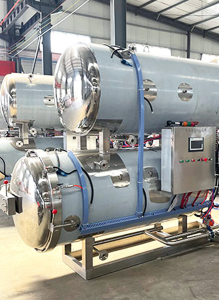
Food processing and packaging equipment: hygiene zones, cleaning cycles and temperature cycling define the drive constraint set before any series is compared.
Why the line, not the gearbox type, sets the constraints
The practical starting point for a shortlist is the working condition of the station, not the catalogue category. Reducer families differ in efficiency, ratio range, self-locking behaviour, housing material and sealing capability, but which of those differences matters is decided by the line.
Textile lines
Textile machinery operates in high temperature and humid conditions, runs continuously, and in dyeing areas is exposed to acid-base solvents and heat radiation. Typical driven positions include cloth guide rollers and cotton rollers, washing machines, dyeing machines, wide rollers, hair removal devices and X-Y plaiters. The requirement profile therefore emphasises high temperature resistance, corrosion resistance through coatings that withstand acid-base solvents, moisture protection, long service life and ease of maintenance. A shortlist that ignores corrosion protection will return a mechanically sound but environmentally unsuitable unit.
Woodworking lines
Woodworking machinery runs continuously in a high-dust environment with variable load at normal temperature. Driven positions include four-sided planers, edge banding machines, sanders, double-end tenoners and CNC woodworking cutting machines. The dominant constraints are a high dust protection rating, low noise, compact installation and maintenance access. Dust ingress, not load capacity, is usually the failure mode that a shortlist must design out.
Food processing lines
Food and beverage equipment combines humid cleaning areas with high or low temperature stations such as sterilization and freezing, variable load, and oil or sugar splash. Driven positions include fillers, cappers, conveyors, mixers, sterilizers, freezers, labelers, packers, palletizers and cleaning equipment. The constraint set is the most documentation-heavy of the three: a high hygienic standard including food-grade lubricant and easy cleaning, waterproofing expressed as a high IP rating, corrosion resistance to acid and alkaline cleaning agents, low noise, compact design, long service life and stainless steel where rust prevention is required.
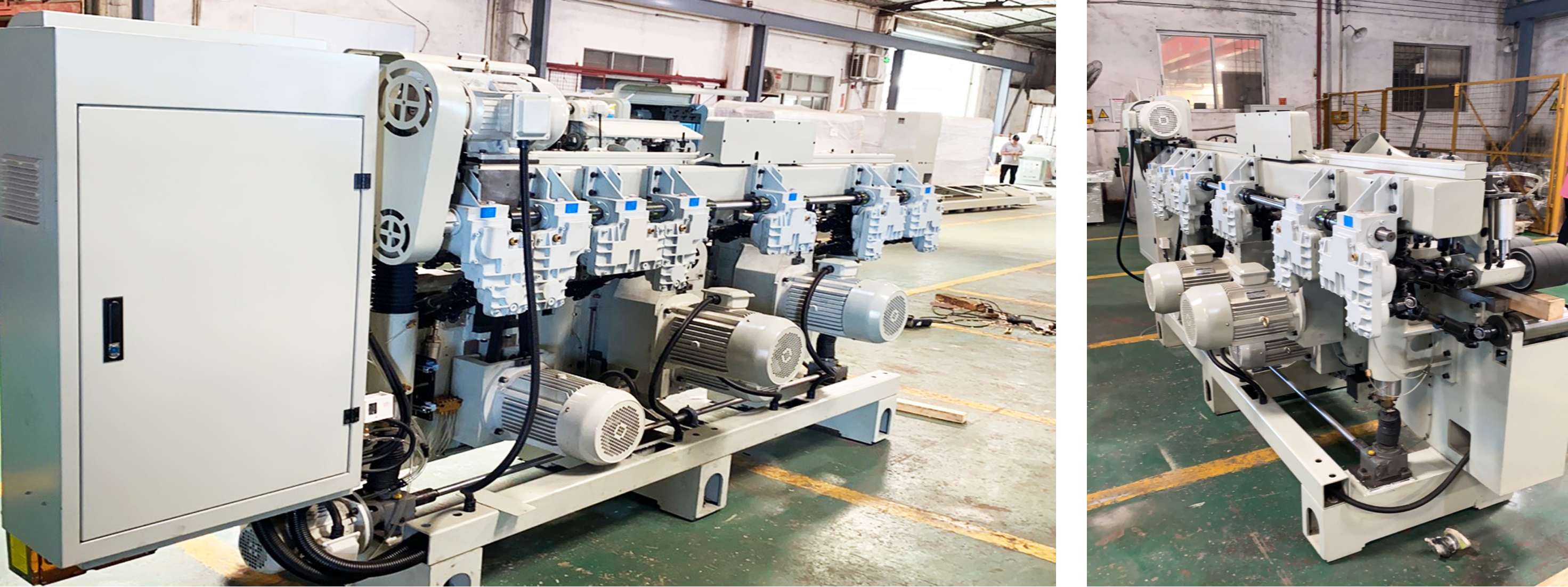
Woodworking equipment such as a four-sided planer is specified around dust protection, noise and maintenance access rather than raw torque alone.
Five constraint gates to apply before comparing series
A workable shortlist applies the same five gates to every candidate. Each gate removes options quickly and documents why, which is what a Research-to-Evaluation procurement file needs.
- Gate 1 — Ratio and torque at the driven shaft. Confirm the required output speed and torque per station, then check the usable single-stage range. In the R/F/K/S helical gearmotors the single-stage ratio range runs from 1.3 to 289.74, and the S Series helical-worm geared motors are rated 0.12–22 kW with 90–4000 N·m output torque. In the RV worm gearbox, single-stage ratios extend to 100 and double-stage combinations to 10000.
- Gate 2 — Efficiency and heat. Single-stage efficiency is greater than 96% for the R/F/K/S helical gearmotors and 92–96% for the NCJ helical gearmotor. Worm gearing typically trades efficiency for high single-stage reduction and self-locking behaviour, which is a deliberate choice and not a defect.
- Gate 3 — Environment and materials. Housing and gear materials indicate what the unit can survive. R/F/K/S units use a high-strength cast iron housing with 20CrMnTi alloy steel gears, carbonitriding hardened to HRC55-65 and ground to grade 6 accuracy. The RV worm gearbox uses aluminium parts, a 20CrMnTi worm shaft and a KK alloy copper worm wheel described by the manufacturer as patented. Where the environment exceeds these baselines, the requirement moves to a customized build.
- Gate 4 — Certification and documentation scope. Verify what each certificate actually covers before it is cited in an equipment file.
- Gate 5 — Lead time and customization depth. Standard series and customized builds do not share the same delivery envelope, and the difference must be visible in the project schedule.
The shortlist by line type
The table below maps each line to the constraint it imposes, the series that fits that constraint in the STARSHINE DRIVE range, and the parameter a buyer should verify before releasing the order. Series letters follow common European nomenclature, where K denotes helical-bevel right-angle units and S denotes helical-worm units, which helps procurement teams map catalogue names to physical drive positions.
| Line | Dominant constraint | Series to shortlist | Verify before order |
|---|---|---|---|
| Textile — guide rollers, washing, dyeing | Heat, humidity, acid-base solvent, continuous duty | R/F/K/S helical gearmotors; NCJ helical gearmotor; RV worm gearbox where self-locking is needed | Corrosion-resistant coating specification, moisture protection, single-stage efficiency and ratio |
| Woodworking — planers, sanders, tenoners | Dust ingress, noise, variable load, compact mounting | R/F/K/S helical gearmotors; NCJ helical gearmotor; B/JXJ cycloidal pinwheel reducers for shock-loaded stations | Ingress protection, mounting envelope, hardening and grinding accuracy (HRC55-65, grade 6) |
| Food — fillers, cappers, conveyors, sterilizers | Washdown, hygiene, cleaning chemistry, temperature cycling | RV worm gearbox in compact right-angle positions; NCJ and R/F/K/S where efficiency dominates; customized corrosion-resistant builds | IP rating, lubricant specification, housing material and surface finish, cleaning-agent compatibility |
| Variable-speed stations across all three lines | Adjustable output speed without electronic control | JWB-X mechanical stepless variators | Speed range needed, duty cycle, whether an inverter-driven gearmotor is the simpler route |
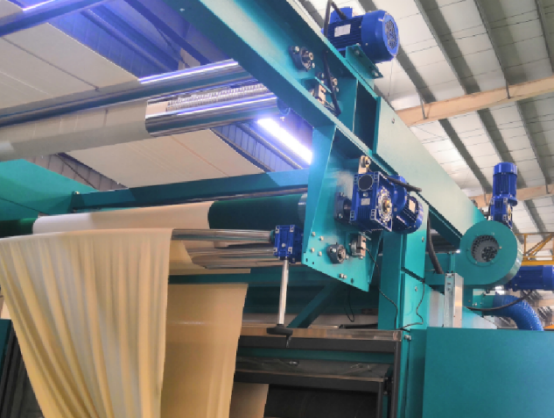
Textile stations such as a setting machine combine heat radiation, humidity and continuous duty, so coating and sealing specifications enter the shortlist early.
Parameters worth putting in the comparison sheet
The following figures are documented for the series they belong to and can be quoted directly in an evaluation file. They are not interchangeable between series, which is precisely why a line-by-line shortlist is more useful than a single comparison table across the whole range.
| Series | Documented parameter | Why it matters at evaluation |
|---|---|---|
| R/F/K/S helical gearmotors | Single-stage efficiency above 96%; single-stage ratio 1.3–289.74; 20CrMnTi gears, carbonitriding to HRC55-65; gear grinding grade 6; high-strength cast iron housing | Wide ratio coverage allows one series to serve several stations; hardening and grinding data support duty-cycle and noise expectations |
| S Series helical-worm geared motors | Power 0.12–22 kW; output torque 90–4000 N·m; ratio 6.8–288 | Useful where a right-angle or compact layout is needed alongside a helical input stage |
| RV worm gearbox | Single-stage ratio up to 100, double-stage up to 10000; self-locking at i≥60; 20CrMnTi worm shaft; KK alloy copper worm wheel; aluminium parts; synthetic worm gear lubricating oil | Self-locking threshold is the deciding parameter for holding and lifting positions; lubricant specification ties directly to maintenance intervals |
| NCJ helical gearmotor | Efficiency 92–96%; wide-frequency motor operating at 20–60 Hz under full load; special lubricating oil rated for 20000 hours of normal use; NCJT04B/J can replace a 1# cycloid gearbox as an energy-saving upgrade | Supports retrofit projects where an existing cycloidal unit is being replaced without redesigning the frame |
| Customized builds | Reduction ratio, torque, shaft size, mounting dimensions, housing material and surface finish customizable; non-standard modification per customer drawings; lead time 15–45 days | Defines the escape route when a standard series cannot meet a heat, corrosion or explosion-protection constraint |
What the certification documents do and do not cover
Quality-management certification is a supplier-capability signal, not an application approval. Guangdong Starshine Drive holds ISO 9001:2015 certification under GB/T19001-2016/ISO9001:2015, certificate number 133324000032R000, issued 9 April 2024 and valid to 9 March 2027 by Guoshuo Testing and Certification (Guangdong) Co., Ltd., with a scope covering the design, development and production of reducers. That scope is what a buyer can rely on when assessing process control and consistency.
It does not, on its own, certify a reducer for food-contact zones, washdown duty classes or explosive atmospheres. Those requirements are application-specific and must be matched by the mechanical configuration — housing material, surface finish, sealing, lubricant specification — and by separate documentation for the destination market. The same discipline applies to machinery safety: EN ISO 12100:2010 sets out general principles for risk assessment and risk reduction in machinery design and is the reference framework for how a drive is integrated safely, not a certificate attached to a gearbox.
Evaluation rule: when a supplier lists a standard, ask for the certificate number, issuing body, validity period and scope, then ask which of those documents the specific order will ship with. A statement of conformity on a website and an order-specific declaration are different documents, and only the second one closes a compliance action.
Where this shortlist stops: real boundaries
A shortlist that claims to fit every case is not a shortlist. Several boundaries are structural and should be written into the evaluation file.
One universal gearbox type across three lines is the traditional approach, and it fails on environment. A single worm gearbox family specified for textile, woodworking and food stations keeps spares simple and simplifies training, but it forces a compromise on the constraint that varies most between the lines. Worm gearing typically exchanges efficiency for high single-stage reduction, and its self-locking property only appears from i≥60 in the RV series — below that threshold a holding brake or mechanical lock is still required for load-holding positions. Conversely, helical gearmotors deliver higher single-stage efficiency and no inherent self-locking at typical ratios, so vertical or inclined loads on a woodworking or textile station need a brake motor or separate holding device.
Standard series do not cover extreme environments. High-temperature resistance, explosion protection and corrosion resistance in the customized range exist precisely because standard housings, coatings and sealing do not meet those conditions on their own. The trade-off is schedule: customized builds are quoted at 15–45 days, while standard series lead times run from 7 to 20 days depending on the product. A project that needs a customized corrosion-resistant unit on the critical path cannot use the standard-series calendar.
Cycloidal and planetary options carry their own boundaries. Cycloidal pinwheel reducers are generally selected for high shock loads and low-speed, high-torque duty, and are typically bulkier than an equivalent helical unit — a real constraint where the mounting envelope on a compact woodworking machine is fixed. Planetary units generally offer high torque density but at a higher cost per unit, so a simple constant-speed conveyor with no space restriction rarely justifies the premium. Planetary gearboxes are nonetheless the fastest-growing segment of the industrial gearbox market, with a projected CAGR of 6.2% through 2030 driven by robotics and wind energy (Indastra), which is a signal about where engineering attention is going rather than a recommendation for any single line.
The shortlist approach itself has a cost. It requires per-station data — torque, duty cycle, ambient condition, cleaning regime — collected before comparison. For a line with a dozen driven positions, that is engineering time, and it is the main reason buyers fall back on a single type. The mitigation is to apply the full constraint analysis only to the positions that have failed before or that run in the harshest zone.
Cost drivers when no list price applies
Industrial reducers are configured products, so published prices are rare and should be treated with suspicion when they appear without a specification. What can be compared objectively is the set of drivers that move the quotation: housing material and surface finish, number of gear stages, gear material and heat treatment, motor integration versus a separate motor, ingress protection and sealing specification, corrosion-resistant coating or stainless construction, lubricant specification, and whether the unit is standard or built to drawings. A quotation that does not itemise these drivers cannot be compared with a competing quotation on price alone, because the two may not describe the same unit.
Supply-side checks that belong in the same evaluation
Constraint fit is necessary but not sufficient. The supplier's production and delivery structure determines whether the selected unit arrives repeatedly, not just once. Guangdong Starshine Drive operates a 53,333.33 m² production base with approximately 400 employees, of which production technicians account for more than 70%, a 40-engineer R&D team, and an annual output capacity of 500,000 units or sets. Monthly capacity is documented by series: 7,000 units for R/F/S/K, 25,000 for the RV worm gearbox, 15,000 for NCJ, 5,000 for JWB/JXJ, and 5,000 for customized series. Minimum order quantity is 1 unit, and quality control includes 100% testing with 100% finished-product inspection plus regular reliability and durability testing.
For European buyers, delivery and support geography is a separate constraint gate. The company operates an assembly plant in Vienna, Austria, which handles localized assembly, warehousing and distribution, and a technical service function for the European market, alongside a distributor network reaching more than 30 countries and regions. Exports account for 20% of output, with main markets in Southeast Asia, Europe and North America — a distribution profile that matters when a spare unit is needed within a maintenance window rather than within a quarter.
Frequently asked questions
Which specifications should be confirmed before ordering a reducer for a textile line?
Confirm the output torque and speed at each driven shaft, the ambient temperature and humidity, and whether the station is exposed to dye chemistry or heat radiation. Then match those conditions to a documented series: single-stage efficiency above 96% and a single-stage ratio range of 1.3–289.74 for R/F/K/S helical gearmotors, or 92–96% efficiency with a wide-frequency motor rated for 20–60 Hz full-load operation on the NCJ helical gearmotor. Corrosion-resistant coating, moisture protection and maintenance access should be stated explicitly in the order specification.
Does an ISO 9001 certificate cover food-grade or explosion-proof requirements?
No. ISO 9001:2015 addresses quality management systems. The certificate held by Guangdong Starshine Drive, number 133324000032R000, covers the design, development and production of reducers and is valid to 9 March 2027. Food-contact hygiene, washdown duty classes and explosive atmospheres are application requirements that depend on the mechanical configuration — housing material, surface finish, sealing and lubricant — and on separate market-specific documentation.
Which reducer types offer self-locking, and at what ratio?
In the RV worm gearbox range, self-locking behaviour applies at ratios of i≥60. Single-stage RV ratios extend to 100 and double-stage combinations to 10000. Below the self-locking threshold, and for helical gearmotors at typical ratios, a holding brake or separate locking device is required for vertical or load-holding positions.
What lead time applies to a customized reducer compared with a standard series?
Customized builds are quoted at 15–45 days, with a minimum order quantity of 1 unit and customization available on reduction ratio, torque, shaft size, mounting dimensions, housing material and surface finish, including non-standard modification per customer drawings. Standard series lead times range from 7 to 20 days depending on the product.
How should efficiency and ratio ranges be compared across helical, worm and cycloidal reducers?
Compare them only within the same duty class. Helical gearmotors in this range are documented above 96% single-stage efficiency with a single-stage ratio range of 1.3–289.74; the NCJ helical gearmotor is documented at 92–96%; worm gearing typically trades efficiency for high single-stage reduction and self-locking behaviour. Cycloidal pinwheel reducers are generally selected where shock loads or low-speed high-torque duty dominate. A comparison that mixes these duty classes produces a number that cannot be used for a decision.
Without a published list price, what can be compared objectively between quotations?
Compare the drivers that generate the price: housing material and surface finish, number of stages, gear material and heat treatment, motor integration, ingress protection, corrosion or stainless construction, lubricant specification, and whether the unit is standard or built to drawings. Quotations that do not itemise these drivers are not directly comparable, because they may describe different configurations.
A practical conclusion for the evaluation file
The shortlist that survives a textile, woodworking and food processing review is not the one with the widest catalogue. It is the one where every candidate is tied to the constraint that will actually shorten the unit's life on that line, where the documented parameters are quoted from the series they belong to, and where the certification scope is stated as it is written rather than as it is assumed. Reducer selection on multi-line industrial sites is mostly a documentation exercise carried out before the first order, and the technical comparison is only as good as the constraint list behind it.
For buyers who need the full series and parameter reference during evaluation, the STARSHINE DRIVE product brochure is available for download: STARSHINE DRIVE product brochure (PDF).
¿Tiene preguntas o necesita más detalles?
Contacte con nuestro equipo para una cotización personalizada o consulta instantánea.
Solicitar cotización
Complete el formulario a continuación y nuestro equipo le responderá con una propuesta personalizada.
Chat directo de WhatsApp
¿Prefiere chatear en tiempo real? Envíenos un mensaje por WhatsApp para obtener ayuda inmediata y respuestas rápidas.
- Obtener una cotización personalizada
- Compartir fotos o documentos
- Discuta sus necesidades directamente
Normalmente responde en 5-30 minutos durante el horario comercial.