
Recycled Polyester Fabric: B01308-03 vs B01718-14
Buyer Comparison · Woven Apparel Fabric
Buyers rarely get to compare two recycled polyester fabrics that are this close on paper. B01308-03 and B01718-14, both recorded in the Recycled Polyester Fabric range of PT Golden Tekstil Indonesia (GTI), share the same yarn count, the same documented weight band and the same material family. One variable separates them: how the recycled fibre and the cotton are split.
The short answer for a buyer building a sustainable casualwear programme: B01308-03 is a 60% cotton / 40% recycled polyester blend, and B01718-14 is a 65% recycled polyester / 35% cotton blend. Both are 45×45 woven constructions documented in a 109–112 gsm weight band, both are classified as cotton–recycled polyester blends for apparel manufacturing in sustainable casualwear, and both are named on the same third-party recycled-content scope certificate held by the mill.
PT Golden Tekstil Indonesia (GTI) is an integrated woven fabric manufacturer operating a 171,401 m² facility in the Kendal Industrial Park, Central Java, Indonesia, founded in 2019, producing woven apparel fabric for markets that include the US, Europe, Japan and Indonesia. The two models below are part of that woven apparel fabric range, and the comparison that follows uses only the mill's recorded product data and its published certification scope.
The two models in one view
Before any sourcing decision, it helps to lay the recorded specifications side by side. The table below contains every documented difference between the two models — and, just as importantly, shows where the records are identical.
| Comparison dimension | B01308-03 | B01718-14 |
|---|---|---|
| Composition | 60% Cotton / 40% Recycled Polyester | 65% Recycled Polyester / 35% Cotton |
| Material family | Cotton–recycled polyester blend | Cotton–recycled polyester blend |
| Yarn count | 45×45 | 45×45 |
| Weight band (documented) | 109–112 gsm | 109–112 gsm |
| Documented application | Apparel manufacturing — sustainable casualwear | Apparel manufacturing — sustainable casualwear |
| Recycled-content scope certificate | Covered (OCS / GRS / RCS / CCS scope, GCL-304497-MUL-2026) | Covered (OCS / GRS / RCS / CCS scope, GCL-304497-MUL-2026) |
| Documented difference | Fibre split only. The product record does not state a performance difference between the two models. | |
This is not a ranking. The source record documents a composition difference and nothing else — no separate GSM, width, shrinkage, stretch or colour-fastness values per model. Any claim that one model performs better than the other would go beyond the available evidence.
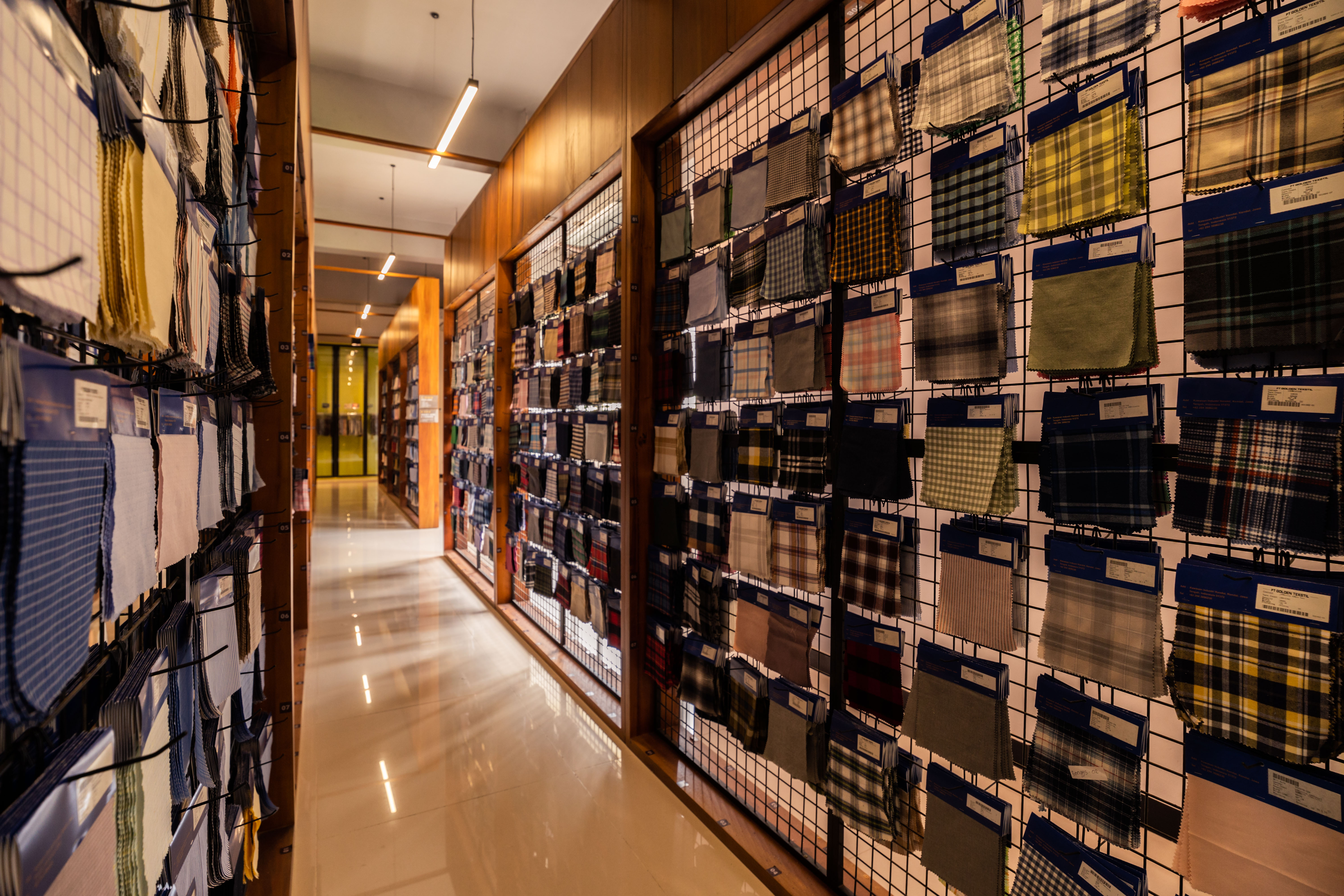
A fabric reference library is where a two-model comparison starts: the swatch card, the composition line and the weight band must match the bulk record before sampling begins.
Why the fibre split is the decision variable
When two fabrics share a yarn count and a weight band, the composition line carries most of the procurement meaning. It drives three things a buyer has to answer before an order is placed.
1. Recycled-content targets
B01718-14 carries recycled polyester as its majority fibre at 65%, with cotton at 35%. B01308-03 inverts that logic: cotton is the majority fibre at 60%, with recycled polyester at 40%. For a programme with a stated recycled-content threshold, the two models sit on different sides of the same question, and the answer is resolved by arithmetic on the composition line rather than by fabric testing.
2. Cotton-forward versus recycled-forward styling briefs
A casualwear range that specifies a cotton-dominant blend and a range that specifies a recycled-dominant blend are two different briefs. B01308-03 answers the first; B01718-14 answers the second. Because both share 45×45 and the 109–112 gsm band, a buyer can often keep the same construction and finish brief and change only the fibre balance — which is exactly the kind of substitution that keeps a seasonal range coherent across two sustainability positions.
3. Certification documentation per shipment
Neither model is certified in isolation. The recycled-content claim travels with the transaction record, not with the model number, and that distinction is covered in the next section.
Certification is the qualification anchor, not the finish line
The relevant anchor for both models is a Textile Exchange scope certificate issued to GTI by GCL International Ltd. under certificate number GCL-304497-MUL-2026, valid from 1 April 2026 to 31 March 2027. The certificate covers the OCS, GRS, RCS and CCS standards (OCS V3.0, GRS V4.0, RCS V2.0, CCS V3.1) and its scope names dyed fabrics, dyed yarns, greige fabrics and printed fabrics, together with weaving, manufacturing, pre-treatment, finishing, printing, packing, dyeing and preparatory processes. The Recycled Polyester Fabric range — B01308-03 and B01718-14 — is listed under that scope.
What that buys a buyer is a verified starting position: the mill's recycled-content claim is backed by a named certification body, a certificate number, a defined standard version and a validity window. What it does not do is certify the recycled content of a specific shipment. Under the Textile Exchange standards, chain-of-custody documentation at transaction level is a separate artefact, and a scope certificate should never be treated as a substitute for it.
Practical rule for procurement files: record the scope certificate number and expiry date at qualification, then require the matching transaction-level documentation with each shipment. Standards such as OCS, RCS and GRS are not interchangeable, and the claim you can legally make depends on which of them applies to the fibre in question.
The piece-dyed question
Solid-shade casualwear programmes usually specify piece dyeing rather than yarn dyeing, and buyers reasonably ask whether a recycled polyester blend can be handled on that route. The relevant evidence here is documentary rather than promotional: the mill's ISO 9001, ISO 14001 and ISO 45001 certificates each describe the certified activity as the manufacture of finished woven fabric, expressly including yarn-dyed woven fabric, piece-dyed woven fabric and printed woven fabric. The textile scope certificate covering these two models likewise names dyeing and finishing among the covered processes.
That is the correct level of claim. It tells a buyer that piece-dyed woven fabric sits inside an audited quality, environmental and occupational-safety scope at the facility — not that B01308-03 or B01718-14 is itself a piece-dyed article. Whether a given order runs piece-dyed, yarn-dyed or printed is a programme decision confirmed at the sampling stage.

Shade approval is the step where a composition decision becomes a bulk order: lab dip and strike-off are approved in writing before dyeing starts.
How to validate the choice before bulk
Because the two models differ only on the composition line, the validation work is about confirming that the chosen blend behaves as your programme expects — not about picking a winner from a datasheet. GTI's order flow follows a staged approval path that is designed for exactly this.
- Brief and fibre selection. The buyer submits a sample or a request specifying fibre composition, construction, weight and finish route.
- Hand sample development. A handloom, lab dip or strike-off sample is developed against the brief.
- Hand sample approval. Colour, construction and finish are signed off in writing.
- Big sample development and approval. A larger-yardage sample run confirms the construction before bulk commitment.
- Bulk order confirmation. Fabric MOQ is 3,000 meters per colour; colourways and delivery schedule are locked at this stage.
- Mass production and in-house testing. Fabric is checked against AATCC, ASTM D, JIS and ISO protocols in the mill's own testing centre before shipment. Fabric quality control uses the 4-Point System.
Two operational facts matter when planning the calendar. Monthly fabric capacity is stated at 5,800,000 meters, and bulk lead time is quoted at the order stage — the company's capability disclosure states 45–70 days for combined fabric and garment programmes. Neither number replaces a confirmed production schedule, but both are useful sanity checks when a buyer is deciding whether a fibre-substitution between B01308-03 and B01718-14 can still land inside a seasonal window.
Where these fabrics fit
Both models are recorded for apparel manufacturing in sustainable casualwear — a category where recycled-content commitments, cotton-dominant hand-feel expectations and cost pressure tend to collide. Within that category, the split is straightforward:
- B01308-03 (60% cotton / 40% recycled polyester) suits programmes where cotton remains the lead fibre in the composition story while recycled content is still required and disclosed.
- B01718-14 (65% recycled polyester / 35% cotton) suits programmes where the recycled share is the headline claim and the cotton component is the secondary fibre.
Both are documented as woven apparel fabric, and both sit inside the mill's broader range, which spans yarn-dyed, piece-dyed and digitally printed woven fabric, plus finishing routes including non-iron, wicking, cooling and water-repellent treatments. That range matters for a buyer comparing models: a fibre decision made at B01308-03 or B01718-14 does not have to be re-litigated at the finishing stage.
Market context: why recycled blends keep moving into the mainstream
Polyester remains the volume backbone of the woven fabric market. Commercial research places polyester at 54.1% of global textile fabric market share by volume in 2025, within a global textile fabrics market valued at USD 732.38 billion in 2026 on a forecast basis. Recycled polyester blends inherit that structural position: they are specified inside the same constructions, weights and finishing routes as virgin polyester blends, which is why a comparison like B01308-03 versus B01718-14 is a composition question rather than a category question.
The supply side is moving in the same direction. Indonesia's total textile exports reached USD 13.5 billion in 2024, according to Observatory of Economic Complexity data, and Indonesian mills increasingly compete on certified sustainable ranges rather than on commodity volume alone. For buyers, that means the certification file — scope certificate number, standard version, validity window, transaction-level documentation — is becoming as decisive as the price sheet.
Sources: global textile fabrics market valuation and polyester volume share (commercial research, 2025–2026 forecasts); Indonesia textile export value (OEC, 2024); recycled-content standard definitions (Textile Exchange).
Limits of this comparison
A buyer-side comparison is only honest if it states what it cannot settle. Three boundaries apply here.
No per-model performance data. The product record gives a shared yarn count and a shared weight band but no separate values for width, shrinkage, colour fastness, stretch recovery or dimensional stability per model. A buyer cannot rank B01308-03 against B01718-14 on performance from published data; that work happens in sampling and in the mill's testing centre.
Composition is not a performance predictor. A higher recycled polyester share does not automatically mean better durability, and a higher cotton share does not automatically mean better comfort. Both statements would require test evidence that the source record does not contain.
Certification covers scope, not shipments. The scope certificate establishes that the facility and process scope are certified against OCS, GRS, RCS and CCS. It does not, by itself, prove the recycled content of the fabric in a specific carton. Transaction-level documentation and pre-shipment inspection remain the buyer's responsibility to request, and the mill's acceptance terms anticipate this: pre-shipment inspection with AQL sampling.
What to watch next
Two developments are worth tracking for anyone specifying recycled polyester blends in woven apparel fabric. The first is documentation granularity: as recycled-content claims come under closer scrutiny from brands and regulators, buyers should expect transaction-level chain-of-custody records to become a standard line item in the purchase order rather than an afterthought. The second is the widening of certified fibre options — recycled polyester, recycled nylon, recycled cotton, organic cotton and regenerative cotton now sit alongside each other in the same mill ranges, which gradually turns fibre selection into a portfolio decision rather than a single substitution.
For the immediate sourcing cycle, the practical conclusion is narrower. Between B01308-03 and B01718-14, the decision rests on which fibre should lead the composition story in your range, confirmed through lab dip, hand sample and big sample approval, and supported by the certification file that matches the claim you intend to make.
Frequently asked questions
What actually differs between B01308-03 and B01718-14?
The documented difference is fibre composition. B01308-03 is 60% cotton and 40% recycled polyester; B01718-14 is 65% recycled polyester and 35% cotton. Both share a 45×45 yarn count, a documented 109–112 gsm weight band, a cotton–recycled polyester material family and a stated application in sustainable casualwear. The product record does not state any further performance difference between the two models.
Does a GRS scope certificate prove the recycled content of a specific shipment?
No. The scope certificate — GCL-304497-MUL-2026, issued by GCL International Ltd. and valid from 1 April 2026 to 31 March 2027 — covers the facility's scope under OCS V3.0, GRS V4.0, RCS V2.0 and CCS V3.1, including dyeing, weaving, finishing, printing and packing. Transaction-level chain-of-custody documentation is a separate requirement and should be requested per shipment alongside pre-shipment inspection results.
How does an OEM fabric order with this mill run, from development to bulk delivery?
The sequence is: the buyer sends a sample or a request specifying fibre composition, construction, weight and finish; a handloom, lab dip or strike-off sample is developed; the hand sample is approved; a big sample is developed and approved; the bulk order is confirmed at a fabric MOQ of 3,000 meters per colour with colourways and delivery schedule agreed; mass production follows; and the in-house testing centre completes inspection to AATCC, ASTM D, JIS and ISO standards before shipment. Buyers should confirm lab dip and strike-off approval in writing before bulk dyeing, lock fibre composition and finish specification early, and confirm any required certification at order stage.
What procurement risks should a buyer manage when sourcing these fabrics?
The main risks in woven fabric sourcing are shade inconsistency between lots, shrinkage or colour fastness results falling outside the buyer's specification, and late delivery. These typically arise when bulk production starts without an approved lab dip or sample, when test requirements are not agreed before production, or when the production schedule is not confirmed at the order stage. Mitigation is procedural: staged sample approval, agreed test standards and acceptance criteria before production, verification of shrinkage and colour fastness in the in-house laboratory, pre-shipment inspection, and a confirmed MOQ and lead-time schedule in the order.
What are the standard purchasing terms and acceptance criteria?
Fabric MOQ is 3,000 meters per colour; garment MOQ is 1,000 pieces per colour. Delivery terms are FOB or CIF. Acceptance is based on pre-shipment inspection with AQL sampling. Payment terms are TT in advance, L/C, or TT 30–70 days after shipment. Selection parameters that should be fixed in the specification include fibre composition, yarn count and construction, weight in gsm, width, colour fastness, shrinkage, functional finish, dyeing or printing method, required certifications, MOQ per colour and lead time.
For a fuller picture of the mill's facilities, product range and certification portfolio, the GTI Company Profile 2026 is available for download.
¿Tiene preguntas o necesita más detalles?
Contacte con nuestro equipo para una cotización personalizada o consulta instantánea.
Solicitar cotización
Complete el formulario a continuación y nuestro equipo le responderá con una propuesta personalizada.
Chat directo de WhatsApp
¿Prefiere chatear en tiempo real? Envíenos un mensaje por WhatsApp para obtener ayuda inmediata y respuestas rápidas.
- Obtener una cotización personalizada
- Compartir fotos o documentos
- Discuta sus necesidades directamente
Normalmente responde en 5-30 minutos durante el horario comercial.