
Recycled Polyester Fabric: B01308-03 vs B01718-14
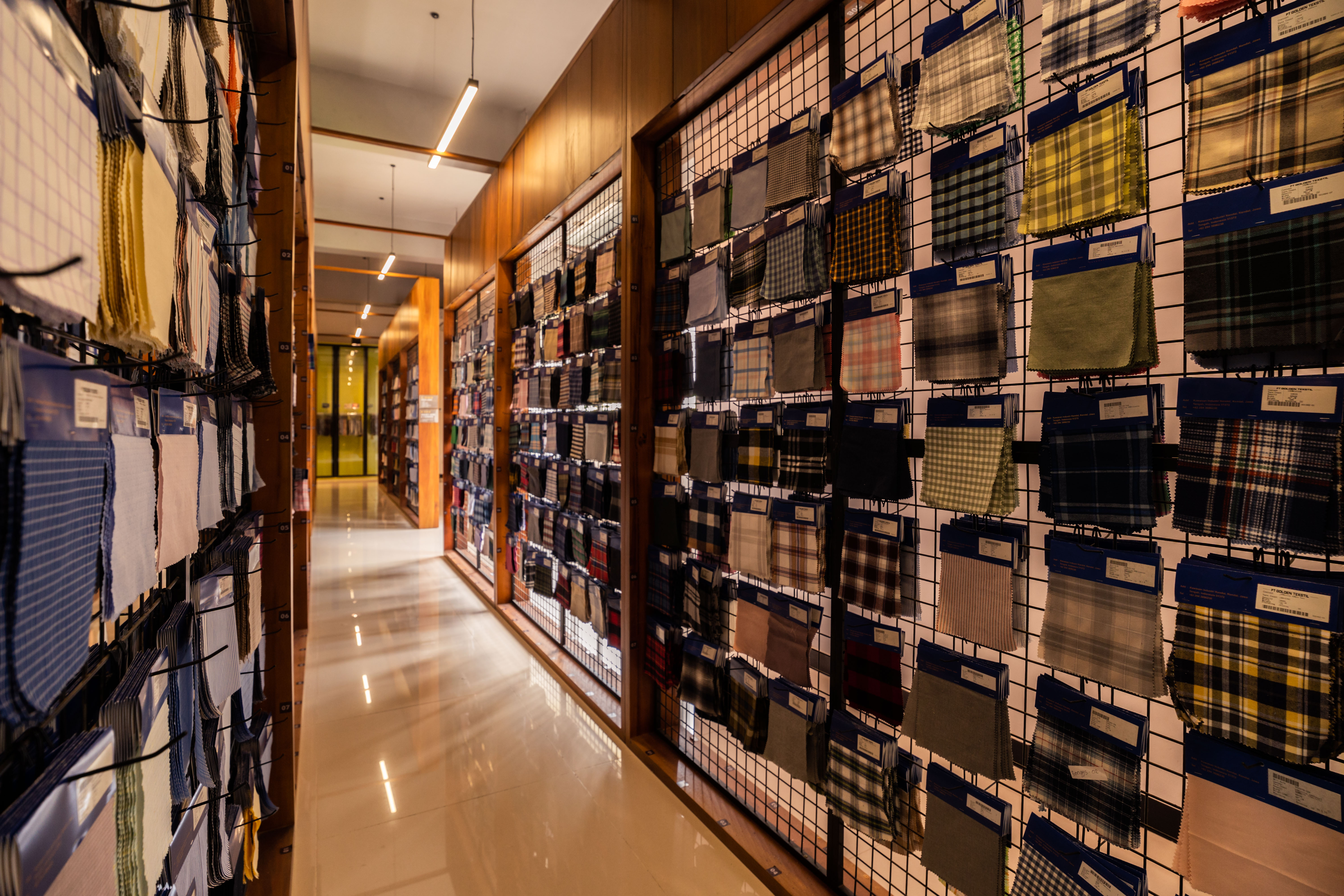
Recycled polyester is no longer a test line at the edge of a casualwear range. It sits in core programmes, and that changes the shape of the buying decision. Instead of asking whether a mill can supply recycled blends at all, buyers increasingly compare two constructions from the same mill that look almost interchangeable on a specification sheet.
B01308-03 and B01718-14, two models in the Recycled Polyester Fabric range of PT Golden Tekstil Indonesia (GTI), illustrate the problem precisely. Both are cotton–recycled polyester blends. Both are listed at a 45×45 yarn count. Both sit inside a 109–112 gsm weight band, and both are positioned for sustainable casualwear. The difference that remains — 60% cotton / 40% recycled polyester in one, 65% recycled polyester / 35% cotton in the other — is small on paper and consequential in a bill of materials, a labelling template and a certification file.
This reference sets out what each model specifies, what the composition gap means for compliance and sourcing work, where each model fits, and where the available specification stops. It does not rank the two. The source material does not state a performance difference between them, and none is implied here.
What B01308-03 and B01718-14 actually specify
The core specification is short. Both models belong to the same product family: a Cotton-Recycled Polyester Blend intended for apparel manufacturing in sustainable casualwear. The distinguishing variable is fibre ratio, not construction class.
| Attribute | B01308-03 | B01718-14 |
|---|---|---|
| Composition | 60% Cotton / 40% Recycled Polyester | 65% Recycled Polyester / 35% Cotton |
| Majority fibre | Cotton | Recycled polyester |
| Yarn count | 45×45 | 45×45 |
| Weight | 109–112 gsm (range level) | 109–112 gsm (range level) |
| Material family | Cotton-Recycled Polyester Blend | Cotton-Recycled Polyester Blend |
| Intended application | Apparel manufacturing — sustainable casualwear | Apparel manufacturing — sustainable casualwear |
| Recycled-content standard referenced | GRS V4.0, within Textile Exchange certificate GCL-304497-MUL-2026 | GRS V4.0, within Textile Exchange certificate GCL-304497-MUL-2026 |
| Stated functional finish | None stated | None stated |
| Stated elastane content | None stated | None stated |
Source: PT Golden Tekstil Indonesia product specification for the Recycled Polyester Fabric range and Textile Exchange certificate GCL-304497-MUL-2026.
Two practical observations follow. First, the yarn count and the weight band are listed for the model pair rather than split per model, so a buyer should confirm model-level weight and width during sampling instead of assuming a difference that the source does not state. Second, neither model lists an elastane component or a functional finish. As specified, both are non-stretch woven blends without a performance finish claim. Buyers who need stretch or a finish such as wicking or non-iron are looking at different ranges, not at a variation of these two.
The composition gap, translated into buyer work
The recycled share is where the two models separate. B01718-14 carries 65% recycled polyester against 40% in B01308-03 — a 25 percentage-point gap — while cotton moves in the opposite direction, 35% against 60%. Three downstream tasks absorb that gap.
Bill-of-materials arithmetic. Brand-level recycled-content targets are usually written per garment, not per fabric. Converting a fabric percentage into a garment figure requires fabric consumption per style and mass share, which means the mill-side percentage is only the first input. Because both models are listed inside the same 109–112 gsm band, the higher recycled share in B01718-14 corresponds to a larger recycled-polyester mass per meter; the exact figure should be calculated after model-level weight is confirmed in writing.
Chain-of-custody documentation. Recycled content is a documented claim, not a description. Under GRS, certified material is tracked through the supply chain, and the scope certificate that qualifies the mill is paired with transaction-level documentation for the material actually shipped. A model change mid-programme is therefore a documentation event as well as a purchasing one, and the paper trail should be updated at the same time as the purchase order.
Declaration and labelling. Fibre order on a composition declaration follows the majority fibre. B01308-03 is cotton-majority and B01718-14 is polyester-majority, so content labels, care-label templates, product page copy and any marketing claim that quotes a recycled percentage need to be written per model. A template approved for one model is not automatically correct for the other.
GRS as the qualification anchor
Qualification for recycled content in this pair runs through one certificate rather than two. The Textile Exchange certification held by GTI, numbered GCL-304497-MUL-2026 and issued by GCL International Ltd., covers OCS V3.0, GRS V4.0, RCS V2.0 and CCS V3.1, and is valid from 1 April 2026 to 31 March 2027. Its stated scope covers dyed fabrics, dyed yarns, greige fabrics and printed fabrics, and extends to weaving, manufacturing, pre-treatment, finishing, printing, packing, dyeing and preparatory processes, with markets listed as the EU, US and Asia. The Recycled Polyester Fabric range, including models B01308-03 and B01718-14, appears among the products related to that certification.
For a buyer, the operative point is the difference between a scope certificate and a shipment certificate. The scope certificate establishes that the certified processes and product categories sit inside an audited system. It does not by itself certify a specific delivery. Transaction documentation for the material in a given order is what substantiates a recycled-content claim at the point of sale, and it should be requested per shipment rather than assumed from the scope document.
Two further checks are worth building into the file. The certificate's stated scope names fabric processes, so a buyer sourcing finished garments should confirm how garment-level recycled content is documented in the same chain. And because the current certificate runs to 31 March 2027, any programme with a delivery window beyond that date should plan for re-verification rather than treating the document as permanent.
Where each model fits — and where it does not
Both models are positioned for sustainable casualwear, and the combination of a 45×45 yarn count with a 109–112 gsm band points to shirt-weight and light casual constructions rather than structured or heavy pieces. That framing is useful because it also marks the boundary of the comparison.
- Casual shirting and shirt-weight casual tops: the stated end use of both models.
- Programmes with a recycled-content target: B01718-14 contributes the higher recycled share at 65%, against 40% in B01308-03.
- Programmes with a cotton-forward composition brief: B01308-03 is the cotton-majority option at 60% cotton.
- Stretch casualwear: neither model lists an elastane component; GTI's stretch offer sits in separate cotton spandex and 4-way stretch ranges.
- Performance casualwear: neither model states a functional finish; wicking, quick-dry, cooling comfort and non-iron are handled in other ranges.
- Bottoms and outerwear: outside the stated weight band; GTI's heavy weight outer and bottom fabrics are specified from 204 to 359 gsm.
Choosing between the two is therefore a composition and compliance decision first, and a fabric-development decision second. It becomes a hand-feel or performance decision only after sampling, where the buyer can test the actual model rather than reason from a percentage.
Recycled blends versus conventional cotton–polyester: what actually changes
Recycled blends are usually presented as an upgrade on conventional cotton–polyester shirting. The defensible comparison is narrower than that framing suggests, and separating the verifiable differences from the unverifiable ones is the point of a buyer-side review.
| Dimension | Recycled polyester blend (B01308-03 / B01718-14) | Conventional cotton–polyester blend |
|---|---|---|
| Fibre sourcing | Recycled polyester share of 40% or 65%, within a documented chain of custody | Virgin fibre content; no recycled-content claim available |
| Documentation load | Scope certificate plus transaction-level documentation per shipment | Composition declaration only |
| Composition declaration | Model-specific: fibre order differs between the two models | Single declaration per construction |
| Performance and hand | Not established by the available specification; settled by sampling and testing | Also settled by sampling and testing |
The limits a buyer should carry into the decision:
- No performance difference between B01308-03 and B01718-14 is stated in the source. A higher recycled share is not, on the available evidence, a claim about moisture handling, durability, colourfastness or hand.
- Neither model states a functional finish, so neither substitutes for a wicking, quick-dry, cooling or non-iron construction.
- The 109–112 gsm band confines both models to light and mid-weight casual apparel; it does not extend to bottoms or outerwear.
- A recycled blend carries administrative overhead that a conventional blend does not. Certification documents must be checked per shipment, and the resource cost of that should be budgeted, not assumed away.
- Commercial commitment is concentrated: 3,000 meters per colour for fabric, with a 45–70 day lead time covering fabric plus garment, means a two-model programme in several colourways locks in development and capital earlier than a single-model programme.
The mill capability that decides whether a model choice survives bulk
PT Golden Tekstil Indonesia (GTI) is a woven apparel fabric manufacturer operating an integrated 171,401 m² site in Kendal Industrial Park, Central Java, Indonesia. Established in 2019, the company employs 2,828 people, maintains a 30-engineer R&D team, and reports a 75% export ratio across the US, Europe, Japan and Indonesia.
The mill provides OEM and ODM production services for woven apparel fabrics and garments, with customisation spanning fabric, fit, collar and cuff style, size, label and packaging. Reported monthly capacity is 5,800,000 meters of fabric and 216,700 garments, with an MOQ of 3,000 meters per colour for fabric and 1,000 pieces per colour for garment, and a lead time of 45–70 days covering fabric plus garment.
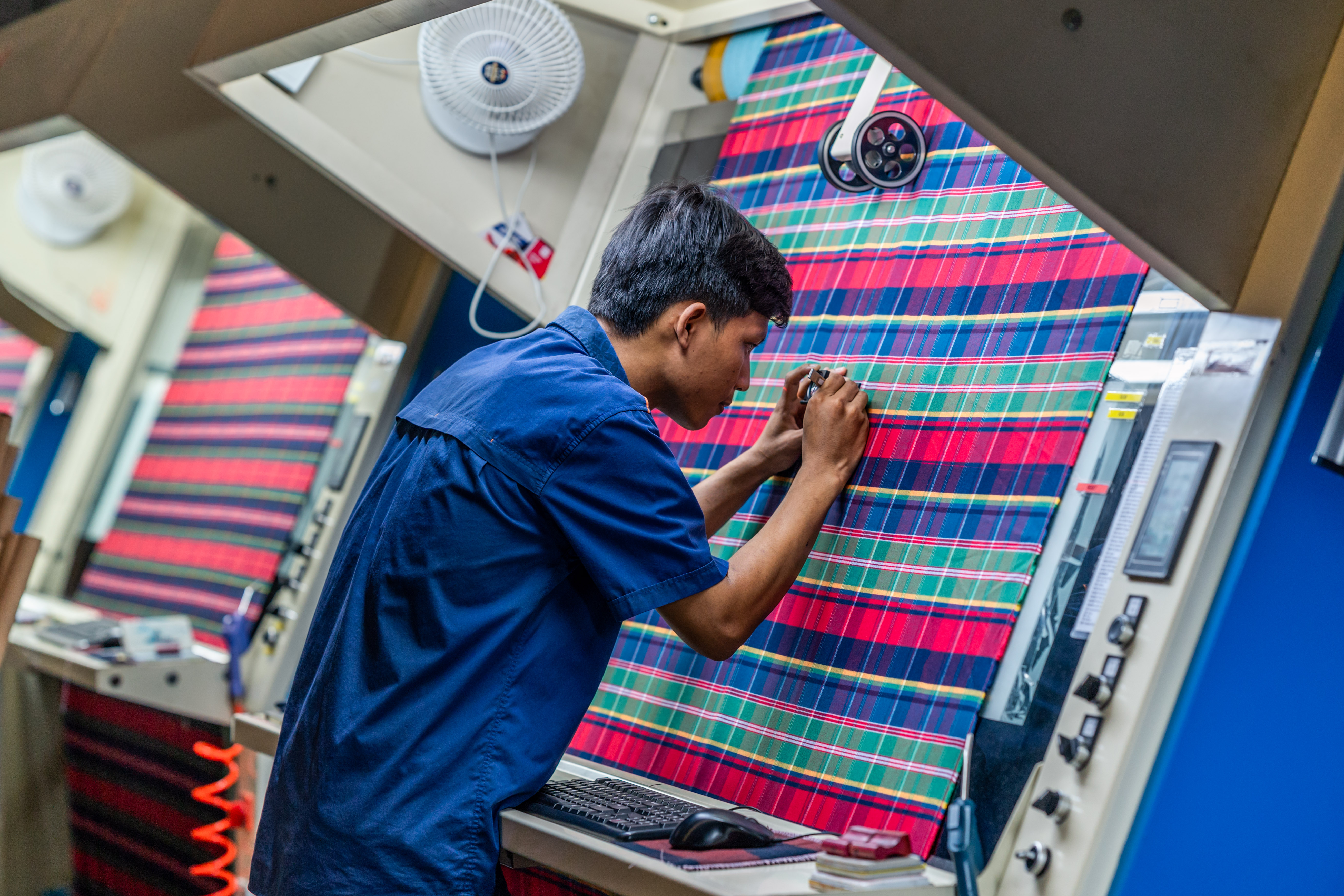
Quality control is where a two-model decision is either protected or lost. Fabric is inspected under the 4-Point System, and garment production runs in-line QC, end-line QC and final or pre-shipment QC. The in-house testing centre is certified to AATCC, ASTM D, JIS and the ISO standard suite, with testing protocols approved directly by Polo Ralph Lauren and Kohl's — a detail that matters less as a name-drop than as evidence that test methods have been reviewed against external buyer requirements rather than set internally.
Sustained volume has been demonstrated in practice. GTI reports a four-year programme with high-end apparel brands totalling 39,000,000 meters of menswear shirting fabric, during which its quality control protocols and testing standards were formally reviewed and approved against the brand's own compliance requirements. For a buyer weighing two similar recycled blends, that is the relevant signal: the difference between the models is a specification decision, while the difference between mills is whether the specification holds across repeat lots.
A six-step evaluation sequence
- Fix the composition brief. Decide whether the programme is led by a recycled-content target (B01718-14 at 65% recycled polyester) or by a cotton-majority composition (B01308-03 at 60% cotton). The brief should state the share, not just the fibre names.
- Request model-level specification in writing. The listed 109–112 gsm band and 45×45 yarn count cover the pair; confirm weight, width and any construction detail per model before costing.
- Verify certification documents. Obtain the scope certificate and check its validity against the delivery window, then require transaction documentation per shipment rather than relying on the scope document alone.
- Approve samples in stages. Hand sample or lab dip and strike-off first, then a big sample, with written approval before bulk dyeing begins; shade or construction changes after bulk starts affect lead time and cost.
- Agree test criteria and acceptance limits. Put shrinkage and colourfastness limits in writing before production, and verify them in the in-house laboratory against the agreed AATCC, ASTM D, JIS or ISO method, followed by pre-shipment inspection under AQL sampling.
- Lock commercial terms. Confirm MOQ of 3,000 meters per colour for fabric, lead time of 45–70 days for fabric plus garment, delivery terms FOB or CIF, and payment terms (TT in advance, L/C, or TT 30–70 days after shipment) in the order documents.
Market context for recycled blends
Polyester accounted for 54.1% of global textile fabric market share by volume in 2025, according to commercial research published on the textile fabrics market (SRC-0001). The recycled variant inherits that scale rather than sitting outside it, which is why recycled blends have shifted from differentiation to expectation in many casualwear ranges. Indonesia's textile exports totalled USD 13.5 billion in 2024, per the Observatory of Economic Complexity, positioning the country as a relevant base for programmes of this kind.
The standards framework behind the claim is equally established but not interchangeable. Textile Exchange identifies the Organic Content Standard, the Recycled Claim Standard and the Global Recycled Standard as separate material-related voluntary standards, each with its own content and chain-of-custody rules. Buyers comparing recycled constructions should confirm which standard applies to a given model, since the claim's strength depends on the scheme rather than on the word recycled.
What to expect next
Recycled-content declarations are moving from a mill-level average to a model-level figure. As brand scorecards begin to ask for scope certificates, transaction documents and per-model recycled share in the same review, mills that can supply model-specific weight data and test results quickly will shorten sampling rounds — and buyers who have already separated composition evidence from performance evidence will avoid the more expensive error, which is writing a performance claim the specification cannot support.
Practically, three preparations hold for the near term: keep certification records current against the delivery window, budget the administrative cost of chain-of-custody documentation into the programme rather than treating it as incidental, and settle hand and performance questions in sampling instead of in supplier presentations.
FAQ
What is the difference between B01308-03 and B01718-14?
The difference is fibre ratio within the same cotton–recycled polyester blend family. B01308-03 is 60% cotton and 40% recycled polyester; B01718-14 is 65% recycled polyester and 35% cotton. Both are listed at a 45×45 yarn count, inside a 109–112 gsm weight band, for sustainable casualwear.
Do the two models share the same yarn count and weight?
The Recycled Polyester Fabric range lists a 45×45 yarn count and a 109–112 gsm weight band covering models B01308-03 and B01718-14. The source does not split weight by model, so buyers should confirm model-level weight and width during sampling rather than infer a difference.
Are both models covered by a recycled-content certification?
Both models appear among the products related to Textile Exchange certificate GCL-304497-MUL-2026, issued by GCL International Ltd. and covering OCS V3.0, GRS V4.0, RCS V2.0 and CCS V3.1, valid from 1 April 2026 to 31 March 2027. The stated scope covers dyed fabrics, dyed yarns, greige fabrics and printed fabrics, and the processes weaving, manufacturing, pre-treatment, finishing, printing, packing, dyeing and preparatory. A scope certificate should be accompanied by transaction-level documentation for the material in a specific shipment.
Which model suits a programme with a recycled-content target?
B01718-14 carries the higher recycled share at 65% recycled polyester, against 40% in B01308-03. B01308-03 is the cotton-majority option at 60% cotton. Converting either percentage into a per-garment recycled-content figure requires model-level fabric weight and fabric consumption per style.
What MOQ and lead time apply to either model?
Fabric MOQ is 3,000 meters per colour, with a lead time of 45–70 days covering fabric plus garment. For programmes that also require garment production, the garment MOQ is 1,000 pieces per colour, and delivery terms are FOB or CIF.
What should be verified before bulk production?
Shrinkage and colourfastness limits should be agreed in writing before production and verified in the in-house testing centre against the agreed AATCC, ASTM D, JIS or ISO method. Sample approval normally runs through lab dip or hand sample, then a big sample, before bulk confirmation; pre-shipment inspection under AQL sampling and the 4-Point System for fabric inspection complete the sequence.
Reference: GTI publishes its 2026 company profile, covering facility, capability and certification detail, as an openly accessible download at GTI Company Profile 2026.
¿Tiene preguntas o necesita más detalles?
Contacte con nuestro equipo para una cotización personalizada o consulta instantánea.
Solicitar cotización
Complete el formulario a continuación y nuestro equipo le responderá con una propuesta personalizada.
Chat directo de WhatsApp
¿Prefiere chatear en tiempo real? Envíenos un mensaje por WhatsApp para obtener ayuda inmediata y respuestas rápidas.
- Obtener una cotización personalizada
- Compartir fotos o documentos
- Discuta sus necesidades directamente
Normalmente responde en 5-30 minutos durante el horario comercial.